
Smallest Private Jets: A Practical Guide to VLJs
Compare the smallest private jets by cabin, range, and cost. Learn which very light jet fits short missions and how charter matching works.

Approved Jets

On this page
- Table of Contents
- Why the Smallest Private Jet Is Not Always the Right Jet
- Four Tests Before You Look at Length
- What Counts as a Very Light or Light Jet
- The Personal Jet Benchmark
- The Twin-Engine Benchmarks
- Comparing Cabin, Range, and Runway Performance
- What the Spread Actually Means
- Performance Trade-Offs That Change the Decision
- One Engine Versus Two
- Why Headline Range Erodes
- Real Missions Where a Small Jet Wins or Loses
- Scenario One, the Regional Business Hop
- Scenario Two, the Short Trip a Turboprop Handles Better
- Scenario Three, the Luggage-Heavy Family or Sports Trip
- Scenario Four, the Time-Critical Movement
- The Real Cost of Flying the Smallest Jets
- Charter Math Versus Ownership Math
- Repositioning and Emissions Change the Total
- How to Match a Small Jet to Your Mission
- A Five-Step Matching Process
- Your Next Step Toward the Right Small Jet
The most popular advice on the smallest private jets is also the least useful. Pick the shortest airframe, pay the lowest hourly rate, and assume you've made the efficient choice. That logic fails on real itineraries, where door-to-door time, payload, runway limits, and repositioning decide whether a very light jet saves you anything at all. Size describes a category. It doesn't match an aircraft to a mission.
Table of Contents
- Why the Smallest Private Jet Is Not Always the Right Jet
- What Counts as a Very Light or Light Jet
- Comparing Cabin, Range, and Runway Performance
- Performance Trade-Offs That Change the Decision
- Real Missions Where a Small Jet Wins or Loses
- The Real Cost of Flying the Smallest Jets
- How to Match a Small Jet to Your Mission
- Your Next Step Toward the Right Small Jet
Why the Smallest Private Jet Is Not Always the Right Jet
You're probably not shopping for smallness itself. You're trying to reach a regional airport near a plant, a second home, or a client site without a commercial connection, or you're taking a first step into private flying and want the least aircraft that'll do the job. Those are mission questions, and the smallest airframe answers them only sometimes.

A mission-first framework works better than a size ranking. Judge every option on four things, in this order.
Four Tests Before You Look at Length
- Door-to-door time: Drive time to and from each airport, plus flight time, not flight time alone.
- Actual load: Passengers plus the luggage, equipment, or gear they'll really bring.
- Airport access: Runway length, elevation, and operating hours at both ends.
- Cost per traveler: Total trip cost divided by people aboard, including repositioning.
Short trips expose the weakness in the smallest-is-best assumption. Takeoff and climb burn a disproportionate share of fuel on short sectors, so a jet spends much of a brief flight in its least efficient phases. Research on short-haul efficiency notes that smaller turboprops such as the Pilatus PC-12 can consume less fuel and produce a lower carbon footprint than comparable private jets, which means a turboprop can win a short mission on cost and emissions while losing only minutes in the air.
Practical rule: Choose a very light jet when it removes a connection, a long drive, or an overnight. If it only removes minutes from a flight a turboprop or airline already serves well, it's probably the wrong tool.
That distinction runs through everything below. The smallest private jets are capable aircraft, but capability only matters when it fits your route, your load, and your schedule.
What Counts as a Very Light or Light Jet
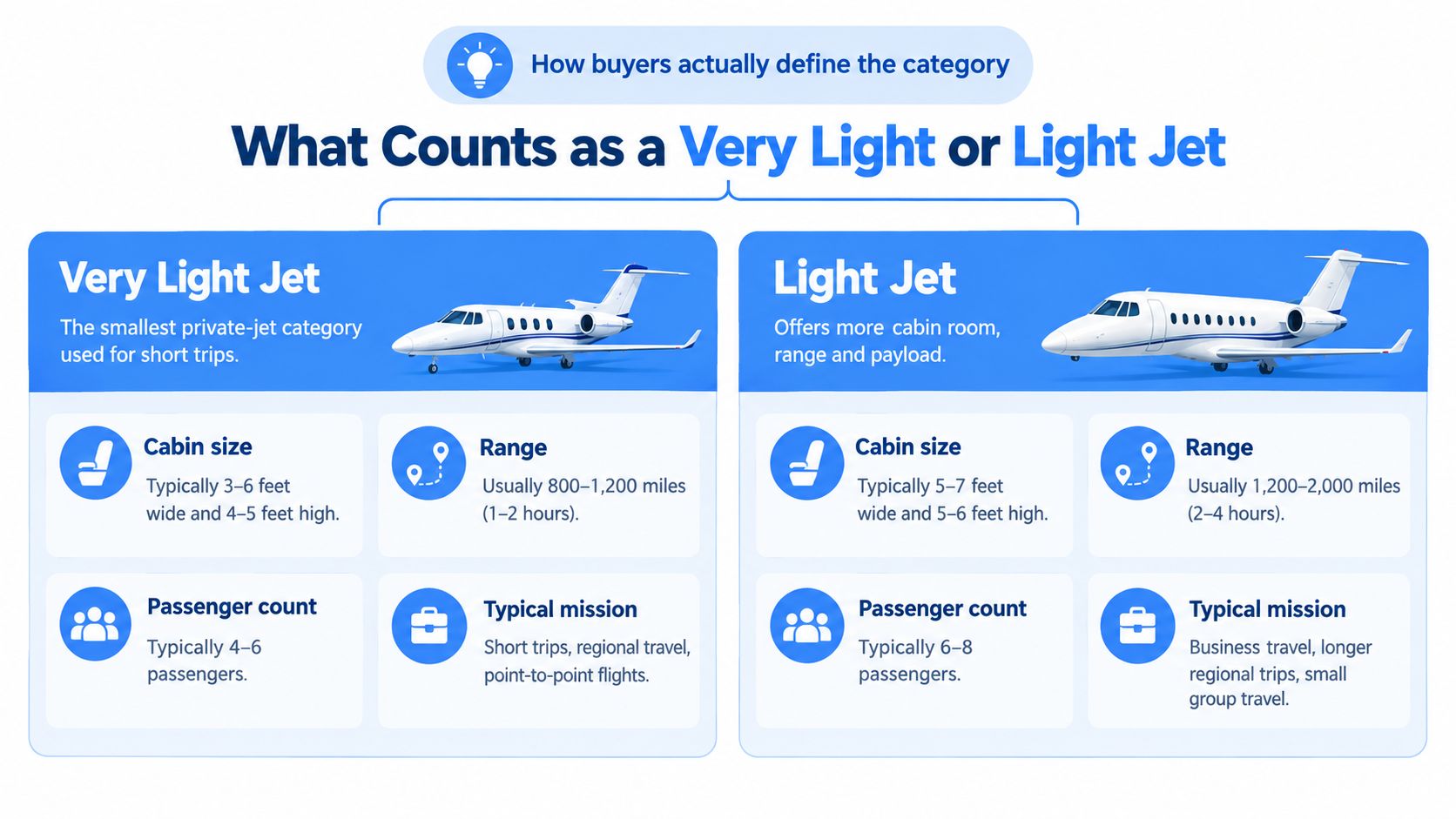
Aircraft length alone does not determine whether a jet belongs in the very light or light category. Buyers and operators weigh configuration, cabin capacity, and mission capability alongside dimensions. Two aircraft of similar size can serve different roles once engine count, seating, and intended use enter the comparison. For definitions of flight terms, see the aviation glossary.
The Personal Jet Benchmark
The Cirrus Vision Jet SF50 is widely recognized as the smallest jet currently in production. It is approximately 30.7 feet long, with a 38.7-foot wingspan, and uses a single Williams turbofan mounted above the rear fuselage. Certified for up to seven occupants, it is most comfortable with five adults and two smaller passengers in the aft seats, according to the Vision Jet type history and specifications. The type received FAA certification on October 28, 2016, following roughly a decade of development that began with concept work in the mid-2000s.
The certification established the personal jet as more than a marketing label: it defined a certified business aviation category between high-performance personal aircraft and conventional light business jets. For mission planning, that distinction matters because seating capacity alone does not describe how comfortably an aircraft carries a group and its baggage.
The Twin-Engine Benchmarks
The Eclipse 500 provides a benchmark for the smallest twin-engine business jets produced in significant numbers. First deliveries began in 2006. The aircraft is approximately 33.4 feet long, has a 37.9-foot wingspan, and accommodates up to six people including the pilot. These specifications distinguish it from the single-engine Vision Jet without implying that one configuration is better for every trip. The Aviation Week HondaJet and light jet overview concerns the HondaJet, so it does not support these Eclipse 500 figures.
A very light jet is the smallest step into jet operations, generally suited to short regional missions and small groups. A light jet typically adds cabin space, payload, and range, which can support more demanding schedules. Those class labels offer a starting point, not a mission verdict: useful capacity depends on the people and baggage aboard, while the route determines whether the aircraft's range and airport access translate into a faster door-to-door trip.
Comparing Cabin, Range, and Runway Performance
A jet's smallest dimensions do not guarantee the most efficient trip. Door-to-door performance depends on whether the aircraft can carry the people and baggage, fly the route with reserves, and use an airport close to the destination. A faster cruise speed saves time only when runway access, payload, and the ground journey support it.
Smallest Private Jets Compared by Cabin, Range, and Runway
| Aircraft | Length | Wingspan | Typical Seating | Max Cruise | Max Altitude | Range | Takeoff Distance | Landing Distance |
|---|---|---|---|---|---|---|---|---|
| Cirrus Vision Jet | 30.7 ft | 38.7 ft | 5 adults comfortable, 7 max | 317 knots | 31,000 ft | About 1,200 nm IFR mission capability | 1,910 ft ground roll | 1,622 ft ground roll |
| Eclipse 500 | 33.4 ft | 37.9 ft | Up to 6 including pilot | Near 375 knots | Not cited | Roughly 1,125 nm | Not cited | Not cited |
| HondaJet Elite II | 42.62 ft | 39.76 ft | 1 pilot plus 6, or 2 plus 5 typical | 422 knots | 43,000 ft | 1,547 nm NBAA IFR, 4 occupants | 3,699 ft | 2,717 ft |
What the Spread Actually Means
The Vision Jet pairs a compact airframe with short ground rolls and a 67-knot flaps-extended stall speed. Cirrus lists an 858-metre takeoff distance over a 15-metre obstacle in its Vision Jet performance data, a more useful planning reference than ground roll alone. Actual dispatch performance depends on obstacle clearance, temperature, slope, payload, and reserve requirements. A nearby short runway can save ground time, but only if the aircraft can depart with the planned load.
The HondaJet sits at the faster, roomier end of this comparison. Its 17.8-foot cabin and 62 cubic feet of combined baggage volume, divided between a 53-cubic-foot aft compartment and a 9-cubic-foot nose compartment, accommodate a different mix of passengers and luggage. Those dimensions favor missions with more baggage, though they come with a longer runway requirement. The table's range figures also need context: the HondaJet Elite II's 1,547 nm NBAA IFR range is specified with four occupants, so it should not be treated as a guaranteed distance with a full cabin and bags.
Range figures depend on aircraft variant, payload, reserves, and operating conditions. Compare them using the passenger and baggage load you expect, and account for the difference between a published maximum and a practical nonstop mission. A guide to how far private jets can fly in operational terms helps put headline range claims in context.
A smaller jet can offer useful speed and range, while a larger cabin may solve a baggage constraint. Match payload and runway access to the actual route before comparing cruise figures.
The useful choice follows the mission. A short destination runway near the final stop can make the Vision Jet's field performance valuable. Longer sectors with more passengers or baggage may favor the HondaJet, provided the departure runway and load support the flight. The best time saving comes from the whole journey, not cruise speed alone.
Performance Trade-Offs That Change the Decision
Spec sheets list maximums. Missions are flown at weights, temperatures, and winds that rarely match those maximums. Three trade-offs explain most of the gap between brochure performance and a dispatchable flight.
One Engine Versus Two
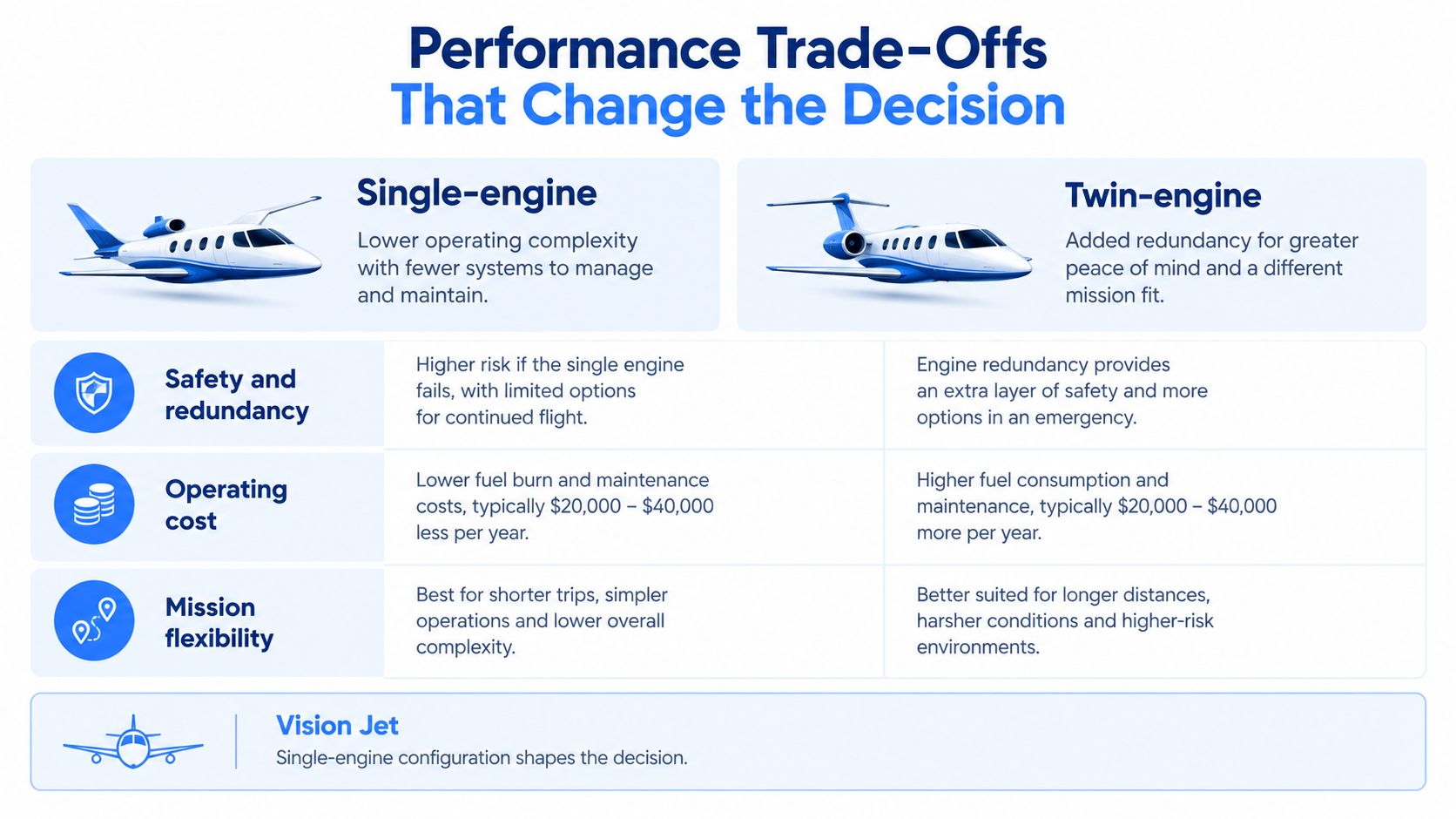
The Vision Jet's single-engine configuration generally reduces system complexity and operating burden. The planning consequence is that you should build in conservative weather, runway, and diversion margins because there's no second powerplant. That's not a disqualification. It's a dispatch discipline, and it's one reason the type suits shorter regional missions over well-served diversion networks.
The HondaJet takes the opposite path. Its two GE Honda HF120 engines provide redundancy and substantially higher cruise performance, while the over-the-wing installation is designed to reduce aerodynamic interference and preserve cabin volume, according to HondaJet performance specifications. Honda cites a 3,990-foot-per-minute climb rate there, which helps the aircraft reach smoother air and favorable winds sooner, subject to traffic and payload. If you're weighing cruise numbers, it helps to see how fast private jets fly across categories rather than comparing one maximum against another in isolation.
Why Headline Range Erodes
- Passenger count and baggage: Every added occupant trades against fuel at maximum weight.
- Temperature and elevation: Hot, high departures lengthen takeoff and reduce climb.
- Headwinds and alternates: IFR reserves and a distant alternate airport consume usable range.
- Runway limits: A short departure runway can force a fuel or payload cut before range is even considered.
The Elite II makes this concrete. Honda reports its 1,547-nautical-mile NBAA IFR range with four occupants, two GE Honda HF-120 engines rated at 2,050 pounds-force of thrust each, takeoff and landing figures of 3,699 feet and 2,717 feet, a maximum takeoff weight of 11,100 pounds, and a maximum ramp weight of 11,180 pounds in the HondaJet Elite II brochure. The four-occupant qualifier is the honest part. Load six people and bags on a hot day, and your planner will build a different flight.
Ceiling follows the same logic. A higher maximum altitude can mean smoother air and better winds, but only if payload and air traffic control let you climb there on your sector length. On a short hop, you may spend little time at any cruise level, which shrinks the practical value of both ceiling and top speed.
Real Missions Where a Small Jet Wins or Loses
Rankings don't fly missions. The four scenarios below show where the smallest private jets earn their cost and where they don't, judged on door-to-door time rather than airborne time.
Scenario One, the Regional Business Hop
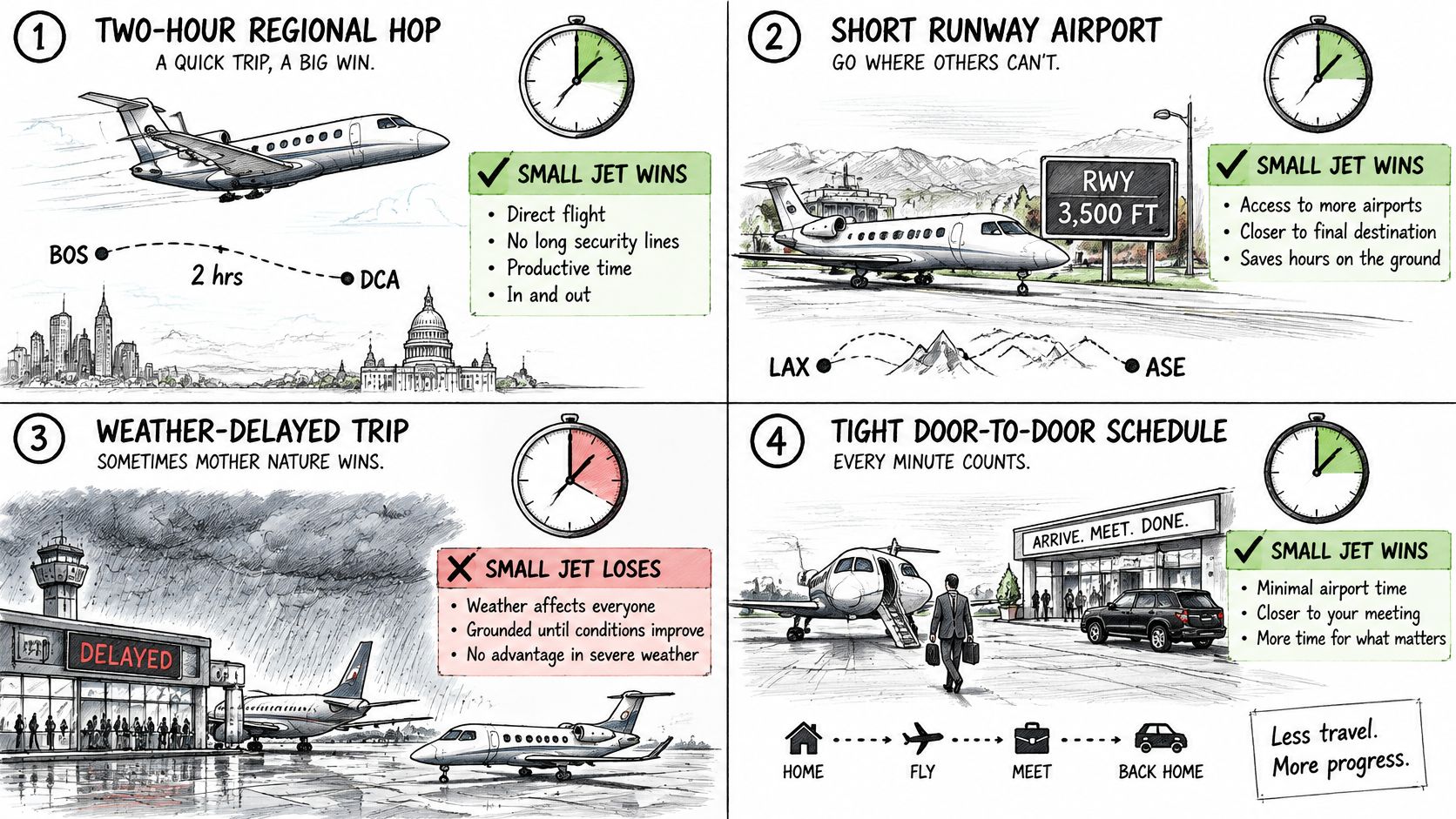
Two executives need to visit a facility near a small airport with no reliable commercial service. Driving to a hub, connecting, and driving back out would consume the day. Here, a very light jet wins clearly, because access to a smaller airport closer to the final destination can cut ground-transfer time and turn an overnight trip into a same-day return. The Vision Jet's approximately 1,200-nautical-mile IFR mission capability makes it suitable for regional city pairs of this kind rather than long transcontinental sectors, as noted in the Cirrus data cited earlier.
Scenario Two, the Short Trip a Turboprop Handles Better
On a short 300-mile trip, the math flips. The jet climbs, briefly cruises, and descends, so its speed advantage compresses into a small airborne saving. A turboprop such as the Pilatus PC-12 can use short runways, carry more, and burn less on that profile. If both aircraft use the same small airports, door-to-door times can be close while operating burden differs materially.
Scenario Three, the Luggage-Heavy Family or Sports Trip
A nominal four- or five-seat cabin shrinks fast once you add sports gear, business equipment, or family luggage. Small jets fall short not on seats but on payload and baggage volume. A party that fits on paper may force a fuel stop, a shipped bag, or a larger aircraft once real bags are weighed. Count volume and weight, not seat belts.
Scenario Four, the Time-Critical Movement
For a medical or otherwise urgent movement, cabin size ranks below rapid aircraft sourcing and appropriate equipment. The right answer may be a small jet if it's positioned nearby and properly equipped, or a different airframe entirely if equipment or medical crew requirements exceed what a very light cabin supports.
Decision rule: A small jet wins when it deletes a connection, a long drive, or a night away. It loses when it only shaves minutes off a trip another option already serves directly.
The Real Cost of Flying the Smallest Jets
Calling very light jets the cheapest entry point to private aviation is true only in the narrowest sense. They're the least expensive jets to operate per hour. That doesn't make them inexpensive per traveler, per year, or per completed itinerary.
Charter Math Versus Ownership Math
Indicative industry figures put VLJ hourly operating costs around $1,800 to $2,800 and annual fixed ownership costs around $350,000 to $700,000, varying with crew, maintenance, financing, hangar location, and utilization, according to the ICCT private jet levies working paper. Those two numbers describe different decisions. A charter customer buys hours on a specific trip. An owner carries fixed costs whether the aircraft flies or sits, so low annual utilization can make each flown hour far more expensive than the hourly operating figure suggests. Before comparing quotes, review what drives private jet travel cost across charter and ownership so you're not comparing a variable rate against a fixed commitment.
Load factor is the variable most guides skip. Fly a small jet with one or two passengers and the cost per traveler climbs sharply, sometimes past the per-person cost of a larger aircraft flown fuller or a premium commercial seat on a direct route. Break-even isn't a fixed passenger count. It's the point where your actual party size, route, and schedule value justify the whole aircraft.
Repositioning and Emissions Change the Total
Empty repositioning legs are the second hidden item. If the aircraft must fly empty to reach you or return after dropping you, you may pay in price, availability, or emissions for distance you never traveled. A slightly larger jet already positioned at your departure airport can produce a lower total trip cost than the smallest jet flown in from elsewhere.
The environmental figures deserve the same honesty. The ICCT analysis cited above estimates private jets emit up to 14 times more CO2-equivalent per passenger than commercial flights, largely because most carry 19 or fewer passengers and many flights operate below capacity, and a separate estimate places typical annual private-jet emissions at about 810 tonnes of greenhouse gases, equivalent to 177 passenger cars. Those figures don't assign the same footprint to every VLJ trip. They do disprove the idea that smallest automatically means modest.
A small jet can be operationally efficient without being passenger-efficient. Compare cost and emissions per traveler across the entire itinerary, including repositioning and ground transport.
How to Match a Small Jet to Your Mission
You can run this matching process yourself in about fifteen minutes, and it's the same sequence a competent broker should run for you. Work in order, because each step can eliminate an aircraft class.
A Five-Step Matching Process
- Define the mission profile: Origin, destination, dates, and how much a delay or overnight costs you.
- Count the load: Passengers plus luggage, business equipment, sports gear, or medical equipment, with honest weights.
- Check both airports: Runway length, elevation, operating hours, and ground time to your start and end points.
- Compare door-to-door: Price the very light jet against a turboprop and a premium commercial alternative on total journey time and cost per traveler.
- Verify the operator: Confirm safety credentials and operating authority before you discuss catering or cabin photos.
In practice, that last step is where a broker earns its fee. Approved Jets, for example, coordinates aircraft through a vetted operator network of 1,000+ aircraft from FAA Part 135 and foreign-equivalent operators, prefers third-party credentials such as ARGUS Platinum and Wyvern Wingman, and works to a stated two-hour quote turnaround target with flights mobilizable in approximately 2 to 4 hours, subject to mission and availability. Those numbers are the provider's own stated standards, so treat them as service targets to confirm on your itinerary, not guarantees.
The structural point matters more than any single provider. A broker acting as an embedded partner matches the airframe to your mission profile and luggage needs. A listing marketplace shows you what's available and leaves the matching, and the mismatch risk, with you.
Your Next Step Toward the Right Small Jet
Before you request any quote, answer five questions on one page: How many passengers, and how much luggage by weight and volume? Which airports at both ends, and how long is the ground transfer from each? How much door-to-door time must you save for private flying to beat the alternatives? Is a turboprop or direct commercial flight competitive? And does the operator hold verifiable safety credentials?
The smallest private jet is a category, not a recommendation. The right airframe is the one that fits your complete mission profile. Gather your itinerary, passenger and luggage count, and timing constraints, then request a mission-matched quote against that real trip rather than choosing from a size ranking.
If you'd rather not run the comparison across operators, runways, and repositioning options yourself, Approved Jets can match a very light jet, turboprop, or larger aircraft to your actual itinerary through its vetted operator network. Send your route, dates, passenger count, and luggage details, and you'll get a quote built around the mission instead of the smallest available cabin.