
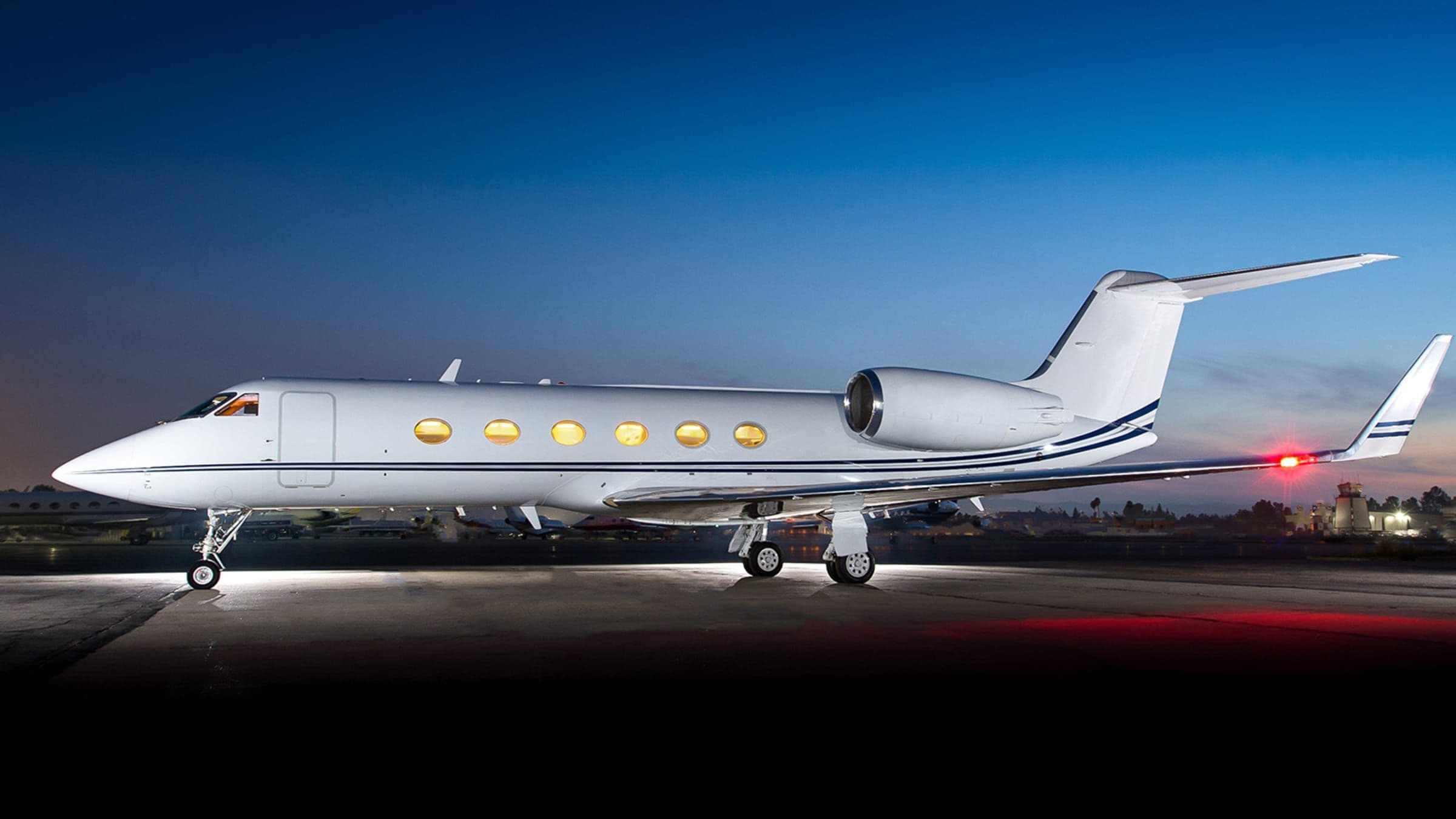
How Fast Do Private Jets Fly: Speed by Category
Discover how fast do private jets fly across light, midsize, and heavy categories, plus real-world factors that change your trip time.

Approved Jets

On this page
- Table of Contents
- The Quick Answer on Private Jet Speeds
- Four speed bands to keep in mind
- Understanding Cruise Speed Versus Maximum Mach
- MMO is the limit, cruise is the working speed
- Why pilots don't just fly at the top number
- Speed Ranges Across Jet Categories
- Category speed table
- Matching the category to the mission
- What Actually Changes Your Trip Time
- The four variables that matter most
- A simple way operators think about it
- Real Routes Compared by Jet Category
- New York to Miami
- Los Angeles to Honolulu
- London to New York
- Why the Fastest Jet Is Not Always the Best Choice
- Speed comes with operating trade-offs
- How operators choose the right aircraft
- Common Misconceptions About Private Jet Speed
- Why a 100 mph gap often doesn't matter much
- Why “faster” can also mean “more expensive”
- Planning Your Charter Around Speed and Mission
- The five things to check first
- A quick mission rule of thumb
The fastest private jets now cruise close to Mach 0.94, or about 721 mph in top-end promotional figures for the Bombardier Global 8000, but that number is not the answer most travelers need. The better question is how much speed survives once you add route length, altitude, winds, and air traffic control.
For most private jets, the practical cruise band sits around 400 to 600 mph, with modern business aviation clustered in a high-subsonic range that's fast enough to matter on long legs and only modestly different on short hops (AirAdvisor, Blackjet). On a short mission, a brochure number can shrink into a much smaller real-world gap. On a transoceanic leg, that same gap can dominate the schedule.
Table of Contents
- The Quick Answer on Private Jet Speeds
- Understanding Cruise Speed Versus Maximum Mach
- Speed Ranges Across Jet Categories
- What Actually Changes Your Trip Time
- Real Routes Compared by Jet Category
- Why the Fastest Jet Is Not Always the Best Choice
- Common Misconceptions About Private Jet Speed
- Planning Your Charter Around Speed and Mission
The Quick Answer on Private Jet Speeds
The short answer to how fast do private jets fly is this, most of them cruise in the 400 to 600 mph range, and the exact number depends on the aircraft category, the mission, and the day's conditions (AirAdvisor). That range is broad because private aviation isn't one machine, it's several different mission types wearing the same label.
Four speed bands to keep in mind
A light jet like the Embraer Phenom 300E is cited around 430 to 450 knots, or roughly 495 to 515 mph. A super-midsize jet such as the Bombardier Challenger 350 sits around 450 to 470 knots, about 515 to 540 mph. Long-range aircraft like the Gulfstream G650 and G700 reach up to roughly Mach 0.90 to 0.935, with published figures near 530 to 610 mph at the top end (AirAdvisor, Aerotime).
Practical rule: brochure speed is a useful starting point, not a door-to-door promise.
A heavy jet can still finish only minutes ahead of a lighter aircraft on a relatively short trip, because climb, descent, taxi, and airport flow eat into the headline number. On longer sectors, the cruise portion grows large enough that a faster jet can save real time. That's why one route may barely notice a 30 to 50 mph difference, while another route feels it all the way to the arrival time.
Private jet speed also tracks cabin size, range, and fuel burn, so the fastest aircraft aren't built just to win a race. They're built to balance speed with flexibility and mission range. That trade-off matters more than a simple top-speed comparison.
Understanding Cruise Speed Versus Maximum Mach
The two numbers that cause the most confusion are maximum operating Mach and cruise Mach. They sound close, but they do different jobs. One is the ceiling, the other is the comfortable operating point.
MMO is the limit, cruise is the working speed
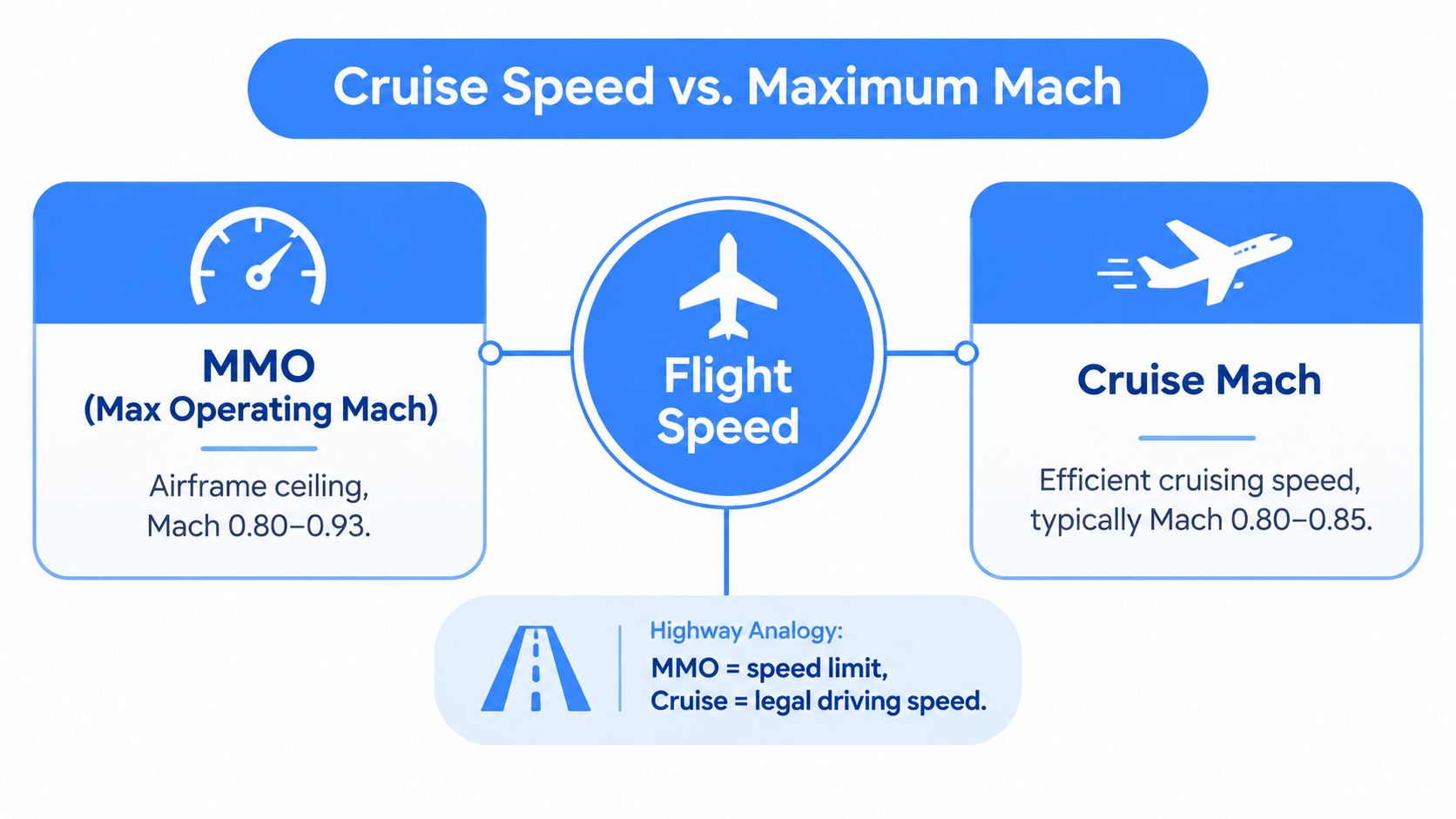
Maximum operating Mach, or MMO, is the certified upper limit for the airframe, usually somewhere in the Mach 0.80 to 0.93 band for business jets (Jet and Beyond). Cruise Mach is the speed pilots use in level flight for efficiency, comfort, and range. In practice, most business jets fly a little below MMO rather than sitting on it.
Imagine driving on the highway. MMO is the speed limit, while cruise is the steady speed you'd choose when you care about fuel economy, control, and not fighting the car the whole way.
Most operators file lower Mach numbers when the mission calls for it. Headwinds, turbulence, or a climb schedule can make a lower cruise speed the smarter choice. That's why brochure cruise speed is a standard-day benchmark, not a guarantee that every flight will match it.
The technical distinction matters because aircraft like the Cessna Citation X+ and Gulfstream G700 can sit near Mach 0.935 at the top end, yet still cruise slower on real missions to preserve fuel and range (Aerotime). The fastest published number isn't the same as the speed you'll see on every route.
Why pilots don't just fly at the top number
A jet that flies faster also fights the air harder. That means more drag, more fuel burn, and more engine stress. Operators usually stay below the ceiling because that's where the mission stays efficient.
The number on the brochure is a ceiling, not a habit.
That's especially true when route conditions don't reward extra speed. If the wind, routing, or altitude profile won't support the top number, the aircraft won't use it. The useful number is the one the aircraft can hold for the segment you actually need.
Speed Ranges Across Jet Categories
The fastest way to understand private jet speed is to compare categories side by side. A light jet, a midsize jet, a super-midsize jet, and a long-range heavy jet can all fly the same trip, but they won't do it at the same pace or with the same cabin economics.
Category speed table
| Category | Cruise Speed (mph) | Cruise Mach | Sample Models |
|---|---|---|---|
| Light Jet | 380 to 450 | 0.70 to 0.77 | Embraer Phenom 100, Citation CJ3 |
| Midsize Jet | 430 to 500 | 0.75 to 0.80 | Citation XLS, Learjet 75 |
| Super-Midsize Jet | 470 to 540 | 0.80 to 0.85 | Challenger 350, Citation Sovereign+ |
| Heavy or Long-Range Jet | 510 to 610 | 0.85 to 0.925 | Gulfstream G650, Global 7500 |
The pattern is simple. As aircraft get bigger, they usually gain range and cabin space, and many also gain speed. But they also need more runway, more fuel, and more operational planning. That's why the category choice isn't just about pace, it's about the mission profile.
Matching the category to the mission
A light jet works well when the route is shorter and the airport is easy to use. A midsize aircraft gives you more cabin comfort without jumping to the highest operating costs. A super-midsize or heavy jet starts to make sense when the mission stretches out, the passengers need more baggage room, or the route needs real cruise speed over a longer sector.
If you want a deeper look at how cabin size and cruise speed fit together in the super-midsize segment, this super-midsize jet guide is a useful reference point. It's the category where many clients first notice that speed, comfort, and mission length start moving together.
The important part is that category speed is only one piece of the decision. Cabin layout, range, and runway access all scale with it, and that's why the fastest aircraft isn't always the right aircraft.
What Actually Changes Your Trip Time
Brochure speed is just the airplane's potential. Real trip time depends on how much of that potential the flight can use. The useful way to think about it is simple: distance divided by true ground speed equals time in the air.
The four variables that matter most
Altitude is the first one. A jet flying higher usually sees thinner air and less drag, which helps speed and efficiency. Weight is next, because a heavier aircraft needs more energy to climb and cruise well. Winds aloft can either help or hurt, and air traffic control can force routing that's less direct than the straight-line map.
A jet flying into a headwind feels a lot like driving on ice, the engine is working, but the ground doesn't move past as quickly as you expect.
For planning, that means the same aircraft can deliver different arrival times on different days. A heavier payload, a lower flight level, or a strong headwind can all shave meaningful pace off the mission. The bigger the route, the more those differences matter.
A simple way operators think about it
On a short leg, climb and descent take up a large share of the trip, so small cruise differences don't always show up clearly in the final arrival time. On a longer leg, cruise dominates, so a faster aircraft starts to pull away.
That's why the operational question isn't “what's the top speed?” It's “what ground speed can this aircraft sustain on this route today?” Busy airspace can change the answer. So can oceanic tracks, departure flow, and spacing around major airports like KJFK, KLAX, and EGLL.
| Variable | Light Jet (mph change) | Midsize Jet (mph change) | Heavy Jet (mph change) |
|---|---|---|---|
| Flight level | Lower speed sensitivity | Moderate speed sensitivity | Higher speed potential at altitude |
| Payload weight | More noticeable on climb and cruise | Noticeable on longer stages | Noticeable, but often better absorbed |
| Headwind | Can erase a chunk of cruise advantage | Can reduce schedule benefit | Can still trim meaningful ground speed |
| ATC routing | Often more exposed on busy days | Moderately exposed | Also exposed, especially on long-haul flows |
The exact effect of each variable changes by aircraft and route, but the direction is consistent. Higher altitude and cleaner routing help. Heavier loads and stronger winds hurt. That is the practical lens clients should use.
Real Routes Compared by Jet Category
The cleanest way to understand category speed is to look at actual itineraries. A jet's brochure number matters less when the route is short, and much more when the route stretches across the country or the ocean.
New York to Miami
On New York to Miami, a Phenom 300 can save about 35 minutes versus a Citation CJ3 because its cruise speed stays ahead even on a relatively short hop. The route is around 950 nautical miles, so climb and descent still matter a lot, but not enough to erase the performance difference.
That's the key point. On a short-to-medium route, speed helps, but it doesn't fully take over the mission. The aircraft still has to climb, level off, descend, and sequence into the destination. Those phases compress the gap.
Los Angeles to Honolulu
The picture changes on Los Angeles to Honolulu, a route of about 2,100 nautical miles. A Challenger 605 beats a Citation Latitude by nearly an hour once the aircraft are settled into cruise and the altitude profile starts to separate them.
Here the cruise segment is long enough to reward the faster machine. The wider the route, the more a faster long-range jet can keep that advantage alive. That's where brochure speed starts turning into real schedule value.
London to New York
On London to New York, roughly 3,000 nautical miles, the difference becomes even clearer. A Gulfstream G650 versus a Falcon 7X shows how supersonic-adjacent cruise performance can compress a seven-hour mission into a six-hour block. The gain isn't just in the air, it's in how much of the flight sits in efficient cruise.
The ground phases still exist on every route. Taxi, climb, descent, and approach stay part of the trip no matter what you fly. What changes is how much cruise time fills the middle of the mission.
| Route | Distance (nm) | Light Jet (hr:min) | Midsize Jet (hr:min) | Heavy Jet (hr:min) |
|---|---|---|---|---|
| New York to Miami | 950 | 2:35 | 2:10 | 2:05 |
| Los Angeles to Honolulu | 2,100 | 5:05 | 4:20 | 3:35 |
| London to New York | 3,000 | 7:10 | 6:20 | 6:00 |
Those times are illustrative of mission planning, not fixed promises. They show the pattern clearly. The longer the route, the more the fastest private jets pull away from the rest of the fleet.
Why the Fastest Jet Is Not Always the Best Choice
An operations director doesn't book the fastest aircraft by default. The job is to match the aircraft to the mission, not to win a speed comparison.
Speed comes with operating trade-offs
A Phenom 300 burns roughly 80 gallons per hour, a Challenger 605 about 250, and a Gulfstream G650 around 350, so faster cruise usually brings a much higher fuel bill per hour. That's before you factor in maintenance reserves, crew duty limits, and the cost of running a larger, more complex airframe.
Runway access changes too. Light jets can work from shorter strips such as KSQL, while a Global 7500 needs 5,800-plus feet in many situations, which can force different airport choices and add ground time. A jet that's fast in the air can still be slow on the ground if the airport network doesn't fit the mission.
How operators choose the right aircraft
A useful rule is simple: pick the slowest jet that still meets the schedule, the baggage, and the runway. If two aircraft can do the job, the smaller or more efficient one often leaves more room for cabin comfort, flexibility, or better departure timing.
For mission planning and cost context, Approved Jets' charter cost guide is relevant because hourly burn and aircraft class drive the quote as much as speed does. If the route doesn't reward extra Mach, the smarter move is usually to buy comfort or access, not raw speed.
Faster isn't always better. It's only better when the route can use it.
That's the standard charter logic. The right aircraft is the one that gets the mission done cleanly, not the one with the flashiest top-end number.
Common Misconceptions About Private Jet Speed
The biggest misconception is that private jets are dramatically faster than airliners in cruise. They're not, at least not by a huge margin. A Gulfstream G650 and a Boeing 787 sit within roughly 50 mph of each other in cruise, so the main advantage often comes from routing, altitude, and ground handling rather than raw airspeed (Aerotime).
Why a 100 mph gap often doesn't matter much
On a 300-mile hop, climb, descent, and approach dominate the schedule. That's why a light jet and a heavy jet can land within minutes of each other even when one brochure looks much faster. The middle of the flight is not long enough for the gap to fully open.
Why “faster” can also mean “more expensive”
Higher cruise speed usually means higher fuel burn, and that raises trip cost. It can also mean more runway demand and tighter operational planning. Speed isn't a free upgrade, it's a trade.
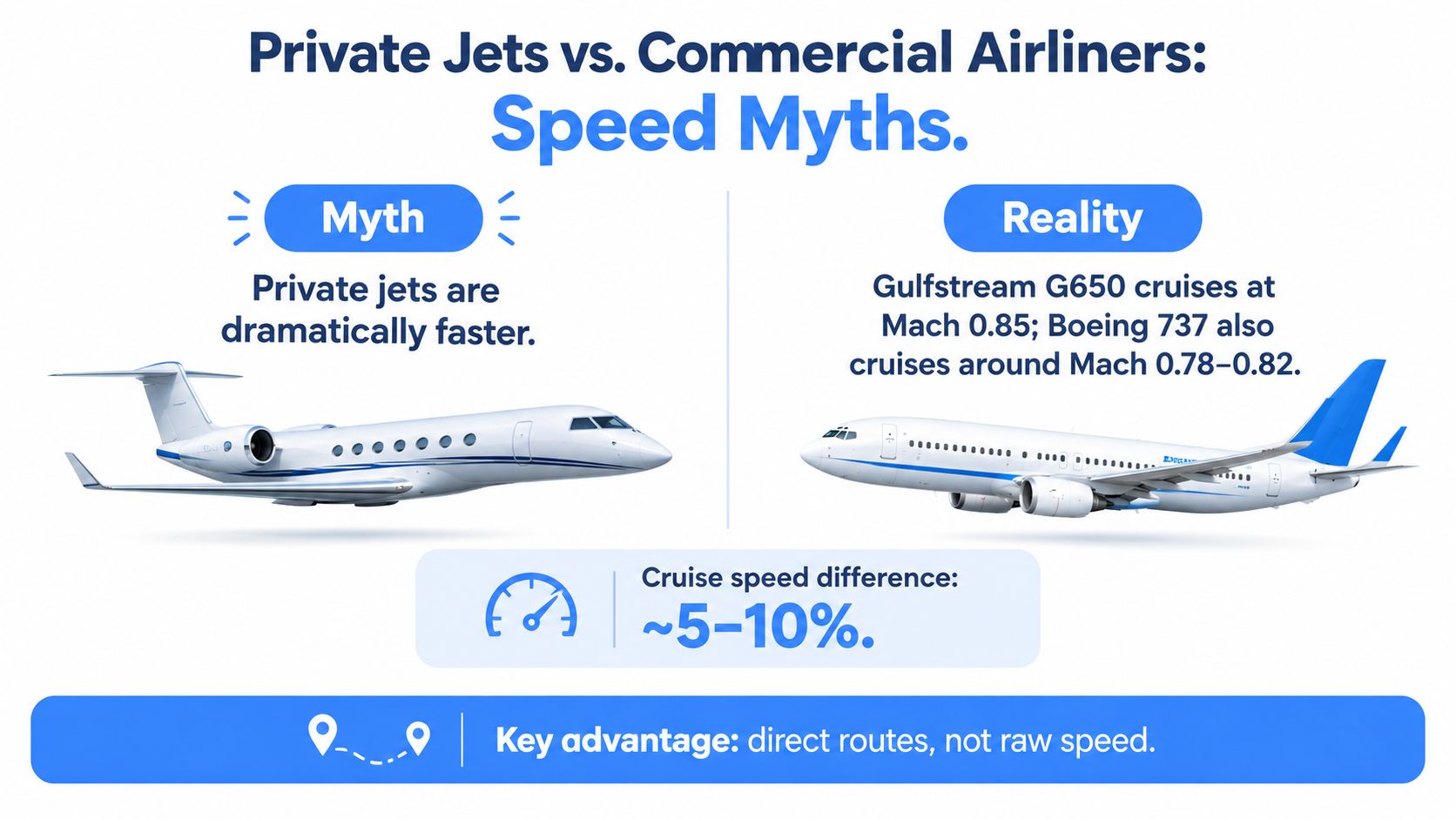
The practical takeaway is simpler than most brokers make it sound. Speed is one variable inside a larger decision tree. If you calibrate your expectations around the whole mission, the quote makes more sense and the aircraft choice gets easier.
Planning Your Charter Around Speed and Mission
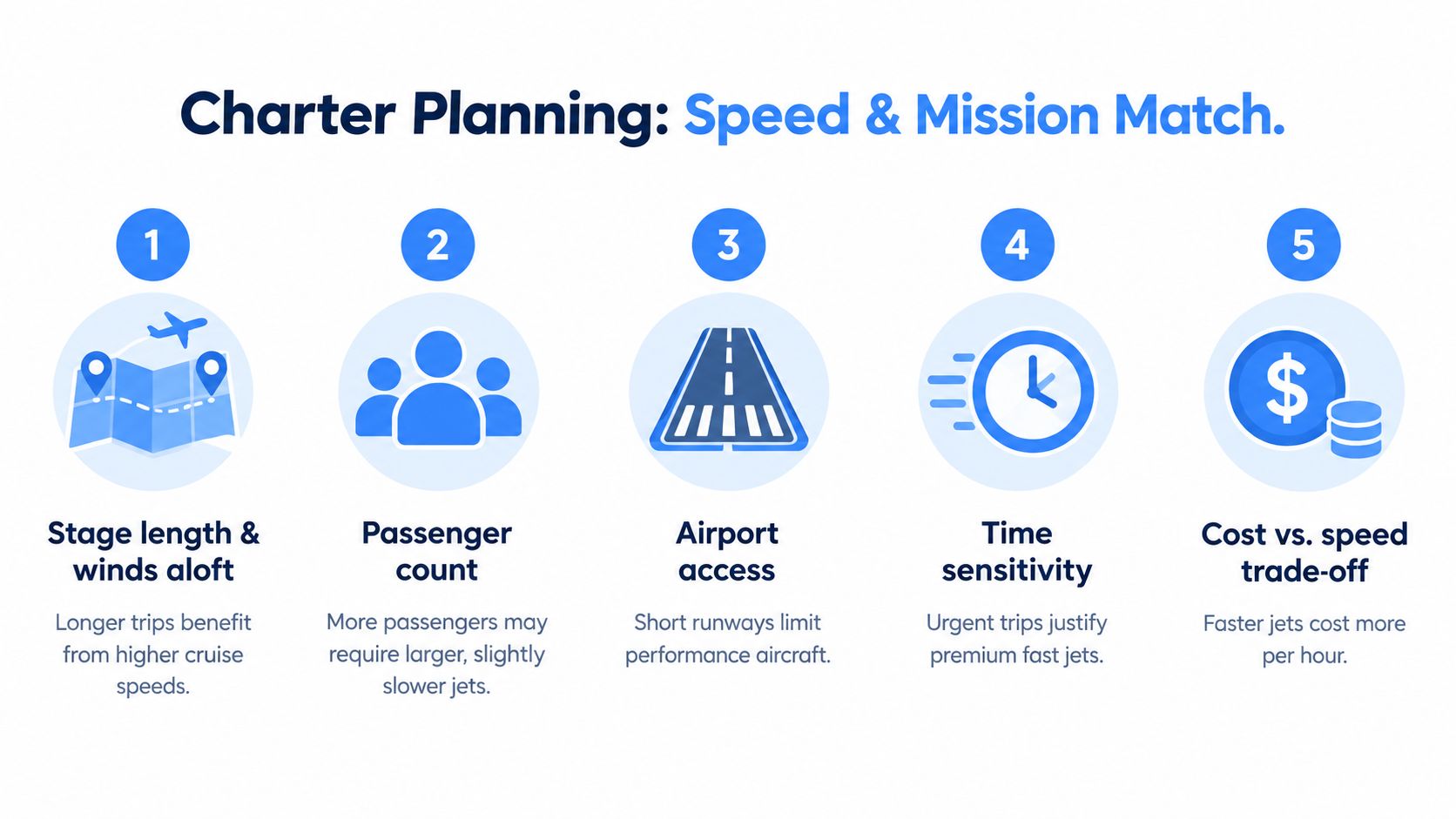
Start with the route, not the brochure. The right aircraft choice usually falls out of five questions, and none of them begins with top speed.
The five things to check first
- Stage length and winds aloft: Longer trips benefit more from higher cruise speed, especially when the route is long enough for cruise to dominate.
- Passenger count and bag volume: More people and more luggage can push you toward a larger cabin, even if it's a little slower.
- Runway access: Short runways can rule out performance-heavy aircraft before speed even enters the conversation.
- Time sensitivity: Urgent trips justify faster aircraft when schedule reliability is the priority.
- Cost versus speed trade-off: Faster jets usually cost more per hour, so the premium has to buy something real.
A quick mission rule of thumb
Under 600 nm, runway access and fuel efficiency usually matter more than pure speed. From 600 to 1,500 nm, midsize cabin economics tend to be the sweet spot. Above 1,500 nm, true cruise Mach and range start to matter much more.
That's why a mission brief is so useful before booking. It lets the broker translate speed, runway, cabin, and budget into one aircraft recommendation instead of guessing from a headline number. For a direct charter conversation and routing support, Approved Jets arranges on-demand private flights and matching aircraft to mission profile through its network. If you want a practical charter recommendation for your next trip, visit Approved Jets and ask for a mission brief that matches the route, passengers, and timing you need.