
How Far Can Private Jets Fly: A Practical Range Guide
How far can private jets fly? Explore range by aircraft class, the factors that shrink it in real life, and when a fuel stop makes more sense.

Approved Jets

On this page
- Table of Contents
- The Real Question Behind How Far Private Jets Can Fly
- Treat range as a planning envelope
- Private Jet Range by Aircraft Class
- Match the category to the itinerary
- How Speed and Cruise Profile Change the Numbers
- Match the quote to the cruise setting
- The Gap Between Advertised Range and Real-World Range
- Treat range as an envelope, then check the actual mission
- Weather, Routing, and the Headwind Problem
- Follow the actual route, not the map line
- Check the destination as carefully as the flight
- Why the Longest-Range Jet Is Not Always the Best Choice
- Run the door-to-door math on both proposals
- A Practical Workflow for Evaluating Any City Pair
- Build a usable mission assessment
- Include the road portion
- Planning a Mission With Approved Jets
- Ask for the reasoning behind the recommendation
If a private jet can fly across an ocean, why might it still need a fuel stop on your trip? The missing detail is usually the mission: who's aboard, what they're carrying, how quickly they need to arrive, and which airports they can use.
Answering how far can private jets fly starts with aircraft specifications, but booking a useful flight requires more than drawing a circle on a map. A thoughtful charter decision balances nonstop capability with airport access, operational margins, and the time you'll spend traveling from door to door.
Table of Contents
- The Real Question Behind How Far Private Jets Can Fly
- Private Jet Range by Aircraft Class
- How Speed and Cruise Profile Change the Numbers
- The Gap Between Advertised Range and Real-World Range
- Weather, Routing, and the Headwind Problem
- Why the Longest-Range Jet Is Not Always the Best Choice
- A Practical Workflow for Evaluating Any City Pair
- Planning a Mission With Approved Jets
The Real Question Behind How Far Private Jets Can Fly
Most first-time charter clients ask for a distance. A broker needs an itinerary. Those sound like different ways of asking the same thing, but they lead to different aircraft choices.
Advertised range describes performance under defined assumptions. Dispatchable range means the distance an operator can realistically plan for your particular departure, passenger load, destination, and operating conditions. Think of the advertised figure as a starting boundary, not a promise attached to every booking.
The Gulfstream G700 illustrates how capability develops through testing and certification. Announced in October 2019, it received FAA type certification in 2024, with its published performance improving during development by 250 nautical miles at each specified cruise setting, according to the G700 development and certification history.
Treat range as a planning envelope
A fixed-radius map suggests that every destination inside the circle is equally reachable. A planning envelope is more useful: the workable distance changes when the operating assumptions change.
A broker and operator need to examine several connected questions:
- Payload: Who's traveling, and what baggage, equipment, or supplies must accompany them?
- Cruise profile: Is the priority the shortest airborne time or the greatest nonstop distance?
- Operating conditions: What winds, routing, and fuel reserves apply?
- Airport access: Can the aircraft use the departure and arrival airports under the expected conditions?
Those questions matter differently to different travelers. An executive might prioritize a meeting deadline, while a family might prioritize luggage and a convenient arrival airport. A sports team's equipment or a medical mission's specialized cabin requirements can change the aircraft shortlist before anyone considers luxury features.
Practical rule: Ask whether the aircraft can complete your specific mission, not whether its advertised range exceeds the distance between the cities.
You don't need to calculate the answer yourself. You do need to give the broker enough information to ask the operator the right questions.
Private Jet Range by Aircraft Class
Aircraft classes provide a useful starting point, but they aren't standardized promises of seating or nonstop performance. Compare them as mission categories rather than rigid distance bands.
Light jets are candidates for regional trips. New York to Miami is an illustrative itinerary to discuss with a broker, not a guarantee that every light jet will complete the flight with every passenger and baggage combination.
Midsize jets broaden the conversation when cabin space, luggage, or a longer domestic sector matters. The midsize private jet guide can help you assess that category before requesting aircraft-specific proposals.
Match the category to the itinerary
Super midsize aircraft are worth evaluating for transcontinental travel. For a proposed New York to Los Angeles flight, ask for an actual nonstop assessment rather than assuming the category name settles the question.
Heavy jets bring larger-cabin options into consideration, while ultra-long-range aircraft address demanding intercontinental missions. London to Singapore is an example of the kind of city pair to submit for an ultra-long-range assessment, with the operator confirming feasibility.
Aircraft within a category can differ because fuel capacity, wing design, engine efficiency, and installed cabin equipment aren't identical. Seating also deserves a separate conversation: seats available for a short flight aren't necessarily the passenger load used to establish maximum range.
For a useful cabin-planning reference, consult INVOLUNTARY REROUTE on aircraft configuration. Use configuration information alongside the operator's payload assessment, rather than treating a floor plan as proof of range.
Private Jet Range by Class at a Glance
| Class | Typical Passengers | Nominal Range (nm) | Representative Mission |
|---|---|---|---|
| Light | Confirm the individual layout | Aircraft-specific | Regional travel, such as a proposed New York to Miami trip |
| Midsize | Confirm seating and luggage together | Aircraft-specific | Domestic business and family itineraries |
| Super midsize | Confirm the actual charter configuration | Model-specific; assess the full payload | Transcontinental planning, such as New York to Los Angeles |
| Heavy | Depends on cabin layout and mission | Model-specific; distinguish cabin size from endurance | Longer sectors where cabin space also matters |
| Ultra-long-range | Benchmark load isn't seating capacity | Global 7500: 7,700, using eight passengers, four crew, Mach 0.85, and NBAA IFR reserves, per Bombardier's specifications | Intercontinental planning, such as London to Singapore |
There isn't a defensible universal passenger count or range for every class. Ask for the specific aircraft model, cabin layout, and mission assumptions behind each proposal. That makes comparisons more meaningful than a category label alone.
How Speed and Cruise Profile Change the Numbers
Speed costs distance. A range figure is an envelope tied to a specific cruise profile, not a fixed circle drawn around your departure airport, and the same airframe can deliver noticeably different endurance depending on the setting the crew selects.
The Gulfstream G700 makes the trade-off concrete: its published range is 7,750 nautical miles at Mach 0.85, equivalent to 14,353 kilometers or approximately 8,917 statute miles, versus 6,650 nautical miles at Mach 0.90, equivalent to 12,316 kilometers; Gulfstream specifies an NBAA instrument-flight-rules theoretical profile with eight passengers, four crew, and required reserves in its G700 performance specifications.
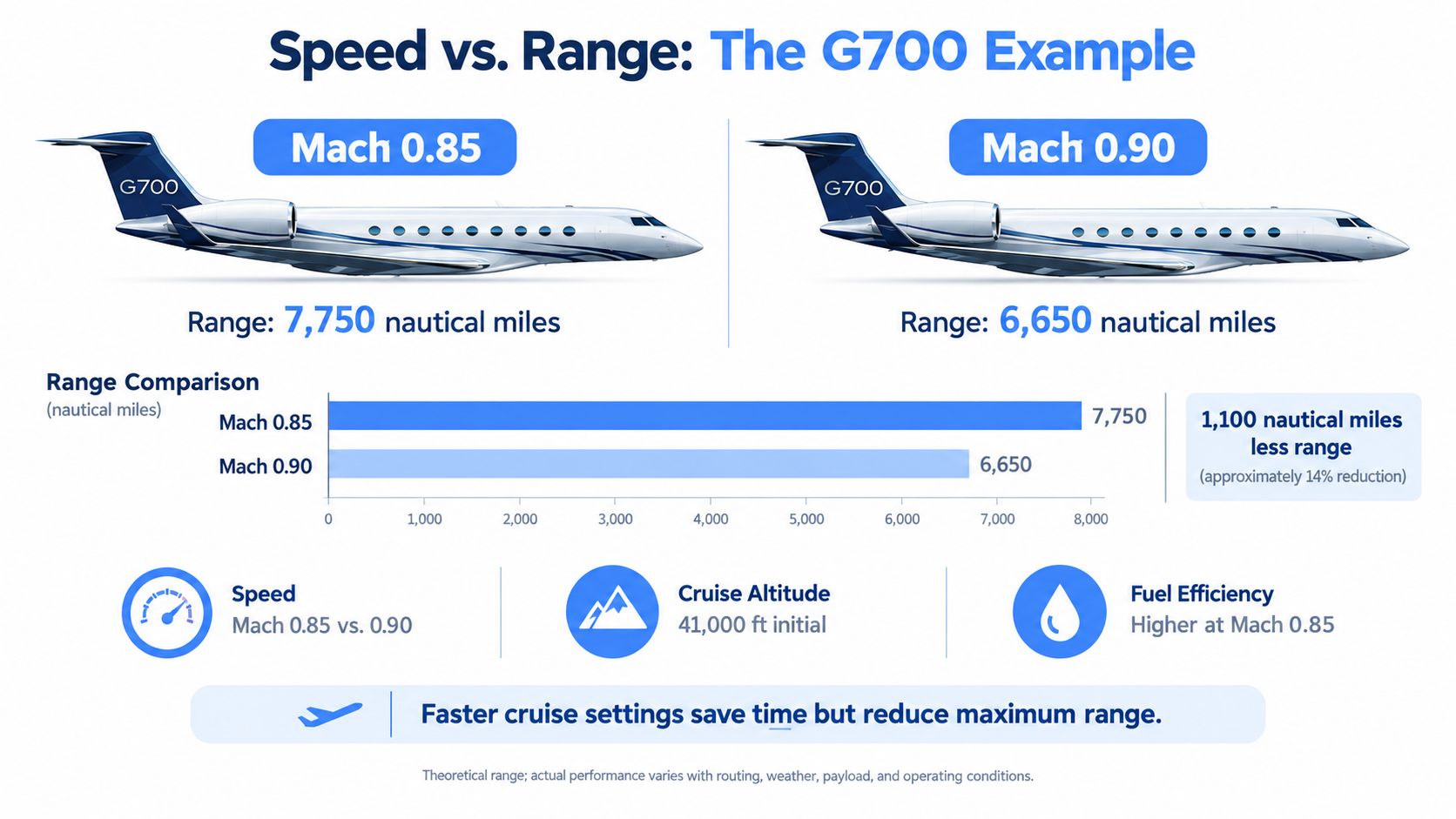
The physics behind that gap works like highway driving. Pushing a car faster burns more fuel per mile because the engine fights more drag, and a jet at higher cruise speed demands more thrust for each nautical mile covered. On a mission already near its endurance limit, that difference decides whether a fuel stop joins the itinerary.
Match the quote to the cruise setting
Three terms tend to blur together in charter conversations. Long-range cruise stretches the fuel carried into the most distance. High-speed cruise buys a shorter flight by spending some endurance. Maximum operating speed is a certified limit rather than a sensible planning assumption or a synonym for maximum-range cruise.
Altitude sits in the same calculation. Bombardier lists the Global 7500's initial cruise altitude at maximum takeoff weight as 43,000 feet, its maximum operating altitude as 51,000 feet, and its standard-day, sea-level takeoff distance at maximum takeoff weight as 5,760 feet, according to its aircraft performance factsheet.
When a quote arrives, ask which cruise profile the estimated flight time assumes, and treat the quickest option and the farthest-reaching option as separate questions. The distinction matters on the ground as much as in the air: much ultra-long-range flying covers sectors well below the airframe's ceiling, so a jet that saves forty minutes only earns that saving if it still reaches the destination nonstop.
The guide to how fast private jets fly separates published speed figures from the pace you can expect door to door.
This video provides an additional visual reference for the speed discussion.
The Gap Between Advertised Range and Real-World Range
A Challenger 350 can look perfect on a listing page and still be the wrong tool for a fully loaded winter departure. The brochure number describes an airplane under stated assumptions. Your booking has people, bags, reserves, weather, and a preferred arrival time attached to it.
A brochure number works like a fuel-economy label: useful for comparison, weak for promising one specific trip. Range is better treated as a planning envelope. The outer edge shrinks as payload rises, reserves tighten, cruise speed increases, and routing adds miles.
An analysis of how private jet range is calculated gives useful examples: a Challenger 350 advertised at 3,200 nautical miles may deliver roughly 2,600 nautical miles with a heavier load, headwinds, and reserve requirements, while a Citation CJ4 listed at 2,165 nautical miles may achieve approximately 1,500 to 1,700 nautical miles with eight passengers and baggage. The same analysis estimates routing can add 3–8% to flown distance and high-speed cruise can reduce range by 5–10%.
Treat range as an envelope, then check the actual mission
Operational data for 2025 puts 65% of ultra-long-range flights under 1,000 nautical miles, which is why the headline radius can distract from the actual purchase: reliable door-to-door performance on the day you fly. A jet with a smaller paper advantage may still be the cleaner answer if it carries your payload with margin and keeps the schedule intact.
The useful question asks whether the operator can carry the required people, equipment, and fuel together, with reserves that satisfy the flight plan.
If the mission does not fit, the fixes are practical rather than dramatic: trim baggage only if the party can spare it, use a more economical cruise plan when the schedule allows, move to an aircraft with a better payload-range match, or keep the load and add a fuel stop instead of forcing a marginal nonstop. Dispatchable range is the result of that calculation, not a directory figure. Ask the operator to show which assumption is limiting the trip and what changes it.
Weather, Routing, and the Headwind Problem
Consider a hypothetical winter booking from New York to London. The map distance hasn't changed, but the operator still needs the forecast winds along the proposed route and at the intended flight levels.
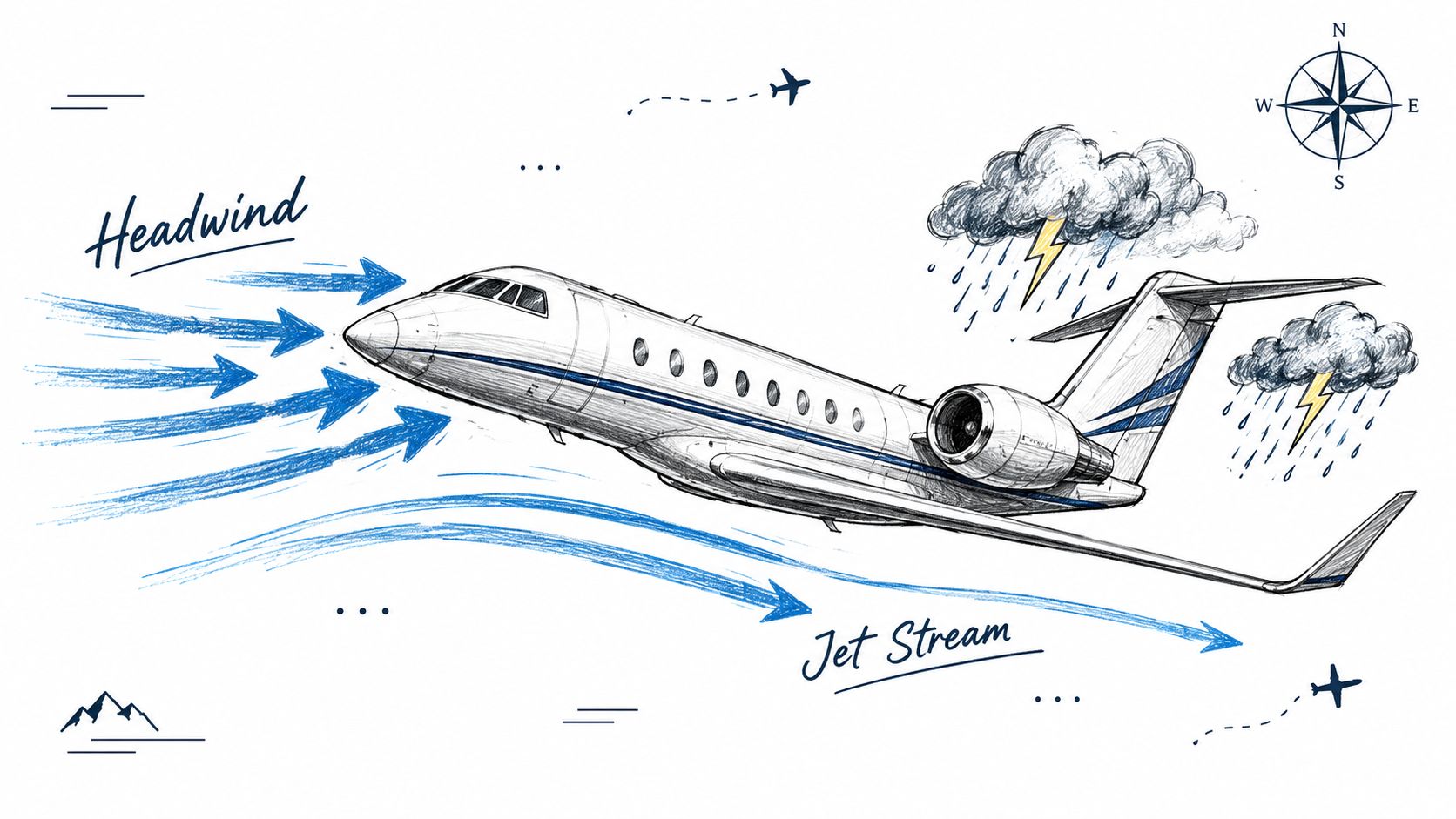
A headwind reduces progress over the ground for a given airspeed. A tailwind helps it. That's why an outbound itinerary and its return shouldn't automatically receive the same nonstop assurance or flight-time estimate.
The sketch below illustrates the relationship between the aircraft's flight path and moving air.
Follow the actual route, not the map line
For the hypothetical transatlantic mission, the operator evaluates forecast winds rather than assuming winter automatically means a headwind in either direction. The assessment must also consider the return flight separately.
The crew may need a route that differs from the shortest line because of air-traffic instructions or weather avoidance. Summer convective weather poses a different planning problem from strong upper-level winds, but either can require a revised route. The routing estimates discussed earlier concern additional flown distance, not a universal percentage to subtract from every aircraft's advertised range.
Don't add independent internet percentages together and call the result an operational forecast. The operator needs a mission calculation using the relevant conditions.
Check the destination as carefully as the flight
Even a satisfactory fuel calculation doesn't settle airport access. Before treating a proposal as workable, ask about:
- Runway suitability: Has the operator checked performance for the aircraft's expected weight and conditions?
- Arrival permissions: Are any required slots, operating approvals, and customs arrangements available?
- Ground handling: Can the airport accommodate the aircraft and support the planned turnaround?
- Recovery options: Which alternative airport or fuel-stop plan remains practical if conditions change?
A weather-driven change can affect more than arrival time. It can alter the ground transfer, customs arrangements, or the feasibility of a tightly scheduled meeting.
For a time-critical trip, ask when the operator will reassess the weather and who will communicate any change. A clear update process is more useful than an early promise that ignores forecast uncertainty.
Why the Longest-Range Jet Is Not Always the Best Choice
In 2025, 65% of U.S.-connected ultra-long-range flights were under 1,000 nautical miles, and 27% were under 250 nautical miles, according to McKinsey's business-aviation analysis, which also reports 417,000 additional U.S. business-jet departures between 2019 and 2025, with leisure-destination airfields accounting for 78% of that increase.
Aircraft built to cross an ocean spent most of their year on short sectors. Some of those travelers were paying for cabin space, not distance. Either way, owning the longest legs and flying them are two different things, and the gap between them is where smart aircraft selection happens.
That gap is why range works better as a planning envelope than a fixed radius. The brochure figure describes a ceiling under specific conditions. The question for any trip is narrower: does this aircraft shrink the total day, from your front door to the arrival curb?
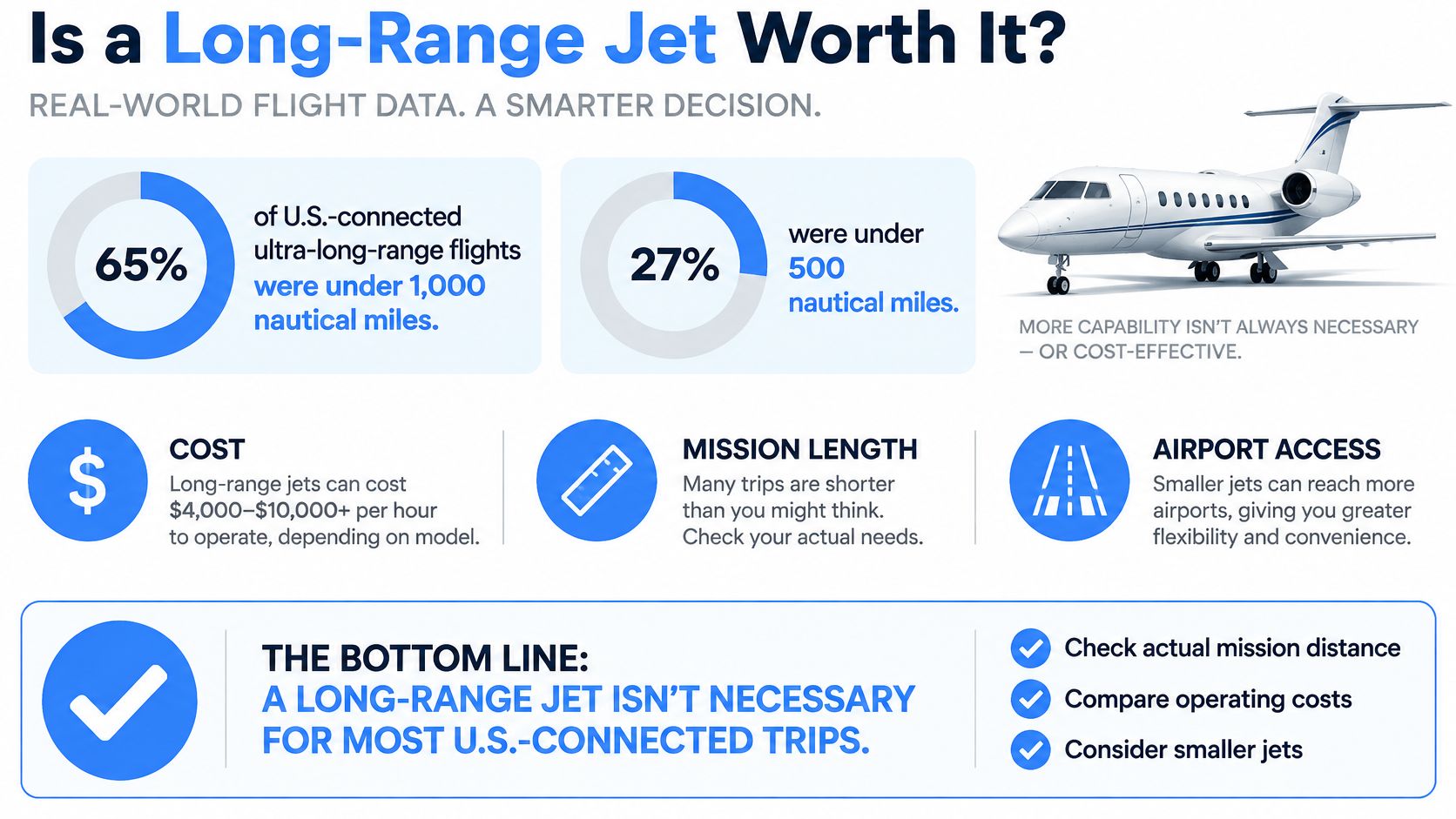
The checklist graphic supports the same comparison. For the shortest-flight statistic, use the threshold stated above rather than the different threshold shown in the image.
Run the door-to-door math on both proposals
A concrete example shows the trade. A midsize jet departs from a field ten minutes from your office and lands at a small airport near the venue. The heavy jet needs a longer runway and more ramp space, so it operates from a larger airport forty minutes away at each end. The bigger aircraft wins the airborne leg and loses the day.
That is a comparison to test on your route, not a rule that smaller always wins. On a demanding long-distance itinerary the answer can flip entirely, because skipping an intermediate fuel stop is worth real hours when payload, schedule, and airport access all line up.
McKinsey also identifies runway, ramp, hangar, maintenance, and crew availability as constraints on where aircraft can operate. Buying more range removes none of them. A larger cabin does not create parking at a busy destination.
Decision test: Compare the time you leave your starting address with the time you reach the meeting, resort, or hospital, not just the period between takeoff and landing.
The right aircraft is the one that serves the whole trip. Maximum endurance is one capability inside that decision, not the decision itself.
A Practical Workflow for Evaluating Any City Pair
Before requesting a charter proposal, prepare a short mission summary: dates, preferred departure window, passenger details, baggage, and the addresses at either end. Include anything unusual, such as bulky equipment, pets, or medical requirements.
The visual below provides a planning sequence. Treat its generic headwind allowance as illustrative only, not as an operational calculation or a substitute for forecast-based analysis.
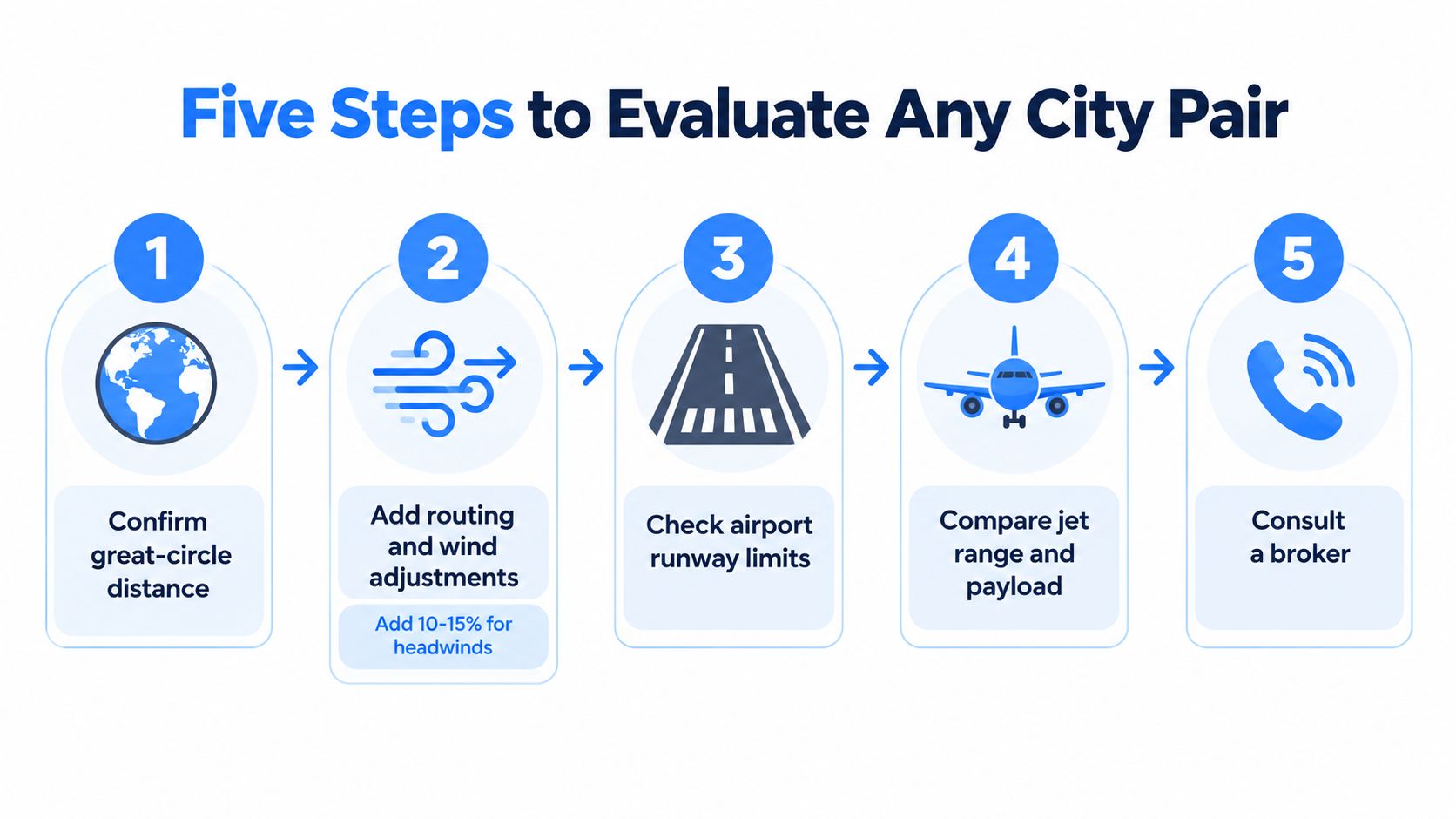
Build a usable mission assessment
- Confirm the airport pair. Establish the shortest map distance between plausible airports, rather than relying on city names alone.
- Allow for the actual route. Ask the operator to assess likely routing instead of applying a universal buffer yourself.
- Match the payload. Provide passenger and baggage information before narrowing the shortlist by cabin photographs.
- Test operating conditions. Have the operator evaluate forecast winds and required reserves. Bombardier's Global 7500 performance brochure explicitly distinguishes theoretical range assumptions from actual performance.
- Verify arrival access. Confirm runway suitability, customs arrangements where needed, and the onward transfer.
For a domestic coast-to-coast itinerary, the cross-country flying guide can help organize the questions you bring to a broker.
Compare alternatives without assuming nonstop is always superior. A fuel stop may be acceptable if it preserves the required aircraft and payload; an upgrade may be preferable when an intermediate landing would compromise the trip's purpose.
Include the road portion
For a Las Vegas and San Diego itinerary that includes a driving leg, you can use MyPerfectStay to plan this drive. Evaluate that ground journey alongside the flight rather than treating it as an afterthought.
Ask for the recommended itinerary and a practical fallback. You'll be better prepared to decide when both proposals explain what changes if weather, availability, or payload assumptions change.
Planning a Mission With Approved Jets
The most useful charter proposal explains why an aircraft fits. It shouldn't leave you to infer operational feasibility from a range figure and a cabin photograph.
As a private aviation broker and mobility platform, the company coordinates on-demand aircraft through an operator network and arranges supporting travel logistics. The aircraft operator remains responsible for the operational assessment, while the broker helps translate your requirements into a workable itinerary.
Ask for the reasoning behind the recommendation
A productive planning conversation should establish:
- Aircraft suitability: Which model and cabin layout accommodate the passengers, luggage, and any specialized equipment?
- Mission assessment: What assumptions support the nonstop recommendation, and what still needs confirmation?
- Airport readiness: Who is checking runway suitability, customs paperwork, and ground handling?
- Contingency arrangements: What happens if the original plan requires a fuel stop or a different aircraft?
For broader budgeting context on a British departure, EC Minibus's UK private jet price guide offers an additional resource. Treat general cost guidance as background, not as a replacement for an itinerary-specific quote.
A useful proposal should also separate confirmed details from items awaiting operational approval. If nonstop service is essential, say so at the start and ask what alternatives remain acceptable if the initial aircraft can't support it.
You don't need to become an aircraft-performance specialist to make a sound charter decision. You need a broker who gathers the right information, an operator who validates the flight, and a proposal that makes the trade-offs understandable. Choose on that basis, and the range figure becomes a useful planning input rather than a misleading promise.
Approved Jets offers on-demand charter coordination and end-to-end travel logistics, matching aircraft options to your passengers, luggage, and itinerary. Visit Approved Jets to request a quote with your travel dates, airport preferences, and baggage requirements, and ask for a nonstop assessment alongside a practical contingency plan.