

How to Charter a Private Jet: The Complete Insider Guide
Learn how to charter a private jet with this step-by-step guide covering quotes, safety vetting, pricing, and booking. Expert tips for stress-free travel.

Approved Jets

On this page
- Table of Contents
- The New Reality of Private Aviation Access
- Access depends on the mission
- Requesting a Quote and Matching Your Aircraft
- Read the quote as an operating plan
- Understanding Real Private Jet Pricing Per Hour
- The Hidden Costs of Repositioning and Deadhead
- Ask what moves when you move the airport
- Vetting Operators and Ensuring Flight Safety
- Use a written operator checklist
- Navigating Documentation, Payment, and Ground Logistics
- Treat ground arrangements as part of the flight
- Smart Tips for Cost Control and Booking Strategy
- Four decisions that protect the budget
You're probably not wondering whether a private jet can fly your route. You're wondering whether the aircraft will hold everyone's luggage, whether the quoted price includes the empty flight to collect you, and what happens if plans change. Those details, not the polished cabin photos, determine whether a charter feels effortless or becomes an expensive operational problem.
Learning how to charter a private jet means treating the trip as a complete movement. The route, aircraft, operator, contract, airport, luggage, catering, pets, ground transport, and contingency terms all need to work together. A capable broker should help you test those assumptions before you authorize payment.
Table of Contents
- The New Reality of Private Aviation Access
- Requesting a Quote and Matching Your Aircraft
- Understanding Real Private Jet Pricing Per Hour
- The Hidden Costs of Repositioning and Deadhead
- Vetting Operators and Ensuring Flight Safety
- Navigating Documentation, Payment, and Ground Logistics
- Smart Tips for Cost Control and Booking Strategy
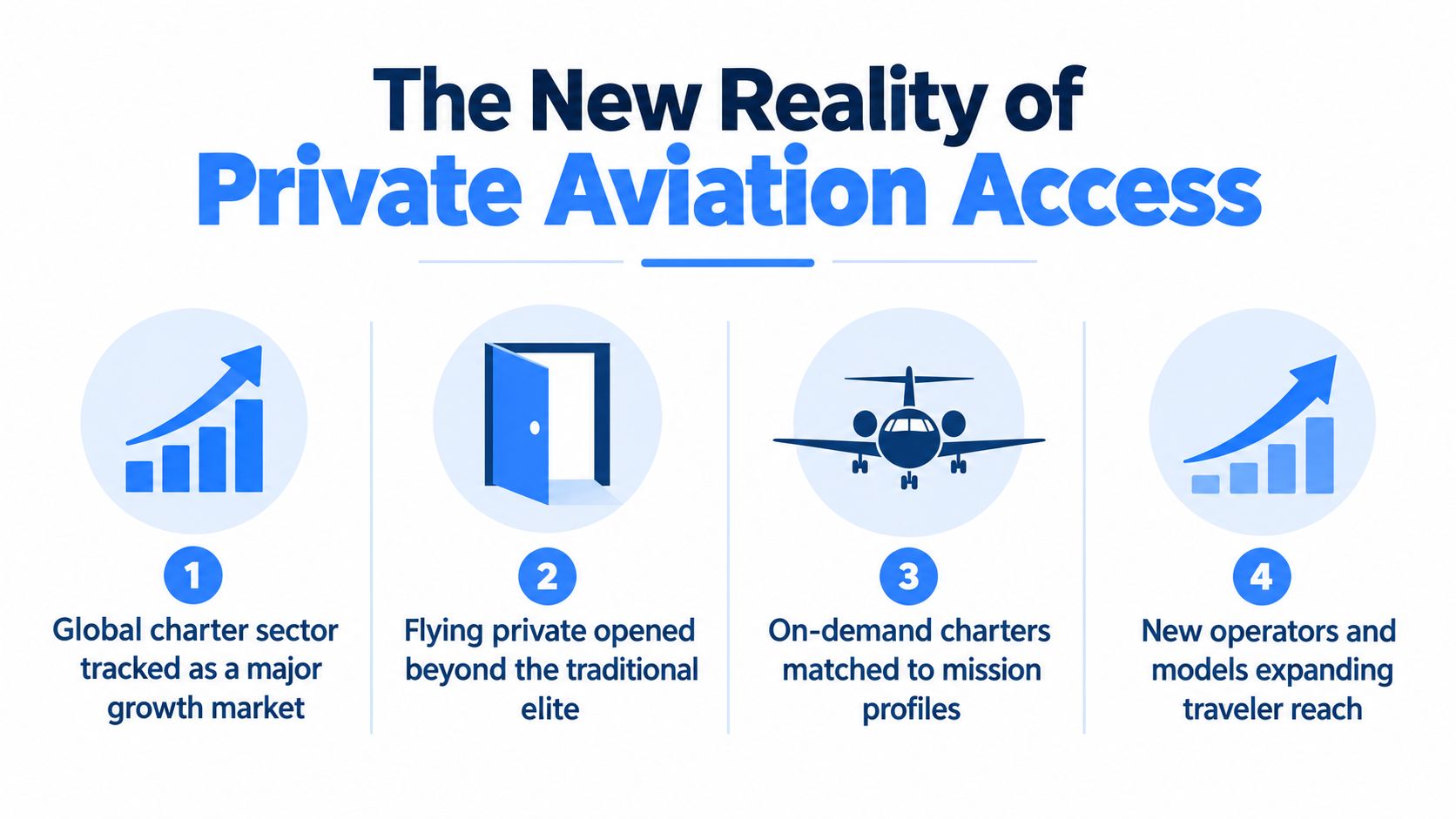
The New Reality of Private Aviation Access
A flight may look simple on a map and still fail operationally. The aircraft may not fit the luggage, the nearest airport may lack suitable handling, or a late change may trigger a cancellation charge. Private charter works best when someone tests those friction points before presenting a price.
The trip begins with a practical question: what time do you need to leave, and which airport gets you closest to the destination? An executive visiting several sites, a family carrying sports equipment, and an organization moving a group may value that flexibility more than cabin finishes. Airport access, aircraft availability, and schedule control often determine the true benefit.
Private aviation is now an established global mobility market. Mordor Intelligence values the private jet charter services market at USD 17.67 billion in 2026, projecting USD 25.79 billion by 2031 at a 7.86% compound annual growth rate, according to Mordor Intelligence's private jet charter market analysis. The forecast indicates sustained demand, but it does not make every charter interchangeable. Supply, aircraft positioning, luggage capacity, and contract terms still shape the outcome of an individual trip.
Access depends on the mission
A short domestic route may suit a turboprop or very light jet. A longer flight, a larger group, or substantial baggage may require a midsize, super midsize, or heavy jet. The right aircraft is the smallest option that can safely and comfortably complete the full mission, including range, runway performance, cabin space, and payload.
Practical rule: Treat private aviation as on-demand transportation with several equipment options, not as a single luxury product.
A broker's value appears in the details. They can compare regional availability, identify repositioning exposure, confirm whether luggage and special equipment fit, and explain the cancellation ladder before payment. That work reduces the risk of selecting an aircraft that looks suitable online but creates problems on departure day.
Chartering also relies on regulated operators rather than informal aircraft rental. In the United States, an on-demand, non-scheduled commercial operator carrying passengers for hire generally operates under FAA Part 135, as described by the Federal Aviation Administration's Part 135 guidance. The operator, crew, maintenance program, and operating certificate are established before the trip is sold. A capable broker uses that operating network to build a workable movement, not merely to display available aircraft.
Requesting a Quote and Matching Your Aircraft
A useful quote request is a mission brief, not a vague message asking for “a private jet to London.” Give the advisor enough information to test the aircraft and itinerary before presenting options.
Start with these inputs:
- Route and airport preferences: State the departure and destination cities, but also mention your final ground destination. A smaller airport may save driving time, while another may offer better aircraft availability or customs capability.
- Passenger profile: Provide the exact number of travelers, including children, crew members, or anyone requiring special assistance.
- Luggage volume: Describe suitcases by quantity and size, then list bulky items such as golf bags, bicycles, skis, musical instruments, product samples, or event equipment.
- Timing: Give your preferred departure window and identify whether the trip is one-way, round-trip, multi-city, or open-ended.
- Special requirements: Flag pets, dietary restrictions, medical equipment, security needs, ground transfers, and privacy concerns at the start.

Read the quote as an operating plan
A reputable advisor should then match the request against cabin dimensions, range, runway limitations, baggage capacity, crew requirements, and availability. A group traveling a short distance with several surfboards may need a larger aircraft than a smaller group flying farther with only hand luggage. Choosing based on route distance alone is one of the fastest ways to create a late aircraft substitution or a luggage compromise.
Approved Jets states a two-hour quote turnaround target, but speed shouldn't replace verification. Ask whether the aircraft is confirmed or merely being held, which operator will conduct the flight, whether the quote includes repositioning, and how long the price remains valid. The private jet charter booking workflow from Paramount Business Jets also emphasizes defining trip requirements, reviewing matched aircraft, signing the charter agreement, and completing payment authorization.
The quote should itemize fuel, landing charges, crew costs, taxes, catering, and premium services where applicable. If the provider uses terms such as “estimated,” “subject to availability,” or “plus repositioning,” ask for a plain-English explanation before signing. A fast answer is valuable only when you understand what it commits the operator to deliver.
Understanding Real Private Jet Pricing Per Hour
Private jet pricing has no single universal hourly rate because an aircraft's operating cost, cabin class, positioning, route, and trip structure all affect the final quote. Hourly figures are useful benchmarks, but they aren't the complete price.
Published industry pricing guides place turboprops around USD 2,000 to USD 4,900 per hour, very light jets around USD 5,500 to USD 6,800 per hour, midsize jets around USD 9,793 to USD 10,824 per hour, and super midsize jets around USD 11,786 to USD 13,027 per hour, according to Stratos Jets' pricing guide. The same guide notes that fuel surcharges can sometimes start around USD 300 per hour during market spikes.
| Aircraft category | Published hourly range | Typical decision question |
|---|---|---|
| Turboprop | USD 2,000 to USD 4,900 | Is runway access and short-range efficiency more important than jet speed? |
| Very light jet | USD 5,500 to USD 6,800 | Can the cabin and baggage hold support the passenger group? |
| Midsize jet | USD 9,793 to USD 10,824 | Does the itinerary require more cabin space or range? |
| Super midsize jet | USD 11,786 to USD 13,027 | Are long sectors, larger groups, or substantial luggage involved? |
These figures don't mean a quote at the upper end is automatically inflated. A newer aircraft, a more capable crew base, a constrained airport, or an empty positioning leg may justify a higher total. Conversely, a low hourly figure can conceal extra charges for repositioning, waiting, catering, de-icing, ground handling, or international coordination.
For a fuller explanation of how aircraft type, trip length, and additional charges interact, see how much it costs to charter a private jet. Then ask the advisor to separate occupied flight time from repositioning, list fixed fees, identify fuel treatment, and state the cancellation exposure. Comparing complete trip totals is more reliable than comparing a headline hourly number.
The Hidden Costs of Repositioning and Deadhead
The cheapest aircraft on a search screen may be the wrong aircraft for your departure airport. An operator might need to fly the jet empty from its home base to collect you, then reposition it again after dropping you off. Those sectors don't carry passengers, but they can still form part of the economics behind your quote.
One published charter program advertises occupied pricing starting at USD 5,700 per hour in some regions. For trips outside those regions, it lists USD 2,850 per hour plus repositioning flight charges, as shown in Tradewind's charter pricing information. The lesson isn't that one rate is good and another is bad. It's that the same passenger journey can produce different totals depending on where the aircraft is located before departure and where it must go afterward.
Ask what moves when you move the airport
Suppose your preferred airport is convenient for the final destination but far from available aircraft. A nearby secondary airport may reduce deadhead time, even if it adds a ground transfer. The right comparison is door to door, not runway to runway.
Ask these questions before selecting an option:
- Where is the aircraft positioned now?
- How much repositioning time is included in the quote?
- Are empty legs priced at the same rate as occupied sectors?
- Could another departure airport reduce the aircraft's empty movement?
- What happens if weather or airport restrictions force a change?
The useful question isn't “What's the hourly rate?” It's “What aircraft movement am I paying for, and which parts of that movement carry passengers?”
A broker who explains deadhead costs clearly can also test alternatives, such as a different aircraft category, a nearby airport, or a flexible departure window. Trying to eliminate every repositioning charge may not be realistic, especially for a time-critical trip. The objective is to understand the charge and decide whether the convenience it buys is worth the total.
Vetting Operators and Ensuring Flight Safety
A polished cabin does not confirm that an operator can handle your itinerary. Start with the certificate holder and the operating structure. U.S. charter flights generally operate under FAA Part 135, which sets standards for pilot training, maintenance, aircraft control, and flight operations. Ask the broker to identify the company legally responsible for conducting the flight, not only the brand that issued the quote.
Pilot experience also requires careful checking. A market summary such as Ken Research's private jet charter market guidance may describe common industry thresholds, but it is not a substitute for the applicable regulation or the operator's records. Request confirmation of the crew's qualifications for the aircraft type, route, and operating conditions. Historical safety figures, including the context discussed in Hogan Aviation's operator-vetting guidance, can inform your questions. They cannot replace screening the specific operator, aircraft, and crew.
Use a written operator checklist
Before authorizing payment, request:
- Legal identity: Confirm the certificate holder, operating name, certificate status, and aircraft registration.
- Aircraft details: Verify the exact aircraft offered, its maintenance status, age, refurbishment history, and luggage capacity.
- Crew and route fit: Ask whether the crew is qualified for the aircraft and whether the airports, runway, customs, weather, and operating-hour limits create restrictions.
- Safety credentials: Check for recognized credentials such as ARGUS Platinum or Wyvern Wingman, while treating them as part of the review rather than a replacement for documentation.
- Contingency terms: Read the aircraft substitution, delay, cancellation, and refund provisions. A low quote becomes less useful when a cancellation ladder or replacement aircraft creates unexpected exposure.
Luggage limits and aircraft repositioning can also affect the safety and practicality of the proposed plan. Confirm baggage weight, oversized items, pets, medical equipment, and sensitive cargo before the operator is locked in. A broker who raises these issues early can test alternatives instead of forcing a last-minute substitution.
For a customer-facing explanation of these screening principles, review guidance on whether private jets are safe. The advisor should answer direct questions and identify the actual operator without hiding behind a generic fleet description.
Navigating Documentation, Payment, and Ground Logistics
The charter agreement is where a flexible travel request becomes a binding commercial commitment. Read it before payment, particularly the cancellation ladder, payment deadline, aircraft substitution clause, waiting-time allowance, weather provisions, and treatment of additional services.
Published terms show how quickly exposure can increase. One agreement charges 20% after signing, 30% when canceled within 14 days, 75% within seven days, and 100% within two days or for a no-show, while another states 100% of the charter price if canceled within two weeks of departure, as shown in published private jet charter terms. These are examples of contract language, not universal industry rules. Your agreement controls.

Treat ground arrangements as part of the flight
A jet can depart on time and the overall journey can still fail if the vehicle is late, customs paperwork is incomplete, or the catering doesn't match the passenger requirements. Send the broker the complete door-to-door plan, including hotel transfers, event arrivals, security preferences, pets, medical equipment, and any sensitive cargo.
International trips add customs and immigration coordination. Families may need pet documentation and suitable handling. Corporate teams may need quiet transfers, meeting space, or a multi-city sequence that leaves little room for delay. Sports and entertainment groups may need equipment manifests, discreet arrivals, and larger aircraft than passenger count alone suggests.
A strong pre-flight itinerary should identify departure and arrival airports, aircraft details, passenger information, ground contacts, catering, and special handling. Ask who remains available if a passenger changes, an airport closes, or a vehicle fails. The broker's value isn't limited to finding a tail number. It lies in keeping all the moving parts aligned through departure and arrival.
Smart Tips for Cost Control and Booking Strategy
Cost control starts before the aircraft search. Event and holiday demand can raise charter rates by 20% to 60% during peak periods, according to Paramount Business Jets' first-time private flying guide. Current industry commentary also suggests supply has partly caught up with post-pandemic demand, putting downward pressure on some peak-season pricing, while broader market forecasts still project growth, as noted in the earlier market discussion.
That creates room for strategy, but not certainty. A flexible departure day, a secondary airport, or an aircraft category that meets the mission without excess capacity can improve the quote. A last-minute holiday request may leave you choosing between expensive repositioning and an inconvenient schedule.
Four decisions that protect the budget
- State priorities early: Tell the advisor whether timing, luggage, nonstop routing, privacy, or cabin size matters most. Hidden priorities become expensive changes later.
- Compare complete itineraries: Review aircraft cost, repositioning, airport charges, taxes, catering, transfers, and waiting terms together.
- Test nearby airports: A short ground transfer may be cheaper and more reliable than paying to move an aircraft from a distant base.
- Read cancellation terms before paying: If your schedule is uncertain, ask whether the contract offers any flexibility. Published agreements can impose full charter charges close to departure, so a low initial quote doesn't eliminate cancellation risk.
Empty-leg opportunities can sometimes help, but they depend on an existing aircraft movement and may offer less flexibility. The private jet charter empty legs guide explains why these options should be evaluated against your exact timing and routing rather than treated as guaranteed discounts.
A broker becomes strategically useful when they explain trade-offs instead of presenting a single aircraft and price. Ask for alternatives, request the operational assumptions in writing, and decide based on the full mission.
Approved Jets arranges on-demand charters through a vetted operator network and coordinates aircraft matching, luggage requirements, ground transfers, catering, and other trip logistics. Share your route and requirements with Approved Jets, and ask for a transparent quote that separates aircraft, repositioning, contract, and service costs before you authorize payment.