
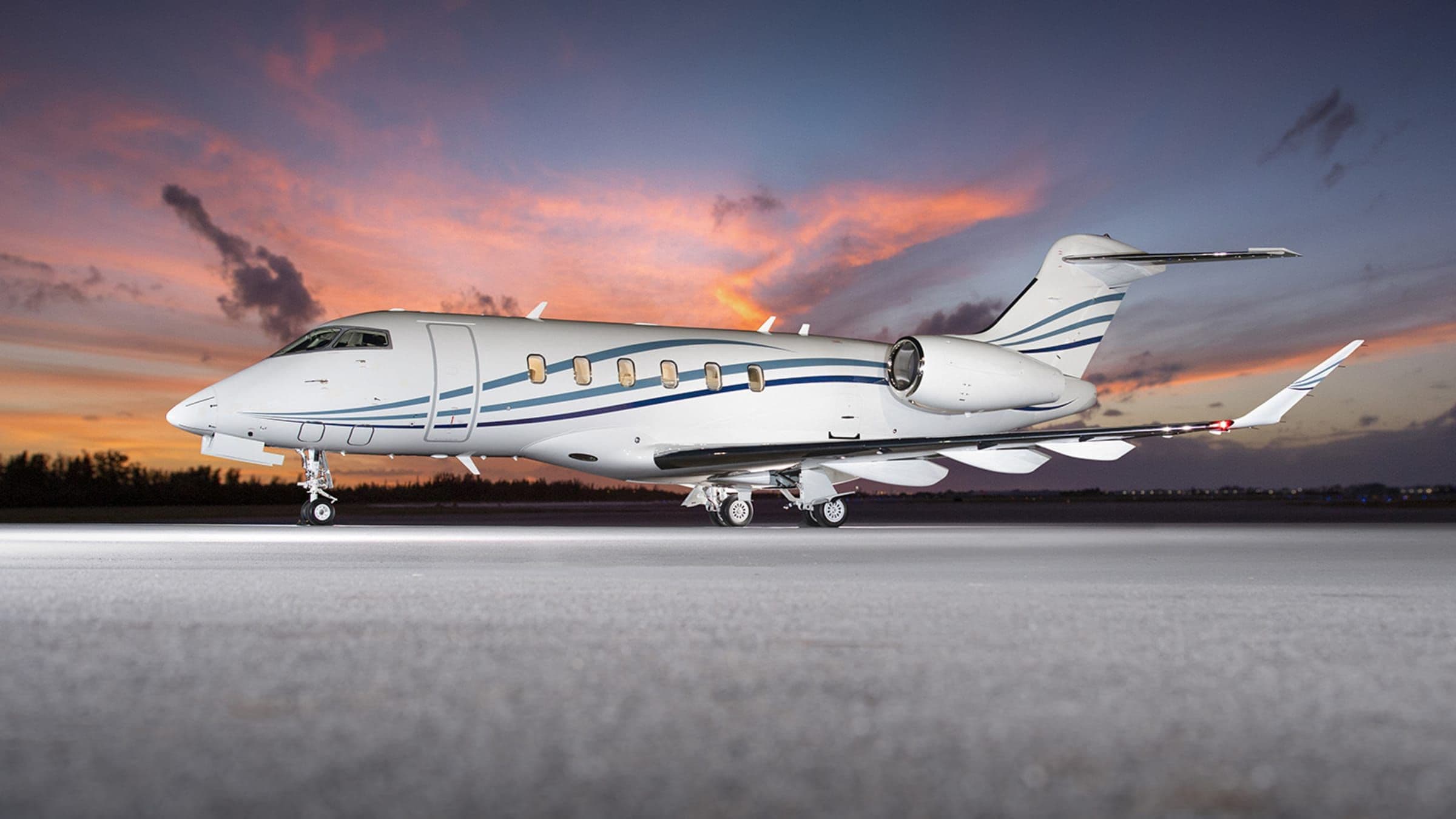
Long Range Aircraft for Global Private Travel
Discover how long range aircraft enable nonstop global travel. Learn key metrics, payload trade-offs, and how to select the right jet for your mission profile.

Approved Jets

On this page
- Table of Contents
- The Myth of Brochure Range in Private Aviation
- What changes usable range
- Defining Long Range Aircraft Performance Metrics
- Range is only one performance metric
- Why systems engineering matters
- Payload Trade-Offs and Oceanic Flight Planning
- The dispatch sequence
- Comparing Heavy Business Jets and VIP Airliners
- Heavy Jets vs VIP Airliners
- Choose the aircraft around the group
- Navigating Emissions and Sustainable Aviation Fuel
- Physical fuel and accounting instruments
- Selecting the Right Aircraft for Your Mission Profile
- A mission-first selection framework
- Vet the operator, not only the airframe
- Common Misconceptions About Global Private Flights
The most popular advice about long range aircraft is also the least useful: choose the jet with the largest number in the range column. That number describes a capability under defined assumptions, not a promise that your passengers, baggage, fuel reserves, weather, alternates, and preferred airport will all fit into the same mission.
A serious buyer or charterer should ask a harder question: what is the usable mission range for this specific flight? A smaller aircraft with a lighter cabin load may complete a route nonstop while a larger jet, loaded with people and luggage, requires a technical stop. That distinction affects executive schedules, sports-team logistics, medical missions, and every corporate itinerary where arrival time matters.
Table of Contents
- The Myth of Brochure Range in Private Aviation
- Defining Long Range Aircraft Performance Metrics
- Payload Trade-Offs and Oceanic Flight Planning
- Comparing Heavy Business Jets and VIP Airliners
- Navigating Emissions and Sustainable Aviation Fuel
- Selecting the Right Aircraft for Your Mission Profile
- Common Misconceptions About Global Private Flights
The Myth of Brochure Range in Private Aviation
Aircraft manufacturers publish maximum range because buyers need a common reference point. The problem begins when operators treat that reference point as an operational guarantee. Maximum range usually reflects a particular payload, fuel load, reserve assumption, routing profile, and atmospheric condition. Your aircraft may be technically capable of reaching a destination, yet unable to do so with the requested passengers, baggage, fuel reserves, and alternate-airport requirements.
Nonstop capable and guaranteed nonstop are different claims. The first describes an aircraft category or performance envelope. The second requires a dispatch review for the actual date, route, payload, weather, airport restrictions, and operating approvals.
What changes usable range
Payload is the first variable. Fuel is heavy, and passengers, baggage, catering, and cargo occupy the same weight budget. As range increases, operators may need to exchange payload for fuel. A full cabin can therefore reduce practical range more sharply than a brochure comparison suggests.
Weather creates another gap between theory and practice. Headwinds can increase fuel burn and flight time, while the route may need to avoid weather systems or use a different airway structure. Dispatchers must also account for reserve fuel, destination access, runway limitations, and an alternate airport suitable for the aircraft and prevailing conditions.
That's why two aircraft with similar published range figures can produce different results on the same mission. One may carry the required bags and preserve its reserve margin. The other may need fewer passengers, less cargo, a different airport, or a fuel stop.
Broker's rule: Never approve an aircraft from the range figure alone. Approve it after the operator has run the route with the real passenger list, baggage estimate, airport pair, season, and reserve requirements.
A short-range comparison can also prevent overbuying. A Phenom 300 range analysis is more useful when it helps a traveler match the aircraft to actual sectors rather than treating every mission as a contest for maximum distance. The same logic applies inside an airport, where passengers may need reliable terminal navigation after a long flight. Resources on wayfinding software for terminals illustrate why the ground experience remains part of the journey.
The practical question isn't “How far can this aircraft fly?” Ask instead, “Can this aircraft complete my mission, with my people and baggage, under the forecast conditions, while meeting its reserve and diversion requirements?”
Defining Long Range Aircraft Performance Metrics
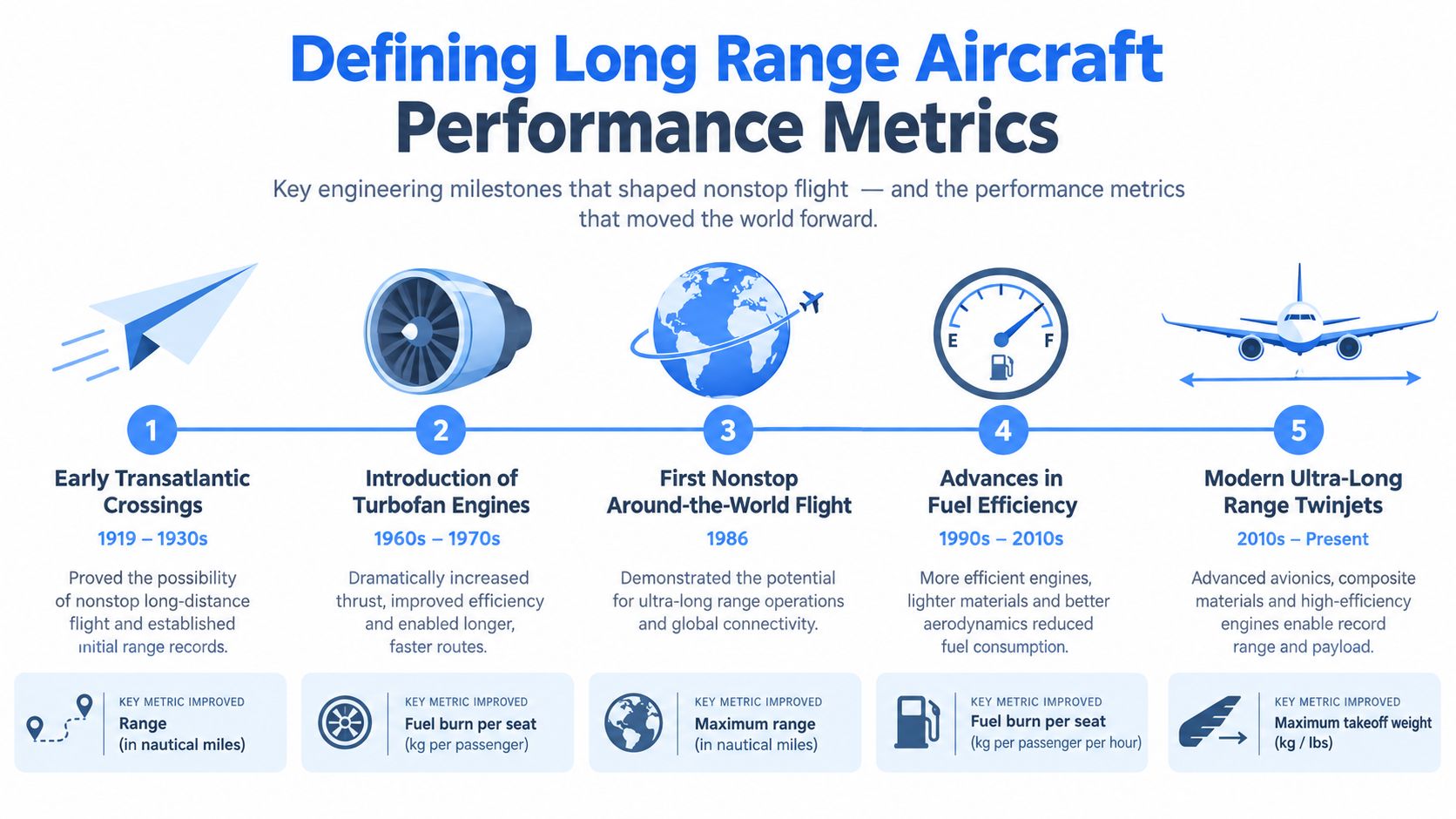
Long range aircraft performance rests on a connected set of engineering choices. Fuel capacity matters, but so do aerodynamic efficiency, engine performance, maximum takeoff weight, structural limits, cabin configuration, and the ability to carry payload while remaining within the required fuel envelope.
A defining milestone occurred in November 2005, when a Boeing 777-200LR completed a nonstop demonstration flight from Hong Kong to London. The aircraft covered 11,664 nautical miles, or 21,601 kilometres, in 22 hours and 42 minutes, setting a distance record for a commercial jetliner at the time, according to Boeing's published record information. The eastbound flight exceeded halfway around the Earth and showed how fuel capacity, engine efficiency, aerodynamics, and high maximum takeoff weight had expanded the practical limits of long-distance aviation.
Range is only one performance metric
Boeing stated that the aircraft was designed to carry 301 passengers and baggage over a service range of up to 9,420 nautical miles, or 17,445 kilometres, although the record flight used a special operating configuration rather than a standard revenue mission. The same record surpassed the 9,200-nautical-mile 747-400 record established in 1989 on a London to Sydney flight by 2,464 nautical miles, approximately 26.8%, and exceeded the 1997 777-200ER record of 10,823 nautical miles from Seattle to Kuala Lumpur. Those figures demonstrate progress, but they also show why record distance and normal commercial service must remain separate categories.
Modern ultra-long-range aircraft now reach approximately 9,700 nautical miles, or 18,000 kilometres, and more than 20 hours of flight time, according to Airbus A350-900 information. The A350-900ULR achieves that capability through a modified fuel system that adds 24,000 litres, increasing fuel capacity from approximately 141,000 litres to 165,000 litres, without installing additional fuel tanks. Its maximum takeoff weight is 280 metric tonnes.
Airbus says the aircraft can operate routes such as Singapore to New York, nearly 9,000 nautical miles, with average flight times of about 18 hours and 45 minutes. Compared with the 1989 747-400 record, its stated maximum range is about 5.4% greater, and compared with the 777-200LR's 9,420-nautical-mile service range, about 3.0% greater, based on the supplied aircraft figures.
Why systems engineering matters
The A350-900ULR example is instructive because its additional range did not come from attaching larger tanks. Airbus adapted the fuel system and relocated sensors so the existing tanks could carry a higher maximum fuel load, as described in the A350-900ULR technical material.
For private aviation buyers, the lesson is straightforward. Evaluate range with payload, maximum takeoff weight, fuel capacity, cruise performance, runway requirements, cabin configuration, and airport access together. A jet that flies farther with a useful executive cabin may be more valuable than an aircraft with a higher theoretical number but less practical room for people and baggage.
Payload Trade-Offs and Oceanic Flight Planning
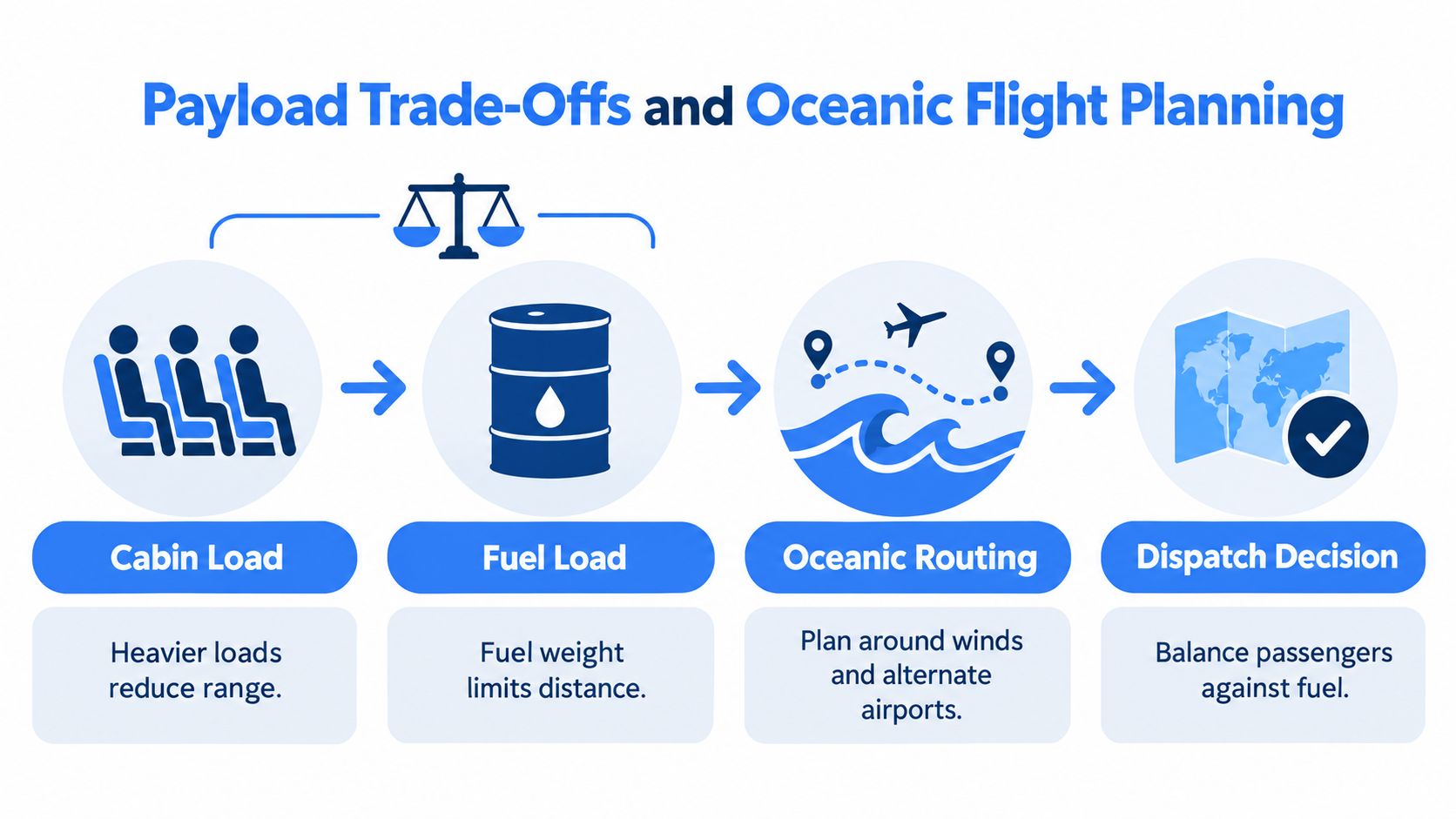
Every long-range dispatch is a weight-management exercise. The aircraft begins with a maximum takeoff weight, and that weight must cover the airframe, crew, fuel, passengers, baggage, catering, and other required items. If the cabin load increases, the operator may have less room for fuel. If the route requires more fuel because of winds or diversion planning, the operator may need to reduce payload.
The dispatch sequence
A professional flight department should treat the process as a series of decisions, not a single range check.
-
Build the actual payload. Count passengers, baggage, sports equipment, medical equipment, cargo, crew, and catering. “Eight passengers” isn't enough if each passenger brings substantial luggage or specialist equipment.
-
Model the route. Use the planned airport pair, available airways, expected winds, destination runway, airport restrictions, and possible alternates. A nominal great-circle distance doesn't capture the full operational route.
-
Calculate reserves and diversions. The aircraft must carry fuel for the applicable regulatory and operational scenarios, not merely enough to reach the destination.
-
Test the result against performance. If the mission exceeds the available payload and fuel envelope, choose between reducing payload, changing airports, adding a technical stop, or selecting another aircraft.
FAA ETOPS guidance requires long-range twin-engine operations to plan for abnormal events including an engine failure, rapid decompression, descent to a lower altitude, weather, and diversion to an alternate airport. Under the cited approval framework, the maximum diversion time can't exceed 240 minutes, and fuel planning must use the greater of the applicable standard requirement or the amount needed for the critical diversion scenario. The calculation also includes a 5% wind-speed factor for possible forecast errors, as detailed in Airbus' summary of FAA ETOPS guidance.
Operational reality: An oceanic flight isn't planned as origin to destination. Dispatchers identify the critical point, confirm suitable alternates, check one-engine-inoperative performance, and protect the fuel required for the relevant emergency scenario.
A smaller aircraft may therefore provide better usable range for a small executive group. It may carry less total fuel, but a lighter cabin load can preserve the payload and fuel balance needed for the route. A larger aircraft filled with passengers, luggage, and cargo can be less flexible than its headline range suggests.
For international planning, airport access matters as much as aircraft performance. The practical differences between permits, customs, routing, and aircraft capability are covered in this guide to whether private jets can fly internationally. The video below provides additional context for how long-range flight planning works in practice.
Comparing Heavy Business Jets and VIP Airliners
The choice between a heavy business jet and a VIP-configured airliner depends on the mission, not prestige. A heavy jet usually provides better access to regional airports, a more private cabin, and a strong balance between executive comfort and intercontinental capability. A VIP airliner wins when the group needs substantial cabin volume, baggage capacity, or dedicated space for equipment.
The Boeing 777-200LR illustrates the airliner side of the decision. Boeing lists a range of 13,650 kilometres, or 7,370 nautical miles, maximum seating capacity of 396 passengers, cruise speed of Mach 0.84, and total cargo volume of 201.6 cubic metres, according to the published aircraft specifications. Boeing also states that the aircraft can carry a full cargo load on routes where other aircraft may be payload-limited. That is a critical distinction for group movement. Range alone doesn't show whether the aircraft can carry the required people, bags, and revenue cargo at the planned fuel load.
Heavy Jets vs VIP Airliners
| Feature | Heavy Business Jet | VIP Airliner |
|---|---|---|
| Cabin purpose | Executive privacy, meeting space, rest areas, and premium service | Large-group transport, extensive cabin volume, and custom layouts |
| Passenger scale | Suited to a smaller executive group or family party | Suited to sports teams, delegations, events, and substantial group movements |
| Baggage and cargo | Strong capability, but configuration and payload must be checked carefully | Greater volume potential, particularly when the mission includes equipment or extensive baggage |
| Airport flexibility | Often better suited to regional airports and private aviation facilities | More dependent on runway, apron, terminal, and handling infrastructure |
| Mission economics | Efficient when the group size matches the cabin | Efficient when moving a large group avoids separate aircraft or complex coordination |
| Privacy | Private cabin designed around a smaller party | Private operation is possible, but the cabin remains closer to an airliner environment |
| Operational trade-off | May require payload discipline on the longest sectors | May offer payload capacity while limiting airport choices |
Choose the aircraft around the group
For a chief executive and a small leadership team, a heavy jet may reduce ground time and simplify airport access. For a sports team carrying people, kit, medical support, and staff, a VIP airliner can make the entire movement more coherent. The aircraft's value lies in avoiding split movements, excess connections, or a cargo solution that undermines the schedule.
A four-engine aircraft can also enter the discussion when mission demands, airport constraints, or passenger requirements justify it. Buyers should assess the actual operational profile rather than assuming that more engines automatically mean greater practical range. A focused review of the 4-engine jet category helps frame that decision without reducing it to a simple engine-count comparison.
Boeing further states that most 777 aircraft are approved for up to 330-minute ETOPS operations, subject to the specific aircraft, operator, route, and regulatory approval. That qualification matters. Approval isn't transferable as a blanket promise across every airframe or operator.
Navigating Emissions and Sustainable Aviation Fuel
Long-range emissions planning needs more discipline than a generic “green flight” label. Three different questions often get mixed together: how efficiently the aircraft burns fuel, whether sustainable aviation fuel is physically available at the departure airport, and how an organization accounts for a reduction through a book-and-claim instrument.
Aircraft efficiency should be compared using an aircraft-specific metric, not broad marketing language. EASA's aircraft CO2 database uses a certified specific-air-range metric adjusted for fuselage size, which gives travel managers a more comparable basis for evaluating aircraft efficiency. That helps separate the aircraft's physical performance from a claim about purchased environmental attributes.
Physical fuel and accounting instruments
Physical SAF uplift means the aircraft receives SAF at the airport, subject to local supply, blending, infrastructure, operator arrangements, and fuel availability. A book-and-claim approach can support SAF production or use elsewhere while the specific aircraft receives conventional fuel at its departure airport. Both approaches may have a role, but they shouldn't be described as the same physical event.
Neste and World Fuel Services announced plans in 2026 to expand Neste-supplied SAF availability to more than 100 airports across the UK and Europe. Neste stated that neat SAF can reduce lifecycle greenhouse-gas emissions by up to 80% compared with conventional jet fuel, as reported in the announcement about SAF availability in Europe. That is meaningful progress, but it doesn't mean every long-range departure can uplift SAF.
Accounting check: Ask whether the claim concerns physical uplift, lifecycle emissions, direct onboard emissions, or a book-and-claim certificate. Those are different statements.
Corporate travel managers should record the aircraft type, route length, fuel method, airport availability, and accounting boundary for each mission. They should also distinguish CO2 from non-CO2 effects such as contrails. A useful review of ESG Consulting on carbon reporting can help teams structure broader reporting, but it shouldn't replace mission-specific aviation data.
The right conclusion isn't that long-range aviation is either inherently unacceptable or solved by SAF. Efficient aircraft reduce fuel demand, SAF can reduce lifecycle emissions where credible supply and accounting exist, and the remaining impact still needs transparent reporting.
Selecting the Right Aircraft for Your Mission Profile
Start with the route and the people, then select the aircraft. Reversing that order creates expensive compromises. A long-range jet may look attractive until the operator adds the actual passenger list, baggage, seasonal winds, alternate requirements, runway limits, customs needs, and ground schedule.
A mission-first selection framework
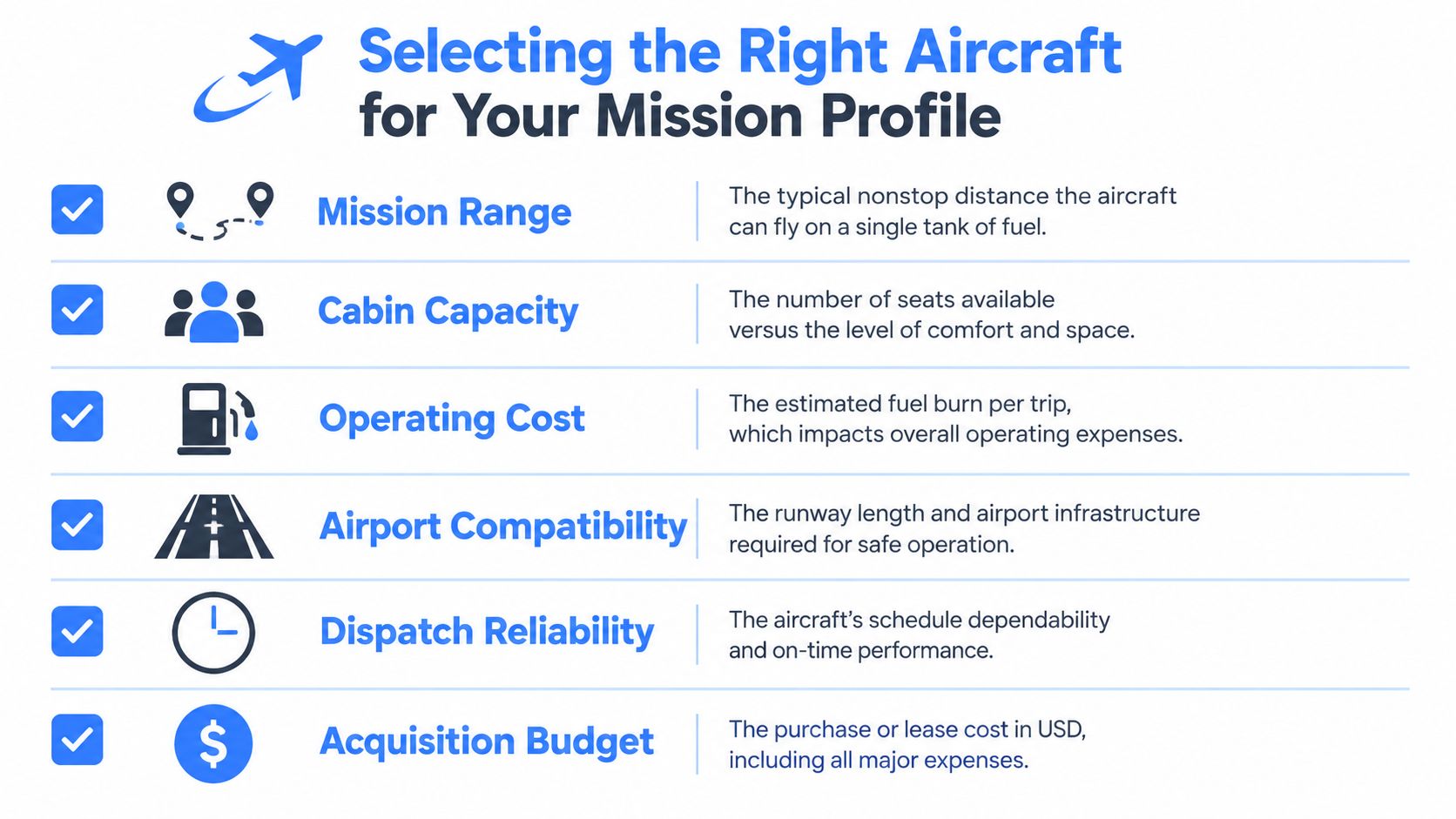
Mission range comes first. Define the typical nonstop sector, not just the longest possible route. Include the preferred airports and identify whether a technical stop is acceptable.
Cabin capacity must reflect comfort as well as seat count. A party may technically fit while luggage, work areas, sleeping arrangements, or medical equipment make the layout unsuitable.
Operating cost should be evaluated per completed mission. Fuel burn, crew requirements, handling, maintenance exposure, and repositioning can change the economics between aircraft categories.
Airport compatibility often decides the result. Check runway requirements, airport hours, customs capability, ground handling, parking, and the ability to support the aircraft without adding an avoidable transfer.
Dispatch reliability means more than aircraft availability. Ask how the operator manages crew duty limits, maintenance events, alternate aircraft, permits, and schedule disruption.
Acquisition budget matters for an owner, while charter clients should focus on the complete trip cost and the operational consequences of choosing a particular aircraft.
Vet the operator, not only the airframe
A capable aircraft can still produce a poor mission if the operator lacks the right approvals, crew experience, maintenance support, or international coordination. Ask for the aircraft's registration and configuration, operator credentials, insurance, maintenance status, crew profile, and the assumptions used in the range analysis.
End-to-end planning also includes customs paperwork, catering, security coordination, ground transfers, and baggage handling. For medical evacuation or sensitive cargo, add equipment compatibility, accompanying specialists, chain-of-custody procedures, and destination-side support.
Approved Jets arranges on-demand charter through a vetted operator network and coordinates aircraft sourcing, international routing, and related trip logistics for corporate, group, cargo, and medical missions. That kind of embedded coordination is useful when the aircraft decision is only one part of a complicated itinerary.
Common Misconceptions About Global Private Flights
A corporate group asks for a nonstop transpacific flight in a fully loaded aircraft because the brochure says the jet has enough range. The operator reviews the passenger count, baggage, forecast winds, reserves, and alternate requirements, then recommends a payload adjustment or technical stop. The aircraft wasn't misrepresented. The mission was just heavier and more demanding than the published maximum-range scenario.
Another executive assumes the largest aircraft must be the safest and most practical choice. A smaller long range aircraft may suit the group better if it can use the preferred airport, carry the required baggage, and preserve the fuel margin without moving passengers through a larger hub. Bigger improves capacity, not every part of the mission.
A third client asks for “guaranteed nonstop” service on a time-critical route. The broker should explain that a responsible commitment depends on aircraft assignment, dispatch approval, weather, airport access, and operational conditions. If the itinerary cannot tolerate a technical stop, the planning process should include a backup aircraft or alternate routing rather than relying on a brochure figure.
Urgent medical and sensitive-cargo missions create another misconception. Rapid mobilization doesn't remove the need for aircraft suitability, medical equipment, permits, crew duty planning, destination access, and chain-of-custody control. Speed comes from coordinated preparation, not from skipping operational review.
The most reliable buying habit is simple: provide the actual passenger count, baggage profile, schedule, airports, and contingency tolerance at the start. Then ask the broker to show the assumptions behind the nonstop recommendation.
Approved Jets arranges long-range charter aircraft through a vetted operator network and coordinates the surrounding logistics, from routing and permits to ground transfers and sensitive cargo requirements. Visit Approved Jets to request a mission-specific aircraft recommendation based on your passengers, baggage, airports, and nonstop priorities.