

Private Jet Travel Cost: A Complete Breakdown for 2026
Understand private jet travel cost in 2026 with hourly rates by aircraft, hidden fees, and pricing models. Practical tips to optimize your charter spend.

Approved Jets

On this page
- Table of Contents
- Why the Hourly Rate Is Not Your Trip Price
- Hourly Rates by Aircraft Category
- The Hidden Line Items on a Charter Invoice
- Positioning and airport charges
- Taxes and related services
- Charter, Jet Card, Fractional, and Full Ownership
- Sample Itineraries and the All-in Number
- Two-hour domestic light jet
- Four-hour heavy jet
- Empty Legs, Memberships, and the Schedule Trade-off
- A Quote Audit Checklist and How Approved Jets Optimizes Spend
- Key Takeaways and Private Jet Cost FAQs
- How do domestic passenger segment fees work?
- When does the international facilities tax apply?
- What should a 2026 budget look like?
- Which signals indicate missing line items?
A private jet charter averages about $5,800 per flight hour, but the all-in trip cost is typically 20%–40% higher once positioning, taxes, crew, and other operating charges are added. A two-hour light-jet flight priced at $4,500–$6,500 per hour can therefore become an invoice of approximately $11,000–$15,000.
That gap is the central fact behind private jet travel cost. The hourly figure is useful for comparing aircraft categories, but it isn't a reliable trip budget on its own. A quote only becomes decision-ready when it shows who pays to position the aircraft, how fuel changes are handled, which taxes apply, and whether the stated total includes ground and crew costs.
Table of Contents
- Why the Hourly Rate Is Not Your Trip Price
- Hourly Rates by Aircraft Category
- The Hidden Line Items on a Charter Invoice
- Charter, Jet Card, Fractional, and Full Ownership
- Sample Itineraries and the All-in Number
- Empty Legs, Memberships, and the Schedule Trade-off
- A Quote Audit Checklist and How Approved Jets Optimizes Spend
- Key Takeaways and Private Jet Cost FAQs
Why the Hourly Rate Is Not Your Trip Price
The $5,800 hourly average is a market reference, not a universal fare. Aircraft category, route length, airport availability, empty-leg positioning, and seasonal demand can move the final price substantially. A light jet and a heavy jet may fly the same route, yet their fuel burn, crew requirements, operating range, and airport constraints create very different invoices. Market estimates for private-jet charter pricing show why a single hourly number can't describe the full mission.
Ancillary expenses can add roughly 20%–40% above the advertised hourly rate. That allowance may cover aircraft positioning, airport charges, fuel surcharges, crew overnights, and taxes. In practice, the aircraft may need to fly to your departure airport before your scheduled departure, remain nearby during a multi-day trip, or return to its base afterward. Those movements can matter as much as the time your passengers spend airborne.
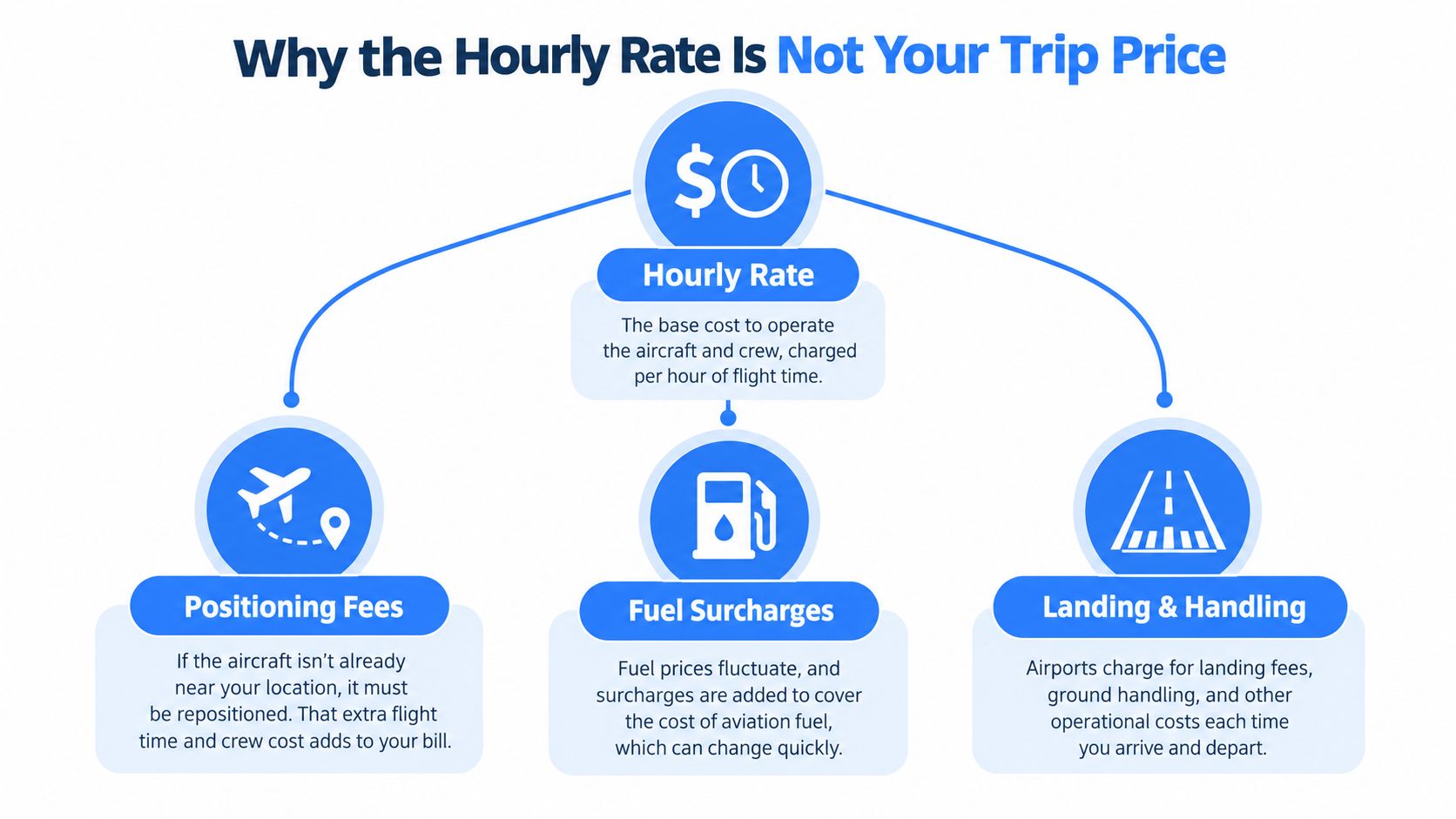
Practical rule: Treat the hourly rate as one input into a quote, not as the price of the trip.
The useful comparison is an all-in, mission-specific price with a stated validity period, a fuel-adjustment formula, and explicit assumptions about positioning and ground time. It should also identify whether the quote includes handling, landing, crew accommodation, catering, and transfers. For passengers comparing the air portion with a complete door-to-door journey, a guide to airport transfer types and costs can help expose ground logistics that are often left outside the aircraft quote.
Hourly Rates by Aircraft Category
Aircraft size creates a steep cost gradient because larger cabins require more fuel, crew capacity, maintenance, and long-range capability. The following ranges are hourly market estimates, before trip-specific taxes and expenses, rather than guaranteed prices for a particular route. Category-level private aircraft rate estimates show how quickly the spread widens as capability increases.
- Turboprops and very light jets: Approximately $2,300–$3,500 per hour. These aircraft can suit shorter regional missions where runway access and efficiency matter more than cabin volume.
- Light and super-light jets: Approximately $3,750–$4,600 per hour. They offer more speed, range, and cabin comfort, but the price still depends on the aircraft's positioning and the operator's minimum billing rules.
- Midsize and super-midsize aircraft: Approximately $4,700–$7,500 per hour. This tier supports longer domestic missions and greater baggage or passenger requirements, with higher fuel and crew costs.
- Large and ultra-long-range jets: Approximately $8,500–$17,000 per hour. Their range, cabin size, onboard systems, and international operating capability create the highest conventional charter rates.
- VIP airliners: Some listings start around $16,000 per hour and exceed $20,000 per hour, reflecting a separate level of cabin capacity and service configuration.
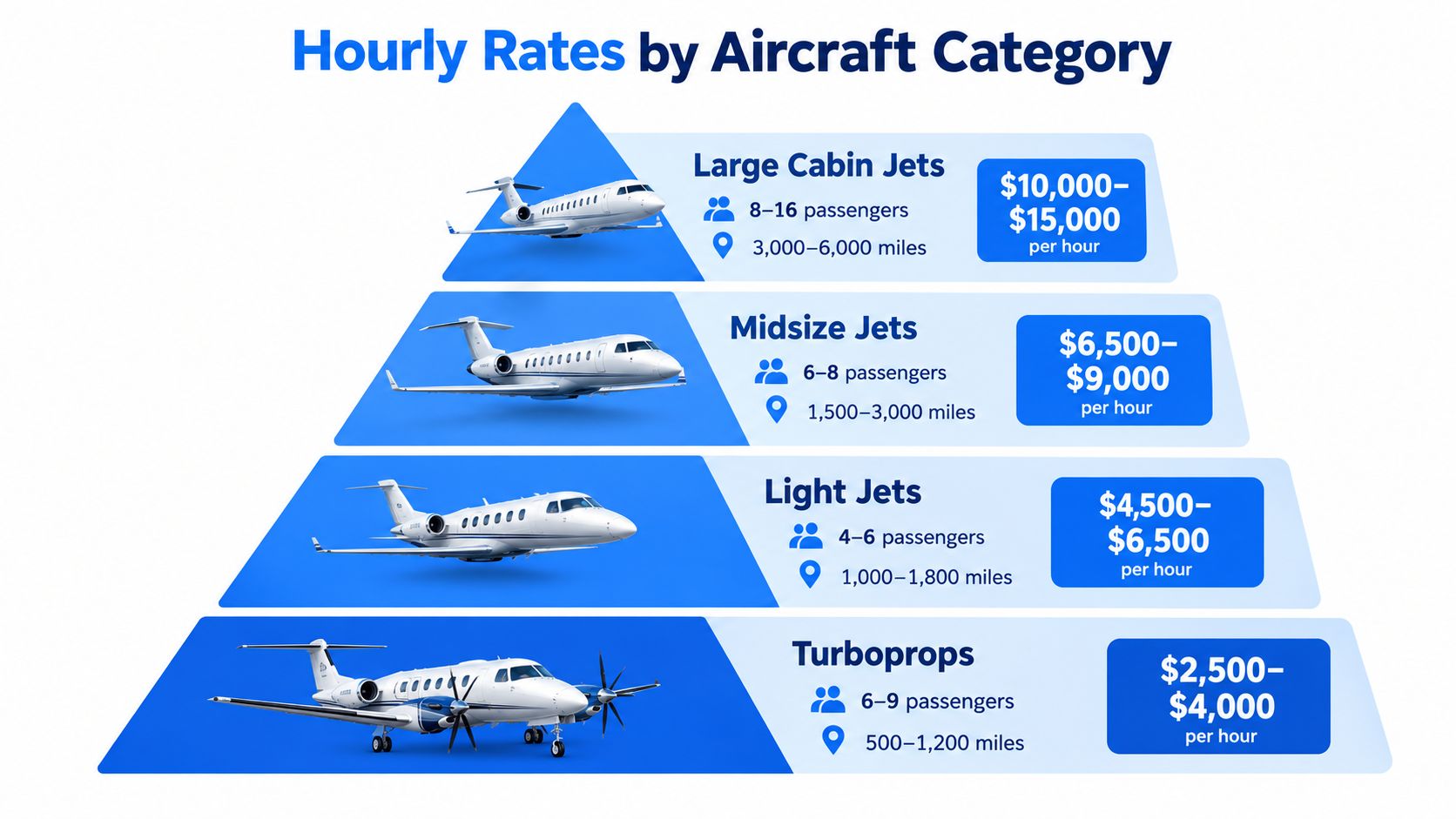
A category isn't just a comfort label. It determines fuel burn, crew staffing, runway performance, range, and the number of airports that can handle the aircraft. A large jet may be wasteful for a short domestic hop, while a light jet may lack the range or payload needed for a nonstop international mission.
The choice should follow the mission profile:
- Short regional travel: A turboprop or very light jet may provide the necessary access without paying for long-range capability.
- Domestic business routes: A light or midsize aircraft may balance cabin capacity, range, and operating cost.
- International nonstop travel: A heavy or ultra-long-range jet may be necessary, even though the hourly rate is several times higher.
For longer missions, the aircraft's capability can reduce operational complexity by avoiding an additional stop. The relevant comparison isn't the cheapest hourly rate. It is the cost of completing the required mission with the right payload, range, baggage capacity, and schedule. For a closer look at the aircraft used for extended missions, see long-range aircraft.
The Hidden Line Items on a Charter Invoice
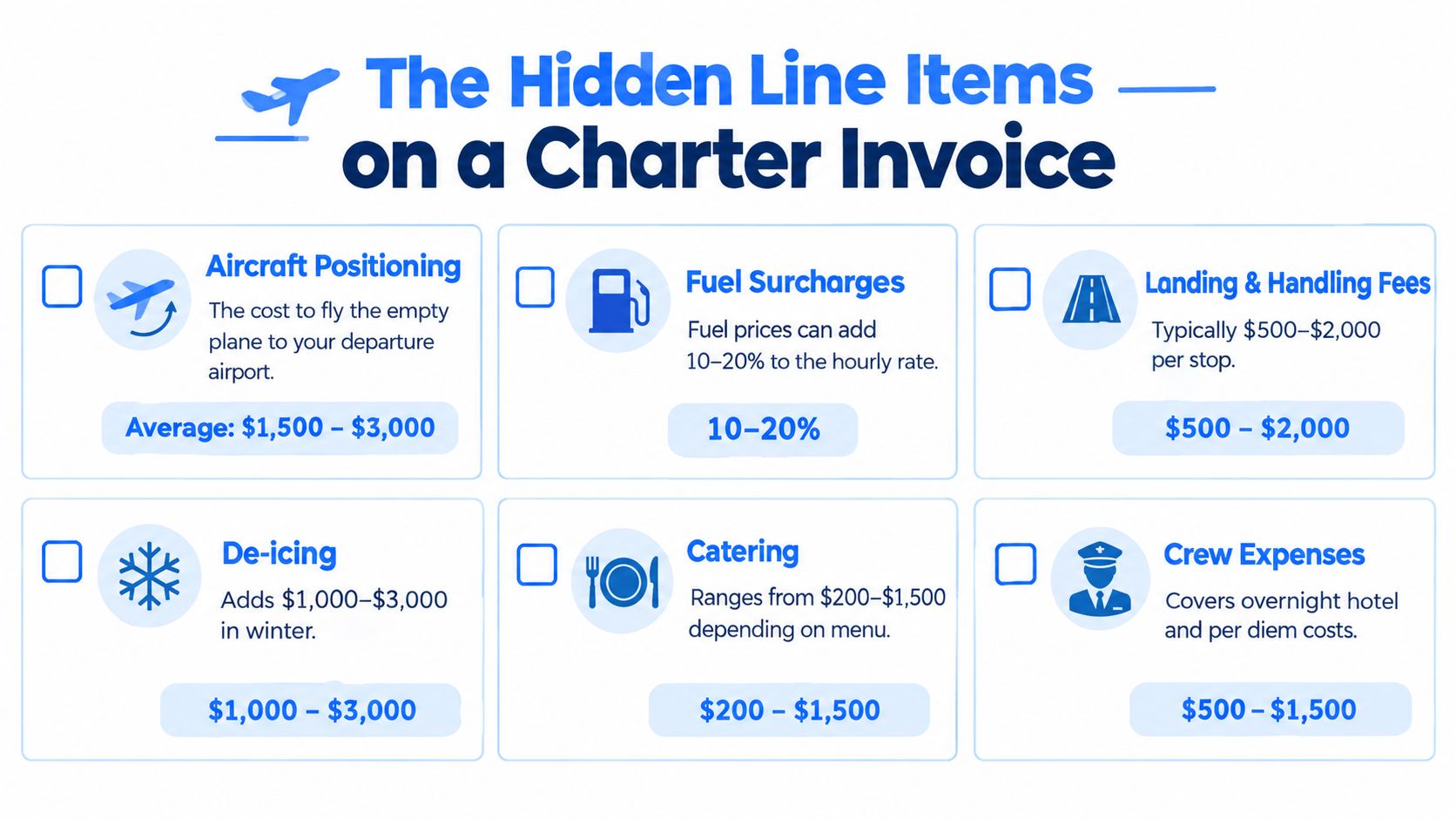
A charter proposal should be read like an expense report. The flight-time line is only the starting point, and every adjacent line can reveal an assumption that changes the final private jet travel cost.
Positioning and airport charges
Aircraft positioning, sometimes called empty-leg-in, covers the aircraft's movement to your departure airport and possibly its return afterward. If the chosen aircraft isn't already nearby, those ferry hours can appear as a separate charge or be embedded in the total. Ask which legs are passenger-carrying and which are repositioning flights.
Landing and FBO handling fees vary by airport. A congested business aviation airport may carry different handling and parking economics from a regional field. The quote should identify each stop, the expected handling treatment, and whether extended ground time creates additional charges.
Crew overnight expenses apply when the crew must remain away from base. Multi-day itineraries may also create hotel, per diem, parking, and aircraft storage costs. Winter missions can add de-icing, while cross-border trips may require international handling, customs paperwork, permits, and overflight coordination.
Taxes and related services
The U.S. federal air transportation excise tax is generally 7.5% for taxable private-charter transportation. The taxable base can include related air-transportation services, including layover charges and associated pilot and crew expenses, not only airborne time. IRS guidance on air transportation explains why the tax base deserves its own line-by-line review.
Consider the IRS-style example. If a domestic charter includes $40,000 for flight time and $5,000 in taxable layover and related transportation services, the taxable base is $45,000. Applying 7.5% produces $3,375 in federal excise tax before other applicable charges.
Other lines may include:
- Fuel adjustments: A contract may allow the operator to pass through higher fuel costs after booking.
- Catering: Menus, special meals, and larger quantities may sit outside the base quote.
- Ground transfers: A private aircraft doesn't automatically include the vehicle that takes passengers to the final destination.
- International services: Customs, permits, overflight administration, and handling can become material on cross-border routes.
The invoice should make clear whether each item is fixed, estimated, or subject to change. A low hourly rate with unbounded fuel or positioning language isn't necessarily a low-cost quote.
Charter, Jet Card, Fractional, and Full Ownership
Private aviation has four different cost structures, and the right one depends on usage, predictability, and how much operational responsibility the traveler wants to assume.
On-demand charter has the lowest commitment. You pay for a specific mission, retain flexibility over aircraft selection, and accept that availability and spot pricing can change. It usually suits irregular travel, changing passenger groups, and routes that don't justify a standing program.
Jet cards use prepaid hours or a defined program structure. They can make rates and booking procedures more predictable, but the traveler trades some trip-by-trip shopping flexibility for program terms. Fuel adjustments, peak-period rules, aircraft categories, and expiration provisions still require review.
Fractional ownership assigns the traveler an interest in an aircraft or managed fleet. The model can provide more consistent access, but it adds acquisition, management, and operating obligations. The FAA's economic-value data reports average total aircraft operating costs of about $1,600 per hour across analyzed aircraft groups, with results ranging from approximately $490 to more than $5,900 per hour depending on size, complexity, and age. FAA aircraft operating-cost data illustrates why ownership economics can't be inferred from a charter quote alone.
| Model | Commitment | Typical Cost Lever | Best Fit |
|---|---|---|---|
| On-demand charter | None beyond the trip | Aircraft choice, positioning, and market quote | Irregular or changing travel |
| Jet card | Prepaid program commitment | Defined rates, availability terms, and fuel provisions | Frequent travelers seeking predictability |
| Fractional ownership | Multiyear ownership interest | Acquisition, management, and occupied-hour costs | Consistent usage and aircraft access |
| Full ownership | Long-term asset and operating responsibility | Crew, hangar, insurance, maintenance, and utilization | Very high, predictable annual use |
Full ownership fixes access around a dedicated asset, but fixed expenses continue whether the aircraft flies or sits. As a practical rule, under roughly 50 hours a year, charter often wins; between 50 and 200 hours, jet cards or fractional arrangements deserve closer analysis; above 200 hours, ownership can begin to pencil. Those thresholds are decision rules, not guarantees, because route mix and aircraft type can change the result.
For corporate groups that need coordinated ground movement as well as aviation, comparing corporate event transport options can prevent the air quote from being evaluated in isolation. A detailed discussion of ownership economics is also available in how much private jets cost to own.
Sample Itineraries and the All-in Number
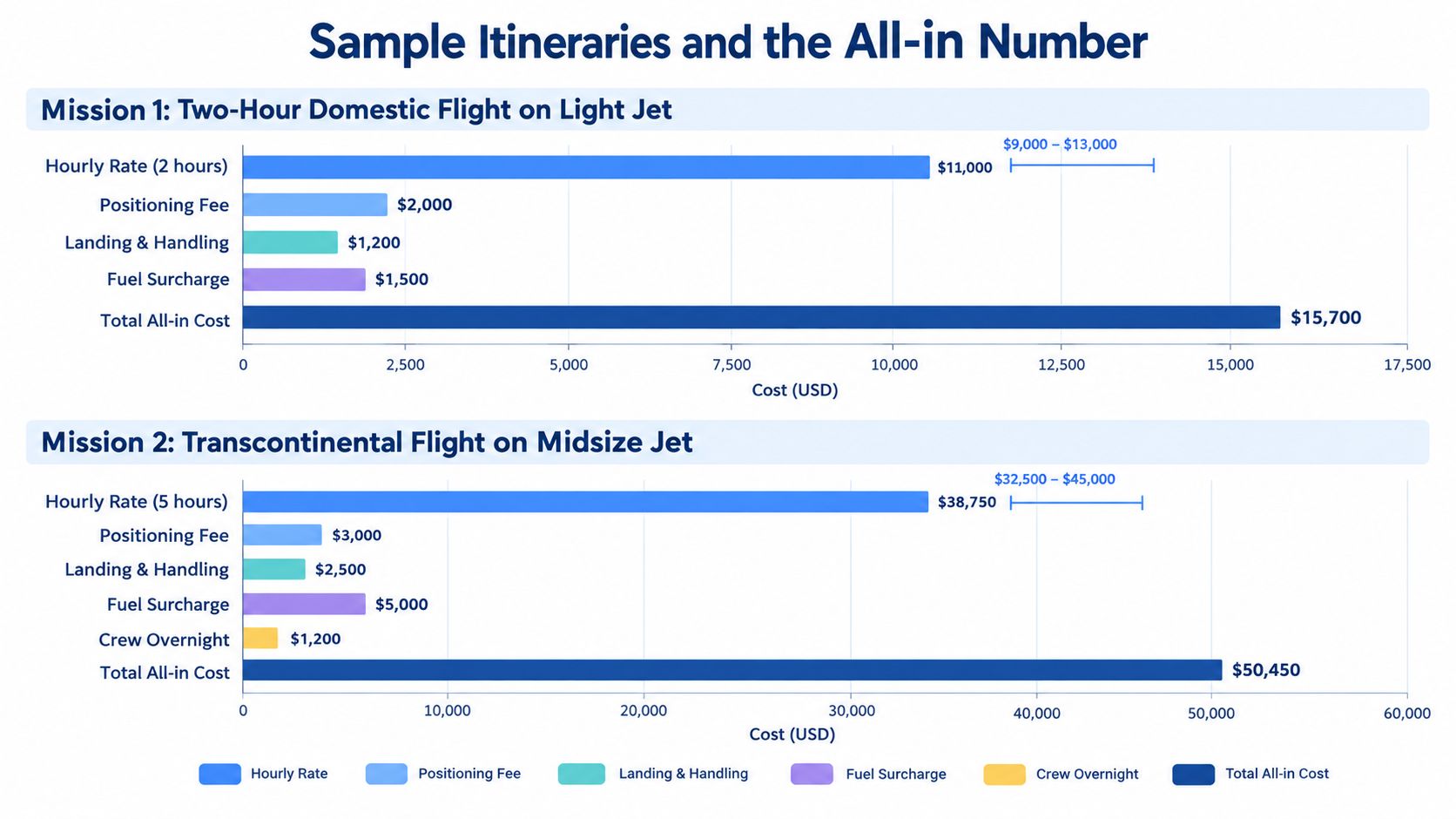
The most reliable way to test a quote is to convert it from hourly language into a mission total. Start with billable flight time, then add the costs that the proposal either itemizes or leaves subject to confirmation.
Two-hour domestic light jet
A light jet priced at $4,500–$6,500 per hour produces a base flight-time charge of approximately $9,000–$13,000 for two hours. After federal excise tax, handling, landing, crew, and other standard fees, the estimated total can rise to approximately $11,000–$15,000. The range isn't a contradiction. It reflects differences in aircraft positioning, airports, crew requirements, and quote assumptions.
Four-hour heavy jet
A heavy jet at $10,000 per hour produces about $40,000 in base flight-time charges for a four-hour mission. Applying a 20%–40% allowance for additional costs implies a potential total of approximately $48,000–$56,000. A quote near the lower end needs clear assumptions about positioning, airport charges, crew time, and fuel exposure.
Passenger-based taxes matter too. A domestic segment charge is assessed for each passenger on each taxable segment. A four-passenger itinerary with two domestic segments creates eight passenger-segment units. At $5.30 per unit, that adds $42.40, separate from the percentage excise tax. IRS Form 720 instructions explains the segment calculation.
For an applicable international itinerary beginning in the United States, the reported international facilities tax is $23.40 per passenger. Six passengers would therefore add $140.40 before the percentage excise tax, airport costs, handling, crew expenses, and other mission charges. IRS legal guidance on international facilities taxes provides the relevant tax framework.
Empty Legs, Memberships, and the Schedule Trade-off
An empty leg can be dramatically cheaper, but the discount is compensation for reduced control. Market coverage reports discounts of roughly 50%–75% below standard on-demand rates, while another industry summary cites a range of 40%–75%. Recent coverage of empty-leg pricing and trade-offs shows why the advertised saving shouldn't be treated like a normal fare reduction.
The aircraft is already moving to another location, so the traveler inherits constraints on the route, departure time, aircraft, and return availability. You may be able to select one or two of those variables, but rarely all of them independently. If a meeting moves, a connection is missed, or the return becomes necessary, the replacement cost can erase the original saving through a new charter, accommodation, ground transport, or lost productivity.
An empty leg is not a cheaper version of a fully flexible charter. It is a different product with a narrower operating envelope.
Assign a value to reliability before accepting the discount. Executives with immovable meetings, medical movements, sports teams, and families carrying complex baggage may need a flexible on-demand option even when the empty leg looks attractive. The relevant comparison is the empty-leg price plus the financial consequence of schedule failure.
There is also an environmental qualification. An empty leg can monetize an aircraft movement that would otherwise occur without passengers, but that doesn't make private aviation low-emission. Research cited in the same market coverage finds private jets can be 5–14 times more polluting per passenger than commercial aviation.
Jet cards and memberships occupy the middle ground. They can reduce repeated sourcing work and offer more predictable terms, but travelers should inspect whether the program passes through fuel changes, includes positioning, or restricts availability during peak demand. The right question is not whether a membership sounds cheaper. It is whether the added predictability matches the cost of the traveler's schedule.
For a focused look at the operational trade-offs, review private jet charter empty legs.
A Quote Audit Checklist and How Approved Jets Optimizes Spend
A quote audit should take place before anyone compares the final totals. Five checks expose most of the gaps between a headline rate and a usable budget.
- Confirm the aircraft category and hourly rate. Check that the proposed aircraft can carry the passengers, baggage, and required fuel load. A lower category rate is irrelevant if it forces a stop or can't meet the mission.
- Request an itemized all-in total. The proposal should separate flight time, positioning, handling, landing, crew, taxes, catering, transfers, and any estimate that remains open. Ask how long the price remains valid.
- Read the fuel-adjustment clause. Fuel-variable language can allow higher costs after booking. The quote should identify the adjustment formula, trigger, and contract treatment.
- Verify positioning assumptions. Ask where the aircraft is based, which legs are ferry movements, and whether those legs are already included. A nominally cheaper aircraft can become more expensive after repositioning.
- Check cancellation and rescheduling terms. A low price with severe change penalties may be unsuitable for executive, medical, sports, or family travel.
Recent reporting notes that fuel-driven increases have reached as much as 20% during periods of sharp price escalation, making the adjustment clause a financial term rather than boilerplate. Reporting on private-charter fuel clauses and rising costs also highlights why corporate travel managers should compare mission-specific totals instead of hourly rates.
A broker can compress this process by matching the aircraft to the route, checking operator availability, and presenting the cost assumptions in one conversation. Approved Jets arranges on-demand charter and integrated travel logistics through a vetted operator network, with transparent quoting aligned to the mission profile, door-to-door coordination, and a stated two-hour quote turnaround target. That operating model is useful when the objective is not merely to find an aircraft, but to identify which line items can be removed, fixed, or priced more clearly.
The savings usually come from choices rather than negotiation theater. A nearby aircraft can reduce positioning, a better airport can reduce handling friction, a suitable smaller category can lower fuel burn, and a flexible schedule can open more operational options. The broker's role is to expose those levers before the traveler commits.
Key Takeaways and Private Jet Cost FAQs
Three rules should govern every charter conversation:
- Compare the total trip cost, not the hourly rate.
- Demand a validity period and a clear fuel-adjustment formula.
- Use broker-led sourcing when aircraft positioning, taxes, crew, and ground logistics make direct comparison difficult.
How do domestic passenger segment fees work?
The domestic segment charge is assessed per passenger for each taxable segment, where a segment generally represents one takeoff and landing. A four-passenger itinerary with two domestic segments creates eight passenger-segment units, and the cited charge is $5.30 per unit, or $42.40 in that example. It sits alongside the 7.5% federal excise tax, not inside it.
When does the international facilities tax apply?
An applicable international itinerary that begins or ends in the United States can trigger an international travel-facilities tax. The reported inflation-adjusted amount is $23.40 per passenger, before the percentage excise tax and operational charges.
What should a 2026 budget look like?
For a single round-trip charter, begin with the aircraft category and mission hours, then add positioning, taxes, airport charges, crew, and fuel exposure. A recurring corporate program deserves a different analysis because predictable demand may justify a jet card, negotiated program, or fractional structure. No single 2026 budget is defensible without the route, aircraft, passenger count, schedule, and quote assumptions.
Which signals indicate missing line items?
A quote is incomplete when it shows only an hourly rate, omits the aircraft's positioning origin, provides no tax treatment, leaves fuel adjustments undefined, or fails to state cancellation terms. Vague language around “standard fees” is another reason to request an itemized total before approving travel.
Approved Jets arranges on-demand private charters and integrated travel logistics, including aircraft matching, ground coordination, and quote review against the mission profile. Visit Approved Jets to request a trip-specific proposal that shows the all-in cost assumptions before you commit.