

Air Ambulance Cost: Pricing, Drivers, and How to Save
Understand air ambulance cost with clear pricing ranges, key cost drivers, insurance rules, and practical ways to reduce your bill when a medevac is needed.

Approved Jets

On this page
- Table of Contents
- What Air Ambulance Cost Looks Like in Real Numbers
- The Cost Drivers That Shape Every Quote
- Aircraft and distance
- Clinical team and equipment
- Helicopter, Fixed-Wing, and Commercial Stretcher Compared
- How the Mission Is Procured From Inquiry to Wheels-Up
- The operational sequence
- Insurance, Billing Rules, and Your Real Out-of-Pocket Bill
- Practical Ways to Reduce an Air Ambulance Bill
- Approved Jets Approach and Next Steps
- What a coordinated mission includes
U.S. air ambulance charges commonly fall between $25,000 and $80,000 for helicopter transport and $18,000 to $60,000 for fixed-wing transport. International or uninsured evacuations can range from $20,000 to over $200,000, depending on mission complexity.
Those figures describe the transport charge, not necessarily what the patient pays. The provider may bill an insurer, the insurer may apply its own allowed amount, and the patient may owe a deductible or coinsurance. In an emergency, the fastest way to control the financial risk is to separate three questions: What does the mission cost? What will insurance cover? What amount can legally and practically reach the patient?
Table of Contents
- What Air Ambulance Cost Looks Like in Real Numbers
- The Cost Drivers That Shape Every Quote
- Helicopter, Fixed-Wing, and Commercial Stretcher Compared
- How the Mission Is Procured From Inquiry to Wheels-Up
- Insurance, Billing Rules, and Your Real Out-of-Pocket Bill
- Practical Ways to Reduce an Air Ambulance Bill
- Approved Jets Approach and Next Steps
What Air Ambulance Cost Looks Like in Real Numbers
A U.S. helicopter mission typically falls between $25,000 and $80,000, while a domestic fixed-wing flight commonly ranges from $18,000 to $60,000, according to current air ambulance cost ranges. Those bands are broad because “air ambulance” covers very different operations, from a short rotor-wing transfer between hospitals to an international ICU-configured jet with multiple ground legs.
A cross-border example makes the difference clear. Consider a cardiac patient moving from Cancun to Miami on a dedicated Learjet with a two-person medical team. The aircraft must be positioned, the patient must be transferred from the departure hospital to the airport, and the receiving hospital must accept the patient before departure. Medical equipment, flight permissions, customs coordination, crew time, and return positioning all influence the quote. A stable patient with straightforward airport access may sit toward the lower end of the fixed-wing range. A patient requiring advanced monitoring, additional clinical staff, or complex ground handling can move substantially higher.
The international ceiling is higher still. Uninsured international evacuations can reach $20,000 to more than $200,000, particularly when long distance, aircraft positioning, specialized care, and cross-border logistics combine, as documented in the HHS ASPE air ambulance briefing.
| Mission Type | Typical Cost Range (USD) | Common Use Case | Key Variables |
|---|---|---|---|
| Helicopter transport | $25,000–$80,000 | Scene response or short hospital transfer | Distance, aircraft availability, clinical acuity, landing access |
| Domestic fixed-wing | $18,000–$60,000 | Long-distance or regional hospital transfer | Aircraft, flight time, crew, airport and ground logistics |
| International evacuation | $20,000–$200,000+ | Repatriation or cross-border medical transfer | Aircraft positioning, permits, staffing, customs, distance |
| Uninsured complex evacuation | Can exceed $200,000 | Long-range or highly specialized mission | ICU support, aircraft range, routing, international coordination |
The quoted transport price still isn't the patient's final bill. A useful primer on new healthcare transparency laws can help families understand why provider charges, insurer payments, and patient responsibility don't always match.
The Cost Drivers That Shape Every Quote
Flight time matters, but it isn't the whole air ambulance cost. A coordinator prices the mission as a chain of aircraft, people, equipment, airports, and transfers. The Health Cost Institute's analysis of air ambulance pricing found that mileage accounted for 35% of helicopter trip cost and 68% of plane trip cost in 2017, showing why routing can matter as much as the aircraft itself.
Aircraft and distance
Aircraft selection sets the starting point. A helicopter solves runway problems but usually carries a high cost for each mile. A turboprop may suit a regional route with smaller airports, while a light jet or larger ICU-configured aircraft may be necessary for longer sectors, pressurized cabin requirements, or more equipment.
Distance multiplies more than fuel. It increases crew duty time, aircraft utilization, medical staffing time, and the chance that a fuel stop or positioning leg will be required. The HCI data also recorded a wide 2017 range for plane transports, from $6,642 at the 10th percentile to $79,350 at the 90th percentile, which illustrates why a single “average price” is a poor procurement tool.
Clinical team and equipment
A paramedic-led transfer is different from a mission requiring a critical-care nurse, physician, neonatal specialist, or advanced life-support equipment. Ventilation, infusion pumps, monitoring, oxygen, and specialty devices add both equipment and staffing requirements. The patient's stability determines whether a commercial option is possible or whether a dedicated medical aircraft is mandatory.
Ground ambulances at both ends can add meaningful cost, especially when the airports are distant from the hospitals or the patient needs a coordinated bed-to-bed transfer. International missions also require permits, customs, immigration, hospital coordination, and controlled-medication documentation.
Practical rule: Ask for an itemized quote that separates aircraft, medical team, equipment, airport handling, positioning, and ground legs. A low headline price can conceal missing services.
Urgency affects procurement. An aircraft available immediately may require repositioning, while an after-hours departure can involve additional coordination and crew expenses. For a hypothetical 1,200-nautical-mile King Air repatriation with a critical-care nurse and paramedic, each operational category can add roughly $2,000 to $15,000 to the base aircraft charter. That range is a planning illustration, not a universal tariff. Two quotes for the same patient can differ by 30% to 60% when operators make different choices about aircraft, staffing, positioning, and ground handling.

Helicopter, Fixed-Wing, and Commercial Stretcher Compared
The right transport category depends on patient condition, distance, and airport access, not on the family's preferred aircraft. A helicopter can reach a scene, rooftop helipad, or rural hospital without relying on a runway. That flexibility makes rotor-wing transport valuable for short, urgent transfers, even though the cost per mile is often high.
Dedicated fixed-wing aircraft become more practical as distance increases. They can carry stretchers, infusion pumps, oxygen systems, and medical teams over longer routes, then use regional airports near the receiving hospital. Airport access remains important. A patient may need ground transfers at both ends if the aircraft can't land directly at the hospitals.
Commercial medical escort is different. A stable, seated patient may fly on a scheduled airline with a nurse or paramedic, avoiding the cost of a dedicated aircraft. Commercial stretcher service, sometimes called airline stretcher service, reserves several rows and installs a stretcher with a medical team. It's less expensive than a dedicated medevac, but airlines and medical coordinators will accept it only when the patient's condition is sufficiently stable.
For aircraft categories and cabin considerations, this aircraft reference provides useful background, but aircraft choice for a medical mission must follow the clinical and routing requirements.
| Mode | Typical Distance | Patient Condition | Airport Access | Relative Cost |
|---|---|---|---|---|
| Helicopter | Short regional or scene transfers | Emergency or unstable patients | Can operate from helipads and limited sites | Highest cost per mile |
| Fixed-wing medevac | Longer domestic or international routes | Stable to critical, depending on configuration | Requires suitable airports and ground transfers | High, but efficient over distance |
| Commercial stretcher | Longer scheduled-airline routes | Stable stretcher-bound patients | Requires airline approval and suitable airports | Lower than dedicated medevac |
| Medical escort | Commercial airline route | Stable seated patients | Uses normal airline airports | Usually the lowest air option |
A simple decision rule works in practice: condition chooses the medical platform, distance chooses the aircraft category, and airport access determines the ground plan. Price comes after those three decisions. Trying to force a cheaper mode before confirming medical suitability can create delays, denied boarding, or an unsafe transfer.
How the Mission Is Procured From Inquiry to Wheels-Up
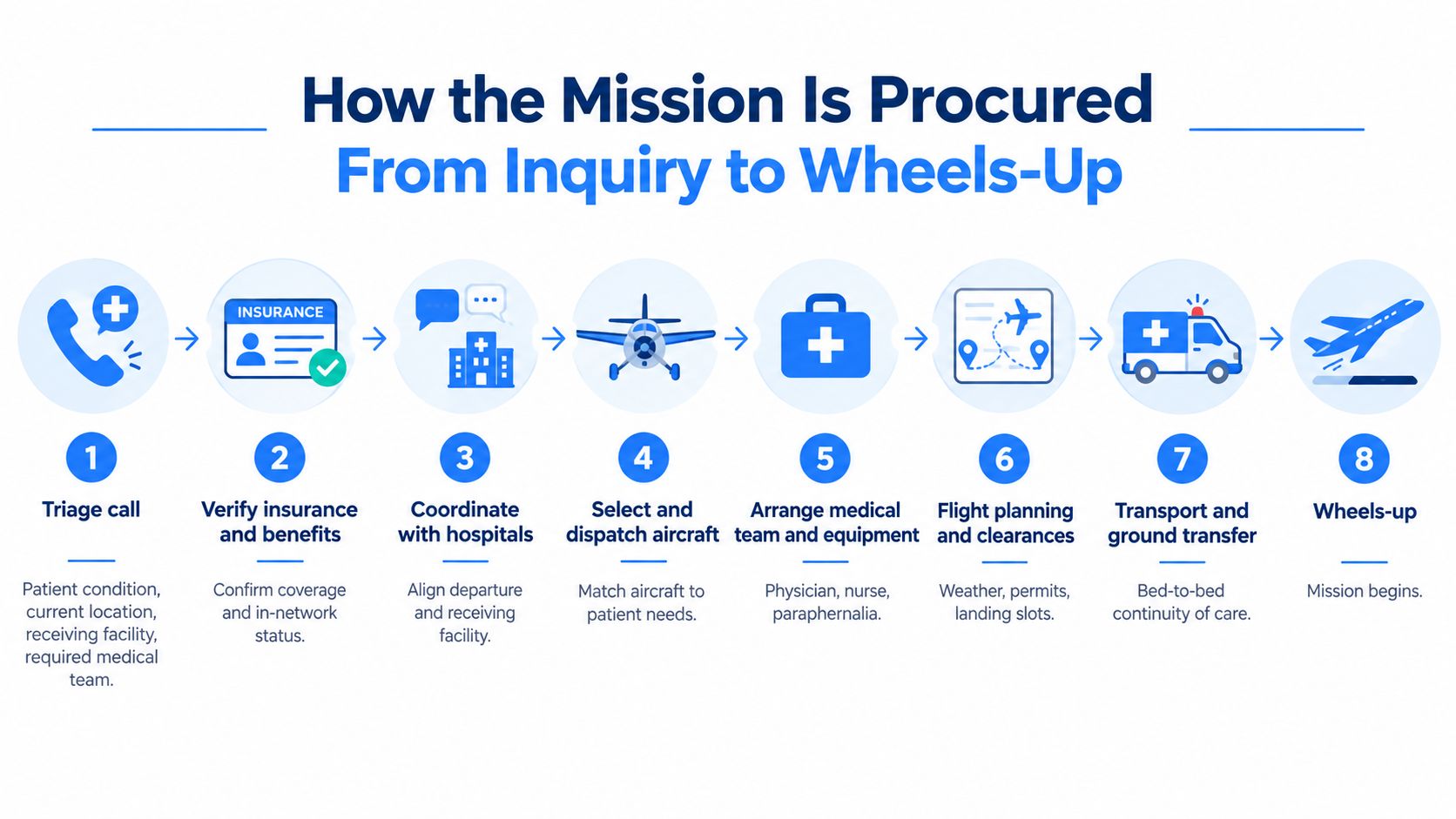
A professional broker starts with triage, not aircraft shopping. During the initial call, the coordinator records the patient's condition, current location, destination hospital, mobility, oxygen or monitoring needs, and the medical team required. That information supports a preliminary option and a verbal quote range.
The operational sequence
- Triage call: The coordinator gathers clinical and logistical facts from the family, hospital, or assistance company.
- Insurance review: The team checks the plan, benefits, authorization requirements, and network questions.
- Hospital coordination: The departure and receiving facilities confirm transfer timing, bed availability, and handover responsibility.
- Aircraft selection: The operator matches aircraft range, cabin space, equipment, and airport access to the patient.
- Medical staffing: The coordinator assigns the appropriate nurse, paramedic, physician, or specialty team.
- Flight planning: The team manages weather, permits, airport slots, fuel planning, and international clearances.
- Ground transfer: Ambulances connect the patient's bedside to the aircraft and the destination airport to the receiving hospital.
- Wheels-up: After confirmation, deposit, crew briefing, and final clearances, the mission begins.
A verbal range should become a firm written quote only after medical records are reviewed. The coordinator normally needs a fit-to-fly letter, treating physician sign-off, patient identification, and receiving-facility acceptance. International legs add passports, visas where applicable, customs pre-clearance, and documentation for controlled medications.
Ask one operational question: “What still has to happen before this aircraft can depart?” The answer exposes hidden dependencies such as a missing hospital acceptance, airport slot, permit, or medical clearance.
Urgent domestic missions may move from confirmation to departure within 4 to 8 hours, depending on aircraft availability, patient readiness, weather, and airport operations. Cross-border flights can take longer because permits, customs, immigration, and receiving-country coordination must align. The quote isn't complete until the entire bedside-to-bedside chain is workable.
Insurance, Billing Rules, and Your Real Out-of-Pocket Bill
The headline charge is not the same as the patient liability. A provider may submit a claim for its full charge, an insurer may calculate an allowed amount, and the plan may apply deductible and coinsurance rules. The patient's final bill depends on coverage, network status, benefit design, medical necessity, and the protections that apply to the plan.
The National Association of Insurance Commissioners' air ambulance guidance places the median U.S. claim around $36,000 to $40,000, but that figure still doesn't tell a family what it will owe. Before federal protections, out-of-network air ambulance cases frequently produced balance bills ranging from $10,000 to more than $50,000.
The No Surprises Act protects patients in covered commercial and self-funded employer plans from balance billing by out-of-network air ambulance providers. It does not erase deductibles or coinsurance, and coverage rules can differ for other plan types, uninsured patients, international patients, and services that fall outside the protected benefit. The practical question is therefore not merely whether insurance “covers” the flight. It is whether the insurer will adjudicate the claim, what cost-sharing applies, and whether a provider can lawfully pursue an additional balance.
| Scenario | Insurer Pays | Patient Owes |
|---|---|---|
| Covered emergency transport under applicable protections | The plan's allowed amount under its rules | Deductible and coinsurance, if applicable |
| Covered transport with remaining deductible | The covered amount after plan processing | The applicable deductible plus coinsurance |
| Uninsured domestic mission | Nothing unless another assistance source applies | The agreed transport charge |
| International mission with limited coverage | The amount approved by the policy | Any uncovered balance under the contract |
| Historically out-of-network balance bill | The insurer's payment or allowed amount | Cost-sharing and potentially the prohibited balance, subject to current protections |
A hypothetical $50,000 flight could produce a $3,500 patient bill under one plan design or a $50,000 obligation for an uninsured patient. Those are not contradictory prices. They're different points in the billing chain.
Families planning travel should find the best evacuation insurance before an emergency, then confirm exclusions, pre-existing-condition rules, destinations, and repatriation terms. Never assume a travel policy replaces health insurance or that a health plan covers international transport without specific confirmation.
Practical Ways to Reduce an Air Ambulance Bill
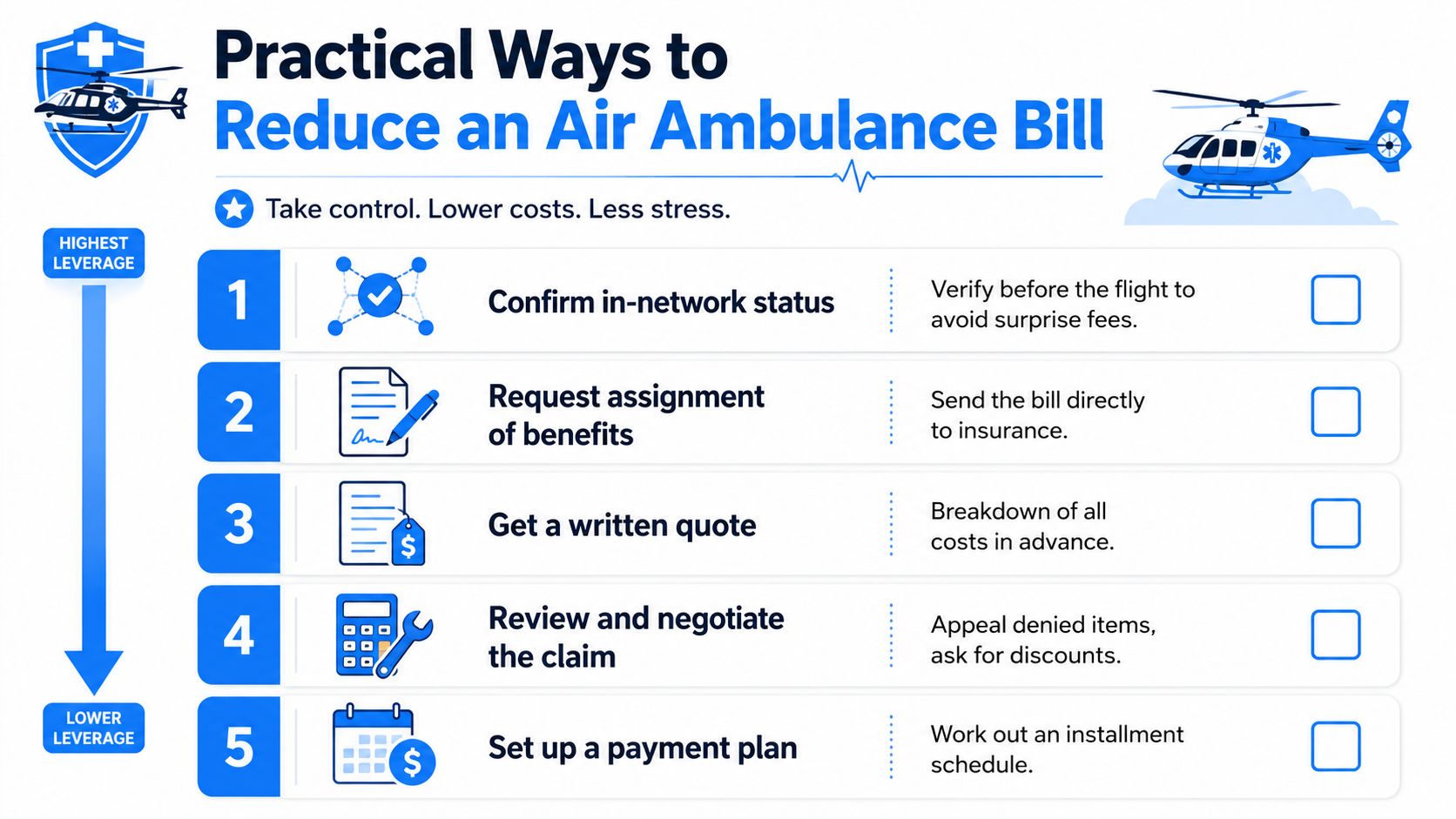
The best savings usually occur before the aircraft moves. Once the patient is airborne, negotiating power narrows and operational costs are already committed.
- Confirm network and benefits first. Call the insurer and ask whether the transport provider, aircraft operator, and medical service are covered. Request the answer in writing when time allows.
- Request assignment of benefits. This lets the provider submit the claim directly to insurance rather than requiring the family to pay the full charge first.
- Demand an itemized written quote. The document should separate aircraft time, medical staffing, equipment, positioning, airport handling, and ground ambulance legs.
- Test lower-cost medically suitable options. Ask the treating physician whether a ground ambulance, commercial medical escort, or commercial stretcher is clinically appropriate. Don't choose a cheaper platform if it compromises care.
- Document medical necessity. Keep the fit-to-fly letter, hospital records, physician notes, crew notes, flight record, and every invoice.
Membership programs such as Air Ambulance Card or Medjet can cap member fees for eligible situations, but travelers must read exclusions carefully. Pre-existing conditions may be excluded, and membership terms don't automatically guarantee transport for every diagnosis or location.
During procurement, decline non-essential upgrades and ask whether the aircraft must be positioned from another city. After the mission, file the claim within the plan deadline, appeal denied items with medical records, and challenge improper balance billing through the applicable No Surprises Act process. A guide to lower-cost private jet charter options may help with general charter planning, but medical suitability remains the controlling factor.
The most useful habit: Make one insurer call before wheels-up. Confirm benefits, authorization, network status, claim routing, and the patient's likely cost-sharing.
Approved Jets Approach and Next Steps
A credible medevac quote is an operational document, not just a number. The coordinator must know where the aircraft is, whether it can carry the patient's equipment, which medical team can staff the mission, whether the airports can accept the flight, and how the patient will move from bedside to bedside.
Approved Jets uses a 24/7 coordination desk, in-house medical crew sourcing, and pre-positioned aircraft partnerships to reduce common delays. Those capabilities can limit repositioning charges, last-minute medical staffing premiums, and customs problems, although the final quote still depends on the patient, route, aircraft, and availability.
The expected turnaround is commonly 4 to 8 hours for domestic missions and 12 to 24 hours for international missions, subject to medical readiness, aircraft availability, permits, weather, and airport operations. The fixed-wing categories include light, midsize, and long-range ICU-configured jets, allowing the aircraft to match the route and clinical requirements rather than forcing every patient into the same platform.
What a coordinated mission includes
The strongest value comes from consolidation. One team can coordinate the ground ambulance, aircraft, flight medical crew, departure hospital, receiving hospital, family travel, customs paperwork, and handover. That reduces the chance that a family must manage separate vendors while also handling a medical crisis.
Transparent quoting matters just as much. An itemized estimate should separate:
- Aircraft hours: The flying and operational time assigned to the aircraft.
- Mileage or routing: The distance, loaded miles, fuel requirements, and positioning legs.
- Medical team days: The time and composition of the clinical crew.
- Equipment: The monitoring, oxygen, ventilation, infusion, or specialty equipment required.
- Ground legs: The ambulances and transfers at departure and arrival.
- International handling: Permits, customs, immigration, airport coordination, and related services.
| Capability | Standard Offering | Patient Impact |
|---|---|---|
| 24/7 coordination | Continuous mission oversight | Faster decisions during urgent situations |
| Aircraft sourcing | Light, midsize, and long-range ICU-configured jets | Better match between cabin, range, and care level |
| Medical staffing | Coordinated flight medical teams | Appropriate clinical support throughout transfer |
| Bedside-to-bedside logistics | Ground ambulance, flight, and hospital handover | Fewer gaps between facilities |
| Itemized estimates | Separate aircraft, medical, equipment, and ground costs | Clearer financial exposure |
| International coordination | Permits, customs, immigration, and receiving-facility planning | Fewer cross-border delays |
The most useful request is a mission-specific estimate, not a generic air ambulance cost range. Submit the patient's current location, destination hospital, medical summary, mobility status, oxygen or equipment needs, and insurance details through the Approved Jets quote request. A coordinator can then determine the medically appropriate platform, identify the actual cost drivers, and explain which portion may reach the patient after insurance processing.
Approved Jets coordinates medical evacuation and repatriation with aircraft sourcing, medical teams, ground transfers, hospital handover, and international logistics under one managed plan. Visit Approved Jets with the patient's location, destination, medical summary, and insurance details to request a mission-specific estimate and clarify the transport cost before departure.