

Private Jet Charter Houston: How It Actually Works
A practical guide to private jet charter Houston, covering airports, aircraft, costs, safety checks, and how to book the right flight for any mission.

Approved Jets

On this page
- Table of Contents
- How Private Jet Charter in Houston Actually Works
- Start with the whole journey
- Choosing Between Houston Hobby, Bush Intercontinental, and the Reliever Airports
- Houston-area airports for private jet charter
- Matching Aircraft to the Mission Rather Than the Headcount
- Aircraft class matched to mission
- The Part 135 Safety Checklist You Should Actually Use
- Request an identifiable operating file
- From Quote to Wheels Up - Booking Logistics for a Houston Departure
- Ask for milestones, not a stopwatch
- Finish the destination arrangements
- What a Houston Charter Actually Costs and Why Quotes Vary
- Put competing quotes on the same basis
- Understand what happens between passenger flights
- Real Houston Charter Scenarios for Business, Group, and Sensitive Missions
- Westchase office to White Plains
- College sports team with equipment
- Medical evacuation or sensitive cargo
- Your Houston Charter Pre-Flight Checklist and Common Questions
- Keep this approval list
- Questions worth asking before you pay
Your morning meeting has moved to White Plains, your team is still in Houston, and you need to be home tonight. You're looking at aircraft photos when someone asks the question that should have come first: which airport gets everyone there fastest, starting from the office rather than the runway?
For private jet charter in Houston, that's the right starting point. My recommendation is simple: choose the airport and operating plan before you fall in love with a cabin. A beautiful aircraft at the wrong field can be a poor travel decision.
Table of Contents
- How Private Jet Charter in Houston Actually Works
- Choosing Between Houston Hobby, Bush Intercontinental, and the Reliever Airports
- Matching Aircraft to the Mission Rather Than the Headcount
- The Part 135 Safety Checklist You Should Actually Use
- From Quote to Wheels Up - Booking Logistics for a Houston Departure
- What a Houston Charter Actually Costs and Why Quotes Vary
- Real Houston Charter Scenarios for Business, Group, and Sensitive Missions
- Your Houston Charter Pre-Flight Checklist and Common Questions
How Private Jet Charter in Houston Actually Works
Consider a same-day Houston-to-White Plains request. Before recommending an aircraft, I'd want the office pickup address, meeting location, required arrival time, return flexibility, passenger details, and baggage description. Those answers define the mission; a preferred jet model doesn't.
The broker coordinates the choices and commercial arrangements. The operating carrier determines whether it can legally and operationally perform the flight. Keep those responsibilities separate, especially when a fast-moving request makes every option look provisional.
Start with the whole journey
Use this booking sequence as a decision map, not a promise that every task happens neatly in order.
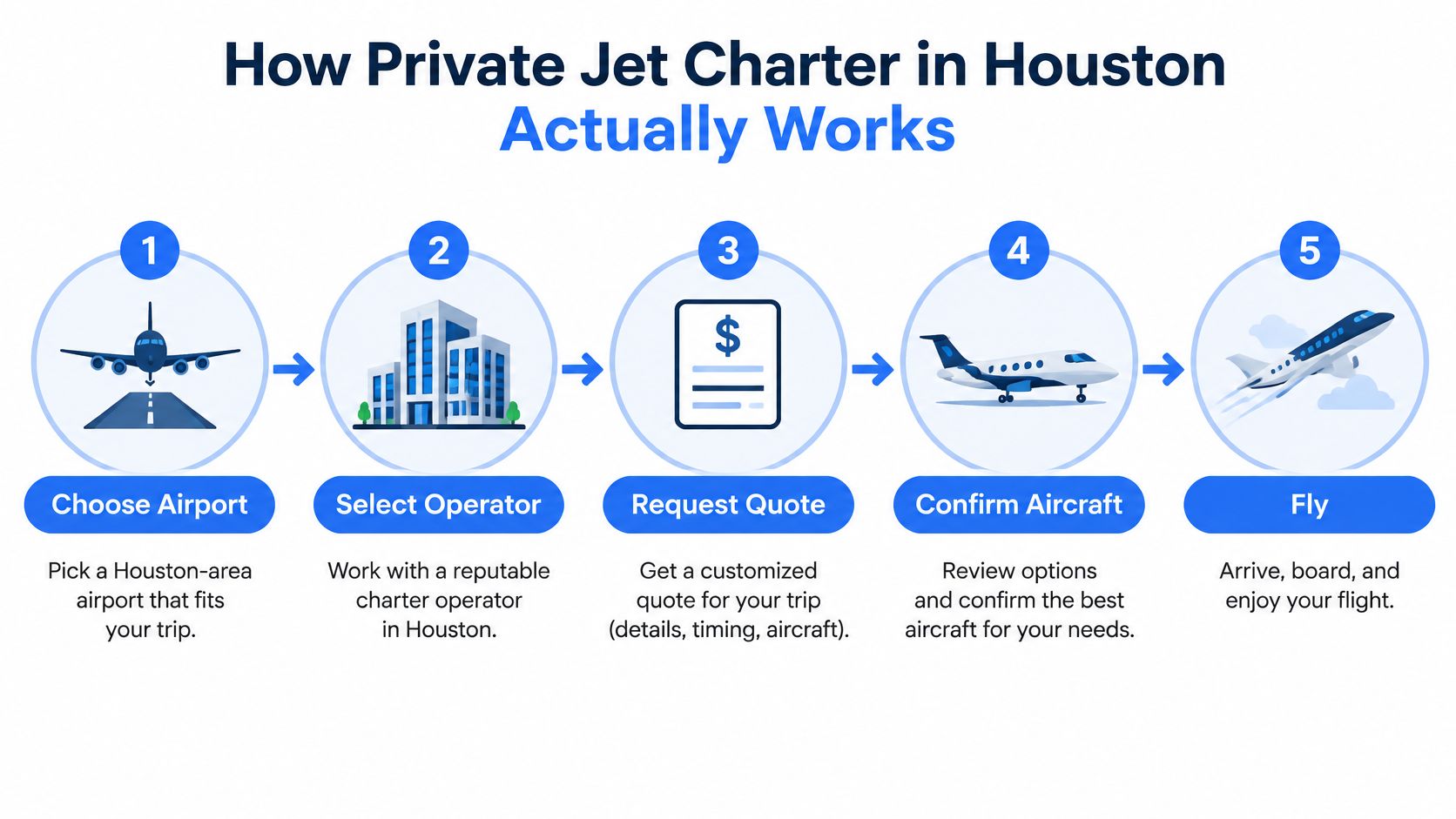
- Define the arrival requirement. Work backward from when the traveler must reach the meeting, not when the aircraft should land.
- Shortlist airport pairs. Compare the Houston departure with the destination airport and both ground transfers.
- Identify the operating carrier. Establish who will operate the aircraft before treating availability as a confirmed solution.
- Compare complete proposals. Match the aircraft, operating assumptions, cancellation terms, and included services.
- Release the trip details. Confirm passenger information, terminal instructions, catering, drivers, and the escalation contact.
For the White Plains traveler, the return deserves as much attention as the outbound. A meeting that runs late changes the operating plan, not just the calendar invitation. Ask what departure flexibility the operator has accepted and what happens if the meeting exceeds it.
Practical rule: Don't approve a charter until someone can explain the journey from your pickup address to your destination address.
The useful deliverable isn't a jet photograph and a departure time. It's an itinerary that names the aircraft, responsible parties, ground arrangements, and unresolved conditions. If the proposal still contains assumptions, make them visible before paying.
Choosing Between Houston Hobby, Bush Intercontinental, and the Reliever Airports
The closest airport isn't automatically the fastest airport. Compare road access, aircraft suitability, private-terminal arrangements, and arrival requirements together. A shorter drive loses its advantage if the chosen aircraft can't operate the mission from that field.
Houston has meaningful airport choice. The Houston-Galveston Area Council regional aviation plan identifies 26 facilities: 2 commercial-service airports, 10 reliever airports, and 14 general-aviation airports, with 18 publicly owned and 8 privately owned.
Hobby's role has deep roots: it began as W. T. Carter Field in 1927, was acquired by the city in 1937, and remained Houston's principal commercial gateway until Intercontinental opened in 1969, according to the historical account of Houston's airport development. That history helps explain its established combination of commercial service and private-aviation infrastructure.
Houston-area airports for private jet charter
The recommendations below are shortlisting guidance, not confirmation of aircraft acceptance or current services.
| Airport | Best for | Notable feature |
|---|---|---|
| William P. Hobby | Starting a comparison for central Houston business travel | Established close-in aviation infrastructure |
| George Bush Intercontinental | Missions where its location or operating suitability wins | Houston's major commercial hub |
| Sugar Land | Testing alternatives for southwest-area origins | Worth comparing against the actual pickup address |
| David Wayne Hooks Memorial | Evaluating a northern-area departure alternative | Part of Houston's broader airport choice |
| Ellington | Comparing options for southeast-area itineraries | Specialized aviation context |
| Houston Executive | Testing a western-area departure option | Included in regional general-aviation planning |
The FAA's National Plan of Integrated Airport Systems appendix identifies Hobby, Intercontinental, David Wayne Hooks, Ellington, and Houston/Southwest among facilities with differing infrastructure and classifications. Don't treat Houston/Southwest and Sugar Land as interchangeable names.
Ask the operator to compare usable runway length against the actual takeoff calculation, then verify FBO availability, operating hours, and customs arrangements where relevant. Don't accept a blanket claim that only IAH can support a heavy jet on a hot afternoon; that requires aircraft-specific performance analysis.
For a Westchase pickup, compare Sugar Land and Houston Executive with Hobby rather than defaulting to a commercial-airport name. For another traveler, traffic on I-45 or the Sam Houston Tollway may reverse the ranking. Require the broker to show the road-transfer assumptions.
Matching Aircraft to the Mission Rather Than the Headcount
A seat count is a screening tool, not an aircraft-selection method. My starting recommendation is the smallest aircraft that comfortably and operationally satisfies the full mission, including baggage, fuel requirements, and reasonable contingencies.
Use the categories below to frame the conversation, then insist on an assessment of the specific aircraft.
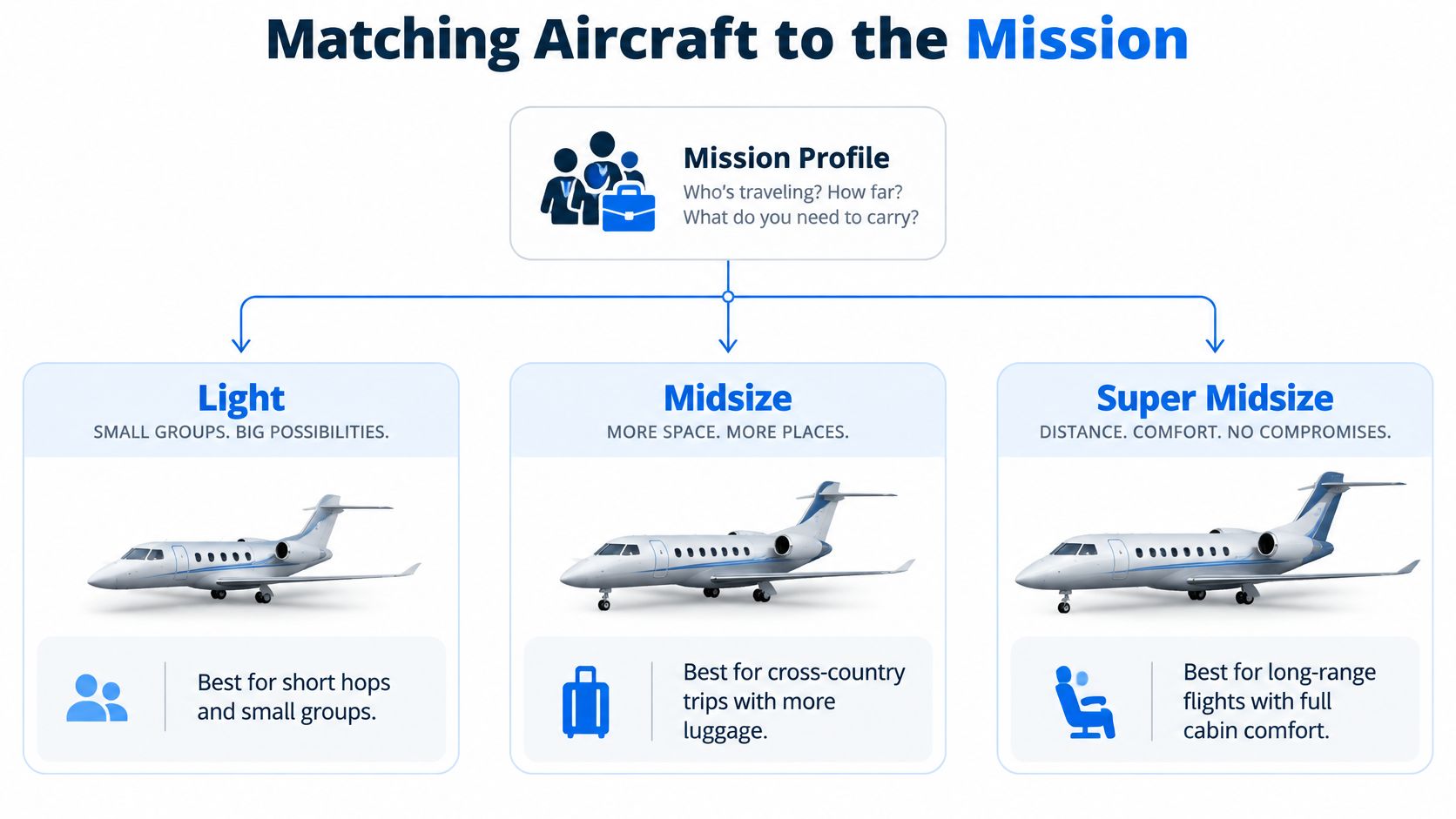
For a hypothetical three-person Houston-to-Austin trip, I'd start with a light jet rather than pay for unused cabin. For a Northeast business itinerary, I'd ask for midsize options, with a specific answer on nonstop feasibility. Neither recommendation is permission to ignore payload.
The FAA's Part 135 operating guidance requires authorization for the operator's scope of operations and an aircraft that meets applicable requirements. Translate that into a practical request: model passengers, baggage, catering, equipment, and fuel together, with applicable international and dangerous-goods requirements addressed.
Aircraft class matched to mission
| Class | Typical mission | Trade-off |
|---|---|---|
| Light | Short regional business trip with modest baggage | Less room to absorb bulky luggage or changing requirements |
| Midsize | Northeast business itinerary, subject to route analysis | Nonstop capability must be confirmed for the actual load |
| Super midsize | Coast-to-coast proposal with bags and reserve requirements | More aircraft than a simple regional hop may need |
| Heavy | International travel, larger parties, or demanding cabin needs | Capacity doesn't establish suitability for specialized cargo |
For Houston–Los Angeles, request a midsize proposal alongside a super midsize alternative if nonstop travel matters. Make the operator explain the assumptions behind each. Houston summer heat is a performance question; don't casually describe Houston as a high-altitude departure.
Cabin layout matters separately from legal seating capacity. Use this private jet seating guide to prepare questions about working space, sleeping arrangements, and who sits where.
This video provides another visual reference for the aircraft conversation.
A corporate shuttle and a sports party shouldn't receive identical recommendations merely because their headcounts match. Ask about equipment dimensions, baggage access, and loading compatibility before choosing the cabin.
The Part 135 Safety Checklist You Should Actually Use
An aircraft registration isn't authorization to sell you a charter flight. Neither is a polished broker website. The decisive question is which certificated carrier exercises operational control over your trip.
The FAA's Part 135 overview describes the framework for on-demand, unscheduled service, generally covering aircraft configured for 30 or fewer passenger seats or with a maximum payload capacity of 7,500 pounds or less. It also states that private pilots may not act as pilot-in-command carrying people or property for compensation.
Request an identifiable operating file
Keep the following checks attached to the actual aircraft and carrier, not just the company selling the itinerary.
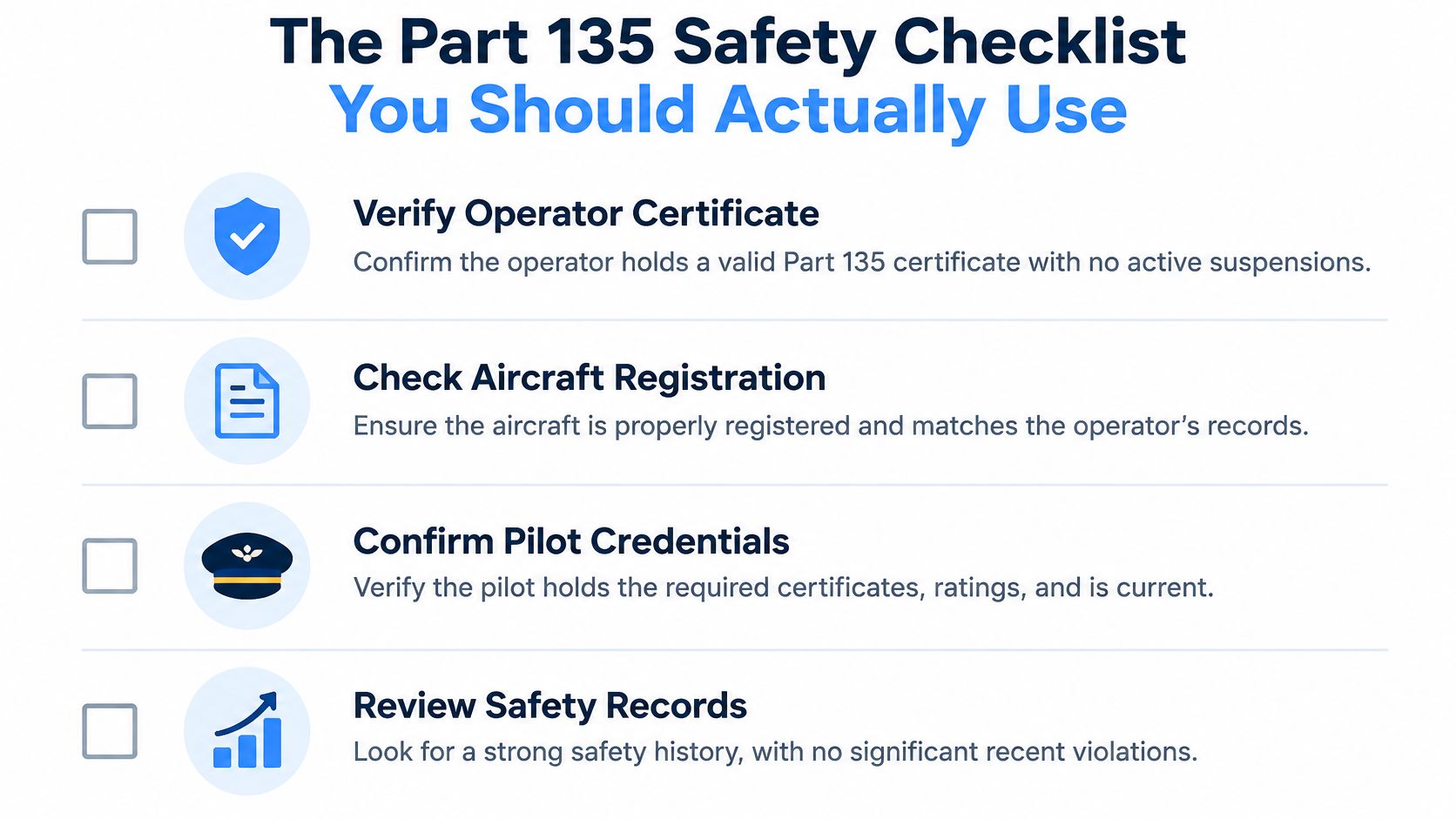
- Operator identity. Obtain the legal carrier name, certificate status, and confirmation that the aircraft is authorized under its operation.
- Aircraft identity. Request the tail number and confirmation of current airworthiness and inspection status.
- Crew qualifications. Ask the carrier to confirm that the assigned crew is qualified for the aircraft and mission.
- Insurance evidence. Obtain documentation identifying the relevant coverage, rather than accepting a general assurance.
- Operational contact. Keep a dispatch or operational-control contact available throughout the trip, including outside office hours.
- Special approvals. Confirm mission-specific documentation for medical transport, sensitive freight, or international operations.
Maintenance deserves more than a question about aircraft age. Under the FAA's Part 135 aircraft and maintenance requirements, aircraft type-certificated for 10 or more passenger seats require a continuous airworthiness maintenance program, while those with nine or fewer follow specified Parts 91 and 43 requirements plus applicable Part 135 provisions; manufacturer-recommended overhaul intervals and complete records also matter.
Ask for confirmation of compliance and documentation continuity, not an improvised technical judgment from the sales desk. The private jet safety discussion can help organize broader questions, but it doesn't replace carrier verification.
A refusal to identify the operating carrier is a reason to stop the transaction, not negotiate harder.
Other red flags include pressure to pay before the operator is identified, vague answers about aircraft substitution, or an intermediary claiming authority it cannot document. A low quote doesn't compensate for uncertainty about who controls the flight.
From Quote to Wheels Up - Booking Logistics for a Houston Departure
A quote is a commercial proposal. A confirmed departure requires an operationally ready aircraft, crew, and itinerary. Don't treat those as the same milestone.
For a Houston departure, ask the broker to identify what is already confirmed, what remains subject to approval, and when the next update will arrive. A universal promise about quotation speed or wheels-up timing isn't useful without that distinction.
Ask for milestones, not a stopwatch
- Request acceptance. Provide the itinerary, passenger and baggage details, return expectations, pets, and special requirements.
- Proposal delivery. Require the airport pair, aircraft description, operating carrier, inclusions, and outstanding conditions.
- Operational confirmation. Ask whether crew availability, aircraft readiness, positioning, and any required airport permissions are resolved.
- Service release. Confirm catering, pickup instructions, destination handling, and international documentation where applicable.
- Departure readiness. Obtain the final itinerary and a named contact for changes.
An aircraft already at the selected airport presents a different readiness question from one that must fly in empty. Ask where the aircraft is physically located and whether its arrival depends on another passenger flight. A proposed move within the Houston area still needs an operating plan; don't assume geography makes positioning immediate.
For pets, disclose the animal before aircraft selection and obtain the operator's acceptance. For international travel, submit the required passenger and documentation details early enough for the carrier to confirm the arrival plan. Catering preferences should never remain unresolved while everyone assumes departure is ready.
Finish the destination arrangements
Tell the receiving FBO who is collecting the passengers, how the driver will receive updates, and what happens after a diversion. If the itinerary continues beyond the airport, request the ground-transfer quote while evaluating the flight.
For a New York-area trip that includes a separate JFK-to-Hamptons road leg, Hamptons Leisure Limo's JFK to Hamptons transfer quote is a relevant resource for that component. Don't apply it to a White Plains arrival without requesting the correct pickup.
The booking is ready when the dependencies are resolved, not when a salesperson starts a countdown.
What a Houston Charter Actually Costs and Why Quotes Vary
Compare total mission prices, not isolated hourly rates. Without live, itinerary-specific proposals, a generic Houston charter price is a poor basis for approval. Ask what you're buying and which costs can still change.
Use this breakdown to challenge an incomplete proposal.

Put competing quotes on the same basis
| Quote component | Question to resolve |
|---|---|
| Aircraft and flight charges | What flying and billable-time assumptions are included? |
| Fuel | Is fuel included, and can a surcharge change? |
| Positioning | Which nonpassenger movements are priced? |
| Airport services | Are landing, handling, parking, and relevant taxes included? |
| Crew arrangements | What waiting or overnight assumptions apply? |
| Passenger services | What catering and ground transport have been accepted? |
| Conditional expenses | How are de-icing, international handling, or itinerary changes charged? |
The private jet charter pricing guide is useful preparation, but the signed proposal must define your actual inclusions. Don't assume a more expensive quote is padded or a cheaper quote is incomplete. Require both sellers to price the same trip.
Understand what happens between passenger flights
An empty leg is an aircraft movement without passengers, often associated with positioning. A one-way booking doesn't tell you the aircraft's complete itinerary, so ask how the operator plans to serve your flight and what dependencies affect it.
That question also matters environmentally. A 2019–2023 study summarized by The Cool Down examined 19 million private flights and found direct carbon emissions rose from 10.7 million to 15.6 million metric tons, a 46% increase, with empty repositioning flights playing a substantial role in total mission emissions.
Buying advice: Request both the passenger itinerary and an explanation of positioning assumptions before calling an option efficient.
An empty-leg offer isn't automatically greener or suitable for a fixed meeting. Ask what happens if the underlying schedule changes. For sustainability reporting, distinguish passenger-leg estimates from total mission estimates and request the calculation assumptions.
Negotiate flexibility in aircraft category, airport, departure window, and service choices. Don't ask an operator to remove required fuel reserves, maintenance obligations, or crew constraints to reach a budget.
Real Houston Charter Scenarios for Business, Group, and Sensitive Missions
The following are illustrative planning scenarios, not accounts of completed customer trips. They show how I'd apply the airport-first approach without pretending that a preliminary aircraft recommendation is an operating approval.
Westchase office to White Plains
Start by comparing Houston Executive, Sugar Land, and Hobby against the office pickup and available aircraft. I'd provisionally favor a western departure if the road-transfer advantage survives the operator's assessment, then request a midsize option alongside a larger alternative if the nonstop requirement warrants it.
For booking, establish the return window before accepting the outbound proposal. Obtain the carrier identification, aircraft authorization confirmation, insurance evidence, and operational contact. The contingency to price is an extended meeting: determine whether the aircraft waits, whether the crew can cover the revised schedule, and what changes commercially.
College sports team with equipment
For an illustrative departure, I would include Hobby on the comparison list, then test alternatives against the team's gathering point and aircraft acceptance. I would not select a heavy jet just because the initial passenger list appears to fit.
Request a complete roster and equipment inventory before choosing between a heavy jet and an airliner charter. Ask the operator to confirm loading suitability and its applicable operating authority. Start sourcing when the schedule becomes usable, and settle the destination bus plan before signing; the planning surprise to avoid is discovering that equipment fits by weight but not by dimensions or access.
Medical evacuation or sensitive cargo
For a hypothetical medical movement, use Hobby as an initial coordination candidate, not an automatic choice. Compare the ground transfer from the patient's location and let the medically appropriate operating plan determine the final airport and equipped aircraft.
Engage the specialist team as soon as the transport need is established. Request confirmation of medical equipment compatibility, accompanying clinical personnel, operator approvals, and receiving arrangements. For sensitive cargo instead, establish handling requirements, dangerous-goods acceptance where relevant, and chain-of-custody responsibilities before release.
For public figures and media-sensitive travelers, add an agreed passenger-information protocol and controlled driver coordination. Discretion should be planned with the people handling the trip, not assumed from the word “private.”
Your Houston Charter Pre-Flight Checklist and Common Questions
Before authorizing the trip, ask the coordinator to return a single, consistent itinerary. The airport, aircraft, operator, and ground arrangements should agree across the proposal, passenger instructions, and final confirmation.
Keep this approval list
- Airport decision. Record the selected field, exact FBO, pickup plan, and reason it won the comparison.
- Aircraft acceptance. Confirm the actual baggage and equipment have been disclosed.
- Operating file. Retain the carrier details, aircraft identification, insurance evidence, and maintenance-compliance confirmation.
- Passenger services. Close catering, accessibility, pet, and security requirements.
- Arrival coordination. Name the receiving contact, driver, and customs arrangements if applicable.
- Contingency plan. Establish who communicates a delay, substitution, diversion, or cancellation.
Keep essential personal items separate from luggage that may be loaded out of reach. Urban Totes' carry on bag essentials can help with personal packing; confirm bag dimensions and access with the charter coordinator rather than assuming commercial-airline rules apply.
Questions worth asking before you pay
Does a one-way Houston charter fly empty afterward?
Not necessarily. Request the operator's positioning assumptions rather than inferring them from your passenger itinerary.
How far ahead must I book a same-day departure?
There's no responsible universal deadline. Ask for the earliest operationally confirmed departure and identify which unresolved condition could move it.
Can a midsize jet reach the West Coast nonstop?
Treat that as an aircraft-specific dispatch question. Require a clear answer for your route and load, plus an alternative if nonstop service can't be confirmed.
Should I vet the broker or the operator?
Both, for different responsibilities. Evaluate the broker's contracting transparency and coordination, and verify the carrier's authority to conduct the flight.
The final decision should be explainable without luxury language: this airport fits the journey, this aircraft fits the mission, and this operator can perform it.
For a Houston departure, Approved Jets offers on-demand charter sourcing and coordination of ground transfers, catering, and other trip logistics. Send your pickup address, destination, arrival deadline, passenger details, and baggage requirements, and ask for an airport comparison alongside the aircraft proposals.