
Are Private Jets Safe What the Safety Data Shows
Are private jets safe? See accident data, Part 135 vs airline safety, ARGUS and Wyvern vetting, and key questions to ask your broker.

Approved Jets
On this page
- Table of Contents
- Introduction Are Private Jets Safe for Today's Traveler
- How Safe Are Private Jets Compared to Airlines and General Aviation
- Why the denominator changes the story
- Reading headlines with the right question
- Understanding Operating Rules That Shape Private Jet Safety
- Private Jet Operating Models Compared
- What buyers should verify first
- How ARGUS and Wyvern Ratings Help You Vet Operators
- What the ratings signal
- Ratings are signals, not guarantees
- Maintenance Crew Training and Safety Systems Behind Every Flight
- The daily controls passengers rarely notice
- What to ask for without demanding private records
- When Private Jet Risk Rises and How Smart Planning Reduces It
- Context changes the margin
- Questions that reveal good planning
- Questions to Ask Your Broker Before You Book a Private Jet
- How to interpret the answers
Have you ever asked whether a private jet is safe, without first asking who operates it, under which rules, and with what oversight? That distinction matters more than the aircraft's paint, cabin finish, or marketing name.
A family may be considering a charter after seeing a crash headline. An executive may be comparing a low quote with a more expensive alternative. In both cases, the natural instinct is to judge the jet itself. A more useful approach is to examine the complete operation, including the operator's certificate, crew training, maintenance control, dispatch practices, and independent safety audits.
The answer is reassuring, but it isn't a simple yes or no. Professionally operated private jets sit in a very different safety category from owner-flown general aviation. Within charter, however, operators still vary. The safest booking decision usually comes from choosing a properly certificated commercial operator and verifying the controls behind the specific flight.
This guide uses accident-rate data, plain-language comparisons, practical examples, and a buyer's checklist. It also reflects the perspective of Approved Jets, a broker that arranges charter flights through vetted operators, without treating any broker logo as a substitute for operator-level verification. If you're new to the process, the private jet charter guide can provide useful booking context.
Table of Contents
- Introduction Are Private Jets Safe for Today's Traveler
- How Safe Are Private Jets Compared to Airlines and General Aviation
- Understanding Operating Rules That Shape Private Jet Safety
- How ARGUS and Wyvern Ratings Help You Vet Operators
- Maintenance Crew Training and Safety Systems Behind Every Flight
- When Private Jet Risk Rises and How Smart Planning Reduces It
- Questions to Ask Your Broker Before You Book a Private Jet
Introduction Are Private Jets Safe for Today's Traveler
A traveler sees a headline about a private-plane accident and starts questioning an upcoming trip. That reaction is understandable. Headlines compress very different kinds of flying into the same phrase, “private jet,” even though a professionally crewed charter jet and an owner-flown small aircraft may operate under very different rules.
Consider two hypothetical bookings. In the first, a family charters a midsize jet through a commercial air carrier. The operator provides professional pilots, structured dispatch, formal maintenance control, and documented operational oversight. In the second, an aircraft owner flies a personal trip under non-commercial rules, makes the flight-planning decisions independently, and relies on a less formal maintenance and training structure. Both flights may be described casually as private aviation, but their safety controls aren't equivalent.
That's why the question “are private jets safe?” needs a more precise answer. The aircraft matters, but the operating model matters more. A modern jet can still face higher exposure if the mission is poorly planned, the crew is fatigued, weather decisions are rushed, or operational control is weak. Conversely, a professionally managed charter operation can use layered controls that reduce risk before the passengers ever reach the airport.
Practical rule: Judge the carrier and the controls around the flight, not just the aircraft model.
The most useful way to assess a quote is to move through three questions:
- Who holds operational control? Identify the legal carrier responsible for dispatching, crewing, maintaining, and conducting the flight.
- What oversight applies? Confirm whether the trip is operated under commercial charter rules rather than owner-flown, non-commercial rules.
- What evidence supports the claim? Ask for current audit information, crew and maintenance confirmation, and the operator's name in the agreement.
The sections ahead separate broad accident data from the practical details a traveler can verify. You'll see why per-hour comparisons are more meaningful than crash headlines, how Part 135 charter differs from Part 91 private flying, what ARGUS and Wyvern ratings can and can't tell you, and how weather, airports, and short-notice missions change the safety margin.
How Safe Are Private Jets Compared to Airlines and General Aviation
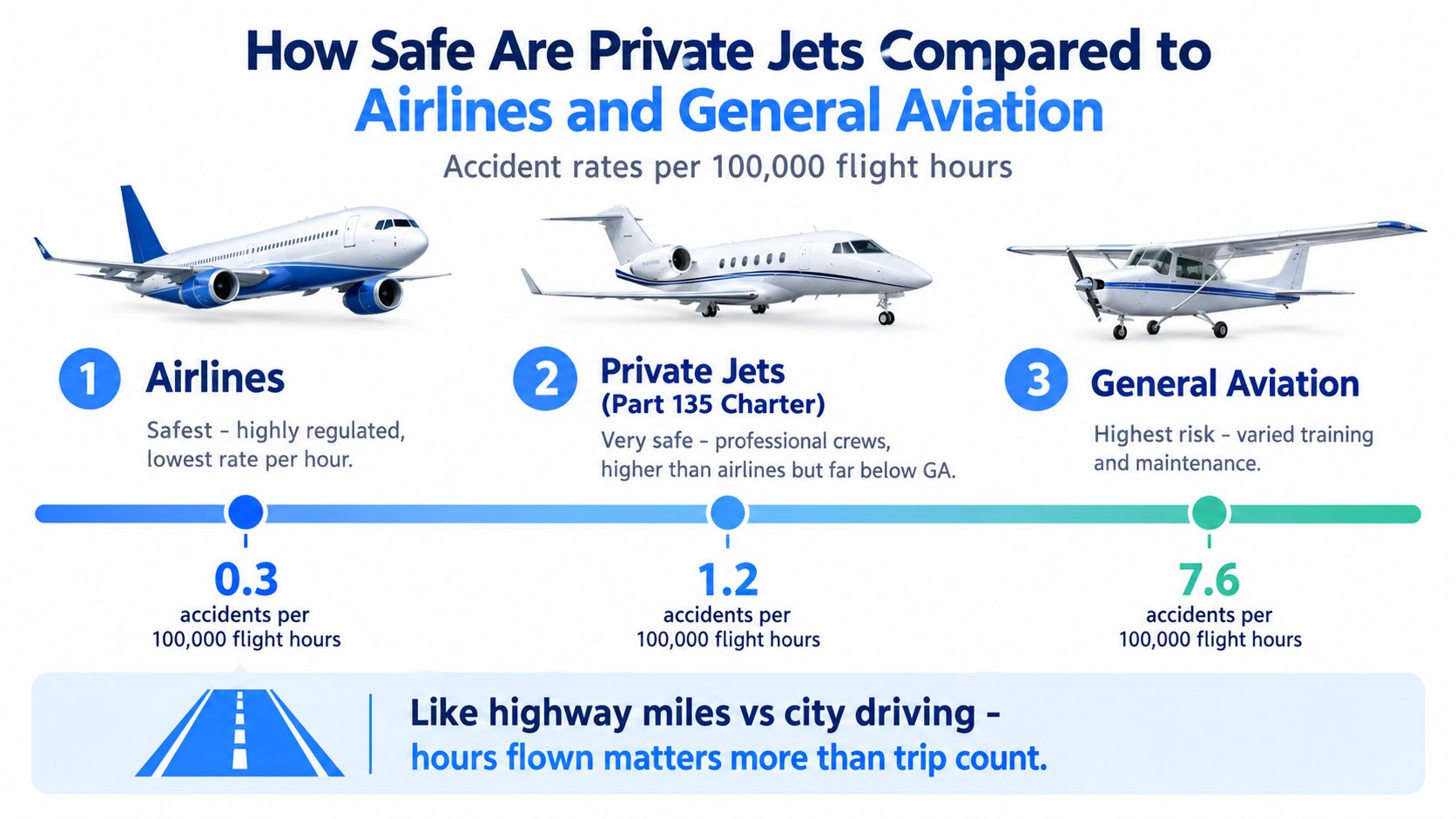
The first mistake in aviation comparisons is counting accidents without considering how much flying took place. A small number of accidents can look alarming when the exposure is unknown, just as comparing highway crashes with city crashes without considering miles driven would produce a misleading result. Aviation analysts therefore often use accident rates per 100,000 flight hours, which makes different operating categories easier to compare.
A major historical FAA and NTSB-era benchmark placed professionally operated business jets at roughly 0.1 to 0.3 fatal accidents per 100,000 flight hours, compared with about 0.006 for scheduled commercial airlines and approximately 0.9 to 1.1 for general aviation overall, according to this historical private-jet safety benchmark. The important point isn't that charter has exactly the same risk as an airline. It's that professionally operated business jets were much closer to airline safety than to the broader general-aviation category.
Why the denominator changes the story
Suppose one category records more incidents because it flies more hours. A trip-count comparison could make that category appear less safe, even if its rate per hour is lower. The exposure-based view asks a cleaner question: how often does a serious event occur during a defined amount of operation?
That still doesn't make averages perfect. “General aviation” includes a wide range of aircraft and missions, from professionally operated business jets to owner-flown airplanes. A general average can therefore conceal major differences in crew training, dispatch, maintenance, aircraft performance, and airport selection.
A modern charter dataset illustrates why context remains essential. For FAA Part 135 activity in 2020, the NTSB table recorded 40 total accidents and 6 fatal accidents, alongside 3,037,404 flight hours. The reported accident rate was 1.3169, and the fatal-accident rate was 0.1975 per 100,000 hours, as summarized in this Part 135 accident-statistics review. Those figures describe a regulated charter category, not every aircraft that a traveler might casually call a private plane.
Reading headlines with the right question
A headline tells you that an event occurred. It usually doesn't tell you whether the flight was Part 135 charter, Part 91 personal flying, corporate aviation, an air taxi mission, or another category. Before using an accident story to judge your own booking, identify the operating rules and the type of operation involved.
A professionally crewed charter jet isn't risk-free. Aviation safety depends on disciplined decisions, and every flight still faces weather, runway, mechanical, and human factors. But the data supports a clear conclusion: private aviation isn't one uniform safety category, and the professionally operated end of the spectrum is substantially different from broad general aviation.
Understanding Operating Rules That Shape Private Jet Safety
The operating certificate tells you what regulatory framework surrounds the flight. In the United States, Part 135 covers on-demand charter and air-taxi operations, Part 121 covers scheduled airline-style operations, and Part 91 generally covers private, non-commercial flying. These labels aren't marketing language. They describe who controls the flight and what operating requirements apply.
Part 135 charter requires a commercial operating structure with professional crews, maintenance programs, and operational oversight. Part 121 scheduled airlines operate within an even more standardized system, typically supported by large-scale dispatch, formal crew scheduling, and extensive procedures. Part 91 owner-flown operations can be conducted safely, but the oversight model is materially different because the owner or private operator directs the flight rather than a commercial carrier managing a charter mission.
A recent NTSB-tracked comparison placed Part 135 at around 0.9 accidents per 100,000 flight hours, versus about 0.19 for Part 121. FAA general-aviation data placed the overall GA fatal accident rate near 0.68 per 100,000 hours in FY24, according to this comparison of private-jet operating categories. These figures show why charter can be safer than owner-flown private flying while still trailing scheduled airlines.
Private Jet Operating Models Compared
| Operating Model | Oversight and Crew Standard | Accident Rate Context |
|---|---|---|
| Part 135 on-demand charter | Commercial operator with professional crews, maintenance control, and operational oversight | Around 0.9 accidents per 100,000 flight hours in the cited comparison |
| Part 121 scheduled airline | Highly standardized airline operation with extensive dispatch and crew systems | About 0.19 accidents per 100,000 flight hours in the cited comparison |
| Part 91 owner-flown flying | Private, non-commercial operation with owner-directed planning and oversight | Broad GA data includes materially higher-risk activity than professional charter |
The practical example is straightforward. A charter broker offers two aircraft with similar cabin sizes. One belongs to a Part 135 carrier with documented dispatch, recurrent crew training, and maintenance control. The other is presented through a private owner arrangement under Part 91. The aircraft type alone doesn't tell you which option has the stronger safety framework. The certificate and operating carrier do.
What buyers should verify first
Ask for the full legal name of the operating carrier, not merely the broker's brand or aircraft owner. Confirm that the carrier is authorized to conduct charter, and make sure the name on the charter agreement matches the carrier responsible for the flight.
For international itineraries, regulatory questions can become more involved because foreign operating authorities and permits may apply. The guide to international private jet flights can help frame those logistics, but the safety principle remains the same: identify the carrier that holds operational control and verify the credentials attached to that carrier.
How ARGUS and Wyvern Ratings Help You Vet Operators
A third-party safety rating is best understood as an independent inspection of the operator's habits and systems. It's similar to a health-inspection grade at a restaurant. The grade doesn't guarantee that every meal will be perfect, but it gives you information about cleanliness, procedures, and management discipline beyond the minimum license to operate.
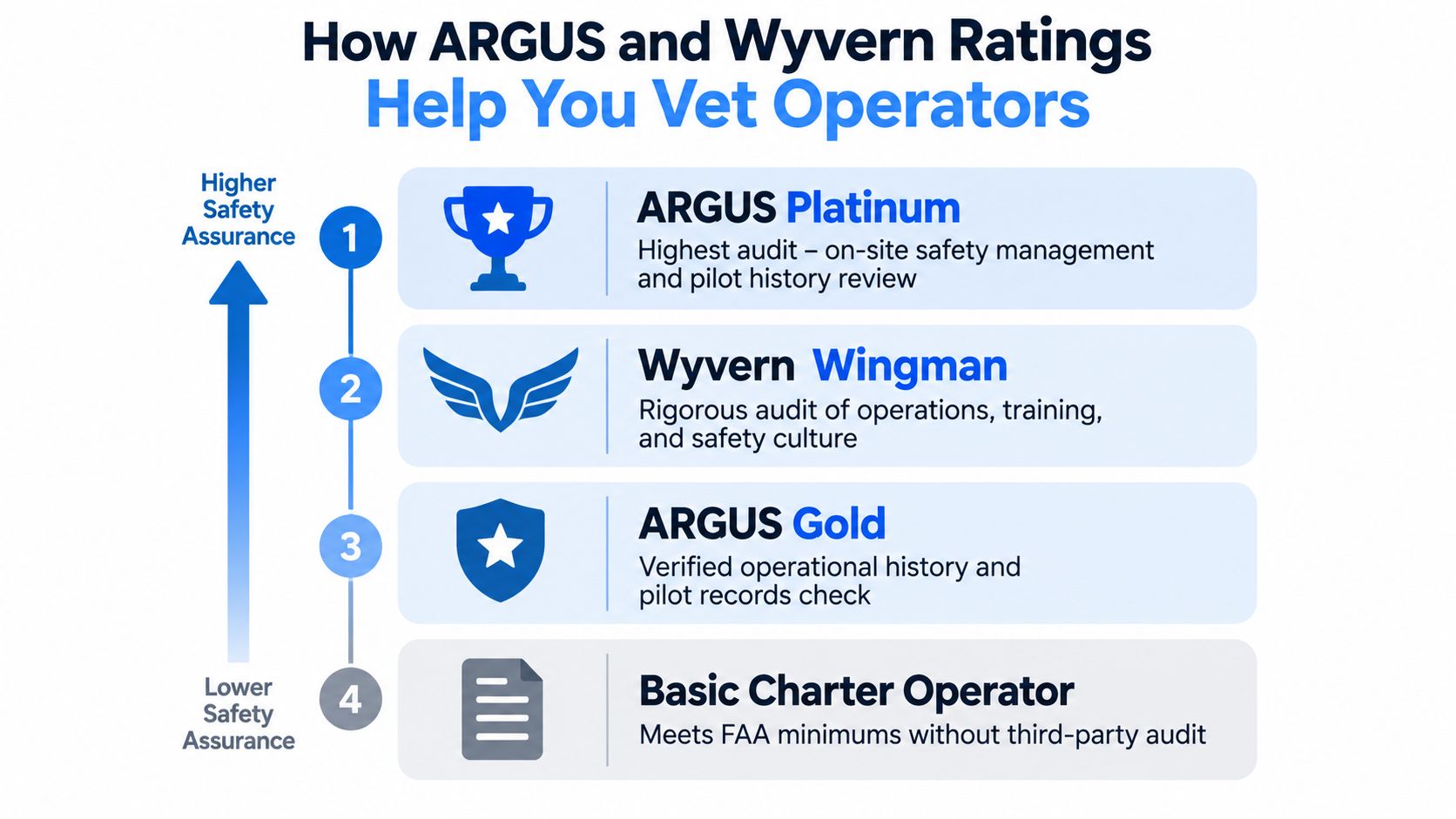
ARGUS Platinum and Wyvern Wingman are operator-level credentials. They don't certify a single aircraft in isolation, and they don't replace the legal requirement for a properly certificated charter carrier. Their value comes from examining elements such as pilot history, training, maintenance practices, operational procedures, safety management, and operational control.
What the ratings signal
ARGUS uses a tiered evaluation structure. Platinum indicates deeper scrutiny than a basic listing or general participation, including review of the operator's real-world systems. Wyvern's Wingman designation similarly signals independent review of operations, training, and safety practices. The exact scope and current status matter, so a logo without a level or date isn't enough.
Business aviation analyses that summarize FAA and NTSB data place professionally operated business-jet fatal accident rates broadly around 0.1 to 0.3 per 100,000 flight hours, while owner-flown private operations are several times higher, as discussed in the NBAA business aviation safety analysis. That contrast supports using ratings to evaluate the operator's systems rather than assuming the aircraft type determines the result.
A sensible request sounds like this:
- ARGUS: What level does the operating carrier hold, and when was the latest audit?
- Wyvern: Is the carrier Wingman, and can the broker confirm that status for the assigned operator?
- Scope: Does the credential apply to the legal carrier named in the agreement, or only to an affiliated brand?
- Recency: Is the audit current, and has the assigned aircraft or crew changed?
Ratings are signals, not guarantees
A top-tier rating doesn't remove weather risk, maintenance surprises, or human judgment from the flight. It tells you that an external organization has examined the operator's processes against defined criteria. That's valuable because travelers rarely have the time or access to audit a carrier themselves.
The strongest workflow uses layers. Start with legal charter authority, add an independent rating, then request trip-level confirmation for the assigned aircraft and crew. If a broker answers only with “we use safe operators” and won't identify the carrier or provide current credential details, treat that lack of specificity as a reason to pause.
Maintenance Crew Training and Safety Systems Behind Every Flight
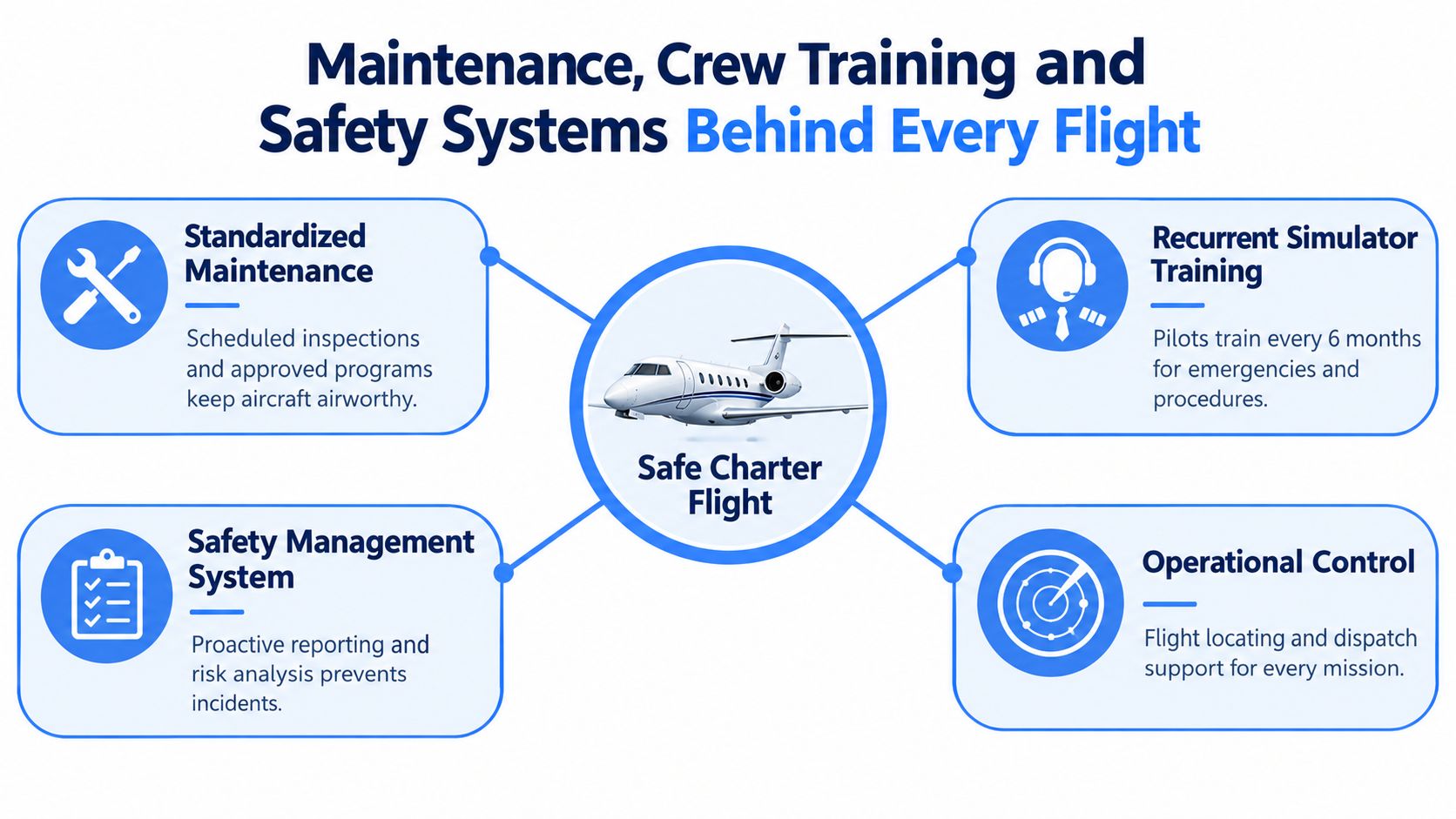
Passengers see the cabin, but the safety system operates mostly out of sight. Maintenance planners track inspections, crews train for abnormal situations, dispatchers assess the route, and safety managers collect reports about hazards and near-misses. These processes matter more than whether the leather seats look new.
A standardized maintenance program gives technicians a defined schedule and approved procedures for inspecting the aircraft. Recurrent simulator training helps pilots practice emergencies and aircraft-specific procedures before they need those skills in the air. A Safety Management System, or SMS, gives the operator a formal way to identify hazards, assess risk, report concerns, and improve procedures.
The daily controls passengers rarely notice
A pilot's recurrent training may cover engine failures, rejected takeoffs, instrument approaches, runway excursions, and crew coordination. The specific program varies by aircraft and operator, but the purpose is consistent: keep responses practiced rather than theoretical.
Maintenance control works in a similar way. A responsible operator doesn't wait for a visible defect to become a serious problem. It tracks scheduled inspections, component status, deferred items, and required records before releasing an aircraft for a mission.
Operational control connects those elements. Dispatch and flight-locating personnel monitor the mission, support weather and routing decisions, and maintain awareness of where the aircraft is operating. The NTSB's review of Part 135 operations found 116 fatal accidents and 460 nonfatal accidents between 2010 and 2022. Within that review, 12 accidents involved operational-control or flight-locating deficiencies, and those accidents together resulted in 45 fatalities, according to the NTSB Part 135 safety review.
The aircraft is only one part of the safety chain. Dispatch, tracking, maintenance records, and crew currency can become failure points if the operator doesn't manage them rigorously.
What to ask for without demanding private records
Travelers don't need every internal maintenance document or a pilot's personal file. They can ask for meaningful confirmation:
- Maintenance: Does the operator use a standardized, documented maintenance program?
- Training: Are the assigned pilots current in the aircraft type and completing recurrent training?
- SMS: Does the operator maintain a functioning safety management system with hazard reporting?
- Operational control: Who dispatches the flight, tracks it, and makes go or no-go decisions?
- Changes: If the aircraft or crew changes, will the operator repeat those checks?
Aircraft age and cabin condition can influence comfort and performance, but they aren't reliable substitutes for documented systems. A well-managed aircraft with a disciplined crew can present a stronger operational profile than a newer aircraft operated with weak oversight.
Operators that manage aircraft for charter also coordinate maintenance tracking, crew staffing, compliance, and records. Approved Jets describes private aircraft management services in that operational context, where safety depends on the systems supporting the aircraft throughout its service life.
When Private Jet Risk Rises and How Smart Planning Reduces It
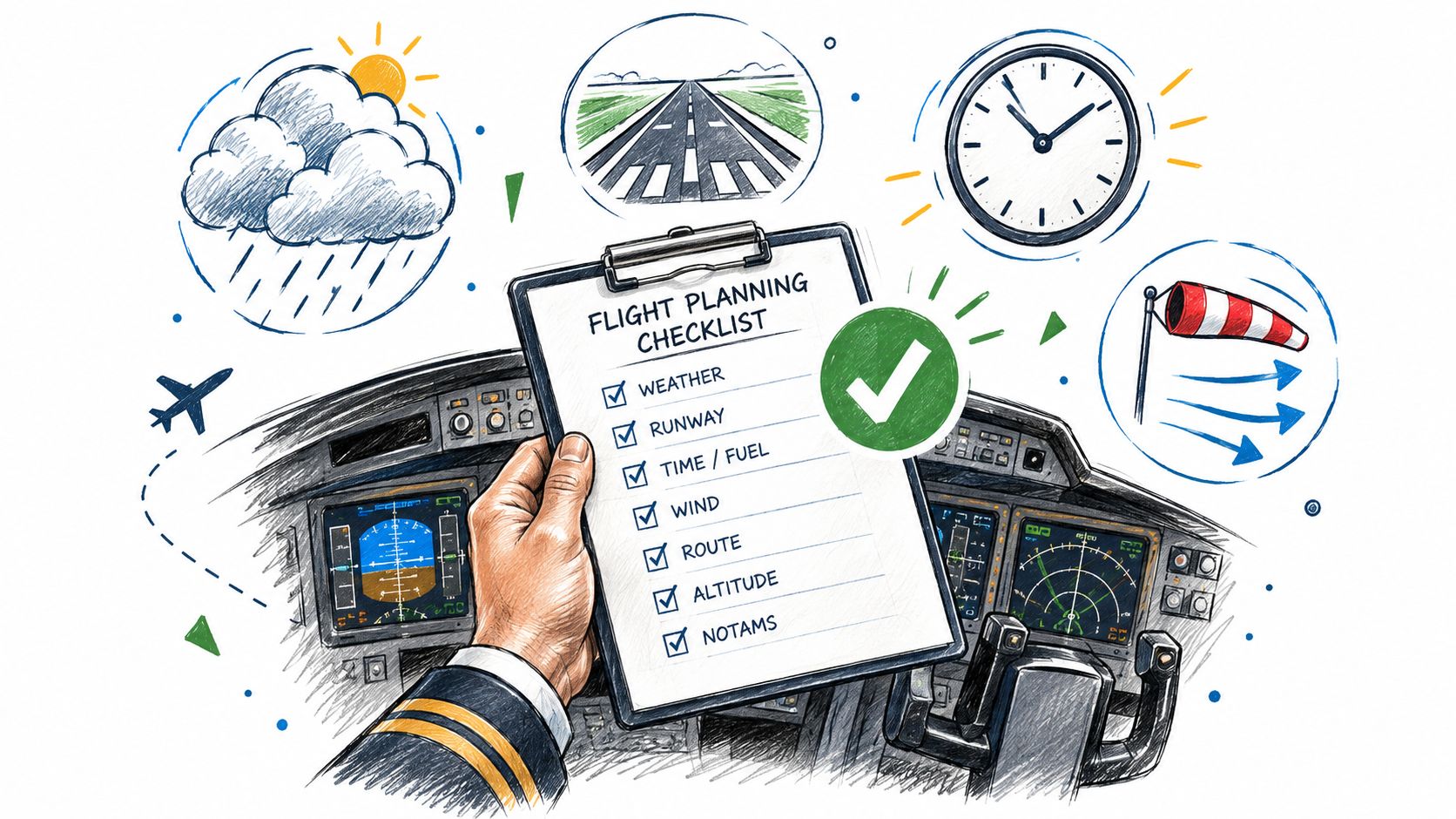
The same aircraft can face very different levels of exposure depending on the mission. A daytime flight between airports with suitable runways and stable weather presents a different planning problem from a last-minute trip to a constrained airport in marginal conditions. The jet hasn't changed, but the workload, available alternatives, and consequences of a poor decision have.
On-demand charter can create pressure because passengers may have urgent schedules. That's where professional dispatch and conservative decision-making matter. A competent team can evaluate runway performance, forecast weather, alternates, airport operating limits, fuel requirements, and the consequences of delaying or rerouting.
Context changes the margin
A short-notice flight to a mountain airport during deteriorating weather may require a different aircraft capability, additional fuel planning, or a firm alternate. A remote destination with a short runway may require careful landing-distance calculations, weight restrictions, and a review of runway conditions. A late arrival can add darkness, fatigue, or changing wind to the decision.
Go-around discipline is another important control. A crew must be willing to discontinue an approach when the aircraft isn't stabilized or conditions fall outside the plan. Passengers sometimes view a go-around as a delay. Operationally, it's a normal safety decision that preserves options.
The data supports taking these contextual risks seriously. One 2026 independent review cited NTSB-tracked U.S. Part 135 on-demand operations at roughly 0.9 accidents per 100,000 flight hours, compared with about 0.19 for Part 121 airlines, a difference of roughly fivefold, according to this review of private-plane crash statistics. The comparison doesn't mean every charter trip carries the same risk. It shows why charter operations need strong planning and oversight, especially when the mission is complex.
Questions that reveal good planning
A broker or operator should be able to explain how it will handle:
- Weather changes: What conditions would trigger a delay, reroute, or cancellation?
- Airport constraints: Is the aircraft suitable for the runway, elevation, terrain, and expected conditions?
- Alternates: What practical backup airports are available if the destination becomes unsuitable?
- Short notice: Can the operator assign a crew and aircraft without weakening normal checks?
- Cabin safety: Will passengers receive clear instructions about seating, baggage, and emergency procedures?
A reassuring answer isn't “the aircraft can handle anything.” It's a specific explanation of the limits, alternatives, and decision authority. Safety improves when passengers accept that a delay or airport change may be the correct outcome rather than a service failure.
Questions to Ask Your Broker Before You Book a Private Jet
A broker should identify the operating carrier before you commit. Ask for the legal company name, the certificate under which it will conduct the flight, and confirmation that the carrier named in the agreement is the one holding operational control.
Use this checklist during your next call or copy it into an email:
- Operating carrier: Who is the full legal operator for this itinerary?
- Certificate: Is the flight operated under Part 135, Part 121, or an equivalent foreign authority?
- Safety rating: Does the operator hold ARGUS Platinum, Wyvern Wingman, or another independent credential?
- Audit date: When was the most recent audit, and what level or scope applies?
- Crew: Are the assigned pilots current and qualified for this aircraft?
- Maintenance: Does the operator use a documented maintenance-control program?
- SMS: Does the operator maintain a functioning Safety Management System?
- Operational control: Who handles dispatch, flight locating, weather monitoring, and go or no-go decisions?
- Replacement aircraft: If the aircraft changes, will the replacement operator and crew undergo the same verification?
- Agreement: Will the legal operating carrier's name appear clearly in the charter contract?
How to interpret the answers
A strong answer is specific. The broker names the carrier, explains the applicable certificate, identifies the audit tier and date, and provides written confirmation for the assigned operation. The broker also distinguishes between its own role and the operator's role, because the carrier, not the booking brand, is responsible for flight operations, maintenance, insurance, and regulatory compliance.
A weak answer relies on general reassurance. Be cautious if you hear “all our jets are safe” without an operator name, “we use the best pilots” without crew confirmation, or “the aircraft is certified” without identifying the carrier's operating authority. A vague response doesn't prove that the flight is unsafe, but it leaves you without the evidence needed to assess it.
Price should remain part of the decision, but it shouldn't be the only comparison. Place quotes side by side with the operator, aircraft, crew, certificate, audit credentials, routing assumptions, and replacement policy. The safer choice often becomes clearer when the offers are compared on documented controls rather than cabin size alone.
Ask for the documents before signing, then save them with the itinerary. If an aircraft or crew changes, repeat the verification instead of assuming the replacement carries the same credentials.
Approved Jets arranges on-demand private jet charters and integrated travel logistics through a vetted operator network, with a preference for operators holding credentials such as ARGUS Platinum and Wyvern Wingman. Visit Approved Jets to request a flight, identify the operating carrier, and compare charter options using documented safety controls rather than price alone.