
Private Jet Charter Prices: What Really Drives the Cost
Understand private jet charter prices with hourly rates by aircraft class, real itinerary examples, hidden fees, and tips for getting a transparent quote

Approved Jets

On this page
- Table of Contents
- Why the Headline Hourly Rate Is Only Half the Story
- The quote has to describe the whole mission
- How Aircraft Class Shapes the Price
- Start with the lightest suitable aircraft
- Bigger aircraft compound the operating cost
- Hourly Rates at a Glance
- Private Jet Charter Hourly Rates by Aircraft Class
- Three Real Itineraries and What They Actually Cost
- A short regional light-jet mission
- A coast-to-coast super-midsize itinerary
- A transatlantic heavy-jet mission
- The Hidden Fees That Quietly Inflate Your Quote
- Which charges deserve pushback
- Empty Legs and the Real Discount Range
- The trade-off is flexibility
- How to Get a Transparent Quote From a Broker
- Send the operational facts first
- Use this broker script
- Putting It Together Before You Book
Private jet charter prices are quoted per flight hour, and hourly rates span roughly $2,500 for a light jet to over $15,000 for an ultra-long-range jet, so trip cost is driven primarily by aircraft class and mission length rather than by a flat fee. A short regional flight can therefore cost several thousand dollars, while a long-range itinerary can reach five figures per flight hour before additional charges.
That range is the first surprise for many buyers, but it isn't the most important one. The hourly number in a broker's first email is often the least useful figure on the proposal. What matters is how the aircraft is positioned, how the operator calculates billable time, which airports you use, whether the crew stays overnight, and how much demand exists on your travel dates.
The practical question isn't, “What's the hourly rate?” It's, “What will I pay for this exact aircraft, on this exact route, with every required charge shown?”
Table of Contents
- Why the Headline Hourly Rate Is Only Half the Story
- How Aircraft Class Shapes the Price
- Hourly Rates at a Glance
- Three Real Itineraries and What They Actually Cost
- The Hidden Fees That Quietly Inflate Your Quote
- Empty Legs and the Real Discount Range
- How to Get a Transparent Quote From a Broker
- Putting It Together Before You Book
Why the Headline Hourly Rate Is Only Half the Story
A $5,200 hourly quote for a light jet can produce a $9,500 invoice on one itinerary and a $22,000 invoice on another. The aircraft may carry the same headline rate, but the missions aren't economically identical.
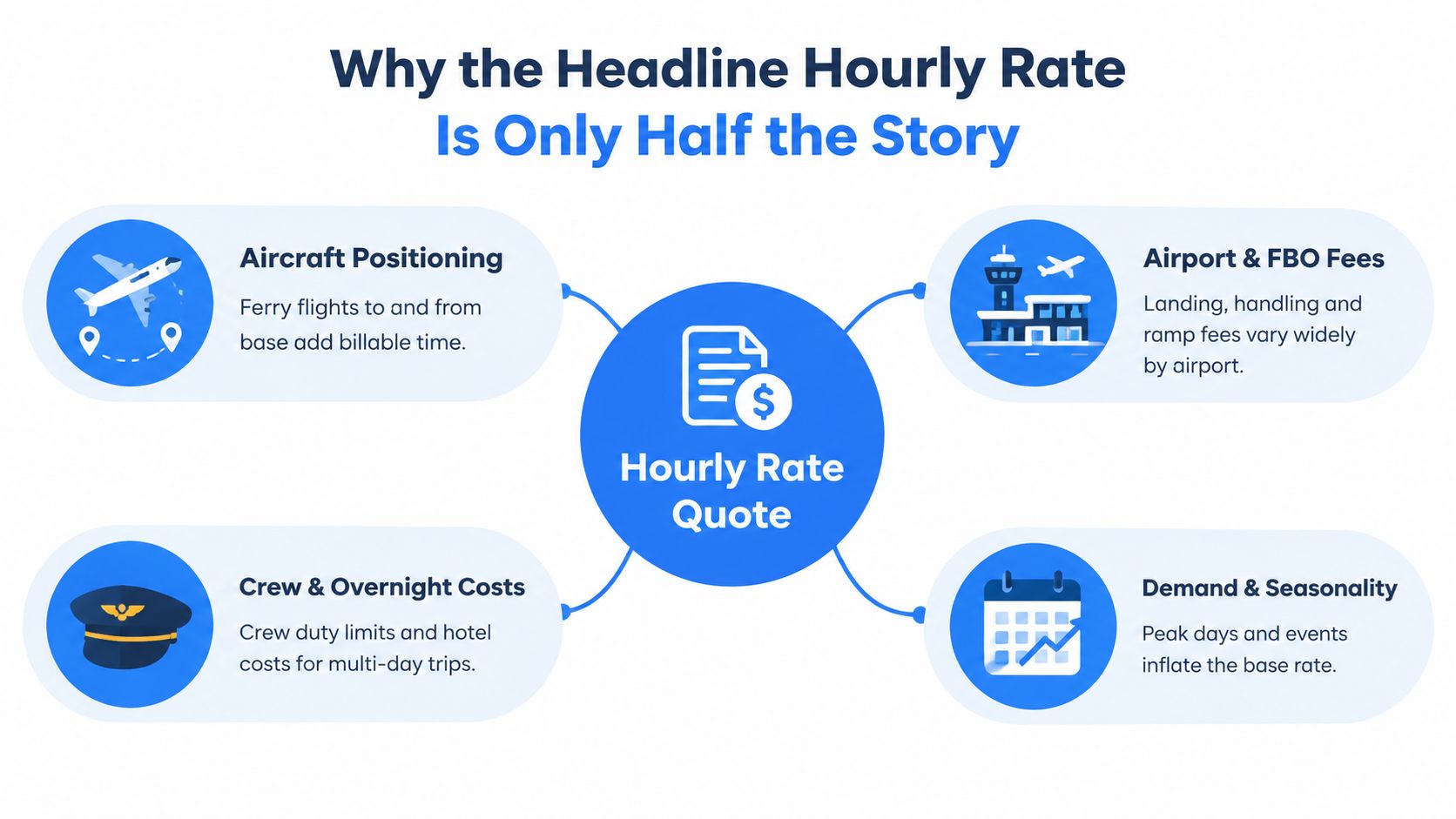
Four variables usually decide the difference:
- Aircraft category: Larger cabins, longer range, higher payload, and more capable performance raise the operating rate.
- Total mission time: Operators may need to fly the aircraft empty to your departure airport and reposition it after dropping you off.
- Fees layered onto the rate: Airport handling, landing charges, taxes, catering, crew expenses, and special services can sit outside the advertised hourly figure.
- Market timing: Holidays, major events, peak travel days, and last-minute demand can narrow availability and increase pricing.
The quote has to describe the whole mission
A broker may quote flight time for the occupied leg while separately pricing ferry flights, overnight crew expenses, and airport services. That isn't automatically improper. Repositioning an aircraft costs money, and operators must recover those operating costs. The problem arises when the proposal gives you one attractive number and leaves the rest buried in vague language.
Published market guides place light jets around $2,500 to $5,500 per hour, midsize jets around $4,500 to $7,500, super-midsize aircraft around $7,500 to $12,500, and heavy or ultra-long-range jets often above $15,000 per hour, with some premium missions reaching $20,000 or more (charter pricing ranges by aircraft class). Another European marketplace reports that about 85% of booked charter flights fall between €4,000 and €14,000 per hour, while observed offers range from roughly €2,000 to more than €42,000 per hour (European charter price benchmarks).
Those figures are useful for setting expectations. They aren't a substitute for an all-in quote. Ask the broker to show occupied flight time, positioning, taxes, airport charges, crew costs, and optional services as separate lines.
How Aircraft Class Shapes the Price
Aircraft class is the biggest pricing lever because it determines what the operator must spend to complete the mission. A turboprop and an ultra-long-range jet don't share a price band because they don't provide the same speed, cabin, range, runway performance, or payload.
Start with the lightest suitable aircraft
Turboprops serve short regional missions, often under two hours. They typically offer lower hourly economics, and recent guides place them around $1,500 to $3,500 per hour (turboprop charter cost guidance). They can make sense when the route is short and the passengers prioritize airport access over jet speed.
Light jets fit regional and shorter domestic missions. A light jet can be the right answer for a small group traveling a few hours, but luggage volume, runway requirements, and nonstop range still need checking. Recent benchmarks place light jets between roughly $2,500 and $5,500 per hour, depending on the source, aircraft, and mission.
Midsize jets add cabin space, baggage capacity, and range. They suit medium-haul routes where passengers want a larger cabin without paying for the long-range capability of a heavy aircraft. Buyers comparing this category should also review midsize private jet considerations, particularly when passenger comfort and luggage affect the aircraft match.
Bigger aircraft compound the operating cost
Super-midsize jets are commonly selected for longer nonstop domestic missions, including coast-to-coast travel. Their higher rate reflects greater fuel capacity, larger cabins, stronger performance, and more complex operating economics. One independent guide places this category around $5,000 to $8,000 per hour (aircraft-class hourly benchmarks).
Heavy and ultra-long-range jets serve intercontinental missions and larger groups. They cost more because the aircraft carries more fuel, supports longer duty profiles, and offers a larger cabin with greater range. Rates for heavy jets can reach $6,000 to $10,000 per hour, while ultra-long-range missions may reach $16,000 to $23,000 per hour (premium charter aircraft pricing).
The right strategy is simple. Choose the lightest aircraft that safely and comfortably completes the route, then compare quotes within that class. Moving up to a larger cabin for prestige alone is an expensive way to solve a problem you may not have.
Hourly Rates at a Glance
The table below shows broad market ranges, not a promise for a particular route. Aircraft age, operator, airport pair, availability, passenger load, and repositioning requirements can move the final proposal substantially.
Private Jet Charter Hourly Rates by Aircraft Class
| Aircraft Class | Hourly Rate (USD) | Passenger Capacity | Range (nm) | Typical Mission |
|---|---|---|---|---|
| Turboprop | $1,500 to $3,500 | Varies by aircraft | Regional range | Short regional hops |
| Light jet | $2,500 to $5,500 | Varies by aircraft | Regional and shorter domestic range | Regional and shorter domestic missions |
| Midsize jet | $3,500 to $7,500 | Varies by aircraft | Medium-haul range | Cross-country and medium-haul routes |
| Super-midsize jet | $5,000 to $12,500 | Varies by aircraft | Long domestic range | Nonstop coast-to-coast missions |
| Heavy jet | $6,000 to above $15,000 | Varies by aircraft | Long-haul range | International and larger-group travel |
| Ultra-long-range jet | $16,000 to $23,000 | Varies by aircraft | Intercontinental range | Extended nonstop international missions |
These ranges combine recent market guides that segment pricing by aircraft capability (hourly aircraft rate ranges, independent class benchmarks, and ultra-long-range pricing). A separate guide places light jets around $2,500 to $5,000 per hour and midsize jets around $3,500 to $6,000, reinforcing that common domestic categories overlap rather than forming neat price steps (light and midsize hourly rates).
That overlap matters. A newer light jet may quote close to an older midsize aircraft, while a scarce aircraft at a convenient airport can cost more than a theoretically larger aircraft positioned elsewhere. If you're comparing private aviation with other premium ground services, Unique Private Transportation pricing offers a useful reference for how luxury travel providers present rate structures. Still, charter buyers should compare mission-matched, all-in proposals, not just the lowest hourly figure.
Three Real Itineraries and What They Actually Cost
Hourly rates become meaningful only after they're attached to a route. The following examples show how a broker should explain a quote, using representative market scenarios rather than guaranteed prices.
A short regional light-jet mission
A 1.5-hour regional hop in a light jet can land near $5,500 all-in when the aircraft is already nearby and the airport charges are manageable. A broker might start with a base rate in the light-jet band, calculate occupied block time, then add fuel, FBO handling, taxes, and any required positioning.
The important point is that a short flight doesn't guarantee a proportionally small invoice. Minimum daily charges or a repositioning leg can matter more than the occupied flight itself. If the aircraft must travel empty to collect you, the quote can rise quickly even though the passenger leg is brief.
A coast-to-coast super-midsize itinerary
A five-hour transcontinental flight in a super-midsize jet can move above $45,000 after repositioning, landing fees, and overnight crew charges are included. The base calculation may use a super-midsize hourly rate and estimated block time, but the operator also has to account for where the aircraft begins, where it ends, and whether the crew can legally and practically complete the schedule without an overnight stay.
For a Los Angeles to New York-style mission, I'd ask for four separate lines: occupied flight time, ferry or positioning time, crew expenses, and airport charges. If the broker combines them into “operational costs,” you can't tell whether the aircraft is expensive or poorly positioned.
A transatlantic heavy-jet mission
A seven-hour transatlantic mission in a heavy jet can reach $90,000 or more once international handling, navigation, and overflight charges are added. The aircraft class is doing most of the work here, but international operations create additional layers that don't appear on a simple domestic hourly comparison.
| Itinerary | Aircraft Class | Flight Hours | Hourly Rate Range | Typical All-In Quote |
|---|---|---|---|---|
| Regional hop | Light jet | 1.5 hours | Light-jet market range | Near $5,500 |
| Transcontinental route | Super-midsize jet | 5 hours | Super-midsize market range | Above $45,000 |
| Transatlantic route | Heavy jet | 7 hours | Heavy and long-range market range | $90,000 or more |
These examples aren't interchangeable price promises. They demonstrate why the same phrase, “private jet charter prices,” can describe radically different invoices. The broker's responsibility is to show which building blocks create the total.
The Hidden Fees That Quietly Inflate Your Quote
A clean hourly rate becomes expensive when the proposal omits the operational details. Some charges are unavoidable, while others can be negotiated through aircraft selection, airport choice, timing, or service level.
| Fee Type | Typical Range | Negotiable? |
|---|---|---|
| Repositioning legs | $1,500 to $7,500 one-way | Sometimes |
| Overnight crew charges | $300 to $500 per crew member per night | Sometimes |
| Minimum daily flight hours | Often 2 hours | Sometimes |
| Peak-day or event surcharge | 10% to 25% | Sometimes |
| Catering beyond basic service | $50 to $150 per person | Yes |
| FBO fees | $200 to $1,500 per leg | Sometimes |
| De-icing | $1,000 to $5,000 | Rarely after required |
| International handling and overflight permits | $500 to $5,000 | Limited |
| Wi-Fi subscription | $200 to $500 per flight segment | Often |
| Pet or smoking cleaning fees | Varies by operator | Sometimes |
The largest surprise is usually repositioning. If the aircraft isn't based at your departure airport, the operator may need to fly it in and later move it toward its next assignment. Ask whether the quote includes both directions, not just the ferry leg needed to reach you.
Which charges deserve pushback
Crew overnights may be reduced by choosing a better-positioned aircraft or adjusting the schedule. Catering is usually the easiest line to control because you can specify a simpler menu or bring appropriate personal items where permitted. FBO charges depend heavily on airport and handling provider, so an alternate airport may materially change the total.
Peak-day surcharges are more difficult. High demand around major events can leave brokers with little room, but the broker should still identify the surcharge rather than blend it into the hourly rate. General luxury transportation proposals can also illustrate how providers disclose hourly pricing, so Max's Luxury Rides pricing tips can be useful when evaluating presentation quality, even though aircraft operations involve different cost categories.
De-icing, international permits, and required handling aren't reasonable targets for aggressive negotiation. You can ask for estimates and alternatives, but you shouldn't pressure an operator to remove a safety or regulatory requirement. For food and onboard service, compare the proposal with private jet catering guidance before accepting a premium package.
Empty Legs and the Real Discount Range
Empty legs aren't a universal bargain. They exist because an aircraft needs to reposition without passengers, and an operator may sell that movement rather than fly it empty. The route, date, departure time, aircraft, and contract terms are fixed by the underlying repositioning need.
Recent market data places empty-leg savings at 25% to 75% off full charter rates, with light jets ranging from $1,000 to $4,500 per hour, midsize jets from $2,000 to $6,000, and heavy jets from $3,500 to $9,750 (2026 empty-leg market data). The broad discount range is the point. A claimed maximum isn't a reliable budgeting assumption.
The trade-off is flexibility
An empty leg works when your schedule can conform to the aircraft. You may have no meaningful choice over departure time, routing, cabin layout, or even the exact aircraft. If the operator books a revenue charter that changes the repositioning plan, the empty leg may be cancelled or altered.
A recent European market analysis also found that light jets represented one-third of offers, while midsize jets represented 20% and ultra-long-range jets 19%, illustrating why smaller aircraft can be easier to source than thinly available long-range categories (European charter offer distribution).
Before booking, ask:
- Operator identity: Who operates the aircraft, and what safety credentials can you verify?
- Cancellation terms: What happens if the underlying charter changes?
- Refund timing: When will your money be returned if the flight is pulled?
- Aircraft substitution: Can the operator offer an equivalent aircraft?
- Schedule control: How much notice will you receive if departure changes?
A useful comparison of the model appears in this guide to private jet charter empty legs.
Empty legs suit flexible leisure travelers better than executives with immovable meetings. If missing the flight creates a business or operational problem, pay for a confirmed charter instead of treating an uncertain discount as a strategic saving.
How to Get a Transparent Quote From a Broker
Treat the quote request as a formal travel brief. An incomplete inquiry forces the broker to make assumptions, and those assumptions often appear later as revised aircraft, changed fees, or a larger final invoice.
Send the operational facts first
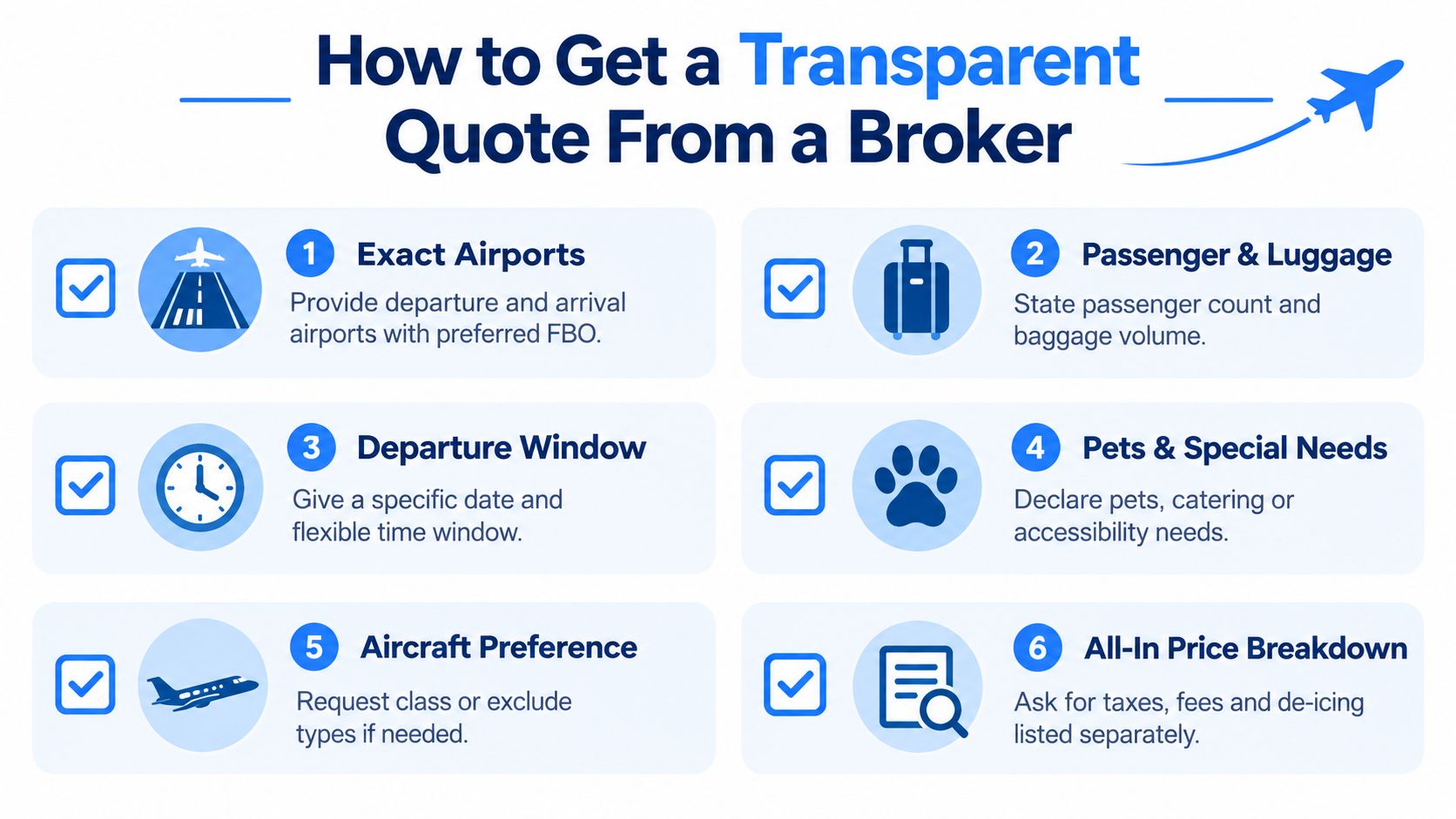
Give the broker:
- Exact airports: Include departure and arrival airports, plus your preferred FBO at each location.
- Passenger and luggage details: State the passenger count, baggage volume, unusual equipment, and oversized items.
- Departure window: Provide a specific date and a realistic time range.
- Special requirements: Mention pets, medical equipment, accessibility needs, catering preferences, and security concerns.
- Aircraft preferences: Request an aircraft class or identify types you won't accept.
Then request a written, all-in proposal. It should show the hourly rate, estimated flight time, positioning, applicable taxes, segment fees, FBO handling, catering, de-icing, international handling, and crew overnight charges as separate lines.
Use this broker script
Please quote the complete trip total and itemize every charge outside the occupied flight time. Show positioning, taxes, airport and FBO fees, crew expenses, catering, de-icing, international handling, and cancellation terms separately.
Reject a proposal that arrives as one round figure with no supporting breakdown. Ask for the operator name, tail number when available, and the Part 135 certificate number. You can then verify the operator through recognized aviation safety resources such as ARGUS or Wyvern.
Request a written price hold for 24 to 72 hours, a clear cancellation window, and the payment schedule before signing. The broker should also explain what can change after the quote is accepted, including weather-related repositioning, airport closures, aircraft substitution, and special handling.
A broker who won't identify the operating carrier or explain the fee structure hasn't given you a complete quote.
Putting It Together Before You Book
Start with the mission, not the aircraft. Confirm the passenger count, route, luggage, schedule sensitivity, and any special requirements. Then choose the lightest aircraft class that safely handles the trip, rather than paying for cabin or range you don't need.
Build a simple comparison sheet with four columns:
- Hourly rate: Record the quoted rate and aircraft type.
- Estimated flight time: Include the operator's stated billable or block-time assumption.
- All-in total: Use the final proposed figure, not an hourly multiplication.
- Fee lines: List positioning, taxes, FBO handling, catering, crew, de-icing, and international charges.
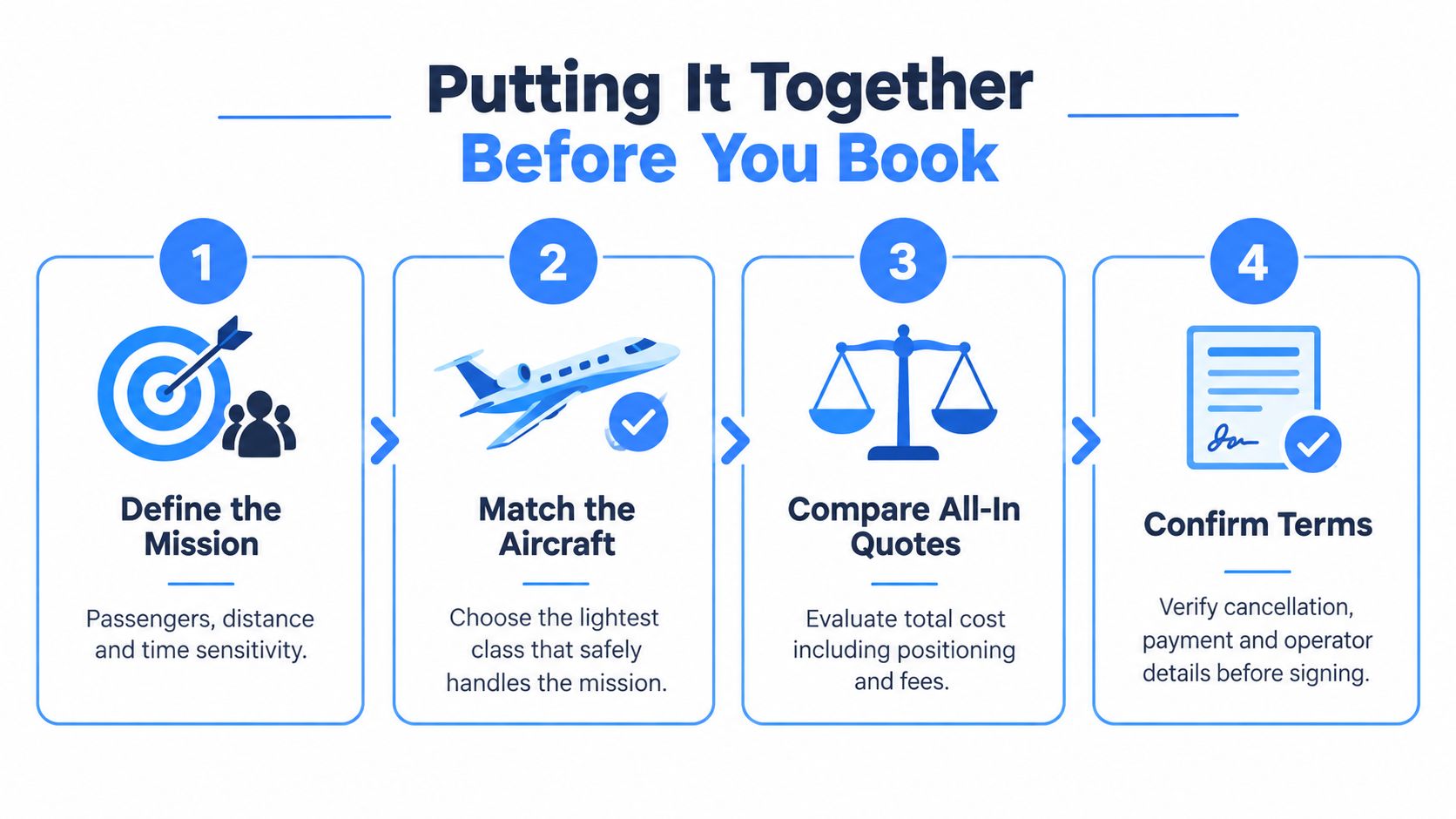
Compare two aircraft within the same suitable class before moving up the fleet ladder. Negotiate on total trip cost, fee waivers, catering credits, airport alternatives, or positioning arrangements. Haggling over a posted hourly number is usually less productive because the operator's economics depend on the complete mission.
Reconfirm aircraft availability, passenger and baggage details, weather assumptions, and overnight charges before departure. Get the cancellation and payment terms in writing, then verify the operating carrier before authorizing funds.
Approved Jets arranges on-demand charter flights through a vetted operator network and provides itemized quote support for domestic and international missions. Visit Approved Jets to request a mission-specific proposal that separates aircraft pricing, positioning, and trip logistics before you book.