

Flying Cross Country by Private Jet
Flying cross country by private jet made practical: aircraft choices, routing, fuel stops, costs, customs, and ground logistics explained

Approved Jets

On this page
- Table of Contents
- What Flying Cross Country Actually Means Today
- Start With the Destination, Not the Jet
- Give Someone Ownership of the Handoffs
- Matching the Aircraft to the Mission
- Aircraft Categories vs Typical Cross-Country Missions
- Confirm the Actual Cabin and Payload
- Planning the Route, Fuel Stops, and Winds
- Replace Headline Range With Trip Fuel
- Work Through the Operational Decisions
- Representative Cross-Country Itineraries
- New York to Los Angeles
- Miami to Aspen
- A Corporate Trip Across the Border
- What Cross-Country Private Flying Actually Costs
- Find the Charges Outside the Flight Rate
- Compare Against the Same Commercial Mission
- Customs, Permits, Pets, and Special Cargo
- Border and Permission Checklist
- Pets and Specialized Missions
- When the Cheapest Option Is Not the Lowest-Cost Choice
- Choose by Consequence, Not Status
- Putting the Mission Together With the Right Partner
- Request a Mission-Specific Proposal
Your team needs to get from New York to a meeting in Los Angeles. The aircraft quote looks straightforward until someone adds presentation equipment, another passenger, and a return departure that depends on when negotiations finish. Then the cheapest jet needs a fuel stop, and the arrival airport leaves everyone facing an inconvenient drive.
Flying cross country is a door-to-door logistics decision, not an hourly-rate comparison. Start with where you need to be, when you need to arrive, and what must travel with you. Buy the aircraft around those requirements, not the other way around.
Table of Contents
- What Flying Cross Country Actually Means Today
- Matching the Aircraft to the Mission
- Planning the Route, Fuel Stops, and Winds
- Representative Cross-Country Itineraries
- What Cross-Country Private Flying Actually Costs
- Customs, Permits, Pets, and Special Cargo
- When the Cheapest Option Is Not the Lowest-Cost Choice
- Putting the Mission Together With the Right Partner
What Flying Cross Country Actually Means Today
For a charter passenger, cross-country flying means coordinating a mission across regions, not satisfying a pilot-training definition. The useful question isn't whether an aircraft can connect the departure and destination airports. It's whether the complete itinerary gets everyone to the actual destination ready to do what they came to do.
That distinction matters for an executive meeting, a family ranch visit, or an athlete traveling between events. An impressive cabin doesn't compensate for baggage that won't fit. An attractive departure time doesn't help if the receiving driver is waiting at the wrong private terminal.
Start With the Destination, Not the Jet
Build the request backward from the commitment that matters. For a board meeting, that's arrival at the office with time to prepare. For a ski trip, it's reaching the lodge with the children, skis, and luggage together.
Give the advisor a mission brief that separates requirements from preferences:
- Hard deadline: Identify the event or appointment that can't move.
- Actual addresses: Provide the starting location and final destination, not just city names.
- Passenger needs: Flag mobility limitations, privacy requirements, pets, and work or rest expectations.
- Operational flexibility: Say whether a different airport, earlier departure, or planned stop is acceptable.
These details let an advisor compare complete itineraries rather than produce superficially similar aircraft quotes.
Practical rule: Choose the itinerary you can execute, not the flight that looks best before ground transport and contingencies are added.
Give Someone Ownership of the Handoffs
Ask who coordinates the aircraft operator, departure terminal, receiving handler, and drivers. You should also know who contacts you if the airport changes while you're airborne.
Keep the responsibilities clear. The operator and flight crew control operational and safety decisions. The broker coordinates sourcing and travel logistics. Your travel manager defines the business priorities and authorizes changes.
Airfare is only one component of mission cost. The planning standard should be arrival readiness, including people, equipment, and onward arrangements. A cabin upgrade is optional. A workable handoff isn't.
Matching the Aircraft to the Mission
Buy capability before cabin prestige. Aircraft selection should start with passenger load, baggage dimensions, route requirements, and airport performance. Cabin photographs come later.
Use the comparison below to establish a shortlist. The seat and range descriptions are deliberately qualitative because a category label doesn't establish the capabilities of the specific aircraft offered.
Aircraft Categories vs Typical Cross-Country Missions
| Category | Typical seats | Nonstop range | Best-fit mission |
|---|---|---|---|
| Light jet | Small-party seating | Regional missions, aircraft-dependent | Executive travel where compact baggage and airport access matter |
| Midsize | Small-team seating with more cabin room | Longer regional missions, subject to load | Travelers seeking additional working space without a large cabin |
| Super midsize | Executive-team seating | Potential coast-to-coast capability after validation | New York to Los Angeles with meaningful luggage requirements |
| Heavy jet | Larger-party seating and varied cabin layouts | Long-distance capability, model-dependent | Coast-to-coast travel with substantial comfort or rest requirements |
| VIP airliner | Group seating, configuration-dependent | Highly dependent on aircraft and payload | Sports teams, touring parties, and coordinated group movements |
A light jet is a sensible starting point for a small executive party traveling from Boston to Washington. Don't extrapolate that regional suitability into a coast-to-coast promise. A midsize jet deserves consideration when cabin space matters but the mission doesn't justify buying substantially more aircraft.
A super midsize jet belongs on the New York-to-Los Angeles shortlist, including when passengers have full luggage. Treat nonstop service as something the operator must validate, not something the category automatically guarantees.
Confirm the Actual Cabin and Payload
For an eight-passenger coast-to-coast trip requiring a sleeper berth, evaluate a heavy jet with the exact sleeping arrangement confirmed. A reclining seat isn't interchangeable with a berth, and a cabin's advertised passenger capacity doesn't tell you how many people can rest comfortably.
For a sports team or tour group, a VIP airliner may solve the passenger problem while introducing separate equipment-loading and airport-handling questions.
Before accepting a match, require confirmation of:
- Usable baggage space: Include skis, instrument cases, medical equipment, and oversized items.
- Runway suitability: Ask the operator to validate the proposed airports under expected conditions.
- Cabin configuration: Confirm seating, sleeping arrangements, and access to essential belongings.
Use this guide to long-range aircraft to narrow the discussion, then obtain mission-specific validation.
Bigger isn't automatically better. Don't pay to transport empty seats unless the aircraft's range, cabin, or operational capability solves a real requirement.
Planning the Route, Fuel Stops, and Winds
A route drawn between airports isn't an operational flight plan. The dispatcher and crew must reconcile weather, airspace, aircraft performance, payload, and fuel requirements before deciding whether the proposed itinerary works.
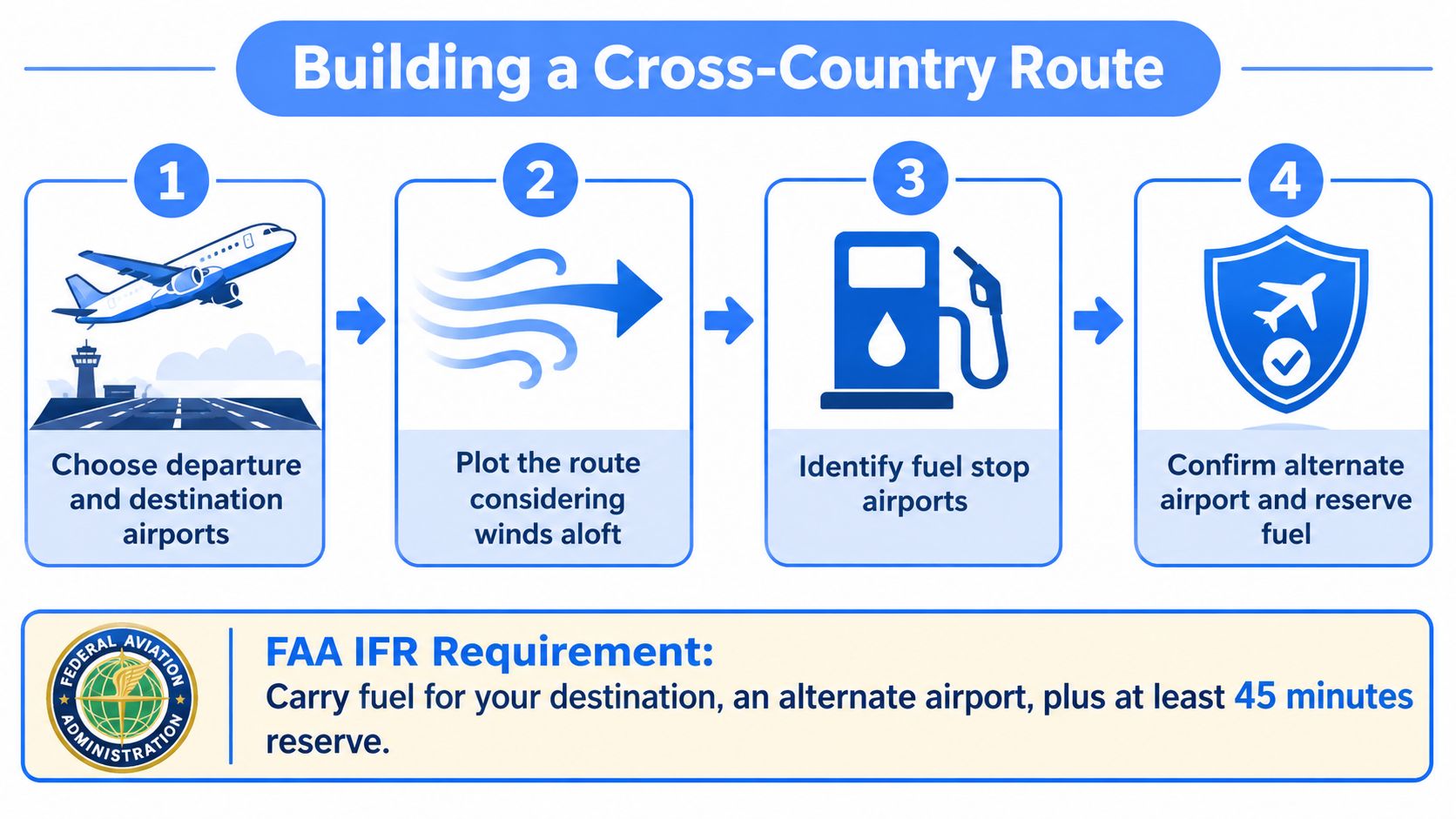
For applicable U.S. IFR planning, the fuel model must cover the destination, a required alternate, and at least 45 minutes at normal cruising speed, as described in FAA fuel-planning guidance. That reserve isn't spare capacity to promise away during the sales conversation.
The planning sequence should remain visible to the traveler, even though the operator performs the calculations.
Replace Headline Range With Trip Fuel
Treat an advertised 3,000-nautical-mile range as a planning hypothesis, not a contractual promise. Ask which payload, temperature, cruise profile, and reserve assumptions underpin it.
The useful calculation separates taxi, climb, cruise, descent and approach, alternate, and reserve fuel. A single average burn rate conceals the differences between those phases and doesn't establish feasible nonstop performance.
Winds also change the result. At a fixed true airspeed, headwinds reduce groundspeed and increase the time and fuel needed to cover a distance; tailwinds do the opposite. The National Weather Service aviation forecasting resource explains the role of winds and temperatures aloft in flight planning.
Work Through the Operational Decisions
Consider a Miami-to-Dallas itinerary as a planning exercise. The crew should examine route weather, NOTAMs, AIRMETs, SIGMETs, winds aloft, fronts, and thunderstorm activity, consistent with the briefing elements in the FAA cross-country planning handbook chapter.
That review should drive a connected set of decisions:
- Departure timing: Would another departure window avoid a problematic weather period?
- Routing and altitude: Which available combination supports suitable conditions and performance?
- Fuel and alternates: What load supports the route without compromising required margins?
- Stop selection: If nonstop performance is marginal, which refueling airport provides a dependable alternative?
Don't demand a precise time advantage before the operator has modeled the options. A wind-favored routing may outperform the shortest geographic route, but the benefit depends on the actual conditions.
A fuel stop cannot preserve nonstop status. It can preserve the mission when a nonstop plan no longer works.
Ask for the expected arrival impact of the stop, including descent, ground service, and another departure. Then compare that complete itinerary against a more capable aircraft.
Representative Cross-Country Itineraries
The following are planning examples, not completed customer case studies. Each illustrates a different reason to look beyond the flight segment.
The coast-to-coast journey is the obvious starting point.

New York to Los Angeles
Start with a super midsize or heavy jet shortlist, then ask the operator to validate the westbound mission with the actual passengers and luggage. Don't assume the return flight will have the same duration or performance margin. Forecast conditions, rather than a general rule about winds leaving the Northeast, must determine the plan.
For a meeting-driven itinerary, request an arrival window at the meeting address, not merely a landing estimate. Have the advisor compare destination airports against the ground journey and keep the receiving driver informed of changes.
The broker's useful contribution is exposing the trade-off before booking: confirmed nonstop suitability, a planned stop, or an aircraft change.
Miami to Aspen
Here, treat airport performance and the lodge transfer as primary selection criteria. Have the operator validate the aircraft against expected runway, elevation, temperature, and weather conditions rather than choosing solely for cabin comfort.
Send the baggage manifest early, including skis and bulky winter luggage. Ask for a diversion plan that identifies the receiving vehicle, passenger communication process, and revised transfer to the lodge.
Don't promise an arrival at the resort that depends on every operational assumption remaining favorable. Build the day's schedule around the validated flight estimate and an agreed fallback.
For a visual companion to the cross-country planning discussion, use the video below.
A Corporate Trip Across the Border
For an itinerary into Mexico, the Bahamas, or the Caribbean, ask the advisor to establish the clearance and handling sequence before committing to a departure.
- Before confirmation: Verify passenger-document readiness and have the operator identify applicable permissions.
- Before departure: Confirm the clearance location, receiving handler, and driver instructions.
- Before the return: Recheck the itinerary against any changed passenger list or departure arrangements.
Timing should remain conditional until the operator and handlers confirm the applicable requirements. A private aircraft doesn't make an incomplete border plan executable.
What Cross-Country Private Flying Actually Costs
A low hourly rate isn't a low trip total. Compare quotes only after the aircraft, routing, included services, and commercial terms are clear.
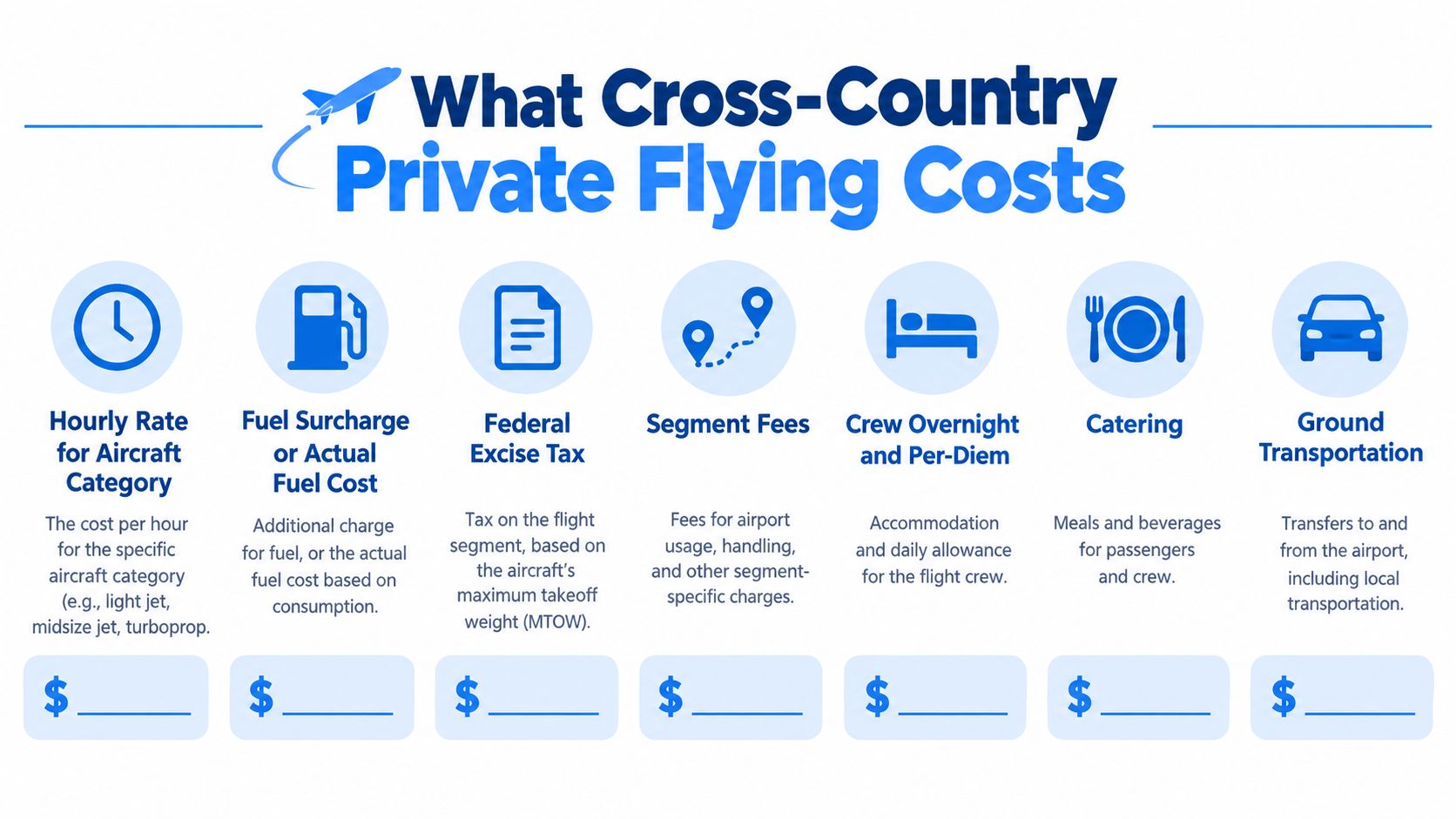
Request an itemized explanation of the aircraft charge, fuel surcharge or actual fuel treatment, applicable federal excise tax and segment fees, crew overnight expenses and per diem, catering, and ground transportation. Have the provider identify which items are included, estimated, or billed after travel.
Use the expense categories below as a quote-review aid, not a price schedule.
Find the Charges Outside the Flight Rate
Ask specifically about repositioning to the departure airport, destination FBO handling and ramp charges, and international handling or navigation charges where applicable. Require an explanation of de-icing and other weather-related additions before accepting the agreement.
The luxury travel insight on jet charter costs from Haute Black is a useful companion for organizing questions about a quote. Pair it with this private jet travel cost guide, then request written clarification of your own itinerary's inclusions.
A smaller aircraft can lose its apparent price advantage when the complete itinerary includes additional flying and ground activity. Compare the total proposed mission, not the rate attached to the aircraft category.
Compare Against the Same Commercial Mission
The Bureau of Transportation Statistics on-time performance standard classifies an arrival as delayed when it reaches the destination at least 15 minutes after schedule. A published three-hour flight therefore shouldn't be treated as three hours of door-to-door travel.
For the commercial alternative, include airport transfers, connection exposure, any necessary hotel stay, and the working time your organization assigns to the journey. For charter, use the complete written quote and the same arrival objective.
Quote-review test: Ask what you'll owe if the mission proceeds exactly as planned, then ask which changes could increase that amount.
Treat productivity as an internal business calculation, not a universal justification for private flying. If the commercial itinerary meets the objective comfortably, acknowledge it.
Customs, Permits, Pets, and Special Cargo
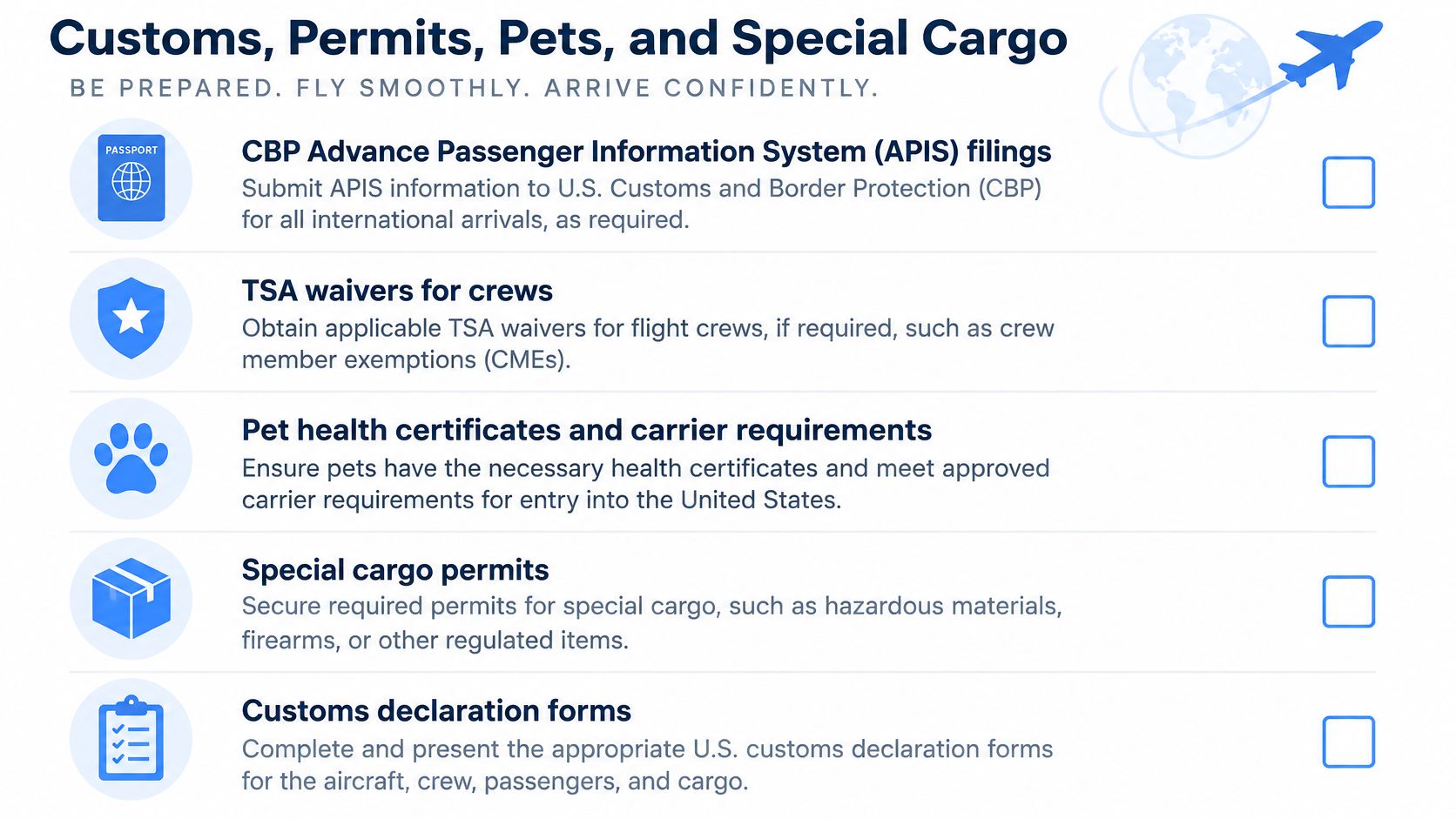
Resolve paperwork before treating the departure as firm. For international and specialized missions, ask the operator and relevant handling specialists to identify the applicable requirements in writing.
Don't use a generic checklist as legal clearance. Use it to assign responsibility and identify missing information.
Border and Permission Checklist
- CBP and APIS: Have the operator confirm applicable Advance Passenger Information System filings, passenger-data requirements, and the planned customs-clearance process.
- TSA waivers: Ask whether the proposed international operation triggers any TSA waiver or authorization requirement. Don't assume every international crew requires the same waiver.
- Overflight and landing permissions: Obtain confirmation of what applies to the aircraft, operator, and route. Ask whether approval timing limits departure or requires a different routing.
- Customs declarations: Assign responsibility for passenger forms, equipment declarations, and any sensitive or high-value items.
Keep names and itinerary details consistent across the booking and clearance documents. When a passenger changes, notify the advisor immediately rather than assuming the flight paperwork will update itself.
Pets and Specialized Missions
For pets, provide species, size, travel-container details, and destination information before aircraft selection. Ask the operator and destination specialists to confirm health documentation, import conditions, cabin acceptance, and restraint or carrier requirements.
Don't assume an emotional-support designation establishes operator acceptance or destination eligibility. Use this pet travel requirements guide to prepare the questions, then obtain itinerary-specific confirmation.
Medical evacuation requires a different booking conversation from ordinary passenger charter. Have the clinical team and operator confirm patient suitability, equipment, accompanying personnel, and the receiving-facility handoff.
For sensitive cargo, require an agreed custody plan:
- Loading responsibility: Identify who accepts and secures the shipment.
- Documentation: Confirm the required descriptions, permissions, and accompanying records.
- Delivery control: Name the authorized recipient and establish proof of handover.
A suitable aircraft with an unresolved permission or receiving arrangement isn't a ready mission. Don't let cabin availability distract from that distinction.
When the Cheapest Option Is Not the Lowest-Cost Choice
The cheapest quote wins only when it delivers the outcome you need. Saving on transportation makes little sense if the selected itinerary jeopardizes a meeting, separates essential equipment from its users, or leaves the traveler without a workable onward plan.
The DOT air-travel consumer reporting resource covers delays, cancellations, mishandled baggage, and oversales as separate service-quality categories. The independent 2025 analysis summarized by PIRG reported approximately 1.66 million major-carrier flights, nearly one-quarter, delayed, canceled, or diverted, including more than 100,000 cancellations.
Choose by Consequence, Not Status
Commercial first class is rational when the schedule works and a disruption wouldn't compromise an essential commitment. Semi-private or charter-by-the-seat travel belongs in the comparison when its published route, timing, and conditions fit.
A one-way charter deserves consideration when the outbound deadline matters but the return remains flexible. Full private coordination is more appropriate when the flight, equipment, border process, and receiving arrangements need active management together.
If a connection fails, make the recovery decision in this order:
- Protect the objective: Establish the latest useful arrival and what happens if it's missed.
- Compare recovery options: Evaluate commercial rebooking, another departure airport, or charter against that deadline.
- Locate baggage: Determine whether essential belongings can travel with the revised itinerary.
- Reset downstream bookings: Contact drivers, hotels, hosts, and onward providers before their arrangements become unusable.
- Preserve records: Keep receipts and written disruption notices without assuming every expense will be reimbursed.
A broker should earn their role by owning this coordination, not merely forwarding an aircraft price. Ask who answers during the disruption and who has authority to arrange alternatives.
Buy private flying when the mission warrants it, not because someone presents it as the automatic answer.
Putting the Mission Together With the Right Partner
Define the required outcome, select a suitable aircraft, obtain operational validation, and confirm the receiving arrangements. Then compare the complete cost against realistic alternatives.
For unavoidable travel, include environmental questions in procurement rather than treating an offset as the entire answer. Ask about consolidating travelers, avoiding unnecessary segments, and reducing empty repositioning. Chalmers research on aviation's climate impact highlights why routing, weather, and contrails complicate a fuel-only comparison.
Request a Mission-Specific Proposal
Send the advisor a usable starting package:
- People and belongings: Passenger count, luggage, oversized equipment, pets, and accessibility needs.
- Timing and geography: Actual addresses, preferred departure window, and latest useful arrival.
- Decision boundaries: Budget priorities, acceptable alternatives, and who can authorize changes.
Look for a partner who explains operator vetting, provides transparent quote assumptions, and identifies responsibility through arrival. Ask for a quote-response target and distinguish it from confirmed aircraft availability.
The right proposal should make the trade-offs understandable before you commit. You don't need the largest jet or the cheapest hourly rate. You need an itinerary whose assumptions, responsibilities, and fallback arrangements are clear.
Approved Jets arranges cross-country charters through a vetted operator network and coordinates aircraft matching, customs paperwork, and ground transfers. Visit Approved Jets with your passenger count, luggage details, departure window, and arrival deadline to request a mission-specific quote rather than a generic hourly rate.