
Medical Emergency on Flight: What to Do
Learn what to do during a medical emergency on flight, from immediate actions to diversion decisions and medevac coordination with private charter support.

Approved Jets

On this page
- Table of Contents
- How Common Are Medical Emergencies on Flights
- Uncommon doesn't mean inconsequential
- Immediate Actions When a Passenger Falls Ill
- Make the first report useful
- Preparation helps more than improvisation
- How Crew and Medical Volunteers Coordinate
- One clinical picture, clearly communicated
- Advice isn't an automatic flight instruction
- On-Board Medical Equipment and What It Can Do
- Standard In-Flight Medical Equipment
- Understand the limits before relying on the kit
- When a Flight Diverts and Who Decides
- Judge access to treatment, not just distance
- Keep the landing decision separate from repatriation
- After Landing and Medevac Options
- Local care versus medically supported transport
- Plan the whole transfer
Medical emergencies occur at an estimated 18.2 events per million airline passengers, according to a systematic review of 18 studies covering approximately 1.5 billion passengers, although the evidence had very low certainty because reporting varied substantially. That's a reassuringly low frequency, but it doesn't make the decision easy when someone becomes seriously ill above an ocean. Managing a medical emergency on flight involves more than finding a doctor: the crew must connect clinical assessment, aircraft operations, and the patient's access to care after landing.
Table of Contents
- How Common Are Medical Emergencies on Flights
- Immediate Actions When a Passenger Falls Ill
- How Crew and Medical Volunteers Coordinate
- On-Board Medical Equipment and What It Can Do
- When a Flight Diverts and Who Decides
- After Landing and Medevac Options
How Common Are Medical Emergencies on Flights
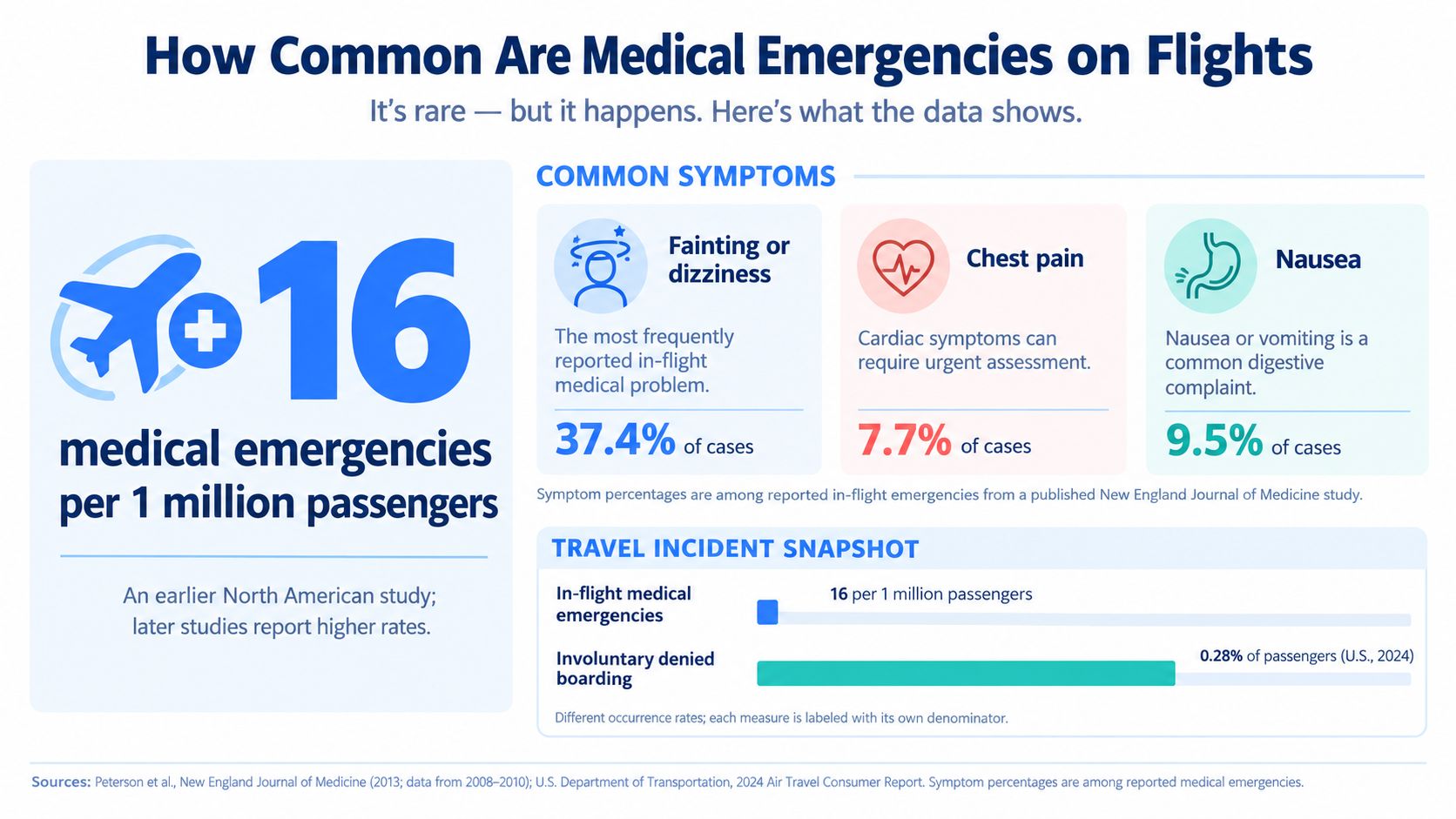
A large observational study of in-flight medical emergencies recorded 11,920 emergencies across approximately 744 million passengers, equivalent to 16 emergencies per million passengers, or roughly one event per 604 flights; physician passengers assisted in 48.1% of cases, and 7.3% resulted in diversion. These figures describe reported events within that study, not a guaranteed rate for every airline or route.
The distinction matters. A brief episode of dizziness and a suspected cardiac arrest create very different demands, even though both may enter an airline's medical reporting system. Frequency alone doesn't tell a family or travel manager how urgently a particular passenger needs help.
The statistical overview puts uncommon events into perspective.
Uncommon doesn't mean inconsequential
In the same observational study, among 10,914 patients with post-flight follow-up, 25.8% were transported to a hospital by emergency medical services and 8.6% were admitted; researchers recorded 36 deaths, equivalent to 0.3% of cases with available outcome data, with 30 occurring during flight. Those outcomes explain why a flight that continues normally may still require an urgent medical reception at its destination.
Operational perspective: Completing the scheduled flight doesn't mean the medical event is over. The patient may still need an ambulance waiting on arrival.
For practical planning, separate three questions:
- Likelihood: How often are events reported? Passenger-based rates provide broad context, not an individual medical risk assessment.
- Severity: Is the passenger improving, remaining unwell, or deteriorating? The response should follow the condition, not the statistical average.
- Continuity: What care will be available after touchdown? A successful cabin response still needs a clear handoff when hospital assessment is warranted.
Consider a passenger who becomes dizzy, briefly loses consciousness, and then appears comfortable. The improvement is useful information, but it shouldn't encourage companions to conceal the episode or assume no assessment is needed. Tell the crew what happened, including whether the passenger struck their head or has a relevant medical condition.
For corporate travel managers, the useful takeaway isn't to treat every journey as hazardous. It's to make medication information, emergency contacts, and assistance arrangements accessible before departure, particularly when a traveler already has significant health concerns.
Immediate Actions When a Passenger Falls Ill
Alert cabin crew immediately and describe what you can observe. Give the seat location, say whether the passenger is awake, and explain whether they're breathing normally or showing symptoms such as chest pain, confusion, or severe breathing difficulty. Don't delay while trying to identify the diagnosis yourself.
Fainting or near-fainting, respiratory symptoms, and nausea or vomiting are among the most frequently reported onboard problems, according to the CDC's guidance on responding to medical emergencies when flying. Familiar symptoms still deserve attention when they're persistent, severe, or accompanied by a change in consciousness.
Crew members need access to the passenger and enough room to bring equipment into position.

Make the first report useful
The opening moments work best when nearby passengers divide simple tasks rather than all trying to help physically.
- Summon assistance: Use the call button and attract a flight attendant's attention. If the passenger is unresponsive or isn't breathing normally, say that explicitly.
- Clear access: Move bags and loose items out of the way when directed. Don't gather in the aisle or relocate an ill passenger without a clear reason and guidance.
- Provide relevant history: Tell the crew about known conditions, prescribed emergency medication, allergies, and when symptoms began. A companion's factual account can be more useful than speculation.
- Follow directions: Fetch an item, help communicate, or move seats if asked. Don't independently give someone else's medication or offer food and drink to a passenger who isn't fully alert.
A useful report might be: “The passenger in this seat suddenly became confused and can't answer normally. They were speaking clearly before this started.” That gives responders a change to investigate without claiming a diagnosis.
Preparation helps more than improvisation
For travelers with asthma or severe allergies, discuss an emergency plan with the treating clinician before flying and keep prescribed rescue medication accessible. For people seeking relevant preparation, TP Training's NSW safety training for allergic emergencies is a resource to review before travel, not something to consult instead of summoning help during an event.
Stay with the passenger if you're their companion, but let the crew organize the response. Filming, arguing over diagnoses, or repeatedly interrupting responders makes an already confined working area harder to manage.
How Crew and Medical Volunteers Coordinate
Consider a hypothetical passenger who develops persistent chest pain during a long-haul flight. A flight attendant alerts the senior cabin crew member and flight deck, while another brings the relevant medical equipment. A volunteer physician assesses the passenger, but the physician doesn't take over the aircraft's chain of command.
The clinical assessment and operational communication run alongside each other. The volunteer can examine the passenger and report findings; the crew maintains the connection with the cockpit and available ground medical support. A clinical review of in-flight medical emergency management describes a structured response involving assessment, onboard resources, qualified assistance, and ground-to-air medical guidance.
One clinical picture, clearly communicated
In this example, the useful report is not that someone has chest pain. Responders need the symptom history, the passenger's level of consciousness, breathing, available vital signs, relevant medication, and whether the condition changes after an intervention.
| Participant | Useful contribution |
|---|---|
| Cabin crew | Organizes access, equipment, communication, and cabin safety |
| Medical volunteer | Assesses the passenger and explains findings within their competence |
| Ground medical support | Advises on care and the urgency of reaching suitable treatment |
| Flight deck | Evaluates available operational options and executes the flight decision |
Ground-based telemedicine adds clinical support; it doesn't eliminate uncertainty. The remote clinician depends on the observations relayed from the cabin. Clear updates about deterioration or improvement are more useful than an unsupported assertion that the passenger is “fine.”
A five-year study of airline medical diversions recorded 220 diversions, with pilots or onboard medical personnel making 91 decisions, or 41.4%; it also recorded 5,386 telemedicine contacts, with ground providers recommending approximately 2.4 diversions per 100 calls. The figures show that a medical-support call isn't synonymous with a recommendation to land elsewhere.
Advice isn't an automatic flight instruction
If the volunteer recommends urgent hospital care, that recommendation needs to reach the cockpit with its reasoning. “Persistent symptoms with worsening responsiveness” is more actionable than “land now” without supporting observations.
A medical volunteer contributes clinical judgment. The captain retains final authority over the flight.
Coordination works when everyone stays within a clear role and updates the same clinical picture. It works poorly when several volunteers issue competing instructions, the companion's observations are ignored, or a reassuring early assessment isn't revisited after the passenger deteriorates.
On-Board Medical Equipment and What It Can Do
Onboard equipment is for immediate assistance and stabilization, not hospital-level diagnosis or treatment. Commercial aircraft carry first-aid supplies and emergency medical resources, but contents, access procedures, and availability vary by operator and jurisdiction. Don't assume the aircraft has every medicine or monitoring device a clinician would normally use.
The crew should establish what's available before a volunteer proposes an intervention. A recommendation that depends on equipment the aircraft doesn't carry wastes attention and can create false expectations for the passenger's family.
Standard In-Flight Medical Equipment
| Equipment | Primary Use |
|---|---|
| First-aid kit and bandages | Basic wound care and assistance with minor injuries |
| Emergency medical kit | Supplies and medications for assessment and emergency care within applicable procedures |
| Supplemental oxygen | Supporting a passenger when clinically indicated and available |
| Blood pressure cuff | Providing a blood pressure measurement where carried |
| Stethoscope | Supporting clinical examination where carried |
| Automated external defibrillator, or AED | Assessing heart rhythm and prompting a shock when indicated during suspected cardiac arrest |
| Protective supplies | Helping responders reduce exposure while providing care |
The table is a practical overview, not a promise of identical equipment on every flight. Ask the crew to identify the available kit and explain its access process rather than searching cabin storage yourself.
An AED has a specific emergency role. It isn't a general treatment for chest pain, and it doesn't replace CPR during cardiac arrest. If a passenger is unresponsive and isn't breathing normally, responders should activate the emergency response, begin appropriate resuscitation, and bring the AED into use promptly while following its instructions.
Understand the limits before relying on the kit
A blood pressure reading can add useful information, but it can't rule out a heart attack or stroke. Similarly, oxygen may form part of care without resolving the underlying cause of breathing difficulty.
- Medication requires judgment: The correct drug depends on the suspected condition, contraindications, the passenger's history, and the responder's competence. Don't treat the kit as a collection of remedies to try.
- Measurements need context: Record findings alongside symptoms and changes in the passenger's condition. An isolated reading shouldn't override obvious deterioration.
- Resources are finite: Confirm available oxygen and supplies with the crew. Continued treatment has to remain feasible for the flight still ahead.
For example, a passenger's breathing may improve after an initial intervention while their need for further assessment remains unresolved. The right question isn't merely whether something in the kit helped. It's whether the available care can safely support the passenger until they reach appropriate treatment.
When a Flight Diverts and Who Decides
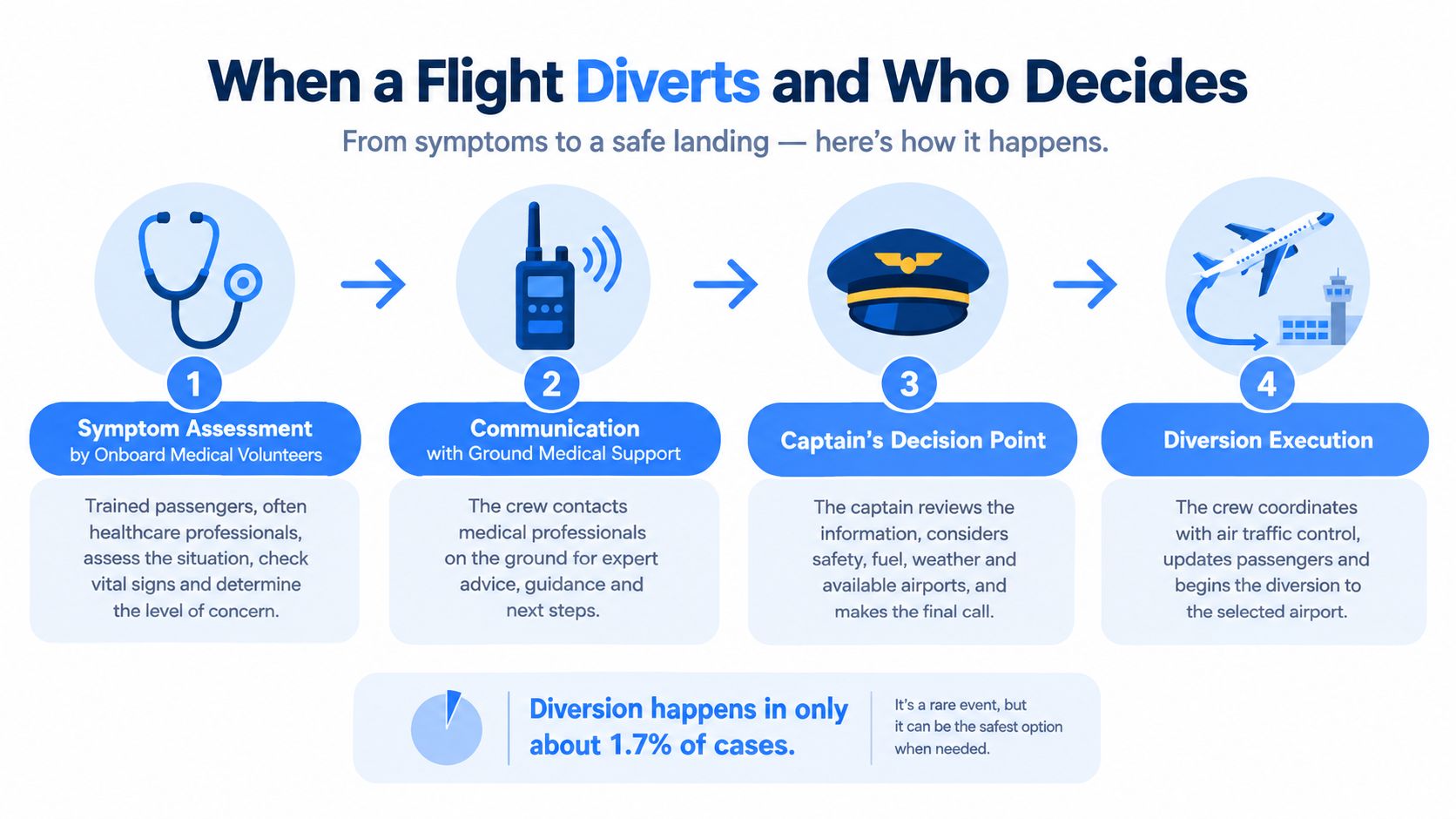
A 2025 cohort study covering 77,790 medical events across 84 airlines found that 1.7% resulted in diversion; neurologic events accounted for 41% of diversions and cardiovascular events for 27%, with suspected stroke showing the strongest association with diversion. That rate belongs to that cohort, not every commercial flight or medical presentation.
The decision follows a coordinated assessment rather than a single symptom automatically triggering a landing.
Judge access to treatment, not just distance
The captain integrates medical advice with fuel, weather, airport capability, distance, border constraints, and access to definitive care. The nearest runway isn't necessarily the quickest route to the treatment the patient needs.
For example, suspected stroke on a remote route creates a difficult comparison. An earlier landing at a small airport may still leave a substantial onward transfer, while another suitable airport may offer better access to specialist care. Responders must assess the realistic path from aircraft to treatment, not just the aircraft's time to touchdown.
Decision rule: Compare time to appropriate care, not merely time to the nearest airport.
Persistent chest pain, worsening neurological symptoms, altered mental status, and an inability to support the passenger adequately onboard can strengthen the case for diversion. Sustained improvement, feasible ongoing care, and proximity to a suitable scheduled destination may support continuing, provided reassessment remains active.
Keep the landing decision separate from repatriation
A diversion airport is an emergency access point, not necessarily the passenger's preferred recovery location. Families and employers shouldn't pressure the crew to choose a familiar city if another destination offers more appropriate immediate care.
The distinction between emergency landing and subsequent medical evacuation and repatriation becomes important once clinicians assess whether further transport is needed.
Use the accompanying video as a supplementary visual reference, not a substitute for crew instructions.
The practical trade-off isn't medical urgency versus inconvenience. A diversion also has to be flown and landed safely, and the receiving location must offer a credible care pathway. Conversely, avoiding disruption isn't a sound reason to dismiss worsening symptoms or delay necessary treatment.
After Landing and Medevac Options
The first priority after landing is appropriate local assessment, not getting the passenger home. When emergency medical services meet the aircraft, the handoff should communicate the symptom onset, observed changes, relevant history, treatment provided, and the passenger's condition at transfer. Companions can help by keeping identification, medication information, and emergency contacts accessible.
An airline incident report and clinical handover serve different purposes. Operational paperwork shouldn't become a substitute for transferring useful medical information to the professionals receiving the patient.
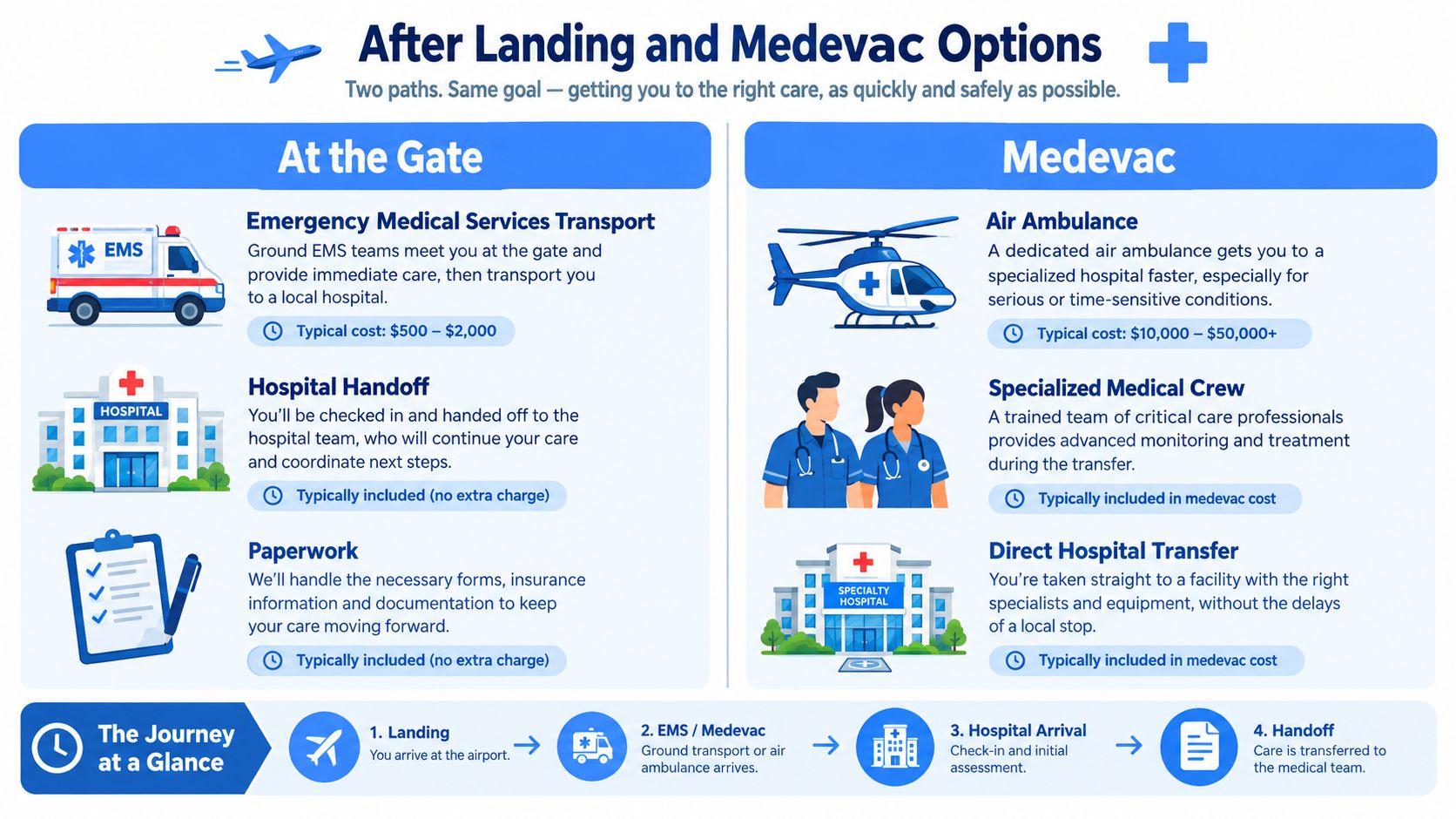
The onward pathway depends on the patient's clinical needs.
Local care versus medically supported transport
Ground ambulance transport and local hospital assessment address the immediate problem. Private charter medevac becomes relevant when a patient needs transfer to another facility, continued medical support during transport, or repatriation after stabilization.
| Pathway | When it may fit | What needs confirming |
|---|---|---|
| Local EMS and hospital care | Immediate assessment or treatment after arrival | Receiving service and clear clinical handover |
| Later commercial travel | Clinicians determine the patient can travel within airline requirements | Medical clearance and necessary assistance |
| Medically equipped charter | The patient needs supported transport beyond ordinary passenger travel | Aircraft suitability, medical team, receiving hospital, and ground transfers |
A private jet alone isn't an air ambulance. The mission must match the patient's requirements, including equipment, monitoring, medical staffing, and arrangements at both ends.
Plan the whole transfer
Medevac can offer direct routing and departure planning around the patient rather than a commercial timetable. It may allow faster mobilization, but availability, clinical readiness, permits, weather, and hospital acceptance still affect departure.
Before committing, establish:
- Clinical suitability: Has the treating team assessed fitness for the proposed transport?
- Receiving arrangements: Which hospital and clinician will accept the patient?
- Connected logistics: Who coordinates ambulances, records, international documentation, and bedside handover?
- Financial scope: What's included in the quote, and what requires separate authorization?
A systematic review of in-flight medical emergencies estimated 11.1 diversions per 100,000 flights and reported unscheduled-landing costs ranging from approximately $15,000 to $893,000 across studies, reflecting factors including aircraft size, fuel burn, and diversion location. Those are airline diversion costs, not medevac prices or automatic passenger liabilities.
For families or assistance teams evaluating onward transport, reviewing air ambulance cost considerations helps frame the questions for a mission-specific quote. Don't book a flight first and try to fit the medical requirements around it afterward.
Approved Jets coordinates medical evacuation and repatriation using specially equipped aircraft, accompanying medical teams, and integrated ground-transfer logistics. If a passenger needs onward transport after an in-flight emergency, visit the team with the treating clinician's transport requirements, proposed receiving facility, and departure location to discuss a coordinated transfer.