
Reliable Jet Maintenance: A Practical Owner's Guide
Discover proven strategies for reliable jet maintenance that keep your aircraft airworthy, safe, and cost-efficient. Practical tips for owners and operators.

Approved Jets

On this page
- Table of Contents
- What Reliable Jet Maintenance Actually Means
- The measures that matter to travelers
- Choosing an Inspection Architecture That Fits the Mission
- Match the schedule to utilization
- Building a Closed-Loop Reliability Process
- Read the trend, not just the monthly score
- Why a Newer Aircraft Is Not Automatically a Reliable One
- Ask how the operator recovers
- What Predictive Maintenance Can and Cannot Do
- Four tests for a predictive program
- Recordkeeping and Airworthiness-Directive Compliance
- Check the compliance matrix before release
- How Aircraft Management Services Reduce Owner Burden
- What credentials establish, and what they don't
- Take this checklist into the next meeting
Your aircraft is ready, the crew is briefed, and the passengers are waiting. Then maintenance control reports that a needed component isn't available, or the aircraft can't return to service until someone verifies a record. The jet may be mechanically sound, but the trip is already at risk.
That's why reliable jet maintenance isn't just a matter of inspections, certifications, or a tidy logbook. It's a documented system that detects problems, proves the aircraft is airworthy, and gets the right people and parts in place to recover when something goes wrong. When you evaluate an operator or aircraft manager, ask for evidence of that whole process, not a general assurance that the fleet is well maintained.
Table of Contents
- What Reliable Jet Maintenance Actually Means
- Choosing an Inspection Architecture That Fits the Mission
- Building a Closed-Loop Reliability Process
- Why a Newer Aircraft Is Not Automatically a Reliable One
- What Predictive Maintenance Can and Cannot Do
- Recordkeeping and Airworthiness-Directive Compliance
- How Aircraft Management Services Reduce Owner Burden
What Reliable Jet Maintenance Actually Means
A clean logbook is useful, but it doesn't prove an operation can respond to a defect before a time-critical departure. Reliable maintenance means the operator can show what was done, why it was done, who approved the work, and how the aircraft's condition is monitored between scheduled inspections. The U.S. Department of Transportation's reliability handbook recommends tracking component performance numerically, such as nonroutine removals or confirmed failures per 1,000 aircraft hours, so actual performance can be compared with expected rates (DOT reliability handbook).
Three terms carry most of the weight. Airworthiness means the aircraft meets applicable requirements for safe operation. Continuing airworthiness is the ongoing work that keeps it compliant and fit to fly. The maintenance program sets the tasks and intervals that support that condition. A claim about dependable service should connect all three to real records and decisions.
The measures that matter to travelers
Don't let an operator use one performance figure to blur different outcomes. Dispatch reliability measures flights departing as scheduled without delays or cancellations. Schedule reliability also accounts for interruptions such as diversions, turnbacks, and late arrivals. A jet might leave on time but encounter a maintenance issue later in the itinerary, so ask which measure the operator reports and what events it includes.
Then pressure-test the evidence behind the claim. Can the operator link flight-hour records, defect reports, component history, inspection findings, and airworthiness decisions in an auditable process? Does it track repeat defects by aircraft tail, or only report a fleet-wide average? Can it show that abnormal trends led to a specific inspection, repair, or approved program change?
Practical rule: Treat “well maintained” as a claim to verify. Ask for trend data, corrective actions, and proof that the fixes worked.
Reliable jet maintenance also includes recovery. A defect can be found and correctly documented while the aircraft remains grounded because an approved repair station, a qualified technician, or a replacement part isn't available. Your working definition should therefore include both sides: evidence that maintenance is controlled, and a credible plan to return the aircraft to service when it isn't ready to fly.
Choosing an Inspection Architecture That Fits the Mission
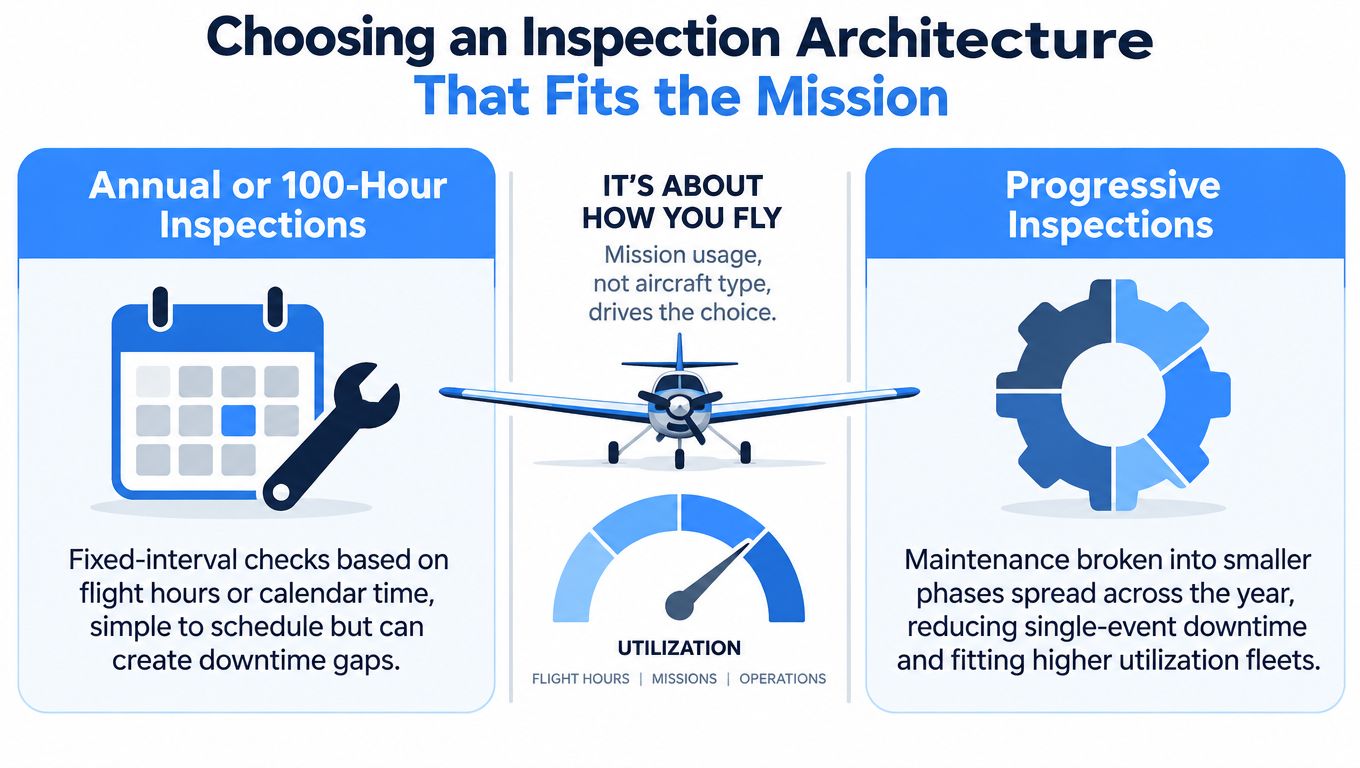
An inspection program should fit how the aircraft is used. A lightly used owner-flown aircraft and a corporate jet operating frequent short sectors don't create the same maintenance-planning problem. The FAA recognizes several structures, including annual or 100-hour inspections, progressive inspections, Approved Aircraft Inspection Programs, and Continuous Airworthiness Maintenance Programs. The program must specify the tasks and intervals needed to keep the aircraft airworthy (FAA guidance on maintenance programs and inspections).
Match the schedule to utilization
An annual inspection concentrates inspection work around a calendar interval. A 100-hour inspection is another defined structure where applicable. These approaches can be straightforward to plan, especially for an aircraft with relatively low utilization, but concentrated work can mean a significant period of downtime. Don't assume those labels alone explain the program. Ask what tasks are covered, when they fall due, and how the operator handles recurring requirements between major events.
A progressive inspection breaks work into phases distributed across planned events. That can suit a frequently flown aircraft when the operator controls the scope, timing, and records carefully. FAA guidance distinguishes annual inspections, whose procedures and scope follow Part 43, Appendix D, from progressive inspections, whose scope and detail are established by the owner or operator under 14 CFR 91.409(d). In either case, applicable airworthiness directives (ADs) must be accounted for.
Consider a corporate jet flying frequent short sectors. The operator could schedule recurring checks around flight-hour or calendar thresholds, inspect high-use systems earlier, and reserve deeper tasks for planned downtime. That structure can reduce the burden of concentrating every task in one large event, but only if maintenance control tracks due items and confirms complete coverage.
Ask the management company: Which inspection structure is approved for this aircraft, what utilization assumptions support it, and how do you verify AD compliance at each release? Then compare those answers with your expected use and travel priorities. If you're also weighing the wider ownership commitment, this private-jet ownership cost overview can help frame the maintenance discussion alongside other operating responsibilities.
The key isn't choosing “progressive” because it sounds more flexible. It's choosing a documented inspection architecture that fits the mission and makes every task, deadline, and sign-off visible. The FAA inspection guidance video offers additional context on inspection structure and maintenance responsibilities.
Building a Closed-Loop Reliability Process
Scheduled inspections are essential, but they don't tell you whether the operator is learning from repeat defects. A reliable maintenance-control team runs a closed loop: identify meaningful indicators, collect complete data, analyze trends, assign fixes, and verify that those fixes worked before adjusting maintenance intervals. FAA guidance calls for identifying fleet data sources, statistically analyzing reliability information, displaying results, and reporting approved recommendations (FAA reliability-program guidance).
Start with indicators that reflect actual disruptions: delays per 100 departures, cancellations, component removals, pilot reports, unscheduled component changes, and deferred defects. Normalize results by flight hours, cycles, or departures so that aircraft with different utilization can be compared more fairly.
| Indicator | What it captures | Normalize by |
|---|---|---|
| Delays per 100 departures | Maintenance-related departure disruption | Departures |
| Cancellations | Trips prevented by a maintenance issue | Departures or flight hours |
| Component removals | Unplanned removals and confirmed failures | Flight hours |
| Pilot reports | Defects or symptoms reported by the crew | Flight hours or departures |
| Unscheduled component changes | Repair activity outside planned maintenance | Flight hours or cycles |
| Deferred defects | Open items awaiting approved corrective action | Flight hours or calendar time |
Read the trend, not just the monthly score
A small fleet can produce sharp swings in a single month, and a fleet-wide average can conceal a recurring defect on one aircraft. Ask to see rolling three-, six-, and twelve-month views, event counts alongside percentages, and results broken down by aircraft tail. The operator should distinguish dispatch reliability from schedule reliability rather than presenting one figure as proof of both.
The loop only matters if the team acts on the findings. A useful dashboard shows alert or action levels, the person responsible for each corrective action, the due date, and how the team verified effectiveness. If the same fault returns, maintenance control should investigate the task, part, repair station, and operating context instead of closing another work order.
For operators assessing component sourcing and repair options, American Additive Manufacturing for MRO provides relevant context on manufacturing and maintenance, repair, and overhaul support. It's a resource to discuss with the operator, not a substitute for confirming which parts and repairs are approved for the aircraft.
Why a Newer Aircraft Is Not Automatically a Reliable One
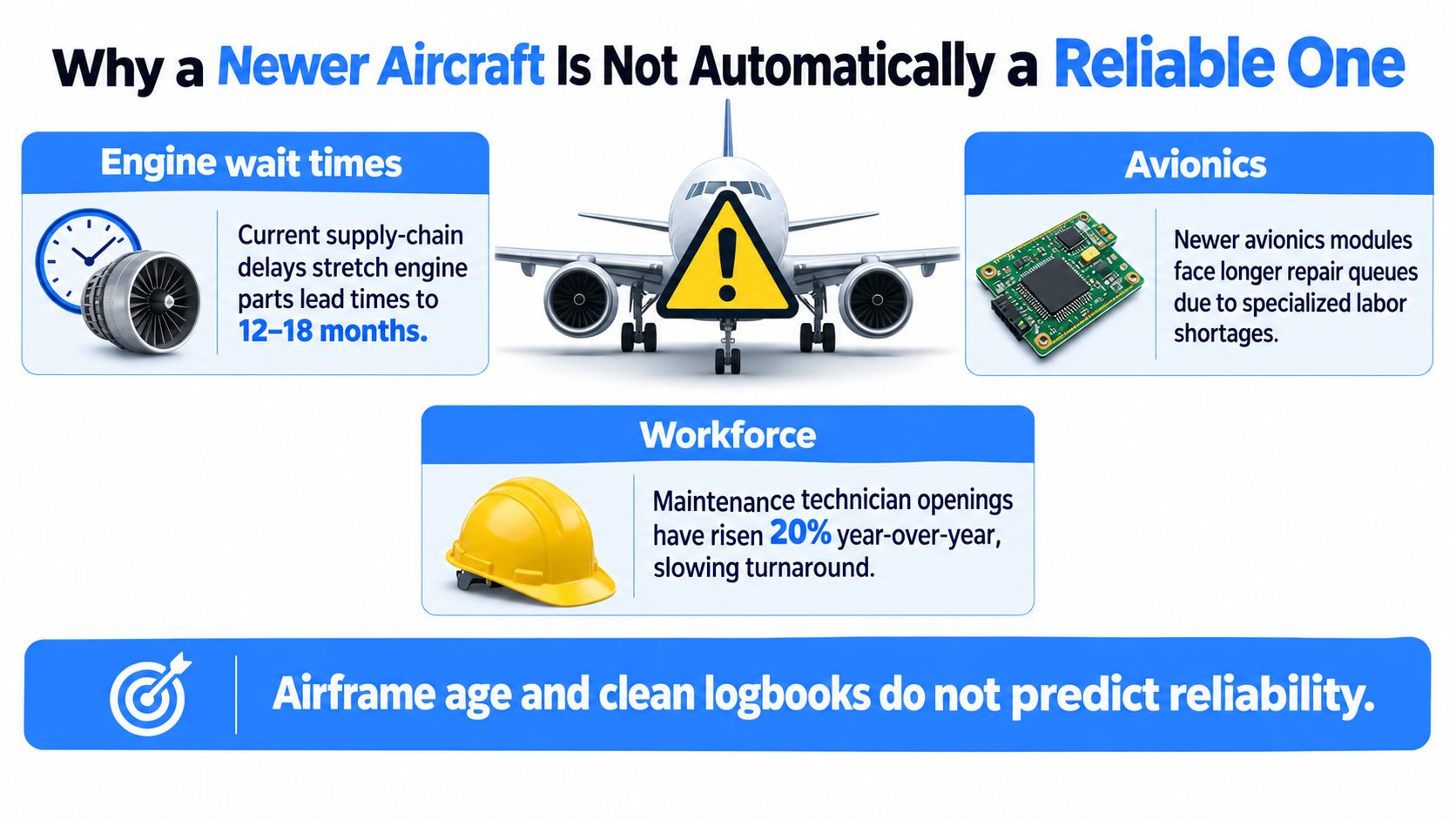
A newer aircraft can still be stranded by a missing piece-part, an unavailable technician, or a repair station without the capability to complete the work. Airframe age and brand reputation tell you little about how quickly an operator can diagnose a defect, source a suitable component, complete approved work, and return the aircraft to service.
The supply chain is a practical reliability constraint. In industry evidence on maintenance, repair, and overhaul, more than 75% of respondents reported longer engine-maintenance turnaround times from 2024 to 2025, while more than 60% reported similar delays for interiors, avionics, and landing gear. Piece-part availability was identified as the leading cause by 80% of respondents (IATA aircraft supply-chain report). Workforce availability matters too: 62% of aviation professionals in a 2025 benchmark survey considered technician shortages a critical problem, according to the same industry evidence.
Ask how the operator recovers
A part sitting at a supplier won't help if the operator can't get an approved technician or repair capability to install and certify it. A reputable operator should be able to explain its practical options without promising that every disruption can be avoided.
Before a trip, ask:
- Exchange components: Does the operator have access to exchange or loaner components for common defects?
- Repair-station coverage: Which approved repair stations can support the aircraft, and what capabilities do they provide?
- Mobile maintenance: Can qualified technicians be dispatched to the aircraft's location when appropriate?
- Alternate lift: What happens if the aircraft can't be returned to service in time, and how does the operator source an alternate aircraft?
- Delay classification: How does the operator distinguish maintenance-related disruptions from weather or air-traffic delays in its reporting?
After a disruption, ask how long diagnosis, parts sourcing, installation, certification, and aircraft repositioning took. Those details show whether the operation can recover, not just whether it can detect a problem. A newer jet with weak logistics may be less dependable for your itinerary than an older aircraft supported by a responsive, well-organized maintenance network.
What Predictive Maintenance Can and Cannot Do
Predictive maintenance can help maintenance teams identify developing faults before they disrupt a trip. But a sensor alert isn't a repaired aircraft, and machine-learning software doesn't create spare parts, qualified technicians, or approved maintenance capacity.
A 2025 maintenance benchmark found that 65% of respondents were exploring predictive maintenance, while many were struggling to integrate it into daily workflows (Veryon Aviation Maintenance Benchmark Report 2025). That's the right lens for judging the technology: adoption is not the same as operational dependability. An alert only helps if someone owns the response and can act on it.
The same benchmark material notes that maintenance-related disruption has been a broader industry concern, including declining technical dispatch reliability and longer maintenance-related delays. Don't turn that into a promise that predictive tools will prevent a specific disruption on a charter flight. Ask whether the operator's system changes maintenance decisions for your aircraft and mission.
Four tests for a predictive program
- Routing: Do alerts go to engineers or maintenance control, or do they sit in a dashboard without an owner?
- Parts: Can the team position a likely replacement component before the aircraft reaches a maintenance base?
- Planning: Can the operator schedule investigation or repair at a suitable location without disrupting the trip unnecessarily?
- Records: Do technicians preserve required inspections, human sign-offs, and regulatory records when they act on an alert?
A strong system can move some work from unexpected downtime into planned maintenance. It can also generate false alarms or flag a condition that still requires inspection and engineering judgment. Neither outcome makes the technology useless. It means the operator must connect sensor information to people, parts, approvals, and decisions.
For a broader look at analytics used to assess flight disruption risk, the Internal Systems aviation project offers useful context. Treat any predictive-maintenance claim the same way: ask what action the alert triggered, who approved it, and what record shows the aircraft was ready to fly afterward. Software adoption is a tool; the proof is in the maintenance response.
Recordkeeping and Airworthiness-Directive Compliance
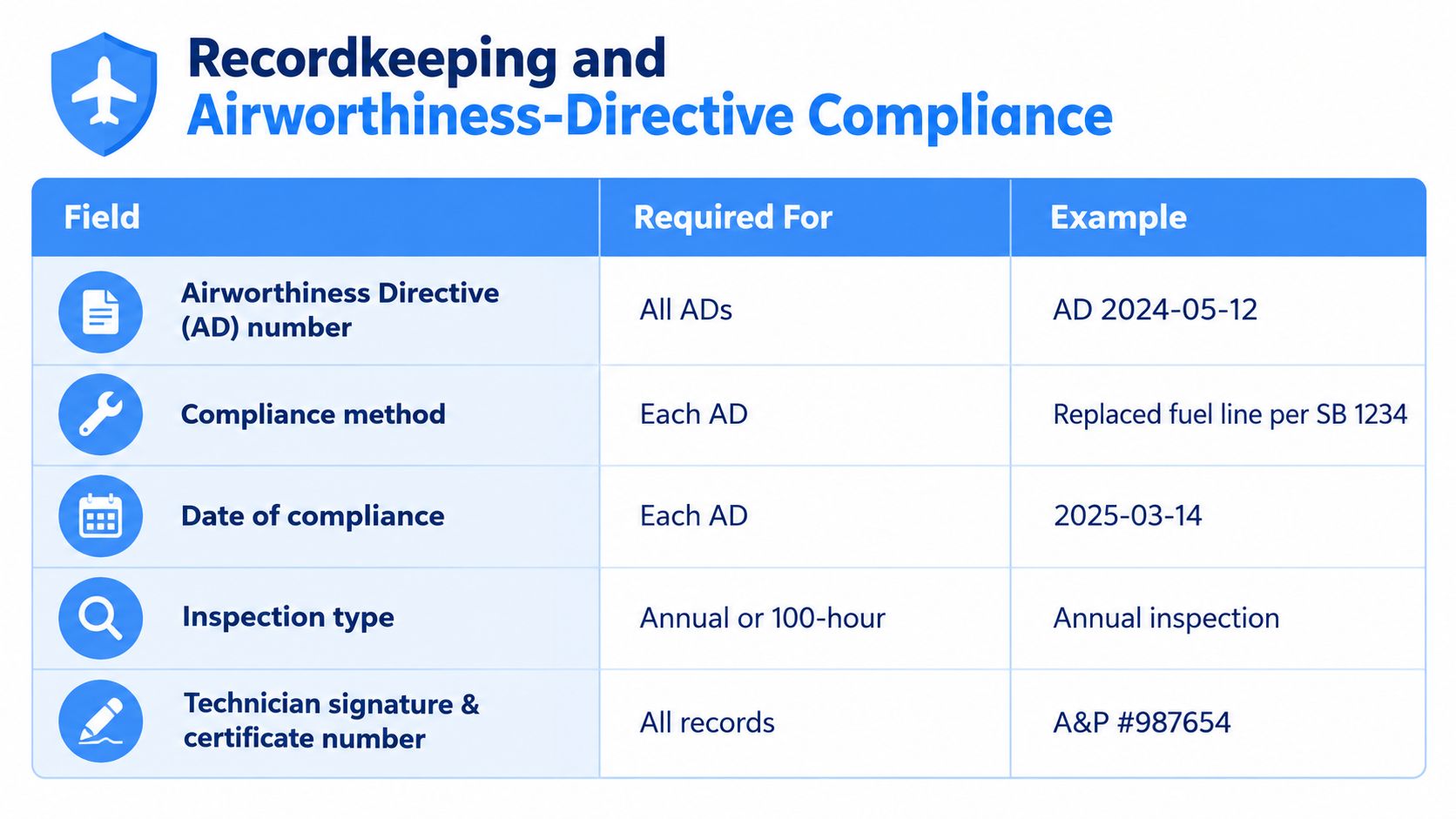
An aircraft can appear mechanically sound and still be legally unairworthy if an applicable airworthiness directive hasn't been complied with. FAA recordkeeping guidance requires the status of applicable ADs to be documented for each aircraft, engine, propeller, rotor, and appliance. Records must identify the AD number, revision date, and method of compliance. If the directive calls for recurring action, the record must also show time in service and when the next action is due (FAA maintenance-record guidance).
Check the compliance matrix before release
For each applicable AD, the operator's records should let you verify:
- Applicability: Which aircraft or component is covered.
- Identification: The AD number and revision date.
- Compliance method: What work or inspection satisfied the directive.
- Recurring requirements: The time in service, compliance date, and next due point when further action is required.
- Release decision: Who reviewed the records and authorized return to service.
For example, if an AD requires a recurring inspection every 100 flight hours, the record should document the completed inspection and calculate the next due point from the aircraft's current time-in-service total. The operator should also flag the deadline early enough to plan the work rather than discovering it during release review. FAA guidance states that an aircraft or product covered by an AD may not be operated except in accordance with that directive.
A signature matters, but it doesn't replace a traceable record of the task and its status. For owners reviewing an aircraft's history, this guide for aircraft buyers and renters provides additional context on maintenance documentation. Operators should reconcile the compliance matrix before release to service, not after someone notices a missing entry.
For a broader view of how corporate operators organize maintenance and flight operations, see this corporate flight management overview. The owner-side standard remains simple: don't accept “the aircraft is current” without records showing what was complied with, when, by what method, and when recurring work comes due.
How Aircraft Management Services Reduce Owner Burden
A management company can take day-to-day maintenance coordination off an owner's plate. But outsourcing work doesn't outsource accountability for choosing a capable partner. Compare companies by the systems and evidence they can show, not by a polished fleet page or a safety credential used without explanation.
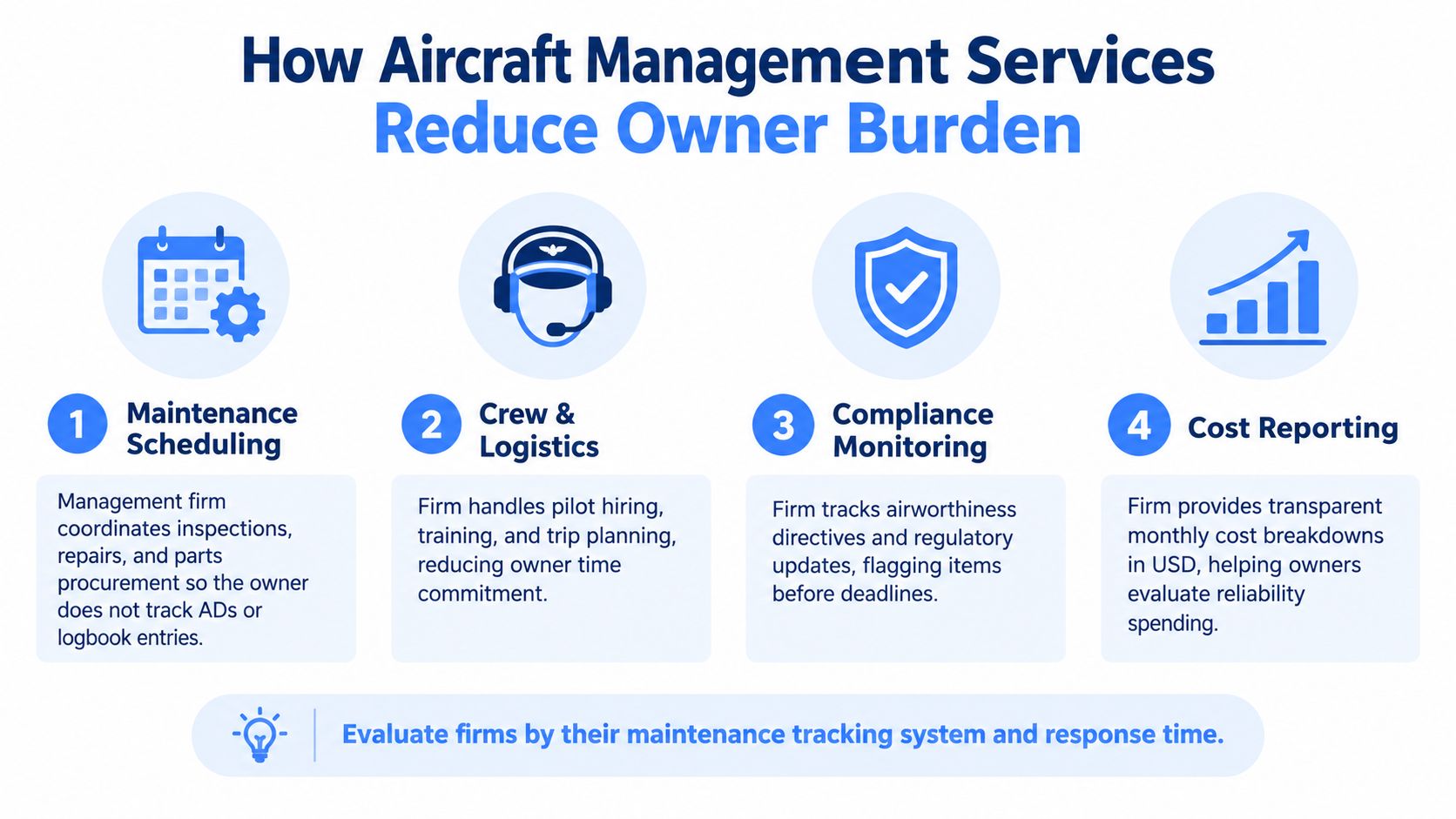
A management firm may coordinate maintenance tracking, inspections, parts procurement, repair vendors, records, regulatory compliance, crew staffing, and charter revenue generation. Those responsibilities can connect maintenance decisions with aircraft availability, but the owner should confirm exactly what's included, who makes technical decisions, and how the firm reports exceptions.
What credentials establish, and what they don't
Credentials such as ARGUS Platinum and Wyvern Wingman can form part of an operator's safety profile. Ask what the specific credential evaluates, whether the operator and aircraft you'll use are covered, and how the company maintains compliance over time. A credential isn't proof that a particular part will be available during an aircraft-on-ground event, or that the company can provide a substitute aircraft for your itinerary.
Put the operational questions directly to the candidate:
- Reliability reporting: Will you share dispatch and schedule reliability separately, with event counts and aircraft-level trends?
- Repair network: Which approved repair stations support this aircraft, and what are their relevant capabilities?
- Parts access: Do you have exchange-pool access or a documented process for sourcing components?
- Recovery plan: How do you arrange mobile maintenance, alternate aircraft, or repositioning when a defect prevents dispatch?
- Records control: Who monitors recurring AD deadlines and confirms their status before release to service?
- Responsibility: Who owns each corrective action, and how will the owner be notified if it remains open?
For an owner or family-office principal, the comparison should also include how the manager handles crew and logistics, cost reporting, and any charter activity. Ask the firm to walk through a recent maintenance disruption without disclosing sensitive details. You want to hear a clear sequence: what the crew reported, who diagnosed the defect, how the team found the part and repair capability, what was recorded, and what happened to the passenger itinerary.
The right management structure depends on the owner's operating model and the level of direct involvement they want. This overview of private aircraft management can help frame the choices. Approved Jets' aircraft management offering includes maintenance tracking for inspections, life-limited components, scheduled work, deferred items, parts, vendors, and aircraft records. That's a practical category of support to compare against another manager's written scope.
Take this checklist into the next meeting
Before signing, request the operator's maintenance-program structure, a sample aircraft-level reliability report, and an explanation of who controls corrective actions. Confirm access to approved repair stations, component support, and alternate-aircraft planning. Ask how records move between the operator, repair facility, and owner.
After signing, set a reporting cadence and agree on what constitutes a maintenance-related disruption. Review overdue or deferred items, upcoming inspection requirements, recurring AD actions, and repeat defects. If the firm reports a performance percentage, request the event counts and the aircraft-level detail behind it.
A capable owner-side process asks for evidence and reads it consistently. A capable operator-side process connects flight data, defect reports, parts history, inspections, and airworthiness decisions, then documents how the team corrected problems. Reliable jet maintenance isn't a clean logbook, a new airframe, or a software subscription. It's the working combination of a mission-fit inspection structure, a closed-loop reliability process, parts and technician readiness, honest predictive-maintenance practices, complete AD records, and a management partner that can explain its decisions.
Bring your maintenance questions to Approved Jets when comparing aircraft management or arranging a time-sensitive itinerary. Its team coordinates aircraft through a vetted operator network and can discuss maintenance tracking, logistics, and recovery planning in the context of your mission. Make the decision with rolling data and aircraft-level evidence, not a single-month snapshot.