

Private Jet Seating: How to Choose Your Ideal Cabin Layout
Master private jet seating by learning how aircraft class, cabin layout, and mission needs shape capacity, comfort, and safety on your next charter.

Approved Jets

On this page
- Table of Contents
- Why Private Jet Seating Starts with Mission, Not Maximum Seats
- The questions that change the aircraft choice
- Aircraft Classes and Typical Seating Ranges
- Match the class to the mission
- Headline Capacity Versus Usable Capacity
- Why one extra seat can matter more than expected
- Ask for a mission-specific comparison
- Seating Geometry and Cabin Comfort Factors
- What to request before accepting a seat map
- Evaluate circulation, not just upholstery
- Safety Regulations and Certified Seating Requirements
- A divan isn't automatically four seats
- Mission-Driven Seating for Different Travel Scenarios
- Four missions, four different cabin priorities
- Accessibility requires operator-specific verification
- How to Specify Private Jet Seating When Booking
- Build the seating brief
- A concise booking checklist
- Choosing the Right Private Jet Seating for Your Mission
Across business-jet classes, typical private-jet seating ranges from roughly 4 to 19 people, depending on the aircraft category. That headline capacity often falls short in practice because cabin layout, baggage, flight duration, work requirements, and sleeping arrangements determine how many passengers can travel comfortably.
The popular advice is simple: count the travelers, choose the largest aircraft that fits them, and enjoy the extra room. That approach fails surprisingly often. A jet with the highest listed capacity may leave less usable space for luggage, movement, meetings, or sleep than a smaller aircraft configured around the mission.
Private jet seating is a planning decision, not a marketing specification. The right question isn't “How many seats does this aircraft have?” It's “How many people can use those seats comfortably, with their actual luggage and the cabin functions this trip requires?”
Table of Contents
- Why Private Jet Seating Starts with Mission, Not Maximum Seats
- Aircraft Classes and Typical Seating Ranges
- Headline Capacity Versus Usable Capacity
- Seating Geometry and Cabin Comfort Factors
- Safety Regulations and Certified Seating Requirements
- Mission-Driven Seating for Different Travel Scenarios
- How to Specify Private Jet Seating When Booking
- Choosing the Right Private Jet Seating for Your Mission
Why Private Jet Seating Starts with Mission, Not Maximum Seats
A brochure's maximum seat count is useful for screening aircraft, but it shouldn't decide the booking. Operators can configure the same aircraft for daytime seating, overnight rest, conference work, privacy, luggage, or a combination of those priorities. Every added seat occupies cabin volume that might otherwise support a table, galley, lavatory access, storage, or a lie-flat berth.
The mission changes the answer immediately. A small jet optimized for a short regional sector may provide fewer seats but better runway access and lower operating costs. A large-cabin aircraft may carry more passengers while dedicating space to separate zones, conference areas, beds, and long-haul comfort. Neither is automatically superior.

The questions that change the aircraft choice
Start with the details that affect usable capacity:
- Passenger profile: Are the travelers executives carrying work materials, a family with children, athletes with equipment, or a medical team accompanying a patient?
- Trip duration: A dense layout can work for a short hop but become restrictive during a multi-hour flight.
- Baggage demand: Golf clubs, sports equipment, medical devices, presentation cases, and large suitcases can change the aircraft recommendation.
- Cabin purpose: Do passengers need face-to-face workstations, privacy dividers, easy lavatory access, or sleeping positions?
- Operating requirements: A route may favor a compact aircraft because of runway access, while range requirements may push the choice toward a larger cabin.
Practical rule: Treat the advertised seat count as a starting filter. Treat the approved layout, baggage capacity, and passenger requirements as the actual specification.
The NBAA describes most business aircraft as carrying approximately six passengers in a cabin about the size of a large SUV, with average stage lengths below 1,000 miles. Those figures are broad operating context, not a promise that six passengers will have the same experience on every aircraft. The seat map and mission determine whether the cabin supports productive travel or merely transports the group. NBAA business aircraft guidance
Aircraft Classes and Typical Seating Ranges
Aircraft category provides a useful first map, but each class contains different models and interior configurations. Typical practical capacity across the main business-jet classes runs from 4 to 19 passengers, with smaller cabins favoring regional access and larger cabins supporting more space, range, and onboard functions. Business-jet class guidance
| Aircraft Class | Typical Seating Range | Best For |
|---|---|---|
| Very light jet | 4–7 | Small groups on short regional sectors |
| Light jet | 6–10 | Compact corporate teams and regional travel |
| Midsize jet | 6–9 | Corporate trips requiring more cabin and baggage space |
| Super-midsize jet | 8–10 | Longer sectors, larger groups, and improved cabin comfort |
| Heavy jet | 10–16 | Executive groups, extensive luggage, and long-range missions |
| Ultra-long-range jet | 12–19 | Intercontinental travel with separate work and rest zones |
These numbers describe practical or comfortable passenger loads, not a universal legal maximum. Operators may trade seats for larger tables, beds, storage, galleys, lavatories, or wider circulation. A midsize aircraft can therefore be the right answer for one group of eight, while a super-midsize or heavy jet may be more appropriate for the same headcount when luggage, nonstop range, or overnight comfort matters.
Match the class to the mission
Very light and light jets work well when the group is small and the itinerary is regional. Midsize aircraft generally give corporate travelers more room to work and carry luggage without moving immediately into a large-cabin solution. Super-midsize jets bridge the gap between regional efficiency and long-haul comfort, while heavy and ultra-long-range aircraft make sense when the group needs more range, cabin zoning, or sleeping capability.
Aircraft photos and fleet pages can help you understand the differences, but don't rely on images alone. A resource such as the BusAustin fleet lineup provides a useful comparison point for thinking about vehicle and group-transport capacity, while aircraft-specific material such as this guide to super-midsize jets helps place the cabin category in a charter context.
The category narrows the field. The actual seat map decides whether the aircraft works.
Headline Capacity Versus Usable Capacity
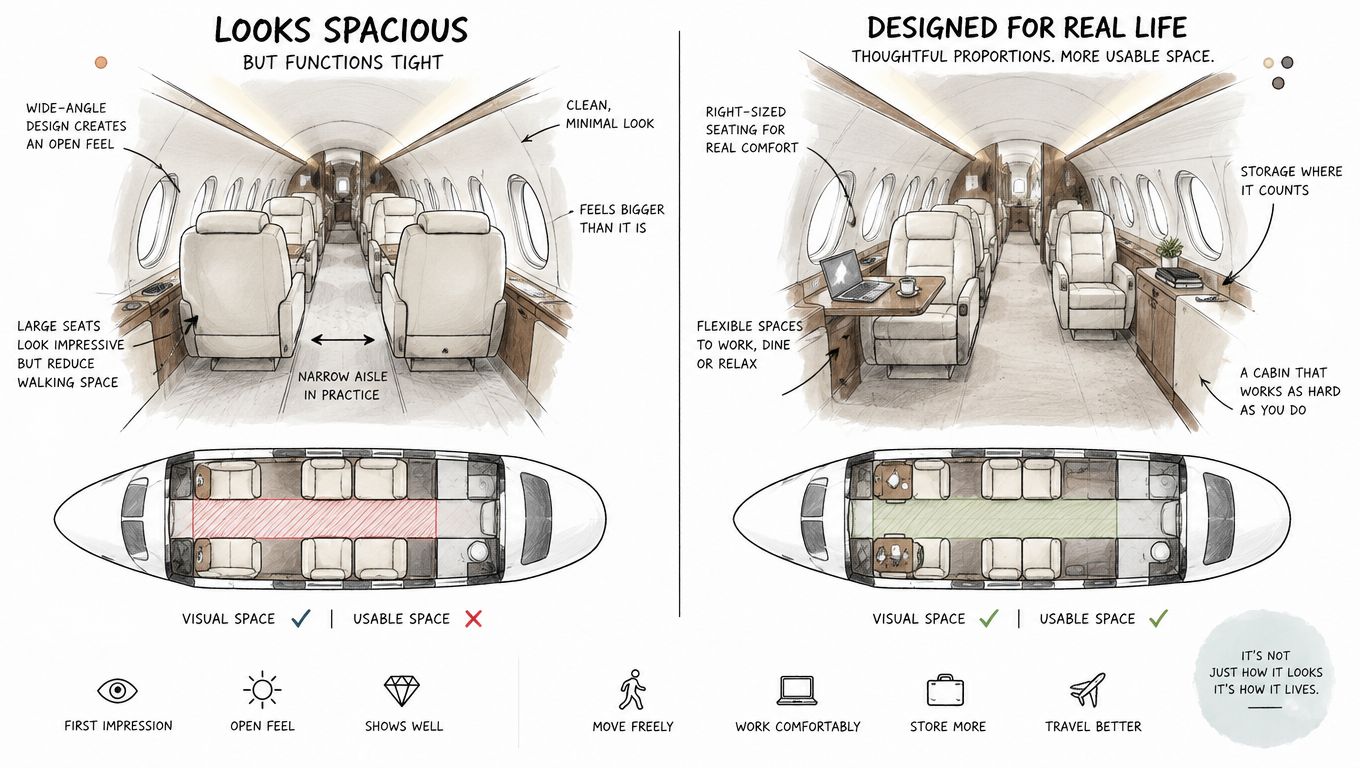
Certified occupancy and usable capacity answer different questions. Certified occupancy asks how many approved passenger positions the aircraft can legally provide. Usable capacity asks whether those passengers can bring their luggage, move around, work, recline, access the lavatory, and rest without turning the cabin into a dense seating box.
A Challenger 605 may seat 10–12 passengers during the day but offer comfortable sleeping arrangements for only about five. A Global 7500 may accommodate up to 19 passengers, while an ACJ319 can vary substantially according to its interior configuration. These examples show why “seats” and “sleeps” belong in separate columns when you're comparing aircraft. Capacity and configuration guidance
Why one extra seat can matter more than expected
Adding passengers creates more than a simple reduction in personal space. Each additional seat consumes cabin volume, increases baggage demand, and can remove the flexibility to rotate, recline, or convert club seats into work or sleep positions. That comfort penalty becomes more noticeable as the flight length increases.
Consider a group that technically fits every certified seat. If several passengers bring bulky luggage, the operator may need to review baggage placement, weight, and cabin access. If the group plans to work, a high-density arrangement may eliminate the table or circulation space that made the larger aircraft attractive in the first place.
The same issue appears in reverse. A smaller aircraft with fewer seats may feel more functional if it leaves each traveler enough room for a briefcase, coat, laptop, or personal movement. This is why choosing the aircraft with the highest listed capacity can produce a worse experience than selecting a smaller cabin with a lower passenger count.
Ask for a mission-specific comparison
Request two configurations when possible:
- Daytime configuration: How many passengers can sit comfortably with the required luggage and work surfaces?
- Overnight configuration: How many passengers can sleep without treating every narrow seat as a bed?
- Operational configuration: Which seats remain usable during taxi, takeoff, and landing, and which positions depend on approved restraints?
- Storage configuration: Where do bags, sports equipment, medical devices, and coats go without blocking circulation?
For a deeper aircraft-specific comparison, review the Bombardier Challenger 350 guide, then ask the operator to confirm the exact aircraft and installed interior rather than assuming every model has the same arrangement.
Seating Geometry and Cabin Comfort Factors
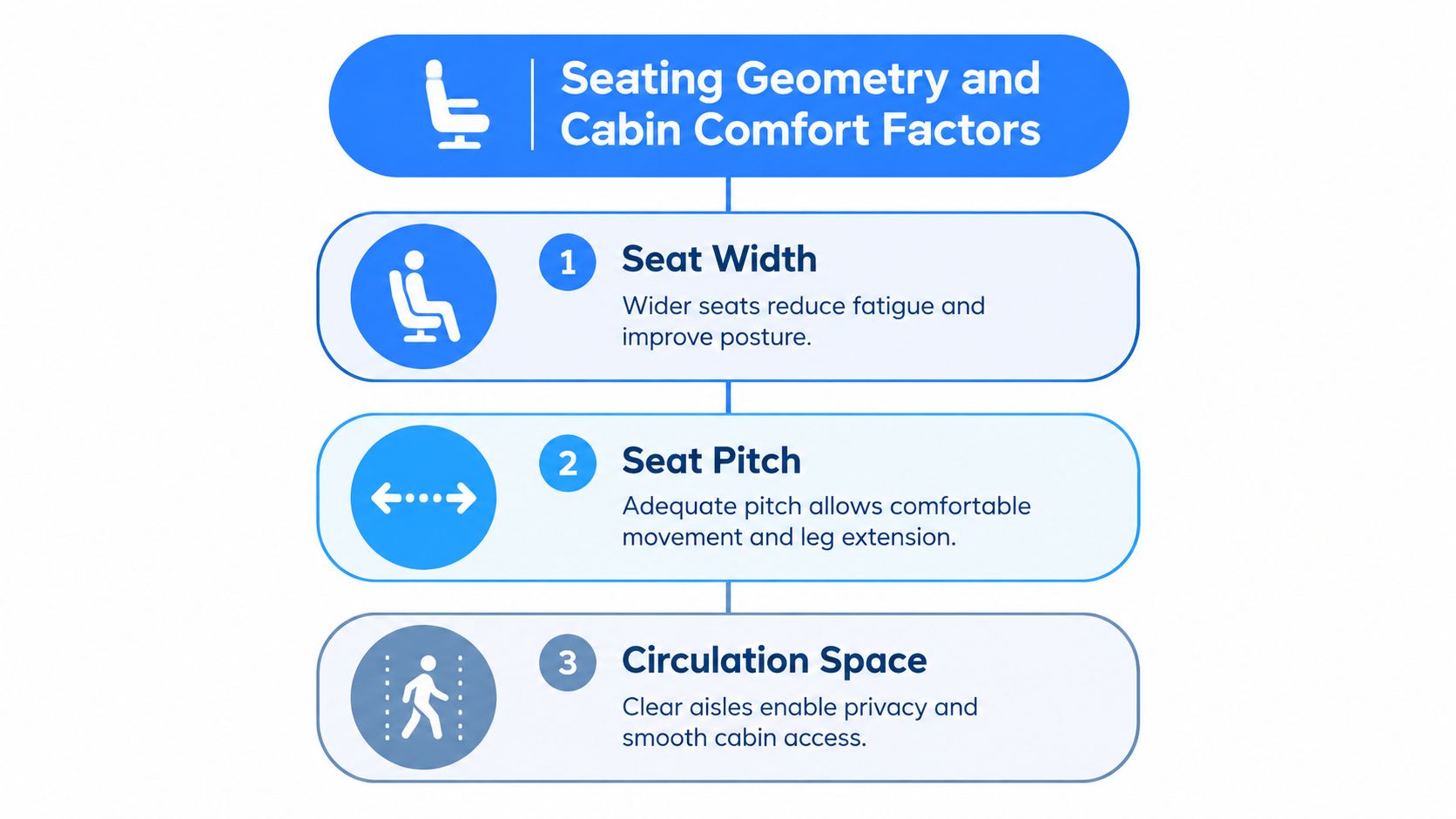
Seat count can't tell you whether a passenger can work, stretch, or stand without disturbing everyone else. Seat width, seat pitch, legroom, cabin height, and circulation space determine how the cabin feels once the door closes. Bulkheads, lavatories, tables, and emergency exits can also make individual positions behave differently from the seats beside them.
The Embraer Phenom 300 is a useful illustration. Published specifications list a maximum seating capacity of nine and a typical seating capacity of seven, with a cabin approximately 17.16 feet long, 5.09 feet wide, and 4.9 feet high. The two-passenger difference isn't a minor marketing detail. It represents the choice between density and a more usable executive layout. Phenom 300 seating and cabin specifications
What to request before accepting a seat map
Don't stop at a cabin photo. Ask for:
- The approved seat map: Confirm which positions are certified for taxi, takeoff, and landing.
- Usable cabin dimensions: Request length and width, not just a broad aircraft-category description.
- Baggage volume: Ask how much usable storage remains with the quoted passenger count.
- Obstructions: Identify seats beside bulkheads, lavatories, galleys, or emergency exits.
- Work positions: Confirm whether tables support laptops, documents, and face-to-face meetings.
- Rest positions: Ask which seats recline, rotate, or convert, and whether the conversion removes a passenger place.
A seat adjacent to a bulkhead may have different legroom from a club seat. A position beside the lavatory may provide convenient access but less privacy. A table may improve executive productivity while limiting leg movement for the passengers around it.
Evaluate circulation, not just upholstery
Luxury materials don't compensate for poor movement. On a multi-hour sector, passengers need to retrieve bags, use the lavatory, change posture, speak privately, and work without repeatedly asking others to move. A cabin that looks spacious in a wide-angle photograph can still feel restrictive when seats are occupied and tables are deployed.
The useful measurement isn't how many seats fit in the cabin. It's how many people can use the cabin without competing for the same space.
Safety Regulations and Certified Seating Requirements
Private jet seating is also a certification issue. FAA material requires seat and restraint systems to protect occupants during emergency-landing conditions, avoid hazardous projections, and avoid deforming in a way that impedes rapid evacuation. For transport-category aircraft, FAA rules require maximum seating capacity to be evacuable within 90 seconds under simulated emergency conditions. FAA seating-system certification material
The same material cites aisle-clearance criteria tied to passenger capacity, including a 12-inch minimum aisle width for aircraft seating 10 or fewer passengers at the relevant floor height. That doesn't mean every private aircraft has a conventional airline aisle. It means the certified arrangement must satisfy applicable requirements for movement and evacuation.
A divan isn't automatically four seats
U.S. rules generally require an approved seat or berth and an approved safety belt for each aircraft occupant aged two or older during takeoff, en route flight, and landing. Under 14 CFR §125.211, two people may share one approved belt only in narrowly defined circumstances, including occupants of a berth during en route flight and occupants of a multiple lounge or divan seat during en route flight. Surface movement, takeoff, and landing generally require each person to occupy an approved seat or berth with a properly secured separate belt. 14 CFR §125.211
A broad divan may look large enough for four people, but appearance doesn't establish four takeoff-and-landing positions. The operator must verify that the approved configuration and restraint system support that use. Shoulder harnesses must also be fastened during takeoff and landing when a seat is equipped with one, subject to the limited crewmember exception in the regulation.
FAA legal guidance adds an important operational detail. Any belt sharing must conform to the aircraft's approved limitations, and the pilot in command must consider whether the belt is approved and rated for the arrangement and whether the seat's structural limits would be exceeded. FAA guidance on approved belts and seating
For passengers who need help with fit or restraint access, a practical guide on FAA regulations for passengers can provide general background. The operator still has to confirm the aircraft-specific approved configuration.
Mission-Driven Seating for Different Travel Scenarios
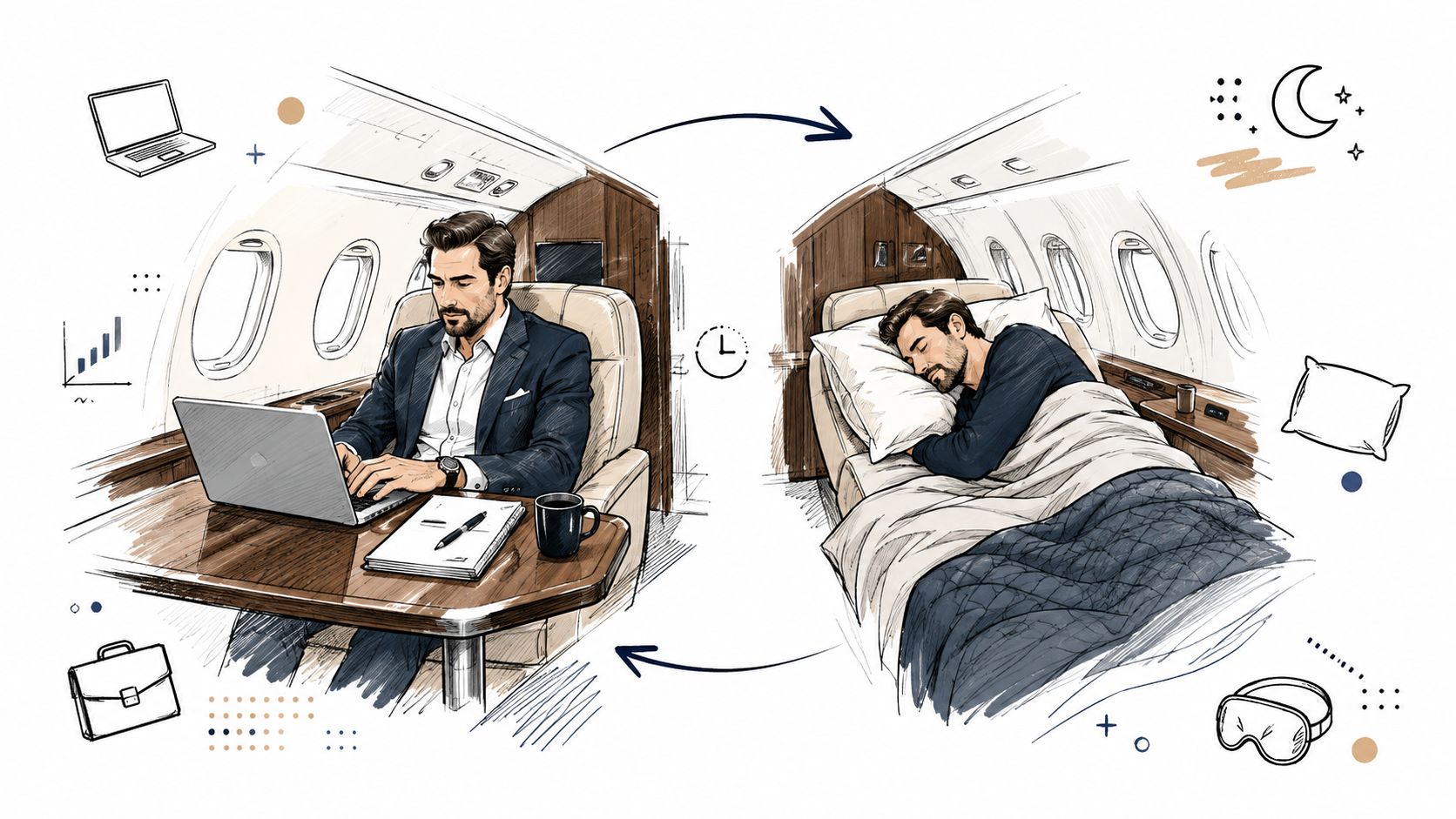
A private jet seating plan should reflect the people onboard and what they need to do after takeoff. An executive team may need face-to-face work positions and privacy. A sports group may care more about fitting equipment and keeping the cabin easy to board. A family may prioritize child access, rest, and lavatory convenience over a conference table.
Four missions, four different cabin priorities
For corporate travel, start with the work pattern. A leadership group traveling to a meeting may need club seating, a conference surface, power access, and enough circulation to change positions without interrupting a discussion. A higher passenger count isn't useful if the team can't open laptops or review documents.
For sports teams and entertainment crews, the cabin must absorb people and equipment together. Seating should be evaluated alongside bags, uniforms, instruments, production cases, and personal gear. A divan can add flexibility, but it shouldn't be counted as a guaranteed takeoff-and-landing solution without confirmation of its approved restraints.
For family travel, ask about child seating, sleeping arrangements, and lavatory access. A cabin with fewer seats but more practical movement may work better than a dense layout, particularly when parents need to assist children during the flight. If overnight rest matters, compare actual berths with daytime seating rather than treating every recliner as a bed.
For medical evacuation and repatriation, seating is subordinate to patient mobility, medical equipment, accompanying staff, and clinical access. The aircraft may need removable seats, equipment mounts, transfer space, and an arrangement that lets the medical team reach the patient without obstructing essential movement.
Accessibility starts before the aircraft is selected. A transfer plan, device inventory, and restraint review belong in the first inquiry, not at the airport.
Accessibility requires operator-specific verification
Private aviation explanations often focus on leather, recline, and club arrangements while skipping wheelchair transfer procedures, onboard mobility, seat restraint limitations, and the dimensions of personal equipment. Those details can determine whether an aircraft is workable for a particular passenger.
In the United States, federal accessibility research is still examining whether passengers can remain in their personal wheelchairs during flight, including structural compatibility, restraint systems, and crashworthiness. U.S. Department of Transportation accessibility priorities
A transfer into an aircraft seat isn't the same as remaining in a personal wheelchair onboard. Ask the operator to document device dimensions and weight, transfer assistance, aisle and lavatory access, and whether seats can be repositioned or removed.
The following video offers additional context for thinking about passenger mobility and cabin access. It shouldn't replace an aircraft-specific review with the operator.
How to Specify Private Jet Seating When Booking
A good charter inquiry doesn't say only "eight passengers." It describes what those passengers are carrying, doing, and requiring during the flight. Give the broker enough detail to match the cabin rather than merely locate an aircraft with enough listed seats.
Build the seating brief
Use this sequence during the inquiry:
- Name the travelers and their needs. Include adults, children, athletes, staff, medical personnel, and anyone requiring transfer assistance.
- Describe the luggage. List ordinary bags plus sports equipment, instruments, presentation cases, medical equipment, or oversized items.
- Define the cabin function. State whether the priority is workstations, privacy, conversation, dining, rest, or sleeping.
- Separate daytime and overnight capacity. Ask how many people can sit comfortably and how many can sleep with appropriate bedding.
- Document accessibility requirements. Provide assistive-device dimensions and weight, transfer needs, aisle requirements, and lavatory considerations.
- Confirm the aircraft configuration. Request the approved interior, seat map, usable cabin dimensions, baggage volume, and any removable or repositionable seating.
- Check the legal positions. Verify that the quoted passenger count matches the certified layout and restraint provisions.
A concise booking checklist
Before approving the aircraft, confirm:
- Passenger count: Does it include every person aged two or older?
- Baggage: Has the operator reviewed volume, weight, and unusual equipment?
- Seat map: Are all quoted positions approved for the relevant phases of flight?
- Comfort: Can passengers recline, work, move, and access the lavatory?
- Sleep: Which positions genuinely convert into usable berths?
- Accessibility: Has the operator documented transfer and equipment requirements?
- Layout: Can any seats or tables be repositioned without changing certification?
- Route: Does the aircraft support the required range and airport access with the intended load?
A transparent quote should explain why the aircraft matches the mission, not just display a passenger number. For broader planning context, review this guide on how to charter a private jet, then bring the completed seating brief to the operator.
Choosing the Right Private Jet Seating for Your Mission
The right cabin is the one that supports the trip after accounting for people, luggage, duration, work, rest, safety, and access. A maximum seat count can be useful, but it can't tell you whether the cabin will remain functional once every passenger and bag arrives at the aircraft.
Use four tests:
- Usable capacity: Compare practical seating with baggage volume and flight duration.
- Cabin geometry: Check width, pitch, circulation, bulkheads, lavatories, and work positions.
- Certified configuration: Confirm that every occupied position has the required approved seat, berth, and restraint.
- Mission fit: Match the layout to executive work, family movement, sports equipment, medical access, or overnight rest.
Accessibility deserves the same precision as luggage planning. If a passenger uses a wheelchair or other mobility device, gather dimensions, weight, transfer requirements, and restraint questions early. A practical resource such as find the right wheelchair may help with general equipment considerations, but the operator must verify aircraft compatibility and approved onboard procedures.
Approved Jets offers on-demand charter coordination, per-seat charter options, aircraft and cabin information, and end-to-end logistics for missions ranging from executive travel to group and medical transport. Visit Approved Jets with your passenger, baggage, accessibility, and sleep requirements so the aircraft search starts with a usable seating specification rather than a headline number.