

Gulfstream vs Bombardier: The Ultimate Jet Comparison
Explore the ultimate Gulfstream vs Bombardier comparison. Analyze range, cabin specs, delivery backlogs, and mission profiles to choose the right private jet.

Approved Jets

On this page
- Table of Contents
- The State of the Gulfstream and Bombardier Rivalry
- Why market position matters to an owner
- Comparing the Ultra-Long-Range Flagship Models
- The next generation changes the question
- Evaluating Cabin Dimensions and Passenger Comfort
- Comfort depends on how people use the cabin
- Analyzing Speed Profiles and Engine Performance
- Time saved has to earn its cost
- Navigating Production Backlogs and Delivery Timelines
- Delivery position can outweigh a specification advantage
- Assessing Fleet Maturity and Resale Value
- A practical residual-value checklist
- Matching the Aircraft to Your Mission Profile
The headline Gulfstream vs Bombardier rivalry is more concentrated than most buyers realize. Bombardier represents about 25.6% of global business-jet revenue, while Gulfstream represents about 17.8%, and the five largest manufacturers together account for roughly 66.9% of market revenue, according to market data on the business-jet sector. The more important question in 2026, however, isn't just which aircraft has the longest range or the most attractive cabin.
It's which manufacturer can deliver the right aircraft at the right time, support it across the intended operating region, and protect its value when the aircraft eventually returns to the market. For a family office or corporate flight department, delivery timing, platform maturity, fleet adoption, and mission fit can matter more than a narrow advantage in brochure specifications.
Table of Contents
- The State of the Gulfstream and Bombardier Rivalry
- Comparing the Ultra-Long-Range Flagship Models
- Evaluating Cabin Dimensions and Passenger Comfort
- Analyzing Speed Profiles and Engine Performance
- Navigating Production Backlogs and Delivery Timelines
- Assessing Fleet Maturity and Resale Value
- Matching the Aircraft to Your Mission Profile
The State of the Gulfstream and Bombardier Rivalry

Gulfstream and Bombardier sit at the most valuable end of business aviation. Their aircraft compete for corporate flight departments, family offices, charter fleets, and buyers who place a premium on intercontinental capability. Yet the two companies don't win on exactly the same scorecard.
In a 2025 major-market snapshot, Gulfstream led Bombardier in unit deliveries, with 170 aircraft versus 138. Bombardier still remained highly competitive in large-cabin and ultra-long-range aircraft through its Global family, while Gulfstream's delivery volume reflected strong momentum in its newer large-cabin products. Those figures come from the same business-jet market analysis, which also shows why unit volume and revenue share can produce different conclusions.
| Measure | Gulfstream | Bombardier | What it indicates |
|---|---|---|---|
| 2025 global business-jet revenue share | About 17.8% | About 25.6% | Bombardier held the larger share by value |
| 2025 deliveries in the cited major-market snapshot | 170 aircraft | 138 aircraft | Gulfstream led on unit volume |
| 2025 total aircraft deliveries in company data | 158 aircraft | 157 aircraft | Overall annual totals were nearly even |
| 2025 large-cabin deliveries | 136 aircraft | 86 large jets | Gulfstream had stronger large-cabin delivery scale |
The apparent contradiction between the delivery figures is useful rather than confusing. Market snapshots and company reporting can use different scopes, so buyers shouldn't treat one number as a complete verdict. Revenue share suggests where value is concentrated. Deliveries suggest manufacturing throughput. Product mix explains why the two measures don't always point to the same winner.
Why market position matters to an owner
Gulfstream has built substantial brand equity around long-range milestones. The Gulfstream II became the first business jet to fly nonstop from the United States to Europe on May 4, 1968, a milestone recorded in the manufacturer's history of Gulfstream aviation. That history supports a strong identity around speed, range, and intercontinental travel.
Bombardier's competitive strength is more concentrated in its Global family, particularly at the large-cabin and ultra-long-range end. The practical consequence is that a buyer isn't comparing two identical product strategies. Gulfstream's current momentum is tied closely to the G700 and G800 production ramp, while Bombardier's Global aircraft compete through cabin zoning, long-range mission capability, and a sizeable operator ecosystem.
For a flight department, that distinction changes the due-diligence process. A jet that wins a specification comparison may still be the weaker operational decision if its delivery position doesn't match the replacement schedule, if crews aren't readily available in the department's region, or if the intended charter network has limited experience with the platform.
Operational rule: Treat Gulfstream and Bombardier as competing ecosystems, not just competing airframes. The aircraft, delivery slot, crew pipeline, maintenance support, and exit market all belong in the same decision.
Comparing the Ultra-Long-Range Flagship Models
The G700 and Global 7500 represent the current flagship contest, while the G800 and Global 8000 push the comparison toward the next stage of ultra-long-range aircraft. The numbers are close enough that mission assumptions matter, but different enough to affect route planning.
| Aircraft Model | Max Range (nm) | Max Speed (Mach) | Engine Thrust (lbf) |
|---|---|---|---|
| Gulfstream G700 | 7,500 | 0.925 | About 18,250 per engine |
| Bombardier Global 7500 | 7,700 | 0.925 | About 18,920 per engine |
| Gulfstream G800 | 8,200 at Mach 0.85 | 0.935 maximum operating speed | Not specified in the verified comparison data |
| Bombardier Global 8000 | 8,000 | 0.95 reported top speed | Not specified in the verified comparison data |
The G700 and Global 7500 are particularly close on speed. Both are published at Mach 0.925, while the Global 7500 carries a certified range of 7,700 nautical miles, compared with 7,500 nautical miles for the G700, as summarized in this Gulfstream and Bombardier aircraft comparison. Bombardier therefore has a narrow range advantage in this direct pairing, but it isn't a decisive victory for every route.
A difference of 200 nautical miles can matter when a planned city pair sits near the edge of an aircraft's usable mission envelope. It may create more routing flexibility, reduce the likelihood of a fuel stop, or provide additional margin when payload and reserve requirements are demanding. It won't automatically translate into a shorter trip, because winds, air-traffic restrictions, payload, reserves, and airport choices still shape the actual flight.
The next generation changes the question
The G800 is published at 8,200 nautical miles at Mach 0.85, with published figures of 7,000 nautical miles at Mach 0.90 and 8,000 nautical miles at Mach 0.87. Its maximum operating speed is Mach 0.935, according to the G800 and Global 8000 performance dossier. That creates a clear tradeoff. The aircraft's greatest nonstop reach comes at a slower cruise profile than its maximum operating speed.
The Global 8000 is reported at 8,000 nautical miles and a top speed of Mach 0.95, while the Global 7500 is reported at 7,700 nautical miles. Those figures are discussed in coverage of the G700 and Global 7500 comparison. Buyers should separate a certified or published range figure from the range available at a high-speed cruise. A family office that values maximum nonstop reach may evaluate the aircraft differently from an executive team that prioritizes schedule compression.
The G800 is already in service with a certified range of 8,200 nautical miles, while the Global 8000 is targeting up to 8,000 nautical miles once certified, according to aircraft guide coverage of the ultra-long-range segment. That distinction is central to acquisition risk. A delivered aircraft with an established operating record is not equivalent to a promised capability awaiting certification and fleet entry.
For buyers comparing the broader Global family, Global Express aircraft information can also help place Bombardier's flagship models within the manufacturer's wider product context.
Evaluating Cabin Dimensions and Passenger Comfort
Cabin comfort is an operating issue, not merely a design preference. On long missions, the usable arrangement of seats, sleeping areas, work zones, galley placement, lavatory access, and baggage flow determines whether passengers arrive ready for a meeting or spend the first part of the day recovering from the flight.
The G700 is reported to have a cabin length of 56 feet 11 inches, compared with 54 feet 5 inches for the Global 7500. The Global 7500 is also described as having about 2,637 cubic feet of cabin volume, while the G800 is reported at around 2,138 cubic feet, according to cabin and performance comparisons for Gulfstream and Bombardier aircraft.
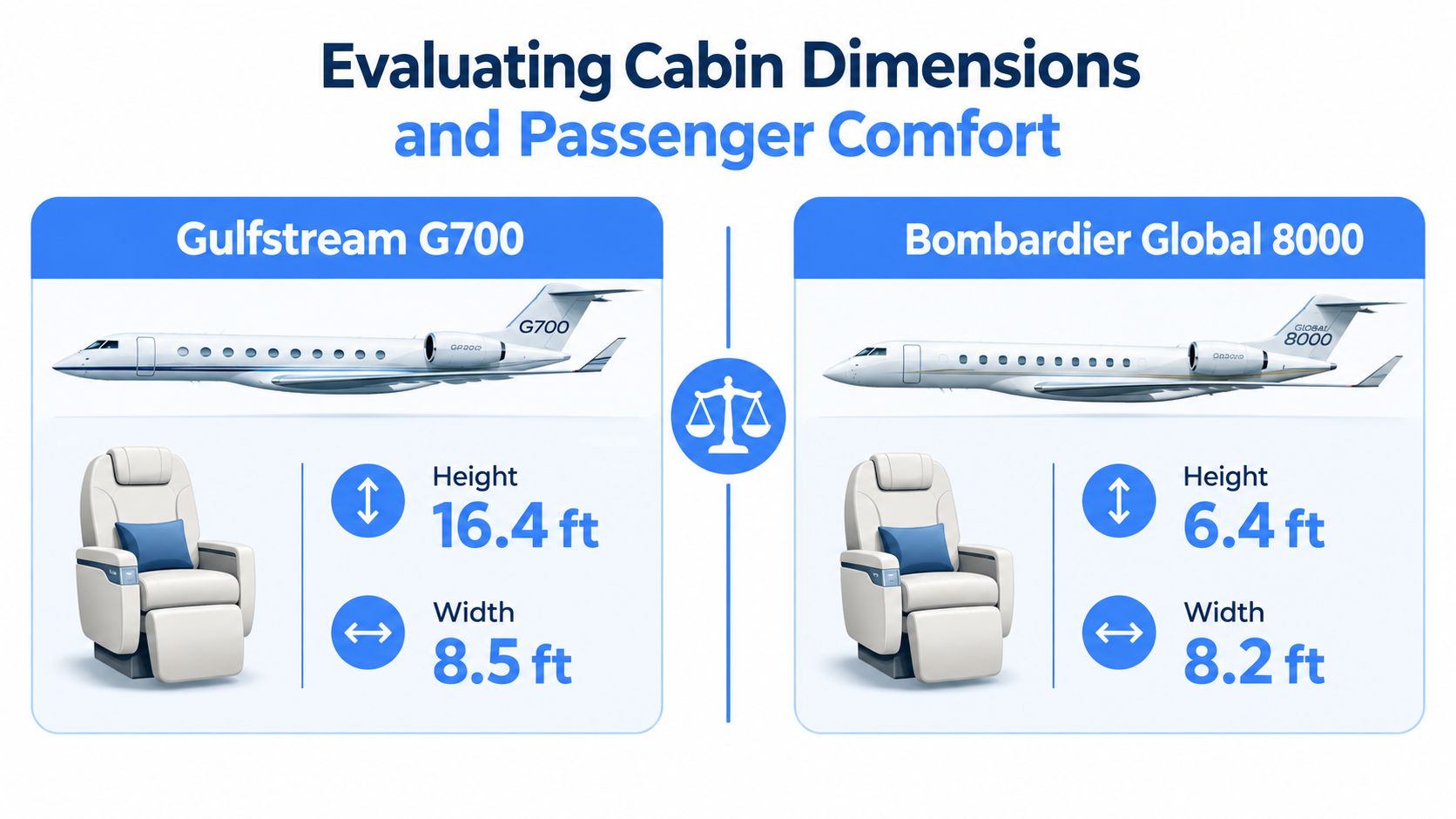
Those figures show why “more spacious” isn't a sufficiently precise conclusion. A longer cabin may create more flexibility for separate working and resting zones, but total volume, interior width, ceiling height, and furniture selection determine how that space feels. A cabin with more cubic volume can still feel less efficient if the layout creates narrow circulation paths or places high-use features inconveniently.
Comfort depends on how people use the cabin
A principal traveling with a small household may value a quiet sleeping zone and direct access to personal luggage. A corporate department carrying executives and advisers may place more weight on conference seating, privacy partitions, and a galley arrangement that supports a full service without disrupting work. A charter operator may prioritize a layout that serves varied passenger groups rather than a specific family configuration.
That makes a physical cabin inspection more valuable than a marketing rendering. Buyers should sit in the intended seats, test movement between zones, inspect baggage access, and review the exact completion specification. The same aircraft model can produce different passenger impressions when interior materials, seat geometry, dividers, and storage choices change.
Passenger test: Don't ask only whether the cabin is large. Ask where each passenger will work, sleep, eat, store luggage, and move during the longest mission your operation actually flies.
The distinction also matters when comparing a flagship with an older but proven aircraft. A buyer evaluating a large-cabin Gulfstream option can review the Gulfstream G550 aircraft profile as part of a broader cabin, range, and acquisition analysis. The relevant question isn't whether an older platform matches every new-aircraft specification. It's whether its cabin and support profile satisfy the mission at a lower acquisition or scheduling risk.
The supplied cabin graphic presents the G700 and Global 8000 through height and width figures, but raw dimensions should still be validated against the actual aircraft configuration. Published measurements can describe the shell, while passenger comfort depends on the completed interior. For long-haul buyers, layout efficiency and fatigue management are more useful decision criteria than a single headline dimension.
Analyzing Speed Profiles and Engine Performance
Speed matters most when the mission is time-sensitive and the airspace allows the aircraft to use its higher cruise envelope. The published maximum speed of Mach 0.925 for both the G700 and Global 7500 creates parity in the direct comparison, while the Global 8000's reported Mach 0.95 top speed challenges Gulfstream's traditional speed positioning.
The engine comparison adds context. The G700 uses two Rolls-Royce Pearl 700 engines producing about 18,250 lbf each, while the Global 7500 uses GE Passport 20-19BB1A engines producing about 18,920 lbf each, according to the technical Gulfstream versus Bombardier comparison. Thrust alone doesn't determine an aircraft's operating economics or mission performance. Airframe design, weight, aerodynamics, fuel planning, maintenance requirements, and the selected cruise profile all matter.
Time saved has to earn its cost
A higher cruise speed can shorten a transoceanic mission, improve schedule recovery, and reduce the time executives spend away from the destination. It can also increase fuel consumption relative to a long-range cruise profile, particularly when the aircraft is flown aggressively rather than at its most efficient range setting.
That creates two legitimate buyer priorities. A chief executive whose schedule depends on arriving early enough for a same-day meeting may place a high value on speed. A family office planning long nonstop sectors with flexible departure times may prefer range margin and a quieter, more economical cruise strategy.
The G800 illustrates this tradeoff clearly. Its published range is 8,200 nautical miles at Mach 0.85, with lower range figures published at faster cruise settings, including 7,000 nautical miles at Mach 0.90. The maximum operating speed is Mach 0.935. A department should therefore model its own sectors at more than one cruise point instead of treating the highest Mach number as the normal operating condition.
For readers benchmarking aircraft against commercial aviation, these passenger-plane speed insights provide useful broader context. Private-jet speed comparisons still need to account for routing and airport access, because a faster aircraft doesn't remove air-traffic constraints or ground-transfer time.
Bombardier's Global 8000 adds another layer, with reporting that places its top speed at Mach 0.95. That capability is meaningful for operators who regularly fly missions where minutes have strategic value, but it shouldn't outweigh a platform's certification status, availability, or support fit.
A practical evaluation should compare planned routes at long-range cruise and high-speed cruise, then add fuel, maintenance, crew-duty, and schedule assumptions. The Bombardier Challenger 350 comparison is useful as a reminder that speed and range decisions apply across the product hierarchy, not only to flagship aircraft.
Navigating Production Backlogs and Delivery Timelines
A specification sheet describes an aircraft. It doesn't tell a buyer when that aircraft will be available. In 2026, that distinction has become central because both OEMs are carrying substantial demand while production and supplier execution still determine delivery timing.
Gulfstream's backlog reached about $24.0 billion in the first half of 2026, and first-half ordering was described as the company's strongest since 2022. Bombardier's growth was described as being pulled more by fleet operators, according to analysis of the two OEMs' backlog positions. These figures don't establish that one company will deliver every aircraft sooner. They do show why buyers need to investigate order-book composition and production execution before committing.

Delivery position can outweigh a specification advantage
A corporate flight department replacing an aircraft has a fixed operational problem. It may need to avoid a gap in intercontinental capacity, align pilot recruitment with the new type, or coordinate hangar and maintenance planning. If the preferred new aircraft cannot arrive within that window, the department may need to buy a pre-owned aircraft, extend the current lease, or charter for interim coverage.
The same issue affects charter access. A model with growing fleet adoption may become easier to source through operators, but high fleet demand can also absorb available aircraft during peak periods. Bombardier's fleet-operator demand profile is therefore relevant to both availability and secondary-market analysis.
Buyers should request a written delivery schedule, identify the contractual treatment of delays, confirm the aircraft's certification status, and assess whether an interim aircraft can cover the operating plan. The best aircraft on paper is not the best acquisition if it arrives after the business need has passed.
Assessing Fleet Maturity and Resale Value
The value of a business jet is shaped by its life after delivery. Fleet size, service experience, parts demand, crew familiarity, training access, and buyer confidence all influence how easily an aircraft can be operated and sold.
Recent delivery data offers a useful measure of platform adoption. Aviation Week reported that in 2025 Bombardier delivered 38 Global 7500s and one Global 8000, while Gulfstream delivered 53 G700s and 13 G800s. Gulfstream also delivered 158 aircraft overall, including 136 large-cabin jets, as detailed in coverage of competition between the ultra-long-range fleets.
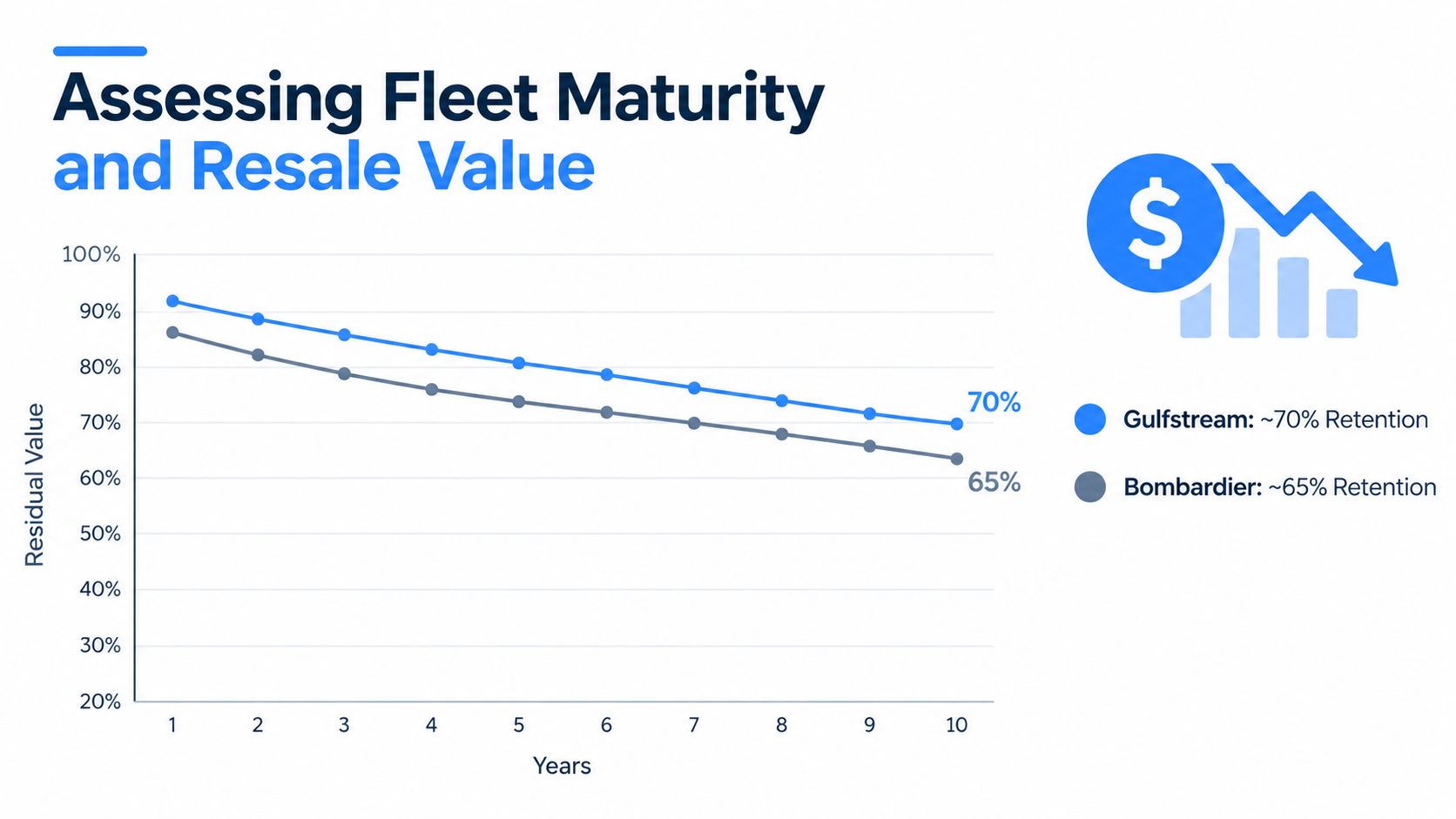
Those delivery totals don't prove that Gulfstream aircraft will retain more value than Bombardier aircraft. Residual value depends on aircraft condition, age, maintenance status, configuration, engine programs, market timing, and the supply of comparable aircraft. Delivery scale does, however, provide evidence of a growing installed base that can support training, maintenance knowledge, parts planning, and buyer familiarity.
A practical residual-value checklist
-
Track the installed base. A platform with meaningful fleet activity gives operators more reference points for maintenance and dispatch planning.
-
Review configuration liquidity. An interior designed for a narrow owner preference may be harder to place than a layout that suits corporate and charter users.
-
Separate maturity from novelty. A newer model may offer superior performance, while a more established platform may provide a longer operating history for buyers and lenders to evaluate.
-
Study the likely exit market. A family office, corporate department, and charter operator may value the same aircraft differently.
Fleet adoption can also cut both ways. Strong operator use may improve parts and training familiarity, but a large operator concentration can expose residual values to fleet-renewal decisions. That risk should be analyzed rather than assumed away.
For a buyer holding an aircraft through multiple ownership cycles, the central financial question is not which brand has the stronger reputation in isolation. It's whether the selected model will remain easy to support and easy to explain to the next buyer.
Matching the Aircraft to Your Mission Profile
There isn't one universal winner in the Gulfstream vs Bombardier decision. The correct choice depends on what the operation is trying to optimize.
For a family office, the G800 deserves close attention when certified nonstop reach and speed flexibility are priorities. The Global 7500 is compelling where the additional range over the G700 helps protect demanding routes, while the Global 8000 deserves evaluation when its certification and delivery timing align with the acquisition plan.
For a corporate flight department, the G700 and Global 7500 should be assessed through actual travel records. Compare the longest sectors, passenger load, preferred cruise speed, baggage requirements, and the cost of a potential fuel stop. A small range advantage matters most when it repeatedly removes operational friction.
For charter and fleet operators, delivery availability, commonality, crew training, maintenance access, and utilization economics may outweigh a marginal performance difference. Fleet scale can support the operating ecosystem, but concentration also creates exposure if a major operator later changes its fleet strategy.
The decision process should finish with three tests:
- Mission test: Can the aircraft perform the demanding routes with the required payload and reserves?
- Availability test: Can the aircraft be delivered or chartered within the required window?
- Exit test: Will the configuration remain attractive to the next owner or operator?
Approved Jets arranges on-demand charter flights, aircraft matching, and end-to-end trip logistics through a vetted operator network, which can help corporate travelers and private clients compare Gulfstream and Bombardier availability without committing immediately to ownership. Visit Approved Jets to discuss a mission-specific charter, aircraft acquisition context, or interim travel plan with an aviation advisor.