
Turboprop vs Piston: Which Aircraft Fits Your Mission
Compare turboprop vs piston aircraft for your next charter. Analyze performance, operating costs, safety, and mission suitability to choose the right flight.

Approved Jets

On this page
- Table of Contents
- Rethinking the Private Aviation Cost Debate
- The real cost of a short trip
- Performance Envelopes and Flight Characteristics
- Where piston aircraft retain an advantage
- Airport access is part of performance
- Operating Costs and the Time-Value Break-Even
- Direct operating cost comparison
- Calculate the completed mission
- Payload Flexibility and Runway Constraints
- Full cabin versus full mission
- Evaluating Safety and Dispatch Reliability
- Engine risk is only one part of trip risk
- Match safety controls to the mission
- Matching the Aircraft to Your Specific Mission
- Short regional hops
- Multi-city corporate travel
- Remote leisure travel
- Securing the Right Charter Through Vetted Networks
- What the broker should verify
The popular advice is simple: choose a piston aircraft if you care about cost, and a turboprop if you care about speed. That advice is incomplete. For corporate travel, the better question is whether the turboprop's higher hourly expense buys enough time, airport access, payload flexibility, and schedule resilience to improve the mission's total value.
A piston aircraft can be the right financial decision for short, fair-weather sectors with light payloads. A turboprop can be the better business decision when a team needs to reach a remote facility, complete several meetings in one day, operate from a demanding airport, or return home without adding an overnight stay. The aircraft that looks expensive on an hourly quote can be cheaper per completed trip and per productive passenger-hour.
Table of Contents
- Rethinking the Private Aviation Cost Debate
- Performance Envelopes and Flight Characteristics
- Operating Costs and the Time-Value Break-Even
- Payload Flexibility and Runway Constraints
- Evaluating Safety and Dispatch Reliability
- Matching the Aircraft to Your Specific Mission
- Securing the Right Charter Through Vetted Networks
Rethinking the Private Aviation Cost Debate
Hourly fuel burn is a useful input, but it's a poor final answer. A travel manager who compares only fuel and maintenance may miss the cost of slower travel, a required fuel stop, a restricted runway, reduced baggage, a missed meeting, or an overnight stay caused by schedule compression.
That's where time-value break-even becomes useful. The question isn't merely, “Which engine costs less to operate?” It's, “At what point does the turboprop's performance recover its premium through saved passenger time, better routing, and lower schedule exposure?”
The real cost of a short trip
Consider a leadership team visiting two regional sites. A piston aircraft may offer the lowest direct operating cost on each individual leg. However, if its lower cruise performance, altitude limitations, or payload restrictions force a longer route or an additional stop, the team may lose the very advantage of private aviation, direct access and control over the working day.
A turboprop generally becomes more compelling as stage length, utilization, payload, and weather demands increase. NASA's Advanced Turboprop Project estimated that advanced turboprops could reduce fuel consumption by 20% to 30% compared with contemporary turbofan aircraft, while targeting speeds up to Mach 0.8 and altitudes of approximately 30,000 feet. NASA's flight testing culminated in 1987, when a modified Gulfstream II demonstrated the technology and confirmed the predicted fuel savings in testing. NASA's history of the Advanced Turboprop Project shows why turboprops have occupied the practical space between piston aircraft and jets.
The same logic applies beyond aviation. A travel manager comparing communications options may study total call duration, connection reliability, and business disruption rather than the advertised per-minute rate. The same broader approach appears in these comparison guides for cheap international calls, where the headline price is only one part of the decision.
Practical rule: If the aircraft saves enough time to protect a meeting, avoid an overnight stay, or bring passengers closer to the final destination, evaluate that value before rejecting the turboprop on hourly cost.
A piston aircraft remains the sensible choice for low-utilization flying, short local trips, and fair-weather missions where the itinerary has generous time margins. But for executives whose time has a measurable business value, “cheaper per hour” can be the wrong metric.
Performance Envelopes and Flight Characteristics
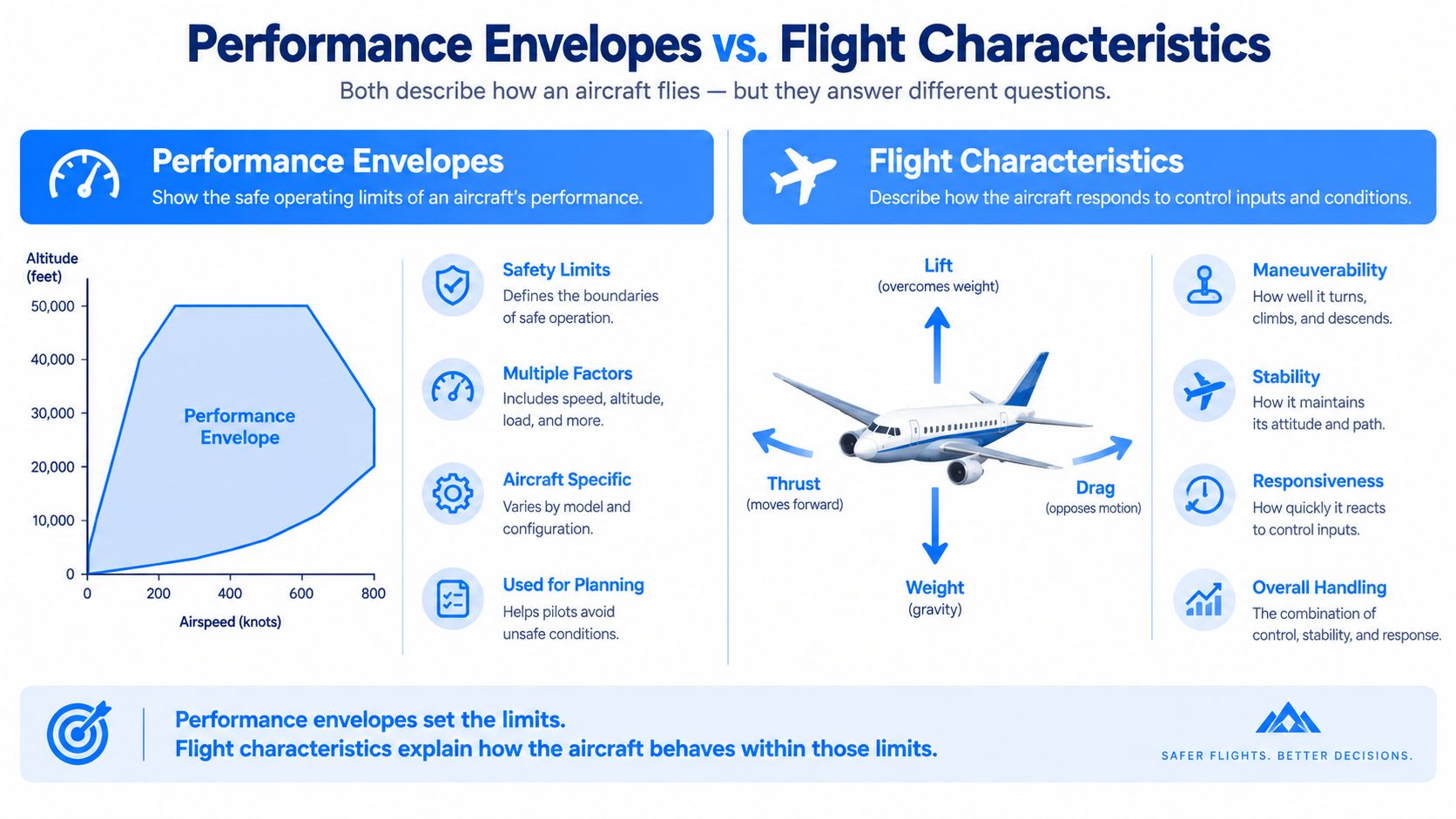
The physical difference between the two categories is straightforward. A piston engine uses reciprocating components to turn combustion into mechanical power. A turboprop uses a turbine engine and reduction gearbox to drive a propeller. Both produce propeller-driven thrust, but they deliver their strongest performance in different parts of the flight envelope.
The FAA identifies the turboprop's most efficient operating range as approximately 250 to 400 mph and 18,000 to 30,000 feet. Turboprops also retain useful low-speed performance for takeoff and landing, which helps them combine cruise efficiency with access to airports that may not suit larger jets. The FAA Airplane Flying Handbook explains the importance of comparing similar aircraft configurations rather than relying on headline engine figures.
Where piston aircraft retain an advantage
At lower speeds and altitudes, a piston aircraft can outperform a turbine powerplant in a comparable configuration. Its lower fuel consumption and simpler acquisition profile make it attractive for short legs between regional airfields, particularly when passengers carry limited baggage and the trip doesn't demand pressurization or high-altitude cruise.
The advantage narrows as speed and altitude rise. Piston engines face practical limits from reciprocating components and combustion-cycle efficiency, while turbine engines perform especially well at the speeds and altitudes typical of regional and executive aircraft. A turboprop generally climbs more strongly, maintains performance better in demanding conditions, and reduces airborne time on longer sectors.
The comparison also requires correct terminology. Reciprocating engines should be evaluated using thrust horsepower, while turbine engines should be assessed using net thrust. Comparing advertised brake horsepower directly with shaft horsepower can produce a misleading result because the figures describe different aspects of engine output.
Airport access is part of performance
A technically faster aircraft isn't automatically faster door to door. If a turboprop can use an airport closer to a mountain property, manufacturing site, or remote corporate facility, its route may outperform a faster aircraft that requires a long ground transfer. Before booking, verify runway length, surface, elevation, temperature, payload, and diversion options. A useful reference for difficult-airport planning is this guide to airports that are difficult to land at.
The practical split is clear. Choose a piston aircraft when the mission stays comfortably inside its lower-speed, lower-altitude strengths. Choose a turboprop when climb performance, pressurization, high-altitude efficiency, and airport flexibility directly affect the itinerary.
Operating Costs and the Time-Value Break-Even
A turboprop costs more to operate directly. That fact shouldn't be hidden. The mistake is treating direct hourly expense as the same thing as total mission cost.
Indicative ownership comparisons place a high-performance piston single at approximately $120 to $200 per flight hour all-in, compared with approximately $400 to $700 for a single-engine turboprop. Turboprop fuel alone is often around $200 to $350 per hour, versus roughly $75 to $110 for a piston. These figures come from an industry ownership comparison published by Flying on upgrading from piston to turboprop, and they should be treated as indicative rather than universal because aircraft type, financing, insurance, maintenance programs, and utilization change the result.
Direct operating cost comparison
| Cost Category | High-Performance Piston | Single-Engine Turboprop |
|---|---|---|
| Indicative all-in flight-hour cost | $120 to $200 | $400 to $700 |
| Indicative fuel cost per hour | $75 to $110 | $200 to $350 |
| Strongest economic use | Short, lower-altitude sectors | Longer or performance-limited missions |
| Main financial advantage | Lower direct expense | More time and payload flexibility |
| Main financial risk | Longer trip and greater schedule exposure | Higher hourly and maintenance expense |
A published AOPA comparison illustrates the operational trade-off. A 1,240-shaft-horsepower Cheyenne II was reported at 260 KTAS at FL190 using 80 gallons per hour, or 245 KTAS at FL250 using 68 gallons per hour. The comparison described that fuel burn as roughly twice that of the piston Aerostar, while reporting approximately 10% higher block speed and substantially stronger runway and climb performance. AOPA's turboprop comparison makes the central point: the turboprop premium buys capability, not cheap fuel.
Calculate the completed mission
For a corporate itinerary, calculate three outputs:
- Cost per completed trip, including repositioning, fuel stops, ground transfers, and likely overnight expenses.
- Cost per productive passenger-hour, which reflects how many passengers can work, meet, or return home within the available window.
- Cost of schedule failure, including a missed meeting, an added hotel night, or a delayed return to headquarters.
A piston aircraft may win the first calculation on a short leg. A turboprop may win the second and third when a team needs to cover multiple locations in one day.
One industry comparison suggests the economics may begin shifting toward turboprops at approximately 400 annual hours, while below 200 hours a piston generally remains cheaper. That isn't a universal rule. Acquisition cost, financing, insurance, training, maintenance, airport access, and delays can move the break-even point substantially.
For charter, ask for a quote that separates aircraft time from the full itinerary. A useful reference is this guide to private jet charter pricing, but the same discipline applies to turboprop and piston bookings. The right comparison is not the cheapest aircraft. It's the aircraft that completes the mission with the least wasted time and operational friction.
Payload Flexibility and Runway Constraints
Aircraft selection is often decided by what must travel, not by the number of seats on the brochure. Five passengers with presentation equipment, samples, winter clothing, or sporting gear can create a more demanding mission than seven passengers with small carry-ons.
A turboprop usually offers stronger climb performance and higher useful capability for demanding airports. That matters at high-elevation fields, in hot weather, or on routes where a full fuel load and full cabin must coexist. A piston aircraft may still perform well, but its margin can narrow faster as density altitude, payload, and runway limitations increase.

Full cabin versus full mission
A charter operator should assess more than passenger count. Provide the following before receiving a final aircraft recommendation:
- Passenger weights and baggage: Include hard cases, sports equipment, medical supplies, and garments that won't fit in soft luggage.
- Runway data: Confirm length, slope, surface, elevation, and seasonal conditions at every airport.
- Weather margin: Review temperature, wind, icing exposure, and likely alternates rather than relying on a standard-day performance assumption.
- Fuel requirements: A full cabin may not coexist with the fuel load required for the planned route and legal reserves.
- Diversion options: Identify realistic alternates before selecting the aircraft, especially for mountain or coastal airports.
A short piston flight between two paved regional airports can be exceptionally economical. The aircraft's lower fuel consumption and simpler ownership profile may outweigh its slower cruise and lower altitude capability. That's particularly true when the passengers are few, the baggage is light, and the schedule has room for weather or routing changes.
The calculation changes for a mountain retreat or remote plant. A turboprop may climb more effectively, reach a suitable cruise altitude, and preserve more options if conditions deteriorate. Its stronger performance can also reduce the temptation to overload the aircraft or accept a marginal runway plan.
A Pilatus PC-12 charter guide is a useful example of why aircraft category must follow mission requirements. The relevant question isn't whether a particular model is fashionable. It's whether its cabin, baggage access, runway performance, and operating profile fit the actual itinerary.
Operational test: Never ask only, “How many people can it carry?” Ask, “Can it carry these people, this baggage, the required fuel, and the needed safety margin from this runway on this day?”
For travel managers, this check prevents a common failure. An aircraft can appear suitable in a booking system yet become unsuitable once baggage, temperature, runway condition, and alternate requirements are applied.
Evaluating Safety and Dispatch Reliability
“Turbines are more reliable” is directionally useful but operationally incomplete. A safe mission depends on the aircraft, operator, crew, maintenance, equipment, airport, weather plan, and passenger profile. Engine type matters, but it doesn't decide every risk.
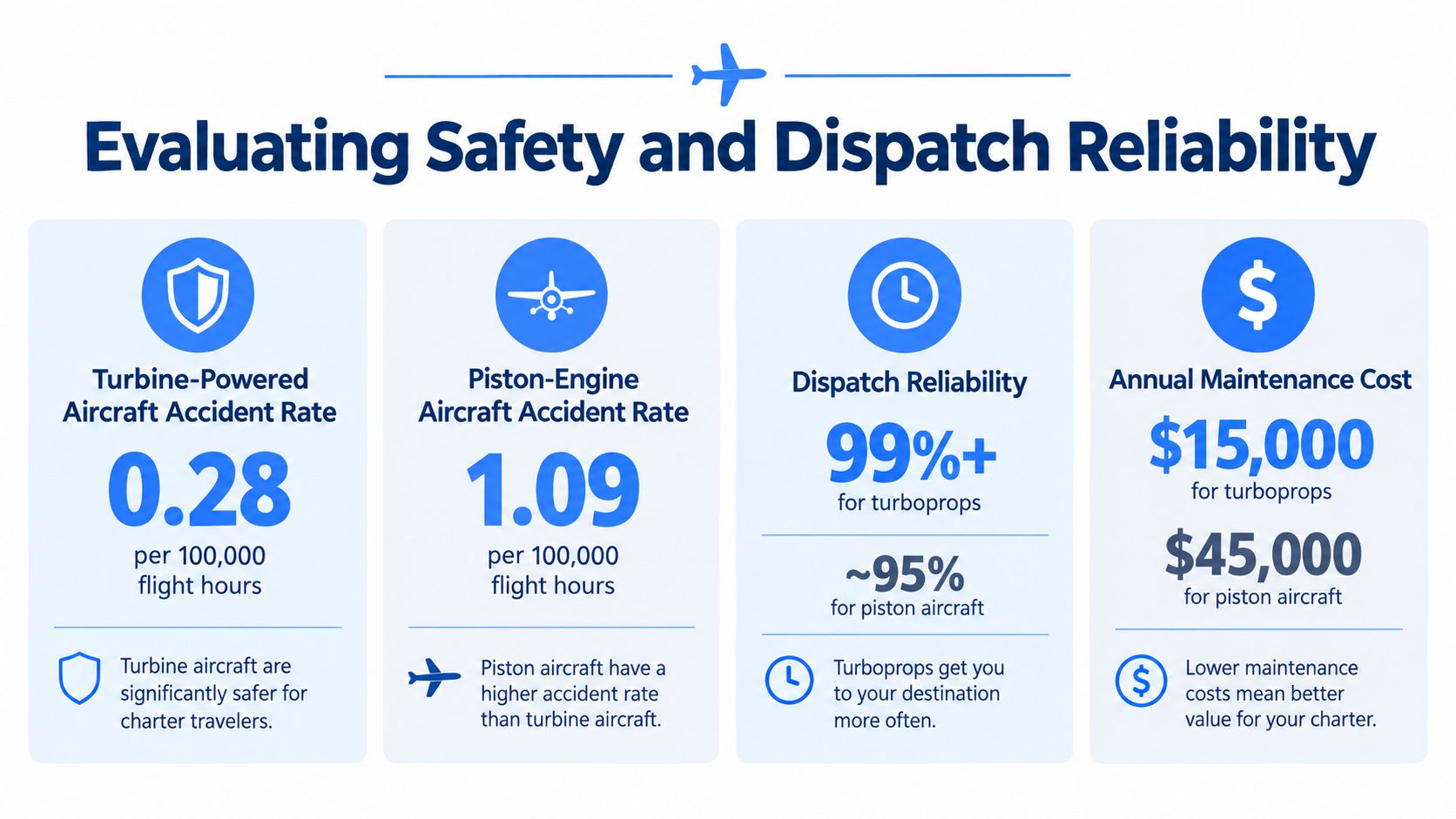
Historical U.S. general-aviation data shows a meaningful distinction between piston and turbine-powered aircraft, while warning against an engine-only causal interpretation. Approximately 75% of registered aircraft had piston engines, and piston aircraft performed slightly worse than the overall general-aviation average in the cited review. Turbine and turboprop aircraft had substantially better accident experience than average, but turboprop accidents could have relatively higher lethality because these aircraft typically operate faster, carry more occupants, and fly more demanding missions. The RGA review of U.S. general-aviation experience provides that historical context.
Engine risk is only one part of trip risk
In 2010, U.S. general aviation recorded 450 deaths and a fatality rate of 1.10 per 100,000 flight hours. Across 2002 to 2012, approximately 18% of general-aviation crashes were fatal. More recent FAA data estimates that the overall general-aviation fatal-accident rate fell to 0.68 per 100,000 flight hours in 2024, compared with 0.83 in 2017 and 0.95 in 2019. Those figures describe broad general aviation, not a clean engine-to-engine experiment. Aircraft size, mission, pilot experience, and operating environment matter.
The FAA identifies accidents involving power-system component failure, controlled flight into terrain, and inadvertent flight into bad weather. That combination is a reminder that preventing an engine failure doesn't eliminate terrain, weather, or decision-making risk. The FAA's 2025 General Aviation Safety Fact Sheet supports evaluating the entire operating system.
Newer turboprops may reduce workload through autothrottle, autoland, improved weather radar, ice detection, and modern avionics. Those features can be valuable during instrument operations, night flights, or demanding approaches, but they're not automatic advantages of every turboprop. Equipment, pilot proficiency, operating rules, and airport infrastructure determine whether the feature improves the mission.
For operators building broader risk controls, the same principle appears in fleet safety camera solutions. Monitoring and oversight work best when they support trained people and disciplined procedures, rather than pretending that one technology solves every operational hazard.
Match safety controls to the mission
A professionally operated turboprop is generally the stronger choice for high-utilization corporate flying, difficult weather windows, high-elevation airports, and missions where dispatch continuity has material value. A modern piston aircraft remains appropriate for lower-utilization, fair-weather trips when its simpler systems and lower ownership barriers support disciplined operation.
The correct question is not whether the turboprop is universally safer. Ask whether its aircraft equipment, operator standards, crew model, maintenance program, and airport capability reduce the specific risks of your trip.
Matching the Aircraft to Your Specific Mission
Start with the itinerary, not the aircraft name. A useful recommendation depends on distance, passengers, baggage, airport conditions, weather, schedule pressure, and the consequences of delay.
Short regional hops
Choose a piston aircraft when the trip is short, the airports are straightforward, the passengers carry light baggage, and the schedule has meaningful flexibility. Lower fuel consumption and a simpler acquisition profile can make it the clear winner for local travel, personal use, and occasional fair-weather missions.
A turboprop earns its premium when the same short route involves a hot or high-altitude airport, a full cabin, a tight return deadline, or a destination where a stronger climb profile improves the operating margin. Distance alone shouldn't decide the aircraft.
Multi-city corporate travel
For a same-day roadshow, start by calculating the ground time between each airport and meeting location. A slower aircraft using a closer airport may beat a faster aircraft that lands farther away. A turboprop is usually the stronger candidate when the team needs several sectors, reliable schedule control, and enough cabin or baggage flexibility to keep the itinerary intact.
Use this decision sequence:
- Define the immovable events. List meetings, presentations, site visits, and the required return time.
- Map airport alternatives. Compare runway capability and ground transfer time, not just airport distance on a map.
- Load the actual payload. Include passengers, bags, equipment, and required fuel.
- Price the completed day. Add ground transport, crew exposure, overnight risk, and the value of passenger time.
- Confirm the operating plan. Ask about crew, weather alternates, aircraft equipment, and dispatch procedures.
Remote leisure travel
For a family travelling to a remote lodge, mountain property, or island facility, turboprop access can outweigh its hourly premium. The aircraft may offer better climb performance, greater payload flexibility, and a cabin designed for longer sectors. A piston aircraft remains attractive where the strip is suitable, the trip is short, and the group can travel light.
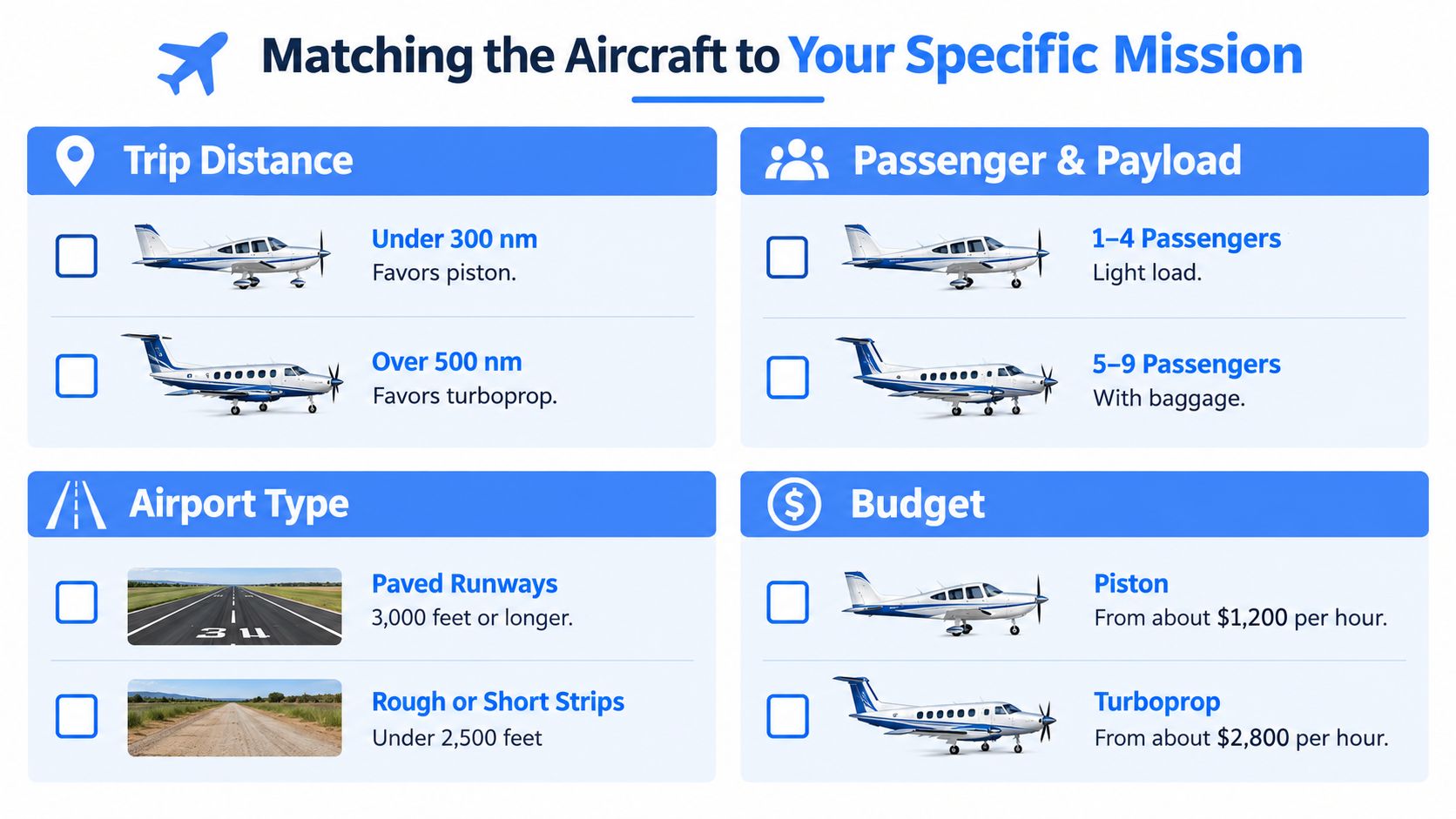
The infographic's planning prompts use under 300 nautical miles as a piston-oriented distance and over 500 nautical miles as a turboprop-oriented distance, while also comparing light loads with larger passenger and baggage demands, paved runways of 3,000 feet with rough or short strips under 2,500 feet, and indicative budgets from about $1,200 per hour for piston aircraft versus about $2,800 per hour for turboprops. Those figures are planning prompts, not universal performance rules. Confirm the actual aircraft and route with the operator.
The decisive test is simple: choose the piston aircraft when its economy supports the mission without compromising the schedule. Choose the turboprop when its speed, climb, payload, or airport access protects the mission's outcome.
Securing the Right Charter Through Vetted Networks
Selecting the category is only half the work. The same turboprop model can produce very different results depending on the operator's maintenance standards, crew experience, dispatch discipline, aircraft positioning, and knowledge of the destination airports.
A professional broker should do more than display availability. It should match the aircraft to the actual mission, verify operator credentials, test the runway and payload assumptions, and keep responsibility for the itinerary from quotation through arrival. That matters even more for multi-stop travel, medical missions, executive movements, and trips involving sensitive passengers or cargo.
What the broker should verify
- Operator quality: Confirm the operator's regulatory status, maintenance program, crew qualifications, and relevant third-party safety credentials.
- Aircraft suitability: Validate cabin layout, baggage capacity, runway performance, fuel planning, weather equipment, and passenger requirements.
- Quote transparency: Separate aircraft cost from repositioning, waiting time, ground transfers, catering, handling, and other itinerary-specific charges.
- Operational oversight: Establish who monitors weather, permits, crew duty, alternates, delays, and aircraft substitutions.
- End-to-end coordination: Keep aircraft, ground transport, security, customs, catering, and passenger communications under one accountable team.
A vetted network is especially valuable when the cheapest aircraft is not the best aircraft. The broker can compare a piston option that minimizes direct cost against a turboprop option that protects the workday, then explain the difference in completed-trip terms.
For corporate travel managers, the right partner also provides continuity. A responsive advisory team can support urgent sourcing, confidential executive travel, complex multi-city routing, medical evacuation, cargo movements, and family travel without forcing the client to coordinate each operator independently.
The aircraft is only one component of trip quality. Operator discipline and active oversight determine whether the aircraft delivers the promised value.
Approved Jets matches private charter aircraft to the real mission, including passenger load, baggage, runway constraints, schedule pressure, and operational requirements. Visit Approved Jets to request a custom charter plan and compare the turboprop or piston option that best protects your time, comfort, and trip outcome.