

Air Freight and Logistics: A Practical 2026 Playbook
Master air freight and logistics in 2026 with a practical guide to service types, routing, customs, chain-of-custody, and time-critical charter oversight.

Approved Jets
On this page
- Table of Contents
- The Moment the Clock Starts Ticking
- Air Freight Fundamentals and the Scale of the Industry
- How the modern network took shape
- Charter vs Scheduled Service and How Capacity Actually Works
- Charter vs Scheduled Air Cargo at a Glance
- Routing and Handling Where Dwell Time Beats Flight Time
- The controls that actually move the needle
- Customs Documentation and What Getting It Wrong Costs You
- What shippers need to verify before wheels-up
- Chain of Custody for High-Value and Sensitive Cargo
- The controls that keep the mission intact
- Building Resilience When Geopolitics Removes Capacity Overnight
- Contingency routing by shipment type
- How Approved Jets Sorts, Sources, and Oversees a Cargo Mission
The phone rings while the aircraft is already moving toward departure, and the shipment on the other end is the one everyone said had to go today. It might be a machine part that stops a production line, a pharma consignment waiting on a clean customs release, or an aerospace component that keeps a grounded asset from staying grounded. In that moment, air freight and logistics stop being a transport purchase and become a mission design problem.
The hard part isn't finding an aircraft. It's making sure the route, the paperwork, the handoffs, and the contingency plan all work together when the clock is already running.
Table of Contents
- The Moment the Clock Starts Ticking
- Air Freight Fundamentals and the Scale of the Industry
- Charter vs Scheduled Service and How Capacity Actually Works
- Routing and Handling Where Dwell Time Beats Flight Time
- Customs Documentation and What Getting It Wrong Costs You
- Chain of Custody for High-Value and Sensitive Cargo
- Building Resilience When Geopolitics Removes Capacity Overnight
- How Approved Jets Sorts, Sources, and Oversees a Cargo Mission
The Moment the Clock Starts Ticking
A lot of shippers first think about air freight after something has already gone wrong. The production manager needs one part, the hospital buyer needs a temperature-sensitive shipment to clear without a paperwork fight, or the ops team learns that the replacement component they counted on is sitting at the wrong hub. The aircraft matters, but it's only one node in the chain.
Practical rule: If the cargo can't survive a missed cut-off, a document query, or a failed handoff, it's not a simple shipping job. It's a controlled mission.
That's why the right question isn't “Which flight is fastest?” It's “Which route still works if the first plan gets interrupted?” A direct service with weak handling can lose more time on the ground than a slightly longer routing with tighter release control. A charter can buy flexibility, but if the consignee isn't ready or the import documents are incomplete, speed just moves the failure point closer to destination.
This is the lens that changes how senior logistics teams work. You stop choosing air freight as a category and start choosing between line-haul time, airport dwell, customs risk, loading constraints, and recovery options. That's the discipline that matters for executives, forwarders, and operators handling time-critical freight.
For readers dealing with urgent cargo, the useful outcome isn't a textbook definition. It's a clear way to decide when to charter, when to use scheduled lift, when to reroute, and when to hold the shipment until the chain of custody is actually ready.
Air Freight Fundamentals and the Scale of the Industry
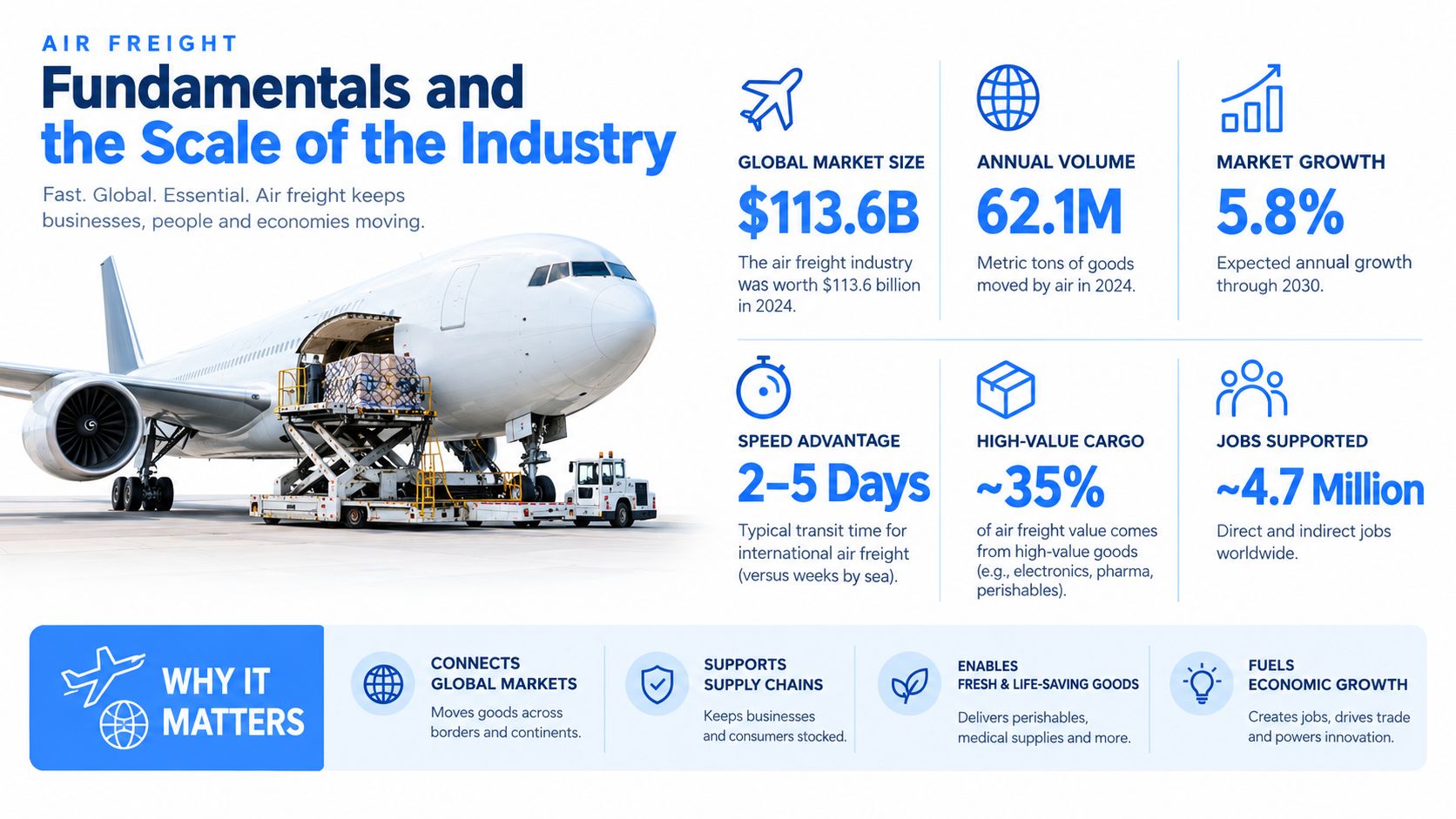
Air cargo is measured in freight tonne-kilometres, or FTKs, because raw tonnage doesn't tell you how much transport work the network is doing. ICAO defines FTKs as the weight of each shipment multiplied by the distance flown on each flight stage, and the freight statistics cover cargo, express shipments, and diplomatic bags, while excluding passenger baggage. That distinction matters, because a small shipment moved a long distance can represent far more operational output than a heavier shipment moved locally. The measure also helps planners compare routes, aircraft use, and demand patterns across markets. ICAO's air cargo facts and figures make that baseline explicit.
In 2023, scheduled global air-cargo operations generated approximately 223.8 billion FTKs and grew 2.7% from the previous year, which shows the size and reach of the system rather than a niche emergency service. The scale is why air freight keeps showing up in discussions about high-value, time-sensitive, and internationally traded goods. It's also why the operational detail behind the number matters as much as the number itself.
How the modern network took shape
The current model didn't appear all at once. Jet passenger aircraft introduced in 1958 expanded belly capacity, which let airlines move more cargo while running scheduled passenger flights. The World Bank notes that international airfreight revenue tonne-kilometres grew at more than 9% per year over the roughly half-century period it reviewed, though that growth varied by cycle and market segment. Later, the U.S. Airline Deregulation Act of 1978 opened the market to broader competition, and open-skies agreements reduced route restrictions that had been locked into bilateral treaties. The result is the hub-based network planners use today, with cargo consolidated, transferred, and rerouted through scheduled and charter capacity. World Bank's industry review
The language in trade reports starts to make more sense once you separate the measure from the mode. FTKs tell you how much transport work is moving through the network, not just how many pieces are on a pallet.
Charter vs Scheduled Service and How Capacity Actually Works
The service choice usually comes down to whether you need a controlled lift or a scheduled slot. On-demand charter gives you mission control over timing and routing, but it asks for more commitment and a tighter fit between the aircraft and the cargo. Scheduled service gives you access to an existing network, yet your shipment has to fit the airline's timetable, handling rules, and load structure.
IATA's planning language helps here. CTK, ACTK, and CLF should be read together, not in isolation. CTK measures freight moved by distance, ACTK is offered capacity, and cargo load factor shows how efficiently that capacity is filled. In December 2025, IATA reported 4.3% year-over-year demand growth, 4.5% capacity growth, and a 47.1% cargo load factor, with full-year international CTK up 4.2% and capacity broadly keeping pace. IATA's December 2025 air cargo market analysis is useful because it shows that advertised space and usable space are not the same thing.
Charter vs Scheduled Air Cargo at a Glance
| Criterion | On-Demand Charter | Scheduled Service |
|---|---|---|
| Minimum commitment | Higher, because you're paying for dedicated lift | Lower, because the shipment shares network capacity |
| Dimensional constraints | Aircraft-specific, but more adaptable if the mission is planned properly | Tied to belly position, pallet rules, and freighter loading limits |
| Hazmat profile | Depends on aircraft, operator approval, and documentation | Depends on airline acceptance and route rules |
| Schedule certainty | High when the aircraft and crew are confirmed | Moderate, because recovery depends on network space and cut-offs |
| Price exposure | More direct, with less room to absorb delay risk | More variable, especially when space tightens on specific lanes |
The table hides a real-world truth, though. The cheapest-looking itinerary can become the most expensive once you add rebooking, missed connections, or extra handling. Scheduled belly capacity is often ideal for routine shipments, but it can break down fast on tight lanes or where the route needs a clean handoff across multiple countries.
Operational reality: A “space available” booking isn't capacity you control. It's capacity you're borrowing until the next disruption.
For teams evaluating a dedicated lift option, a useful starting point is a cargo charter flights overview that frames the difference between aircraft control and network dependence.
Routing and Handling Where Dwell Time Beats Flight Time
The line-haul segment gets too much credit. A fast intercontinental flight can still deliver a slow result if the shipment sits at origin waiting for documents, misses a cut-off, or gets stuck at import release. The World Bank's Logistics Performance Indicators 2.0 treat aviation performance as a combination of connectivity and airport dwell time, using shipment-level tracking data rather than perception. The aviation dwell measure runs from NFD to DLV, meaning Notification of Readiness for Delivery through delivery after customs-cleared release. World Bank LPI 2.0 methodology makes the distinction clear.
That's the part many shippers miss. Flight time is easy to quote. Dwell time is where the route usually wins or loses.
The controls that actually move the needle
- Pre-arrival document validation: Catch mismatches before the shipment reaches the airport.
- Broker pre-clearance: Reduce the chance that customs becomes the bottleneck.
- Harmonized shipment data: Make sure the commercial record, airway bill, and packing data line up.
- Confirmed consignee availability: A ready consignee prevents avoidable storage and release delay.
- Clear escalation ownership: Someone needs to own terminal exceptions the moment they appear.
A route with better flight times can still lose if the local ground process is weak. That's why multi-stop planning has to account for connection risk, handler availability, and the ability to recover after a missed handoff. A useful planning resource on route complexity is this multi-stop route planner guide, especially if your cargo moves through more than one airport before final delivery.
For load protection, packaging matters too. A shipment secured with stretch hood film solutions can hold its integrity better through handling changes, especially when the mission includes extra transloads or terminal dwell. The better the protection, the less likely you are to lose time on damage checks or repackaging.
The logic is simple. If the airport process is shaky, the aircraft schedule won't save you.
Customs Documentation and What Getting It Wrong Costs You
A customs delay often begins before cargo reaches the border. The file must match the freight: commercial invoice, packing list, airway bill or equivalent, accurate HS classification, applicable certificates of origin, and any commodity-specific documents. Pharmaceuticals, perishables, and controlled goods require particular care because the paperwork must describe the shipment's actual configuration, not an earlier version of the booking.
One missing or inconsistent document can trigger a chain of operational costs. Customs may hold the freight, the terminal may begin charging storage, and the broker or shipper may need to correct and resubmit the file. The aircraft may have completed its leg, yet the delivery clock keeps running.
International movement also depends on the requirements at both ends of the route. Certificates of origin, import permissions, and carrier documentation need to align before acceptance. For a practical overview of cross-border flight requirements, see this guide on whether private jets can fly international. Where documents cross languages, Translators USA expert translation services can help reduce ambiguity in legal and commercial wording before customs or the airline reviews the shipment.
Dangerous goods add another acceptance gate. The FAA states that U.S. air carriers must maintain training, processes, and procedures to identify and refuse noncompliant shipments, including batteries, gases, aerosols, flammables, chemicals, and related hazardous materials. The agency also reports that more than 261,000 tons of regulated dangerous goods move by air in the United States each year, compared with more than 3 billion tons transported domestically by all modes. FAA dangerous goods regulations and guidance reinforces the operating order: classify the commodity first, then select the permitted packaging, handling, and routing.
What shippers need to verify before wheels-up
- Commodity classification: Confirm the HS code and regulated status early.
- Document consistency: Reconcile the invoice, packing list, and airway bill.
- Packaging compliance: Match packaging to the commodity and air mode.
- Quantity limits: Check the applicable limits for the shipment class.
- Handling instructions: Record stowage and segregation requirements.
- Translation accuracy: Have specialist translators review critical multilingual documents.
A lithium-battery shipment shows why configuration matters. A package may move through a ground lane without difficulty, then face stricter air requirements because its classification, quantity, or packing method changes. One version can be acceptable while another requires different documentation or handling.
The cleanest air cargo mission is the one that arrives with a release-ready file.
Chain of Custody for High-Value and Sensitive Cargo
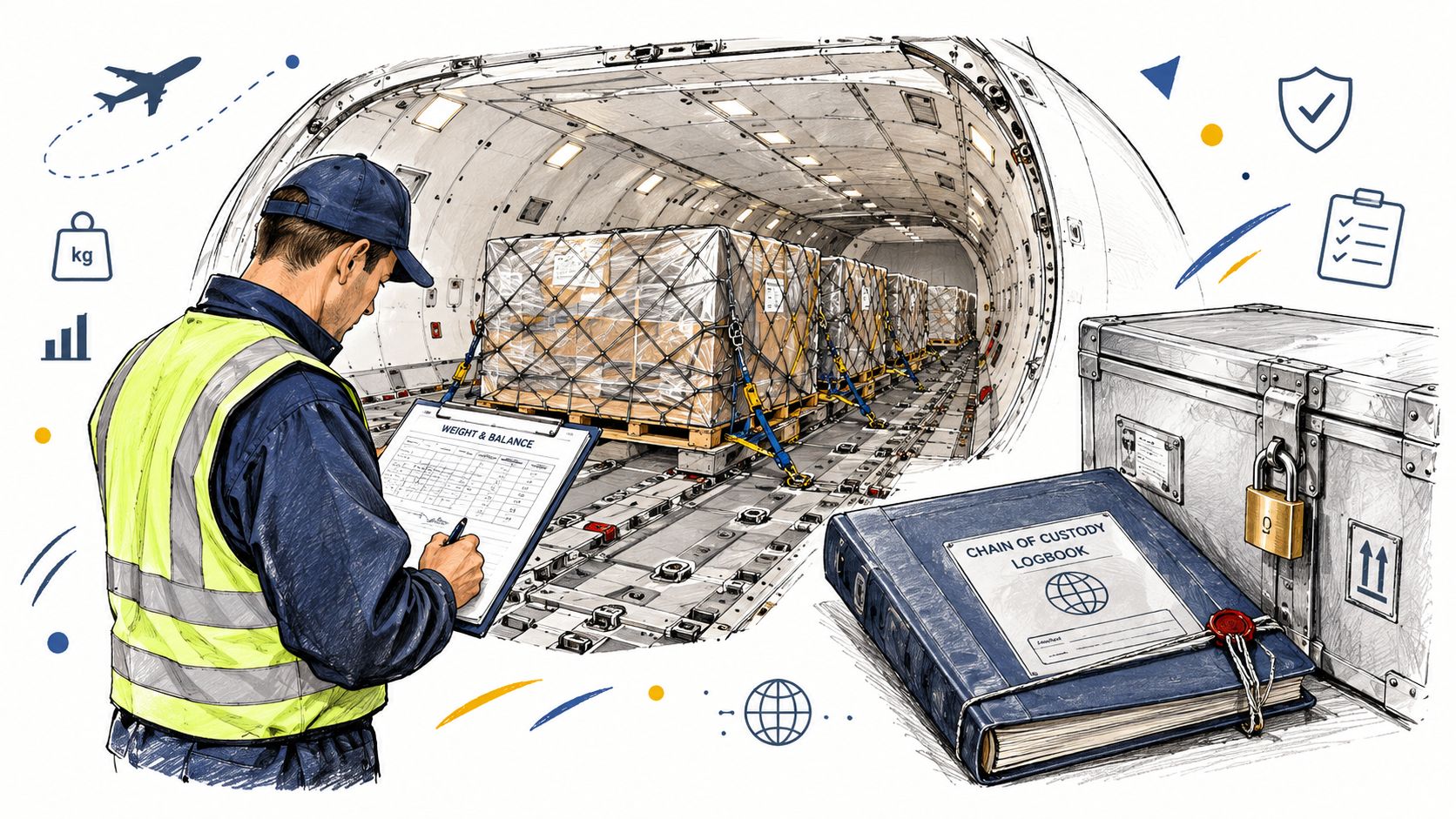
High-value freight is an aircraft safety problem wearing a logistics label. The FAA's cargo-safety guidance puts weight and balance, aircraft configuration, load manifests, hazardous-materials status, and the aircraft flight manual at the center of acceptance. That means a shipment doesn't clear just because it fits under the payload number on a spec sheet. It has to fit the aircraft's actual loading logic. FAA cargo safety guidance is blunt on that point.
An instrument panel, a pallet of medical supplies, or a battery-equipped shipment can all sit comfortably inside gross-weight limits and still fail the mission if the position, restraint, or segregation is wrong. Once you move into chartered or dedicated freight, the checklist becomes more than a transport document. It becomes the evidence trail that proves the cargo stayed under control.
The controls that keep the mission intact
Signed handoffs matter because they show who touched the freight and when. Sealed ULDs matter because they reduce the chance of tampering or unlogged access. Controlled access matters because a shipment's handling history is only as good as the people allowed to touch it. And if the aircraft changes at the last minute, the load manifest and balance data have to change with it.
That's where last-mile discipline meets aircraft discipline. If a mission involves medical, pharmaceutical, aerospace, or jewelry-grade freight, the planner needs to know whether the operator will maintain the same custody standard across every transfer point, not just at departure. The machine part may be small, but the consequences of a chain break can be large.
Later in the process, a live operations team may even refer to the flight through a short embedded update, and a good one will keep that change visible all the way to arrival.
If the loading record, the seal control, or the balance data can't be defended, the shipment isn't mission-ready yet.
Building Resilience When Geopolitics Removes Capacity Overnight
Diversifying carriers and airports sounds sensible until a regional disruption makes paper capacity unusable. In April 2026, IATA reported global cargo demand down 4.8% year over year and capacity down 4.7%, while Middle East cargo traffic plunged 54.3%, Middle East–Asia traffic contracted 58.6%, and Europe–Middle East traffic declined 57.6% as airspace restrictions and hub disruption weakened connectivity. IATA's April 2026 cargo market update shows why resilience has to be designed, not assumed.
The point isn't that one lane is always broken. The point is that a seemingly open route can become dead weight if the connection structure collapses, the truck leg disappears, or customs at the destination can't absorb a new handoff pattern.
Contingency routing by shipment type
- Alternate hubs: Useful when the cargo can tolerate a new connection path and the consignee can absorb a revised delivery time.
- Scheduled freighter capacity: Better when belly space is unstable but dedicated cargo flights are still operating.
- Passenger-belly lift: Can work on routes where those aircraft still fly and the commodity fits the acceptance profile.
- Sea or road for part of the route: Useful when the long-haul air leg is viable but the last segment is not.
- Dedicated charter: The cleanest choice when the mission can't absorb slot risk, hub risk, or a customs reset.
A faster route is not automatically the smarter one. If a missed connection triggers a storage hold, a slot issue, or a customs rework, the elegant routing can become the slowest option on the board. The right fallback is the one that still has local handling, trucking, permits, security screening, and destination customs capability behind it.
Key takeaway: Geographic diversification only helps when the ground chain can actually support the air chain.
Resilience for air freight and logistics is about preserving usable options, not collecting airports on a slide deck.
How Approved Jets Sorts, Sources, and Oversees a Cargo Mission
A broker-led mission works best when the team can turn a fragile shipment into a managed workflow. Approved Jets operates with an inquiry-to-arrival model that fits that need, starting with mission profiling, then aircraft matching through a vetted operator network, then transparent quoting with a stated two-hour turnaround target. In practice, that matters when the shipper needs a clean decision path instead of a pile of disconnected quotes.
The value shows up in the handoffs. A dedicated coordinator can align routing, loading constraints, customs paperwork, and chain-of-custody checks before the wheels start turning, then keep oversight live if the aircraft or crew changes. That's the difference between buying lift and managing a mission.
Approved Jets also works from a U.S.-based headquarters in Miami with 24/7 concierge access, and it places emphasis on vetted operators and recognized third-party safety credentials. For shippers handling urgent freight, high-value freight, or sensitive equipment, that model can reduce the burden of coordinating multiple vendors while keeping control of the critical points that usually fail.
When the cargo is time-sensitive, the question isn't whether someone can find an aircraft. It's whether someone will own the route, the release, the custody trail, and the contingency if the first plan breaks. Approved Jets is one option for that kind of oversight, especially when the mission needs dedicated coordination rather than a self-serve booking flow.
If you're moving cargo that can't afford a weak handoff, a bad document set, or a missed recovery option, speak with Approved Jets about a mission plan built around routing, custody, and release control. Visit Approved Jets to review how their cargo and mobility services support time-critical freight, then use that framework to compare your next shipment against the actual risks on the lane.