
Pet Travel Requirements for Private Jet Travel
Get the latest pet travel requirements for private jet charter, including documentation, health checks, and airline policies for a smooth flight.

Approved Jets
On this page
- Table of Contents
- Why Pet Travel Is a Documentation Game, Not Just a Flight Booking
- The two approvals that control the move
- Navigating Federal Rules and Airline Policy
- Separate the decision into three questions
- Mastering the Health Certificate Timeline
- A workable preparation sequence
- IATA Crate Standards and Cabin Dimensions
- Cabin carrier versus hard transport crate
- Country-Specific Entry and Transit Rules
- The United States applies a different gate
- Booking Pet Charter Flights with Approved Jets
- A disciplined charter workflow
- Private vs Commercial Pet Travel Experience
- Where the trade-off appears
- Pre-Flight Pet Travel Checklist
- Records and timing
- Aircraft and handling
For U.S. air travel, dogs and cats must be at least eight weeks old, weaned for at least five days, and usually accompanied by a health certificate issued within 10 days of shipment. Private jet pet travel requirements are split between FAA safety rules and destination-country import rules, so one certificate rarely completes the journey.
You may be looking at a proposed itinerary, a newly issued vaccination record, and a pet carrier that seems perfectly adequate. The flight itself appears simple. Then an advisor asks whether the animal will clear customs during a layover, whether the microchip was implanted before the rabies vaccination, or whether the certificate will still be valid when the aircraft reaches its final destination.
That's where many otherwise well-planned moves fail. Pet travel is a two-layer process: the operating carrier or aircraft must accept the animal under its safety and handling policy, while every country on the route must accept the animal under its entry and transit rules. Private aviation can reduce terminal friction and simplify the passenger experience, but it doesn't remove border controls, veterinary requirements, or operator approval.
Table of Contents
- Why Pet Travel Is a Documentation Game, Not Just a Flight Booking
- Navigating Federal Rules and Airline Policy
- Mastering the Health Certificate Timeline
- IATA Crate Standards and Cabin Dimensions
- Country-Specific Entry and Transit Rules
- Booking Pet Charter Flights with Approved Jets
- Private vs Commercial Pet Travel Experience
- Pre-Flight Pet Travel Checklist
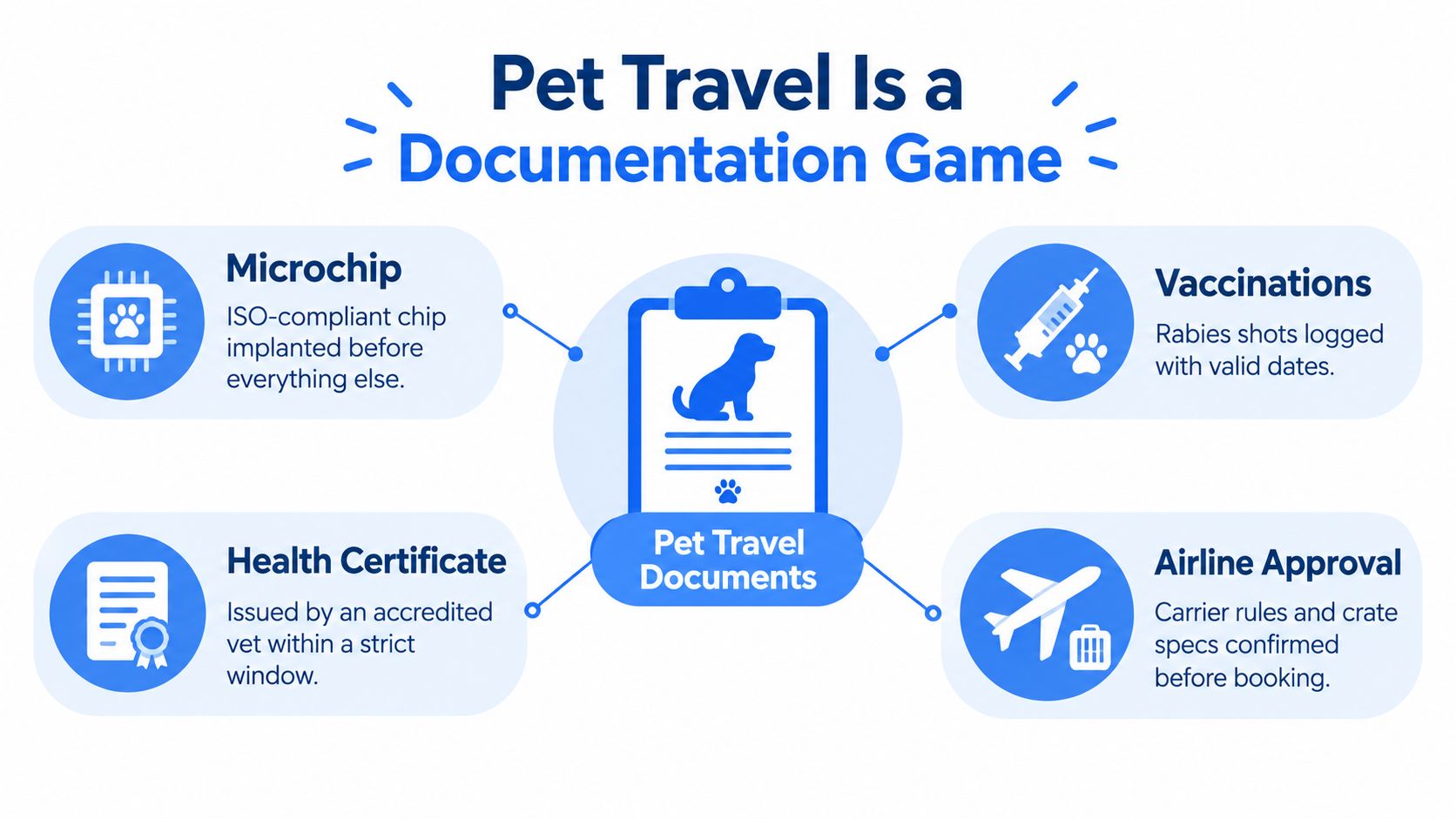
Why Pet Travel Is a Documentation Game, Not Just a Flight Booking
A charter owner once approached a move as if the only question were whether the dog could sit in the cabin. The destination country accepted the animal's health certificate, and the owner had already arranged a suitable carrier. The overlooked issue was the transit stop. That country required its own customs and animal-health review, so the final destination's approval didn't solve the problem at the intermediate airport.
This distinction changes the order of work. The aircraft should not be treated as the starting point. First, establish the animal's identity, vaccination history, health status, route, transit points, and entry mode. Then match those facts against the destination government's requirements and the operator's acceptance criteria.
The two approvals that control the move
The first layer concerns aviation safety and carriage. The FAA says each airline decides whether pets may travel in the passenger cabin. If an airline permits cabin travel, the container must fit under the seat, be stowed before the cabin door closes, and remain stowed during taxi, takeoff, and landing. The second layer concerns government entry. The destination country sets import rules, and those rules can involve microchips, rabies timing, certificates, translations, permits, and inspections. FAA guidance on flying with pets explains the safety framework, while USDA guidance warns that transit countries can impose their own requirements before the pet reaches its final destination. USDA answers on international pet travel are useful for identifying that additional layer.
A generic checklist doesn't capture the operational reality. A dog traveling directly to a country with straightforward entry rules may need fewer interventions than a cat moving through a third country, or a dog whose route triggers customs clearance during a stop. Certified translations can also be required, and a document that works at departure may not satisfy an authority at transit.
Practical rule: Build the compliance file around the exact route, not around the pet alone. Change the transit airport, and you may change the paperwork.
The right question is not “Can my dog fly?” It's, “Can this animal, with these records, on this aircraft, clear every border on this route without an unresolved document or timing issue?”
Navigating Federal Rules and Airline Policy
A pet can meet federal carriage conditions and still miss the aircraft. In a private aviation move, that failure usually comes from treating government rules and operator acceptance as the same approval.
The FAA framework addresses safe carriage, including containment, cabin placement, and when the carrier must keep the container secured. The airline or private operator controls the commercial decision: whether pets are accepted, which species and sizes are permitted, what crate is suitable, and which documents must be reviewed before departure.
FAA guidance on pet carriage notes that dogs and cats must be at least eight weeks old and weaned for at least five days. It also identifies the general requirement for a health certificate issued within 10 days of shipment. These points establish a federal baseline. They do not guarantee boarding, particularly when an operator applies an earlier document-review deadline or imposes stricter acceptance conditions.
Separate the decision into three questions
| Question | Who controls it | What must be confirmed |
|---|---|---|
| Can the animal be carried safely? | FAA framework and operator | Container location, stowage, behavior, and aircraft suitability |
| Will the carrier accept the animal? | Airline or private operator | Pet policy, cabin approval, documents, and crate requirements |
| Will the animal enter the country? | Destination and transit authorities | Health records, identification, vaccination timing, customs, and permits |
This separation prevents a common booking error. A veterinary document does not complete the approval process. The certificate is only one component of eligibility. The aircraft must have an approved place for the animal, the operator must be satisfied that the pet can be carried safely, and border authorities must accept the paperwork for every country on the route.
Transit-country enforcement is where generic checklists often fail. A destination may accept the documents, while a stopover authority requires additional clearance, inspection, translation, or permit handling. An operator may also refuse a route if the certificate reaches its internal review window too late, even though it remains valid under the federal baseline. The trade-off is direct: changing a stop can reduce flight time while creating a new compliance requirement.
For a private charter, obtain written pet acceptance before finalizing the aircraft. Confirm whether the animal stays in the cabin, whether a hard crate is required, when the operator needs the certificate, and whether the itinerary includes a customs stop. “Pet friendly” is not an operating approval. Written conditions are.
Mastering the Health Certificate Timeline
Health certificates fail when owners treat the issue date as the only date that matters. The certificate must be correct for the destination, issued by the appropriate veterinarian, endorsed when required, and valid at the relevant inspection or departure point.
Start with the rabies history and microchip record. For travel from the United States to France, USDA guidance says the pet must have a working microchip before receiving the rabies vaccination for EU travel. If the chip isn't ISO-compliant, the animal may need a second compatible chip or a scanner that can read the existing one. The same guidance requires a wait of at least 21 days after a primary rabies vaccination before travel. USDA's France travel guidance sets out that sequence.
A workable preparation sequence
-
Confirm the identity record first. Have the veterinarian scan the microchip and verify that its number appears consistently on vaccination and health documents. Correcting an identity mismatch after endorsement can be more difficult than correcting it before the appointment.
-
Check the rabies date against the route. The EU's 21-day waiting rule after a primary vaccination is different from the certificate's separate validity window. Don't use the certificate date to calculate the rabies waiting period.
-
Schedule the final examination close to departure. The CDC advises that a health certificate should be dated within 10 days of departure. The U.S. Department of State also notes that airlines often require certificates no older than 10 days, even when a destination accepts older paperwork. CDC travel guidance for pets provides the current planning reference.
-
Allow time for endorsement and corrections. If a government authority must endorse the certificate, build that step into the schedule. A certificate issued on time but returned for a correction can become unusable if there's no room before departure.
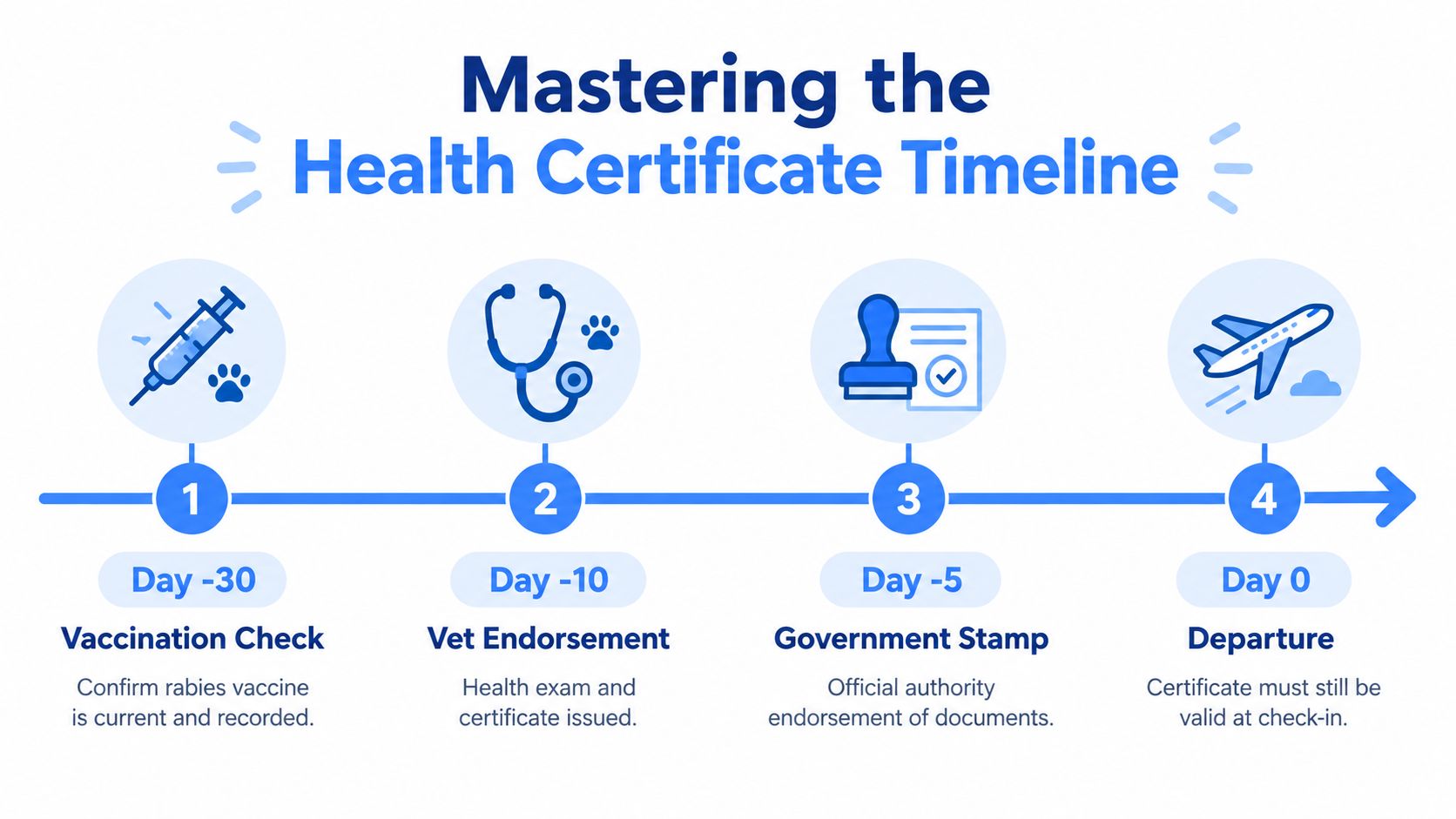
The timing becomes tighter when a route has a separate inspection requirement. Delta states that travel to Mexico effective August 3, 2026 requires a New World Screwworm Inspection Certificate issued by a USDA-accredited veterinarian no more than five days before arrival. That isn't interchangeable with a general health certificate. It's a route-specific document with its own issuing authority and arrival window, so the veterinarian appointment must be planned around the actual landing date, not merely the departure date.
For a practical explanation of the supporting paperwork, dog travel health certificate requirements can help owners prepare questions for their veterinarian. Use it as a planning aid, then verify the final requirements with the relevant authority, operator, and transit points.
IATA Crate Standards and Cabin Dimensions
The crate is not just a comfort item. It determines whether the animal can travel in the selected position and whether ground staff can accept the setup. IATA identifies its Live Animals Regulations as the worldwide standard for transporting live animals by commercial airlines, with the current edition taking effect on January 1, 2026. IATA also states that animals must be at least eight weeks old and fully weaned before air travel. IATA's live animal guidance provides the regulatory reference.
For cabin travel, the first constraint is usually the aircraft's under-seat space. Only small dogs and cats can generally travel in the cabin, subject to airline or operator policy. The animal must be able to stand, sit erect, lie naturally, and turn around normally inside the carrier. A medium-sized dog can be medically fit and behaviorally calm yet still require a different transport position because its carrier cannot fit safely in the permitted space.
Cabin carrier versus hard transport crate
| Cabin arrangement | Hold or cargo arrangement |
|---|---|
| Small dog or cat, only if the operator permits it | Larger animals whose size exceeds cabin limits |
| Carrier must fit under the seat | Rigid container sized for the animal and aircraft handling |
| Animal remains contained throughout the relevant flight phases | Container must support secure handling and ventilation |
| Cabin access depends on operator approval | Cargo or hold acceptance depends on aircraft and route |
IATA's container standards include specific physical thresholds. Openings must be no larger than 25 millimetres by 25 millimetres for dogs and 19 millimetres by 19 millimetres for cats. The total ventilated area must equal at least 16% of the four side surfaces, and the container must carry a Live Animal label. IATA container requirements gives the technical specifications.
A crate that looks roomy in a warehouse can still fail because the animal can't turn naturally, the ventilation design is inadequate, or the openings are too large. Measure the pet in the position required by the standard, then have the operator approve the proposed container before purchasing an itinerary around it.
Country-Specific Entry and Transit Rules
The route creates the compliance profile. The same dog can qualify for one itinerary and fail another because the origin, transit country, final destination, vaccination history, or arrival airport has changed.
For movement within the EU, dogs, cats, and ferrets must receive rabies vaccination from an official or authorized veterinarian. The animal must be at least 12 weeks old on the date of the primary vaccination, and the microchip must be inserted before that vaccination. For pets entering the EU from non-EU countries, the rabies vaccination must be completed at least 21 days before movement. European Commission guidance on movement within the EU sets out the sequence.
A 13-week-old puppy illustrates the practical consequence. The puppy may be old enough for the primary vaccination, but a trip planned immediately afterward won't satisfy the 21-day waiting period for entry from outside the EU. The age requirement and the waiting period are separate tests.
The United States applies a different gate
CDC guidance requires dogs entering the United States to be at least six months old, microchipped, healthy on arrival, and accompanied by a CDC Dog Import Form receipt. A dog vaccinated for rabies outside the United States must arrive through an approved port of entry, undergo examination and revaccination at a CDC-registered animal care facility, and either have a valid rabies serologic titer from an approved laboratory or complete a 28-day quarantine after revaccination. CDC guidance in the Yellow Book explains these import conditions.
A layover doesn't erase the final arrival requirements. A foreign-vaccinated dog that changes aircraft or crosses a border during the journey still needs to satisfy U.S. import rules at the approved final arrival point.
The same principle applies to Mexico-related routes. The screwworm certificate described earlier is a separate inspection document, and its five-day issuance window is measured against arrival. A passport, vaccination booklet, or general health certificate shouldn't be assumed to replace it. For a useful distinction between identity records and formal veterinary entry documents, animal health certificate vs passport provides helpful context.
Before finalizing a multi-country itinerary, map every border crossing and ask whether the pet must clear customs at the transit point. Operators and owners can also review international private jet procedures while assessing customs coordination, but the government authority for each country remains the decisive source.
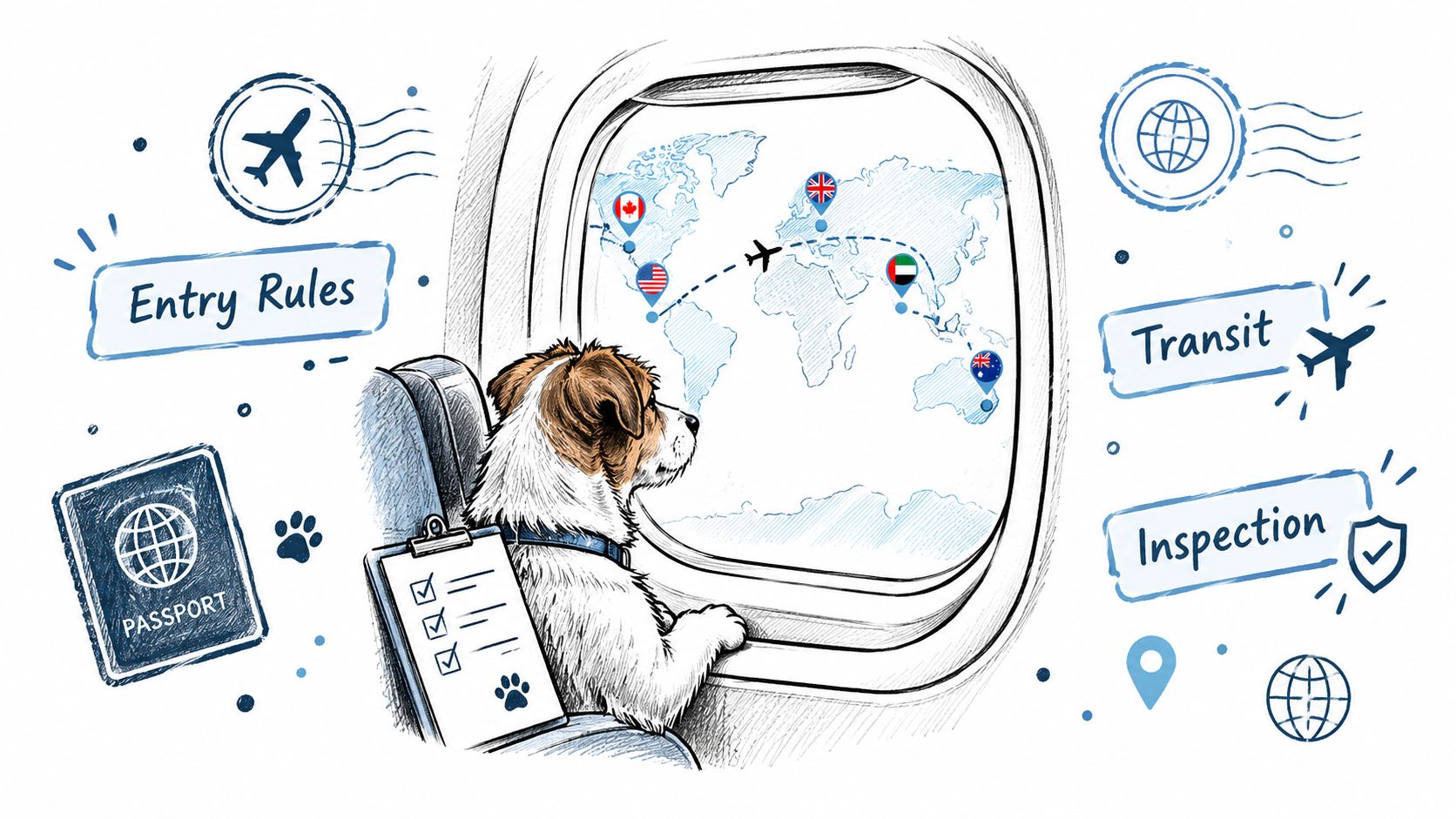
Booking Pet Charter Flights with Approved Jets
Pet coordination should begin before aircraft selection, not after the itinerary has been quoted. The advisor needs the species, breed, size, weight, temperament, carrier dimensions, origin, destination, transit points, and intended cabin arrangement. Without that information, an aircraft can look suitable on paper while failing the animal's practical requirements.
Approved Jets coordinates on-demand charters through a vetted operator network and provides pet travel facilitation, including operator matching and documentation guidance. Its stated network includes more than 1,000 aircraft, so the relevant task isn't only finding an available jet. It's matching the mission profile to an operator that will accept the pet, the carrier, and the route.
A disciplined charter workflow
- Start with the animal profile. Provide accurate measurements and explain whether the pet needs cabin access or can travel in another approved position.
- Submit the full route. Include every planned stop, because transit-country requirements can affect the aircraft and the ground handling plan.
- Confirm operator acceptance. Ask for written confirmation of pet approval, container placement, and any documents required before departure.
- Coordinate customs paperwork. International itineraries may require health documents, translations, inspection arrangements, or customs clearance at a transit point.
- Lock the timing. Align the veterinary examination and certificate window with the actual arrival date, particularly where an inspection document has a shorter validity period.

A broker's useful role is operational oversight. That means checking the proposed aircraft against the pet's containment needs, confirming that the operator understands the animal's status, and keeping the documentation conversation connected to the flight plan. It doesn't mean replacing a veterinarian, government authority, or customs official.
For clients unfamiliar with the charter process, how to charter a private jet offers broader booking context. For the pet move itself, the critical deliverable is a route-specific plan that joins aircraft acceptance, veterinary timing, and border clearance.
Private vs Commercial Pet Travel Experience
Private and commercial travel don't create the same operating environment for an animal. Commercial travel may involve airline-specific cabin limits, crowded terminals, security screening, baggage or cargo handling, and handoffs between airport teams. Depending on the route and carrier, the pet may not remain with the owner throughout the airport process.
A private charter changes the ground sequence. Passengers generally use an FBO rather than a main terminal, and the pet can often remain with the owner until boarding, subject to the operator's procedures. That reduces exposure to crowds and unnecessary handling, but it doesn't remove the need for a safe carrier or valid entry documents.
Where the trade-off appears
| Operating factor | Commercial travel | Private charter |
|---|---|---|
| Terminal experience | Public terminal, security process, and airline handling | FBO access and a more controlled departure process |
| Cabin access | Limited by airline policy and under-seat dimensions | Subject to aircraft, operator, and safety approval |
| Routing | Often constrained by scheduled services and connections | Can be planned around the mission and selected aircraft |
| Documentation | Airline and government rules both apply | Government rules still apply, with operator coordination added |
| Handling exposure | More potential handoffs across airport processes | Fewer planned touchpoints, depending on the itinerary |
The strongest private-aviation advantage is usually control, not regulatory exemption. A pet may stay near its owner, the itinerary can avoid an unnecessary connection, and the team can plan ground transfers around the animal's needs. Those benefits matter for anxious animals, large pets that cannot use an airline cabin carrier, and families managing a complex international move.
The trade-off is that the operator has a direct say in the aircraft and cabin setup. A private jet isn't automatically appropriate for every animal or crate. The aircraft's cabin layout, door dimensions, ventilation, and crew procedures still need review. Travelers evaluating aircraft safety and operating practices can consult private jet safety considerations, but pet acceptance must be confirmed separately for the specific mission.
Private aviation can simplify the journey's physical handling. It cannot simplify a destination country's import law.
Pre-Flight Pet Travel Checklist
A reliable final review ties the animal's records to the exact aircraft and route. Don't treat the checklist as a collection of documents. Treat it as a chain, where a failure in identity, timing, containment, or transit clearance can stop the move.
Records and timing
- Verify the microchip: Confirm that the chip scans correctly and that its number matches every relevant veterinary record. For EU travel, confirm that implantation occurred before the primary rabies vaccination.
- Review rabies timing: Check whether the route requires a waiting period after a primary vaccination. The EU and destination-specific rules may apply different conditions.
- Schedule the final examination: Arrange the health certificate within the applicable 10-day window and leave enough time for any required government endorsement.
- Check special certificates: For routes to Mexico affected by the New World Screwworm requirement, confirm the inspection certificate's five-day issuance window against arrival.
- Prepare translations: Ask the destination authority whether certified translations are required. A document can be medically accurate and still fail an entry review if officials can't accept its format.
Aircraft and handling
- Obtain operator approval: Confirm that the selected aircraft accepts the animal, the species, the breed, and the proposed carrier.
- Measure the carrier: For cabin travel, verify that it fits under the seat and allows the animal to stand, sit erect, lie naturally, and turn around normally.
- Inspect the crate: Check the IATA ventilation, opening, construction, and Live Animal label requirements when a rigid container is required.
- Map the transit: Identify every country where the aircraft lands and determine whether the pet must clear customs or undergo an inspection there.
- Prepare the travel file: Carry originals and accessible copies of identification, vaccination records, health certificates, endorsements, import forms, and operator approvals.
The final question should be operational: if an official or crew member asks for the pet's documents at departure, transit, or arrival, can the responsible person produce the correct version immediately? If not, the move isn't ready, even if the aircraft and passenger itinerary are confirmed.
Approved Jets arranges private charter flights and integrated travel logistics, including pet operator matching and documentation guidance for complex domestic and international routes. For a route-specific assessment of your aircraft, transit points, and pet travel requirements, visit Approved Jets and submit the animal profile before booking.