How Much Do Private Jets Cost to Own in 2026
How much do private jets cost to own? See full breakdown of purchase, annual fixed and hourly costs by jet class and when ownership beats charter.

Approved Jets
On this page
- Table of Contents
- Introduction Why Sticker Price Is Only the Beginning
- How Private Jet Ownership Costs Really Work
- Bucket one: variable direct operating costs
- Bucket two: annual fixed costs
- Bucket three: capital costs
- Private Jet Costs by Aircraft Class and Size
- Why range increases the bill twice
- Fixed and Variable Costs That Drive Your Annual Budget
- The fixed side of the ledger
- The variable side of the ledger
- Ownership vs Charter and When Each Makes Financial Sense
- Building a break-even-hours model
- Where management can fit
- Real World Ownership Examples and Annual Cost Scenarios
- Light jet flown 150 hours
- Midsize jet flown 300 hours
- Heavy jet flown 400 or more hours
- Deciding If Full Ownership Is Right for You
Annual recurring costs for a private jet typically run $500,000 to $1,000,000 or more, before financing and depreciation. Total ownership can reach 10% or more of the aircraft's value each year, so the purchase price is only the entry ticket, not the full budget.
That's the central answer to how much do private jets cost to own. A jet that rarely leaves the hangar still carries insurance, storage, management, crew, and compliance expenses. Once you fly regularly, fuel and maintenance reserves rise with every hour. The right question isn't just “What does the aircraft cost?” It's “How many hours will I fly, what missions will I fly, and which costs will remain fixed?”
The figures below build that answer step by step. You'll see how three cost buckets work, how aircraft classes change the economics, and why the comparison with charter depends on utilization rather than a universal ownership threshold.
Table of Contents
- Introduction Why Sticker Price Is Only the Beginning
- How Private Jet Ownership Costs Really Work
- Private Jet Costs by Aircraft Class and Size
- Fixed and Variable Costs That Drive Your Annual Budget
- Ownership vs Charter and When Each Makes Financial Sense
- Real World Ownership Examples and Annual Cost Scenarios
- Deciding If Full Ownership Is Right for You
Introduction Why Sticker Price Is Only the Beginning
A new Embraer Phenom 300E typically costs about $12 million, while midsize aircraft such as the Citation Latitude or Challenger 3500 often cost $15 million to $28 million new. Those figures show the size of the purchase, not the full cost of keeping an aircraft ready to fly. Market benchmarks for aircraft acquisition and hourly economics show how size, range, and engine count influence both the initial payment and the ongoing operating burden.
Ownership becomes easier to evaluate when its expenses are placed into three buckets. The first is the aircraft itself, including the purchase price, financing, and depreciation. The second covers fixed annual commitments, such as crew, hangar space, insurance, and management. The third changes with use, including fuel, maintenance, and other flight-related charges. Paramount Business Jets' ownership-cost breakdown explains why the operating budget can outweigh the purchase decision over time.
For many aircraft, recurring ownership expenses include fuel, maintenance, crew, hangar space, insurance, and management. Industry cost breakdowns place annual spending around $300,000 to $500,000 for light jets, $500,000 to $700,000 for midsize jets, and more than $700,000, sometimes above $1 million, for large jets.
Use changes the result. More flying raises fuel and hourly maintenance costs, but spreads fixed expenses across more trips. Fewer flights reduce variable spending while annual bills continue. The aircraft can therefore look affordable on a purchase worksheet yet expensive per trip.
The practical test: Approve an aircraft only when its annual fixed budget, expected flight hours, and capital cost fit together.
The analysis ahead uses this utilization-sensitive model to compare aircraft capability, annual expenses, and the flight volume at which ownership can make more sense than charter.
How Private Jet Ownership Costs Really Work
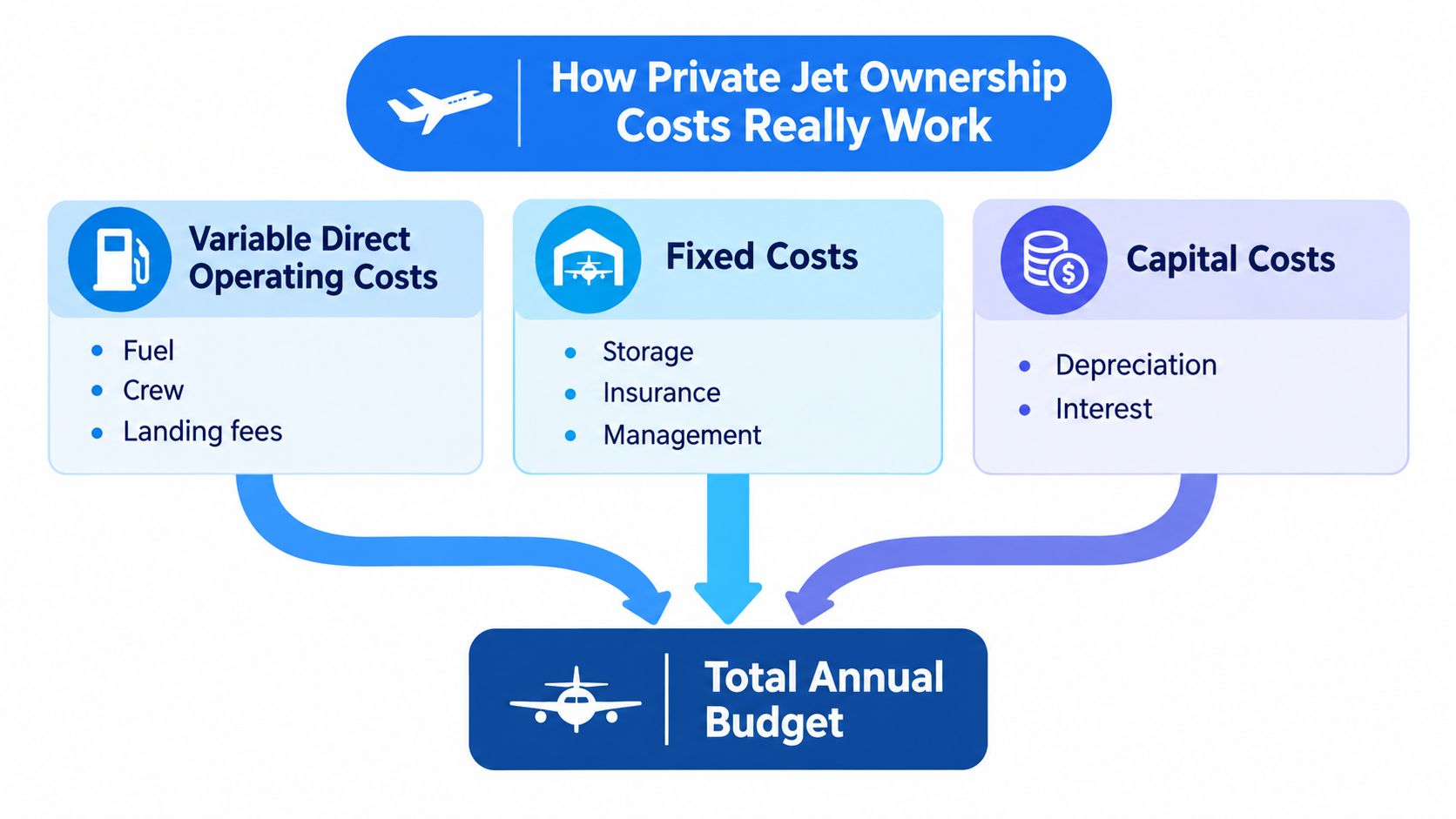
The purchase price is only one part of the ownership equation. A useful model separates the aircraft into three cost buckets: expenses that rise with flight hours, bills that continue while it is parked, and capital tied up in the asset. This works like a building with utilities, maintenance, and financing. Each category behaves differently, so one annual total can hide the true economics.
Bucket one: variable direct operating costs
These expenses follow the aircraft into the air. Fuel is the most visible example, joined by hourly maintenance reserves, engine-program charges, landing fees, navigation charges, and other trip-related costs. Fuel commonly represents 40% to 55% of direct operating cost, and the price paid at a fixed-base operator differs from ordinary retail fuel pricing. Aircraft size also affects fuel burn, engine exposure, and hourly direct cost.
For a midsize jet, published estimates put fuel alone at about $2,500 to $3,800 per flight hour. That figure matters because every additional flight adds another layer to the annual budget. Higher utilization raises variable spending, but it also spreads standing expenses across more trips.
Bucket two: annual fixed costs
Fixed costs continue whether the aircraft flies or remains in its hangar. Hangar space protects the aircraft, insurance transfers operating risk, management coordinates the program, and crew costs support readiness. Registration, FAA or EASA oversight, and airworthiness certificate renewals can add roughly $10,000 to $50,000 annually. Regulatory compliance is part of the ownership bill, not an occasional administrative detail.
Crew, hangar, insurance, and management costs vary with aircraft type and location, yet they do not disappear during a quiet travel period. This creates the break-even hours problem: an owner needs enough annual use to spread these standing bills across meaningful trips.
Bucket three: capital costs
Capital costs include the aircraft's purchase value, financing, and depreciation. Cash expenses can therefore understate the economic cost of ownership. A jet might require $1.2 million to $2.0 million in annual cash ownership costs, while newer calculators place midsize annual ownership nearer $2.2 million to $3.2 million once broader accounting treatment is included. A midsize ownership cost analysis shows why utilization, depreciation, and financing produce such a wide range.
Maintenance records affect this calculation because they influence future liability and resale confidence. Before buying, review DuBois Aviation on record risks alongside an independent pre-purchase inspection. A low purchase price can lose its appeal quickly if incomplete records indicate expensive deferred work. Ownership makes financial sense only when capital cost, annual fixed bills, and expected flight hours fit the same operating plan.
Private Jet Costs by Aircraft Class and Size
Aircraft class changes ownership economics in two ways. Larger aircraft usually cost more to acquire, and they also consume more fuel and carry higher maintenance exposure every hour they fly. That makes mission matching the most practical cost-control decision available to a buyer.
A very light or light jet may suit regional travel where a larger cabin and longer range add little value. A midsize aircraft brings more cabin space and range, but its engine reserves, fuel burn, and maintenance programs raise the operating budget. Ultra-long-range aircraft add global capability, and that capability carries a substantial recurring price.
| Aircraft Class | New Price Range | Direct Operating Cost Per Hour |
|---|---|---|
| Very light and light jets | Phenom 300E typically about $12 million new | About $1,800 to $2,400 |
| Midsize jets | About $15 million to $28 million new for examples such as Citation Latitude and Challenger 3500 | Varies by aircraft and utilization |
| Ultra-long-range aircraft | Not stated as a single verified acquisition range | About $7,000 to $9,500 |
The light-jet benchmark requires careful interpretation. The Phenom 300E's acquisition figure is a specific example, not a universal price for every light aircraft. Pre-owned examples can range from $6 million to $11 million, depending on condition, equipment, and market position. Approved Jets' midsize private jet buyer's guide is useful when comparing aircraft by purchase price, direct hourly expense, charter pricing, and utilization logic.
Why range increases the bill twice
Range and cabin size add value only when your missions use them. If your passengers usually travel shorter regional routes, paying for intercontinental capability may leave capital tied up in features that provide little practical benefit. A larger aircraft also exposes you to higher engine-program contributions, fuel use, and maintenance reserves.
Engine count, weight, and range all influence direct operating cost. The same source places hourly direct costs from $1,800 to $2,400 for very light and light jets up to $7,000 to $9,500 for ultra-long-range aircraft. That spread can transform a small difference in planned utilization into a major annual budget difference.
A sensible comparison therefore starts with missions, not brands:
- Regional travel: A very light or light jet may offer the needed airport access and capacity without paying for unused range.
- Longer domestic missions: A midsize aircraft may justify its higher cost through cabin comfort and nonstop capability.
- Global travel: A heavy or ultra-long-range jet can make sense when its range and cabin are used consistently.
Fixed and Variable Costs That Drive Your Annual Budget
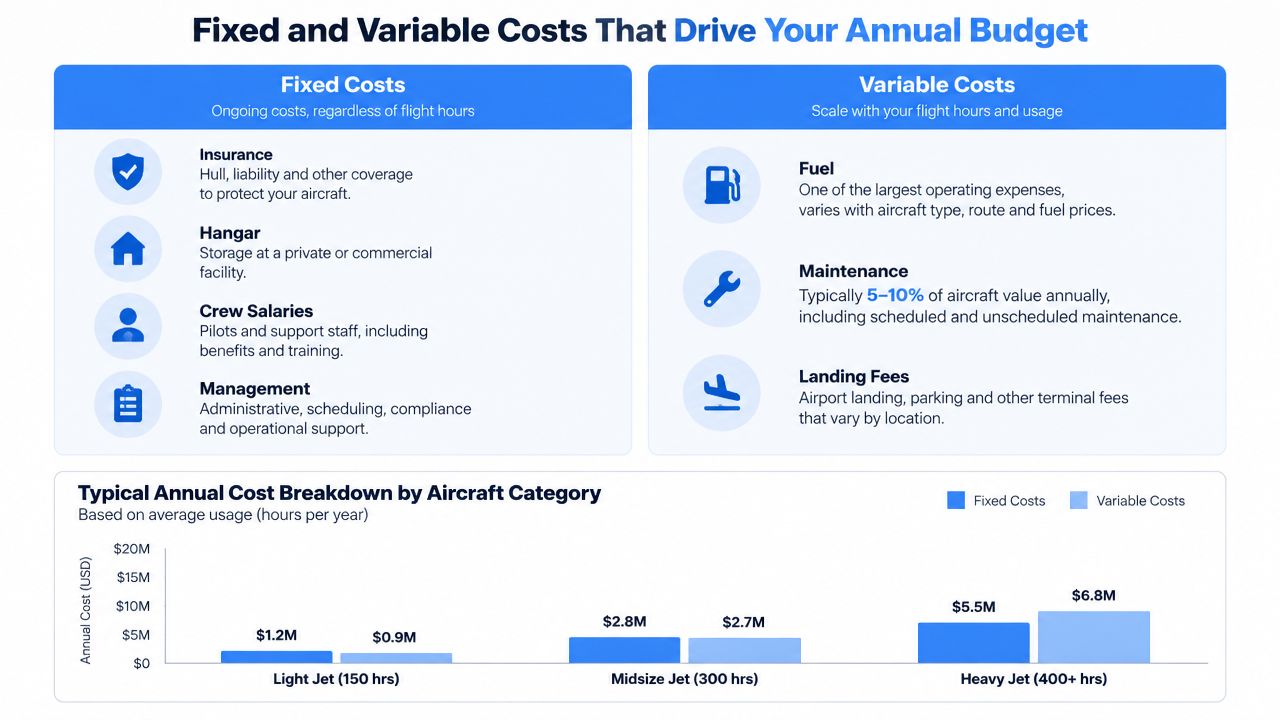
The annual budget has three practical buckets: fixed costs, variable costs, and capital costs. Fixed expenses continue while the aircraft sits idle. Variable expenses follow each flight. Capital costs cover depreciation and the money tied up in the aircraft. Separating them prevents a low hourly estimate from hiding a large ownership commitment.
The fixed side of the ledger
Maintenance sits between the first two buckets. Scheduled reserves may be calculated per flight hour, while calendar-based inspections and unexpected repairs can arrive even when utilization is low.
Annual maintenance alone can equal 5% to 10% of aircraft value. For a $10 million jet, that means $500,000 to $1 million per year for upkeep before other ownership expenses. Empty Leg Guide's maintenance and ownership discussion also places insurance around 1% to 3% of insured value annually, with published hull-and-liability examples ranging from approximately $15,000 for very light jets to $500,000 or more for large-cabin aircraft.
Crew is another recurring commitment. Typical crew expenses for midsize aircraft are often cited at $200,000 to $350,000 per year. Hangar costs vary by airport and region, while management fees pay for services such as operational coordination, maintenance tracking, compliance oversight, and scheduling. Approved Jets' private aircraft management guide outlines what outsourced management can cover.
Insurance needs its own review because aircraft size, pilot qualifications, operating territory, and liability exposure affect the premium. Buyers can use guidance on insurance for multi-engine planes to organize questions before requesting formal quotes.
The variable side of the ledger
Fuel, hourly maintenance reserves, engine programs, landing charges, and navigation fees generally rise with flight activity. Fuel alone can make up 40% to 55% of direct operating cost, so route length, aircraft weight, and fuel pricing at the departure location all affect the hourly result.
Capital costs complete the picture. A useful planning rule is to budget around 10% of aircraft value or more annually, particularly when depreciation and heavier utilization are included. Broader industry guidance places annual operating costs at 5% to 15% of aircraft value, depending on the aircraft and operating profile. That range is a planning framework, not a guaranteed bill.
Flying roughly 300 to 400 hours can change the economics sharply. More trips spread fixed costs across greater utilization, but fuel, reserves, and fees continue to rise with each hour. The aircraft may cost less per trip while costing more in total for the year.
Ownership vs Charter and When Each Makes Financial Sense
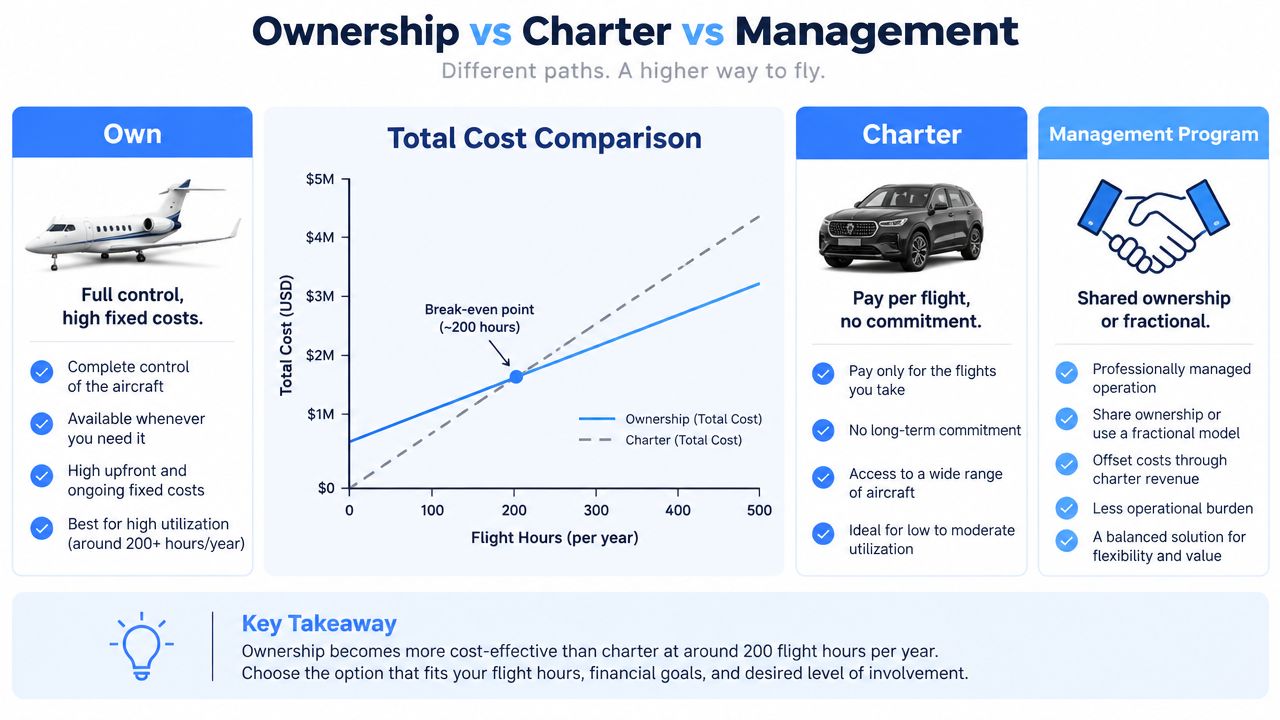
The ownership decision usually comes down to one question: how often will the aircraft perform missions that justify carrying fixed costs? Ownership has a fixed annual layer, a variable hourly layer, and a capital layer. Charter largely converts the decision into a trip-by-trip expense, while management may change how the aircraft's unused availability is handled.
A midsize jet illustrates the tension. Independent summaries place annual cash ownership around $1.2 million to $2.0 million, while newer calculators place annual ownership closer to $2.2 million to $3.2 million when depreciation and broader capital treatment enter the calculation. The Jet Finder's 2026 ownership breakdown separates fixed costs, hourly costs, and break-even hours, which is the right structure for comparing alternatives.
Building a break-even-hours model
Start with three inputs:
- Annual fixed cost: Insurance, hangar, crew, management, compliance, and other expenses that continue when the aircraft is idle.
- Variable hourly cost: Fuel, maintenance reserves, landing charges, and other costs tied to each flight hour.
- Comparable charter cost: The cost of booking equivalent aircraft for equivalent missions, including the same passenger, range, and scheduling requirements.
The ownership equation becomes more favorable as flight hours increase because fixed costs are spread across more trips. However, variable costs still rise with every hour, and depreciation or financing can remain substantial. One 2026 breakdown cites approximately $675,000 in annual fixed costs plus roughly $3,000 per flight hour before depreciation for a midsize jet. That example shows why low-utilization ownership can produce a high cost per trip even when the annual headline appears manageable.
Break-even is not a magic number. It changes with aircraft class, mission length, charter pricing, financing, depreciation, and whether the aircraft earns revenue when you aren't using it.
Where management can fit
An owner who permits charter use through a management arrangement may offset part of the fixed burden with outside revenue. That revenue isn't guaranteed, and it must be evaluated against additional wear, scheduling constraints, regulatory requirements, and the owner's access priorities. The relevant comparison is net cost after realistic utilization, not gross charter income.
Charter remains attractive when travel is irregular, missions vary by route, or the buyer values flexibility over control. A practical reference for comparing those trip-based economics is Approved Jets' private jet charter pricing guide. The right choice comes from modeling the actual travel calendar rather than adopting a generic ownership threshold.
Real World Ownership Examples and Annual Cost Scenarios
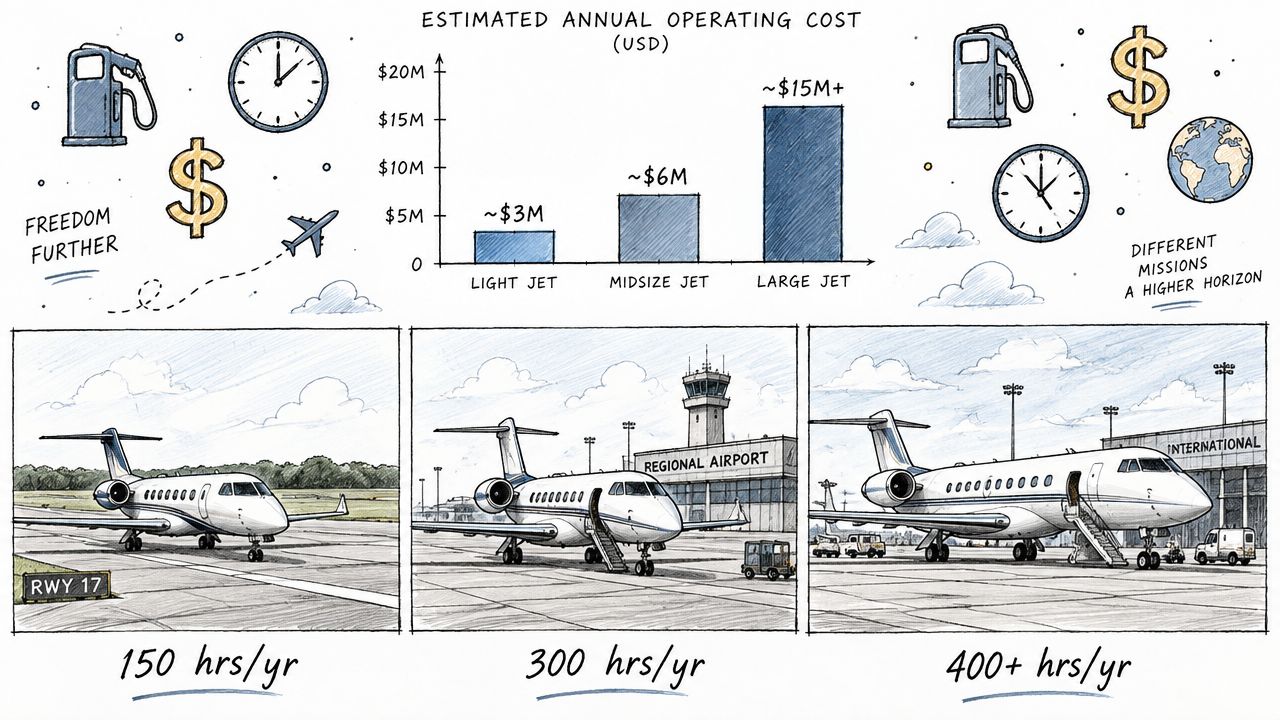
Annual utilization changes the ownership math more than the aircraft label suggests. The examples below use a light jet at 150 hours, a midsize jet at 300 hours, and a heavy jet at 400 or more hours. They are planning frames, not quotes for a specific aircraft. Each shows how fixed, variable, and capital costs interact.
Light jet flown 150 hours
A light jet used for regional business travel generally has lower fuel and hourly maintenance spending than a midsize or heavy jet. Its annual budget still includes hangar space, insurance, crew arrangements, management, and scheduled maintenance. Planning estimates commonly place annual light-jet costs around $300,000 to $500,000, before financing and depreciation.
At 150 hours, the fixed bucket carries much of the burden. Hangar, insurance, management, and other recurring commitments continue even if the aircraft flies less than planned. Each additional flight spreads those costs across more trips, but low utilization keeps the effective cost per flight high.
Midsize jet flown 300 hours
A midsize aircraft can provide the cabin and range required for longer business missions, with a larger annual budget to match. Published estimates put cash ownership around $1.2 million to $2.0 million, while broader all-in calculations can reach $2.2 million to $3.2 million once depreciation is included.
At 300 hours, fixed expenses are distributed across more trips. Variable costs then become more visible, particularly fuel and maintenance reserves. The break-even question is whether the owner's travel schedule creates enough use to justify those recurring commitments.
A management arrangement may allow charter use during periods when the owner does not need the aircraft. Any potential revenue should be weighed against added wear, scheduling limits, and reduced access. It changes the operating model, rather than eliminating ownership costs.
The following video offers another visual explanation of how recurring expenses accumulate across an ownership model.
Heavy jet flown 400 or more hours
A heavy jet used for frequent long-range travel has the greatest exposure to fuel burn, maintenance reserves, crew, hangar, and management costs. Large jets can exceed $700,000 annually and sometimes top $1 million in recurring operating costs, before financing and depreciation. Higher utilization can make that budget easier to justify when the owner regularly needs the aircraft's range and cabin capacity.
Short, occasional missions may leave much of that capability unused. Regional hangar pricing, crew structure, engine-program enrollment, and maintenance history can also change the result substantially. A buyer should request a model based on the actual aircraft, expected hours, routes, and maintenance status, then compare that annual total with the travel alternatives.
Deciding If Full Ownership Is Right for You
Full ownership suits buyers whose travel produces high and consistent utilization, follows a stable mission profile, and requires control or guaranteed access. It is also reasonable when the aircraft's range, cabin, or airport capability solves a recurring business need that charter cannot handle as efficiently.
Use three cost buckets to test the decision:
- Operating costs: Fuel, maintenance, crew, hangar, insurance, management, and regulatory expenses.
- Utilization: Expected annual hours, route lengths, passenger loads, and seasonal variation.
- Capital costs: Depreciation, financing, resale exposure, and the opportunity cost of committed capital.
A conservative plan may estimate annual spending at 5% to 15% of aircraft value, then test that range against actual missions and a credible charter comparison. The percentage is only a starting screen. Your aircraft, routes, maintenance status, and financing terms determine the actual result.
The break-even question is simple: how many hours will you fly, and how much fixed cost will those hours carry? A buyer flying irregularly may pay for capacity that sits unused. Charter or managed access can fit better when trip requirements vary, while fractional models can reduce capital commitment and preserve planned availability.
Before signing, document travel history, forecast realistic hours, identify the smallest aircraft that meets each mission, and request transparent ownership, management, and charter quotes. Approved Jets arranges on-demand charter, aircraft management, and travel logistics through its operator network, allowing buyers to compare access with ownership's full financial burden.
Approved Jets can compare aircraft options, charter, and management against your routes and annual utilization. Visit Approved Jets to request a mission-specific consultation before committing capital.