

Private Jet Charter Cheap: 7 Ways to Save
Find a private jet charter cheap with 7 practical strategies, from empty legs and shared flights to regional airports, memberships, and smarter timing.

Approved Jets

On this page
- Table of Contents
- 1. Aircraft
- Match the aircraft to the mission
- 2. XO
- Where the model breaks
- 3. Stratos Jet Charters
- Compare the risk-adjusted quote
- 4. Paramount Business Jets
- Ask what the broker margin changes
- 5. Jets.com
- Separate benchmarking from booking
- 6. Tradewind Aviation
- When turboprop value disappears
- 7. Victor
- Use comparison data intelligently
- Cheap Private Jet Charter, 7-Provider Comparison
- Choose the Lowest Total Cost, Not Just the Quote
- Final quote checklist
The lowest-cost private flying usually starts around $2,300 per hour for a turboprop or $3,500 per hour for a light jet, while an ultra-long-range jet can reach $17,000 per hour. The practical ways to reduce the bill are buying a seat instead of a whole aircraft, taking an empty leg, choosing a smaller aircraft, or accepting flexible timing and airports.
Private aviation is rarely cheap in absolute terms. The price gap narrows when you change what you buy, not when you search harder for a provider. A solo traveler may save by joining a shared flight, while a group can make a full charter more sensible by dividing the aircraft cost. An empty repositioning leg can be attractive, but only if its fixed route and timing fit the trip.
Aircraft category, distance, repositioning, airport choice, timing, passenger count, luggage, taxes, and requested services all affect the final invoice. Published 2026 ranges illustrate the spread, from $2,300–$3,500 per hour for turboprops to $11,000–$17,000 for ultra-long-range jets. (Uncompromised Travel)
A flexible regional traveler might move departure by a day, use a nearby airport, and accept a turboprop. A fixed-date executive itinerary may need a specific aircraft, direct routing, substantial luggage capacity, and guaranteed recovery support. The second traveler may pay more because schedule control is part of the product.
Flexibility is the primary currency of lower-cost charter travel.
The seven options below are organized around why each method can reduce pricing, when it fails, what flexibility it requires, and how to compare quotes fairly. Before booking, it also helps to compare the surrounding ground-travel costs, including how to compare parking costs at Dubai airports, rather than judging the flight in isolation.
Table of Contents
- 1. Aircraft
- 2. XO
- 3. Stratos Jet Charters
- 4. Paramount Business Jets
- 5. Jets.com
- 6. Tradewind Aviation
- 7. Victor
- Cheap Private Jet Charter, 7-Provider Comparison
- Choose the Lowest Total Cost, Not Just the Quote
1. Aircraft
The most dependable way to reduce charter cost is to choose less aircraft. A turboprop can suit a short regional route, while a light jet may justify its higher rate when speed, range, or cabin comfort matters. Selecting a midsize, heavy, or ultra-long-range jet without needing its range, space, or luggage capacity creates capacity overspending.
Published 2026 hourly ranges show how the aircraft category sets the baseline. Turboprops commonly run $2,300–$3,500 per hour, light jets $3,500–$5,200, midsize jets $4,700–$8,000, super-midsize jets $6,000–$10,500, heavy jets $8,000–$14,000, and ultra-long-range jets $11,000–$17,000. (Aircraft cost comparison) A separate market summary places a four-seat very light jet at about $2,500 per hour and ultra-long-range aircraft at $14,000 or more, reinforcing the effect of cabin class on the starting price. (Private jet charter pricing)
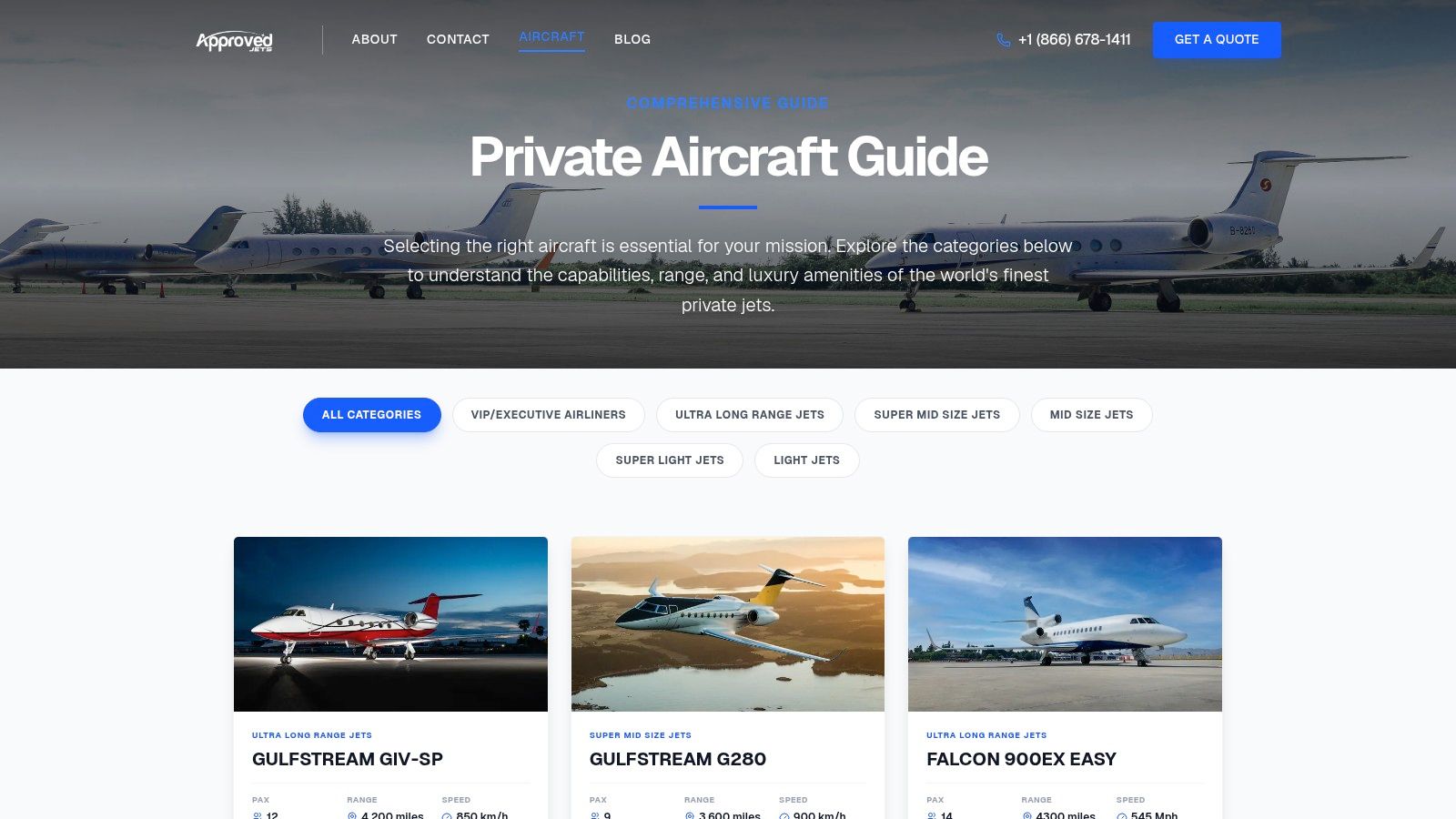
Match the aircraft to the mission
Approved Jets can help when passenger count, luggage, cabin requirements, routing, or timing make a basic price search inadequate. Its network includes 1,000+ aircraft and airliners across light, midsize, super-midsize, and heavy categories. (Approved Jets aircraft options)
Its role is active coordination rather than a simple aircraft listing. The service handles operator selection, safety review, crew and compliance checks, catering, ground transfers, and customs. It states a target of transparent quotes within two hours and the ability to mobilize many missions in approximately 2–4 hours, subject to availability and mission requirements. (Approved Jets aircraft service)
Best use case: Complex, urgent, executive, group, cargo, pet, or medical missions where the lowest suitable aircraft still requires operational coordination.
Savings mechanism: Matching capacity to the mission can avoid paying for an oversized cabin, while access to regional operators may reduce positioning requirements.
Pros: A vetted network, ARGUS Platinum and Wyvern Wingman preferred safety filters, ground-transfer coordination, 24/7 Miami-based concierge support, and specialty handling for medevac and high-value cargo.
Cons: Coordination may cost more than a bare-bones marketplace quote. Aircraft availability still depends on operator schedules, positioning, and regulatory constraints. Compare total pricing, including repositioning, taxes, handling, and requested services, before treating the lowest hourly rate as the cheapest option.
2. XO
XO is strongest when you're willing to treat the aircraft as shared capacity rather than a private product reserved entirely for your party. Its marketplace and brokerage model provides whole-aircraft charter estimates, online and mobile booking, and public “Jet Deals” for empty legs. It also allows travelers to list or sell extra seats, which can reduce the effective per-passenger cost when the itinerary and demand align.
The platform searches 60,000+ routes, according to its product description, giving price-sensitive travelers a broad starting point for comparing aircraft and routing options. (XO) The operational saving comes from utilization. An aircraft already moving for another assignment may be offered at a lower price than a newly positioned aircraft, while selling unused seats spreads the charter cost across more travelers.
Where the model breaks
XO works best for flexible leisure trips, small groups willing to share, and travelers who can monitor inventory rather than demand a particular tail number. Public empty-leg listings can disappear quickly, and an attractive price may require a membership tier or tolerance for off-peak departure times.
Use XO when: You want digital search, broad aircraft access, public empty-leg opportunities, or the option to share seats.
Avoid relying on it when: A board meeting, medical appointment, event arrival, or complex multi-stop itinerary makes schedule changes unacceptable.
Before accepting a quote, confirm whether you're buying a seat, a shared charter, or the whole aircraft. Those products shouldn't be compared on headline price alone. Check the aircraft category, baggage allowance, departure airport, taxes, and cancellation conditions in the same review.
3. Stratos Jet Charters
Stratos Jet Charters takes a broker-led approach for travelers who want on-demand access without committing to a membership. It shops the wider operator market according to the mission and budget, then applies a structured safety and aircraft review process. That can be valuable for infrequent flyers who don't want to prepay for access they may not use.
The company's positioning around Risk-Managed Private Aviation is more relevant to a cheap-charter search than it might first appear. A low hourly figure isn't useful if a mechanical issue leaves the traveler without a workable recovery plan. Stratos highlights FlightGuard mechanical recovery protections and operator due diligence using ARGUS and Wyvern data. (Stratos Jet Charters)
Compare the risk-adjusted quote
Stratos doesn't promise a universal fixed hourly rate, because on-demand pricing changes with aircraft availability, positioning, route, and timing. That variability can work in the buyer's favor when multiple operators can cover the same mission, but it also means an early estimate isn't necessarily a locked final price.
Best use case: Occasional travelers who want a broker to shop operators without a long-term contract or deposit.
Why it can reduce cost: Competitive sourcing can identify an aircraft already near the departure point or a smaller model that meets the route requirements.
Flexibility required: Moderate. Empty-leg options aren't guaranteed, and the traveler may need to accept a different aircraft or departure time.
Quote checks: Ask for the operating carrier, aircraft type, total bill, repositioning assumptions, recovery terms, and every included service. A cheaper quote with weaker recovery support may not be the cheaper trip if the mission is time-critical.
4. Paramount Business Jets
Paramount Business Jets (PBJ) emphasizes price transparency, including disclosure of broker earnings. That detail helps buyers distinguish a competitive quote from a low figure that excludes operating costs. The company handles on-demand charter and complex multi-leg routing, with an optional jet-card structure for travelers seeking more predictable rates.
The advertised hourly rate may cover only 65%–75% of the total bill. Positioning, fuel, landing fees, taxes, and other surcharges can materially increase the final price, as shown in this 2026 private jet pricing comparison.
Ask what the broker margin changes
Complex itineraries can add positioning costs when an aircraft must wait, return to base, or transfer between airports. PBJ's experience with multi-leg routes may help identify those assumptions before booking, although operational complexity can still limit savings.
Best use case: Buyers who want an itemized quote, occasional charter access, or assistance comparing complicated routing.
Savings mechanism: Separating aircraft, positioning, fees, and broker earnings makes it easier to challenge unnecessary movements and compare the same mission across providers.
Trade-off: On-demand rates still depend on aircraft availability, routing, and timing. The optional jet-card program may improve predictability, but its commitment can be unsuitable for occasional travelers.
A quote comparison works only when each provider receives identical requirements: passengers, baggage, preferred airports, acceptable alternatives, departure window, return needs, catering, ground transport, and cancellation tolerance. Ask whether each total includes positioning, taxes, handling, crew costs, and recovery arrangements. Flexibility over airports or departure times can lower the price, while a fixed schedule or complex routing may eliminate that advantage.
5. Jets.com
Jets.com combines on-demand charters with jet-card options and emphasizes transparent, all-in pricing. Its public routing and cost references can give buyers a useful benchmark before requesting a quote, particularly when a provider's initial number seems disconnected from the aircraft category or route.
The platform is most useful as a comparison checkpoint. A buyer can ask whether an apparently cheap quote includes positioning, taxes, handling, crew costs, and requested services, then compare that total with private jet charter prices explained by Approved Jets. (Jets.com)
Separate benchmarking from booking
A public reference price isn't a guarantee for your date. Aircraft are sourced from third-party operators, and the market can change according to availability, airport positioning, and demand. The jet-card route may improve predictability, but it requires prepayment, so it shouldn't be treated as an automatic saving for a traveler with sporadic demand.
Best use case: U.S.-centric travelers who want a straightforward quote process and public pricing references.
What lowers the bill: Comparing an all-in estimate against competing quotes can expose hidden fees or oversized aircraft selection.
Where it fails: The cheapest option still depends on positioning and inventory. A card may solve rate uncertainty without solving low usage.
Use Jets.com to pressure-test the total, not just the hourly number. Confirm whether the proposal covers the same airports, aircraft class, luggage assumptions, ground services, and cancellation terms as the alternatives.
6. Tradewind Aviation
For short regional trips, a turboprop can be the most rational answer to a private jet charter cheap search. Tradewind Aviation operates Pilatus PC-12 turboprops and PC-24 light jets across the Northeast, Florida, and the Caribbean, with access to 3,000+ airports, including short-runway fields. (Tradewind Aviation charter)
The cost advantage comes from mission fit. A PC-12 doesn't need to be treated as a compromised version of a large jet. On a shorter route with a modest passenger count, turboprop economics and access to a nearby regional airport can avoid the cost of oversized aircraft and congested major hubs.
When turboprop value disappears
Tradewind is particularly relevant for routes suited to its regional network. A short runway near the actual destination can also reduce ground-transfer time, which matters when the traveler values total door-to-door efficiency rather than flight speed alone. Its simplified pricing and operator control may make frequent routes easier to quote and understand.
Best use case: Northeast, Florida, and Caribbean regional travel where a PC-12 or PC-24 fits the route, passenger count, luggage, and airport requirements.
Savings mechanism: Smaller aircraft economics and access to short-runway airports reduce the need for larger aircraft and major-hub handling.
Flexibility required: Route flexibility is more important than schedule flexibility. The aircraft must be suitable for the distance and passenger needs.
Limit: Longer missions may favor a jet, and travelers outside Tradewind's core regions may need third-party lift. Read the operational trade-offs in the Approved Jets guide to chartering a Pilatus PC-12 before assuming the lowest hourly rate produces the lowest total trip cost.
7. Victor
Victor is built around quote transparency. It shows operator and aircraft details before booking, provides side-by-side comparisons, and includes sustainability and fuel-burn information to help travelers examine more than the headline price. Its inventory spans turboprops through long-range jets, so the comparison can reveal whether a smaller aircraft fits the mission.
That transparency matters because a cheap quote isn't meaningful without aircraft identity and operating assumptions. Victor's model helps a buyer compare a turboprop, light jet, or larger cabin against the same itinerary rather than accepting the first available category. (Victor)
Use comparison data intelligently
Victor is a strong fit for price-sensitive travelers who can move dates, consider alternative airports, or accept intermittent empty-leg availability. Dynamic pricing means the platform won't provide a fixed universal hourly rate unless the traveler joins another qualifying program, and the cheapest inventory may not remain available.
Best use case: Competitive bidding on flexible itineraries where the buyer wants operator, aircraft, quote components, and fuel-burn information visible before booking.
Savings mechanism: Side-by-side aircraft comparison makes over-sizing easier to spot and can surface lower-cost operators for the same route.
Cons: Empty-leg deals are intermittent, and schedule flexibility is essential. Partner-network coverage also means the service experience can vary by assignment.
For a deeper look at the operational logic behind repositioning discounts, see the Approved Jets explanation of private jet empty legs. Treat any empty-leg price as conditional until the operator confirms the route, aircraft, departure window, cancellation policy, and recovery plan.
Cheap Private Jet Charter, 7-Provider Comparison
| Service | 🔄 Complexity (process/coordination) | 💡 Resource Requirements | ⚡ Speed / Efficiency | ⭐ Effectiveness / Quality | 📊 Expected Outcomes |
|---|---|---|---|---|---|
| Aircraft (Approved Jets) | High, full door‑to‑door mission management | High, premium pricing, 24/7 concierge, vetted operators | Very fast, quotes ~2 hrs, mobilize 2–4 hrs | ⭐⭐⭐⭐⭐, safety‑first, curated fleet | Discreet, reliable missions for urgent/complex travel |
| XO | Medium, digital marketplace + broker workflows | Medium, membership improves pricing; variable operator quality | Fast, instant estimates & online booking | ⭐⭐⭐⭐, broad fleet access; operator variability | Opportunistic savings (empty legs/shared seats); flexible travelers |
| Stratos Jet Charters | Medium, broker with risk‑managed vetting | Low–Medium, no membership; pay‑per‑trip | Medium, on‑demand quotes | ⭐⭐⭐⭐, safety‑focused, FlightGuard protection | Cost‑competitive for infrequent flyers with safety assurances |
| Paramount Business Jets (PBJ) | Low–Medium, straightforward broker processes | Medium, optional jet‑card for rate predictability | Fast, rapid quote turnaround | ⭐⭐⭐⭐, transparent pricing; multi‑leg expertise | Clear pricing validation and optimized complex routings |
| Jets.com | Low, U.S.‑centric, simple quoting flow | Medium, jet‑cards require prepayment; variable inventory | Medium, on‑demand charters & cards | ⭐⭐⭐, transparent benchmarks; market‑dependent | Benchmarkable, all‑in pricing for U.S. itineraries |
| Tradewind Aviation | Low, operator‑controlled regional service | Low, turboprop economics, simplified pricing | Fast, efficient regional operations | ⭐⭐⭐⭐, consistent operator service on core routes | Cost‑effective short/regional trips with short‑field access |
| Victor | Medium, tech‑enabled broker with upfront operator data | Medium, dynamic pricing; compare options easily | Medium, on‑demand quoting with comparisons | ⭐⭐⭐⭐, transparent quotes and sustainability info | Price‑sensitive, data‑driven choices via side‑by‑side comparisons |
Choose the Lowest Total Cost, Not Just the Quote
The cheapest private charter depends on what you're prepared to give up. If your schedule can move, start with shared-seat inventory or an empty leg. Those options trade control for a lower price, and they work best for leisure travelers or noncritical journeys. If you need the whole aircraft, compare a turboprop or light jet before considering a larger cabin for a short regional mission.
A membership or jet card can make sense when you fly often enough to justify its terms, but occasional travelers should be cautious about paying for predictability they won't use. On-demand brokers are usually the more logical comparison point when your dates are irregular and you want several operators competing for the same mission.
The market baseline is also moving. One industry comparison reported an average hourly rate of $11,273 in Q2 2025, up 2.9% year over year, while a later Q2 2026 report placed North American jet-card rates at $11,314 per hour. (Private jet card price comparison) “Cheap” therefore means cheaper than the relevant alternative, not inexpensive in absolute terms.
Final quote checklist
Before approving a charter, ask every provider to confirm:
- Aircraft category: Is it a turboprop, light, midsize, super-midsize, heavy, or ultra-long-range aircraft?
- Passenger and luggage fit: Does the aircraft handle the actual group and baggage without an operational compromise?
- Positioning: Are ferry, repositioning, or recovery legs included?
- Airport access: Are nearby secondary or short-runway airports available, and what ground transfer follows?
- Taxes and fees: Does the total include landing, handling, fuel, customs, taxes, crew, catering, and transfers?
- Cancellation terms: What happens if an empty leg changes or the primary aircraft becomes unavailable?
- Operator identity: Which Part 135 or foreign-equivalent operator will conduct the flight?
- Safety credentials: Does the operator meet recognized filters such as ARGUS Platinum or Wyvern Wingman?
- Recovery support: Who arranges a replacement aircraft after a mechanical or operational disruption?
Approved Jets is a relevant option for travelers who value vetted aircraft matching, end-to-end logistics, rapid quote targets, and complex or time-sensitive coordination. Its global network includes 1,000+ aircraft, and its service can extend beyond the flight to catering, customs, ground transfers, cargo, pet travel, medical evacuation, and aircraft management. (Approved Jets)
Request comparable quotes with identical itinerary assumptions. If one provider prices a light jet from a nearby airport and another prices a midsize jet from a major hub, the difference isn't a discount. It's a different product.
The cheapest charter is the one whose schedule, aircraft, airport, and service level genuinely fit the mission.
For travelers planning a Key West charter, the same principle applies to the complete journey. A lower flight quote can lose its advantage if it requires a distant airport, oversized aircraft, expensive repositioning, or ground logistics that weren't included.
Approved Jets arranges on-demand private charters through a vetted global operator network, with aircraft matching, transparent quote targets, and end-to-end coordination for complex, urgent, corporate, group, cargo, and medical missions. Visit Approved Jets to request a comparison based on your passengers, luggage, airports, timing, and flexibility.