

Sharing Private Jet Flights How to Choose the Right Model
Compare sharing private jet flights models, costs and privacy tradeoffs. Find the best per-seat, membership or empty-leg option for your needs.

Approved Jets

On this page
- Table of Contents
- Introduction to Sharing Private Jet Flights Today
- The core tradeoff
- Who should consider it
- How Jet Sharing Models Actually Work
- Per-seat charter
- Membership programs
- Fractional ownership
- Empty-leg sharing
- Detailed Comparison of Cost Flexibility and Privacy
- Jet Sharing Models Compared by Cost Flexibility and Privacy
- Where each model wins
- Where buyers get disappointed
- Privacy is not binary
- What Sharing Private Jet Flights Really Costs
- Empty legs and full charter pricing
- Why one-way inventory is priced differently
- Cost per seat depends on load factor
- Fractional cost logic is different
- Best Use Cases for Each Sharing Model
- Solo executive on a familiar corridor
- Family using private aviation occasionally
- Sports, entertainment, and larger groups
- Frequent flyer with a control requirement
- Flexible bargain hunter
- Privacy Reliability and Legal Checks Before You Book
- Occupancy and confirmation risk
- The privacy downgrade most buyers underestimate
- Legal structure matters
- Automation improves search, not certainty
- Recommendation for Choosing Your Ideal Sharing Option
- A practical selection framework
- Where a broker fits
Roughly 30% to 40% of all private jet flight hours are repositioning flights, meaning the aircraft is moving without paying passengers on board, according to Sky Access's empty-leg market report. That single fact changes how you should think about sharing private jet flights. This isn't mainly a luxury shortcut. It's a way the market tries to recover value from underused aircraft time, partial cabin occupancy, and one-way demand.
For buyers, the question isn't “can I fly private for less?” It's narrower and more useful: when does shared access improve mission economics without breaking the mission itself? Sometimes the answer is yes. A solo executive on a dense route may accept a shared cabin to avoid airline friction. A leisure traveler with flexible timing may do even better on an empty leg. A public figure, legal team, or deal crew usually won't.
The right comparison isn't private versus commercial. It's cost per seat versus control per mission. Once you frame it that way, the tradeoffs become much easier to price: schedule certainty, passenger screening, luggage flexibility, discretion, and what happens if a minimum seat threshold isn't met.
Table of Contents
- Introduction to Sharing Private Jet Flights Today
- How Jet Sharing Models Actually Work
- Detailed Comparison of Cost Flexibility and Privacy
- What Sharing Private Jet Flights Really Costs
- Best Use Cases for Each Sharing Model
- Privacy Reliability and Legal Checks Before You Book
- Recommendation for Choosing Your Ideal Sharing Option
Introduction to Sharing Private Jet Flights Today
A shared private flight only works economically when enough of the cabin is sold to push seat revenue above the operator's trip threshold. That is the starting point. Sharing is a fleet-utilization tool first, and a consumer savings product second.
Viewed that way, the category becomes easier to assess. A shared flight is one of three ways to improve aircraft economics on a given mission: fill otherwise empty seats, spread a fixed trip cost across unrelated travelers, or place flexible passengers onto inventory that would be inefficient to fly half full. The buyer gets lower entry cost, but only by accepting some loss of control.
The core tradeoff
The useful comparison is not private versus commercial. It is full-aircraft control versus acceptable load factor.
If four travelers can fill most of a light jet on a route they would have chartered anyway, sharing can preserve much of the mission value while lowering per-person cost. If only one or two seats sell on a published shared flight, the economics weaken fast unless the operator already needed to move the aircraft for another reason. That is why some shared products feel reliable and others feel conditional. The difference is usually not branding. It is whether the flight can clear its occupancy threshold.
| Decision factor | What sharing usually improves | What sharing usually weakens |
|---|---|---|
| Cost per traveler | Better fit for solo travelers and pairs on routes with repeat demand | Whole-aircraft control |
| Aircraft utilization | Higher seat occupancy and better recovery of fixed trip cost | Freedom to set your own departure profile |
| Terminal access | Private-terminal process is often retained | Cabin exclusivity and passenger selection |
| Route efficiency | Strong on dense city pairs where demand repeats | Flexibility on thin routes or complex multi-stop itineraries |
| Budget discipline | Easier to match spend to actual seat count needed | Reliability if minimum occupancy is required for the flight to operate |
One sentence matters here. Sharing tends to work best when the aircraft would have flown anyway, or when seat demand is deep enough that the operator is not depending on last-minute sales to make the trip viable.
Who should consider it
Shared private flying suits travelers whose trip has a clear time-saving benefit but limited privacy sensitivity. That can include a founder flying alone between high-frequency business markets, a couple heading to a resort on a known shuttle route, or a small team that values private-terminal access more than exclusive use of the cabin.
It is a weaker fit for missions where the cabin itself is part of the requirement. Deal teams discussing live transactions, public figures managing exposure, families with oversized baggage, and security-sensitive travelers usually lose too much once other passengers enter the equation. At that point, lower seat cost can be the wrong metric.
A practical detail still matters on the ground. If you are crossing borders on short notice, organized documents reduce friction at customs and FBO handoffs. A durable passport wallet is a simple way to keep IDs, entry forms, and transfer paperwork in one place.
Shared private aviation makes sense when your mission can tolerate partial loss of control in exchange for better aircraft utilization and lower per-seat spend. Once privacy, timing precision, or passenger-screening standards rise above that threshold, full charter usually stops being a luxury upgrade and starts being the operationally cleaner choice.
How Jet Sharing Models Actually Work
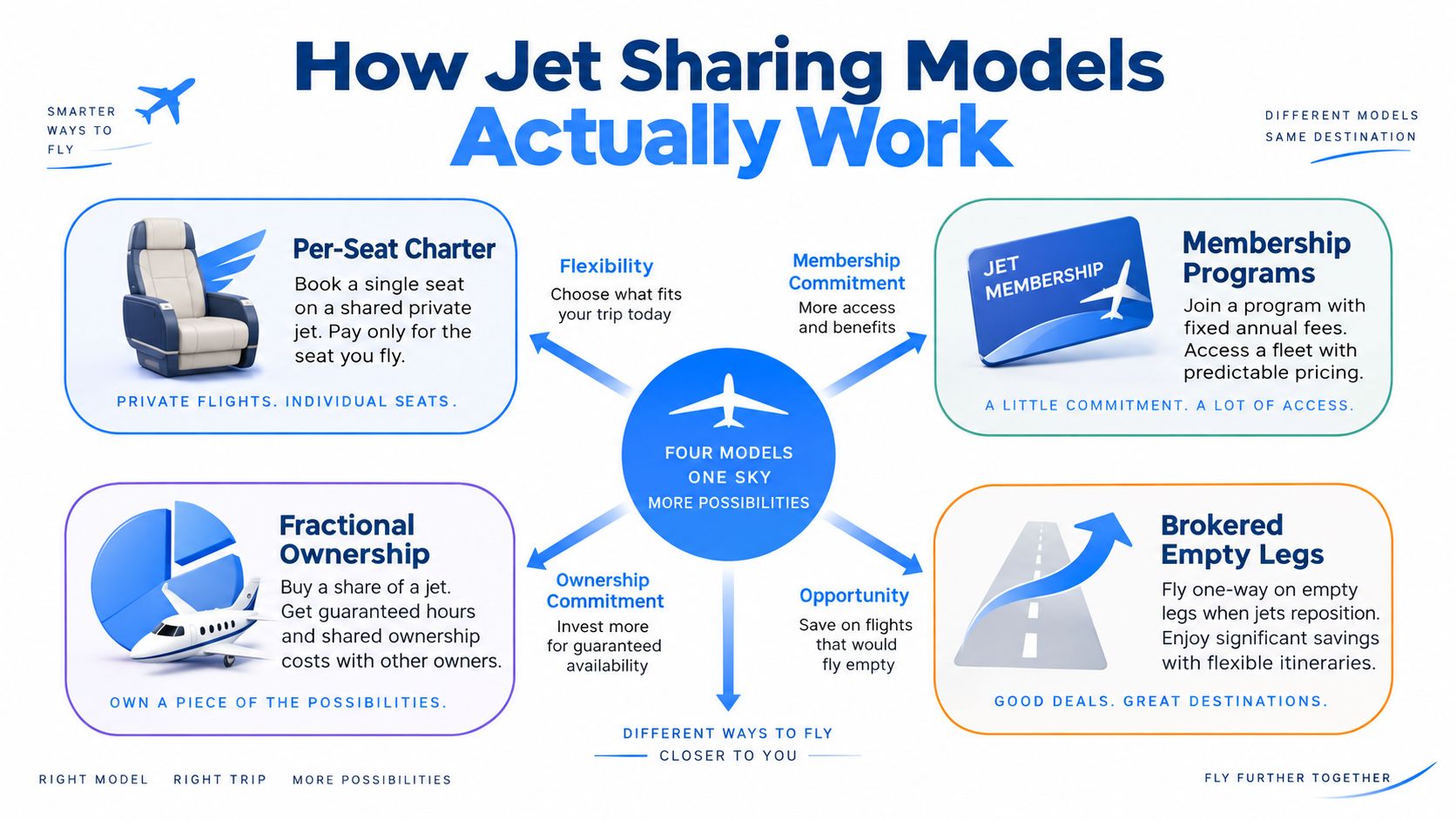
There isn't one shared-jet model. There are four common ones, and they create inventory in different ways.
Per-seat charter
This is the cleanest version of seat sharing. An operator or charter organizer publishes a route and sells individual seats instead of the whole aircraft. The key mechanic is confirmation risk. One industry explanation says the flight is confirmed only once enough seats are sold, and per-seat pricing depends on aircraft type, route distance, demand, and final load factor, as described by Private Jets Connect's shared-flight explanation.
Operationally, that means the buyer isn't just purchasing transportation. The buyer is also accepting threshold risk.
Membership programs
Membership and subscription models sit between ad hoc booking and long-term commitment. A traveler pays for access to a network, a shuttle schedule, seat inventory, or preferential pricing. Some memberships focus on recurring regional routes. Others combine shared seats with upgrades into whole-aircraft charter when needed.
The value here is not ownership. It's structured access.
For buyers comparing models, it helps to understand how these shared formats differ from a traditional private jet charter model, where the aircraft is sourced for your mission rather than your mission being fitted into pre-existing inventory.
Fractional ownership
Fractional ownership is a different category because you're buying a share in an aircraft program, not just a seat. The sharing happens at the asset level, with usage rights allocated across owners. One source notes that an owner's allotment is depleted only for occupied flight time plus taxiing, usually with a minimum of 1 to 2 hours, while ferry or deadhead repositioning isn't charged to the customer, according to this explanation of fractional ownership accounting.
That billing treatment matters. It means the operator absorbs repositioning risk within the program instead of passing every ferry cost directly to your trip.
Empty-leg sharing
Empty legs come from repositioning. An aircraft has to move anyway, so the operator tries to recover some revenue on that leg. One source describes these as repositioning sectors that can be sold at significant discounts, sometimes starting as low as $100 for short trips, in BlackJet's overview of shared private flying.
This isn't the same as per-seat charter. In many cases, empty-leg inventory is sold as discounted whole-aircraft access. In others, the leg may be broken into individual seats by a seller or platform. The common feature is fixed routing and limited buyer control.
Buy shared inventory only after you know who controls the aircraft, who sells the seat, and what triggers final confirmation.
Detailed Comparison of Cost Flexibility and Privacy
The simplest mistake buyers make is comparing these models only on price. In practice, the harder variables are flexibility, cabin control, and how much uncertainty your trip can absorb.
Jet Sharing Models Compared by Cost Flexibility and Privacy
| Criteria | Per-Seat Charter | Membership Program | Fractional Ownership | Empty-Leg Sharing |
|---|---|---|---|---|
| Price structure | Pay by seat on a specific shared flight | Access fee or subscription plus trip usage rules | Capital commitment plus ongoing program costs and trip usage accounting | Opportunistic discount tied to repositioning need |
| Schedule flexibility | Low to moderate. You fit published timing or organizer timing | Moderate to high on supported routes or program terms | High within program rules and fleet availability | Low. Route and timing are largely fixed |
| Privacy level | Lowest of the four because you share the cabin | Varies by program. Better than open seat sales, weaker than whole aircraft control | Strong. You typically use the aircraft privately for your mission | Mixed. Can be private if sold as whole aircraft, limited if sold seat by seat |
| Reliability | Depends on whether enough seats sell and whether the organizer confirms | Better than ad hoc seat sales if inventory is structured | Strongest among shared-access formats | Vulnerable to aircraft repositioning changes |
| Baggage control | Usually tighter because multiple parties share limited hold space | Program-specific | Better, because your mission drives the load plan | Often constrained by aircraft type and pre-set mission |
| Best fit | Solo or couple on dense routes | Repeating travelers who want some structure without ownership | Frequent flyers who prioritize access and privacy | Flexible buyers chasing one-way value |
Where each model wins
Per-seat charter works when the cabin is a commodity to you. If you need a seat, a private terminal, and a direct route, it can make sense. If you need to work sensitive material en route, the economics weaken quickly because the shared cabin changes the value of the trip.
Memberships are stronger when your travel pattern repeats. If you're moving between the same business centers or leisure corridors often enough, a program can reduce sourcing friction. You're paying partly for access discipline, not just transportation.
Fractional ownership is the most “private aviation” option in this group. It carries more commitment, but it also preserves more of what full charter buyers care about: schedule control, cabin discretion, and billing logic that doesn't punish you for every repositioning move.
Where buyers get disappointed
Empty-leg sharing produces the best headline price and the most buyer regret. That isn't because the model is flawed. It's because people buy it for the wrong mission.
An empty leg is excellent value when your schedule can bend. It's poor value when your schedule can't.
The same applies to per-seat flying. If the route is popular and the platform manages inventory well, the proposition is straightforward. If demand is thin, your low price may depend on strangers you've never met deciding to book the same departure.
Privacy is not binary
Most buyers think “private” means one of two things: private jet or not. In real procurement, privacy sits on a spectrum.
- Cabin privacy: Who's physically on board with you.
- Operational privacy: Who sees your itinerary, manifests, and timing.
- Behavioral privacy: Whether you can talk, work, rest, or move freely without exposure.
A full charter maximizes all three. Shared models usually preserve some operational privacy because you still avoid the airline terminal. They reduce cabin and behavioral privacy to varying degrees.
For many missions, that difference matters more than the savings.
What Sharing Private Jet Flights Really Costs
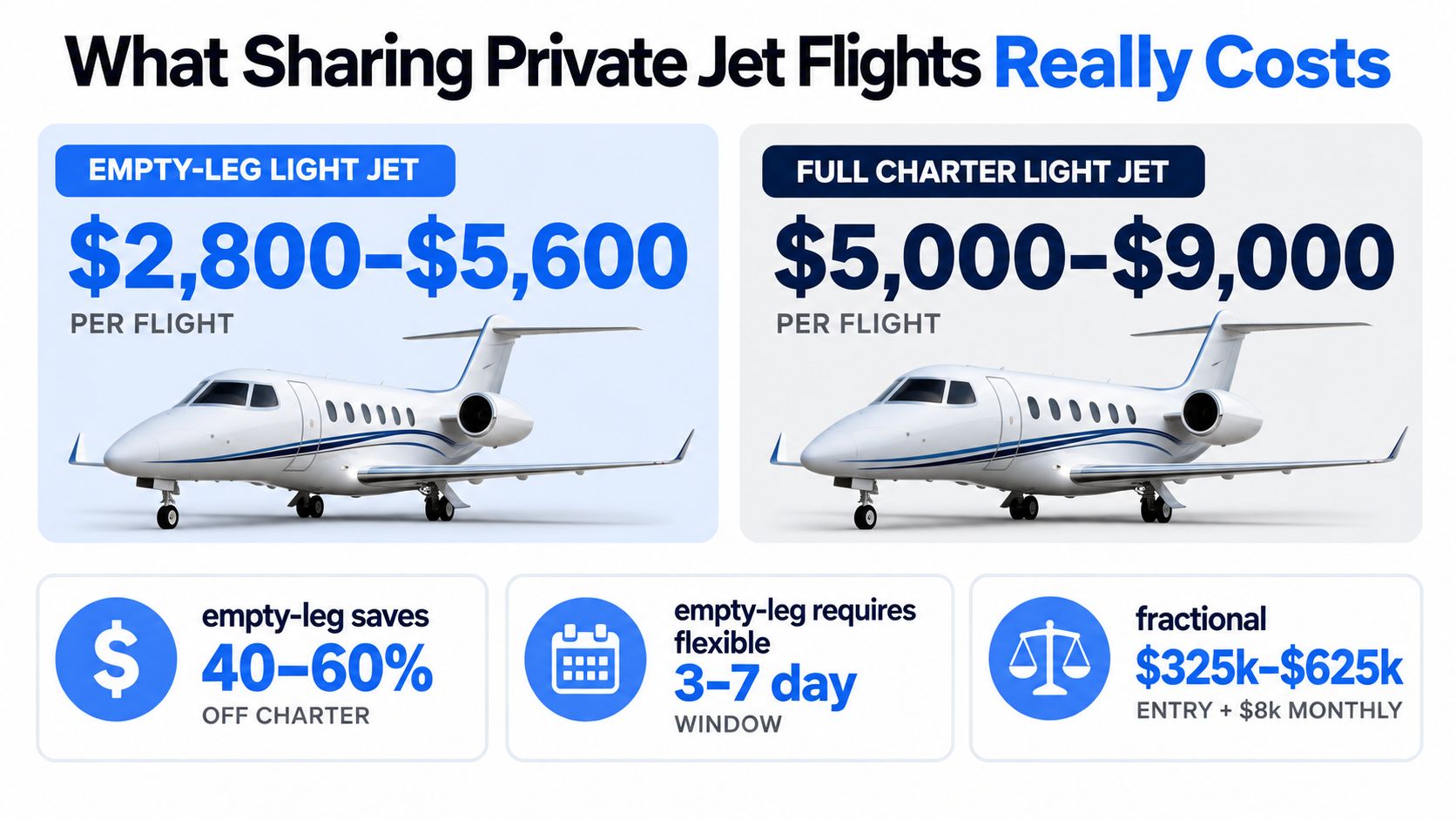
Shared private flights only price well when the aircraft's fixed cost is spread across enough occupied seats. That is the economic question. You are not comparing “cheap private” against full charter. You are comparing different load factors, different routing constraints, and different privacy losses.
Empty legs and full charter pricing
Published industry ranges generally put light-jet empty-leg flying below standard on-demand charter for similar aircraft categories, often at a material discount when the operator already needs the repositioning sector flown. PrivateFly's pricing guidance, for example, places many empty-leg opportunities in a lower band than equivalent bespoke charter because the core trip cost has already been underwritten by another customer's itinerary, according to PrivateFly's explanation of empty leg pricing.
The catch is mission math. A cheap seat or cheap one-way sector only works if your origin, destination, and timing already fit the aircraft movement. If you need a separate positioning flight, ground transfer, overnight hold, or a commercial return, the apparent discount narrows quickly. Buyers looking at these deals should understand the operating logic behind private jet charter empty legs. The lowest visible sector price is often different from the lowest total trip cost.
Why one-way inventory is priced differently
Shared inventory is largely a byproduct of fleet positioning. Aircraft do not end up in the empty-leg market because operators want to run low-margin scheduled service. They appear there because the airplane has to move for its next revenue flight, maintenance event, or base return.
That distinction matters for budgeting. One-way shared flying can be efficient because you are stepping into capacity that already exists. Matching both outbound and return legs at the same savings level is harder. Once a traveler needs schedule symmetry, cost certainty often shifts back toward full charter, a membership structure, or a program with guaranteed access.
Cost per seat depends on load factor
Load factor determines cost per seat.
A six-seat cabin with two paying passengers behaves very differently from the same cabin with five. The aircraft cost is still mostly fixed. Fuel varies somewhat, but crew, landing fees, handling, and a large share of operator margin do not disappear because fewer people are on board.
That creates three common outcomes:
- Low load factor: Higher effective cost per passenger, with better cabin space and less conversation risk.
- High load factor: Better seat economics, but less discretion and less room for schedule slippage.
- Threshold load factor: The point where the operator covers the trip comfortably and the passenger still sees clear value versus booking the whole aircraft.
This is why per-seat pricing can look irrational from the outside. Two seats on a shared shuttle can cost more than expected because the seller is protecting the flight at a modest booking level. A full aircraft charter can also become surprisingly rational once a small group is large enough to absorb the fixed trip cost themselves. On many light and midsize missions, that crossover arrives sooner than first-time buyers expect.
Fractional cost logic is different
Fractional programs use a different accounting model. The customer is buying access to a share of fleet capacity rather than opportunistic surplus inventory. Billing is usually tied to occupied flight time and program rules, which reduces some of the route-by-route volatility seen in empty legs and ad hoc seat sales.
That does not make fractional cheaper. It makes it more predictable for repeat users with consistent annual hours. The trade is commitment. You accept a larger financial obligation in exchange for cleaner budgeting, stronger dispatch reliability, and fewer instances where the trip depends on other passengers filling the cabin.
The practical conclusion is simple. Sharing works best when you are helping absorb excess capacity that would move anyway, and when your privacy requirement stops short of exclusive use. Once occupancy assumptions weaken, or once your party size rises enough to spread the aircraft cost internally, full charter often becomes the cleaner buy.
Best Use Cases for Each Sharing Model
The right model depends less on net worth than on mission shape. I'll put this the way charter desks usually do it: who's traveling, how fixed is the schedule, what can't go wrong, and who can't be seen with whom?

Solo executive on a familiar corridor
A founder or executive moving alone between a few dense business markets often fits per-seat charter or a membership program. The priority is ground efficiency and reduced friction, not exclusive cabin use. If the traveler isn't discussing confidential matters in flight, paying for one seat instead of one aircraft can be rational.
The caveat is timing discipline. If the meeting can't move, the traveler needs clear confirmation terms before booking.
Family using private aviation occasionally
Families usually don't need ownership. They need simplicity. A membership can work if trips recur seasonally and the route pattern is stable. Otherwise, flexible empty-leg opportunities can make sense for leisure travel when departure timing isn't rigid and everyone packs within realistic baggage constraints.
What families should avoid is assuming any “shared private” product works like a full family charter. It usually doesn't.
Sports, entertainment, and larger groups
These clients rarely benefit from seat sharing unless the group is very small and the mission is non-sensitive. Teams, touring parties, and entourage-heavy movements usually need baggage control, coordinated timing, and a sealed manifest. That pushes them toward whole-aircraft solutions rather than open shared cabins. For these missions, group charter flights are usually operationally cleaner than trying to force a multi-person movement into seat-based inventory.
Frequent flyer with a control requirement
The traveler who flies often enough to care about repeatability, not just price, is the natural fractional ownership candidate. This is the buyer who values a known service framework, clearer usage accounting, and a stronger privacy position than ad hoc sharing can deliver.
Flexible bargain hunter
There is one traveler profile that consistently wins with empty legs: the buyer whose destination matters more than exact timing and whose return plan can be built separately.
- Best fit: Opportunistic leisure trips and one-way moves.
- Weak fit: Court appearances, investor roadshows, live events, media tours.
- Decision trigger: Book only if you can tolerate changes without breaking the broader trip.
The best shared-flight buyer is not the person who wants private aviation at any cost. It's the person whose mission still works after giving up some control.
Privacy Reliability and Legal Checks Before You Book
The phrase “shared private” can hide a lot of compromise. On the ground, you may still get the private terminal experience. In the air, the mission may behave much more like a high-touch pooled service than a private aircraft movement.
Occupancy and confirmation risk
One source on shared-flight mechanics states that the flight is confirmed only after enough seats are sold. That means the commercial threshold sits upstream of your itinerary. If the load factor doesn't develop, the seller may cancel, postpone, or reroute under its terms.
That's fine for discretionary travel. It can be expensive for a business trip that carries downstream hotel, ground, or meeting commitments.
The privacy downgrade most buyers underestimate
Transport & Environment reports an average occupancy of 4.7 passengers per private-jet flight and estimates an overall private-jet load factor of about 0.38, while another report it cites says larger UK private jets average only 2.5 passengers per flight, implying a load factor under 20%, according to the Transport & Environment report. Low baseline occupancy is exactly why sharing looks economically attractive. It's also why the privacy trade can feel sharper than buyers expect. You're moving from a category with chronically underfilled cabins into one where the seller needs strangers to solve the economics.
Legal structure matters
In the U.S., a key legal distinction is whether the arrangement complies with public charter rules. A seat-selling model is described as legal when a certificated air carrier operates the aircraft and a public charter operator sells the seats under 14 CFR Part 380, while a private pilot can't legally advertise seats to the public or collect money for them because that would be treated as compensation and holding out, as explained by Jet and Beyond's summary of seat-selling compliance.
That isn't a technical footnote. It tells you whether the seller is operating inside a recognized commercial framework.
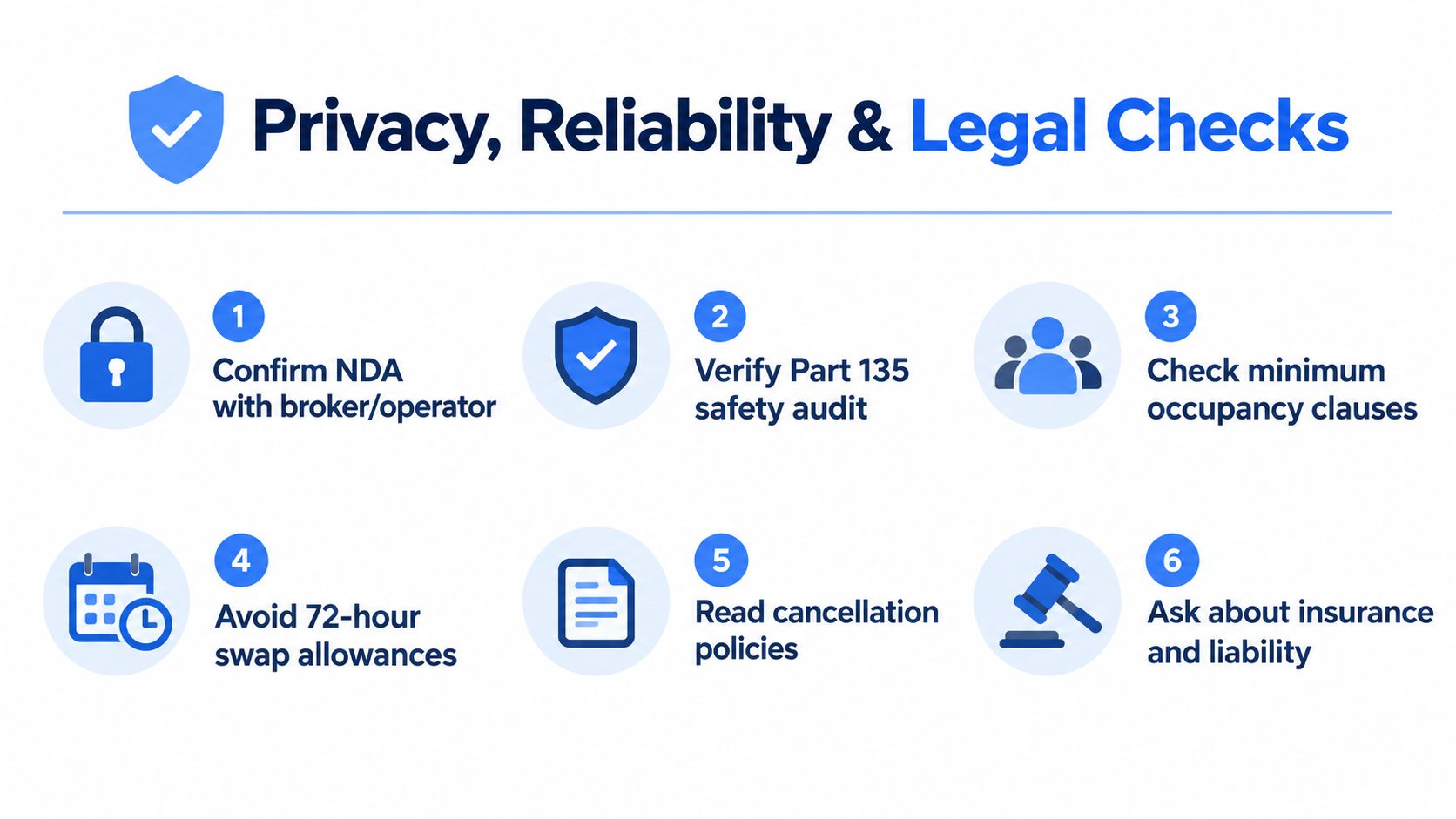
Before booking, ask these questions:
- Who operates the aircraft: Confirm the certificated carrier, not just the app or seller.
- What confirms departure: Ask whether the trip is guaranteed or threshold-dependent.
- Can the aircraft be swapped: Substitutions can affect baggage fit, cabin layout, and mission comfort.
- Who else is on board: Screening and manifest rules matter if discretion matters.
- What happens if plans change: Read cancellation and refund terms carefully.
A short explainer on seat-selling and charter structure is helpful here:
Automation improves search, not certainty
Industry commentary notes AI-assisted empty-leg and seat-finding tools are entering this segment, while charter and fractional flights were reported up 7% globally in H1 2026 versus H1 2025 in Private Jet Card Comparisons' discussion of AI and jet sharing. Better discovery can help buyers find inventory faster. It doesn't remove the need to verify terms, operator structure, screening, or reliability.
The more automated the front end becomes, the more carefully serious travelers need to read the back-end conditions.
Recommendation for Choosing Your Ideal Sharing Option
Choose the model by deciding what you're willing to surrender.
A practical selection framework
If you want to test private aviation at the lowest commitment level, start with per-seat charter. It works best when you travel alone or as a pair, your route is well trafficked, and cabin privacy isn't central to the mission.
If you travel repeatedly and want more structure without buying into ownership, look at a membership program. You're paying for access consistency, not just a lower fare.
If your schedule is fixed, your passenger list is sensitive, and you fly often enough to value predictability over opportunism, fractional ownership is the strongest shared-access answer. It isn't cheap, but it protects the variables that matter most to frequent serious users.
If your travel dates are flexible and your goal is to capture pricing inefficiency, empty-leg sharing can be the best buy in the market. Just treat it as tactical inventory, not dependable transport.
Where a broker fits
For buyers who don't want to sort through seat products, one-way anomalies, and aircraft fit alone, a broker can compare whether sharing beats a full charter on the specific mission. In that context, Approved Jets can be one option for sourcing and evaluating on-demand charter against shared alternatives, particularly when luggage, discretion, or time sensitivity may make a whole-aircraft solution more rational than a seat-based one.
The right answer isn't the cheapest seat. It's the option that still works when the trip encounters real-world constraints.
If the mission breaks when timing slips, baggage shrinks, or strangers join the cabin, sharing has stopped being efficient. At that point, full charter is usually the cleaner decision.
If you're weighing shared seats against a full aircraft, Approved Jets arranges on-demand charter and coordinated travel logistics through a vetted operator network, which is useful when privacy, baggage fit, or schedule control may outweigh seat-level savings. Bring them the mission details, not just the route, and compare the trip economics before you book.