Pet Flight Cost in 2026: What You Will Actually Pay
Pet flight cost runs from $95–$150 for an airline cabin seat to thousands on private charter. See the price factors, paperwork and savings tips.

Approved Jets
On this page
- Table of Contents
- Pet Flight Costs at a Glance
- Typical pet flight cost by travel option, 2026
- Why old fee tables mislead
- Which Pricing Model Applies and What Moves the Price
- Pricing model by pet case
- Run the acceptance check before comparing prices
- Cargo availability changes the comparison
- Health Certificates, Crates and Other Paperwork Costs
- Documentation and equipment costs before departure
- Build the budget around dependencies
- How Brokers Price a Private Charter for a Pet
- Separate aircraft charges from pet arrangements
- Judge the matching work, not an unsupported promise
- Commercial Cabin Versus Private Charter
- Trip totals by pet scenario, commercial versus charter
- When a charter deserves a serious quote
- Confirm the Quote Before You Book
- Test the alternatives before committing
Cabin pet fees reported in 2024–2025 ranged from about $95 to $150 each way. For example, Delta's domestic fee moved from $95 to $150. This is not a 2026 allowance: confirm the current charge for the airline, ticket date and route. Private charter pricing depends on the aircraft and flight hours, not a standard pet fee.
Neither price is a complete travel budget. The key question is which transport option your pet can use. A cabin fee does not help if the kennel cannot fit under the seat, the flight has no pet spaces left, or the destination requires different handling.
For an executive relocation or family move, compare complete, eligible itineraries. Separate the transport charge from the crate, veterinary documents, handling and arrival arrangements before deciding which option costs less.
Table of Contents
- Pet Flight Costs at a Glance
- Which Pricing Model Applies and What Moves the Price
- Health Certificates, Crates and Other Paperwork Costs
- How Brokers Price a Private Charter for a Pet
- Commercial Cabin Versus Private Charter
- Confirm the Quote Before You Book
Pet Flight Costs at a Glance
The cabin fee is only one part of a pet's travel bill. It buys transport under specific conditions and is charged in addition to the passenger's airfare. Eligibility and the services included in a quote determine what else the owner must pay.
A historical comparison shows why dates matter. In 2011, American, Delta, United and Continental generally charged about $125 each way for cabin pets. United charged as much as $250 each way for pets traveling as checked baggage, according to this historical pet-travel pricing account. Those checked-baggage fees are historical, not current offers.
Typical pet flight cost by travel option, 2026
The cabin figure below is a dated planning benchmark, not a current quote. It covers each way, per kennel. For other options, request an individual price. No supported charter hourly range or per-leg estimate is available to publish here.
| Travel option | Typical cost, each way | What the price covers | Main variable |
|---|---|---|---|
| Airline cabin, small pet | Approximately $95–$150 per kennel as a historical planning benchmark | Airline pet fee only | Airline, route and chargeable connections |
| Airline checked or excess baggage | Confirm directly with an eligible carrier | Baggage-style pet transport charge | Carrier policy, crate size and weight |
| Airline cargo, unaccompanied | Individually quoted per shipment | Cargo transport; confirm crate and handling separately | Crate dimensions, routing and season |
| Semi-private fly-share seat | Operator quotation required | A seat on a shared flight; confirm pet acceptance and charges | Route, availability and operator |
| Private jet charter, light jet | Mission-specific quote required | Confirm aircraft, crew, fuel and airport charges | Flight time, positioning and date |
| Private jet charter, heavy jet | Mission-specific quote required | Confirm aircraft, crew, fuel and airport charges | Aircraft requirements, range and availability |
| Pet fee on private charter | Unconfirmed until stated in writing | Operator-specific pet or cleaning arrangements | Operator policy and cabin condition |
The $95–$150 cabin range reflects fees reported for 2024, not a 2026 rate guarantee. Delta's published policy states that its domestic fee increased from $95 to $150 for tickets issued on or after April 8, 2025, and lists $200 for international travel. The 2024 range therefore includes an earlier fee as well as Delta's later domestic charge; it should be read as a historical reference, not a uniform current price.
Confirm the amount for the ticket issue date, route and airline or operator. Cabin fees cover the pet add-on, not the owner's ticket or carrier. Checked-baggage pricing applies only when an airline accepts the animal under that program. Cargo requires a shipment quote that specifies what is included.
Fly-share quotes should identify the seat charge and pet conditions. Light- and heavy-jet quotes need a defined itinerary and confirmed aircraft suitability, rather than an assumed hourly rate. Any charter cleaning charge remains unconfirmed until the operator puts it in writing.
Why old fee tables mislead
American increased its carry-on pet fee from $125 to $150 in February 2024. A dated policy matters because a table without an effective date can put an older fee beside one that applies to a later ticket. The fee alone rarely gives the full bill: the transport option, its conditions and the quote's inclusions determine what the traveler still needs to arrange.
Which Pricing Model Applies and What Moves the Price
Start with the kennel, not the animal's weight alone. Under FAA cabin-pet guidance, the container must fit beneath the seat without obstructing access to the aisle, be stowed before the final passenger door closes, and remain stowed during aircraft movement, takeoff and landing.
Airlines can also limit cabin pet numbers, restrict species, require the animal to remain inside its container throughout the flight, and request a recently issued health certificate. Passing the size test therefore doesn't guarantee acceptance.
Pricing model by pet case
| Pet case | Likely pricing model | Main blocker |
|---|---|---|
| Cat or small dog, domestic, owner on board | Cabin pet fee | Under-seat fit and available cabin pet space |
| Dog too large for a seat, domestic | Checked baggage or cargo, where offered | Cabin eligibility fails; alternative service must exist |
| Pet traveling without its owner | Cargo rate, potentially plus shipper fee | Individually quoted service and limited availability |
| Pet on an international trip, owner on board | Cabin or cargo, depending on airline and destination | Documentation and destination acceptance |
| Route in a restricted season | Cargo may be unavailable | Airline temperature restrictions |
For a small dog, the first task is checking the container against the aircraft's permitted dimensions. For a larger dog, asking for a cabin fee wastes time if the animal cannot meet the under-seat rule. For an unaccompanied animal, the owner's passenger booking doesn't establish a transport entitlement.
These are different products, not different surcharges for the same service.
Practical rule: A failed eligibility check can change the entire pricing model. Don't treat it as a small adjustment to the advertised fee.
Run the acceptance check before comparing prices
Ask the airline or arranging broker:
- Will the kennel fit? Supply its external dimensions and describe the animal's ability to move inside it.
- Is a cabin pet space available? Confirm acceptance on the actual flight, not merely the airline's general willingness to carry pets.
- Does the route accept cargo in the travel season? Ask about the whole itinerary, including connections and handling points.
The Department of Transportation's guidance on flying with pets explains that airlines differ in their fees, baggage treatment, animal restrictions and temperature limitations. A passenger seat being available doesn't establish that the pet can travel.
The following video offers an additional visual reference for pet-travel planning.
Cargo availability changes the comparison
U.S. airlines transported 188,223 animals as cargo in 2022, less than half the 2019 level, according to reporting on reduced airline pet-transport capacity. United and Delta discontinued ordinary pet-cargo service while retaining limited exceptions for some military and foreign-service travelers.
That makes a cargo quote an availability question before it becomes a price question. American's cargo-pet pricing is variable and confirmed at booking, so a generic cabin comparison cannot substitute for a shipment proposal.
Use the following fields to request comparable quotes:
- Aircraft and transport model: Identify whether the offer is for cabin travel, baggage, cargo, a shared seat or the whole aircraft.
- Routing and connections: Request the accepted itinerary, not just departure and arrival cities.
- Crate and handling: State dimensions and ask which equipment or terminal services are included.
- Destination requirements: Request a separate explanation of documentation, customs coordination and entry-related charges.
- Accompaniment: Establish whether an escort is required, who provides that person and how their travel is priced.
The important distinction is eligibility-adjusted cost. The lowest published fee has no budget value if the airline won't accept your animal on your itinerary.
Health Certificates, Crates and Other Paperwork Costs
Most airlines require a veterinarian-issued health certificate for animals traveling in the cabin or as unaccompanied shipments, according to IATA's pet transport guidance. The certificate must establish that the animal is healthy and fit to fly.
IATA also specifies that the crate must let the animal turn normally, stand and sit erect, and lie in a natural position. A crate that fits the airline's space but prevents the animal from moving appropriately isn't a workable budget solution.
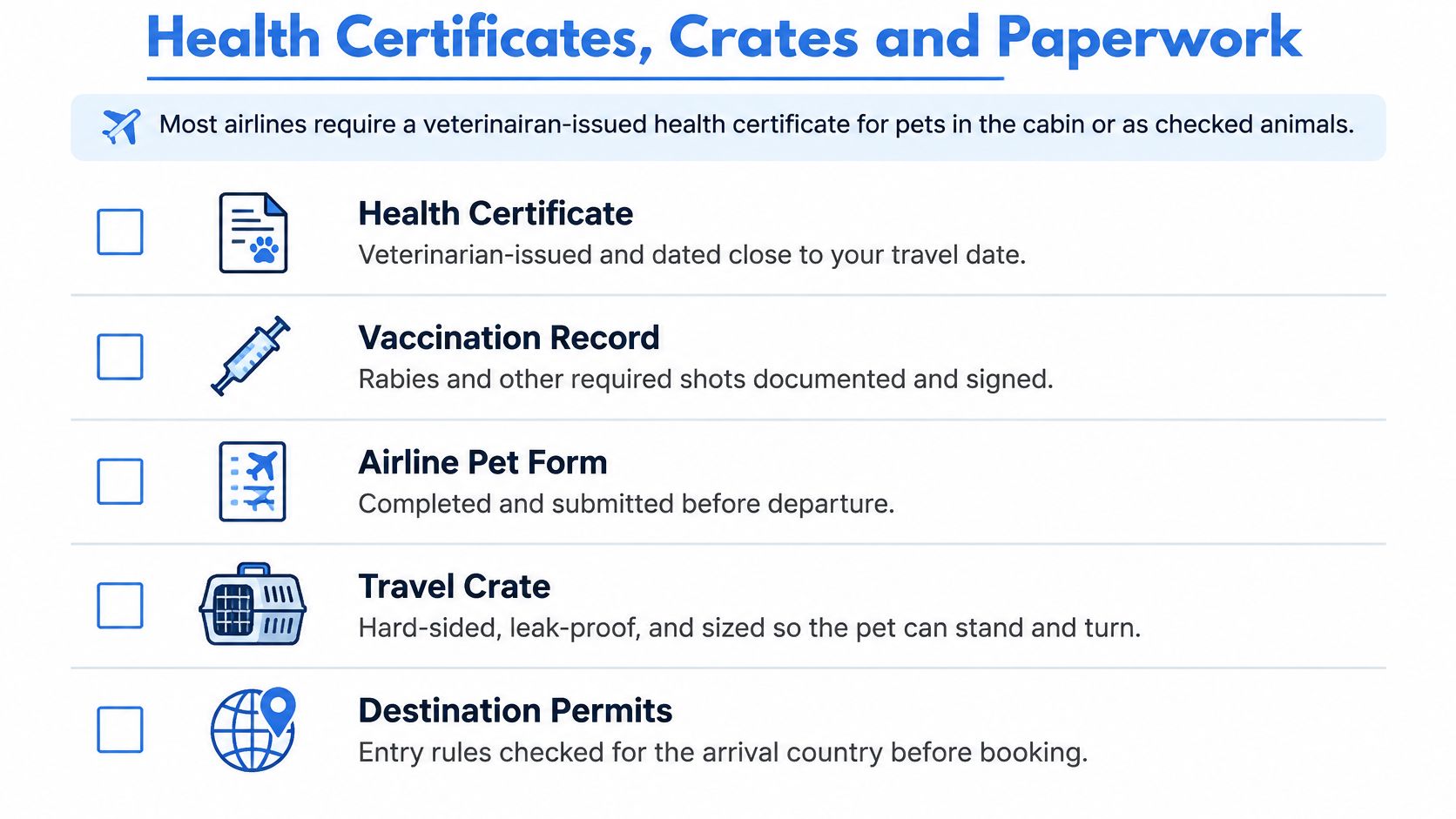
Documentation and equipment costs before departure
| Requirement | Typical cost | Lead time and note |
|---|---|---|
| Veterinary exam and health certificate | Veterinary quotation required | Confirm the certificate's permitted issue window before scheduling |
| Airline-compliant crate | Supplier price for the accepted model and size | Check animal movement and carrier acceptance before purchase |
| Rabies titer test, where required | Veterinary and laboratory quotation required | Ask about processing and any destination waiting requirements |
| USDA endorsement, where applicable | Confirm the applicable official charge | Establish whether the itinerary requires endorsement |
| Destination import permit or entry documents | Confirm with the destination authority | Check application and arrival requirements before booking |
The veterinary line should identify whether the examination and certificate are billed together. For the crate, obtain acceptance of the actual model and dimensions rather than relying only on a retail description.
Treat laboratory testing, endorsement and import permits as conditional budget lines, not universal requirements. Ask the veterinarian and destination authority which apply, who submits them, and whether their charges are included in a relocation service.
Build the budget around dependencies
Don't schedule the certificate just because a veterinary appointment is available. First establish the airline's and destination's timing requirements, then arrange the examination within the accepted window.
The same logic applies to equipment. Confirm the transport model before purchasing a crate, because a container suitable for cabin travel may not be the container requested for a cargo shipment.
For a worked international-move budget, list the exam and certificate, accepted crate, any required testing, endorsement, permits, handling and ground transport separately. Add the supplier quotations before adding the flight. There isn't a defensible universal paperwork total because the required items differ by itinerary.
Use this pet travel requirements guide to organize the questions, then confirm the answers with the airline, veterinarian and destination authority.
Budget only the documents your itinerary requires, but don't assume that buying a flight settles the entry paperwork.
How Brokers Price a Private Charter for a Pet
Ask for an itemized mission quote, not just an aircraft hourly rate. A useful proposal identifies the aircraft, itinerary, operator acceptance and charges that remain outside the quoted total.
A private aviation broker can match the aircraft to the passengers, pet, luggage and route, then coordinate with the operating company. For pet travel, that matching work should establish acceptance before the traveler pays a deposit.
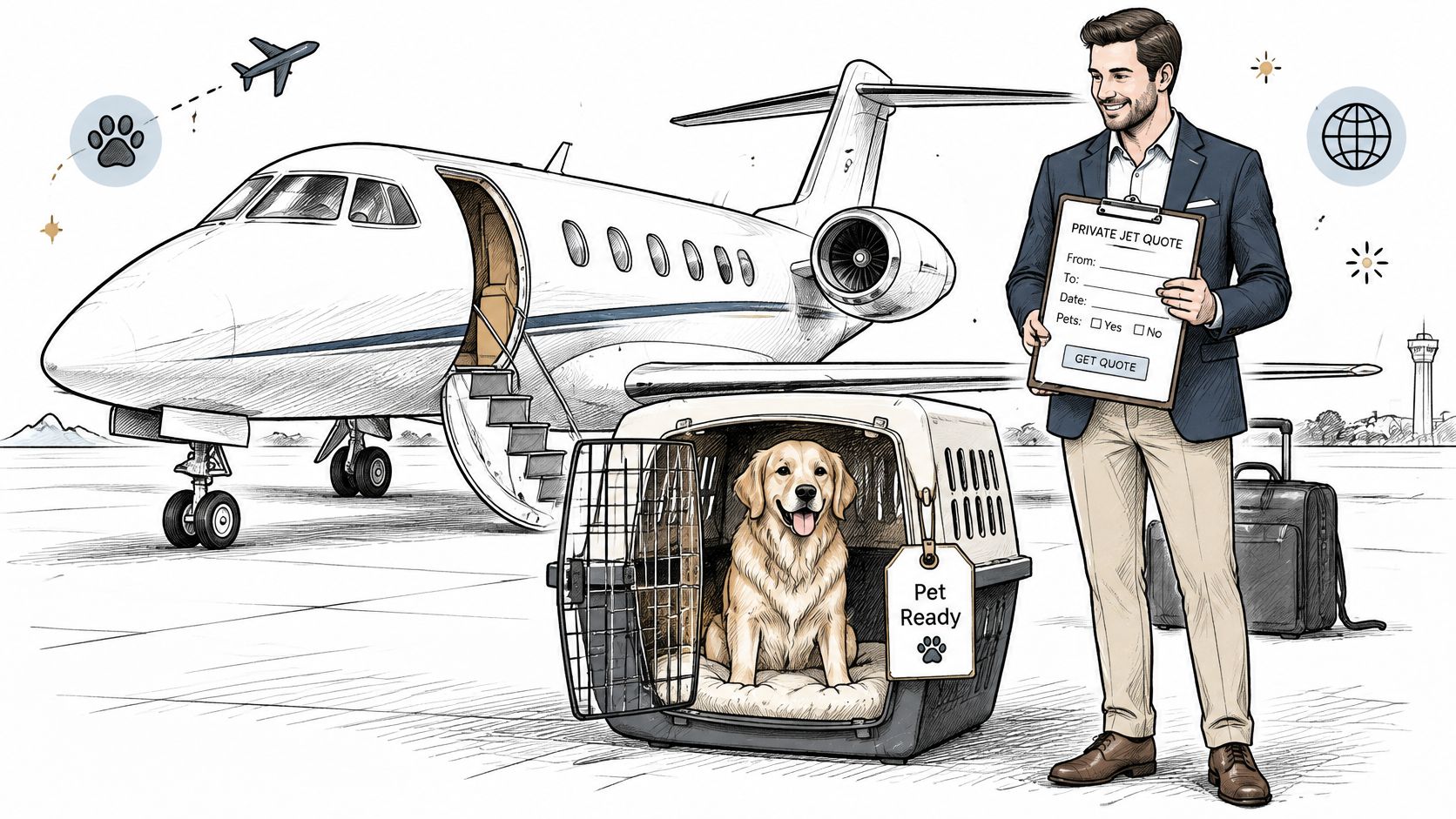
Separate aircraft charges from pet arrangements
Use this checklist when reviewing a proposal:
- Aircraft charge: Ask what flying time the quote includes and how itinerary changes would be priced.
- Fuel: Confirm whether it's included or shown as a separate charge.
- Landing and handling: Request the airports and ground services covered by the proposal.
- Repositioning: Ask whether moving the aircraft into position is included.
- Pet acceptance and cleaning: Obtain the operator's written conditions and any applicable charge.
- Handler or escort: Identify who accompanies or transfers the animal and whether that service is included.
- Permits and arrival coordination: Distinguish assistance with paperwork from payment of official or third-party charges.
These are review questions, not a claim that every charter attracts every charge. The objective is to prevent an apparently complete price from concealing unresolved services.
A private jet charter pricing guide can help you structure the comparison. The actual decision still needs a dated proposal for the requested mission.
Judge the matching work, not an unsupported promise
Approved Jets is one broker option for aircraft coordination, operator matching, pet-documentation guidance and integrated trip logistics. Ask any broker to explain how it will confirm a suitable aircraft, obtain operator approval and coordinate the arrival arrangements.
Don't substitute advertised network scale or response speed for mission-specific confirmation. What matters is whether the proposed aircraft and operating company accept your pet, your crate or restraint arrangement, your luggage and your itinerary.
A lower hourly rate isn't automatically a lower trip total. Compare the complete quoted mission, its exclusions and the consequences of changing airports or departure times.
Before paying a deposit: Request written confirmation that the identified operator accepts the pet in the cabin under the proposed arrangements.
A broker's practical value is finding a compatible aircraft and operator and coordinating the required services. That's a more useful purchasing criterion than choosing an aircraft from an hourly-rate table alone.
Commercial Cabin Versus Private Charter
Compare the same journey with the same inclusions. A pet-only airline add-on and a whole-aircraft charter quote aren't competing totals until passenger travel, equipment and required logistics are accounted for.
The following are illustrative trip descriptions, not observed bookings or priced case studies. Charter totals remain quotation-only because there's no supported hourly schedule from which to calculate them.
Trip totals by pet scenario, commercial versus charter
| Scenario | Commercial route total | Private charter total | Biggest variable |
|---|---|---|---|
| Light cat, one way, 2.5-hour domestic trip | Passenger airfare, applicable cabin fee and accepted carrier | Full mission quote required | Airline and ticket date |
| 70-pound dog unable to fit under a seat, domestic | Eligible baggage or cargo quote, crate and required handling | Pet-accepted aircraft quote required | Availability of an acceptable commercial service |
| Family of four plus dog, one way, two-hour domestic trip | Four passenger airfares, applicable pet fee and equipment | Whole-aircraft quote, or separately quoted shared seats if available | Flight date and available seats |
| Unaccompanied dog, international | Cargo rate, applicable shipper fee and required logistics | Charter and any necessary handler, individually quoted | Destination acceptance and handling |
For the small cat, commercial cabin travel is the logical first option to price. The owner is buying a passenger ticket and a pet add-on rather than funding an aircraft mission, provided the airline accepts the container and has space.
For the larger dog, the key change isn't a higher cabin fee. The cabin product is unavailable in this example, so the comparison becomes accepted baggage or cargo service against other transport arrangements. Ask whether a commercial itinerary exists before trying to optimize its cost.
When a charter deserves a serious quote
The family example requires a group-level comparison. Add all passenger fares and required pet expenses, then compare that total with a whole-aircraft proposal or eligible shared-flight seats. Don't assume that filling more seats automatically makes charter cheaper.
The unaccompanied international dog needs a different cost model again. The Department of Transportation's explanation of accompanied animals and cargo shipments distinguishes baggage-style transport from cargo handled by the carrier's cargo department; the international model described by the U.S. State Department can also include a pet shipper's fee.
Charter starts to deserve closer examination when an acceptable commercial option cannot meet the animal's eligibility requirements or the traveler's necessary schedule. That's an access and logistics threshold, not a universal financial break-even point.
For a relocation manager, the sound comparison is therefore conditional: first establish which options can complete the move, then compare their full totals. An unavailable bargain shouldn't remain in the shortlist.
Confirm the Quote Before You Book
- Measure the kennel and weigh the pet. Send the external dimensions and animal details with the inquiry.
- Confirm the pricing model. Resolve under-seat fit, cabin availability and seasonal cargo acceptance before relying on a fee.
- Arrange the certificate and crate. Confirm the applicable requirements and timing before purchasing or scheduling.
- Request a dated, itemized quote. Ask for an issue time, validity period, inclusions, exclusions and change conditions.
- Get written pet acceptance. The confirmation should identify the airline or operating company and the relevant itinerary.
- Set aside a contingency. Base it on plausible rebooking, replacement-document and ground-transport costs rather than an unsupported universal percentage.

Test the alternatives before committing
- Reserve early: Ask when pet reservations must be completed and when acceptance becomes firm.
- Offer flexible windows: Request alternative departure dates or airports and compare complete totals.
- Investigate shared flights: Confirm that the operator accepts your animal; shared seating alone doesn't establish eligibility.
- Compare less-constrained dates: Ask for actual alternative quotes rather than assuming an off-peak discount.
Treat an undated price as a lead, not a budget commitment. The Delta policy change discussed earlier demonstrates why a ticket's issue date can matter.
Check that the final proposal covers routing, connections, crate dimensions, operator policy and destination import requirements. For a private flight, use the charter booking process guide to organize the inquiry and approval sequence.
Your request should include the pet's weight, kennel dimensions, passenger count, route and travel date. Those details let the arranger quote an eligible journey rather than an attractive but unusable starting price.
Approved Jets arranges private charter flights and coordinates pet operator matching, documentation guidance and trip logistics. Send your pet's weight, crate dimensions, route and travel date to request a dated, itemized quote with written pet acceptance and clearly identified exclusions.