Private Jet Pet Travel: The Complete Step-by-Step Guide
Master private jet pet travel with expert tips on vetting operators, documentation, costs, and safety. Plan a seamless, stress-free journey for your pet today.

Approved Jets
On this page
- Table of Contents
- Why Private Aviation Is a Different Beast for Pets
- Demand creates opportunity and risk
- Vetting Your Charter Operator for Pet Safety
- What to verify before accepting an aircraft
- Navigating Documentation and Health Requirements
- Build the document sequence around the destination
- In-Cabin Comfort Versus Cargo Solutions
- The breed and carrier decision
- Understanding the True Cost of Flying with Pets
- Where the budget actually moves
- Executing a Seamless Arrival and Ground Transfer
- Assign ownership for each arrival task
- Essential Planning Checklist and Emergency Prep
- Use a working checklist
You're standing at the FBO with your dog's carrier, passport, vaccination records, and a flight scheduled to cross an international border. The aircraft is ready, your family is ready, and your pet appears calm. Then someone asks a simple question: which airport is authorized to receive the animal, and is the health certificate still valid on arrival?
That's where private jet pet travel stops being a comfort upgrade and becomes an operational exercise. A private aircraft can reduce crowds, handling transfers, and cabin stress, but it doesn't suspend animal-health law, operator policy, or border-control procedures. The aircraft is only one part of the move. The bulk of the work is matching the pet, route, documents, aircraft, crew, and arrival plan before anyone boards.
Table of Contents
- Why Private Aviation Is a Different Beast for Pets
- Vetting Your Charter Operator for Pet Safety
- Navigating Documentation and Health Requirements
- In-Cabin Comfort Versus Cargo Solutions
- Understanding the True Cost of Flying with Pets
- Executing a Seamless Arrival and Ground Transfer
- Essential Planning Checklist and Emergency Prep
Why Private Aviation Is a Different Beast for Pets
A commercial itinerary can turn a manageable journey into a sequence of stress points. Your dog may face a crowded terminal, unfamiliar handlers, a restrictive carrier, and a cargo process you can't observe directly. A cat that normally sleeps through a household disruption can react very differently when separated from its owner and exposed to unfamiliar noise, movement, and temperature changes.
Private aviation removes many of those variables, but not all of them. On a well-planned charter, the pet may remain with the family in the cabin, move through a quieter FBO, and avoid multiple handoffs. The operator still needs to confirm where the animal can sit, whether restraint is required during taxi, takeoff, and landing, how a large carrier fits in the cabin, and what happens at the destination.
Demand creates opportunity and risk
Pet travel has expanded sharply in major markets. One industry report said NetJets accommodated 20,000 pets in 2019, then added 4,000 more in 2020 despite fewer flights. VistaJet reported an 86% increase in pet travel from September 2019 to September 2021, while cat travel rose by 357% over that period, according to industry reporting on private aviation pet travel.
Those figures show a serious market, not a passing preference. They also create a qualification problem. A broker may be able to source an aircraft quickly, yet the operator might have limited experience with large dogs, brachycephalic breeds, international documentation, or arrival-side customs coordination.
Practical rule: “Pet friendly” should describe a documented operating process, not a sales phrase.
The right question isn't just whether pets are allowed. Ask whether the aircraft, crew, ground team, and destination plan are suitable for this specific animal. For some routes, a carefully assessed air or road for your pet comparison may reveal that ground transport is safer or simpler for one leg.
Vetting Your Charter Operator for Pet Safety
A pet booking deserves the same operational scrutiny as a corporate flight carrying executives or sensitive equipment. Start with the operator's safety oversight, then examine whether the aircraft and crew can handle the pet's actual needs.
Third-party credentials such as ARGUS Platinum and Wyvern Wingman can help distinguish operators that submit to structured safety audits from providers that offer little visibility beyond a fleet photograph. These credentials don't prove that an operator has a strong pet program, but they provide a meaningful baseline for maintenance discipline, crew standards, and operational oversight.
What to verify before accepting an aircraft
Request the following information in writing:
- Operator identity: Confirm who holds operational control, not just which broker arranged the trip.
- Safety oversight: Ask about current ARGUS, Wyvern, or equivalent third-party review.
- Crew experience: Confirm whether the crew has handled large animals, nervous pets, carriers, and restraint procedures.
- Aircraft layout: Check door dimensions, cabin floor space, seating restrictions, and whether the carrier can be secured without blocking an aisle or exit.
- Mission conditions: Review expected tarmac exposure, fuel stops, repositioning, and overnight handling.
- Ground coordination: Establish who owns customs paperwork, veterinary inspection arrangements, and the pet-friendly vehicle transfer.
A large dog may fit comfortably inside a midsize cabin but become a poor match for a compact light jet once luggage, passengers, and a rigid carrier are loaded. Conversely, choosing a larger aircraft only for cabin space can add unnecessary cost if the route and pet can be handled safely on a smaller platform.
Approved Jets describes a network access model involving 1,000+ FAA Part 135 and foreign-equivalent operators, with aircraft matching based on mission profile and luggage requirements. Whether you use that broker or another qualified provider, the evaluation standard should remain the same. Review private jet safety considerations alongside the pet-specific questions, because an agreeable cabin experience can't compensate for weak operator controls.
Navigating Documentation and Health Requirements
Private aviation offers flexibility in cabin access and routing. It doesn't exempt the journey from animal-health regulations. In the United States, private flights still operate within a framework involving FAA authority, USDA animal-health requirements, and CDC import rules when applicable.
For domestic U.S. travel across state borders, USDA guidance commonly requires a rabies vaccination and a health certificate issued by a licensed veterinarian within 30 days of travel, as described in Textron Aviation's pet travel guidance. Treat that period as a planning boundary, not an invitation to schedule the veterinary visit at the last possible moment.
Build the document sequence around the destination
- Identify the destination rules first. Determine whether the country or state requires a microchip, specific rabies timing, a government-endorsed certificate, an import permit, or an approved arrival point.
- Confirm the aircraft and airport. The airport must be suitable for the intended customs and animal-health process. A private terminal doesn't automatically have the authority or facilities to clear an international pet.
- Schedule the veterinary examination. The health certificate window may be narrow. The U.S. State Department says airlines commonly require certificates no older than 10 days, and destinations such as the EU may require ISO microchips 11784 and 11785 implanted before a required rabies booster, according to its international pet travel guidance.
- Check weight classification. Animals weighing 100 lbs. or more including the cage are typically charged as cargo under the State Department's guidance, even when traveling on the same plane as the owner. That classification can affect handling and paperwork.
- Carry originals and copies. Keep vaccination records, certificates, endorsements, microchip details, and permits physically with the travel party and digitally with the operations team.
A broker should map these dependencies before the aircraft is finalized. For additional veterinary preparation, use a detailed resource on vet prep for international pet travel, then have the destination authority and operator confirm the current requirements.
In-Cabin Comfort Versus Cargo Solutions
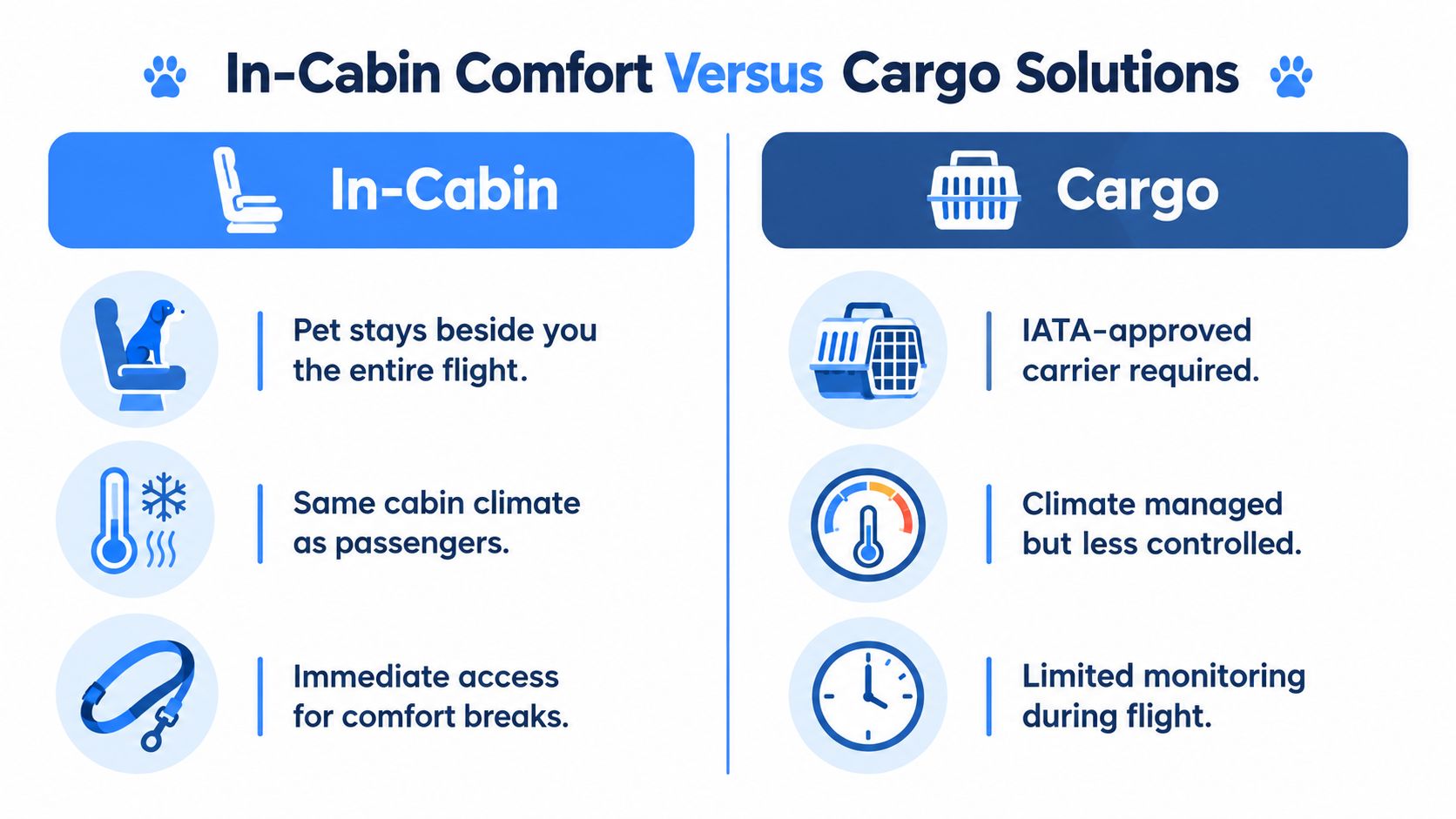
The cabin is usually the preferred environment for a pet that can remain calm and safely restrained around passengers. A lower compartment may be appropriate for a properly prepared animal when the aircraft, carrier, temperature controls, and handling plan are suitable. The decision should follow physiology and aircraft capability, not a blanket preference for one location.
IPATA states that less than 0.01 percent of pets transported by air have an incident, implying that more than 99.99 percent are safely reunited with their families worldwide, according to its statement on the safety of pet travel. A separate DOT-based analysis reported fewer than one incident per 10,000 animals transported in 2016. Those benchmarks cover air transport broadly rather than private jets specifically, but they show that compliant processes and competent handling matter more than anxiety-driven assumptions.
The breed and carrier decision
Brachycephalic dogs and cats require early screening. Military pet-movement guidance notes that brachycephalic breeds accounted for about 89% of AMC pet fatalities over five years, making snub-nosed animals a major edge case for heat, ventilation, and stress management.
For those pets, schedule during lower-temperature conditions, minimize tarmac exposure, and make the crew aware of the risk profile. Cabin travel may offer closer observation, but it doesn't remove the need for restraint and temperature control.
For a small dog or cat, IATA Container Requirement 1 allows a soft-sided carrier. The carrier must still let the animal turn normally, stand, sit erect, and lie naturally, with ventilated area covering at least 16% of the total surface of the four sides, according to IATA's container requirements. IATA also states that animals must be at least eight weeks old and fully weaned before air transport, and its live-animal guidance explains that in-cabin carriage remains subject to airline or operator policy.
For larger or more complex movements, review how the operator handles cargo charter flights. The useful comparison isn't “cabin good, cargo bad.” It is whether the selected arrangement gives the animal adequate space, ventilation, restraint, monitoring, and legally compliant handling throughout the mission.
Understanding the True Cost of Flying with Pets
Private jet pet travel isn't priced like a commercial pet fee. The aircraft and mission drive the quote, while the pet affects aircraft selection, handling, timing, and compliance work.
A short domestic trip with one small dog in the cabin may require only modest additional coordination. A long-range international flight with several passengers, a large crate, special ground handling, and destination inspections creates a different operational profile. The quote must account for positioning, flight time, crew requirements, airport charges, customs coordination, handling, and any ground transfer.
Where the budget actually moves
- Aircraft class: A light jet may suit a small party and compact carrier. A large dog, multiple pets, or substantial luggage may require a roomier cabin.
- Routing: A direct itinerary can reduce handling and connection risk, but aircraft availability and destination approvals determine whether it's workable.
- Ground services: Veterinary inspection, customs coordination, secure tarmac movement, and a climate-controlled vehicle can be more important than an arbitrary pet surcharge.
- Crate and baggage volume: A compliant carrier can consume meaningful cabin or cargo space, especially when the pet travels with household goods.
- Schedule changes: Altering the departure date after veterinary certification may force a new examination or invalidate a document window.
For animals 100 lbs. or larger including the cage, the State Department's cargo classification may introduce a different handling and pricing structure, even when the animal remains on the owner's itinerary. Ask for a line-item explanation of what the quote includes, and spend first on direct routing, qualified handling, and document control. Those are the elements that prevent an inexpensive booking from becoming an expensive recovery exercise.
Executing a Seamless Arrival and Ground Transfer
The arrival plan should be complete before departure. A pet that remains calm in the cabin can become distressed when the family discovers that customs is closed, the designated inspection team isn't present, or the waiting vehicle cannot safely accommodate the carrier.

Assign ownership for each arrival task
Before wheels-up, confirm:
- Arrival authority: Verify that the airport can receive the pet under the destination's rules and that the required inspection process is available.
- Document handoff: Decide who carries the originals, who presents them, and who retains copies for the operator and ground agent.
- Customs and veterinary clearance: Confirm whether the pet will be inspected on the ramp, in a terminal facility, or at another designated location.
- Vehicle readiness: Specify a vehicle with sufficient floor space, ventilation, climate control, and a safe method for securing the carrier or restraining the dog.
- Contingency contacts: Keep the operator, destination agent, veterinarian, and driver reachable during the arrival window.
The State Department recognizes cabin, accompanied-baggage, and cargo travel categories, but the category doesn't remove the possibility of inspection. A large dog may need a different arrival process from a small cat in a soft carrier. The operations team should know that before the aircraft departs, not after landing.
For itinerary control, an executive travel itinerary template can help organize flight, document, handling, and transfer details in one working file. Use it as an operational record, not a decorative schedule.
A calm arrival depends on small details, including a quiet handoff, water access when appropriate, familiar bedding, and a vehicle that doesn't force the animal into an unstable position.
Essential Planning Checklist and Emergency Prep
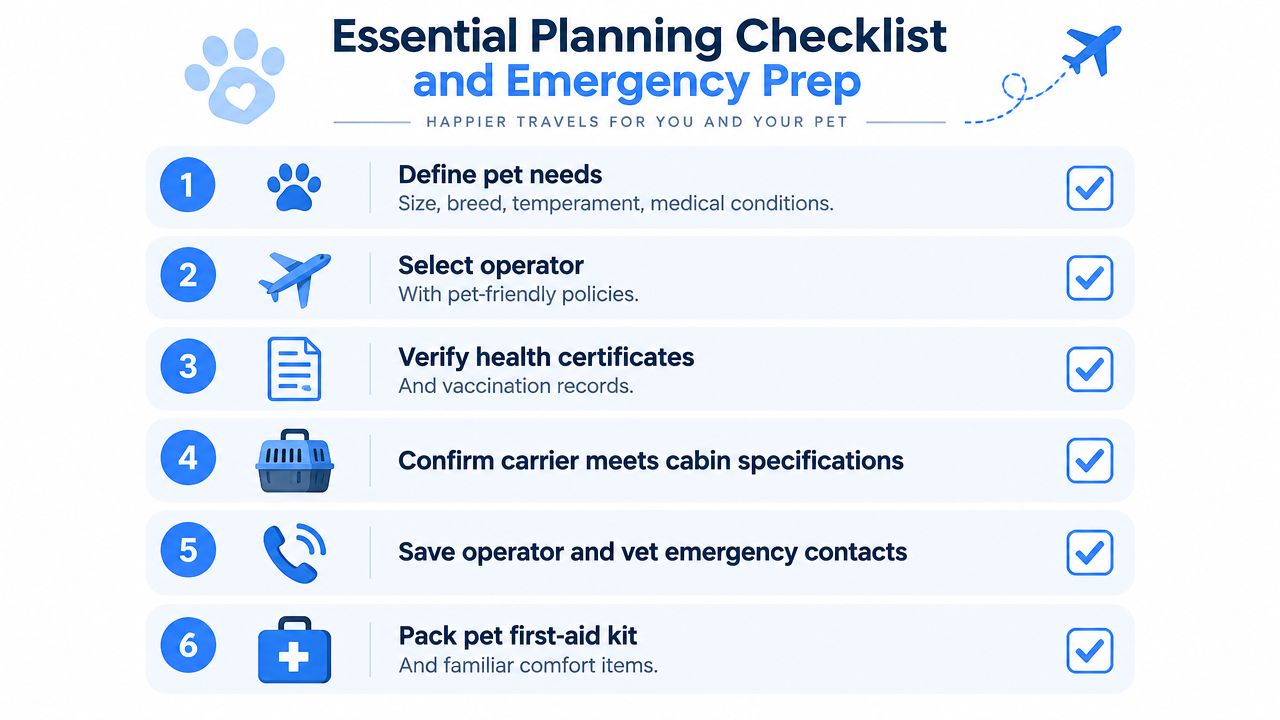
A reliable pet movement begins with the animal, not the aircraft. Define the pet's size, breed, temperament, age, medical history, and tolerance for confinement before discussing cabin configuration. A 10-week-old kitten, a nervous senior dog, and a brachycephalic breed may need entirely different handling plans.
Use a working checklist
- Define the animal: Record species, breed, weight, temperament, medical conditions, and medication schedule.
- Screen the operator: Confirm operational control, safety oversight, pet policy, aircraft suitability, restraint rules, and ground-handling responsibility.
- Build the document file: Gather vaccination records, microchip details, health certificates, permits, endorsements, and destination instructions.
- Validate the carrier: Check posture, ventilation, labeling, dimensions, and secure placement. IATA's requirements are more specific than a generic “pet friendly” approval.
- Control the route: Verify airports, border procedures, customs availability, tarmac conditions, and the final vehicle transfer.
- Prepare the travel kit: Pack familiar bedding, normal food, water equipment, medications, cleaning supplies, and copies of every document.
- Plan for failure: Identify a destination veterinarian and define what happens if the flight is delayed, the certificate expires, the pet shows heat stress, or customs clearance takes longer than expected.
For a high-risk breed, lower-temperature scheduling and avoidance of extended ramp exposure should be explicit requirements. The crew should also know when the pet must remain in a carrier or under restraint during taxi, takeoff, and landing. Don't rely on informal assurances from a booking agent.
A move may also require a backup care plan if the pet cannot travel on the intended date. Reviewing options for your dog while you travel can help households plan for that possibility without making a rushed decision.
The best private aviation experience feels simple because the complicated work happened beforehand. Treat the pet as a high-value, living passenger with compliance, welfare, and liability requirements, and the journey becomes far more predictable.
Approved Jets coordinates private charter aircraft, operator matching, documentation guidance, and arrival-side logistics for travelers moving with pets. Share your pet's profile, route, aircraft needs, and timing with Approved Jets before booking so the aviation plan and international paperwork are assessed together.