

Los Angeles Jet Charter: How LA Private Flights Work
Los Angeles jet charter explained: LAX vs Van Nuys, aircraft categories, routes, pricing drivers, and how to verify a Part 135 operator before you book.

Approved Jets

On this page
- Table of Contents
- Why Los Angeles Is a Mature Private Charter Market
- The fleet shifted from props to jets
- Why LAX volume changes the charter math
- Who Actually Operates Your Los Angeles Charter Flight
- What to ask before you pay
- Choosing Between LAX, Van Nuys, Burbank and Long Beach
- How the four fields actually differ
- Matching Aircraft Categories to Your LA Mission
- Four categories, four different LA jobs
- What Drives the Price of a Los Angeles Charter
- Why two quotes for the "same" trip disagree
- The Booking Process from Inquiry to Wheels Up
- From quote to a hold you can trust
- How Corporate, Group, Medical and Cargo Missions Differ
- Your Next Step Toward an LA Charter Quote
In 1971, Van Nuys Airport became the busiest general-aviation field in the United States, with 562,079 aircraft operations that year. It still averages more than 217,000 takeoffs and landings a year on about 730 acres. A Los Angeles jet charter is not a cabin brochure. It is a slot in a mature system where the airport and the certificate holder decide whether you leave on time.
Most listings sell interiors and quote speed. Those details matter after two harder calls: which airport fits the full door-to-door trip, and which Part 135 operator controls the flight. A broker's inventory does not answer either question.
Table of Contents
- Why Los Angeles Is a Mature Private Charter Market
- Who Actually Operates Your Los Angeles Charter Flight
- Choosing Between LAX, Van Nuys, Burbank and Long Beach
- Matching Aircraft Categories to Your LA Mission
- What Drives the Price of a Los Angeles Charter
- The Booking Process from Inquiry to Wheels Up
- How Corporate, Group, Medical and Cargo Missions Differ
- Your Next Step Toward an LA Charter Quote
Why Los Angeles Is a Mature Private Charter Market
Van Nuys opened on December 17, 1928, as Metropolitan Airport on about 80 acres. The City of Los Angeles bought it from the U.S. War Assets Administration in 1949 for $1. By 1971 it led the country in general-aviation operations. Today it has two parallel runways, four major fixed-base operators, and more than 100 businesses on site. Los Angeles World Airports reports that airport-related activity contributes more than $2 billion a year to the Southern California economy, according to the Van Nuys history published by Los Angeles World Airports.
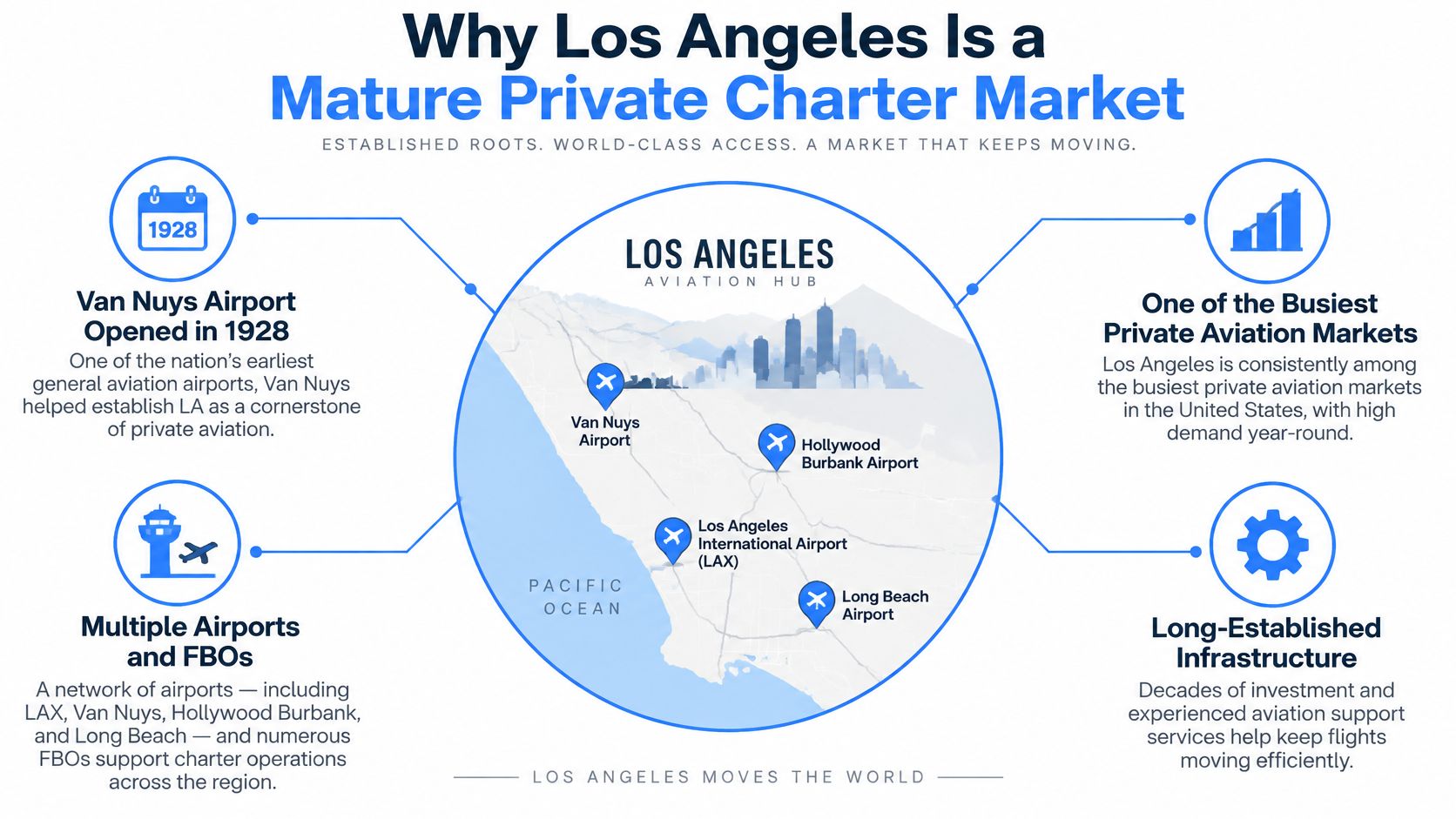
The fleet shifted from props to jets
A 1999 economic study tracked the change that still shapes charter supply. Based propeller aircraft at Van Nuys fell from 836 in 1986 to 538 in 1998, while based jets rose from 61 to 122, a 50% increase. Private-air-charter and corporate operations had increased 50% since 1992. Employment rose nearly 15%, and total economic activity grew by more than 30% in six years. The field already averaged about 1,500 takeoffs and landings a day, and one year brought 312,700 visitors who spent $96 million, as reported in the Los Angeles Times account of that study.
By 2023, Van Nuys had 619 based aircraft: 282 jets, 307 propeller aircraft, and 30 helicopters. Jets were roughly 45.6% of the based fleet. That is a business-aviation base, not a weekend strip.
Why LAX volume changes the charter math
Los Angeles International Airport handled about 73.71 million passengers and 580,996 aircraft movements in 2025, about 69.80% of passenger traffic across the seven commercial airports in the Southern California Association of Governments region. Of those passengers, about 50.11 million were domestic and 23.60 million were international, per the 2025 LAWA aviation activity analysis.
Practical rule: Treat Los Angeles as a capacity market. Aircraft availability, runway access, FBO handling, and operator coordination decide the trip, not the lounge photos.
Who Actually Operates Your Los Angeles Charter Flight
The screening test is the operator's FAA authorization and operational control, not the aircraft photo on a broker site. On-demand charter in the United States generally runs under 14 CFR Part 135. The certificate holder must obtain FAA authorization for each approved operation through its Operations Specifications. Pilots carrying passengers or property for compensation must be employed by, or act as agents of, the certificate holder that keeps operational control. A private pilot can't legally do that job just because an airplane is available for hire, as the FAA explains in its Part 135 certification overview.
Part 135 is not a slogan. For IFR passenger operations, the rules specify equipment that includes a vertical-speed indicator, a free-air-temperature indicator, heated pitot tubes for the airspeed indicators, and a power-failure warning device or vacuum indicator for gyroscopic instruments, under the FAA's Part 135 operations framework.
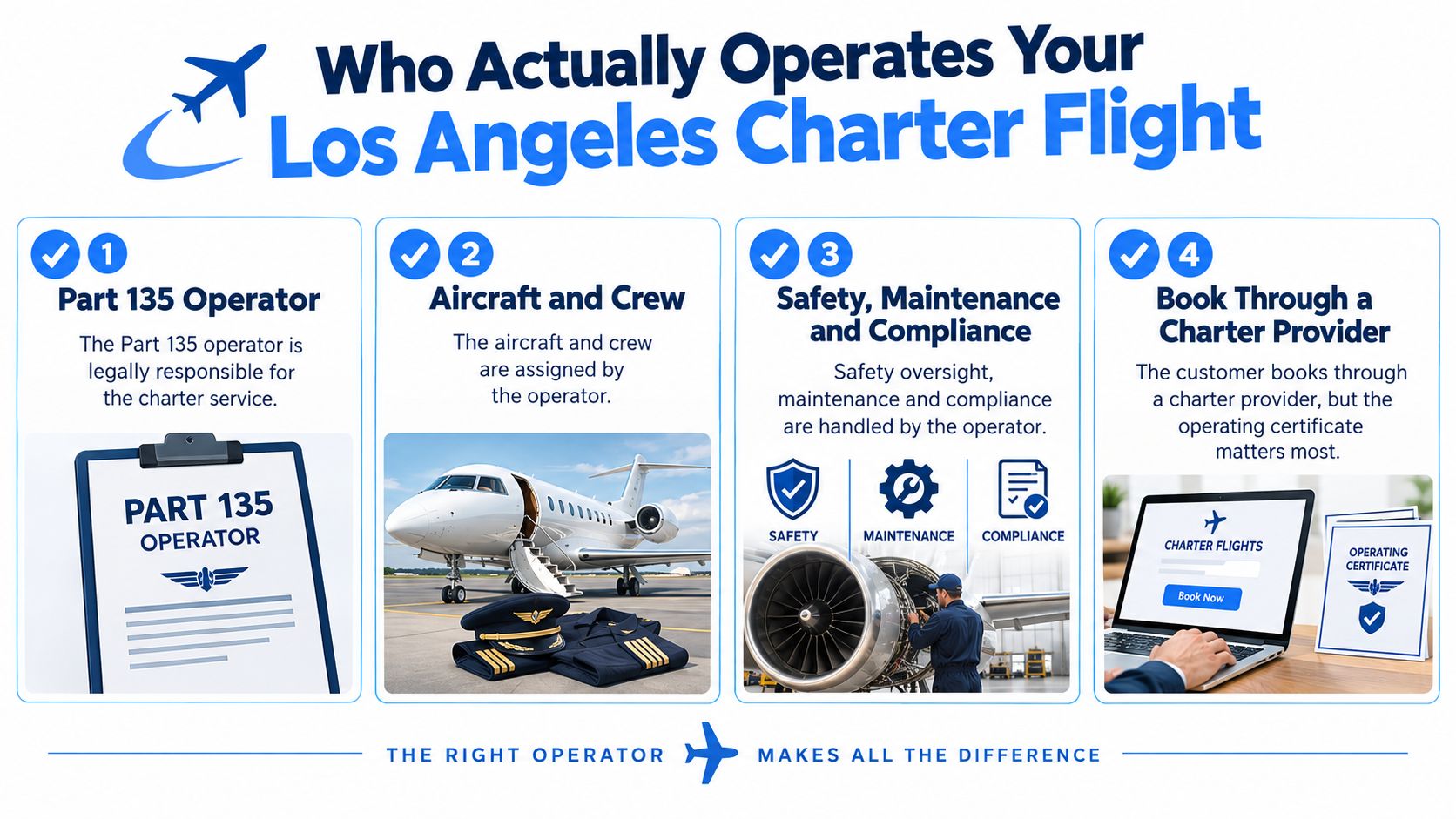
What to ask before you pay
The FAA advises customers to request the operator's Air Carrier or Operating Certificate before booking, and it treats a refusal as a warning sign. Unauthorized Part 135 flying remains a nationwide problem, and compensated flights have to sit inside the commercial framework, according to the FAA's guidance on thinking about chartering an aircraft.
On an urgent entertainment, executive, sports, or medical trip, a low price or an "empty leg" can tempt you to skip that check. Don't.
- Name the carrier. Get the legal name of the Part 135 certificate holder, not only the broker or the owner.
- Match the tail. Confirm the aircraft registration is on that operator's authority for this mission type.
- Read the limits. Ask which OpSpecs cover multi-stop, international, medical equipment, or high-value cargo, if any of those apply.
- Separate the product. Lawful whole-aircraft charter is not seat-selling or informal ridesharing. If someone is selling you a seat on a "shared" flight outside a proper commercial setup, walk away.
- Check the tax line. Ask how Federal Excise Tax is treated on a compensated charter so the quote isn't missing a required charge.
A wide aircraft network does not create safety or legal authority. The only relevant question is which certificated operator is conducting this specific flight.
Choosing Between LAX, Van Nuys, Burbank and Long Beach
Airport choice is an operational trade-off. The field closest to the hotel can still be the slowest door-to-door trip if congestion, permission rules, customs, or a noise procedure eats the time you saved in the air.
Business-jet demand in the Los Angeles area is not flat. The region recorded about 14,003 business-jet movements in May, compared with 11,567 in February, a swing of roughly 2,400 operations. LAX alone recorded 22,620 business-jet movements in 2025, and at least one LAX facility operated under a continuing Prior Permission Required program, so crews have to watch operational notices, based on Los Angeles metro business-jet figures compiled by Skystar.
How the four fields actually differ
| Airport | Primary Strength | Key Constraint | Best For |
|---|---|---|---|
| LAX | International scale and specific runway access | Passenger volume, sequencing, and PPR at some facilities | Cross-border missions that need that gateway |
| Van Nuys | Dedicated general aviation, FBO depth, Valley location | Noise procedures and aircraft performance limits | Executive, entertainment, and sports trips avoiding airline terminals |
| Burbank | Short ground time for many studio and downtown profiles | Runway and aircraft limits on heavier types | Shorter domestic missions when the runway fits |
| Long Beach | Useful South Bay and Orange County access | Operating constraints and repositioning risk | Trips whose ground leg starts south of the city |
Van Nuys is the default for a lot of private flying because it is built for that traffic, not because it is always nearest. Burbank can win when the passengers, baggage, and aircraft category all fit a shorter runway and a tighter ground transfer. Long Beach can win the same way for a south-side pickup. LAX earns its place when international handling or a particular runway is the point of the trip, not when someone assumes the big airport is automatically better.
Local rules sit on top of federal ones. Operators must follow FAA noise-abatement procedures and the rules, policies, resolutions, and ordinances of the City of Los Angeles, LAWA, and the Board of Airport Commissioners, as set out in LAWA's noise abatement section. A late-night arrival that looks open on a range chart can still be a no.
Pick the airport from the whole itinerary: passengers, bags, pets, medical equipment, security, customs, and the car on both ends. Then name a backup field before you ask for a price.
Matching Aircraft Categories to Your LA Mission
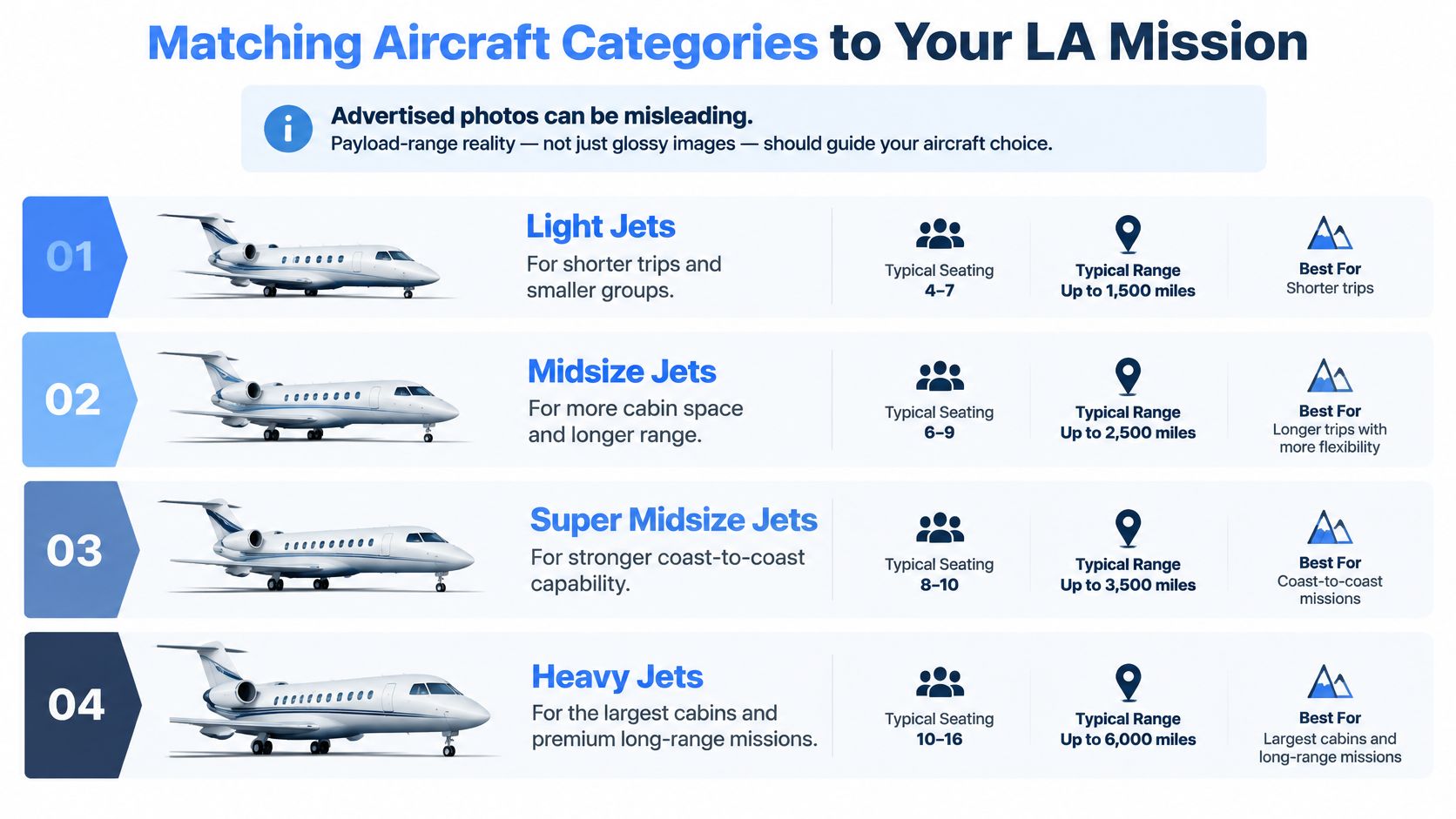
Cabin photos are a poor sizing tool. Advertised seats shrink once fuel, bags, catering, pets, medical gear, or cargo go on the weight-and-balance sheet.
Part 135 aircraft need current registration, airworthiness certification, identification, and an airworthy condition. Maintenance records must be complete, with no gaps on time-limited or cycle-limited parts. Operators must follow manufacturer-recommended time-between-overhaul intervals, and inspection programs can include annual, 100-hour, or an approved aircraft inspection program, under the FAA's Part 135 general requirements.
Four categories, four different LA jobs
Light jets fit a short hop to Las Vegas or the Bay Area with a small group and modest bags. They lose the argument fast if you add golf clubs, a pet, and full fuel on a hot afternoon.
Midsize jets buy more cabin and a bit more range for regional work, still with a hard payload ceiling. If the quote assumes every seat plus every bag, ask for the planned fuel load.
Super midsize jets are the usual answer when the day runs coast to coast and people need to work. Range is the selling point. Runway, temperature, and reserves still decide whether that range is real out of your chosen field.
Heavy jets cover the largest cabins and long international legs. They also narrow the airport list, raise handling cost, and make repositioning a bigger line item. A heavy jet parked in the wrong county is not a convenience.
Category guides such as the Approved Jets aircraft overview are useful only after you test the specific tail.
Before you accept a match, ask for takeoff weight against that day's conditions, required fuel reserves, baggage volume, and any equipment restriction. A failed check shows up as an offload, a substitute aircraft, or a cancellation.
A short walk-through of how operators think about category and mission is here:
What Drives the Price of a Los Angeles Charter
The bottom number on an LA quote is a stack of constraints, not a cabin rate. Routing and distance set the flight time. Departure timing hits crew duty and, at some fields, noise or permission rules. Aircraft category and which jets are free that day move the price more than the brochure does.
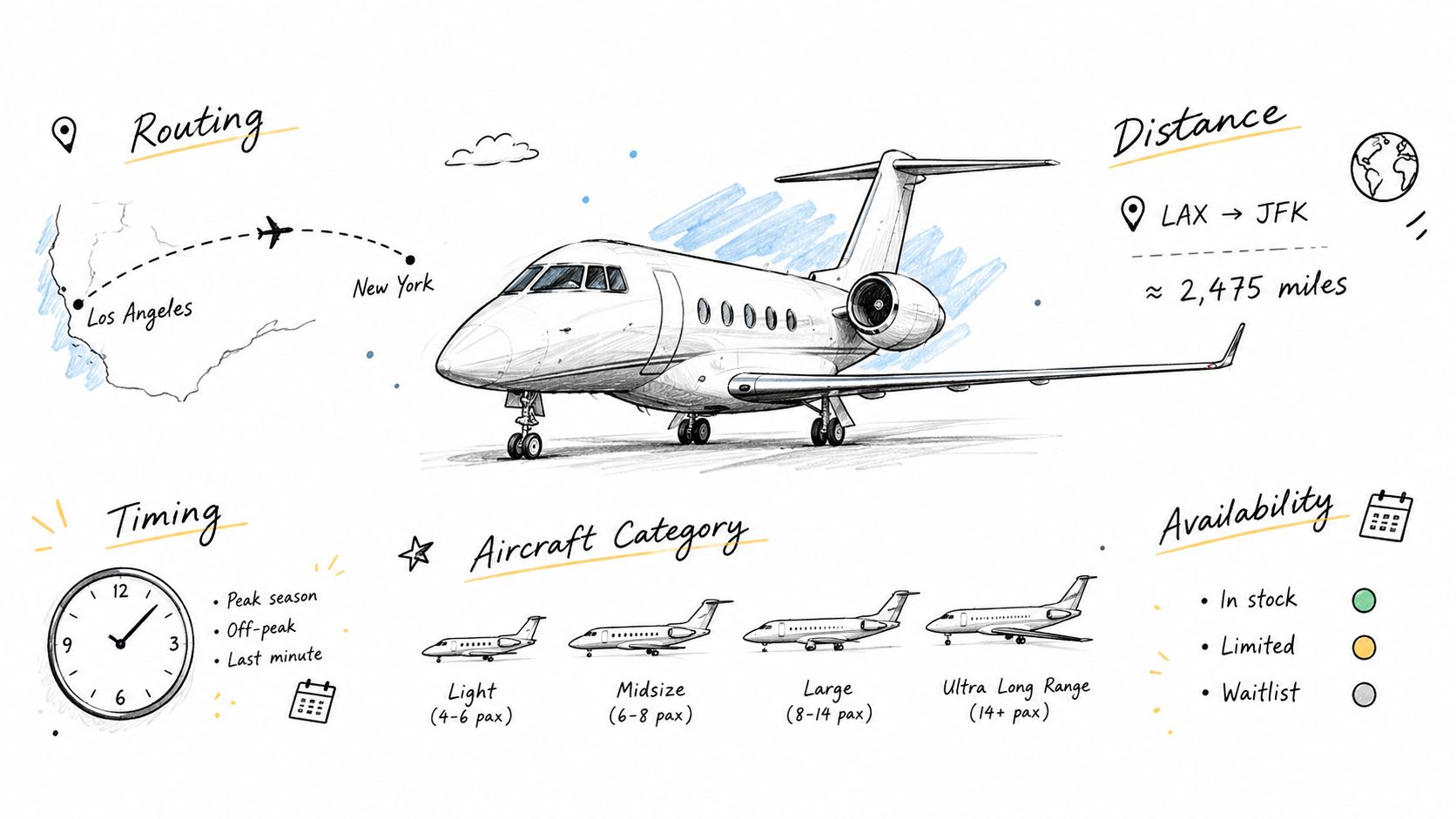
Why two quotes for the "same" trip disagree
Round trip pricing usually keeps the airplane with you, so the operator isn't hunting a new revenue leg. One-way pricing often includes the empty positioning flight that gets the jet to Los Angeles, or the flight that takes it away afterward. Empty-leg pricing looks cheap because the airplane was already going to move. It is also brittle: the time, the airport, and the operator are mostly fixed, and the legal operator still has to be the one on the certificate.
Demand is lumpy. The monthly swing in area business-jet movements, already noted above, is why a Tuesday in a quiet month and a Friday in a busy month are not the same product. Fuel, crew overnight costs, landing and handling fees, and a long reposition from another city can hide under a low headline.
A late-night departure can add cost or be unavailable once local noise rules are applied. Confirm Federal Excise Tax treatment in the quote rather than assuming the first number is the all-in price.
Ask every bidder for the same lines: aircraft category and registration, operator name, routing, block time assumption, fuel treatment, repositioning, handling, overnight, tax, and what happens if the tail changes. A plain explanation of how those pieces usually add up is in this private jet travel cost breakdown. Compare the lines. Don't compare slogans.
The Booking Process from Inquiry to Wheels Up
Start with a mission profile, not an aircraft name. Passengers, baggage, pets, medical equipment, departure and arrival airports, a backup field, and the timing window are what an operator can actually accept or refuse.
From quote to a hold you can trust
A usable quote names the Part 135 operator, the tail, the category, and the airport assumptions behind the price. Confirm the certificate before you treat the quote as real. Then paperwork: identification for a domestic leg, passports where a border is involved, and customs details when the trip leaves the country. Pets and medical gear need to be in that packet, not mentioned at the FBO.
LAWA's traffic reporting already separates charter from commuter, cargo, mail, and other operations, with arrivals and departures tracked on their own, in the April 2025 volume of air traffic report. Your flight is one of those distinct movements. Runway demand and sequencing still sit around it, which is why the broker should confirm the actual field and the handling plan, especially on multi-stop, medical, or large-group trips.
Between confirmation and departure, someone has to lock catering, security, and the cars. Passengers using a private FBO typically arrive 15 to 30 minutes before departure, not hours early. Mobilizing a flight can take about 2 to 4 hours when the mission and the airplane line up, and a two-hour quote target is a reasonable planning window, not a promise that every tail is free.
If you are weighing a one-way against a trip that brings you back, it helps to be clear on how return flight bookings work before you lock the routing. The same sequence, written as a passenger checklist, is covered in how to charter a private jet.
Approved Jets is one broker that matches tails through Part 135 operators and stays on the trip through arrival. You should still hold the operator name, the registration, the itemized quote, and the airport plan before you leave for the field. Discovering a missing certificate at the counter is too late.
How Corporate, Group, Medical and Cargo Missions Differ
The same Los Angeles system serves missions that should not share an aircraft plan.
Corporate programs buy confidentiality, a timetable that matches the meeting, and a reliever airport so leaders aren't in an LAX terminal. Direct routing is the product. A light or midsize jet on Van Nuys or Burbank is often enough, until the route goes transcontinental and the category has to step up.
Group movements for teams, premieres, and large parties flip the constraint. You need a heavy jet or an airliner, more ground staff, and a field that can take the airplane. The nearest FBO to the venue loses if the runway can't.
Medical evacuation and repatriation override cabin preference. The aircraft has to carry the equipment and the medical team, and the chain of custody has to survive the handoff. A pretty interior that can't take the stretcher is the wrong airplane, even if it is already in position.
Cargo and high-value freight need dedicated oversight and a routing plan, not leftover seat space. People sometimes confuse that with riding in the hold. Passpaw's guide to cargo hold travel is a useful contrast: a pallet with a chain of custody is a different operation from a passenger trip.
Aircraft owners sit slightly outside these four. Management that centralizes maintenance, crew, compliance, and charter revenue is how a based jet stays legal and earns when the owner isn't flying.
One itinerary can mix these. An executive inbound, a medical add-on, and a freight leg the next morning are three operator problems. The broker's job is to keep each leg with a certificate holder who is approved for it, and to keep the airports and cars from fighting the schedule.
Your Next Step Toward an LA Charter Quote
Have this ready before you ask for a number.
- Mission profile: passenger count, bags, pets, and any medical equipment.
- Airports: first choice and a backup on both ends, plus the ground address that drives the choice.
- Timing: dates, and how many hours you can move if duty time or noise rules get in the way.
- Constraints: confidentiality, security, or cargo that changes the operator search.
A quote you can compare should name the Part 135 operator, the registration, the category, the itemized charges including handling and tax treatment, and the airport and timing assumptions. Confirm the operating certificate before you pay. That is the step that should not be skipped, including on an empty leg.
Send the mission, then judge the reply against that list. A lower headline that hides the operator, the reposition, or the field is not a better offer.
Approved Jets arranges on-demand Los Angeles jet charter through FAA Part 135 operators, matching the aircraft to your passengers, bags, timing, and airports, then coordinating ground transfers, catering, and customs when the trip needs them. If you want a quote built around the operator and the field, not just a cabin photo, start with your mission details at Approved Jets.