
4 Engine Jet Explained How Four Engines Work
Learn what a 4 engine jet is, why quadjets were built, key examples like 747 and A380, and how they compare to twinjets today.

Approved Jets
On this page
- Table of Contents
- Introduction to the 4 Engine Jet Concept
- What travelers often get wrong
- A more useful way to think about quadjets
- How a 4 Engine Jet Works and Why Four Engines Exist
- Thrust distribution in plain language
- Why engineers chose four
- History and Evolution of Four Engine Jets
- The era when quadjets ruled long haul
- Why the decline happened
- Four Engine Jets Versus Twinjets Performance and Economics
- Where quadjets pay a penalty
- Quadjet vs Twinjet Trade Offs at a Glance
- Why the industry moved anyway
- Iconic 4 Engine Jet Examples and What They Do Best
- Boeing 747 and the classic long-haul heavy lifter
- Airbus A380 and the very high-capacity mission
- Airbus A340 and the long-range specialist
- When a 4 Engine Jet Still Makes Sense Today
- Missions where four engines still fit
- A practical decision framework
- The modern bottom line
- Key Takeaways on 4 Engine Jets and Next Steps
- What to remember when you spot one
- Smart next questions
Most travelers look at a jet with four engines and assume they're seeing a relic. That's the wrong starting point.
A 4 engine jet is better understood as a design answer to a specific problem: how do you move a lot of weight, a very long way, with strong built-in redundancy and enough thrust to make the mission practical? Once you frame it that way, quadjets stop looking like outdated giants and start looking like purpose-built tools.
At the gate, the difference is easy to spot. A twinjet has one engine under each wing. A quadjet spreads the work across four. That changes everything from wing design to payload options to maintenance demands. It also explains why some of the most famous airliners ever built, including the Boeing 747 and Airbus A380, carry four engines even though most new long-haul aircraft today use only two.
Travelers usually ask a simple question. Why would anyone want four engines now that twins can cross oceans too? The short answer is that four engines still make sense for some missions, but not for most. The long answer is where the learning starts.
Table of Contents
- Introduction to the 4 Engine Jet Concept
- How a 4 Engine Jet Works and Why Four Engines Exist
- History and Evolution of Four Engine Jets
- Four Engine Jets Versus Twinjets Performance and Economics
- Iconic 4 Engine Jet Examples and What They Do Best
- When a 4 Engine Jet Still Makes Sense Today
- Key Takeaways on 4 Engine Jets and Next Steps
Introduction to the 4 Engine Jet Concept
You're walking through an airport concourse and glance out at a widebody pushing back from the gate. The wings look unusually busy. Two engines hang under the left wing, two under the right, and the airplane has a presence that feels different from the twin-engine jets parked nearby.
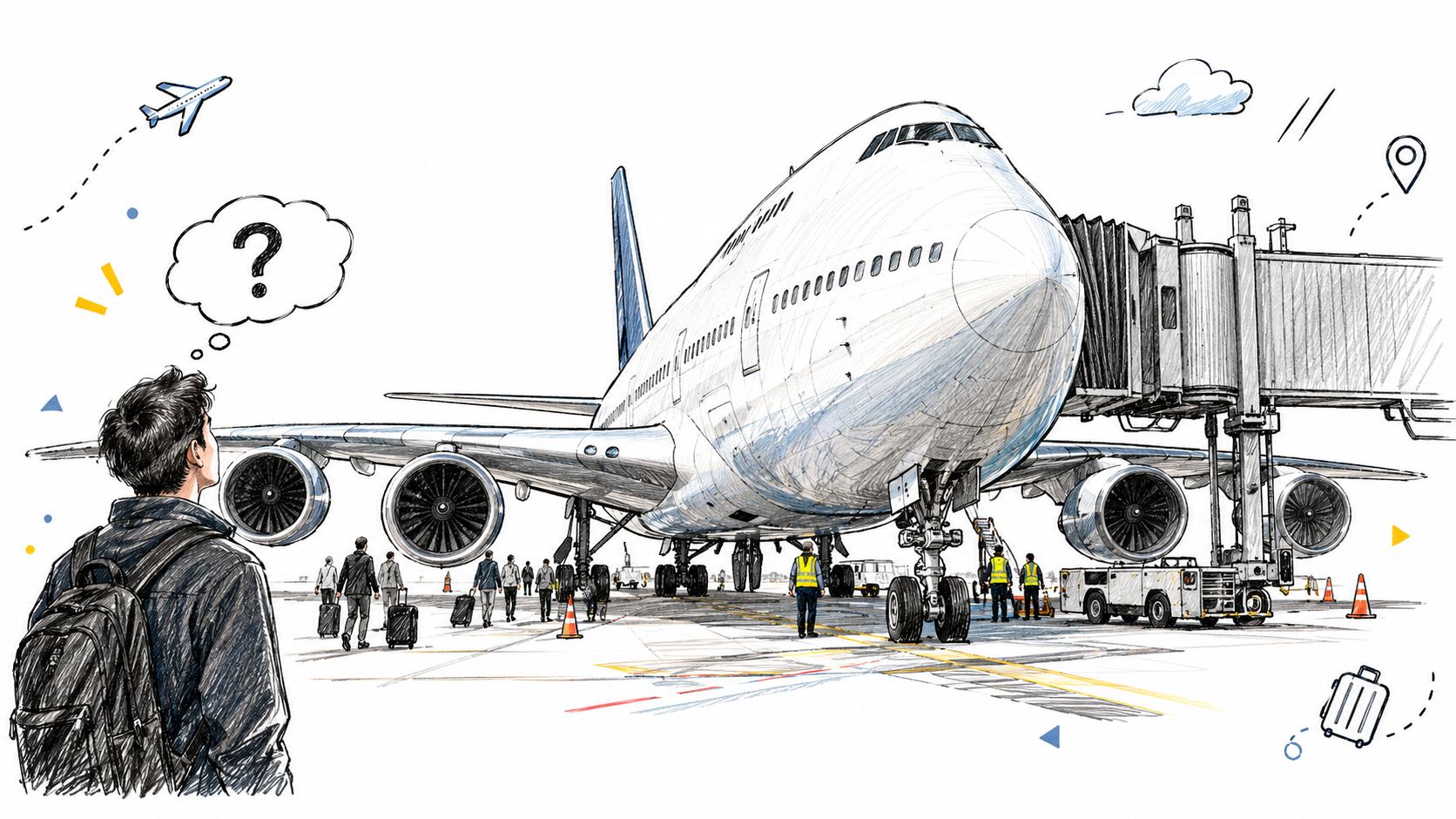
That reaction is common because a quadjet announces its purpose visually. It says long range, heavy lift, or very high capacity before it ever leaves the ramp. A 4 engine jet isn't just “a plane with extra engines.” It's a different set of engineering compromises.
What travelers often get wrong
Many people assume more engines automatically means more safety, more speed, and better capability in every situation. Some of that intuition comes from older aviation logic, and some of it comes from how powerful these aircraft look. But aircraft design never works in only one direction.
A fourth engine can help an aircraft carry more weight over longer distances. It can also increase the number of engine inspections, parts, and overhaul events operators must manage. That's why quadjets earned their place on long-haul routes, then gradually lost market share when twin-engine aircraft became more capable.
Practical rule: When you see four engines, think mission first, not age first.
A more useful way to think about quadjets
The clearest mental model is this:
- Capacity question: Does the mission involve a lot of passengers or cargo?
- Range question: Does the route demand long overwater or intercontinental performance?
- Efficiency question: Is the operator willing to accept higher fuel and maintenance burdens for that capability?
Those three questions explain most of the story.
They also help when you compare aircraft that look similar from the terminal but serve different roles in practice. A Boeing 747-400, an Airbus A340, and an Airbus A380 are all four-engine jets, yet each represents a different answer to the same core challenge: moving people and payload across serious distance without asking too much from any single engine.
How a 4 Engine Jet Works and Why Four Engines Exist
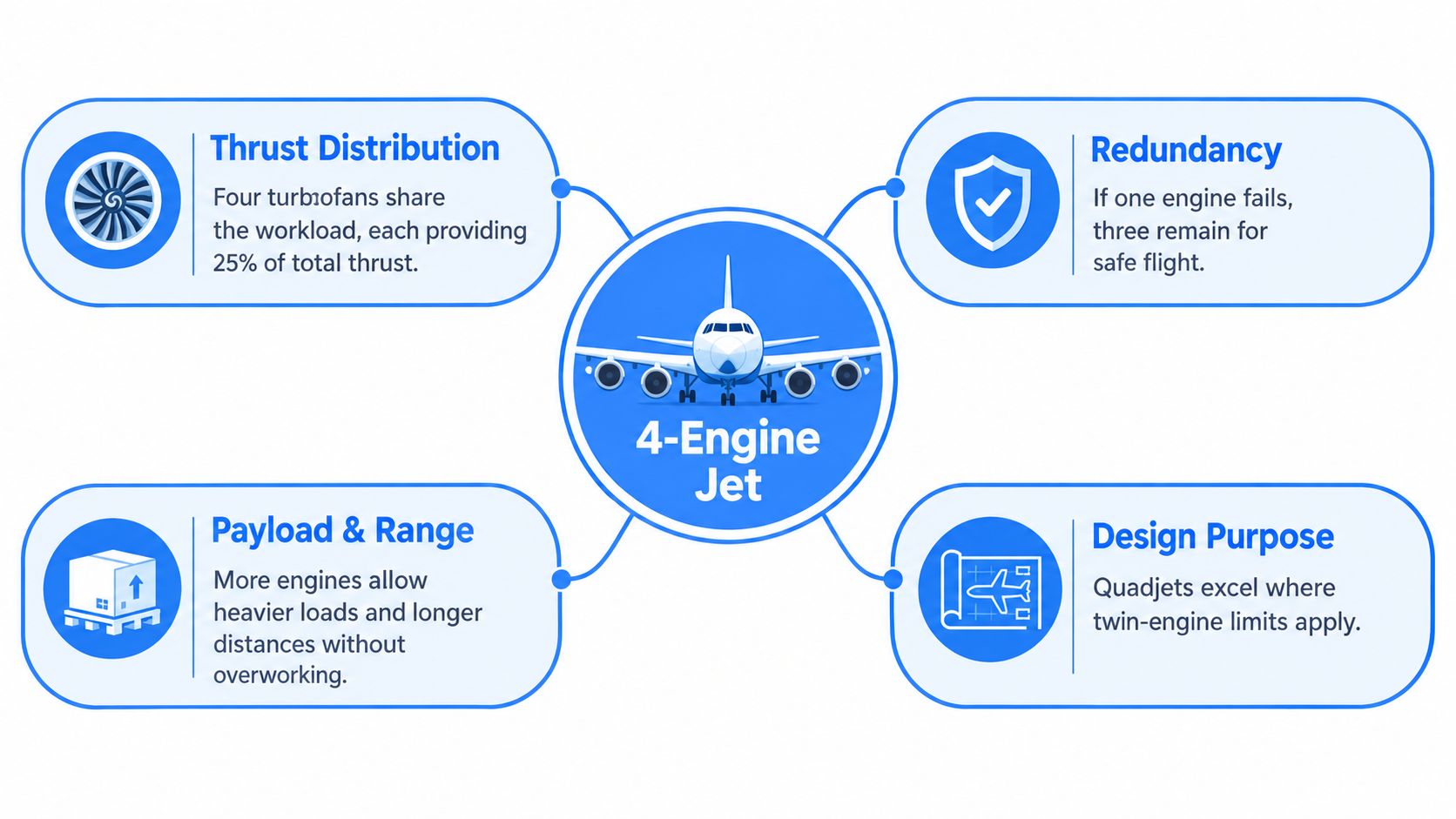
A quadjet works on a simple idea. Instead of asking two very powerful engines to do all the work, it divides thrust among four engines. Four rowers moving a heavy boat each contribute part of the effort, so the total load is shared.
That doesn't mean each engine is small. It means the airplane's performance comes from distributed thrust. On a large airliner, that affects takeoff performance, climb capability, and how the aircraft handles heavy payloads on long sectors.
Thrust distribution in plain language
Each engine on a four-engine jet contributes a share of the total push. On the Boeing 747-400, for example, the aircraft uses four high-bypass turbofans producing about 63,300 lbf (282 kN) each, for roughly 253,200 lbf total installed thrust, along with a maximum range of about 7,285 nautical miles (13,490 km) and a cruise speed near 481 knots according to Aerocorner's Boeing 747-400 specifications.
That tells you something important. The 747-400 wasn't built for short hops where quick turnarounds and low per-trip cost matter most. It was optimized for long-haul work where payload and range had to coexist.
Why engineers chose four
Historically, engineers picked four engines when airlines wanted one or more of these things:
- Heavy payload capability: More total thrust helps move more airplane, more fuel, and more passengers.
- Long-route flexibility: Four engines gave operators confidence on demanding sectors, especially before long-range twin operations became routine.
- Redundancy by architecture: Losing one engine still leaves three producing thrust.
The Airbus A340 family shows that logic well. The A340-300 uses four CFM56-5C engines rated around 31,200 to 34,000 lbf each and still delivers about 11,800 km range at cruise Mach 0.86, while later A340-500 and A340-600 versions used higher-thrust Trent 500 engines, as summarized in the Airbus A340 reference entry.
Three remaining engines give a crew options, but those same four engines also give maintenance teams more hardware to inspect, support, and overhaul.
If you're studying aircraft systems and want a structured aviation foundation, the aviation course Avi30419 gives useful context on how aircraft design choices connect to operations and maintenance. For travelers comparing mission types, it also helps to understand how aircraft are selected for route needs, including on international private jet flights.
History and Evolution of Four Engine Jets
Why did early jetliners so often have four engines?
Part of the answer is history, and part is engineering. In the first jet age, airlines wanted more speed, more range, and enough thrust to lift heavier aircraft from the runways available at the time. Four smaller engines were the practical answer many designers could build and certify.
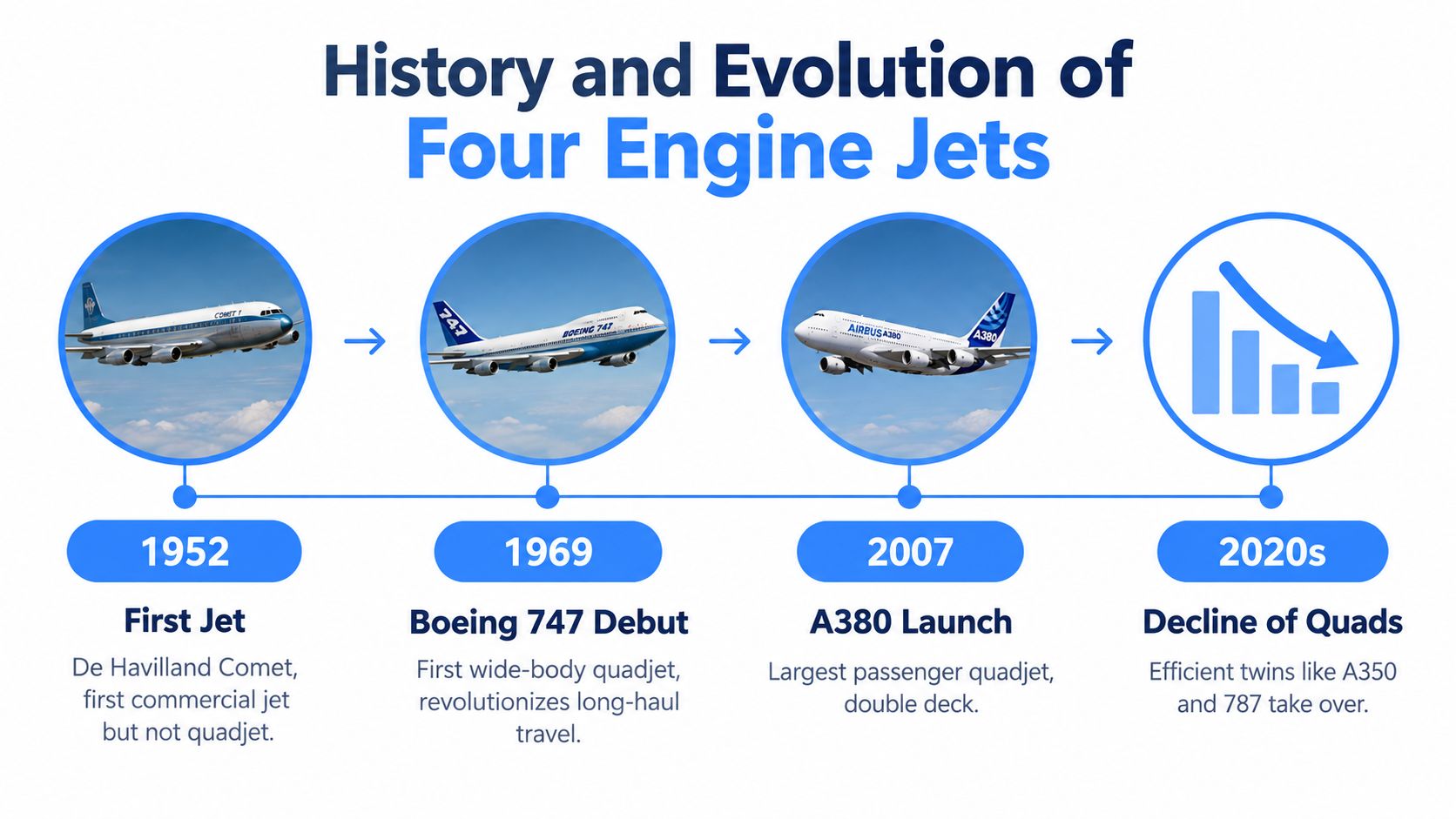
The de Havilland Comet showed that answer first. It is widely recognized as the first commercial jet airliner, and it was also a four-engine jet. The Comet 1 entered service with BOAC in May 1952, carried over 30,000 passengers in its first year, and was roughly 50% faster than comparable piston-engine aircraft on long routes, cutting London-to-Tokyo travel from 86.5 hours to about 36 hours, according to Shell's history of the Comet.
For passengers, that was not just a faster trip. It was a new standard for what intercontinental travel could be. The aircraft family was manufactured from 1949 to 1964, and the final Comet remained in service until 14 March 1997, which shows how durable the four-engine layout could be once operators learned where it fit best.
The era when quadjets ruled long haul
By the 1960s and 1970s, four engines had become the standard solution for serious long-range jet travel. If an airline needed to cross oceans, carry a large passenger load, and keep useful performance in hot weather or at challenging airports, a quadjet was often the conservative and capable choice.
That helps explain why aircraft such as the Boeing 707 and Douglas DC-8 became so important. They were not flying with four engines for style. They were using the engine technology of their day to meet range and payload goals that would have been much harder for a twinjet of that era.
Then came the Boeing 747, the aircraft that turned the quadjet from an engineering solution into a global symbol. Boeing ended 747 production in December 2022 after a 54-year run, and 1,574 aircraft were built, as reported in SPS Aviation's review of the four-engine airliner's slow fade.
That number matters because the 747 did more than fill seats. It showed what four engines could do when airlines needed very high payload, very long range, and strong takeoff performance in one airframe. In other words, the quadjet was not an oversized relic waiting to be replaced. It was the right answer for a specific set of mission demands.
A short visual history helps bring that timeline into focus:
Why the decline happened
Quadjets became less common after engine reliability improved and long-range twin-engine rules expanded. As twinjets gained the ability to fly routes once reserved for four-engine aircraft, airlines could carry similar loads on many sectors with less fuel burn, fewer engine overhauls, and lower day-to-day maintenance exposure.
The key point is easy to miss. Four engines did not become obsolete in a technical sense. The market changed around them.
By September 2023, worldwide quadjet schedules had fallen to about 11,700 commercial flights, down 44% from 2019, according to an OAG schedule analysis of the shrinking commercial quadjet fleet. That drop shows a narrower role, not a useless design. Modern airlines usually choose twinjets for routine long-haul service, while four-engine aircraft remain strongest where payload, range, field performance, or fleet-specific redundancy still outweigh the extra operating burden.
Four Engine Jets Versus Twinjets Performance and Economics
If you strip away nostalgia, the contest is simple. Airlines compare a quadjet and a twinjet by asking which one moves the required payload over the required distance with the lower total operating burden.
That's where four-engine aircraft face their hardest math.
Where quadjets pay a penalty
A four-engine airliner spreads thrust well, but each added engine also adds work. More nacelles, more inspections, more spare-part exposure, and more overhaul planning all show up in the operating picture. That's one reason twinjets took over so much of long-haul flying.
An engineering review cited transpacific operations and found large four-engine jets to be roughly 20 to 25% less fuel-efficient per passenger than the best twin-engine aircraft on similar long-haul routes, as discussed in this engineering review on airliner fuel efficiency.
The A340-600 gives that penalty a practical shape. One technical source states it burns about 8,000 to 10,000 kg of fuel per hour in cruise, and a Paris to Singapore mission can require about 95,000 kg total fuel. The same source also notes that modern ETOPS rules reduced the main operational advantage four-engine aircraft once had, as outlined in this A340-600 technical overview.
Quadjet vs Twinjet Trade Offs at a Glance
| Criterion | 4 Engine Jet | Modern Twinjet |
|---|---|---|
| Thrust layout | Thrust is distributed across four engines | Thrust is concentrated in two larger engines |
| Heavy payload missions | Often well suited to carrying high payload over long distance | Often very capable, but mission limits depend on aircraft design |
| Long-range heritage | Historically favored for demanding intercontinental routes | Now handles most long-haul flying thanks to engine and ETOPS advances |
| Fuel efficiency | Typically weaker on comparable missions | Generally stronger on similar long-haul routes |
| Maintenance burden | Higher because there are more engines and related systems to maintain | Lower because there are fewer engines |
| Fleet economics | Best when mission profile truly needs the capability | Best for most airlines seeking lower trip and lifecycle cost |
Why the industry moved anyway
For most airlines, the deciding factor isn't romance. It's whether a route can make money consistently. If a twinjet can perform the same mission with lower fuel burn and fewer engine-related maintenance demands, the business case usually points to two engines.
That logic also shapes parts strategy and repair planning. Anyone curious about how modern production methods support airline hardware can look at aerospace additive manufacturing parts, especially for understanding how complex aircraft components are produced and supported. Travelers comparing ownership or access models may also find it useful to read about private jet ownership costs.
Decision shortcut: If the mission can be flown just as effectively by a twinjet, economics usually favor the twin.
Iconic 4 Engine Jet Examples and What They Do Best
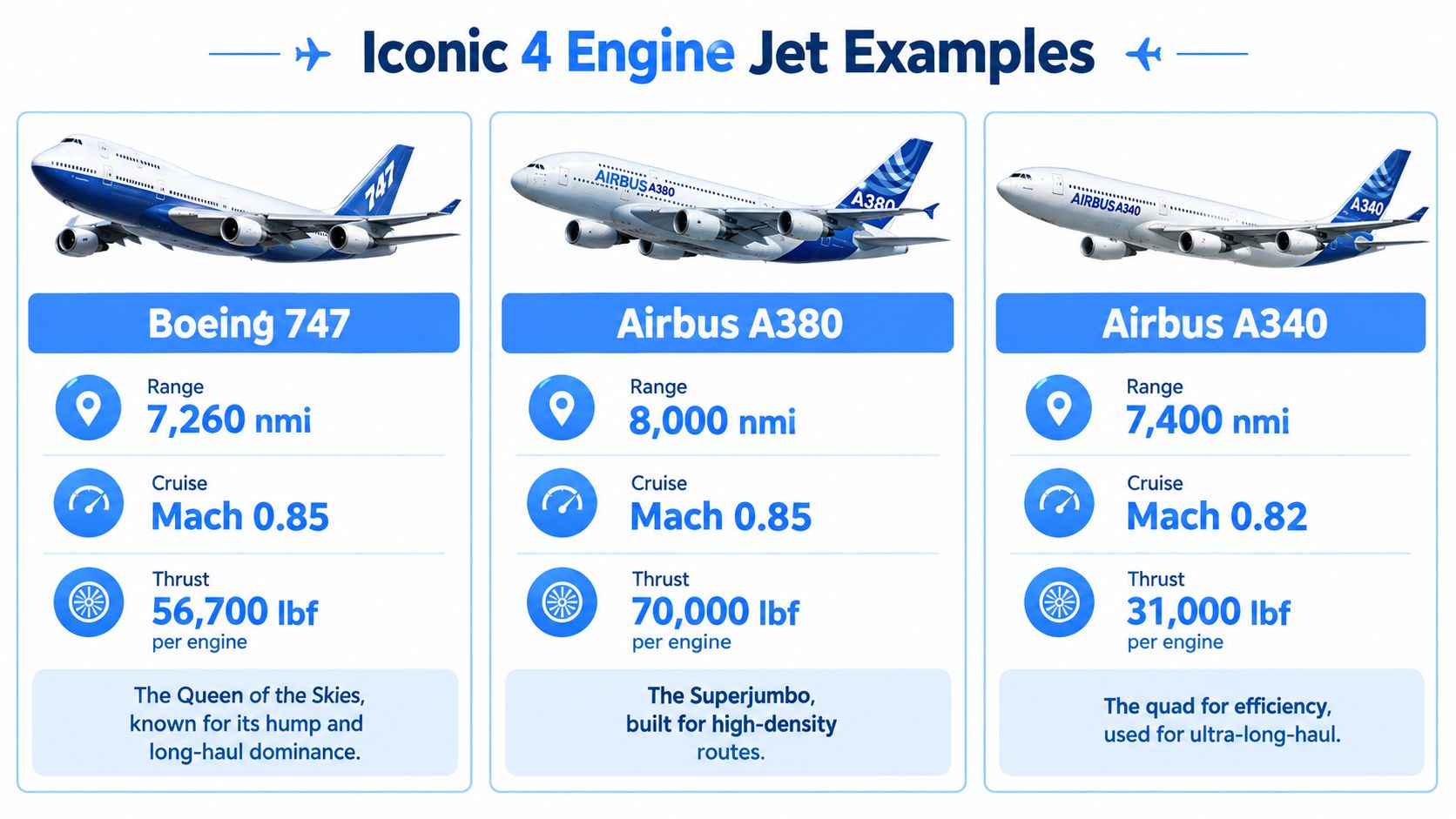
Aircraft become easier to understand when you attach the design logic to real names. Three quadjets do that job especially well: the Boeing 747, Airbus A380, and Airbus A340. Each represents a different version of “why four engines?”
Boeing 747 and the classic long-haul heavy lifter
The 747 is the aircraft many people picture when they hear “jumbo jet.” Its upper-deck hump became a symbol of global travel, but the deeper point is performance. The 747-400 combines about 253,200 lbf of total installed thrust, a range of about 7,285 nautical miles, and a cruise speed near 481 knots, making it a textbook long-haul quadjet built for payload-range work rather than short-sector efficiency.
That combination made the 747 valuable on transoceanic routes, trunk international services, and cargo missions where volume and weight mattered. It wasn't big. It was built to do big jobs.
Airbus A380 and the very high-capacity mission
The A380 answers a different question: what if the mission is moving huge numbers of passengers on dense long-haul routes? It's powered by either four Engine Alliance GP7000 engines or four Rolls-Royce Trent 900 engines, with certified thrust ratings in the roughly 70,000 to 81,500 lbf range depending on variant, according to this A380 technical attachment.
Its published maximum range is about 8,000 nautical miles, or 15,000 kilometers, with some variant datasheets listing a design-load range up to 15,700 kilometers, according to Airbus A380 facts and figures.
That tells you exactly what the A380 was built to do. It wasn't chasing minimal engine count. It was chasing long range plus extraordinary passenger-carrying ability.
Airbus A340 and the long-range specialist
The A340 often gets less public attention, but pilots and planners understand its niche. It used four engines to support serious long-range performance before long-range twins became the universal default.
The A340 family fits routes where range mattered and where operators valued the quadjet architecture enough to accept the fuel and maintenance trade. In private aviation discussions, travelers sometimes use large-cabin charter examples as a bridge for thinking about mission fit, and browsing a VIP jet charter for executives can help frame how aircraft choice changes when passenger count, baggage, privacy, and route length all interact. For another mission-fit comparison at the charter end of the market, this guide on chartering a Gulfstream G650 shows how very long range can also be achieved in a very different aircraft category.
The best-known quadjets weren't doing the same job. The 747 carried the long-haul widebody era, the A380 maximized capacity, and the A340 stretched range logic in a different way.
When a 4 Engine Jet Still Makes Sense Today
A quadjet still makes sense when the mission is unusual enough that the penalties are worth paying. That usually means the operator values payload, cabin volume, or mission-specific redundancy more than pure fuel efficiency.
For most scheduled airlines, that threshold is harder to justify than it used to be. For niche missions, it can still be rational.
Missions where four engines still fit
A 4 engine jet can still be a sensible choice in cases like these:
- Very large group transport: High passenger volume on routes where cabin capacity matters more than minimal operating cost.
- Heavy cargo work: Large freight missions where the aircraft's structure, volume, and lift capability are central.
- Specialized long-haul operations: Missions where route structure, payload needs, and operator preferences make quadjet performance useful.
- Prestige or unique cabin experience: Some operators and travelers value the cabin scale and identity of aircraft such as the 747 or A380 for reasons that go beyond spreadsheet efficiency.
A practical decision framework
If you're evaluating aircraft for charter, corporate movement, or group travel, ask these questions in order:
- How many people are traveling? Not “might travel.” Traveling.
- How much baggage or freight is involved? Payload drives aircraft choice quickly.
- How far is the nonstop mission? Long stage length changes the equation.
- Is airport access limited? Some aircraft are more practical than others depending on runway and handling constraints.
- What matters more, efficiency or capability margin? That answer narrows the field fast.
For readers looking at private or group air options rather than airline fleet planning, one practical route is to compare mission profiles with a broker that matches aircraft by range, luggage, and passenger count. Approved Jets arranges on-demand charter flights and group air transport through a vetted operator network, which makes it one example of a service built around mission matching rather than a fixed fleet.
The modern bottom line
ETOPS expansion removed a major historical advantage of four engines for many routes. That's why twinjets now dominate most long-haul flying. But “less common” doesn't mean “pointless.”
It means four engines have become a specialized answer instead of the default answer.
Key Takeaways on 4 Engine Jets and Next Steps
The simplest way to understand a 4 engine jet is to stop treating it as a museum piece. It's an aircraft layout built around specific priorities: moving heavy loads, covering long distances, and distributing thrust and redundancy across four engines.
That design once defined long-haul aviation. The Comet opened the jet age. The 747 became the most important commercial quadjet family. The A380 pushed capacity to the extreme. The A340 held onto the long-range logic of four engines even as the market changed.
What to remember when you spot one
- Four engines mean intent: The airplane was designed around demanding payload, range, or capacity goals.
- More capability can mean more cost: Extra engines bring extra maintenance and usually weaker fuel economics than top twinjets.
- Modern twins changed the market: Most routes no longer need four engines to be practical.
- Some missions still do: Large groups, heavy cargo, and special long-haul profiles can still justify the configuration.
Smart next questions
When you compare aircraft, ask about:
- Range with payload
- Passenger count versus cabin comfort
- Fuel and maintenance implications
- Whether the mission needs a quadjet
That last question is the most useful one. If the answer is yes, a four-engine aircraft can still be exactly the right tool. If the answer is no, a modern twinjet will usually do the job more efficiently.
A quadjet makes the most sense when the mission is hard enough that “good enough with two engines” isn't the real requirement.
The fun part is that once you know the logic, airports look different. You're no longer just seeing a big airplane. You're seeing an engineering decision in plain sight.
If you're weighing aircraft options for executive travel, large groups, cargo, or complex international routing, Approved Jets helps match the mission to the right aircraft type and operator profile. To compare practical charter solutions against the range, payload, and efficiency trade-offs discussed here, visit Approved Jets.