
Private Jet Charter Explained How It Works and Costs
Learn how private jet charter works, what it costs, aircraft types and when to choose charter over alternatives. Practical guide with data and examples.

Approved Jets

On this page
- Table of Contents
- Introduction to Private Jet Charter and Why It Matters Now
- Charter solves a time problem before it solves a comfort problem
- Access matters as much as speed
- How Private Jet Charter Actually Works
- Charter starts with the mission, not the airplane
- Who does what
- What happens after you request a trip
- Service Levels Safety Standards and What to Verify
- Part 135 is the line that matters
- Third-party audit labels are not all the same
- A practical verification checklist
- Aircraft Categories and Matching the Right Jet to Your Mission
- Why the same route can require different aircraft
- Private Jet Categories by Mission Profile
- Match the airplane to the business goal
- Booking Process From Quote to Wheels Up
- What to send with the first request
- What happens after you accept the quote
- Understanding Private Jet Charter Costs and What Drives Price
- What a charter quote is actually paying for
- Why prices move around so much
- What you can control
- When to Choose Charter Versus Alternatives
- Key Takeaways and Next Steps for Booking Your Charter
Your calendar says Chicago at 8 a.m., Nashville at noon, and South Florida by dinner. Your team needs to visit two sites, hold one confidential meeting, and be home the same night. Commercial service can often get you to one city. It usually can't make that whole day work without overnight stays, connection risk, and hours lost inside terminals.
That's where private jet charter starts to make sense. Not as a status purchase, but as a time and access tool. You're paying for control over departure time, the ability to use airports closer to where business happens, and a travel process built around your schedule instead of an airline's schedule.
That distinction matters more now because this isn't a tiny niche market. The global private jet charter services market was estimated at USD 17.67 billion in 2026 and is projected to reach USD 25.79 billion by 2031, with a 7.86% compound annual growth rate during 2026 to 2031 according to Mordor Intelligence's private jet charter services market analysis. The same analysis places the market at USD 16.38 billion in 2025, which shows the sector had already added roughly USD 1.29 billion before that 2026 benchmark.
A first-time executive traveler usually asks the same practical questions. How does charter work? Who's responsible for safety and legal compliance? Which aircraft fits the trip? What drives the quote? And when is charter smarter than first class, a jet card, or ownership?
Table of Contents
- Introduction to Private Jet Charter and Why It Matters Now
- How Private Jet Charter Actually Works
- Service Levels Safety Standards and What to Verify
- Aircraft Categories and Matching the Right Jet to Your Mission
- Booking Process From Quote to Wheels Up
- Understanding Private Jet Charter Costs and What Drives Price
- When to Choose Charter Versus Alternatives
- Key Takeaways and Next Steps for Booking Your Charter
Introduction to Private Jet Charter and Why It Matters Now
At 7:15 a.m., your team leaves for an airport on the edge of town. By 7:45, bags are loaded, the car is parked steps from the aircraft, and the wheels are up. You land closer to the plant than any airline serves, finish the visit, hold a confidential meeting in a second city, and get home that night. For some trips, private jet charter is less about comfort than about protecting the shape of the day.
Private jet charter works like hiring the right vehicle for a specific job. You are buying access to a flight plan built around your timing, your airports, and your group size. That matters when the mission includes tight arrival windows, multiple stops, or destinations where airline schedules force a hotel stay that the trip does not need.
Charter solves a time problem before it solves a comfort problem
First-time executive travelers often expect the main difference to be the cabin. The bigger difference is control. Charter lets you choose a departure time that fits the meeting, use airports closer to where business happens, and keep the same travelers together instead of splitting across airline options.
That changes the cost discussion.
A trip can look expensive next to airline tickets and still save money once you count executive hours, extra ground transfers, overnight stays, and the risk of losing a full afternoon to a missed connection or limited return schedule.
Practical rule: If the true cost of the trip is lost work time, missed meetings, and overnight disruption, charter belongs in the discussion.
Access matters as much as speed
Speed in private aviation is often misunderstood. The aircraft may be only modestly faster than a commercial flight on the same route. The larger advantage is total trip time, because charter can use a wider network of private terminals and smaller airports.
One useful reference point comes from this guide to private jet arrival timing and FBO access, which explains how private flyers use FBOs instead of the main airline terminal. That setup can shorten check-in and curb-to-cabin time, and it often puts you closer to secondary airports that airlines do not serve well.
That is why charter tends to make the most sense for factory visits, resort access, energy sites, secondary cities, and dense same-day schedules. The airplane is only part of the value. The airport choice, arrival window, and reduced terminal friction often matter just as much.
A broader industry trend supports that shift. Analysts at The Business Research Company's private jet charter services report describe a market supported by an established global business-aviation fleet and steady flight activity. In plain terms, charter is no longer a fringe option for celebrities or owners. It is a working travel tool for companies and families whose trips do not fit the airline grid.
One final point is easy to miss. Charter is rarely a yes-or-no luxury decision. It is an aircraft-to-mission matching decision. The right question is not, “Should I fly private?” The better question is, “Does this specific trip justify paying for time, access, and control?”
How Private Jet Charter Actually Works
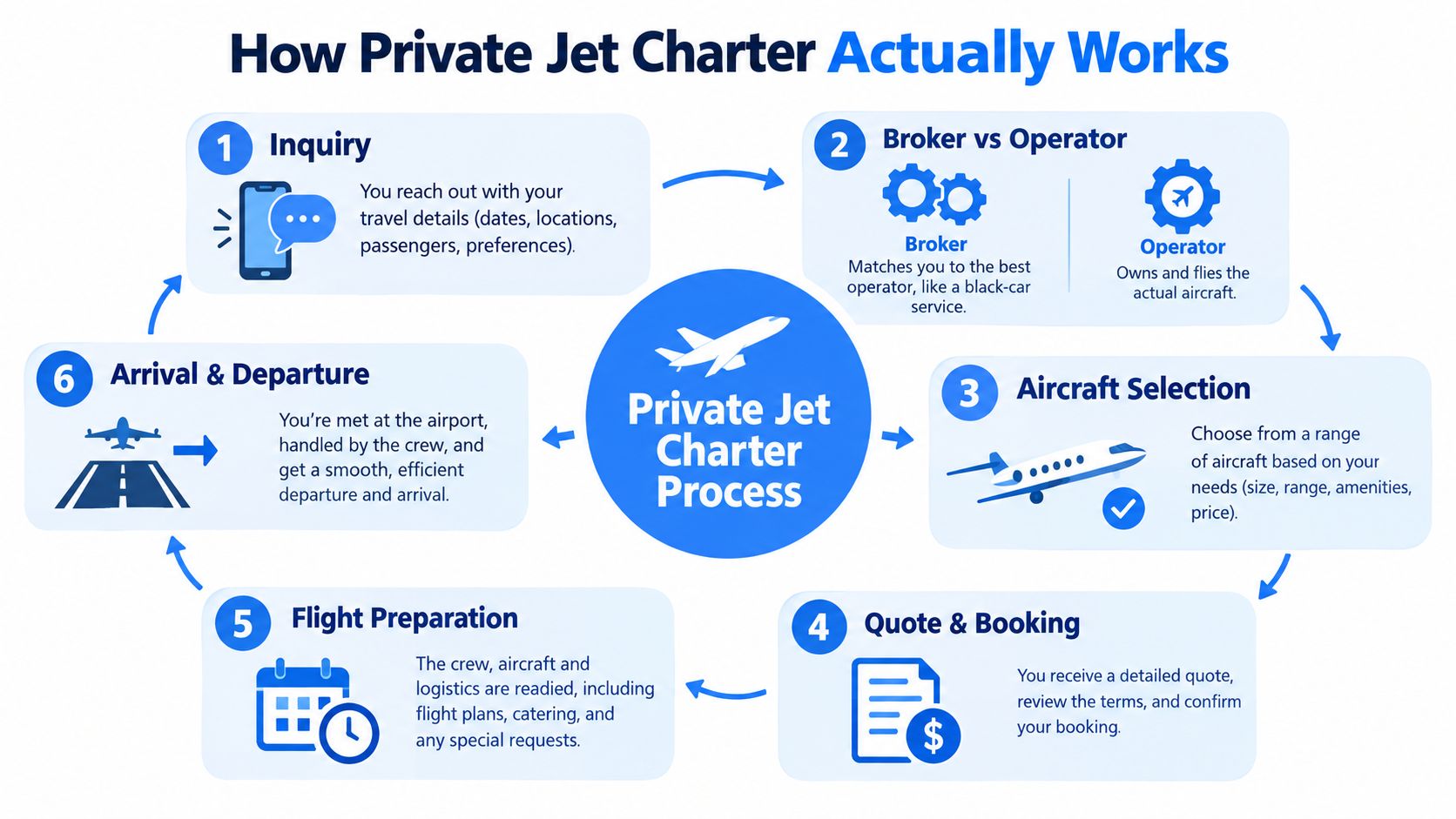
Private jet charter works like booking a car service built around your schedule, except the planning is far more precise because the aircraft, crew, airport access, and timing all have to fit the trip.
Charter starts with the mission, not the airplane
A first-time flyer often starts by asking for a midsize jet or a super-midsize jet. In practice, the process works in the opposite direction. You describe the trip first, then the market narrows to aircraft that can do that job well.
That mission profile usually includes departure and arrival points, preferred time windows, passenger count, luggage, and any details that affect the cabin or the airports. A same-day investor roadshow has different needs than a family ski trip. So does a factory visit into a secondary airport with a short runway.
That is why charter is often a time and access decision before it is a comfort decision. The right aircraft is the one that can use the airport pair that saves the most ground time, depart within the window that protects your schedule, and carry the actual payload without performance compromises.
Who does what
The roles can be confusing at first because several parties may touch one trip.
- Broker: Sources options, compares aircraft and operators, and coordinates the booking.
- Operator: Runs the aircraft, provides the crew, and conducts the flight.
- Passenger or travel manager: Gives the trip details clearly so the aircraft match is accurate.
- FBO staff and ground partners: Handle arrival, baggage, and curb-to-cabin logistics.
A good advisor does more than send photos and hourly rates. They check whether the aircraft can fly the route efficiently, whether the baggage will fit, whether the destination airport has any operating limits, and whether a different airport nearby would save an hour on the ground.
What happens after you request a trip
Once the mission is clear, the broker or charter desk checks live availability from operators and filters out aircraft that do not fit the assignment cleanly. First-time travelers are often surprised. Two jets in the same category can perform very differently once you add passengers, bags, runway length, weather, or a late-day departure slot.
You then receive options with aircraft details, schedule, and pricing. After you choose one, the rest of the process moves into confirmation. Passenger names are collected, catering and ground transportation are arranged, and any customs details are handled if the trip crosses borders.
Most of that work stays behind the scenes.
From the traveler's point of view, the day of departure feels simple. You arrive at the FBO, meet the staff, walk a short distance to the aircraft, and board. But that easy experience depends on careful aircraft-to-mission matching done well in advance.
Service Levels Safety Standards and What to Verify
The first safety question isn't “Is the company reputable?” It's “Is this specific operation legal for charter, and is this specific aircraft authorized for it?”
Part 135 is the line that matters
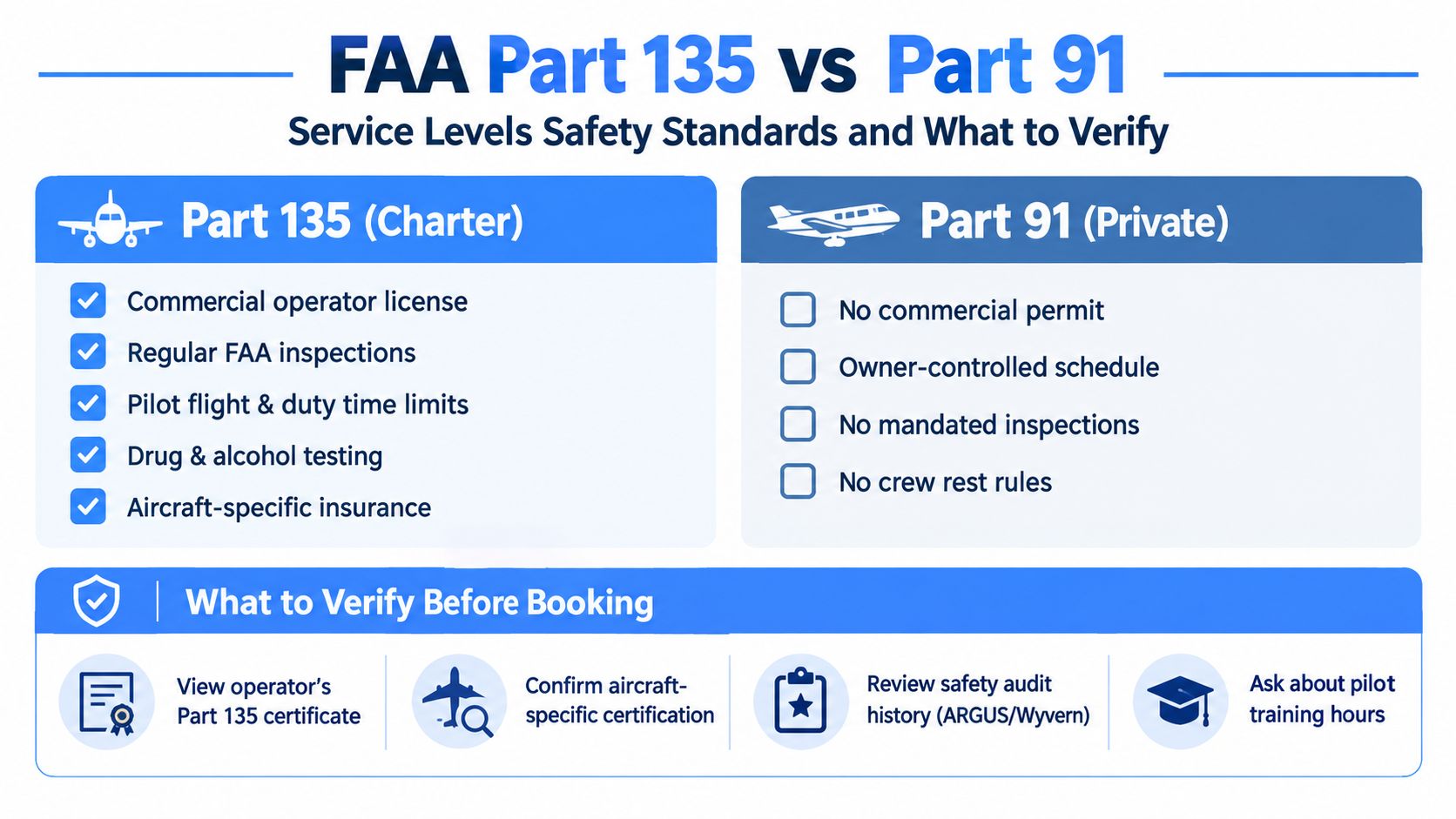
In the U.S., legal on-demand charter must be conducted under FAA Part 135, which separates charter and air-taxi flying from personal private flying under Part 91, as outlined by the FAA's list of legal Part 135 holders. The practical point for a buyer is easy to miss. Authorization is aircraft-specific, not just company-specific.
That means an operator may hold a charter certificate, but you still need to know whether the actual aircraft assigned to your trip is certificated for charter under that framework. For a first-time flyer, this is one of the most important questions to ask.
Third-party audit labels are not all the same
Many operators describe themselves as “audited.” That word alone doesn't tell you much.
Independent guidance summarized in this explanation of private jet safety standards and audit programs notes that ARGUS Platinum requires an operator to already hold Gold, then pass a two-day on-site audit and demonstrate a mature, actively used Safety Management System. Wyvern Wingman also requires a two-day on-site audit of training records, maintenance procedures, and crew qualifications. The same guide explains that Wyvern PASS is different. It is a 150-plus-point inspection focused on the specific aircraft and crew for one flight, not the operator's annual standing.
That distinction helps you ask sharper questions instead of relying on marketing language.
Ask this directly: Is the flight operating under Part 135, what is the operator's current audit status, when was the audit completed, and has the assigned tail number been checked for this trip?
A practical verification checklist
Before approving a charter, confirm these items:
- Operator identity: Get the legal name of the operator, not just the brand handling the booking.
- Part 135 status: Verify that the trip is being conducted as legal charter.
- Aircraft-specific eligibility: Confirm the exact aircraft is authorized for charter use.
- Audit tier and date: Ask whether the operator holds ARGUS Platinum, Wyvern Wingman, or another credential, and when it was last reviewed.
- Trip-specific review: For higher-scrutiny travel, ask whether the actual crew and aircraft have been checked for that flight.
- Service details: Make sure promises about catering, cabin setup, and special handling are written into the trip record. If you want to understand how inflight meal planning fits into charter operations, this overview of catering on private jets is a useful companion.
Aircraft Categories and Matching the Right Jet to Your Mission
First-time charter clients often start by asking for a “nice midsize jet” or a “large-cabin aircraft.” That's understandable, but it's the wrong starting point. The right question is what the mission demands.
Why the same route can require different aircraft
Two trips between the same city pair can call for different jets. Add more passengers, hard-shell luggage, a short runway, high field elevation, or poor weather margins, and the aircraft shortlist changes quickly.
Published runway length, surface condition, and field elevation directly affect whether a given aircraft can safely operate with the required payload and fuel, according to the FAA airport data and performance reference system. That's why a charter advisor looks at the airport pair, not just the mileage.
Private Jet Categories by Mission Profile
| Aircraft Category | Best For | Runway and Range Consideration |
|---|---|---|
| Light jet | Short regional business trips, small teams, quick out-and-back days | Often well suited to shorter sectors and smaller airport access, but mission limits can tighten with luggage, weather, or shorter runways |
| Midsize jet | Executive trips that need more comfort, baggage room, and operational flexibility | Often a balanced choice for regional and longer domestic flying, though airport constraints still matter |
| Super midsize jet | Longer domestic missions, coast-to-coast style business travel, larger executive groups | Brings more range and cabin performance, but may not fit every shorter-field mission |
| Heavy jet | Long-range travel, international trips, larger parties, premium cabin needs | Usually needs more runway and can be limited at smaller general aviation airports |
| Airliner or VIP airliner | Sports teams, tours, corporate shuttles, large group moves | Best for group lift where passenger count outweighs small-airport flexibility |
A traveler comparing cabin classes can get a better sense of the middle of the market in this guide to midsize private jets.
Match the airplane to the business goal
A short-hop regional meeting may only need a light jet if the passenger count is low and the airport is straightforward. A transcontinental executive trip may justify a super midsize or heavy jet because nonstop capability, workspace, and passenger comfort affect productivity. A team movement to a tournament or event may point directly to a heavy jet or airliner because moving the group together matters more than using the smallest possible aircraft.
Experienced charter planning earns its keep. The “cheapest suitable option” and the “least expensive quote” are not always the same thing. The better mission fit often avoids fuel stops, baggage problems, airport substitutions, or payload compromises that create delays later.
Booking Process From Quote to Wheels Up
Once you know the mission and the likely aircraft class, the booking flow becomes much easier to manage. The key is giving complete information early so the quote reflects the trip.
What to send with the first request
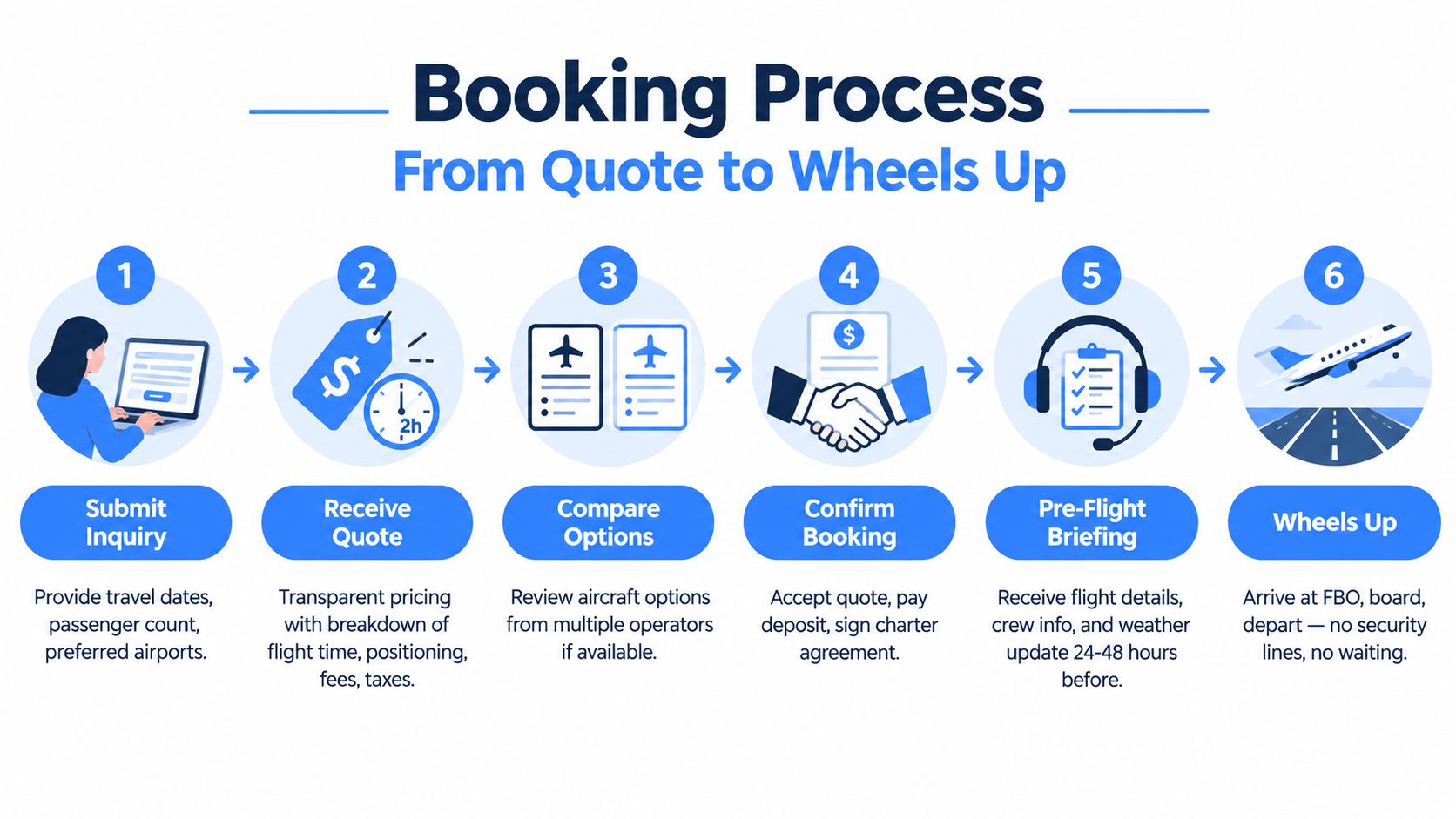
A useful charter inquiry should include:
- Travel dates and flexibility: Exact timing matters, but so does whether you can shift by an hour or a day.
- Passenger count: Not just seat count. Include infants, staff, security, or support personnel.
- Airport preferences: Name your preferred departure and arrival airports, plus any acceptable alternates.
- Luggage reality: Golf clubs, skis, sample cases, musical instruments, and pet crates all change the aircraft match.
- Special handling: Catering, Wi-Fi expectations, customs support, ground transfers, and accessibility needs should be clear from the start.
Some charter providers, including Approved Jets, state a two-hour quote turnaround target and can coordinate flights with approximately 2 to 4 hours of mobilization when the mission and aircraft availability allow. That's useful for urgent travel, but it works best when the passenger information is complete.
A short explainer can also help first-time flyers understand the booking rhythm before they request options:
What happens after you accept the quote
After aircraft selection, you'll review the charter agreement, submit passenger details, and finalize add-ons. If the trip is international, document review matters more than many travelers expect. The aircraft can be ready, but the paperwork still has to work.
For day-of timing, many operators and NBAA-aligned guides say passengers on a domestic U.S. private flight should arrive at the FBO 15 to 30 minutes before departure, while international private flights typically require 30 to 60 minutes because passports, customs paperwork, and related formalities add processing time, as explained in this private flight arrival timing guide.
Domestic private charter compresses airport time sharply. International private charter still saves time, but document-heavy travel needs a wider pre-departure buffer.
If you're flexible on timing, one area worth learning about is empty leg private jet charter flights. They won't fit every mission, but they can be useful when your route and schedule align with an aircraft's repositioning need.
Understanding Private Jet Charter Costs and What Drives Price
A charter quote is really a mission quote. You are not buying a seat. You are arranging for a specific aircraft, crew, airport pairing, and schedule to work together for your trip.
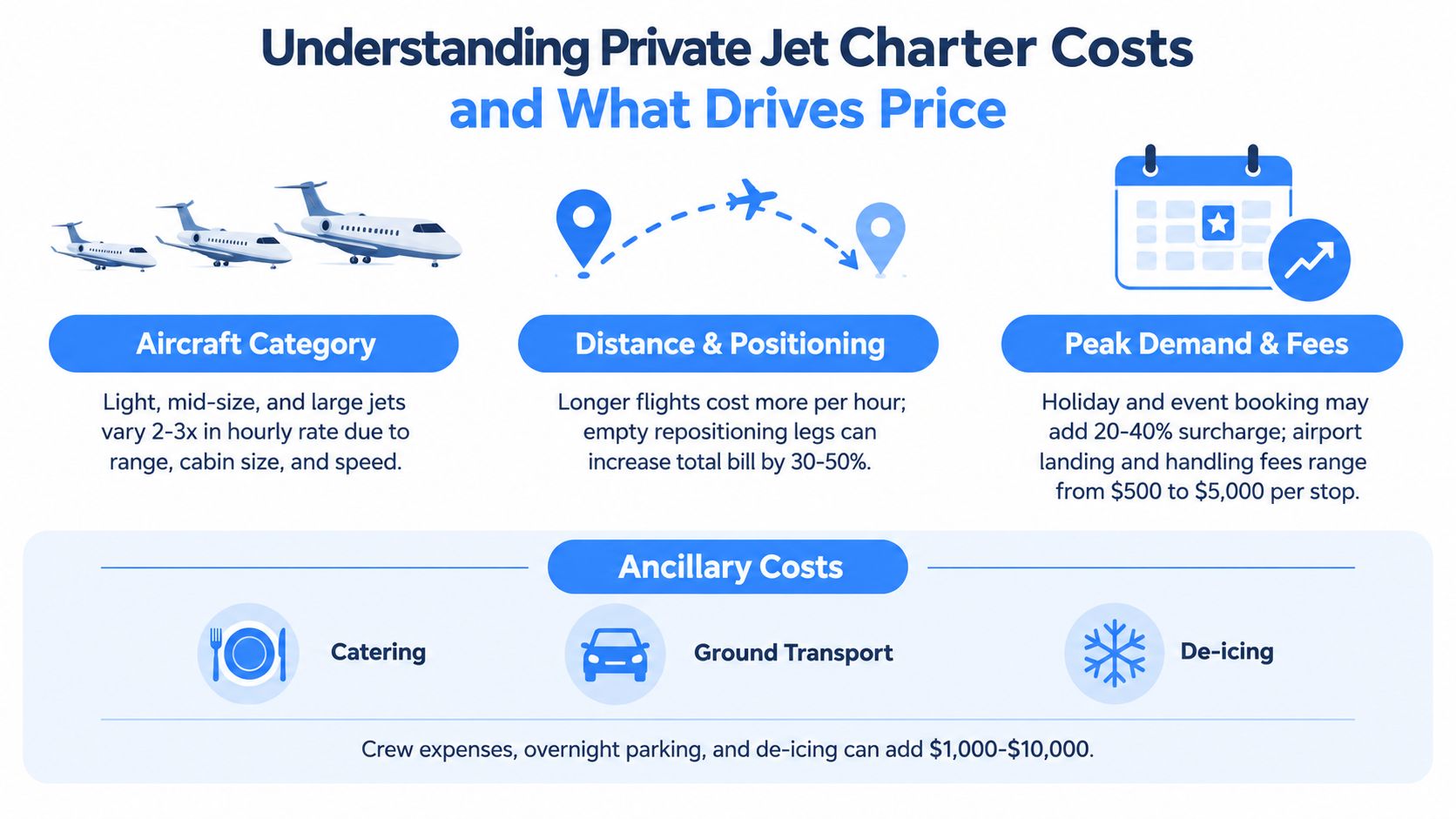
That distinction matters because private charter is often a time and access decision before it is a luxury decision. If one aircraft can use the closer airport, arrive inside your meeting window, and avoid an overnight stay for four executives, the higher flight quote can still be the lower total trip cost.
What a charter quote is actually paying for
Hourly rate is only one input. The price is shaped by how hard the trip is on the aircraft schedule and how closely the aircraft fits the mission.
A short example helps. A light jet may look cheaper on paper for a regional meeting, but that changes if your team has six passengers, full-size luggage, and a late-day return. You may need a larger cabin, more baggage space, or a jet that can make the route without a fuel stop. The aircraft that looked less expensive at first can become the costlier choice once delays, repositioning, or a second leg are added.
The quote usually changes based on a few operational factors:
- Aircraft category: Larger cabins, longer range, and stronger runway performance usually raise operating cost.
- Trip pattern: One-way trips often cost more per flown hour if the aircraft must reposition without passengers.
- Airport pairing: The closest airport is not always the lowest-cost airport, but it may still be the best value if it cuts ground travel and protects your schedule.
- Departure window: Flexibility gives the broker or operator more aircraft to source and can reduce repositioning expense.
- Seasonal and weather factors: Peak travel days, de-icing, and crew overnight requirements can all affect the final number.
- Special requests: Catering, Wi-Fi needs, pet travel, ground transport, and other extras add cost in small or sometimes meaningful ways.
This is why two quotes for the same city pair can differ. One may include a better-suited airport, a newer aircraft, a stronger baggage margin, or a schedule that keeps your arrival window intact.
Why prices move around so much
Private charter does not price like a published airline fare. Aircraft have to be available in the right place, at the right time, under the right operating conditions. If the nearest suitable jet is already based close to your departure airport, the quote can look efficient. If the aircraft has to fly in empty first, the price usually rises.
Supply also shifts by day and route. Analysts at Grand View Research describe private jet charter as a large global market with continuing demand across business and personal travel, which helps explain why pricing remains active rather than fixed across all routes and aircraft types. Market size creates options, but it does not make aircraft interchangeable.
That is where access changes the math. A wider FBO network can shorten your drive, reduce schedule padding, and open airport choices that commercial service does not offer. For an executive team, those saved hours have a real cost value even if they do not appear as a line item on the quote.
What you can control
You usually have more influence over price than first-time charter clients expect.
| Decision area | Why it changes the quote |
|---|---|
| One-way vs. round-trip structure | Keeping the aircraft with you can be more efficient than sending it away and bringing another one back |
| Primary vs. secondary airport | A smaller airport may cut handling time, ground transfer time, or congestion |
| Firm schedule vs. flexible window | Even a modest time window can expand sourcing choices |
| Honest luggage count | Accurate baggage details prevent last-minute aircraft swaps |
| Passenger count and mission detail | Clear requirements help match the right jet the first time |
| Extras chosen early | Catering, transfers, and onboard requests are easier to price cleanly in advance |
One practical rule helps. Ask which option delivers the best total trip outcome, not just the lowest flight figure. That keeps the conversation focused on time saved, airport access, and aircraft fit.
If you want a plain-English companion on pricing logic before requesting quotes, the EC Minibus private jet cost guide is a helpful outside resource because it explains cost around trip variables rather than a single headline rate.
When to Choose Charter Versus Alternatives
Charter wins when flexibility and airport access matter more than fare visibility. It's often the smart choice for occasional executive trips, urgent multi-stop schedules, confidential travel, and airport pairs that commercial airlines don't serve well.
Commercial first class works when the route is nonstop, the airline schedule fits, and privacy isn't important. Jet cards can make sense for travelers who want a more standardized buying process and expect recurring use. Fractional ownership fits flyers with frequent, predictable patterns who want access without full ownership burden. Full ownership is a different decision entirely. It adds management, crew, maintenance, and utilization pressure.
A simple decision matrix helps:
- Occasional executive travel: Charter is often the cleanest fit.
- Frequent but varied travel: Charter or a jet card may make more sense than ownership.
- Large group movement: Heavy jets or airliners under charter are often the right tool.
- Urgent medical or sensitive cargo missions: Dedicated charter is usually the operational answer.
The access advantage remains important. Private aviation can tap over 5,000 FBOs across the U.S., compared with roughly 500 commercial airports, as cited earlier in the article. That's often the deciding factor when the destination isn't close to a major airline hub.
Key Takeaways and Next Steps for Booking Your Charter
Private jet charter is easiest to evaluate when you treat it as a mission-planning decision. The right aircraft depends on the route, airports, passenger count, luggage, timing, and the level of privacy or flexibility you need.
For a first charter, keep your checklist short and disciplined:
- Define the mission clearly: Include real passenger count, luggage, airport preferences, and schedule limits.
- Verify legal charter status: Make sure the trip is operating under Part 135 and that the actual aircraft is approved for charter.
- Check safety oversight: Ask about audit tier, audit date, and whether the assigned aircraft and crew have been reviewed for your trip.
- Confirm ground timing: Know which FBO you're using and whether the trip is domestic or international.
- Read the quote as an itinerary, not just a price: Airport choice, baggage fit, repositioning, and trip extras all matter.
If the trip is complex, multi-stop, international, or highly time-sensitive, involve a charter advisor early. The smoother the planning on the front end, the more private aviation delivers what you're buying. Control, access, and time back in your day.
Approved Jets arranges on-demand private jet charter through a vetted operator network and coordinates the details that usually make first-time bookings feel complicated, including aircraft sourcing, logistics, and mission-specific planning. If you want help matching the right aircraft to your schedule, airports, and passenger needs, visit Approved Jets.