
Phenom 300 Range Explained for Charter Buyers
Discover what the Phenom 300 range really means, what affects it, and how to plan nonstop charter missions with confidence using real-world data and examples.

Approved Jets

On this page
- Table of Contents
- The Question Most Charter Clients Actually Ask
- The real client question is narrower than the brochure
- What the Published Phenom 300 Range Means
- NBAA IFR reserves are already included
- How Passengers and Bags Reshape the Range Curve
- Payload changes the mission faster than most buyers expect
- Weather Winds and Reserves in Real Flight Planning
- Four things that move the number
- Popular Routes the Phenom 300 Can and Cannot Fly Nonstop
- Easy wins, borderline missions, and hard no's
- Flight Planning Tips Before You Book the Charter
- Run this checklist before you sign
- When a Phenom 300 Is the Right Jet for the Mission
- Where it fits, and where it doesn't
- Phenom 300 Range Questions Charter Buyers Ask Most
- Common buyer questions, answered plainly
Embraer publishes 2,010 nautical miles for the Phenom 300E with five occupants and NBAA IFR reserves. In real charter planning, the Phenom 300 range lives closer to 1,811 to 2,077 nautical miles, depending on passengers, bags, reserves, and winds.
Table of Contents
- The Question Most Charter Clients Actually Ask
- What the Published Phenom 300 Range Means
- How Passengers and Bags Reshape the Range Curve
- Weather Winds and Reserves in Real Flight Planning
- Popular Routes the Phenom 300 Can and Cannot Fly Nonstop
- Flight Planning Tips Before You Book the Charter
- When a Phenom 300 Is the Right Jet for the Mission
- Phenom 300 Range Questions Charter Buyers Ask Most
The Question Most Charter Clients Actually Ask
A client calls about a winter trip from Teterboro to Aspen, or a family vacation from New York toward the Caribbean, and the first thing they hear is that the Phenom 300 can “do 2,010 nautical miles.” That sounds simple. It isn't.
The brochure number is the promise. The actual question is whether the jet can make your trip nonstop, with your people, your bags, and the reserve fuel the operator has to protect. That's why a good charter broker doesn't stop at the headline number, they translate it into a mission plan, and they should be able to show you the difference in plain language, not marketing copy. For a clean overview of how charter quoting gets framed, see the broader charter context at Approved Jets private jet charter.
The real client question is narrower than the brochure
Most buyers aren't asking whether the Phenom 300 is a good jet. They're asking whether it can fly their route nonstop without forcing a fuel stop. That's the right question, because the answer changes once the cabin fills up, the bags get heavier, or winter winds show up along the route.
Practical rule: if a mission sits close to the edge of the published range, treat it as a planning exercise, not a yes/no answer.
The Phenom 300 range discussion gets muddled when people treat one figure as universal. A family of four with light bags can get a very different result from a six-person business trip with hard cases and winter alternates. That's not a flaw in the aircraft, it's the nature of light-jet performance.
The rest of the math is simple: more payload means less range, reserves are required, and weather can erase a comfortable margin fast. If the route is important, you want the operator to quote the mission you're flying, not the brochure mission the aircraft can fly on paper.
What the Published Phenom 300 Range Means
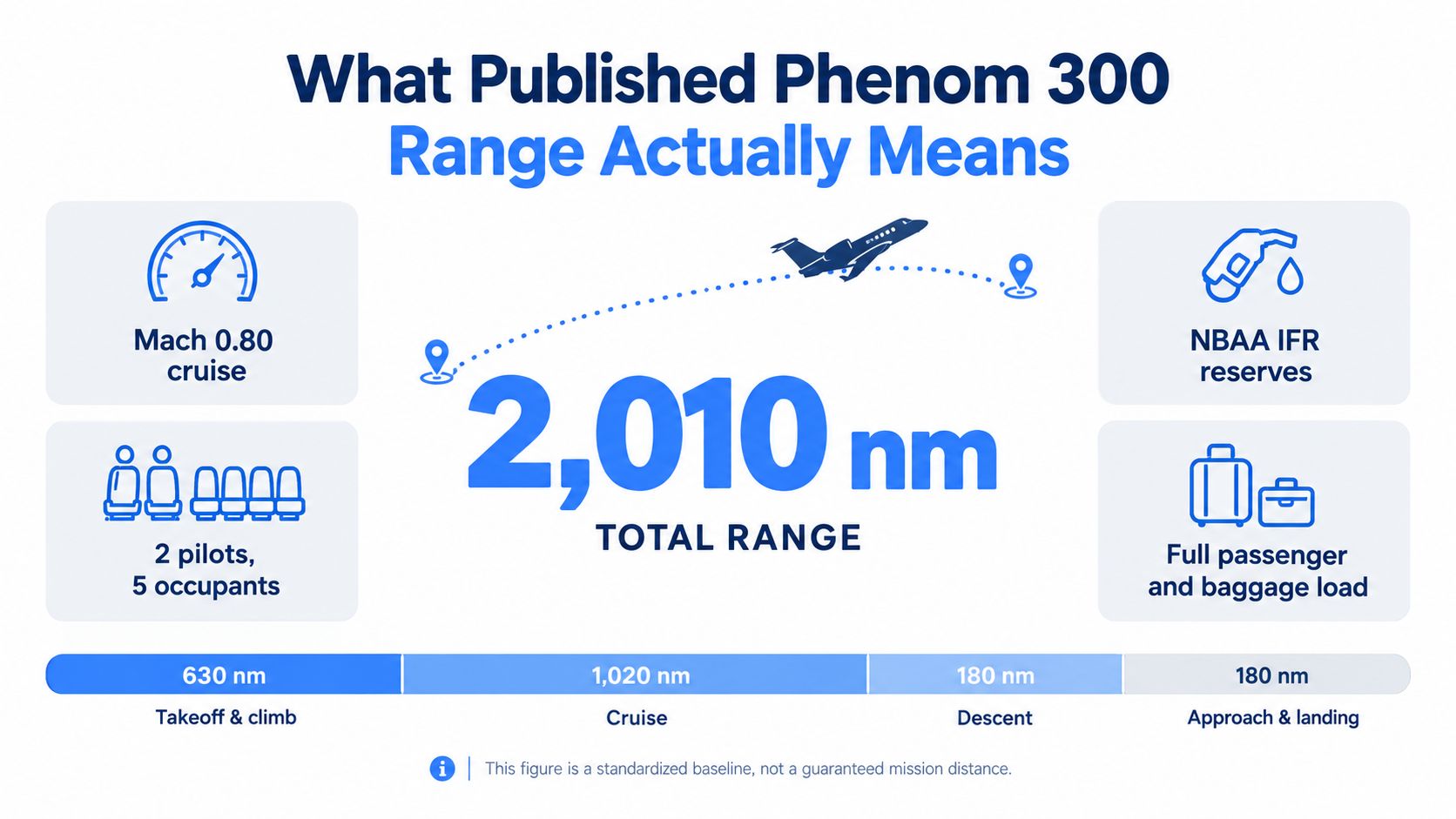
The 2,010 nautical mile figure for the Phenom 300E is a standardized benchmark, not a guarantee for every nonstop itinerary. Embraer ties that figure to five occupants, NBAA IFR reserves, and the updated 300E platform's Mach 0.80 capability. Published specifications also list about 3,723 km, or 2,010 nmi, with IFR reserves for five occupants (Embraer Phenom 300 reference).
NBAA IFR reserves are already included
NBAA IFR reserves protect the flight plan by covering fuel to reach an alternate airport and hold for a set period. The published range therefore assumes the aircraft will land with the required reserve, not at empty tanks.
Use the number for aircraft comparison, not as a booking promise. A distant alternate, stronger headwinds, or an extended hold reduces the fuel available for the route. If the itinerary sits near the published limit, the operator must calculate the specific payload, weather, alternates, and reserve requirement.
The original Phenom 300 has a lower published figure. Independent specifications place the legacy aircraft around 1,971 nautical miles with 6 occupants under NBAA IFR reserves (FlyRadius specifications). Buyer guidance presents the model's range across a wider operating band because payload assumptions vary (AvBuyer buyer guide). The 300E's improvement reflects platform refinements, not a larger fuel tank.
Bottom line: treat published range as the upper end of a defined operating case. For a real charter, approve the route only after the operator confirms passengers, bags, reserves, alternates, and forecast winds.
How Passengers and Bags Reshape the Range Curve
A Phenom 300's range is a payload tradeoff, not a fixed headline figure. Two passengers with minimal bags can move the aircraft toward its upper range case. A full cabin and heavier luggage consume fuel capacity, leaving less distance available. For phenom 300 range, the passenger list and baggage plan belong in the first booking conversation.
Payload changes the mission faster than most buyers expect
A buyer guide lists 2,077 nautical miles with four passengers and 1,811 nautical miles with full payload (GlobalAir buyer guidance). A separate specification sheet gives the original aircraft 1,971 nautical miles with 6 occupants and NBAA IFR reserves (Hal specs PDF). These figures describe different loading cases, so comparing them as one promise produces the wrong booking decision.
| Phenom 300E Payload vs. Range | ||
|---|---|---|
| Passengers | Baggage | Approx. Range (nm) |
| 2 | Minimal bags | 2,077 |
| 4 | Standard luggage | 1,971 |
| 6 to 7 | Full baggage | 1,811 |
A 1,800 nautical mile mission has useful margin with three passengers and light bags. With six passengers, the same route becomes tight. The aircraft has a fixed weight ceiling, and passengers, luggage, and fuel compete within it. An operating reference also cites a maximum payload near 2,216 lb, alongside takeoff and landing performance figures that reinforce the jet's practical limits (Pilot report summary).
Ask the broker to run your actual passenger and baggage manifest. That calculation shows whether the nonstop remains workable, whether a fuel stop should be planned, or whether a larger jet fits the mission better. If payload pushes a light jet beyond its useful range curve, review this Pilatus PC-12 charter guide as a lighter single-engine comparison before choosing a different cabin class.
Weather Winds and Reserves in Real Flight Planning
Brochure range collapses fast when weather gets involved. A Phenom 300 that looks comfortable on paper can turn marginal once headwinds, hotter-than-standard air, or alternate requirements enter the plan. That's why charter brokers ask about the destination forecast before they quote a nonstop.
Four things that move the number
Headwinds are the biggest visible hit on long eastbound trips. Strong winter air can force the aircraft to spend more time in the air, which means more fuel burned to cover the same distance. On the other side, tailwinds can stretch the usable range and make a route that looked borderline suddenly workable.
A mission is only as clean as the reserve plan behind it.
Published range also assumes favorable atmospheric conditions. When temperatures sit above standard day assumptions, climb and cruise efficiency suffer. Add a coastal alternate, or a destination with poor weather, and the fuel margin shrinks again because the aircraft has to protect the reserve rather than spend it on direct distance.
FBO fuel availability matters too. If the destination or alternate has awkward fuel logistics, a broker may choose a stop that makes the whole mission cleaner, even if the aircraft could technically go farther. That's the difference between theoretical nonstop capability and a trip that's dispatchable on the day you fly.
| How Range-Shifting Variables Affect Phenom 300 Missions | ||
|---|---|---|
| Variable | Typical Impact on Range | Charter Implication |
| Headwinds | Reduces usable distance | Eastbound legs often need a stop |
| Hotter air | Cuts efficiency | Summer departures can tighten margins |
| Reserve policy | Reduces fuel available for cruise | The quote may be shorter than the brochure figure |
| Required alternates | Consumes range margin | Coastal and winter missions need more caution |
For context on how international routing gets more complicated than domestic flying, the broader private jet international travel guidance is a useful companion. The short version is this, range is never just range. It's range plus weather, alternates, and fuel policy.
Popular Routes the Phenom 300 Can and Cannot Fly Nonstop
The Phenom 300 is a very strong North American and near-international tool, but it's not a universal nonstop machine. If you want a clean verdict, compare the route distance against the realistic envelope, then subtract the extra drag from weather and payload.
Easy wins, borderline missions, and hard no's
New York to Miami at 1,090 nautical miles, Los Angeles to Cabo at 1,250 nautical miles, and Chicago to Phoenix at 1,440 nautical miles are all straightforward examples of where the jet makes sense. Those are the kinds of city pairs where the aircraft's speed and cabin size matter more than stretching the range chart.
New York to San Juan at 1,600 nautical miles is different. It can work with light payload and a disciplined fuel plan, but it's not the kind of trip I'd green-light casually if the cabin is full or the weather looks ugly. A broker who promises that route without asking about bags is selling optimism, not aircraft performance.
| Phenom 300 Nonstop Feasibility by City Pair | |||
|---|---|---|---|
| City Pair | Distance (nm) | Nonstop Status | Notes |
| New York to Miami | 1,090 | Yes | Comfortable nonstop mission |
| Los Angeles to Cabo | 1,250 | Yes | Strong fit for the jet |
| Chicago to Phoenix | 1,440 | Yes | Efficient light-jet use case |
| New York to San Juan | 1,600 | Maybe | Better with light payload |
| Seattle to New York | 2,400 | No | Needs a stop, often mid-continent |
| Los Angeles to Honolulu | 2,556 | No | Not a Phenom 300 mission |
| London to Dubai | Varies by routing | No | Requires a different aircraft class |
The long-haul examples are where buyers usually overreach. Seattle to New York at 2,400 nautical miles and Los Angeles to Honolulu at 2,556 nautical miles are beyond the aircraft's practical envelope, and London to Dubai belongs in a different category altogether. If a mission like that matters, the right move is to plan a fuel stop instead of trying to force a light jet into a heavy-jet job.
Practical rule: if your route sits above the aircraft's realistic range band, stop shopping the brochure and start shopping the mission.
Flight Planning Tips Before You Book the Charter
A smart charter buyer doesn't ask, “Can the Phenom 300 do it?” A smarter buyer asks for the exact assumptions behind the quote. That means passenger count, bags, reserves, alternates, and the specific tail number on offer.
Run this checklist before you sign
- Confirm payload early: Ask for the aircraft's range against your actual passenger count and total baggage weight, not a generic fleet figure.
- Demand the reserve policy: Make sure the operator states the fuel reserve basis in writing, because that changes the usable range.
- Check alternates and airports: Request the filed route with alternates, especially if you're flying into a coastal or winter-weather airport.
- Verify runway and elevation: Some missions look easy on distance alone but get squeezed by airport performance limits.
- Match the aircraft to the itinerary: Ask whether the jet is positioned for nonstop, or whether a stop would produce a cleaner and safer plan.
The ideal quote is tail-number specific, because serial numbers, maintenance status, and installed configuration can all affect what the aircraft can do on the day. That's also where a broker should tell you whether the mission needs a different type of cabin, not just a different price point. If you're comparing private travel options and want a practical lifestyle lens, RedSim for digital nomads is a helpful resource for trip-planning context outside aviation.
When a Phenom 300 Is the Right Jet for the Mission
The Phenom 300 is the right answer when the mission sits inside roughly 1,800 nautical miles with five passengers or fewer, when you need light-jet airport access, or when you're trying to beat a commercial itinerary without paying for a midsize cabin you don't need. The aircraft is also a strong choice for same-day round trips in the 600 to 900 nautical mile band, because it gives you speed without overbuying range.
Where it fits, and where it doesn't
It fits cleanly on dense domestic routes, regional business travel, and short leisure missions where cabin efficiency matters more than long-range bragging rights. It's the wrong jet for transcontinental U.S. trips with full payload, Hawaii, or any mission that depends on generous winds and perfect reserve conditions to work on paper.
If you're evaluating a romantic or two-person trip specifically, the same logic applies, just with less payload pressure. For a broader lifestyle angle on private air travel for couples, private air charter for couples is a useful comparison point, but the mission math here stays the same, keep the cabin light and the route realistic.
The best decision rule is simple: if the route is inside the range band with your actual bags, the Phenom 300 is a smart charter. If the trip needs optimism, it isn't the right aircraft.
Phenom 300 Range Questions Charter Buyers Ask Most
Common buyer questions, answered plainly
The published gap is modest: the 300E is rated at 2,010 nautical miles with five occupants and NBAA IFR reserves, while the original Phenom 300 is listed at about 1,971 nautical miles with six occupants and NBAA IFR reserves (Embraer reference, FlyRadius specifications). That difference can help on a marginal route, but it does not turn the Phenom 300 into a long-range aircraft. Payload, wind, reserves, and alternate requirements still control the decision.
| Phenom 300 Range Questions Buyers Ask | Short Answer | Planning Implication |
|---|---|---|
| How much farther does the 300E go? | Somewhat farther, not dramatically farther | It helps at the margin, not on long-haul routes |
| Does range change by serial number or service bulletin? | Configuration and aircraft condition can affect performance | Request the exact tail number, not a fleet average |
| What happens above Flight Level 450? | Do not build the itinerary around that profile | Ask for a normal cruise plan |
| Why do charters quote different block times? | Routes, winds, alternates, and reserves differ | Compare assumptions, not just price |
| Can it fly New York to Bermuda or Aspen in winter? | Sometimes, depending on payload and weather | Require a route-specific calculation |
| What is ferry range with no payload? | It represents the upper end of the envelope | It does not describe a passenger mission |
A broker quoting different block times may still be planning responsibly. A coastal route with a winter alternate can require more fuel than the same route in calm summer conditions. Ask the broker to state the planned routing, wind assumptions, reserve policy, and alternate in plain language.
For a borderline itinerary, request a tail-number-specific performance calculation before paying a deposit. The calculation should show passenger and baggage load, expected winds, fuel reserves, alternate airport, and whether the aircraft can complete the sector nonstop. If those assumptions change, the answer can change with them.
A one-stop option may be the better charter decision when the nonstop plan leaves little margin. Refueling at a suitable airport can protect the schedule and preserve reserve requirements, even though it adds ground time. That trade-off is preferable to discovering after booking that the advertised range required unusually light bags or ideal winds.
If you want a broker who treats range as a mission decision rather than a brochure figure, Approved Jets can compare aircraft against your route, passenger count, baggage load, and preferred alternates. Send the complete itinerary and request a quote based on real charter planning.