
Door to Door Transport Service in Private Aviation
Learn how a door to door transport service in private aviation works, from pickup and ground transfers to FBO flow, customs, and end-to-end coordination.

Approved Jets

On this page
- Table of Contents
- What a Door to Door Day Actually Looks Like
- Defining Door to Door Transport Service in Private Aviation
- How the End to End Journey Actually Works
- From pickup to departure
- From arrival to final drop-off
- The Real Benefits of Door to Door Coordination
- A Worked Example of a Multi Leg Itinerary
- How Approved Jets Delivers Door to Door Service
- What to confirm when you request a trip
- What Most Providers Don't Explain About Door to Door
- Compliance questions belong in the itinerary
- Choosing a Door to Door Provider You Can Trust
You're leaving a hotel for an overseas meeting, and the flight itself is only one part of the day. A car has to reach the hotel entrance, someone needs to confirm your departure terminal, the aircraft must be ready, and the arrival team has to coordinate customs and the final ride across town. If any handoff is unclear, even a well-planned flight can leave you waiting.
That's the practical meaning of a door-to-door transport service in private aviation: one managed journey, with ground transport, airport handling, flight, border procedures, and onward travel coordinated as connected parts. The aircraft matters, but so does the plan that gets you to it and carries you onward.
Table of Contents
- What a Door to Door Day Actually Looks Like
- Defining Door to Door Transport Service in Private Aviation
- How the End to End Journey Actually Works
- The Real Benefits of Door to Door Coordination
- A Worked Example of a Multi Leg Itinerary
- How Approved Jets Delivers Door to Door Service
- What Most Providers Don't Explain About Door to Door
- Choosing a Door to Door Provider You Can Trust
What a Door to Door Day Actually Looks Like
Your day starts at the hotel, not at the airport. A chauffeur meets you at the entrance, confirms the destination and luggage, and takes you to the private terminal. Before departure, the trip coordinator checks that the passenger details, ground arrival, and flight arrangements still line up.
At the Fixed-Base Operator, or FBO, staff handle the departure process. You may wait in a private lounge while the operator and coordinator confirm flight readiness and any required screening. Once the aircraft is ready, you board and depart. The crew and trip coordinator remain in contact about the arrival plan, including customs procedures and who will meet you on the other side.
After landing overseas, customs and immigration come before the onward drive. The arrival FBO team helps manage the handoff, while the ground operator tracks the flight and adjusts pickup timing if the arrival changes. Your driver then takes you across town to the meeting. From your perspective, it feels like one itinerary. Behind the scenes, several companies and teams have to act in sequence.
The practical test: Can one named coordinator tell you who is responsible for each handoff, and what happens if the schedule changes?
Travelers preparing for an airport security process can also review these airport checkpoint preparation tips. They're useful context, though private-terminal procedures depend on the operator, facility, and mission.
The rest of the journey becomes easier to assess once you can distinguish a continuous trip from a collection of separate bookings. The key is to ask not only how the flight is arranged, but who keeps the ground legs, arrival process, and final drop-off connected.
Defining Door to Door Transport Service in Private Aviation
A familiar comparison comes from parcel delivery. A package doesn't count as delivered because it reached a sorting hub. The last mile is the movement from that hub to the customer's home or business, the final operational link in a longer journey. In logistics, that final segment can account for as much as 30–35% of total delivery cost, with some estimates reaching 41% or 53%, depending on the market and measurement method. The fragmentation of many individual stops, changing routes, and failed deliveries helps explain why it can be costly. These logistics figures describe delivery networks, not the price of a private aviation itinerary. (DHL's overview of last-mile solutions explains the role of that final link.)
Private aviation applies the same end-to-end idea to a person's trip. The service may involve a hotel pickup, a road transfer to an FBO, aircraft handling, a flight, customs, and a second ground journey. Different operators may manage those pieces, but an integrated arrangement gives the traveler a clear point of coordination across them.
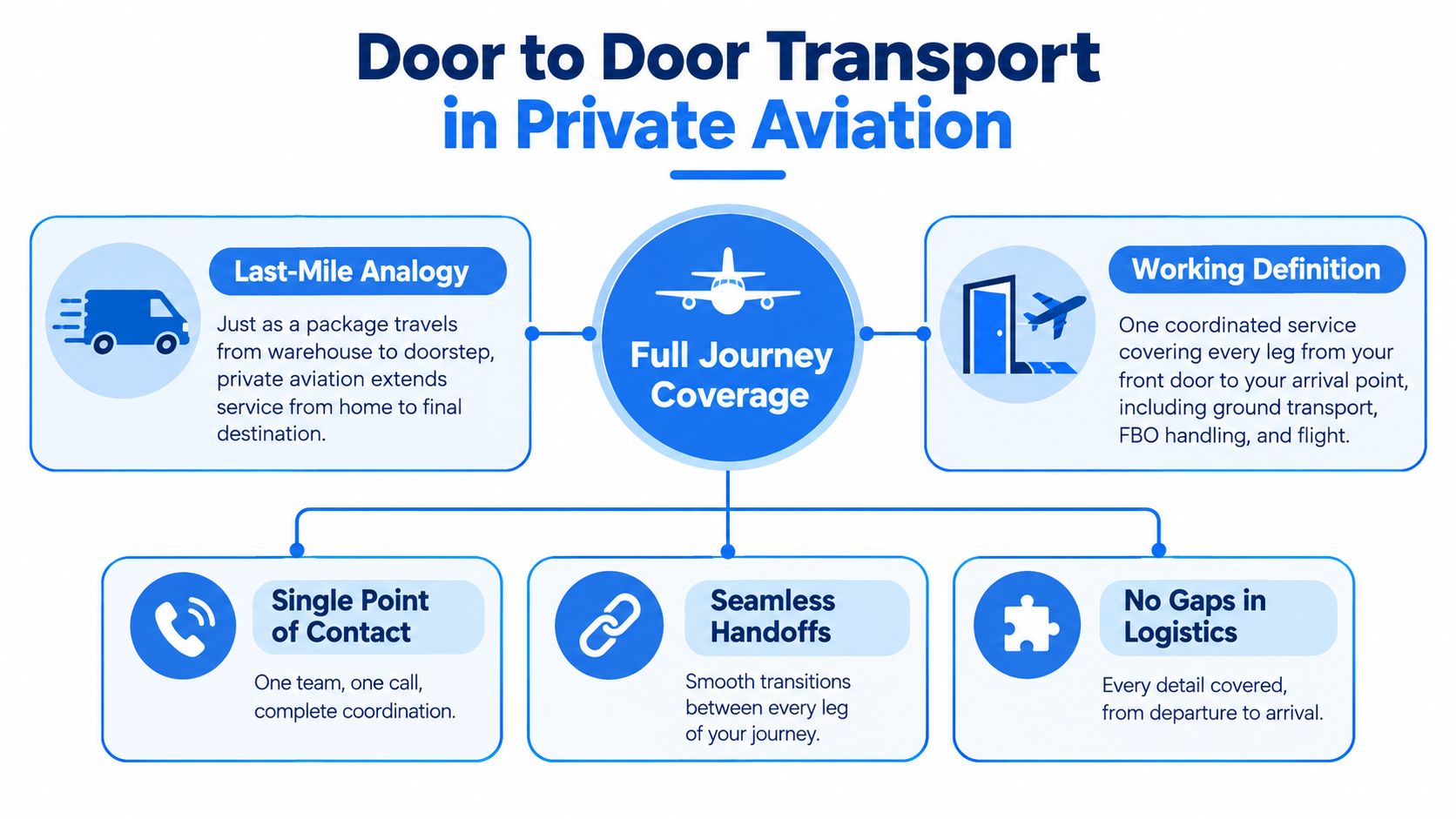
A black-car ride from home to an airport is a ground transfer, not a complete door-to-door aviation service. First-class airline travel may improve the flight experience, but it doesn't automatically coordinate pickup timing, private-terminal handling, international arrival procedures, or the final drive.
The difference is accountability for the chain. The traveler should experience one continuous itinerary, while the provider coordinates multiple modes, handlers, and jurisdictions. That doesn't mean every step is performed by the same company. It means someone tracks the steps as one operation, confirms handoffs, and communicates when plans change.
The World Economic Forum projected that global last-mile delivery demand would grow 78% by 2030, with delivery vehicles in the world's largest cities projected to rise 36% between 2019 and 2030. Those projections concern delivery networks, but they underline a broader planning lesson: coordinating the final leg is a system problem, not a small add-on. (The World Economic Forum's report on the future of the last-mile ecosystem provides that wider context.)
How the End to End Journey Actually Works
A coordinated trip has a sequence, but it also has a person responsible for keeping the sequence intact. The vehicle, FBO, aircraft operator, and arrival team may all be different providers. The coordinator connects their timing and confirms that each has the information needed for the next handoff.
From pickup to departure
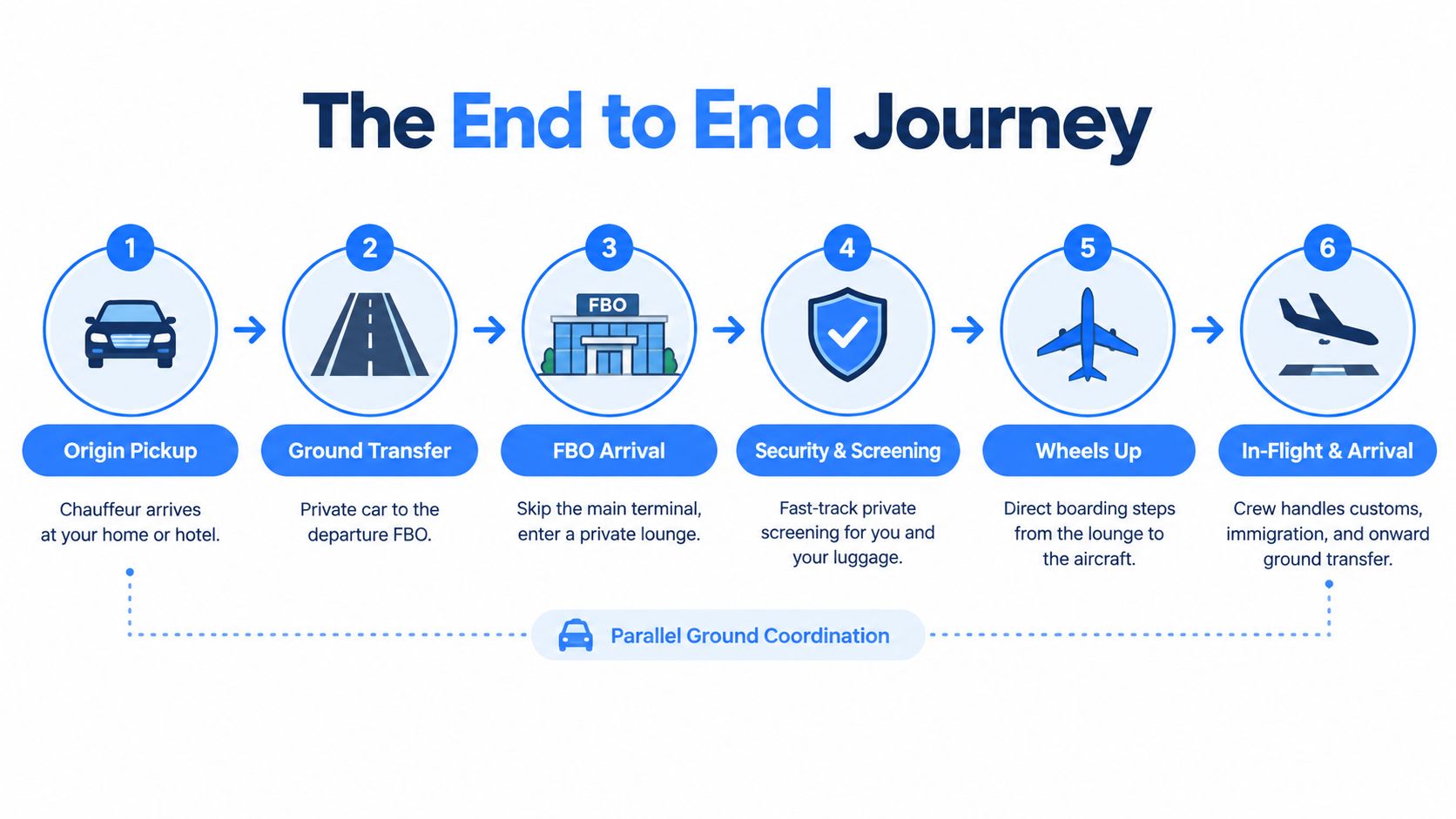
- Origin pickup. The ground operator confirms the passenger, address, luggage, and pickup instructions. A hotel pickup may require the driver to coordinate with the front desk or meet at a designated entrance.
- Road transfer. The driver heads to the departure FBO. The coordinator monitors timing and alerts the flight team if traffic or another delay affects arrival.
- FBO arrival and screening. FBO staff direct the passenger through the facility's departure process. Screening requirements depend on the operator, airport, and route, so the coordinator should confirm what applies rather than promise a universal procedure.
- Boarding and flight. The aircraft operator manages the flight and crew. The coordinator keeps the arrival team informed of expected timing and any schedule changes.
A useful end-to-end measure is elapsed time from pickup readiness to final arrival, not just time in the air. The OECD recommends looking at logistics through dimensions such as operational efficiency, service quality, and environmental impact, and tracking measures including travel time, reliability, and on-time delivery. Its guidance also recognizes that road feeder services are necessary when origins and destinations aren't directly connected by other transport modes. (The OECD's logistics performance measurement guidance supports treating the whole chain as the unit of performance.)
From arrival to final drop-off
- Arrival FBO and border formalities. The arrival team follows the planned customs and immigration process. The coordinator confirms who is responsible for documents and whether the passenger can proceed directly to the next transfer.
- Reconciliation and onward travel. Staff confirm passengers and baggage or cargo are accounted for, then the arrival ground crew takes over. If the aircraft lands later than planned, the driver should receive the updated timing rather than wait on an outdated schedule.
A single coordinator can't prevent every delay. The value is that one person sees how a delay affects the next leg and can organize a response. For the road portion, travelers can use a separate 3rd-i rideshare safety guide to think through general ground-transport precautions. If you're new to charter planning, this guide to chartering a private jet can help clarify the aircraft-booking side of the process.
The Real Benefits of Door to Door Coordination
The main benefit isn't just a faster flight. It's less uncertainty between the flight and the rest of the day. When a coordinator aligns pickup, FBO arrival, aircraft readiness, border arrangements, and the onward car, the passenger has fewer separate schedules to manage and fewer chances to discover that one provider was waiting on another.
For private aviation, the publisher's stated service details include 15–30 minute pre-departure arrivals at the FBO, depending on the mission and procedures. That's a planning reference, not a promise that every traveler will board within a particular time. Screening, paperwork, airport requirements, and aircraft readiness still matter. The useful comparison is not a universal time-saving figure, but whether your provider has confirmed the required arrival time for your specific itinerary.
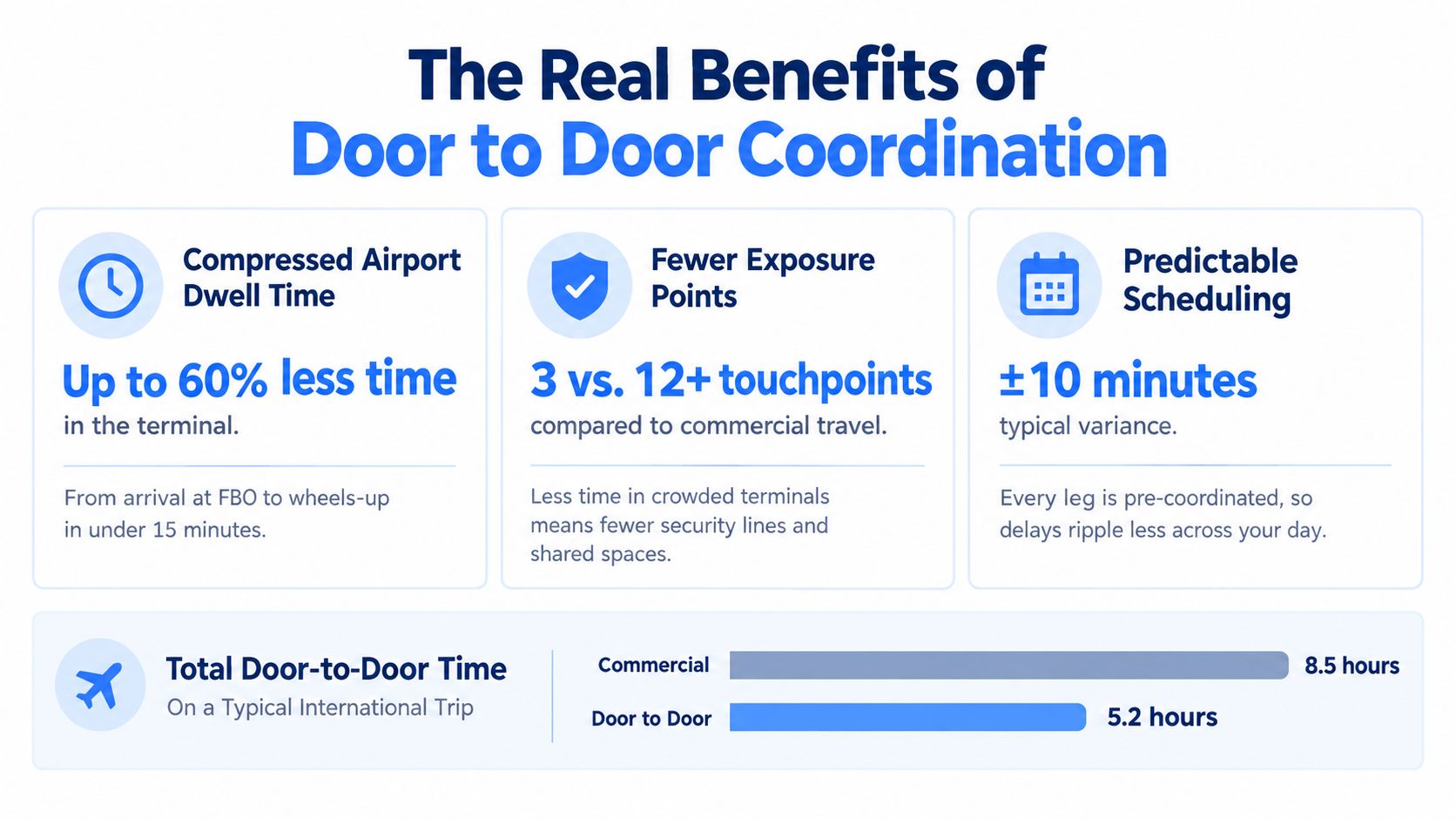
The infographic's numerical comparisons are illustrative, not verified service guarantees. In particular, don't assume a fixed reduction in terminal time, a specific number of touchpoints, or a standard end-to-end schedule without having the operator confirm it for your route.
That distinction matters for an executive who needs to reach a meeting, a medical team coordinating a patient transfer, or a cargo manager moving sensitive equipment. If a departure car arrives late, a flight may be affected. If customs takes longer than expected, the arrival driver needs an update. A well-managed chain makes those dependencies visible and gives someone responsibility for acting on them.
The same logic applies to ordinary trips with multiple destinations. For example, a traveler comparing ground travel between theme parks may need to account for the actual road journey, not just the distance on a map; this guide to travel times between Universal and Disney offers a simple example of why the ground leg belongs in itinerary planning.
In short, coordination reduces the number of unmanaged transitions. It doesn't remove the need for buffers or backup plans. It makes those plans part of the service rather than a problem the traveler has to solve alone.
A Worked Example of a Multi Leg Itinerary
Consider an executive traveling from a hotel in one country to a remote worksite in another. The itinerary includes a car to a departure FBO, a transatlantic charter flight, customs and immigration, a connection to a smaller regional airport, and a final drive. The exact timings depend on the route, airport rules, aircraft, and ground conditions, so a reliable plan assigns responsibility and buffers without pretending every leg runs to an identical schedule.

The ground operator confirms the hotel pickup point and takes the executive to the departure FBO. The broker or trip coordinator checks that the driver's arrival, passenger details, flight plan, and FBO arrangements remain aligned. The FBO team handles the local departure process, while the aircraft operator is responsible for the flight and its operational control.
At the destination, the customs handler or designated arrival team supports the required border process. The coordinator keeps the regional-airport connection and final ground crew updated. The arrival driver shouldn't be dispatched based only on the original landing time; the pickup should reflect actual progress through the border and baggage or cargo handoff.
A schedule buffer belongs where delay can affect the next commitment. That may mean allowing time between landing and the regional connection, rather than planning every leg as if it will happen instantly. If the border process runs long, the coordinator can determine whether to hold the onward vehicle, adjust the connection, or activate a contingency route.
The trade-off is straightforward. A route with fewer transfers may cost more, while a lower-cost or multimodal option may require more time and expose the itinerary to more handoffs. Intermodal research has found that studied routes were cheaper than all-road alternatives, while trip duration was approximately 70% to 400% longer, depending on the corridor. Those results apply to the studied cases, not every charter itinerary. (The comparative research on intermodal transport shows why cost and duration must be assessed together.)
In plain terms, the coordinator should choose a workable balance: keep the trip within the traveler's maximum acceptable duration, preserve enough connection time, and meet the required reliability standard. An executive travel itinerary template can help a travel manager make those responsibilities and handoffs explicit before departure.
How Approved Jets Delivers Door to Door Service
Approved Jets is a private aviation broker and mobility platform that coordinates charter flights and related travel logistics. Its stated network includes 1,000+ aircraft from FAA Part 135 and foreign-equivalent operators. The company also states a two-hour quote turnaround target, the ability to mobilize flights in approximately 2–4 hours subject to mission and availability, and 24/7 concierge access through its Miami headquarters. These are service capabilities, not guarantees that every aircraft or route will be available on the same timeline.
The operating model is designed to connect the aircraft booking with the other parts of the trip. That can include ground transfers, catering, security coordination, customs paperwork, and oversight through arrival. Rather than leaving the traveler to align separate providers, the broker can help organize the required steps around the itinerary and communicate changes among the people responsible.
What to confirm when you request a trip
A useful inquiry gives the coordinator the information needed to match the aircraft and ground plan to the mission. Share the origin and destination addresses, preferred timing, passenger and luggage needs, border requirements, mobility considerations, and any cargo or medical details that affect handling. If the itinerary includes a remote destination or several stops, flag that early so the team can plan the ground and connection legs alongside the flight.
Approved Jets says it gives preference to operators with credentials such as ARGUS Platinum and Wyvern Wingman, and describes its processes for high-profile clients as discretion-first. A buyer should still ask which operator will conduct the actual flight, who holds operational control, what ground services are included, and which parts of the itinerary remain subject to confirmation.
The quote should also make clear what the price and schedule cover. Ask whether the proposed plan includes the relevant FBO arrangements, customs coordination, ground vehicles, and contingency handling. A transparent proposal should connect those items to the mission rather than present an aircraft listing as if it were the entire journey.
What Most Providers Don't Explain About Door to Door
The difficult questions tend to appear at the handoffs. What happens if the flight lands late? Who updates the final driver? Can the passenger get assistance from inside a building, and will the vehicle accommodate a wheelchair, stretcher, medical equipment, or unusual luggage? A provider should answer these questions before booking, not leave them for the day of travel.
Accessibility needs to be specific. Ask what assistance the driver provides, where that assistance begins and ends, whether each vehicle can accommodate the passenger and equipment, and what happens at a building without step-free access. The U.S. National Council on Disability reported that wheelchair-accessible ride-hailing vehicles were offered in approximately 10 cities, and that about one-third of people with disabilities reported always or usually having difficulty accessing transportation for spontaneous events. Those figures describe a broader access problem, not a measurement of private aviation services. (The National Council on Disability's report on ground-transportation barriers provides further context.)
Reliability also requires more than tracking the aircraft. Confirm how the provider handles a late pickup, a border delay, a missed connection, or a vehicle that can't reach the planned address. Ask who has authority to arrange a replacement vehicle, how the traveler will be updated, and what buffer is built into each critical handoff.
Compliance questions belong in the itinerary
For U.S. on-demand charter, verify the operating certificate and the carrier's operational control. The FAA explains that Part 135 operators are subject to operating rules and oversight, and that a pilot carrying passengers or property for compensation must operate under the certificate holder's authority. (The FAA's charter guidance outlines the framework.)
Security procedures vary by operation and facility. TSA guidance describes approved security-program requirements for covered operators, which may include passenger and property screening and vetting for certain personnel. (TSA's general aviation security guidelines explain why travelers should ask which procedures apply to their mission.)
Cargo needs its own chain of custody. IATA describes the Consignment Security Declaration as an audit trail of how, when, and by whom a shipment was secured. (IATA's cargo-security guidance covers the role of documented controls.) For regulated materials, the FAA says most Part 135 carriers must maintain an approved hazardous-materials program. (The FAA's Part 135 hazardous-materials information is relevant when planning shipments such as medical supplies or equipment.)
Choosing a Door to Door Provider You Can Trust
A real door-to-door provider can describe the itinerary as one chain: pickup, ground transfer, FBO, flight, border process, arrival handling, and final drop-off. Someone should be accountable for checking that each provider has the right timing and information, and for telling you what happens when a leg slips.
Before booking, ask who coordinates the whole trip, which operator will conduct the flight, what assistance is included at each address, how connection buffers are set, and how the provider handles delays. Request clear service expectations for pickup punctuality, updates, and recovery plans. If the answer focuses only on aircraft type and departure time, you may be buying a flight leg rather than a managed journey.
Approved Jets is one example of a broker that describes its role as coordinating charter and related travel logistics. You can also review its private jet safety information while preparing questions about operator verification and oversight.
A dependable door-to-door trip should feel simple to the traveler because the coordination is explicit behind the scenes. Judge the service by the handoffs it manages, not just the aircraft it books.
If you're planning a private aviation journey, Approved Jets can coordinate charter options alongside ground transfers, customs paperwork, and other itinerary logistics. Share your route, timing, passenger needs, and any special handling requirements with Approved Jets to discuss a trip plan built around the complete journey.