

Medical Evacuation and Repatriation: A Complete 2026 Guide
Learn how medical evacuation and repatriation works in 2026, from aircraft and crews to insurance, costs, and end-to-end mission planning.

Approved Jets
On this page
- Table of Contents
- A Cross-Border Emergency and the Hidden Logistics Inside It
- Why the ground operation controls the air mission
- What Medical Evacuation and Repatriation Actually Mean
- Mission Planning From First Call to Wheels-Up
- Aircraft Types and Cabin Configurations for Patient Care
- Medical Crews, In-Flight Standards, and the Pre-Flight Checklist
- Insurance, Costs, and the Triggers That Get a Flight Authorized
- What the Receiving Country Does After Landing
- The receiving-side plan
- The End-to-End Provider Process and a Final Decision Checklist
A patient is stable in a regional hospital, but the treating team can't provide the specialist care required. The family wants the patient home. The insurer wants clinical justification. The employer wants a firm departure time. Meanwhile, someone must secure a receiving hospital, select an aircraft and medical crew, arrange ambulances, obtain permissions, and make sure the patient's companion can cross the same borders.
That is the operational reality of medical evacuation and repatriation. It isn't a flight booking. It's a chain of clinical decisions, aircraft constraints, permits, ground movements, hospital acceptance, insurance approvals, and post-landing care. The aircraft matters, but the handoff after landing often determines whether the mission succeeds.
Table of Contents
- A Cross-Border Emergency and the Hidden Logistics Inside It
- What Medical Evacuation and Repatriation Actually Mean
- Mission Planning From First Call to Wheels-Up
- Aircraft Types and Cabin Configurations for Patient Care
- Medical Crews, In-Flight Standards, and the Pre-Flight Checklist
- Insurance, Costs, and the Triggers That Get a Flight Authorized
- What the Receiving Country Does After Landing
- The End-to-End Provider Process and a Final Decision Checklist
A Cross-Border Emergency and the Hidden Logistics Inside It
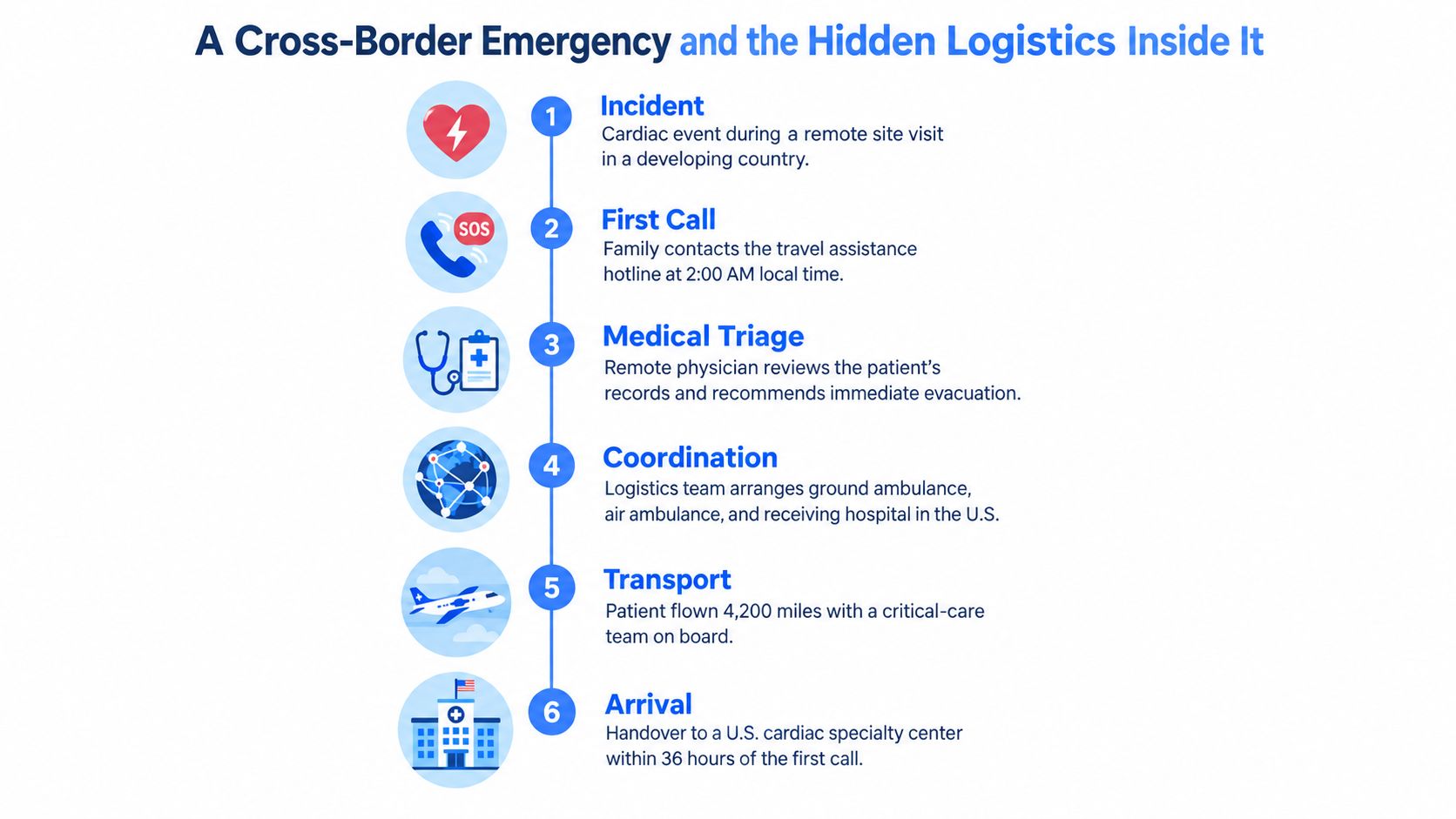
An executive suffers a cardiac event during a remote site visit. The local hospital stabilizes the patient but cannot provide the required intervention. A remote physician reviews the records and approves air transport. The receiving hospital must accept the patient, the aircraft must carry the right equipment, a critical-care team must be assigned, overflight and landing permissions must clear, and ambulances must be ready at both ends.
The mission is not ready when an aircraft is available. It is ready when the receiving team can take over without a gap in care after landing. A vetted broker coordinates that handoff while confirming the aircraft, crew, permissions, hospitals, insurers, and ground operators as one cross-border operation.
If the executive's spouse travels with the patient, the coordination expands. The companion may need a visa, passport checks, a seat or cabin arrangement, and separate ground transport. A departure estimate has little value until those dependencies are confirmed together.
Why the ground operation controls the air mission
Aeromedical transport developed around coordinated movement, not speed alone. During the U.S. Civil War, Union medical director Jonathan Letterman established a dedicated ambulance corps with standardized stretcher-bearers, transport, and medical organization. That system provided an early model for moving casualties into organized medical care.
The first recorded medical transport by aircraft occurred in Serbia in autumn 1915 during World War I. In April 1944, U.S. Army pilot Carter Harman used a Sikorsky YR-4B in Japanese-held Burma for multiple rescue trips, recovering an American pilot and four injured British soldiers. Helicopter evacuation matured from approximately 17,000 soldiers moved during the 1950 to 1953 Korean War to more than 900,000 wounded troops transported in Vietnam (Health.mil). The civilian lesson is direct:
- Access must be rapid: Aircraft and ambulances must reach the patient without creating another delay.
- Stabilization comes first: The patient must be prepared for pressure changes, vibration, limited cabin space, and possible diversion.
- The aircraft follows the patient: Cabin layout, oxygen supply, monitoring, and crew must match the clinical profile.
- Origin and destination work as one system: Safe transfer continues until the receiving team accepts care.
Approved Jets coordinates these workstreams in parallel rather than waiting for one department to finish before contacting the next. That approach matters when international permissions, aircraft range, cabin configuration, and hospital acceptance must align. It also helps determine whether a private aircraft can support the mission, as explained in this guide to international private jet operations.
Operational rule: Mission readiness means the patient, aircraft, permissions, crew, ambulances, and receiving facility are ready together.
What Medical Evacuation and Repatriation Actually Mean
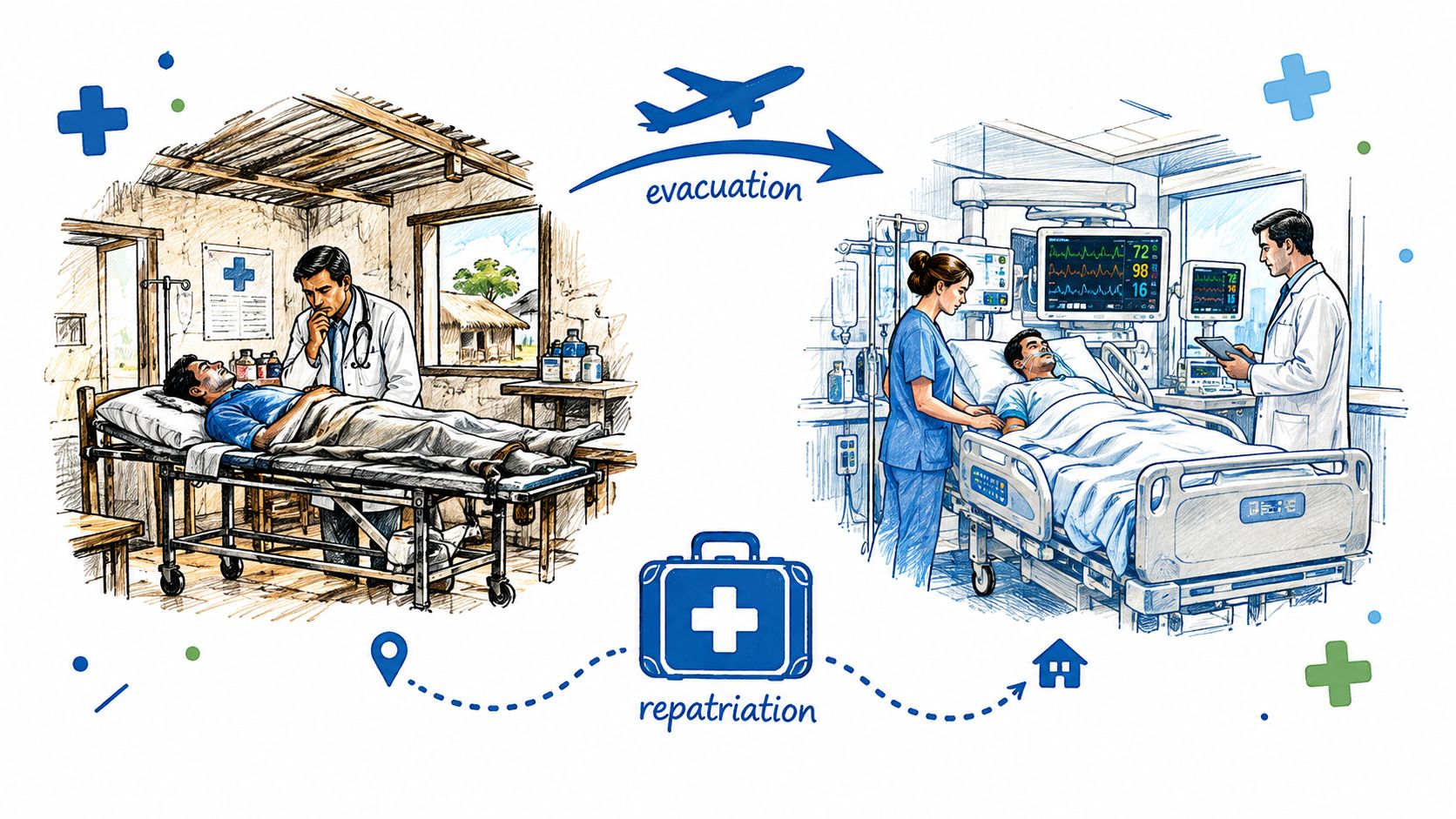
Medical evacuation moves a patient urgently from a location where suitable care isn't available to a facility that can provide it. The destination may be in another city or another country. The priority is access to appropriate treatment, not necessarily a return home.
Medical repatriation usually takes place after stabilization. It moves the patient home or to a designated treatment center where continued care, rehabilitation, or family support is available. The patient may still require a stretcher, oxygen, monitoring, or a medical escort.
An air ambulance is an aircraft configured for patient transport, usually with a stretcher, medical equipment, oxygen, communications, and a dedicated clinical team. A medical escort accompanies a patient on a commercial flight when the patient's condition and airline rules permit that arrangement. A commercial stretcher transfer uses a blocked and modified cabin area, often with a medical team and specialized loading process.
The patient is the person receiving care. An essential medical companion could be a physician, nurse, respiratory therapist, or paramedic. A spouse, parent, child, interpreter, security officer, or employer representative is a companion, not a clinical escort, and must be briefed separately on seating, documents, baggage, and border requirements.
Mission Planning From First Call to Wheels-Up
The first call should produce a clinical file, not just a destination and a preferred departure time. The coordinator needs the diagnosis, recent imaging, vital trends, medications, devices, oxygen or ventilator requirements, passport details, and the treating physician's contact information.

A remote medical director then decides whether the patient can fly, what level of crew is required, and which receiving hospital can accept the case. Only after that decision should the coordinator lock the aircraft, stretcher system, oxygen plan, crew, ambulances, permits, customs arrangements, and passenger manifest.
A quoted two to four hour mobilization window is meaningful only when the route dependencies are confirmed. Aircraft availability alone doesn't clear overflight permissions, landing rights, fuel stops, crew duty limits, customs processing, or a visa-locked companion. A multi-leg route may require a fuel stop and crew change, while a companion may need an emergency visa before boarding.
Scheduled repatriation is different. If the patient is stable, the team can coordinate a later departure around receiving-hospital availability, equipment, insurance authorization, and family logistics. An urgent evacuation prioritizes clinical suitability and route resilience. Neither should be budgeted as a normal charter.
The operational sequence is straightforward, but every step can stop the mission:
- Initial inquiry: Collect clinical, identity, location, and insurance information.
- Medical acceptance: Confirm fitness to fly and the receiving hospital's willingness to admit.
- Aircraft and crew: Match range, cabin space, equipment, and specialty coverage to the patient.
- Permissions: Secure overflight, landing, customs, immigration, and any destination-country approvals.
- Ground movements: Position ambulances, loading teams, and hospital transport at both ends.
- Final release: Recheck the patient, documents, equipment, crew, route, and receiving unit before departure.
Aircraft Types and Cabin Configurations for Patient Care
Aircraft selection starts with the patient, not the operator's preferred fleet. A light jet may suit a short regional transfer with one stretcher and a compact medical team. A midsize or super-midsize jet may provide more cabin length, lavatory access, baggage capacity, and range for a longer domestic or regional mission. A heavy jet becomes relevant when the route is intercontinental, the patient needs more equipment, or the mission includes companions and substantial medical stores.
The medical module replaces passenger seats and creates a working area around the stretcher. Oxygen cylinders, ventilators, monitors, suction equipment, infusion pumps, batteries, and emergency medications must be accessible and secured. Cabin altitude, range, loading access, and diversion options all affect patient safety.
| Mission profile | Recommended class | Typical medical fitout | Useful range |
|---|---|---|---|
| Short regional transfer | Light jet | Single stretcher, oxygen, monitoring, compact critical-care kit | Short regional sectors |
| Regional trauma or cardiac transfer | Midsize or super-midsize jet | Stretcher, ventilator, infusion pumps, expanded crew workspace | Short to mid-range missions |
| Intercontinental repatriation | Heavy jet | Advanced life support, larger oxygen reserve, extensive equipment and baggage capacity | Long-range international sectors |
| Infectious-disease or complex isolation case | Midsize, super-midsize, or heavy jet, subject to fitout | Isolation measures, dedicated clinical equipment, infection-control supplies | Route-dependent |
| Bariatric patient with companion | Super-midsize or heavy jet | Reinforced stretcher solution, wider access planning, additional cabin space | Route and payload dependent |
A neonatal case may need incubator compatibility and temperature control. A ventilated trauma patient may need a larger medical team and reserve capacity for diversion. A bariatric patient may require aircraft doors, loading equipment, and stretcher dimensions to be checked before the aircraft is accepted.
For long intercontinental missions, review the aircraft class and cabin layout using long-range aircraft guidance. Ask for the usable cabin dimensions, stretcher access route, oxygen capacity, medical power availability, baggage limits, and the planned diversion strategy.
Medical Crews, In-Flight Standards, and the Pre-Flight Checklist
Titles don't establish competence. The crew must match the patient's acuity and equipment. A critical-care paramedic may manage advanced airway care, vascular access, and emergency medication. A flight nurse may lead monitoring, ventilator management, medication documentation, and handover. A physician may make real-time clinical decisions, while a respiratory therapist can be essential for complex ventilation.
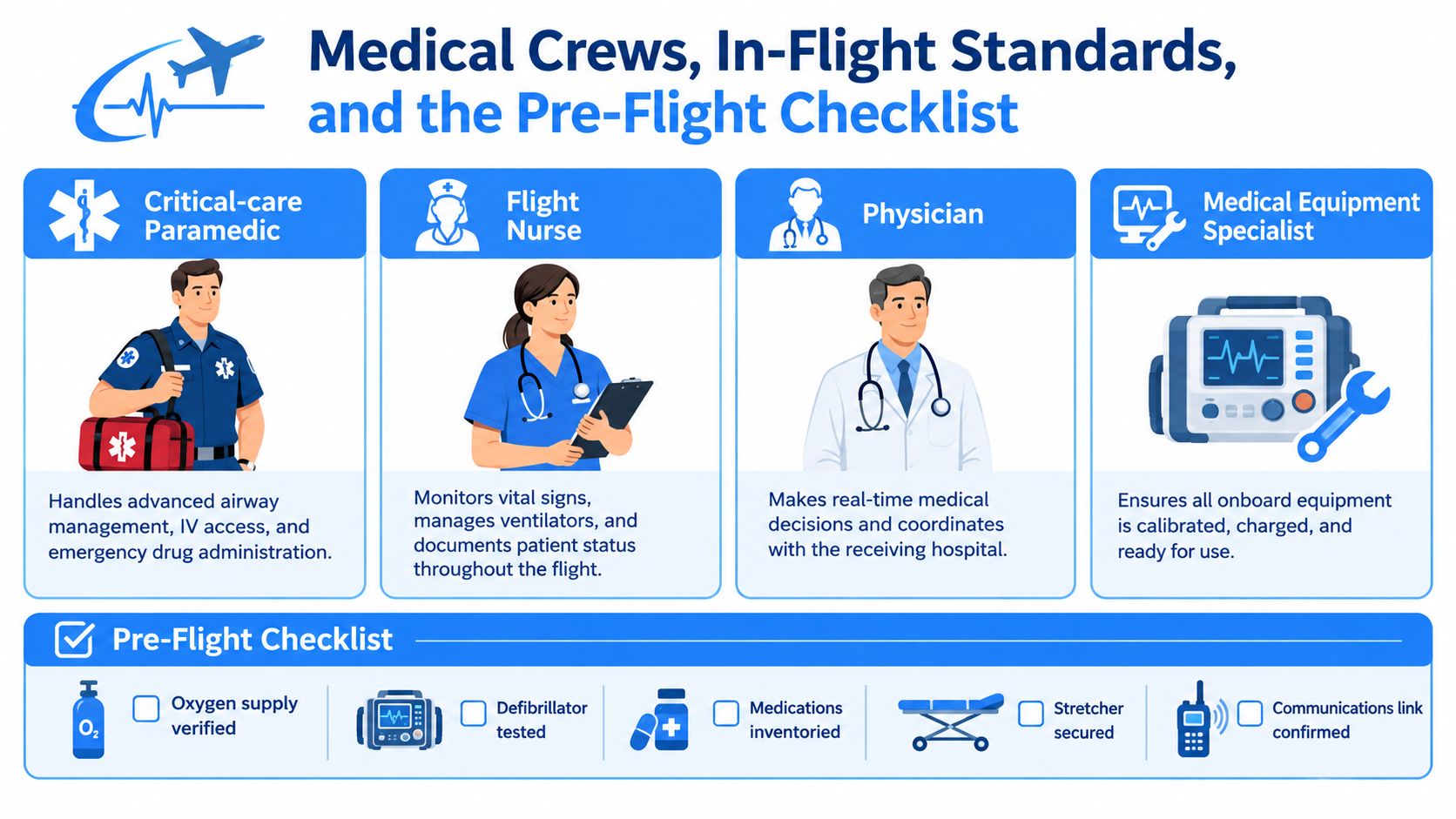
Before departure, the team should verify the diagnosis, imaging, airway, hemorrhage control, fractures, lines, drains, oxygen, ventilator settings, medications, battery duration, and receiving-facility capability. A pneumothorax requires particular attention. Trapped pleural air can expand during ascent, worsening respiratory and hemodynamic compromise. Aeromedical guidance recommends drainage before air transport, with a chest tube connected to a Heimlich valve or an approved collection system (U.S. Army Medical Department).
The same principle applies to every critical device. Intravenous lines, drains, ventilator tubing, monitors, infusion pumps, and stretcher restraints must remain patent and secure. Oxygen and battery reserves should cover the planned flight and the longest credible diversion, not merely the scheduled airborne time.
Preflight standard: If the crew can't state what happens after a diversion, the patient isn't ready to depart.
During transport, clinicians should reassess mental status and vital signs every 5 to 15 minutes, while repeatedly checking tourniquets, airway devices, ventilators, and infusions (Joint Trauma System). The mission plan should define escalation thresholds before takeoff, such as persistent hypotension, worsening oxygenation, increasing ventilator demand, altered consciousness, or infusion failure.
The receiving unit needs a concise movement summary with the diagnosis, current medications, devices, monitoring requirements, infection-control risks, and recent changes. Clear documentation tools can reduce handover errors, and teams evaluating digital workflows may also compare medical dictation apps for clinical note capture.
Insurance, Costs, and the Triggers That Get a Flight Authorized
Authorization starts with medical necessity, not passenger preference. The insurer and its medical team usually decide whether evacuation is warranted, using the treating physician's information, local standards of care, transport risk, and the receiving facility's capability (CDC Yellow Book).
Typical triggers include hospitalization with several more days of care expected, or specialist surgery or treatment that the local system cannot provide to a comparable standard. A request based on comfort, family preference, or convenience may fail the policy's medical-necessity test. Secure the insurer's case number, medical review contact, and written authorization before committing an aircraft.
Costs can reach six figures. CDC travel guidance reports that air-ambulance evacuation to the United States may cost approximately $20,000 to $200,000, depending on the location and the patient's medical condition, and warns that transport from a remote area to a high-quality hospital can cost more than $100,000 (U.S. Department of State). Ordinary health plans often exclude return to the United States by specialized air ambulance. Use this air ambulance cost guide to frame the operator questions, then obtain a mission-specific quote.
Check these policy terms before deployment:
- Maximum limits: Confirm the evacuation ceiling and whether the limit applies per incident or per policy period.
- Geographical scope: Check remote territories, war-risk exclusions, and destination restrictions.
- Authorization: Ask who can approve transport and how quickly physician-backed assistance is available.
- Included personnel: Verify whether medical escorts, physicians, nurses, and respiratory specialists are covered.
- Direct payment: Confirm whether hospitals and operators can be paid directly.
- Companion rules: Determine whether an accompanying family member's travel is included.
Billing disputes can become a second handoff problem. For practical context on ambulance billing and coverage protections, review RevGuard's No Surprises Act resource. The final quote still depends on the patient, aircraft, route, permissions, crew, and timing.
EU citizens without representation in the crisis country face another approval requirement. Under the European Commission framework, medical evacuation generally requires prior consent from the citizen's Member State of nationality, except in cases of extreme urgency (European Commission framework). The framework references up to EUR 1,000 for a long-haul evacuation based on the last available commercial ticket, EUR 150 for an internal journey to safety, and EUR 2,500 for medical assistance. These amounts are not a universal price cap for private air ambulance operations. A broker should confirm authorization, payment responsibility, and the receiving-side handoff before wheels-up.
What the Receiving Country Does After Landing
Landing marks the start of the receiving country's work. A patient may arrive safely yet wait because the hospital has not accepted the case, a rehabilitation bed is unavailable, infection-control information was not transferred, or the ambulance cannot carry the required equipment.
A 2025 Japanese study found that about one-third of medical-repatriation inquiries resulted in hospital admission. Nearly one-quarter of those admissions were mainly for entry coordination rather than acute treatment. One-third of patients lived outside Tokyo, where rehabilitation and long-term-care access was limited (Journal of General and Family Medicine). More than half carried multidrug-resistant organisms, and vancomycin-resistant enterococci created especially difficult transfer barriers.
The receiving-side plan
Approve the destination plan before departure. The broker should obtain and document:
- Hospital acceptance: A named receiving physician, confirmed unit, bed status, and admission conditions.
- Clinical records: Secure transfer of imaging, laboratory results, medication lists, care summaries, and infection-control information.
- Ground transport: An ambulance matched to the stretcher, ventilator, oxygen supply, monitoring equipment, and accessibility needs.
- Continuing care: Rehabilitation, skilled nursing, home care, or specialist follow-up arranged before the aircraft departs.
- Fallback placement: A defined response if the planned facility rejects admission or loses capacity.
- Family logistics: Accommodation, accessible transport, interpreters, documents, and scheduled updates.
For the receiving side, the guide to setting up care handovers provides a useful operational reference. The transfer is complete only after the next care team accepts responsibility and has the records, equipment, and instructions to continue treatment.
Cross-border access can fail even when an aircraft is available. WHO reported that 6,295 patients had been evacuated from Gaza by 24 February 2025, while an estimated 12,000 to 14,000 still required evacuation. The same WHO account recorded 2,714 patients, including 1,592 children, evacuated through 119 missions to more than 25 countries in 2025 (WHO account). The operational lesson is direct: permissions, security, routes, fuel, receiving beds, and post-arrival transport can constrain a mission more than aircraft supply.
The End-to-End Provider Process and a Final Decision Checklist
A capable broker keeps clinical, aviation, regulatory, and receiving-side dependencies in one operating picture. Approved Jets coordinates medical evacuation and repatriation through a vetted network of more than 1,000 aircraft, linking aircraft sourcing, medical teams, ground transfers, hospital handover, and international permissions. The objective is continuity of care after landing, with each responsibility assigned before departure.
The operating sequence should include:
- Clinical intake: Collect records, diagnosis, devices, recent imaging, treating doctor details, and patient identity.
- Medical acceptance: A qualified medical authority confirms fitness to fly, crew requirements, and destination suitability.
- Aircraft matching: Check stretcher dimensions, oxygen, power, cabin space, range, payload, and diversion options.
- Route clearance: Confirm permits, overflight approvals, landing rights, customs, immigration, fuel stops, and crew duty limits.
- Ground execution: Position ambulances and hospital teams at both ends, with contact details and escalation procedures confirmed.
- Post-landing ownership: A named coordinator confirms arrival, admission, records transfer, and onward care.
Ask which dependencies have already been resolved before committing to a departure window. Timelines compress when medical acceptance, hospital admission, permits, and ground transport are pre-cleared. Private FBO infrastructure may allow passengers to arrive 15 to 30 minutes before departure, but that convenience does not replace medical acceptance or regulatory clearance.
Before signing, ask:
- Who is the named medical director, and what are the crew credentials?
- Which physician has accepted the patient for transport?
- Which hospital has accepted the patient after landing?
- What equipment, oxygen reserve, batteries, and medications are onboard?
- Which permits are confirmed, and which remain pending?
- Are fuel stops, crew changes, customs, and immigration included?
- What ambulance is waiting at each end?
- Who owns the medical-record and infection-control handoff?
- What happens if the receiving hospital rejects admission?
- Has the insurer provided written preauthorization?
- Is the quote inclusive of medical crew, equipment, ground transport, permits, and contingencies?
- What does the provider mean by mission-ready, rather than merely aircraft-available?
Require written answers. Red flags include a vague departure promise, no named medical director, cash-only pricing, no hospital acceptance, reluctance to discuss equipment, and refusal to plan the receiving-country transition. The quote should show who owns each cross-border dependency and what happens if that dependency fails.
Approved Jets coordinates specially equipped aircraft, medical teams, ground transfers, hospital handovers, and international permissions for urgent medical evacuation and repatriation missions. Speak with Approved Jets before departure so the aircraft and post-landing care pathway are planned as one operation.