
Business Jet Maintenance: Complete Owner’s Guide 2026
Master business jet maintenance from routine inspections to budgeting for downtime. A practical guide for owners and operators

Approved Jets
On this page
- Table of Contents
- Why Business Jet Maintenance Is a Strategic Asset
- The asset value connection
- Availability is a financial metric
- Navigating FAA Regulations and Compliance
- Start with the operating framework
- Control every configuration-specific obligation
- The True Cost of Ownership and Downtime
- Build a downtime budget
- Parts provenance is part of the cost decision
- Scheduled Inspections Versus Predictive Maintenance
- What scheduled work does well
- What predictive systems add
- The Role of Brokers and Management Companies
- Management companies control continuity
- Brokers protect the mission choice
- Real-World Scenarios in High-Stakes Operations
- Building a Proactive Maintenance Strategy
The most popular advice about business jet maintenance is to focus on the hourly maintenance rate. That number matters, but it doesn't answer the question owners and travel managers face: what will a maintenance event cost when the aircraft can't fly?
A grounded jet can trigger substitute lift, ferry flights, crew disruption, missed meetings, delayed cargo, and lost productivity. A lower shop quote may become the more expensive choice if parts access is weak or the turnaround is unpredictable. Sound maintenance planning therefore measures not only invoices, but also availability, schedule certainty, records quality, and operator discipline.
Table of Contents
- Why Business Jet Maintenance Is a Strategic Asset
- Navigating FAA Regulations and Compliance
- The True Cost of Ownership and Downtime
- Scheduled Inspections Versus Predictive Maintenance
- The Role of Brokers and Management Companies
- Real-World Scenarios in High-Stakes Operations
- Building a Proactive Maintenance Strategy
Why Business Jet Maintenance Is a Strategic Asset
The most expensive maintenance decision is often made before the aircraft enters the hangar. Poor planning can leave an operator with an aircraft that is technically serviceable on paper but unavailable when the schedule demands it. A disciplined maintenance program protects flight access, commercial reliability, and the aircraft's future value.
An industry statistics compilation covering business-aircraft operating costs identifies ownership, fuel, maintenance, and personnel as the four largest cost positions. Together, those categories represented 79% of direct operating costs in one modeled case and 88% in another. A peer-reviewed transport study placed maintenance at approximately 10% to 20% of aircraft-related operating costs, depending on factors such as aircraft age and utilization. The exact share changes with the aircraft and accounting method, but maintenance remains a major ownership decision rather than a minor line item.

The asset value connection
A maintenance program protects airworthiness and the credibility of the aircraft's history. That credibility affects how easily the aircraft can be financed, insured, managed, marketed, or sold.
Buyers, lenders, insurers, and management companies review inspection status, component life, engine history, airworthiness directive compliance, and record continuity. Attractive equipment and a clean cabin cannot offset serious uncertainty in those areas. An aircraft approaching a major inspection, carrying incomplete time or cycle records, or relying on hard-to-source components can create exposure long after the purchase closes.
Periodic maintenance also needs a funding plan that reflects when costs occur. Recurring inspections may be manageable, while engine work, component replacement, and heavy checks can create a much larger cash requirement. A monthly reserve can feel excessive during quiet operating periods, then prove inadequate when a major event arrives. Owners should therefore model maintenance by expected exposure and aircraft use, not by a simple hourly figure.
Practical rule: Judge an aircraft by its next maintenance exposure, not only by its current hourly price.
Availability is a financial metric
For a charter broker or aircraft-management provider, maintenance status determines whether a jet can be assigned to a mission and whether the published schedule can be trusted. An aircraft nearing an inspection threshold might be legal for one trip yet unsuitable for several international sectors with little recovery time.
Planning early lets operators reserve labor, secure parts, coordinate hangar capacity, and arrange substitute lift before disruption becomes urgent. It also gives corporate travelers and high-value passengers something more valuable than a low quote: predictable access to the aircraft they were promised.
Maintenance becomes a strategic asset when it protects three business outcomes:
- Safety: The aircraft remains compliant and airworthy.
- Availability: Planned work reduces avoidable aircraft-on-ground disruption.
- Value: Clear records and controlled maintenance exposure support the aircraft's future marketability.
Navigating FAA Regulations and Compliance
The correct compliance pathway depends on how the aircraft operates, how many passenger seats it is certificated for, and which maintenance program the operator has approved. An annual inspection alone does not show that an aircraft is ready for charter or that its records support continuous airworthiness.
Start with the operating framework
For a U.S.-registered aircraft operated under Part 91, the operator must ensure that a complete aircraft inspection occurs at least once during every 12-calendar-month period. This may be a conventional annual inspection or an approved progressive inspection program. A progressive program divides the work into recurring segments, but it does not reduce the inspection scope. The complete aircraft still must be covered within the required period (FAA Advisory Circular on progressive inspections).
For aircraft operated under Part 135, the maintenance-control structure changes according to passenger-seat certification and operational complexity. Aircraft certificated for nine or fewer passenger seats may use the Part 91 and Part 43 framework with Part 135 requirements added. These include service-difficulty reporting, mechanical-interruption summaries, additional maintenance, and, where approved, an Approved Aircraft Inspection Program. Aircraft certificated for 10 or more passenger seats generally operate under a Continuous Airworthiness Maintenance Program (FAA Part 135 certification guidance).
Those distinctions matter when selecting an operator. Ask for the operator's certificate, approved maintenance program, inspection status, maintenance-control procedures, and continuity of records. A completed annual inspection does not prove that two operators have equivalent compliance systems. The operator's broader safety credentials matter as well, as explained in this guide to private jet safety.
Control every configuration-specific obligation
Airworthiness Directives are legally enforceable requirements covering aircraft, engines, propellers, and installed appliances. The owner or operator must identify applicable ADs by product model, series, installed part number, or configuration, comply by the specified deadline, and record completion in the maintenance records. Operating contrary to an applicable AD violates 14 CFR 39.7 (FAA AD responsibility and compliance guidance).
A practical review should reconcile:
- Effective dates and compliance deadlines
- Repetitive inspection intervals
- Terminating modifications
- Component serial numbers
- Approved compliance methods
- Evidence signed into the aircraft records
The same discipline applies to manufacturer-recommended time-between-overhaul limits for Part 135 aircraft. Incomplete records for time- or cycle-limited components may require restoration to zero-time status, creating substantial cost and scheduling exposure during onboarding or pre-charter review.
For aircraft carrying persons for hire, the annual or 100-hour inspection generally must be completed within the preceding 100 hours of time in service, unless an exception applies. A progressive inspection may exceed an individual interval by no more than 10 hours while the aircraft is en route, and that excess must be included when calculating the next interval (Federal Aviation Regulations section 91.409). This allowance is not a general extension. Maintenance control must document the circumstances and recalculate the next due point.
The True Cost of Ownership and Downtime
An hourly maintenance quote is only one line in the ownership decision. The more useful calculation asks what happens when the aircraft is unavailable, how quickly a replacement can be arranged, and whether the selected shop can obtain the required component without extending the outage.
The market is placing pressure on both parts and labor. In Oliver Wyman's 2025 MRO survey, more than 75% of respondents reported longer engine maintenance turnaround times between 2024 and 2025, while more than 60% reported similar delays for interiors, avionics, and landing gear. IATA estimated that extending an engine-overhaul baseline from 60 days to 90 to 120 days could create an industry-wide financial burden of $2.6 billion to $5.0 billion (IATA aircraft supply-chain analysis). Airline data isn't identical to business-jet data, but it shows why turnaround time belongs in an owner's budget.
Build a downtime budget
A useful maintenance budget separates planned technical cost from the commercial consequences of lost availability.
| Cost area | What to include |
|---|---|
| Planned maintenance | Inspections, scheduled component work, engine events, and required post-maintenance checks |
| Unscheduled exposure | Probability-weighted component failures, troubleshooting, and corrective work |
| Aircraft unavailability | Lost charter utilization, executive productivity, or mission flexibility |
| Replacement lift | Substitute charter aircraft, repositioning, and possible ferry flights |
| People and logistics | Crew changes, hotel disruption, ground transport, and revised passenger arrangements |
| Records and compliance | Audits, missing documents, data reconstruction, and delayed return to service |
This model doesn't require false precision. It requires the operator to identify the events most likely to affect the mission and assign a realistic commercial consequence to each one.
An aircraft approaching engine work may still have a compelling acquisition price. That price becomes less attractive if the owner hasn't funded the downtime, replacement lift, and schedule disruption associated with the event. Likewise, an operator with a slightly higher shop rate may be the more economical choice if it has stronger parts access, experienced troubleshooting capability, and a reliable path back to service.
Parts provenance is part of the cost decision
The choice between an OEM part, an approved alternative, and used-serviceable material isn't only a price comparison. The buyer must verify traceability, release documentation, life limits, serial-number history, installation records, warranty implications, and the effect on future resale or insurance review.
A 2025 AIN product-support survey found parts availability to be a weak point in most business-jet OEM ratings. The highest reported score among the named manufacturers was 7.61, while another major manufacturer scored 6.67. The same market context included material-cost inflation above expectations by 100 to 200 basis points per segment and labor inflation of approximately 5.5% to 6.0% (AIN Product Support Survey 2025).
The right question isn't “Is this part cheaper?” It's “Can the operator prove that this part is approved, traceable, within life, correctly released, and suitable for the mission?” A properly documented alternative or serviceable component can reduce downtime, but an inadequately documented component can create an airworthiness, insurance, dispatch, and resale problem.
For a broader ownership framework, compare the technical reserve with the operational consequences in this guide to private jet ownership costs.
Scheduled Inspections Versus Predictive Maintenance
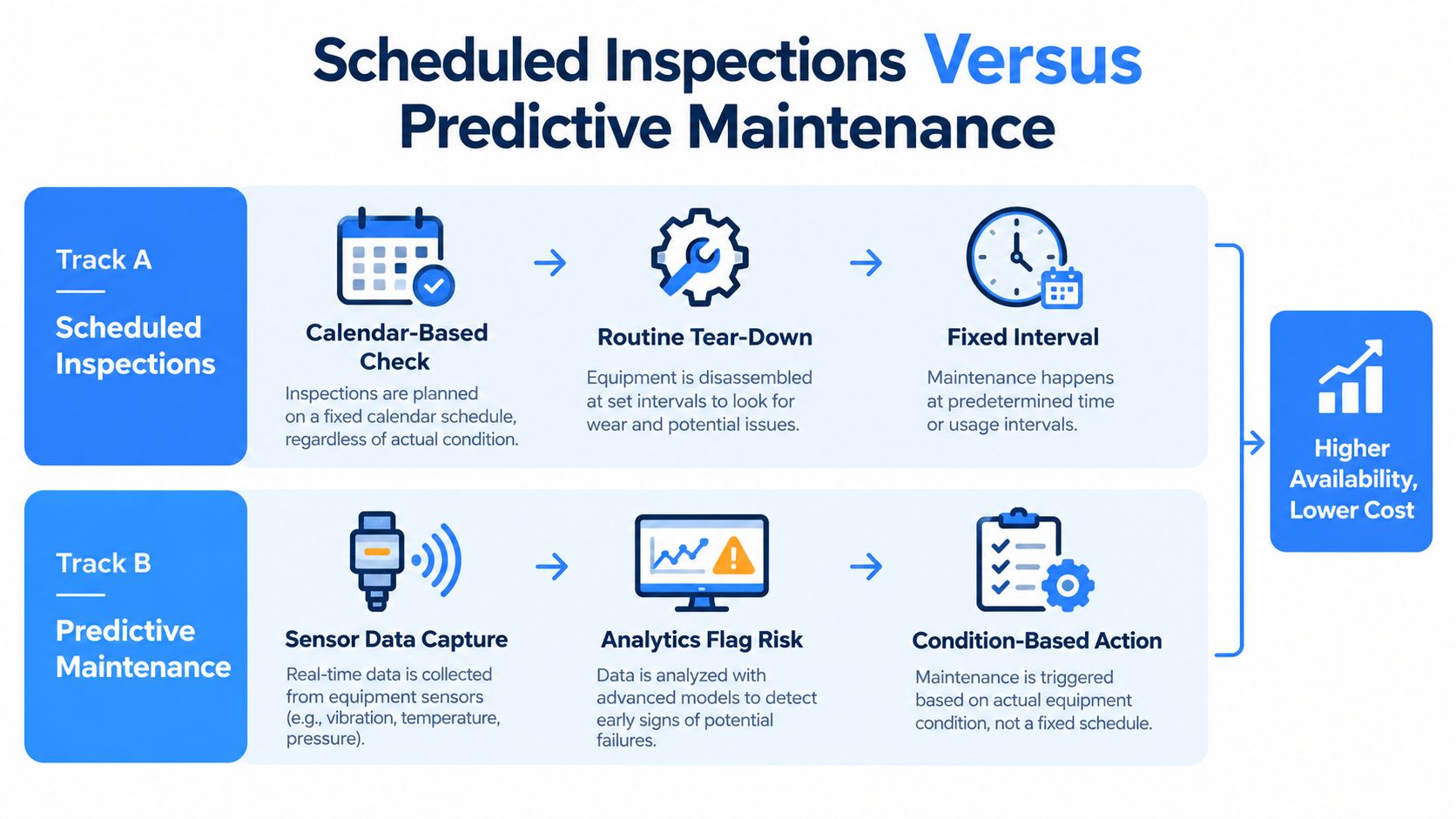
Scheduled inspections remain the foundation of airworthiness. Predictive maintenance adds a different capability, it uses aircraft-health data and trend analysis to identify abnormal behavior before the problem becomes an operational event.
The two approaches aren't substitutes. A predictive system doesn't remove an inspection required by the aircraft's approved maintenance program, and a calendar-based schedule doesn't necessarily reveal a developing fault between visits.
What scheduled work does well
Scheduled maintenance gives the operator a defined compliance structure. It ensures that recurring tasks, life limits, inspections, and manufacturer requirements are forecast and completed within approved intervals.
The FAA distinguishes between routine and detailed work in a progressive inspection system:
- Routine inspections involve visual examinations or checks of systems, components, and appliances as far as practicable without disassembly.
- Detailed inspections require a thorough examination and whatever disassembly is necessary. Component or system overhaul counts as detailed work.
- Progressive sequencing divides tasks across visits, but the aircraft receives a complete inspection at the beginning of the program and continues through the approved schedule.
- Turbine engine return to service requires engine operation after an annual, 100-hour, or progressive inspection to establish satisfactory performance in accordance with the manufacturer's recommendations (FAA Inspection Authorization information guide).
A short routine visit and a detailed inspection aren't interchangeable. The latter may require panels-off access, component removal, specialist labor, parts, post-maintenance testing, and an engine run.
What predictive systems add
Predictive maintenance monitors aircraft-health and maintenance data for abnormal trends. The operator can then plan labor, parts, and hangar time rather than waiting for a fault to appear during a mission sequence.
A 2024 aircraft lifecycle-management study reported unscheduled maintenance events falling from 50 to 35 per 1,000 flight hours, a 30% improvement. It also reported average downtime per event falling from 12 hours to 8 hours, a 33% reduction, modeled maintenance cost per flight hour falling from $1,200 to $900, a 25% decrease, and aircraft availability increasing from 85% to 92%, a 7-percentage-point improvement (2024 predictive-maintenance lifecycle study).
These results shouldn't be treated as a guaranteed business-jet outcome. They show the operating logic: earlier detection can turn an unscheduled event into a planned action, especially for fleets flying short-notice missions, multiple sectors, or international positioning.
Teams evaluating the wider principles can also review this practical resource on reducing downtime with maintenance strategies. The useful test is simple: does the system help maintenance control make a better decision before dispatch is threatened?
The Role of Brokers and Management Companies
Owners rarely need to perform every maintenance task themselves, but they do need someone accountable for the decisions surrounding those tasks. A management company usually controls the aircraft's ongoing maintenance system, while a broker or mobility provider evaluates whether a particular aircraft is suitable for a specific mission.
Management companies control continuity
A capable manager tracks inspections, life-limited components, deferred items, engine and airframe status, vendors, work orders, and signed records. The manager also coordinates crew availability, hangar access, parts procurement, regulatory obligations, and return to service.
That coordination matters because maintenance events rarely occur in isolation. A component replacement may affect the schedule, crew duty planning, passenger arrangements, and the next inspection forecast. A missing record can delay dispatch even when the physical work has already been completed.
For owners considering outsourced oversight, private aircraft management services can include maintenance tracking alongside crew staffing, regulatory compliance, charter revenue generation, and flight operations. The relevant question isn't whether a provider uses software. It's whether qualified people review the data and act on exceptions.
Brokers protect the mission choice
A broker should not treat a maintenance status report as a decorative document. Before assigning an aircraft, the broker should confirm the operator's certificate, inspection program, current due items, records continuity, AD status, and any restrictions that could affect the itinerary.
The broker also needs to ask operational questions:
- Can the aircraft complete every planned sector?
- Is it approaching a calendar or utilization threshold?
- Are critical components available through the operator's support network?
- Does the aircraft have a realistic recovery option if a fault appears away from base?
- Can the operator provide a suitable replacement without compromising the passenger's schedule?
A management company optimizes the aircraft over its lifecycle. A broker evaluates the aircraft against the mission. When both roles communicate properly, the owner gets more than compliance. The owner gets a buffer against technical uncertainty and a clearer link between maintenance decisions and commercial availability.
Real-World Scenarios in High-Stakes Operations
A maintenance decision becomes easier to understand when the aircraft is attached to a real mission. The same technical discrepancy can have a manageable consequence for a flexible corporate trip and a severe consequence for a medical evacuation or team movement.

Consider a medical repatriation planned around a patient transfer, medical crew, receiving facility, and ground ambulance. A technical issue found before departure isn't something the operator can push into the next available maintenance window. The team has to determine whether the aircraft can be legally and safely dispatched, whether the equipment configuration remains suitable, and whether another aircraft can meet the required routing and medical setup.
The maintenance record becomes operational evidence in that moment. Inspectors and maintenance control need current status, clear release documentation, and confidence that the aircraft's configuration matches the mission. A broker coordinating the flight also needs a replacement plan that accounts for medical equipment, cabin layout, range, crew, and airport access.
A corporate example looks different but creates the same pressure. An executive aircraft is scheduled for several meetings across multiple cities, with a narrow return window for a board event. A minor fault appears during a preflight inspection. The correct response isn't to choose the cheapest immediate fix without understanding the next leg. Maintenance control should assess the discrepancy, available parts, qualified personnel, required testing, and the consequences of delaying the aircraft at that location.
The operational question is not only whether the jet can depart. It is whether the entire mission sequence remains credible after departure.
Strong supplier relationships help in both scenarios. Operators that know which repair stations can troubleshoot a specific avionics system, which vendors can source a component, and which facilities can perform the required return-to-service work can make decisions faster. That doesn't eliminate technical problems, but it reduces the time spent searching for a solution after the aircraft is already grounded.
The following video provides useful visual context for the inspection environment and the coordination required around aircraft maintenance.
In high-stakes operations, proactive planning also means identifying the point at which a substitution becomes safer and more reliable than waiting for the original aircraft. A well-managed operator can make that call using records, technical advice, aircraft availability, and mission requirements rather than passenger pressure alone.
Building a Proactive Maintenance Strategy
A practical strategy starts with one change in mindset. Treat maintenance as an availability plan with technical, financial, and regulatory layers, not as a repair invoice that appears after the aircraft has a problem.
Review the aircraft's approved inspection program, upcoming calendar and utilization thresholds, engine and component exposure, AD matrix, deferred items, and records continuity. Then add the commercial layer: expected downtime, replacement lift, ferry requirements, crew disruption, and the value of the mission that could be delayed.
Use scheduled inspections to control compliance and predictive tools to identify abnormal trends earlier. Select repair stations based on capability, parts access, documentation quality, and turnaround reliability, not only quoted labor. For charter missions, verify the operator's certificate and maintenance program before considering the aircraft's cabin, range, or hourly price.
The safest and most cost-effective ownership experience comes from disciplined forecasting and accountable relationships. When maintenance control, management, brokers, vendors, and passengers work from the same current information, the aircraft has a better chance of being ready when the schedule demands it.
Approved Jets offers aircraft management that coordinates maintenance tracking, inspections, life-limited components, scheduled work, deferred items, parts, vendors, records, crew, and regulatory compliance. If you need help evaluating aircraft availability or arranging a mission through a vetted operator network, visit Approved Jets to discuss the right approach.