

Sports Team Charter Flights: A Practical Guide
Learn how sports team charter flights work, what they cost, and how to book one. A practical guide for travel managers and team operations leaders.

Approved Jets
On this page
- Table of Contents
- What a Sports Team Charter Flight Actually Is
- The operating components
- Why Teams Choose Charters Over Commercial and Bus Travel
- The return on the premium
- Aircraft Options and Cabin Configurations
- Start with the cabin
- Then verify the cargo
- What Drives the Price
- Demand changes the quote
- Ground Operations and Logistics
- Build the movement backward from wheels-up
- Safety Standards and Operator Vetting
- Documents to request
- Booking Process and Lead Times
- The working sequence
- Checklist, FAQs, and Next Steps
- Ten checks before release
- Operator questions that expose weak plans
At 5:40 a.m., the bus bay is already crowded. Forty-seven players, 11 coaches, two trainers, an equipment manager, and roughly 60 duffel bags are waiting to travel east for a noon tip-off. The aircraft isn't the difficult part. The difficult part is making sure every person, bag, credential, meal, vehicle, and contingency plan moves as one controlled operation.
That distinction separates a sports team charter flight from a luxury booking. The aircraft is only one component of a transport program that has to protect recovery time, preserve preparation, handle specialist equipment, and keep a traveling party together under pressure. The model has been part of professional sport for decades. The Smithsonian's account of baseball's early charter flights records the 1934 Cincinnati Reds' flight on two American Airlines Ford Tri-Motors and the 1946 New York Yankees' full-season United Airlines charter on the Yankees Mainliner.
Table of Contents
- What a Sports Team Charter Flight Actually Is
- Why Teams Choose Charters Over Commercial and Bus Travel
- Aircraft Options and Cabin Configurations
- What Drives the Price
- Ground Operations and Logistics
- Safety Standards and Operator Vetting
- Booking Process and Lead Times
- Checklist, FAQs, and Next Steps
What a Sports Team Charter Flight Actually Is
A sports team charter is a single-occupant aircraft wet-leased to one organization for a defined itinerary. The operator supplies the aircraft, crew, fuel, dispatch, maintenance coordination, and operational control. Depending on the aircraft and operation, the flight may fall under FAA Part 135, or under Part 121 when a larger airliner such as a Boeing 737 is chartered.
The traveling party drives the configuration, not the standard seat map. A 60-person group may need wide aisles, lie-flat seats, medical space, equipment storage, team meals, and a cabin layout that lets players rest without splitting the roster across multiple flights. Professional sports commonly uses VIP narrow-body airliners because group charters need 30 to 80 seats with domestic or international range, a configuration described in this group jet charter overview.
The operating components
The contract should identify the aircraft type or an acceptable replacement category, departure and arrival FBOs, operating carrier, routing, schedule, and baggage assumptions. The operator clears the passenger manifest, accepts equipment as manifested cargo, and manages crew and dispatch for the trip.
That makes a charter different from:
- A fractional share, which gives an owner access to aircraft within a broader program rather than exclusive control of one defined team itinerary.
- Scheduled service, where the airline controls the timetable, cabin, routing, and passenger environment.
- A commercial block purchase, where the team buys seats but still operates inside the airline's normal airport process.
- A one-off jet card trip, which may provide private access but isn't necessarily structured around a season-long team movement plan.
The practical test is simple. If the team can't control the manifest, cargo plan, departure process, and recovery plan, it hasn't yet built a true charter operation.
Operational rule: Treat the aircraft as the platform. The manifest, cargo plan, ground movement, and backup aircraft plan are the program.
Team travel also affects the group itself. A carefully organized itinerary can reinforce habits around communication and accountability, while these team-building tips from Gym Membership Tips offer ideas for strengthening those behaviors away from the aircraft.
Why Teams Choose Charters Over Commercial and Bus Travel
The decision isn't just private air versus airline convenience. A travel manager is balancing time, control, cargo, fatigue, and cost across three distinct transport modes.
Commercial travel may work for a small staff with light luggage and flexible arrival times. It becomes more fragile when a 60-person team needs to move together. Individual tickets create separate check-in records, security flows, boarding groups, baggage rules, and rebooking exposure. A delayed connection can turn one travel problem into several arrival times, while a bus keeps the group together but sacrifices a large part of the day on a long road trip.
A charter centralizes the movement. The team uses a controlled FBO environment, boards against one manifest, and can load equipment according to an agreed cargo plan. That doesn't make every charter faster or cheaper. It means the travel manager can design the journey around the game rather than fitting the game around scheduled airline capacity.
| Travel Mode | Door-to-Door Time | Cost Range | Split-Party Risk | Cargo Capacity |
|---|---|---|---|---|
| Commercial flight | Longer airport process, connections may apply | Lowest air option | High when seats or rebooking split the group | Airline baggage limits and separate handling |
| Bus | Longest on extended road routes | Usually lowest per mile | Low | Strong for ground cargo, subject to vehicle capacity |
| Team charter | Direct routing with controlled FBO handling | Highest | Low when the aircraft fits the party | Planned hold and cabin capacity for team equipment |
The return on the premium
The return isn't prestige. It's recoverable time and operational control. Players can arrive together, staff can brief in a controlled cabin, and the equipment manager doesn't have to coordinate dozens of unrelated baggage journeys. A larger aircraft also helps keep the party on one platform instead of forcing a split between multiple business jets.
The trade-off becomes sharper during major events. 2026 North American private aviation coverage reported a 2.2% year-on-year increase in June activity and a 4.3% forecast increase for July, while Europe was nearly flat at 0.1% in June as football clubs adjusted schedules around the FIFA World Cup. The same coverage cited Seattle at roughly double its usual daily private-jet traffic around an opening match, Mexico City at about 1.7 times baseline, and Signature recording 2,000 World Cup-related flight operations in the first week.
Those surges affect availability, positioning, airport slots, and pricing. A manager comparing travel modes should also account for athlete recovery routines, including nutrition planning. An athlete-focused supplement guide can help staff organize questions for medical and performance professionals, but it shouldn't replace team-specific clinical guidance.
For a structured overview of larger-party aircraft planning, see group charter flight coordination. The useful question isn't whether a charter feels premium. It's whether the saved time and reduced fragmentation justify the total mission cost.
Aircraft Options and Cabin Configurations
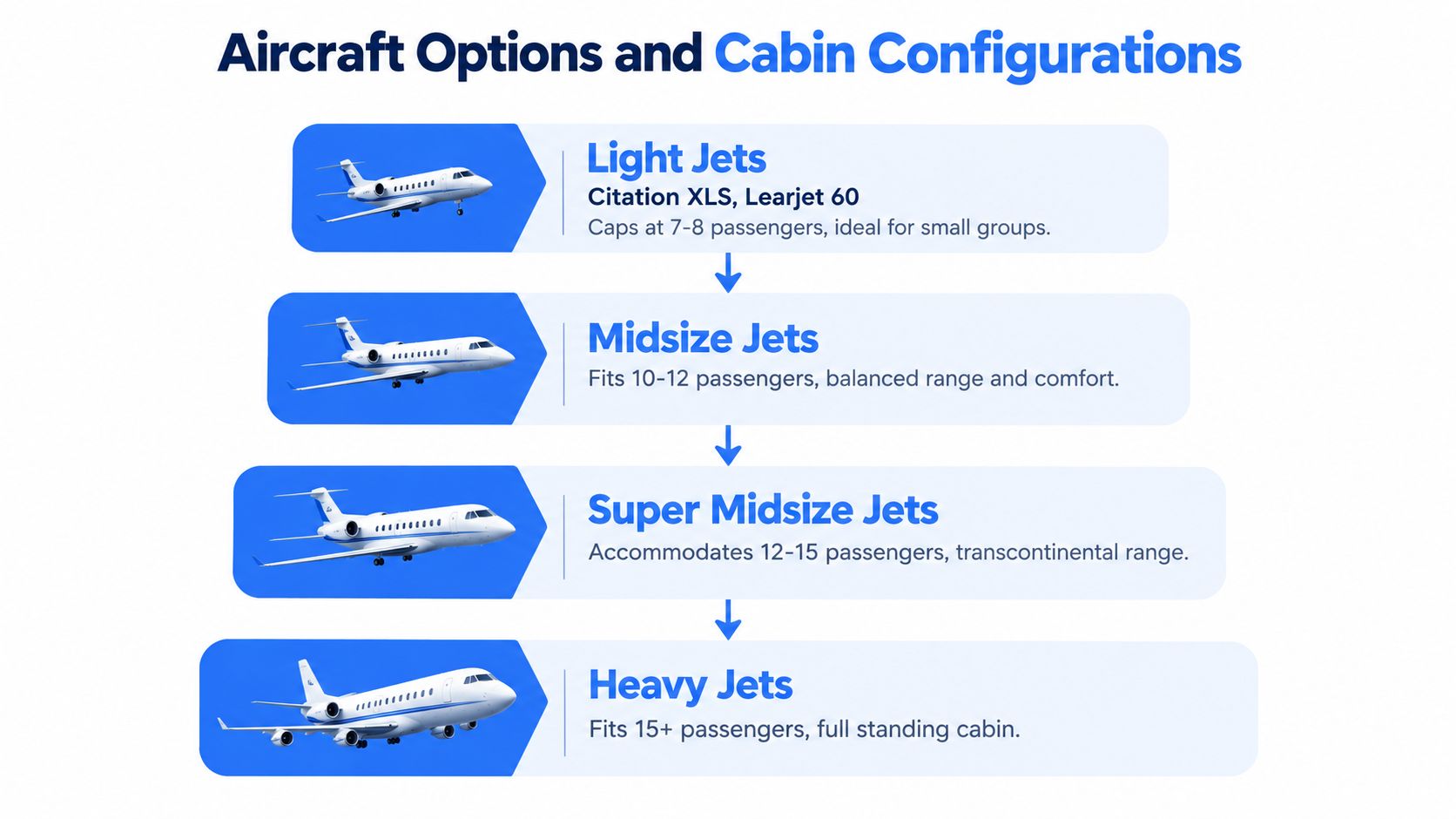
Match the aircraft to the roster and cargo profile, not the other way around. A small coaching group may fit a light jet, but a full football or hockey movement needs an airliner, not a stretched business jet with an optimistic baggage assumption.
Start with the cabin
Light jets such as the Citation XLS or Learjet 60 generally serve small coaching staffs and management groups. Midsize aircraft, including the Citation Sovereign and Hawker 4000, offer more range and cabin room but still leave limited space for bulky baggage.
Super-midsize aircraft such as the Challenger 350 and Citation Longitude are common choices for basketball or soccer staffs. They balance range, comfort, and a more useful cabin, while large-cabin aircraft such as the Challenger 605 and Gulfstream G550 serve larger staff movements where privacy and rest matter. A practical reference for comparing the midsize category is this guide to midsize private jets.
Above those categories sit airliners. Boeing 737, Airbus A320, and Embraer E190 or E195 aircraft can move full football or hockey rosters and are better suited to one-aircraft travel for groups of 60 to 90 people.
Then verify the cargo
The cabin isn't the whole mission. Ask for cargo-hold dimensions, door height, loading method, and usable volume. Below midsize cabins, operators may offer roughly 60 to 100 cubic feet of lower-deck capacity, but that figure is only useful when the equipment manager knows whether the bags will physically pass through the cargo door.
Hockey sticks, pads, ski racks, basketball hoops, and video cases should be pre-bagged, measured, and palletized where the aircraft supports pallet loading. A 36-inch cargo door can be more important than the aircraft's advertised cabin size.
The regulatory split matters, too. Part 135 generally covers smaller on-demand aircraft, while Part 121 governs scheduled airline operations and larger chartered airliners. The categories carry different crew-duty, maintenance, dispatch, and operational-control requirements. Don't accept “large enough” as an aircraft specification. Require the operator to confirm the applicable certificate and the exact configuration before the contract is signed.
What Drives the Price
A charter quote is the sum of a mission, not a seat price. The seven variables that usually move it are aircraft category, flight hours, repositioning, crew overnight expenses, catering, international handling, and peak-period demand.
Aircraft category creates the largest first-order difference. A light jet and a narrow-body airliner may fly the same route, but they don't carry the same party, cargo, crew complement, or operating cost. Flight hours then multiply the aircraft rate, while an empty repositioning leg can add cost before any athlete boards.
| Aircraft Category | Hourly Rate (USD) | Typical Party Size | Common Surcharges |
|---|---|---|---|
| Light jet | Not stated in verified data | Small staff group | Repositioning, crew expenses, catering |
| Midsize or super-midsize jet | Not stated in verified data | Staff or small team movement | Repositioning, overnight crew, handling |
| Large-cabin jet | Not stated in verified data | Larger staff group | Crew duty, international handling, peak demand |
| VIP narrow-body airliner | Not stated in verified data | 30 to 80 seats | Positioning, airport handling, event demand |
Demand changes the quote
Peak periods around major tournaments and championship events can tighten the fleet. The 2026 World Cup coverage cited earlier shows why host-city demand is a planning issue, not just a pricing footnote. Aircraft that appear available on a search screen may already be committed to positioning, crew recovery, or another event movement.
Ask for a leg-by-leg breakdown. It should identify aircraft, operating carrier, flight hours, repositioning, crew costs, catering, handling, taxes, international requirements, and cancellation terms. A lump sum conceals the parts of the mission that are most likely to change.
The same discipline applies to the aircraft contract. A team may need a wet lease with operator-provided crew and operational control. A dry-lease structure shifts more responsibility to the lessee and may not fit a travel department that needs one accountable operating carrier. Clarify that distinction before comparing totals, because two quotes can describe materially different services.
Ground Operations and Logistics
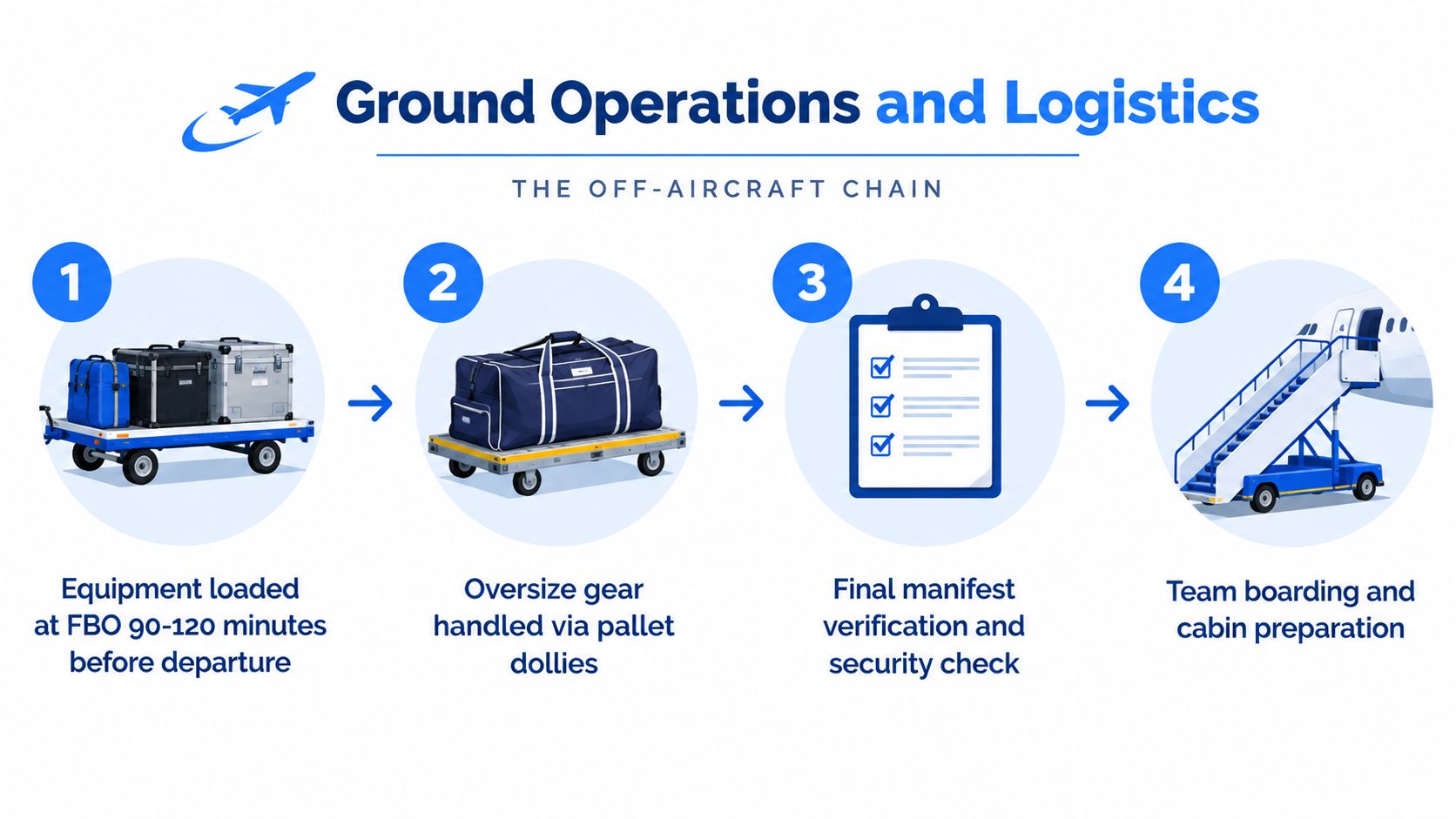
Most charter failures begin on the ground. The aircraft can be technically suitable, yet the trip still breaks down because equipment arrives late, a passenger is missing from the manifest, or the bus plan ignores ramp timing.
Start at the FBO. Equipment is commonly staged before departure, then loaded with ground carts or pallet dollies. Oversize items should be pre-bagged, weighed, and checked against the operator's baggage manual. The equipment manager should provide dimensions, weight, quantity, and handling instructions rather than sending a photograph of a pile of bags.
Build the movement backward from wheels-up
The NCAA provides a useful benchmark for disciplined team movement. Its Division I women's basketball guidance requires eligible teams to arrange charter travel through the NCAA program, limits that program to Part 121 and Part 135 aircraft, and states that travelers must report to the airport no later than one hour before scheduled departure. The NCAA travel memo also requires government-issued photo identification matching the manifest, limits baggage to one personal bag up to 50 pounds plus one carry-on up to 15 pounds, and advises institutions to keep the travel party at 145 or fewer. These requirements appear in the NCAA travel memo.
For an international flight, add customs coordination, APIS filing, passport verification, and designated-FBO requirements. Those tasks should be completed before the team arrives, not while players wait beside the bus.
The final handoff should account for deplaning, ramp transfer, baggage movement, and bus loading. A 55-passenger party needs an assigned arrival lead, a separate equipment lead, and a transport manifest that matches the aircraft manifest.
A useful visual reminder of that chain appears in the ground-operations video.
Safety Standards and Operator Vetting
Safety vetting starts with the named operating carrier, not the broker's logo. Ask who holds operational control, which certificate covers the flight, what aircraft is assigned, and which crew will operate it.
The verified industry safety summary for FAA Part 135 on-demand flying lists an accident rate of about 1.3 per 100,000 flight hours and a fatal accident rate of about 0.4 per 100,000 flight hours. Those figures provide context, but they don't replace operator-level diligence. A rate for a broad category can't tell you whether a specific carrier has the maintenance discipline, training program, and management depth your trip requires.
Documents to request
Before signature, request:
- Named operator: The carrier's legal name and current certificate information.
- Safety audit: ARGUS Gold or Platinum, Wyvern Wingman or Star, or another independently verifiable program.
- Operational records: Pilot duty-time information, aircraft maintenance status, and a written safety-management summary.
- Insurance evidence: A certificate of insurance with limits appropriate to the mission and passenger profile.
- Aircraft identity: The assigned tail number or a clearly defined replacement process.
Red flags include a quote with inconsistent tail numbers, an older aircraft without current ADS-B Out capability, refusal to disclose the operator, or vague language about who controls dispatch. A travel manager who wants broader context can also review this private jet charter guide from Passport to Adventure.
Use the same scrutiny when evaluating safety explanations. Private jet safety considerations can help frame the questions, but the broker should still provide the actual carrier documents for the specific mission.
Booking Process and Lead Times
A reliable booking sequence begins with a complete request for proposal. Send the roster, passenger roles, cargo dimensions, dietary requirements, medical considerations, preferred airports, schedule windows, and any international requirements in the first message.
The working sequence
- Issue the RFP. Ask several suitable operators or brokers to quote the same mission, not a vague “best aircraft available” request.
- Compare proposals. Check the carrier, aircraft, seat layout, cargo plan, ground handling, cancellation terms, and replacement language.
- Confirm the aircraft. Put the aircraft category, operating carrier, route, and schedule into the contract.
- Coordinate the ground plan. Assign FBO handlers, buses, equipment loaders, catering, security, and arrival contacts.
- Freeze the manifest. Reconcile names, identification, baggage, and last-minute changes before dispatch.
Off-peak trips may confirm in 5 to 7 days, while college football Saturdays often need 14 to 21 days of planning. For 2026 FIFA World Cup host-city travel, the cited market coverage reports minimum booking windows of 30 to 45 days in affected corridors. Those are planning benchmarks, not guarantees.
Last-minute recovery is possible, but it depends on aircraft position, crew duty limits, maintenance status, airport permissions, and cargo complexity. A broker may source an alternative in under 12 hours when the mission is simple and capacity exists. That isn't a promise that an international, equipment-heavy team movement can be rebuilt on the same timeline.
| Trip Type | Minimum Lead Time | Notes |
|---|---|---|
| Off-peak domestic movement | 5 to 7 days | Confirm aircraft, operator, FBO, and manifest |
| College football Saturday | 14 to 21 days | Demand and airport handling tighten options |
| 2026 World Cup host-city movement | 30 to 45 days | Event surge can affect availability and positioning |
| Same-day recovery | Case dependent | Mechanical swaps, crew duty, and permissions control feasibility |
Checklist, FAQs, and Next Steps
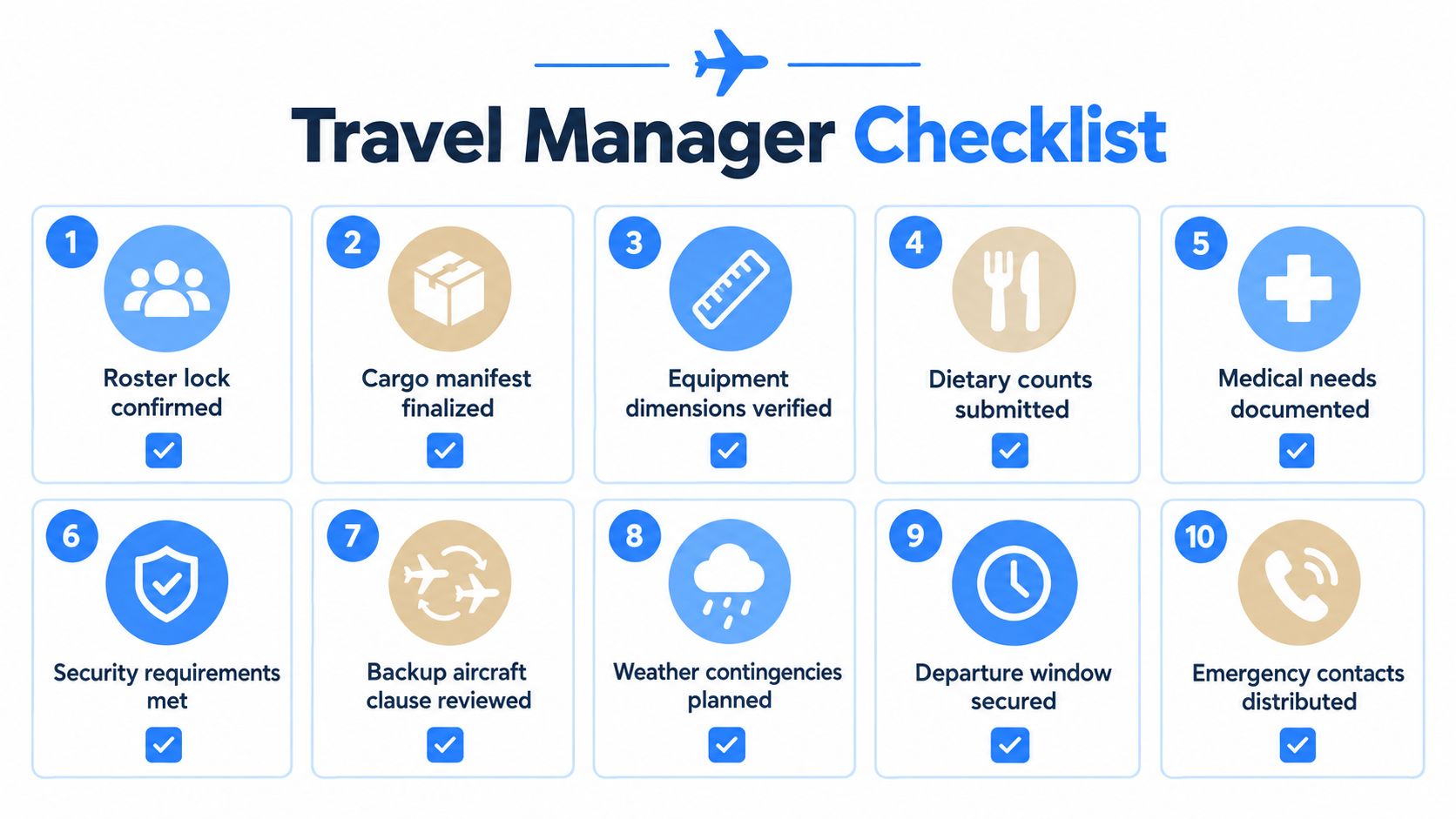
A travel manager's checklist should be short enough to use at the gate and detailed enough to prevent an avoidable failure.
Ten checks before release
- Roster lock: Confirm every traveler and role.
- Cargo manifest: List each equipment category and quantity.
- Dimensions: Verify door, hold, pallet, and weight limits.
- Dietary counts: Send meals and restrictions to catering.
- Medical needs: Document medication, treatment, and support requirements.
- Security: Confirm credentials, escorts, and venue protocols.
- Backup aircraft: Review the replacement aircraft clause.
- Weather: Set decision points for storms, alternates, and buses.
- Departure window: Secure the FBO, slot, and ground schedule.
- Emergency contacts: Distribute one current contact sheet.
Operator questions that expose weak plans
How many bags can each player bring? There isn't one universal allowance. The operator's aircraft, baggage manual, contract, and NCAA rules may all apply, so reconcile the team policy with the manifest before travel day.
Can athletes stream team content onboard? Ask the operator about connectivity, bandwidth, content restrictions, and cybersecurity. Don't assume a business-jet internet system will support a full team's simultaneous use.
What happens after a mechanical problem? The carrier should explain its recovery process, including maintenance control, replacement aircraft, crew legality, passenger care, cargo transfer, and ground transport. A vague “we'll find another jet” clause isn't an operational plan.
Can an NCAA team charter privately? NCAA Division I championship rules state that eligible schools located 400 or more miles from the assigned competition site may book a charter through Short's Travel Management. If an otherwise eligible school chooses to charter, the school may bear the extra cost, and splitting the travel party or adding travelers can also create additional institutional expense. Review the applicable championship memo, because rules vary by event.
What insurance applies? Request the carrier's certificate of insurance, confirm the named insureds and limits, and check whether the policy covers the actual operating carrier and mission. Don't treat a broker's general statement as proof.
How will World Cup surge pricing work? Host-city demand can affect aircraft positioning, FBO availability, crew accommodation, and replacement capacity. Ask for a validity period, change terms, positioning assumptions, and any event-related surcharge rather than accepting an unexplained premium.
The next step is a written intake, not a casual availability check. Send the roster, cargo list, trip calendar, airports, preferred departure windows, and budget band. Request three aircraft options, independently verify any ARGUS or Wyvern credential, confirm the Part 135 certificate through the FAA registry, and require a clear wet-lease or dry-lease explanation before signing.
Approved Jets offers on-demand charter coordination, group aircraft sourcing, manifest and ground-handling support, catering, security coordination, customs paperwork, and backup planning for complex movements. For a structured review of a sports travel calendar, visit Approved Jets and request an intake call focused on roster size, equipment, budget, and operational contingencies.