
How Much Does It Cost to Charter a Private Jet in 2026
How much does it cost to charter a private jet? See hourly rates by aircraft class, fees, and real trip examples to budget your charter accurately.

Approved Jets

On this page
- Table of Contents
- Introduction What Charter Pricing Really Means for Your Trip
- How Private Jet Charter Pricing Works by Aircraft Class
- Start with the smallest suitable aircraft
- Read the rate table as a suitability guide
- Beyond the Hourly Rate What Your Final Invoice Includes
- The line items that change the total
- Why the Same Jet Costs Different Amounts on Different Routes
- Route comparison matters more than sticker price
- Real Trip Examples From Short Hops to Long Haul Missions
- Key Factors That Drive Your Charter Cost Up or Down
- Six questions to ask before selecting an aircraft
- Smart Ways to Optimize Your Private Jet Charter Spend
Turboprops typically cost $1,500-$3,000 per flight hour, light jets $2,500-$5,000, midsize jets $3,500-$7,000, and heavy aircraft $8,000-$14,000+, with the highest ultra-long-range tiers reaching $22,000 or more per hour. Your final trip cost also adds positioning, airport fees, crew expenses, taxes, and other operational charges on top of the flight hours.
That range answers the first question, but it doesn't answer the question that matters when you're ready to book: what will this specific itinerary cost from departure to arrival? A quote that looks like a simple hourly rental is closer to a car rental with mileage, fuel, insurance, and a one-way drop-off charge added at checkout. The aircraft's rate is the starting point, not always the amount charged to your card.
Table of Contents
- Introduction What Charter Pricing Really Means for Your Trip
- How Private Jet Charter Pricing Works by Aircraft Class
- Beyond the Hourly Rate What Your Final Invoice Includes
- Why the Same Jet Costs Different Amounts on Different Routes
- Real Trip Examples From Short Hops to Long Haul Missions
- Key Factors That Drive Your Charter Cost Up or Down
- Smart Ways to Optimize Your Private Jet Charter Spend
Introduction What Charter Pricing Really Means for Your Trip
A first-time charter buyer might see a light jet quoted at $5,000 per hour, estimate a short flight, and expect a tidy total. The final proposal may be higher because the aircraft has to reach the departure airport, the crew may need overnight accommodation, and the itinerary may trigger landing, handling, catering, customs, or waiting charges. Those costs aren't necessarily hidden, but they are often separated from the headline rate.
The basic structure is straightforward. Private aviation is generally priced per aircraft and per billable flight hour, with the aircraft class setting the rate and the mission determining how many hours, legs, and operational services are involved. Aircraft type, range, cabin size, and operating complexity have historically driven pricing more strongly than the calendar year or route alone, as described in current private jet hourly-rate benchmarks.
Practical rule: Treat the hourly figure as the price of using the aircraft, not automatically the price of completing your trip.
Consider two travelers departing from the same city. One needs a turboprop for a short regional hop and can use a nearby airport. The other needs a heavy jet for an international mission, with more fuel, crew support, range, and airport coordination. Their invoices won't differ only because one aircraft is larger. The entire operating plan changes.
This distinction also separates chartering from owning an aircraft. Ownership brings acquisition, maintenance, storage, staffing, and compliance responsibilities, while chartering turns those obligations into a trip-specific expense. Readers comparing both models can review this overview of private jet ownership costs.
The useful way to approach “how much does it cost to charter a private jet” is to build the estimate in layers. Start with the aircraft class, match range and cabin to the mission, calculate the flight-hour component, then ask which positioning, airport, crew, tax, and service charges are included. That method produces a quote you can compare rather than a headline number that may not apply to your route.
How Private Jet Charter Pricing Works by Aircraft Class
Aircraft class sets the starting point for a charter estimate. It affects speed, range, cabin size, luggage capacity, and the airports an aircraft can use. The hourly bands below describe the base aircraft cost before itinerary-specific charges. Published guidance places turboprops around $1,500-$3,000 per hour, light jets around $2,500-$5,000, and higher categories in progressively broader bands (aircraft-class rate coverage).
Start with the smallest suitable aircraft
A turboprop often fits a short regional mission when jet speed is not necessary. Typical pricing is about $1,500-$3,000 per flight hour, according to 2026 turboprop and jet rate guidance. Very light jets generally serve 2-4 passengers and about 700-1,400 nautical miles, while light jets commonly accommodate 4-8 passengers and roughly 1,100-2,000 nautical miles (aircraft mission profiles).
Midsize aircraft suit larger groups and longer domestic sectors. They typically carry 7-9 passengers, cover about 2,000-3,000 nautical miles, and cost around $3,500-$7,000 per hour. Heavy jets handle more demanding missions, with typical capacity of 10-16 passengers and ranges around 4,500-6,500 nautical miles.
Airport fit can matter as much as cabin size. A smaller aircraft may use a closer regional airport with a shorter runway, while a heavier aircraft may require a longer runway and more airport support. Luggage volume also affects the choice, particularly when passengers carry sports equipment or several large bags.
Read the rate table as a suitability guide
| Aircraft Class | Typical Hourly Rate | Runway and luggage consideration |
|---|---|---|
| Turboprop | $1,500-$3,000 | Often suited to regional airports and practical short-trip luggage |
| Very light jet | $1,500-$3,000 | Smaller baggage compartment and flexible airport access |
| Light jet | $2,500-$5,000 | More cabin and luggage room, with broad airport flexibility |
| Midsize jet | $3,500-$7,000 | Greater baggage capacity and runway needs than smaller jets |
| Super-midsize jet | $5,500-$9,500 | Larger cabin and luggage capacity for longer missions |
| Heavy jet | $8,000-$14,000+ | Requires suitable runway infrastructure and supports substantial luggage |
| Ultra-long-range jet | Above $10,500, with top tiers reaching $22,000+ | Built for intercontinental missions, with extensive cabin and baggage capacity |
The table is a suitability guide, not a menu in which the lowest hourly rate always wins. An aircraft with insufficient range may require a technical stop or a less efficient operating plan. A heavy jet on a short route can charge for capacity and range that the group does not use.
Compare the full operating fit, not only the aircraft label. Just as travelers compare limo rental pricing by vehicle, duration, and service terms, charter buyers should compare aircraft category, billable hours, airport access, luggage needs, and included services. The right aircraft makes the hourly quote meaningful.
Beyond the Hourly Rate What Your Final Invoice Includes
The most important budgeting fact is that the quoted charter price can represent only 65%-75% of the final invoice, according to an independent analysis of private jet cost per hour. In other words, the advertised flight-hour component may account for roughly two-thirds to three-quarters of what you ultimately pay, while the remaining balance comes from the trip's operating details.
That doesn't mean every itinerary receives the same surcharge. A simple domestic flight with the aircraft already positioned at the departure airport may have fewer additions than an international trip requiring repositioning, customs handling, catering, and an overnight crew stay. Ask the broker to identify each item as included, estimated, or billed at cost.
The line items that change the total
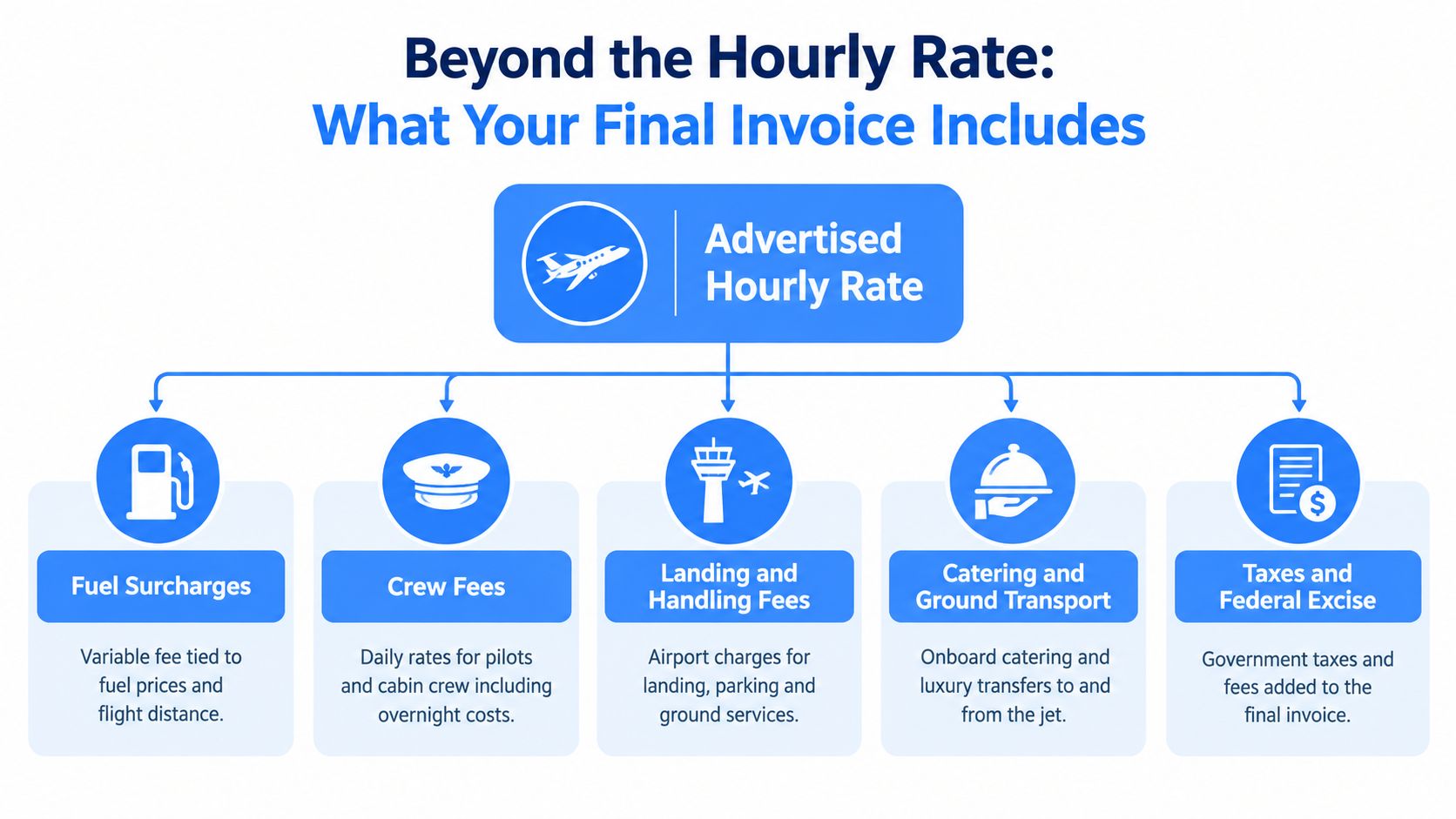
- Positioning and repositioning: If the aircraft isn't already at your departure airport, the operator may need to fly it to you. After dropping you off, it may also need to reach another base or passenger.
- Airport charges: Landing, parking, terminal handling, and ground services vary according to the airport and aircraft.
- Fuel adjustments: Some operators pass through fuel-related changes, particularly when distance or market conditions affect operating cost.
- Crew expenses: Pilots and cabin crew may require daily compensation, hotels, meals, or other overnight support.
- Passenger services: Catering, ground transportation, premium handling, and special onboard requests can appear outside the aircraft rate.
- International requirements: Customs, immigration, permits, and related coordination can add complexity to an international itinerary.
- Weather and waiting: De-icing, extended aircraft waiting, or schedule changes can create charges that weren't part of the initial flight-hour estimate.
Suppose a proposal shows a $5,000 hourly rate. Multiplying that number by the occupied flight time gives you only the base calculation. It doesn't tell you whether the aircraft must reposition, whether the crew will stay overnight, or whether the quote includes handling and catering. The correct question isn't “what's the hourly rate?” It's “what does the all-in total include, and what assumptions could change it?”
If your trip includes multiple activities, such as planning a Mediterranean yacht charter, coordinate the aviation segment with the wider itinerary. A late aircraft arrival, ground transfer delay, or customs requirement can affect the value of the entire journey, not just the flight.
Why the Same Jet Costs Different Amounts on Different Routes
A jet doesn't earn its hourly rate in isolation. The operator has to consider where the aircraft begins, where it ends, how long it sits on the ground, which airports it uses, and whether it has a paying mission afterward. That's why route-based pricing can diverge materially from a simple hourly estimate, as shown by published comparisons from Clay Lacy's charter cost examples.
A short hop can look inexpensive because the aircraft spends little time in the air. Yet fixed costs may occupy a large share of the trip. Positioning, minimum billable time, handling, and airport charges don't shrink in direct proportion to distance. The result can be a high cost per mile even when the total flight is brief.
A longer route creates the opposite effect in some situations. More flight time means more fuel and crew duty, but fixed charges are spread across a longer mission. The aircraft category may also change because a light jet's range, payload, or comfort may not suit the itinerary.
Route comparison matters more than sticker price
Published U.S. estimates place a Los Angeles to Las Vegas trip at about $11,000 in a light jet and $41,500 in a large jet. For Los Angeles to New York, the comparable estimates rise to roughly $56,000 for a light jet and $102,000 for a large jet. Those figures illustrate how stage length amplifies block hours, fuel burn, and aircraft-category economics.
Airport selection can shift the effective cost as well. A major commercial hub may offer convenient access but carry different landing and handling economics from a regional airport. A nearby alternative can work well if ground transport remains practical and the aircraft can operate there comfortably.
One-way and round-trip quotes deserve separate scrutiny. A round trip may allow the same aircraft and crew to remain connected to the mission. A one-way itinerary may require the operator to move the aircraft elsewhere, creating a repositioning charge. Empty-leg availability can reduce a price when the timing and route align, but it isn't dependable enough to treat as the default budget.
Real Trip Examples From Short Hops to Long Haul Missions
Concrete itineraries make the pricing system easier to use. The following published 2026 examples show how aircraft type and route length create very different trip totals, but they should be treated as market ranges rather than guaranteed quotes. The aircraft price is calculated for the complete mission, and the final invoice can change when positioning, airport services, taxes, or special requests are added.
A Miami to the Bahamas turboprop trip is cited at roughly $3,500-$7,000. The route demonstrates why a turboprop can be practical for a short regional mission. It offers a lower aircraft-class rate than a jet, but the buyer still needs to confirm airport handling, passenger services, and whether the aircraft starts at the departure airport.
A Miami to New York light-jet mission is cited at about $12,000-$18,000. The light jet brings more speed and jet-cabin convenience, while the route's longer stage length increases the base aircraft cost. If the aircraft has to reposition before or after the flight, the one-way estimate may not reflect the full operating plan.
A New York to Los Angeles midsize-jet trip is cited at approximately $18,000-$35,000. This is a mission where cabin comfort, baggage needs, and nonstop capability can matter as much as the passenger count. A quote should state the aircraft type, whether the rate assumes a minimum, and which airport fees are included.
An ultra-long-range New York to Dubai flight is cited at roughly $80,000-$120,000 (published route examples). At this level, range, crew planning, international handling, and the aircraft's availability become central to the proposal. The headline number reflects a major mission, not just a larger version of a short domestic hop.
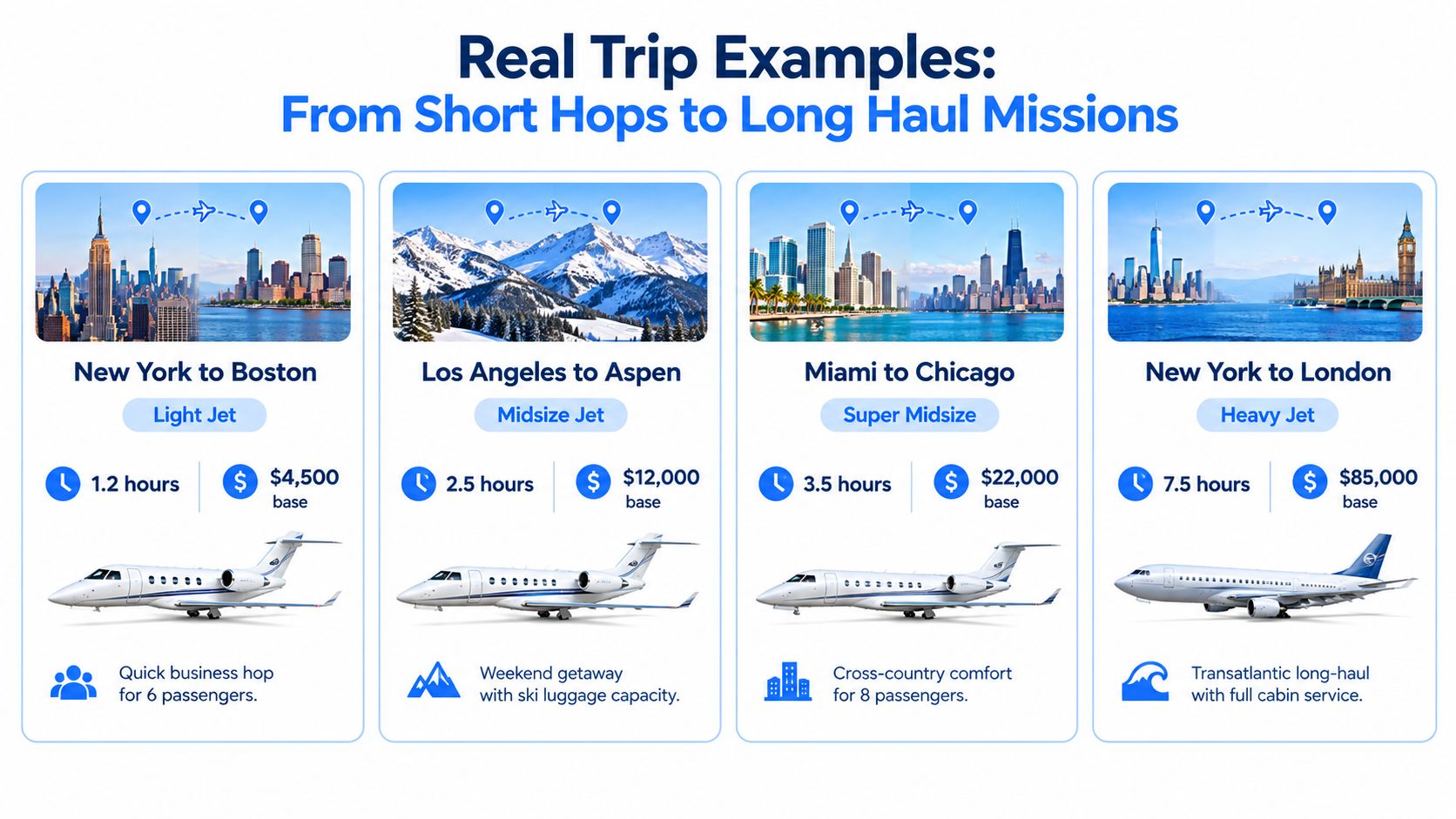
Use these examples as a planning template. Identify the likely class, estimate the occupied flight time, ask whether positioning is required, then request a written list of fees and assumptions. The arithmetic becomes useful only when every leg is visible.
Key Factors That Drive Your Charter Cost Up or Down
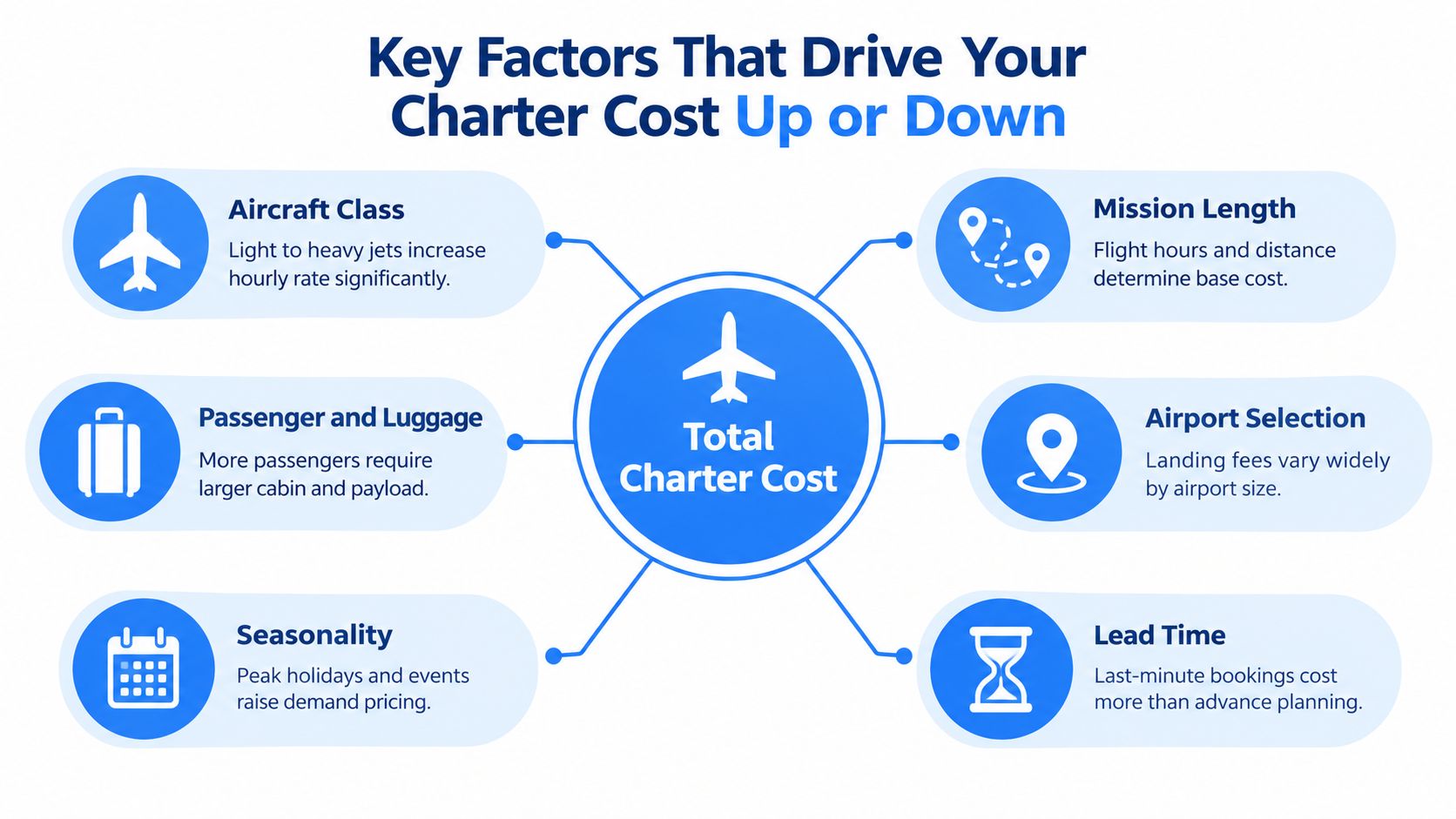
A charter quote reflects the whole mission, not just the aircraft class. Passenger count, luggage, route, airport access, timing, and availability work together. Change one factor, and the operator may need a different aircraft or operating plan. The hourly figure is often only part of the invoice, because positioning, minimums, and airport services can add cost.
The main trade-off is capability versus practicality. A group of 4-8 passengers may fit a light jet, but choosing a midsize aircraft can provide more payload room, baggage flexibility, or nonstop range. That larger cabin may also require different airports, with higher handling charges or longer ground transfers. A smaller aircraft can cost less per hour yet become less economical if it needs a fuel stop, cannot carry the luggage, or must be repositioned. Review aircraft rate and range profiles for a general comparison, then ask how the aircraft fits your actual route.
Six questions to ask before selecting an aircraft
- Aircraft class: Are you paying for unused cabin, payload, or range?
- Mission length: How many flight hours and separate legs are billable?
- Passengers and luggage: Will equipment, pets, or bulky bags change the aircraft choice?
- Airport choice: Does a nearby regional airport reduce handling or ground time?
- Seasonality: Could event dates limit aircraft availability?
- Lead time: Would earlier planning provide more suitable options?
Daily minimums matter on short trips. The aircraft may fly briefly while the operator bills a minimum time or adds a repositioning leg. The cheapest hourly category therefore may not produce the lowest final total.
Route economics also depend on the aircraft's next assignment. An empty leg can reduce the quoted cost when its route and timing align, but it may offer less scheduling flexibility. See these private jet charter empty legs for the trade-offs.
Travel managers should coordinate aviation with the full schedule. Detailed executive itinerary planning can show whether an airport change, transfer, or departure adjustment improves the overall result. Ask for each assumption in writing, including positioning, minimums, airport fees, and crew expenses.
Smart Ways to Optimize Your Private Jet Charter Spend
Cost control works best when you flex the variables that don't affect the purpose of the trip. You may not be able to change the destination, but you might be able to use a nearby airport, shift the departure window, or select a midsize aircraft instead of a larger class.
- Right-size the aircraft: Match the cabin, range, and payload to the actual group. Don't pay for intercontinental capability on a regional mission.
- Compare airports: Ask for practical options near both ends of the journey. A regional airport may change the fee structure and ground-transfer time.
- Keep timing flexible: Give the operator more than one workable departure window when possible. Flexibility can improve aircraft availability.
- Evaluate empty legs carefully: An empty leg can be attractive when the route and timing match, but the schedule may be less adaptable and the aircraft may not be positioned exactly where you need it.
- Compare one-way and round-trip structures: Ask how the aircraft will be used after drop-off and whether a return or repositioning leg affects the total.
- Request an itemized quote: Require the proposal to show flight hours, positioning, airport charges, crew expenses, taxes, catering, ground transport, and assumptions in separate lines.
- Use a clear response process: A broker with a stated quote turnaround target can help you compare live availability before the aircraft option changes.
For another perspective on lowering the total, review guidance on cheap private jet charter options, while keeping the safety, aircraft condition, operator credentials, and all-in price visible. A low headline rate isn't a bargain if it requires an unsuitable aircraft or adds substantial positioning costs.
Before accepting, compare each proposal on the same basis: same airports, same passenger and luggage details, same dates, same aircraft class, same number of legs, and the same definition of “included.” Then ask what can change between quote and departure.
Approved Jets arranges on-demand domestic and international charters through a vetted operator network and coordinates aircraft matching, ground transfers, catering, customs support, and other trip logistics. Visit Approved Jets to request an itemized private jet quote built around your route, passengers, luggage, timing, and preferred airports.