

Super Midsize Jets: The Ultimate Guide
Discover what super midsize jets are, their range capabilities, key models like the Challenger 3500, and why they are the top choice for corporate travel.

Approved Jets

On this page
- Table of Contents
- Why Super Midsize Jets Are Leading the Market
- The segment solves a common fleet problem
- Defining the Capabilities of a Super Midsize Jet
- Start with the cabin, not the brochure range
- Match the aircraft to the mission profile
- Key Models That Define the Segment
- The established benchmark
- The broader competitive field
- Performance Specifications and Airport Flexibility
- Comparing published performance
- Airport access changes the value equation
- Real-World Utility Versus Advertised Range
- The luggage test is often decisive
- Where the category works, and where it doesn't
- The Business Case for Super Midsize Operations
- Why frequent users see the difference
- The workhorse conclusion
Super midsize jets lead all aviation segments at 32.6 flight hours per tail year-to-date, with utilization 19.9% above 2019 levels. That makes them more than a comfortable middle ground, they're the current workhorse for frequent private aviation missions.
The appeal is operational rather than ornamental. A super midsize aircraft can carry a useful executive group, fly meaningful transcontinental routes, preserve a stand-up cabin and practical baggage capacity, and still avoid the size and mission cost of a large-cabin jet. For corporate buyers, fractional users, charter clients, and travel managers, that combination often matters more than prestige.
The right question isn't whether a super midsize jet looks luxurious. It's whether the aircraft can perform your actual missions with enough payload, runway flexibility, scheduling resilience, and cabin utility to justify its place in the fleet.
Table of Contents
- Why Super Midsize Jets Are Leading the Market
- Defining the Capabilities of a Super Midsize Jet
- Key Models That Define the Segment
- Performance Specifications and Airport Flexibility
- Real-World Utility Versus Advertised Range
- The Business Case for Super Midsize Operations
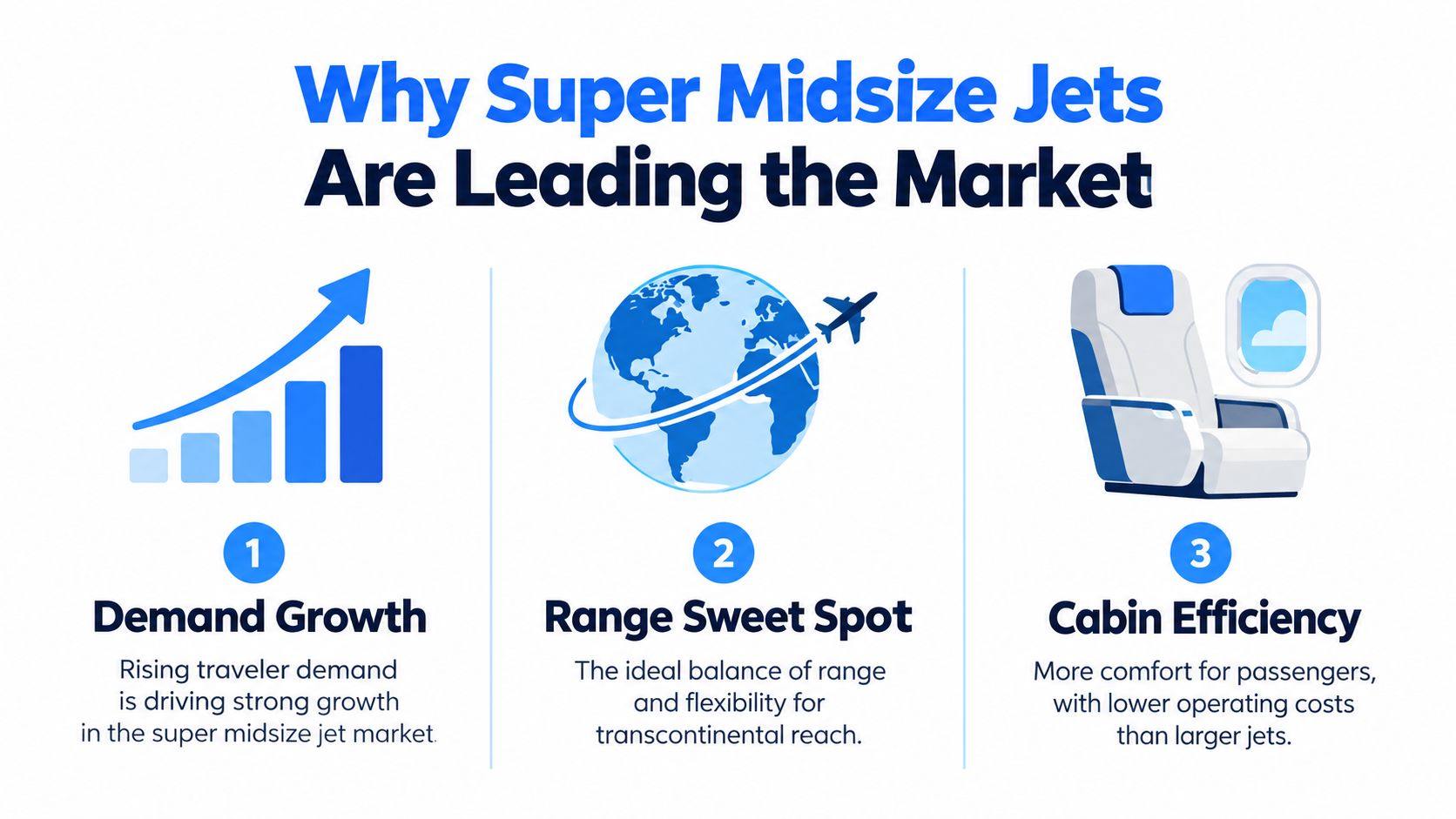
Why Super Midsize Jets Are Leading the Market
Super midsize jets recorded 32.6 flight hours per tail year-to-date through May 2026, the highest utilization among the aviation segments tracked. Their activity was 19.9% above 2019 levels and 3.0% ahead of 2025 year-to-date performance, according to the May 2026 JETNET and WINGX market monitor.
Utilization at that level reflects a fleet decision, not a luxury preference. Operators are assigning these aircraft to corporate travel, regional connectivity, coast-to-coast sectors, and recurring multi-passenger missions. The class earns its place by completing more of those trips without the acquisition, operating, and airport demands associated with a large-cabin jet.
The segment solves a common fleet problem
A light or conventional midsize jet can handle a short business hop efficiently, but its cabin, baggage space, and payload margins become less comfortable as sectors lengthen. A large-cabin aircraft addresses those constraints, while adding capacity and cost that many businesses cannot use on routine domestic or regional missions.
Super midsize jets fill that operational gap. The class is commonly configured for 6 to 9 passengers, with the cabin volume, baggage capacity, and runway performance needed for frequent corporate flying. Published aircraft specifications place individual models across a broad band of range, cruise speed, and service ceiling, so buyers should compare the exact airframe and mission profile rather than rely on a segment label.
That distinction matters in route planning. A New York to Los Angeles or London to Dubai mission may fit the aircraft's advertised capability, but the usable result depends on passenger and baggage payload, winds, fuel reserves, airport conditions, alternates, and regulatory requirements. A broker evaluating the aircraft against an actual schedule should test those variables together.
Practical rule: Utilization is a stronger buying signal than cabin glamour. If an aircraft can perform more of your real missions without being oversized for the task, it deserves closer attention.
The segment also supports charter, corporate, owner-flown, and fractional operations. That broad operator base can make it easier to find qualified crews, maintenance expertise, charter demand, and comparable resale transactions than with a more specialized aircraft class.
For an executive buyer, the case is straightforward. Super midsize jets lead because they function as operational workhorses. They carry several passengers, support meaningful luggage requirements, handle recurring longer sectors, and preserve scheduling flexibility without requiring large-cabin capability on every trip. The right aircraft is the one that matches the fleet's actual duty cycle, not the one with the most impressive brochure.
Defining the Capabilities of a Super Midsize Jet
Most broker definitions center on about 8 to 10 seats and 2,800 to 3,600 nautical miles of standard-mission range. That profile covers many nonstop transcontinental routes, including New York to Los Angeles and London to the Middle East, according to Sky Access's guide to private jet aircraft classes. Maximum-range figures can run higher, reaching about 4,500 nautical miles, while cruise speeds generally fall between 450 and 528 KTAS. The difference reflects how manufacturers and brokers define the category, including whether they emphasize standard mission range, maximum range, cabin size, or the wider market.
The practical definition is an operational one. Recent JETNET and WINGX utilization data is useful in that context because it focuses attention on recurring aircraft use rather than cabin appeal. A super midsize jet earns its place as a workhorse when its capacity, speed, and range support a large share of the operator's actual schedule.
Start with the cabin, not the brochure range
Cabin dimensions determine how usable the aircraft feels on longer sectors. Super midsize jets commonly offer a stand-up interior with a height of roughly 5'9" to 6'2", giving passengers room to move during the flight. Many also feature a flat floor, which improves circulation and feels less restrictive than a smaller midsize cabin.
Baggage capacity carries equal weight. Published space commonly reaches 80 to 100 or more cubic feet, giving executives a better chance of carrying passengers and luggage together without sacrificing payload. The super midsize aircraft overview from ACASS explains how cabin ergonomics, range, speed, and baggage capacity interact.
Evaluate the aircraft with a representative passenger load, not an empty cabin. Confirm that it can carry the normal group, luggage, fuel, and required reserves on the longest frequent mission. An aircraft with ten seats is not a ten-passenger solution if that load cannot reach the intended destination with the required baggage and reserves.
Match the aircraft to the mission profile
Use this sequence when comparing a super midsize jet with a conventional midsize aircraft:
- Count the actual passengers. Base the assessment on the normal executive group, not the maximum seating configuration.
- Measure baggage demand. Samples, presentation materials, sports equipment, and winter clothing can change the aircraft choice.
- Map recurring routes. Review the actual origin and destination airports, not only the city names.
- Test the longest practical sector. Include reserves, weather, payload, and likely winds.
- Check the cabin over time. A four-hour sector can expose ergonomic weaknesses that a short flight hides.
A super midsize jet makes sense when its cabin, speed, and mission range work together. The category alone does not justify its cost. Compare the aircraft with midsize private jet alternatives, then identify where the added cabin and performance create measurable operational value.
Key Models That Define the Segment
The super midsize jet became an operational workhorse because several platforms combine useful cabin volume, transcontinental capability, and broad operator support. The Bombardier Challenger 350 is the clearest example. The Flying Engineer's 2026 private jet types guide reports more than 1,050 aircraft delivered from 2014 through 2023, making it the best-selling aircraft in the class. The same guide records the Gulfstream G280's entry into production in 2012, 250 deliveries by March 2023, and an average of 112 super midsize jet deliveries annually between 2018 and 2022.
These figures describe more than sales momentum. A large installed base gives operators access to trained crews, maintenance providers, charter experience, and comparable aircraft in the pre-owned market. That support reduces execution risk for buyers who need a dependable fleet tool rather than a novelty aircraft.

The established benchmark
The Challenger 350 shows why the category moved into mainstream corporate and charter operations. Its cabin provides the space buyers expect from a super midsize aircraft, while its mission profile avoids the cost and capacity of a large-cabin jet when those capabilities are unnecessary. Its market presence also gives buyers more operating references when assessing an acquisition, charter program, or replacement aircraft.
A Bombardier Challenger 350 market overview provides useful background for comparing the platform with newer designs. The practical advantage is predictability. Buyers can evaluate known maintenance patterns, crew familiarity, cabin configurations, and resale comparables instead of relying mainly on projected performance.
The broader competitive field
The Gulfstream G280 gives the segment a second established reference point. Its production record confirms that demand extends beyond one manufacturer, while the broader delivery average indicates sustained activity across the category rather than a single-model surge.
Current shortlists commonly include the Embraer Praetor 600, Cessna Citation Longitude, Bombardier Challenger 3500, and Gulfstream G280. Compare them on cabin layout, avionics, runway requirements, baggage access, maintenance coverage, and payload at the required range. A newer aircraft may offer a more current cabin or technology package. An established aircraft may provide stronger availability, deeper operational familiarity, and a more predictable pre-owned market.
The right choice follows the recurring mission. Select the aircraft that handles the normal passenger load, route pattern, baggage requirement, and reserve policy with the fewest compromises. Specification-sheet leadership matters less than dependable execution across the trips the aircraft will fly.
Performance Specifications and Airport Flexibility
A super midsize jet earns its workhorse status through repeatable airport access, not headline range alone. Range matters only when the aircraft can depart with the required fuel and payload from the airport your operation uses. Representative aircraft such as the Praetor 600, Citation Longitude, and Challenger 3500 are published with ranges near 3,900 to 4,620 nautical miles and takeoff distances around 1,438 to 1,474 meters, according to IBC Aviation's comparison of midsize and super midsize jets.
Treat those figures as comparison points, not guaranteed dispatch results. Takeoff distance changes with aircraft weight, temperature, runway elevation, surface condition, wind, obstacles, and the assumptions used by the manufacturer. A buyer who focuses only on maximum range can select an aircraft that reaches a destination on paper but cannot depart from the preferred airport with a useful payload.
Comparing published performance
The published figures place these aircraft in a similar operating band, but they do not describe one universal result for every configuration. Each model's actual performance depends on the selected engine setting, fuel load, passenger count, baggage, runway conditions, and required reserves. That is why a clean comparison should identify the source figure and its assumptions rather than repeat a generic range band.
A practical review should record, for each aircraft:
- published range in nautical miles;
- takeoff distance in meters;
- payload available at the planned range;
- runway requirements under expected temperature and elevation;
- fuel and reserve assumptions behind the published result.
That information gives the buyer a useful screening tool. It does not replace a formal performance analysis for a specific trip.
Airport access changes the value equation
Airport flexibility can determine whether private aviation saves meaningful time. Landing near a factory, project site, regional office, or final meeting may matter more than adding distance to the aircraft's maximum capability. A super midsize jet with suitable runway performance can support more useful routing options than an aircraft that requires a major hub for the same mission.
The practical test is a real itinerary. Give the operator the departure airport, arrival airport, passenger count, baggage requirement, desired departure time, and return schedule. Ask for the dispatch assumptions, payload limits, fuel restrictions, and any runway margin concerns.
A longer-range jet can still be the wrong aircraft if its runway and weight margins do not support the airport your business actually uses.
Hot-and-high airports require particular scrutiny. Reduced air density can increase takeoff requirements and constrain payload, so the aircraft that appears strongest in a brochure may lose that advantage under demanding conditions. Review airport suitability before choosing a fleet or fractional share. That discipline is what turns a super midsize jet from a specification-sheet purchase into a dependable operational workhorse.
Real-World Utility Versus Advertised Range
Advertised range is a starting point, not a dispatch promise. It describes how far an aircraft may travel under defined assumptions, but it does not confirm that the jet can carry your normal passengers and luggage, depart from your preferred runway, arrive with suitable reserves, or complete the route without a fuel stop in the conditions you will face.
As noted earlier, the segment covers a broad published range, outlined in ACASS's super midsize jet guide. That capability supports many coast-to-coast U.S. missions and demanding corporate routes. It does not make a super midsize aircraft a substitute for a long-range cabin on every international itinerary. The useful question is how much of the advertised capability remains after payload, weather, reserves, and airport limits are applied.
The luggage test is often decisive
A buyer may begin by asking, “Can this jet fly from one city to another?” The better question is, “Can it fly that route with the people and equipment we normally carry?”
Executives may bring garment bags, product samples, presentation cases, technical equipment, or seasonal clothing. A cabin can feel spacious while its baggage access remains awkward or its usable storage proves restrictive. That creates a direct trade-off between passenger count and luggage. Flat-floor cabins and substantial baggage capacity are therefore operating features, not just comfort upgrades.
Payload discipline separates a dependable workhorse from a brochure performer. Confirm what the aircraft can carry on the proposed route, not what it carries on a lightly loaded demonstration flight.
Industry commentary describes super midsize jets as putting pressure on the midsize segment because customers value roomy cabins and practical baggage compartments alongside range. For recurring corporate travel, that combination can protect productivity and reduce packing compromises on longer sectors.
Where the category works, and where it doesn't
Super midsize jets fit missions such as:
- Transcontinental domestic travel: Routes such as New York to Los Angeles can suit the class when payload, weather, and airport conditions support the flight.
- Frequent executive sectors: The cabin offers a more practical environment for work and movement during longer trips than many smaller midsize aircraft.
- Passenger and baggage integration: The aircraft can often carry a useful group without requiring a large-cabin solution.
- Regional airport access: Suitable runway performance can place the aircraft closer to the final destination than a commercial hub.
Transatlantic missions need closer review. These aircraft will usually require a fuel stop for transatlantic flying, so buyers should not treat a super midsize jet as a true replacement for a long-range intercontinental aircraft. That limitation may be acceptable when most travel is domestic or regional. It becomes a poor fit when nonstop ocean crossings are a routine requirement.
The right comparison is mission utility, not brochure range. A midsize jet may cover shorter sectors efficiently, while a heavy or large-cabin aircraft may earn its cost through regular intercontinental work. Super midsize jets function as operational workhorses when the business needs more cabin and range than midsize aircraft provide, but does not require large-cabin capability on most trips.
The Business Case for Super Midsize Operations
The strongest argument for super midsize jets is operational productivity. Recent market coverage places the segment at the top of utilization, while a separate 2026 market report states that availability is 5.3% of the fleet and absorption is under four months, according to the OmniJet 2026 second-quarter market report.
Those conditions suggest that demand is being driven by how operators use the aircraft, not merely by the appeal of a larger cabin. The same market commentary describes the tier as the healthiest part of the pre-owned market and the most requested share in fractional fleets. That combination is consistent with a workhorse asset, an aircraft that can generate value across many recurring missions.

Why frequent users see the difference
A company flying executives between major offices may need more than a comfortable cabin. It needs an aircraft that can support dense scheduling, carry the required group, reach useful airports, and avoid the operational excess of a large-cabin jet.
A super midsize aircraft can be especially compelling when the trip profile includes repeated domestic transcontinental flights, multi-city corporate travel, and passenger groups that change from one mission to the next. It can also serve more than one department or executive team, improving fleet versatility compared with an aircraft designed around a narrower route profile.
That doesn't mean the category is automatically the cheapest ownership choice. Acquisition cost, crew, maintenance, hangar, insurance, repositioning, and downtime still determine the actual economics. The business case improves when utilization is high enough to spread fixed costs across many productive missions, and when the aircraft avoids the need to charter a larger jet for routine trips.
For a structured ownership analysis, buyers should compare their projected missions with private jet ownership costs, including the cost of backup lift when the primary aircraft is unavailable. Fractional users should apply the same discipline. The headline aircraft category matters less than guaranteed access, peak-day availability, repositioning rules, and the ability to match aircraft size to each trip.
The workhorse conclusion
Super midsize jets offer a strong utility-to-complexity balance for businesses that fly frequently but don't require large-cabin intercontinental capability. They provide enough cabin scale for executive groups, enough range for many transcontinental missions, and enough operational breadth to support charter, corporate, fractional, and owner-flown use.
The model also has a contrarian advantage. Buyers who focus only on luxury may overlook the category's more important benefit, asset productivity. A jet that is suitable for a wide range of business missions can be more useful than a larger aircraft that spends much of its time carrying unused cabin capacity.
A serious decision should begin with the company's route map, passenger patterns, baggage requirements, preferred airports, and schedule pressure. If those factors point toward frequent domestic and regional use, super midsize jets deserve to be evaluated as an operating platform, not a status purchase.
Approved Jets arranges on-demand charter flights and integrated travel logistics, including aircraft matching based on mission profile and luggage requirements. To evaluate a super midsize option for your routes, passenger load, and preferred airports, contact Approved Jets for a personalized recommendation.