

Cargo Charter Flights: The Essential 2026 Guide
Discover everything you need to know about cargo charter flights in 2026, from booking and benefits to cost-saving tips for shipping urgent freight.

Approved Jets
On this page
- Table of Contents
- What Cargo Charter Flights Actually Are
- Why the category exists
- Ad hoc versus wet lease
- How the Booking and Operations Workflow Runs
- The eight operational stages
- Aircraft Types and Payload Capabilities
- What Drives the Cost of a Cargo Charter
- The quote anatomy
- Regulatory, Customs, and Chain-of-Custody Rules
- Operator and dangerous-goods checks
- Customs and custody
- When a Cargo Charter Beats the Alternatives
- Where charter earns its place
- Practical Planning Checklist and FAQs
- The pre-flight check
- FAQs
At 02:00, a plant manager rarely cares whether a flight is called premium, bespoke, or non-scheduled. They care whether the replacement part reaches the line before the morning shift, whether customs releases it, and whether the aircraft can carry it safely. That's the purpose of cargo charter flights. They're a recovery tool, a capacity hedge, and sometimes the cheapest option once downtime, missed launch windows, or failed temperature control enter the calculation.
Charter isn't automatically the right answer. If scheduled freight can meet the delivery window, use it. If the shipment can move by ocean without damaging production or customer commitments, don't rent an aircraft. But when the cost of waiting exceeds the cost of controlling the entire mission, a charter gives you something a timetable can't: direct capacity under your command.
Table of Contents
- What Cargo Charter Flights Actually Are
- How the Booking and Operations Workflow Runs
- Aircraft Types and Payload Capabilities
- What Drives the Cost of a Cargo Charter
- Regulatory, Customs, and Chain-of-Custody Rules
- When a Cargo Charter Beats the Alternatives
- Practical Planning Checklist and FAQs
What Cargo Charter Flights Actually Are
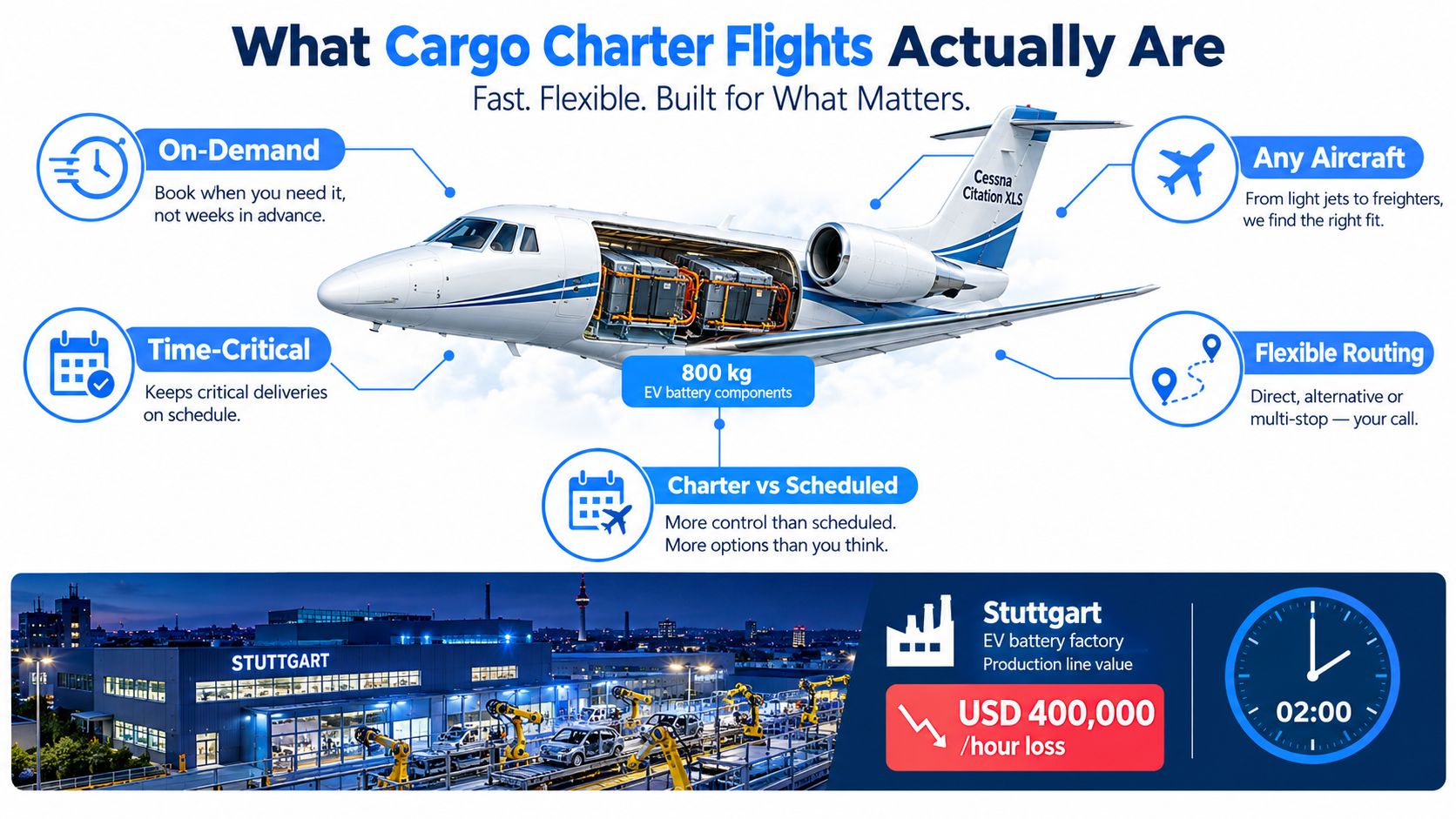
At 02:00, an EV battery plant in Stuttgart loses a production line. The replacement control units are in Lyon, weigh 800 kg, and must arrive before the morning shift. A Cessna Citation XLS may be the practical answer, not because it carries a large load, but because it can move a small, valuable shipment directly when a freight network can't meet the deadline.
That is a cargo charter flight, a one-off aircraft hire arranged for a defined mission. The buyer, or a broker acting for the buyer, books the aircraft, available payload, crew, and routing for that movement instead of purchasing space on a published airline service. The arrangement is built around the shipment's need, not the carrier's existing schedule.
Why the category exists
Scheduled freight works well for consolidated pallets, repeat lanes, and predictable handovers. It's poorly suited to a production line that has already stopped, hospital blood stocks, or a 12-metre industrial rotor that cannot fit through a conventional cargo door. Charter exists because some shipments need a dedicated aircraft, a non-standard airport, or control over the departure sequence.
The model has deep roots. On 7 November 1910, the Wright brothers carried 200 pounds of silk 65 miles from Dayton to Columbus, Ohio, in 57 minutes, widely cited as the first documented freight flight. That early movement established the commercial logic of urgent, point-to-point air freight long before dedicated cargo networks appeared. Industry history on the first freight flight and the development of cargo charter operations also describes how the jet age and later deregulation expanded charter use by improving speed, range, and payload choices.
Buyers usually confuse three categories:
- Full-fuselage cargo: A freighter or combi aircraft is reserved for one shipper's cargo, often for large, sensitive, or irregular loads.
- Dedicated converted freighter: A converted passenger jet, such as a narrowbody freighter, carries pallets, containers, or loose industrial cargo on a routing.
- Small-payload charter: A business jet or turboprop moves a compact load, such as AOG components, medical samples, or documents, when cargo volume is modest but timing is severe.
For temperature-sensitive medical freight, the shipment may need a specialist provider experienced in air shipping for pharmaceutical goods, particularly when packaging, handling, and delivery timing matter as much as the flight itself.
Ad hoc versus wet lease
An ad hoc charter is a single mission under a charter agreement. The operator supplies the aircraft and crew, while the contract defines the route, cargo, timing, payment, cancellation terms, and responsibilities.
A wet lease, commonly called ACMI, supplies aircraft, crew, maintenance, and insurance for a longer operating arrangement. The customer may control the commercial programme while the operator runs the aircraft. Don't treat these as interchangeable. The choice affects insurance allocation, crew liability, operational control, customs documentation, and who carries responsibility when the plan changes.
Broker's rule: If you need one urgent movement, start with an ad hoc charter. Consider ACMI only when you're replacing capacity over a continuing operating period.
How the Booking and Operations Workflow Runs
A charter succeeds or fails on the quality of the first message. “Need a plane from Lyon to Stuttgart” isn't an RFQ. The broker needs cargo dimensions, gross weight, piece count, hazardous-goods status, airport pair, cargo readiness time, and the latest acceptable delivery time.
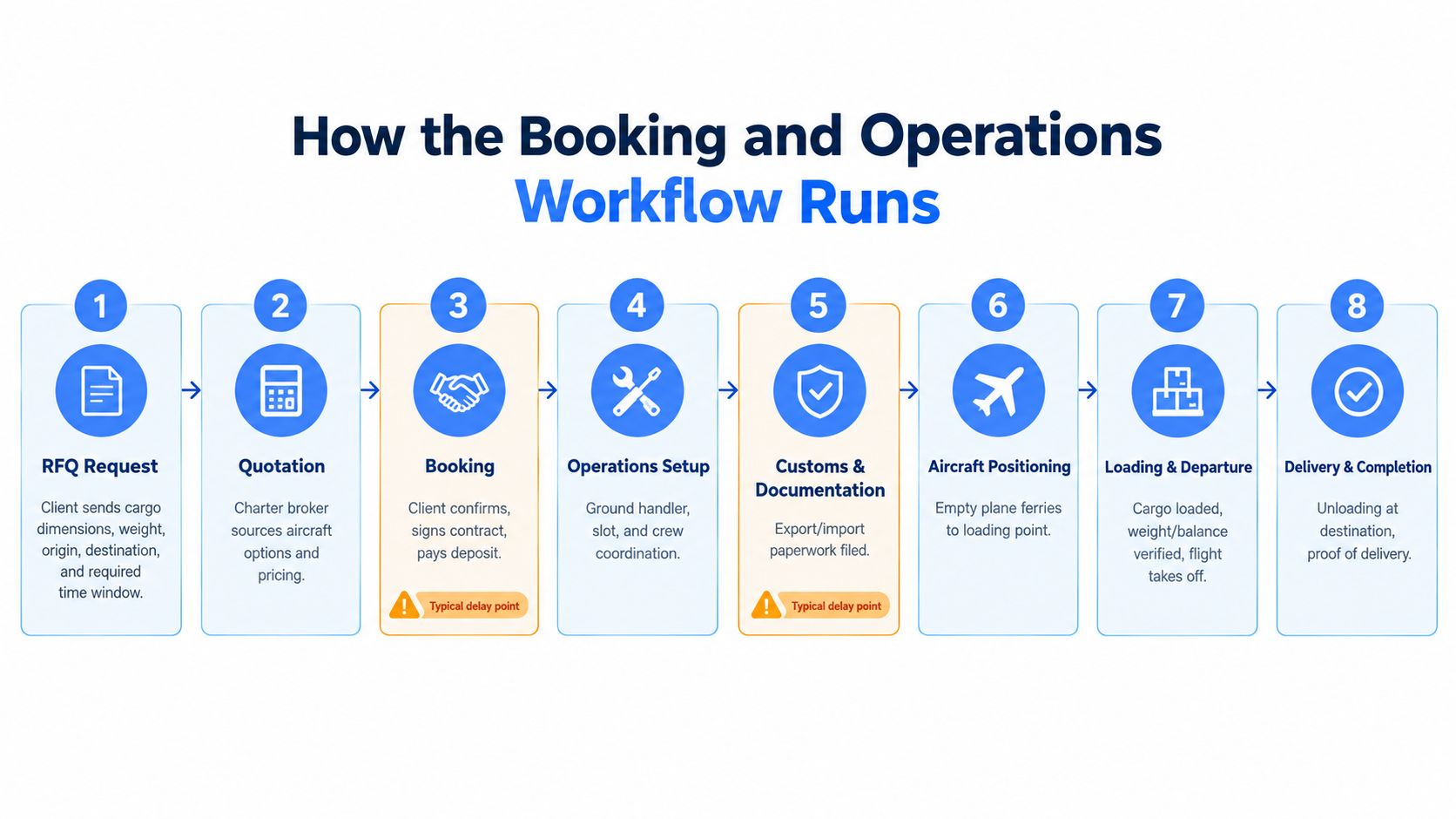
The eight operational stages
-
RFQ request. The client supplies the physical and commercial facts. Include length, width, height, weight per piece, total weight, packaging, stackability, commodity, origin, destination, and deadline. The client owns accuracy here. An under-declared piece can invalidate the aircraft choice.
-
Aircraft sourcing. The broker tests the requirement against operators, aircraft availability, runway limits, cargo doors, permits, and crew legality. For a standard mission, the market may produce several viable options. A genuine AOG request moves faster only when the cargo is ready and the paperwork is complete.
-
Commercial close. The client selects the aircraft and confirms the contract structure. Payment terms, deposit requirements, cancellation exposure, insurance, and responsibility for customs should be written down before anyone treats the flight as secured.
-
Operational setup. The operator plans routing, fuel, slots, overflight permissions, airport handling, crew positioning, and aircraft arrival at the loading point. The operator owns flight legality. The broker coordinates the moving parts and escalates conflicts.
-
Ground handling. Handlers build unit load devices where applicable, weigh the cargo, inspect packaging, complete security screening, and prepare the load for acceptance. The shipper must present cargo in the agreed condition. The handler controls acceptance and physical processing.
-
Flight execution. The captain retains authority over loading, weight distribution, fuel, weather decisions, and aircraft safety. A buyer can request a route and deadline, but can't override a safe-load decision.
-
Arrival handling and customs. Many “confirmed” shipments lose time. The destination handler unloads the freight, while the importer or customs broker provides clearance documents, classifications, licences, and duty instructions. The broker should track the handoff, but the importer remains responsible for the accuracy of import information.
-
Proof of delivery and debrief. Obtain signed delivery evidence, reconcile charges, record exceptions, and review what failed or worked. For recurring freight, this debrief should change the next routing, airport, packaging, or standing agreement.
Before the flight, ask one question for each handoff: who owns the next delay? That simple discipline prevents the common failure where the aircraft is ready, but the warehouse, customs broker, or consignee isn't.
The operational sequence is easier to understand visually, but the responsibility split matters more than the diagram. Use the flight updates to verify milestones, not to replace named owners.
Aircraft Types and Payload Capabilities
Aircraft selection should begin with payload, range, runway, and cargo-door geometry. A broker who offers the biggest aircraft first is solving the wrong problem. You're buying a mission, not an impressive tail number.
Light aircraft work when the shipment is compact and the destination has a constrained runway. A King Air 350 or Citation XLS can suit medical samples, AOG parts, and diplomatic movements where access matters more than volume. A Challenger 604 or Falcon 2000 sits higher in the payload range and can be useful for heavier urgent spares or controlled medical freight.
Converted narrowbody freighters are the practical middle ground. A Boeing 737-800SF carries about 20 to 22 tonnes, cruises at roughly 820 to 850 km/h, and can reach up to approximately 3,700 km at optimized payload, according to Boeing 737-800SF operating specifications. That wording matters. Range isn't a fixed promise. Fuel, reserves, weather, payload, and routing can force a trade between load and nonstop reach.
| Aircraft Class | Typical Examples | Max Payload (kg) | Range (nm) | Cargo Door (m) | Best Fit Mission |
|---|---|---|---|---|---|
| Light turboprop or business jet | King Air 350, Citation XLS | 1,000 to 1,800 | 1,500 to 3,500 | Side door, aircraft-dependent | Medical samples, AOG parts, compact sensitive cargo |
| Midsize business jet | Challenger 604, Falcon 2000 | 2,500 to 3,500 | Mission-dependent | Side door, aircraft-dependent | Urgent automotive spares, pharma, smaller specialist loads |
| Narrowbody freighter | Boeing 737-300SF, 737-400F, 737-800SF | 18,000 to 22,000 | 2,500 to 3,700 | Main deck, aircraft-dependent | European and intra-Asia freight, palletized cargo |
| Widebody freighter | Boeing 747-8F, 777F, 747-400ERF | 100,000 to 130,000 | Up to 7,000 | Main deck and nose or side systems, aircraft-dependent | Full-fuselage loads, defence logistics, engine rotations |
| Oversize specialist | AN-124-100, Beluga, Dreamlifter | Up to 120,000 for AN-124-100 | Mission-dependent | AN-124 nose door about 6.4 wide | Aerospace structures and outsize industrial cargo |
The World Bank's air-cargo efficiency analysis provides the clearest utilization lesson. For an airframe weight equal to about 55% of maximum take-off weight, increasing load factor from 60% to 90% reduces fuel consumption per tonne of cargo by about 20%. The World Bank analysis of air-cargo efficiency supports a straightforward recommendation: consolidate where the deadline allows it.
For a practical overview of midsize aircraft trade-offs, compare midsize private jet specifications, then apply cargo-door and loading constraints rather than passenger-cabin assumptions. Even a small movement involving animals or special handling may need separate documentation guidance, such as the Passpaw pet travel widget for US to Spain, when live-animal logistics are part of the wider movement.
What Drives the Cost of a Cargo Charter
A charter quote isn't a price per kilogram. It's the cost of making an aircraft and crew available for a defined operating block, then adding everything required to perform the mission legally and on time.
The aircraft and block hours dominate. A short European flight in a light aircraft may need little positioning, simple handling, and ordinary permits. A widebody charter across the Atlantic or into Asia-Pacific can add positioning sectors, crew planning, fuel stops, heavy-lift equipment, airport parking, and extensive coordination.
The quote anatomy
| Cost Driver | Typical Share of Quote | Key Influencing Factors |
|---|---|---|
| Aircraft and block hours | Primary cost component | Aircraft class, flight time, availability, crew duty |
| Positioning legs | Material variable | Aircraft base, empty ferry distance, return positioning |
| Fuel | Variable operating component | Route, payload, reserves, fuel-stop requirements |
| Landing and handling | Airport-dependent | Airport, operating hours, cargo weight, equipment |
| Permits and slots | Mission-dependent | Countries crossed, airport restrictions, route complexity |
| Customs and security | Shipment-dependent | Commodity, screening regime, clearance complexity |
| Dangerous goods | Special-cargo surcharge | Classification, packaging, trained handling, documentation |
| Insurance | Contract-dependent | Declared value, liability allocation, cargo coverage |
The most expensive mistake is comparing only the live cargo leg. The aircraft may need to fly empty to your origin, wait for loading, and reposition afterward. A turboprop on a transatlantic mission isn't a realistic substitute for a freighter because its hourly rate looks lower. Its range, payload, fuel stops, and operating limits can erase the apparent saving.
Urgency also changes availability. Same-day and overnight departures usually command a premium because the broker must displace other work, locate an aircraft and crew, secure handling, and obtain permissions under pressure. Remote airports compound the problem when they have short runways, limited cargo equipment, restricted operating hours, or no experienced freight handler.
Pricing discipline: Ask for the total mission price, not the aircraft hourly rate. Require the quote to identify positioning, fuel, handling, permits, customs support, screening, special cargo fees, insurance, and cancellation exposure.
For a consumer-facing reference point on charter pricing mechanics, see private jet charter prices. The aircraft may differ from a freighter, but the same commercial principle applies: availability, positioning, timing, and operational complexity drive the invoice.
Regulatory, Customs, and Chain-of-Custody Rules
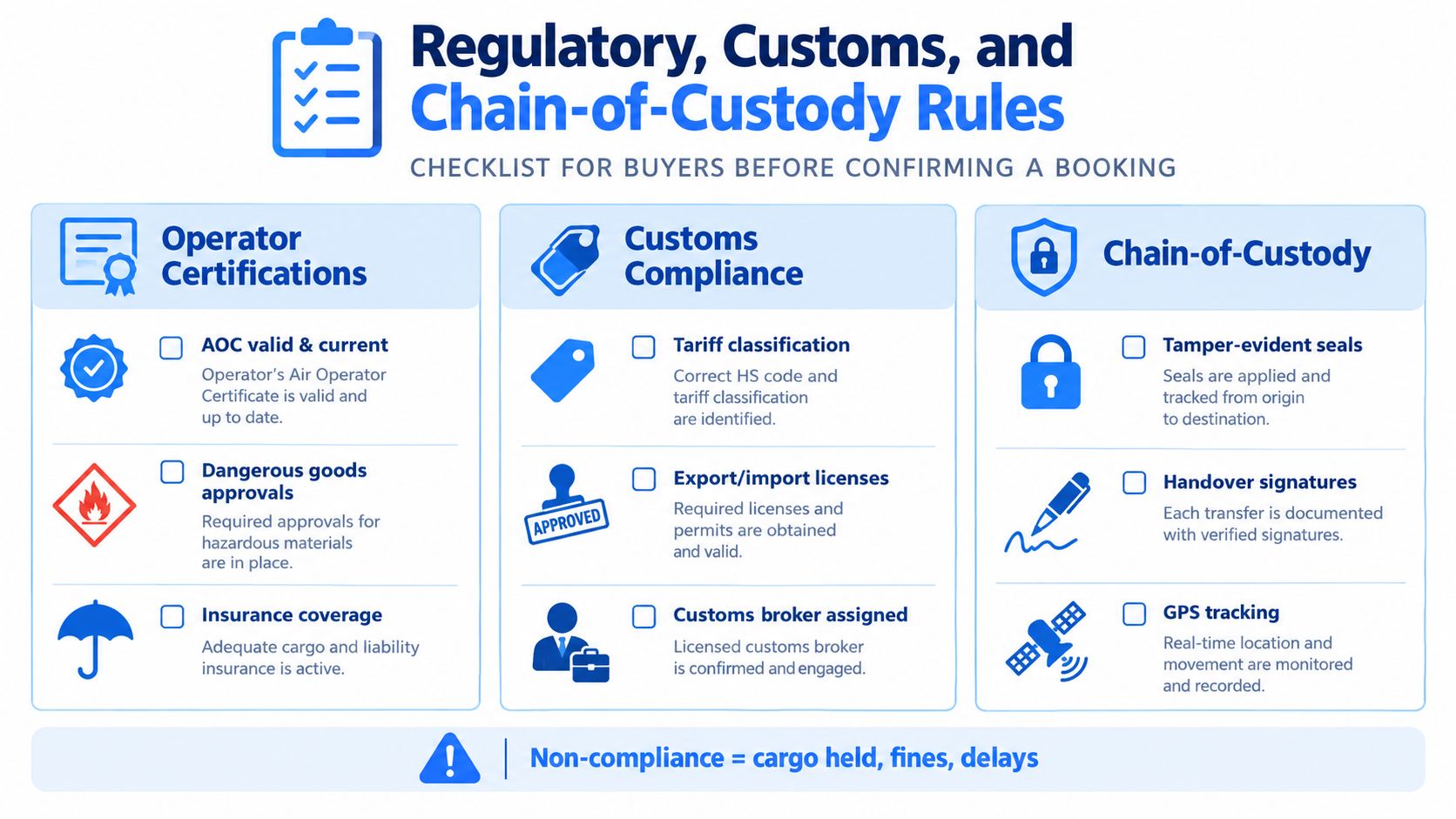
A private or dedicated aircraft doesn't create a private set of safety rules. The operator still needs the right approvals, the shipper still needs accurate declarations, and customs still has authority to hold the cargo.
Operator and dangerous-goods checks
Before confirming, request evidence that the operator holds a valid air operator certificate and the approvals required for the aircraft, route, and commodity. Dangerous goods acceptance needs particular scrutiny. The FAA states that charter-type services handling dangerous goods must follow the Hazardous Materials Regulations in 49 CFR Parts 100–185 and the ICAO Technical Instructions for transporting dangerous goods by air.
That applies even when the aircraft is privately booked. Packaging, classification, marking, documentation, and crew training remain mandatory. Dry ice used with temperature-controlled pharmaceuticals may be acceptable only when it's declared, packed, and handled under the applicable dangerous-goods rules.
Security requirements can depend on the aircraft and route. The TSA Twelve-Five Standard Security Program applies to scheduled and charter passenger and cargo operations involving aircraft with a maximum certificated takeoff weight of more than 12,500 pounds when operating to, from, within, or outside the United States. NBAA's summary of the Twelve-Five Standard Security Program explains the threshold and the need for a TSA-approved programme for relevant operators.
Customs and custody
Prepare the commercial invoice, packing list, airway bill or cargo manifest, HS classification, export licences where required, and import instructions before the aircraft departs. Decide whether the cargo needs normal clearance, bonded movement, or temporary admission. Assign a customs broker by name, not merely by company.
For high-value or pharmaceutical shipments, write the custody chain into the handling plan:
- Sealing: Use tamper-evident seals and record seal numbers at every handover.
- Handover: Require signatures from warehouse, handler, driver, and consignee.
- Temperature: Specify the acceptable range, packaging qualification, monitoring device, and intervention plan.
- Security: Confirm screening, controlled access, escort requirements, and tracking.
- Records: Keep declarations, photos, condition reports, and delivery evidence together.
Teams managing multiple handovers may benefit from structured bills of lading software to keep signatures and transport documents aligned. Software won't correct a wrong HS code or missing licence, but it can reduce the administrative gaps that make custody disputes harder to resolve.
When a Cargo Charter Beats the Alternatives
The right comparison isn't charter versus scheduled freight by headline price. It's total charter cost versus the financial consequence of waiting.
Start with the loss created by delay. Add production downtime, emergency labour, customer penalties, missed launch revenue, spoilage, clinical-trial disruption, inventory recovery, and the cost of rerouting later. Then compare that total with the complete charter quote, including positioning and customs support.
Where charter earns its place
An automotive or aerospace AOG part is the obvious example. If a missing component stops a line, a direct flight can be cheaper than allowing the line to remain idle. The same logic applies to an oil and gas rig that needs a replacement component at a remote field, where scheduled service may require several transfers and a long surface journey.
Pharmaceutical and clinical-trial shipments need a stricter test. If the product has a narrow temperature or timing tolerance, a charter may reduce handovers and give the shipper control over departure and arrival handling. That doesn't make charter automatically compliant. The packaging, monitoring, declarations, and GDP-compliant process still have to work.
Humanitarian relief and high-value art create a different calculation. Availability, access, custody, and security can outweigh the lowest transport rate. A sealed point-to-point movement may also reduce exposure to repeated handling, although insurance terms must be reviewed rather than assumed.
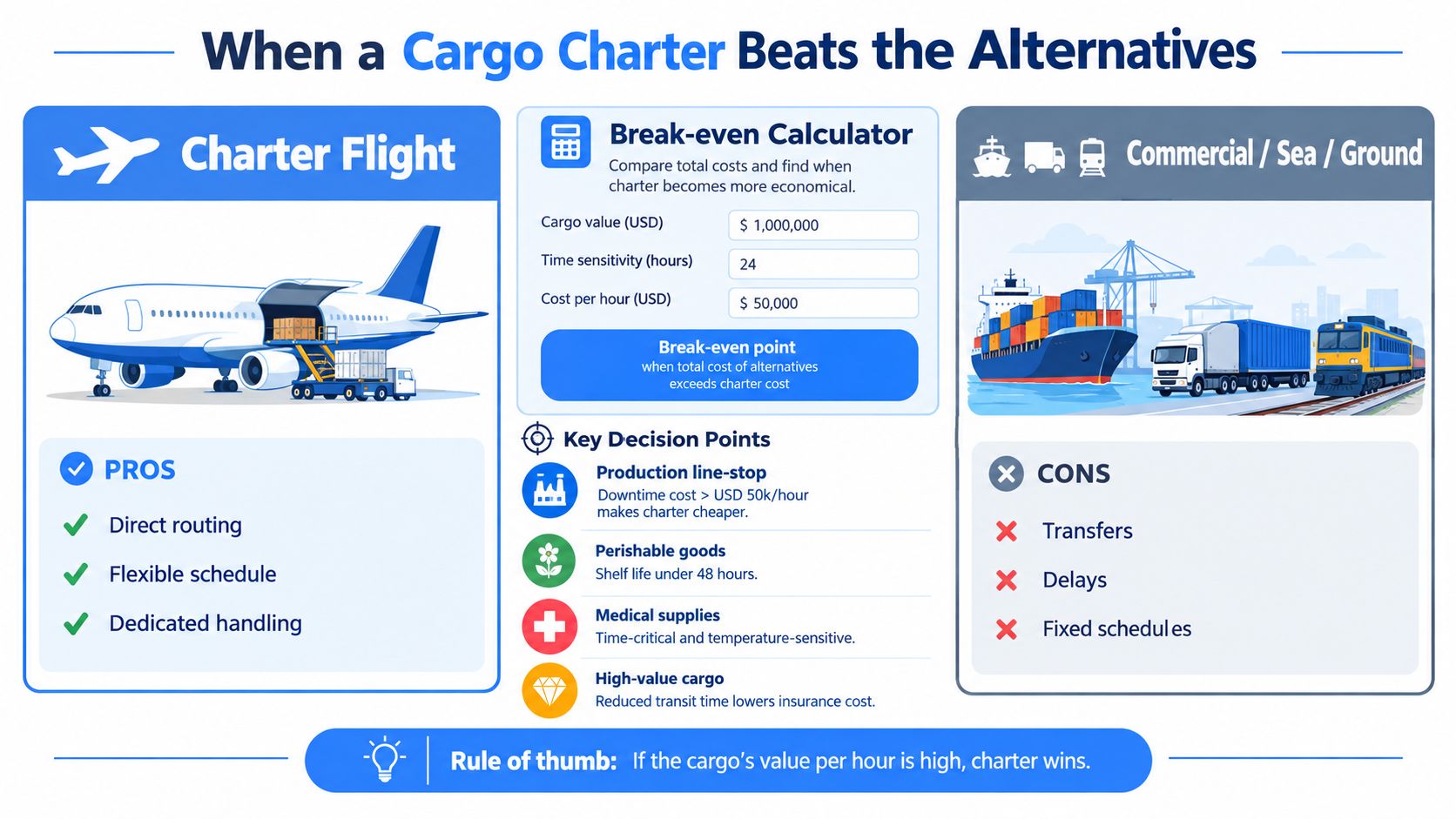
Scheduled freight remains the correct choice for routine cargo on established lanes. Ocean-air splits can work when the shipment can tolerate a slower first leg and needs faster final distribution. Express courier services suit smaller consignments that fit their networks and documentation rules. None is a good substitute when the cargo exceeds their physical envelope, misses their cut-off, or needs a destination they don't serve directly.
The market also shows why buyers shouldn't assume charter demand is only emergency-driven. ICAO reported that non-scheduled services represented 15% of total freight in 2019 and roughly 20% in 2023, with 2023 non-scheduled freight traffic reaching 34.3 billion freight tonne-kilometres. STAT Times' coverage of non-scheduled freight also cites IATA's estimate of 14 million tonnes in 2023, down 9.1% from 15.4 million tonnes in 2022. The lesson is not that charter always wins. It's that non-scheduled capacity is structurally important, while the value depends on the mission.
For a broader view of private aircraft selection and routing, review private jet charter options. Use that information as a starting point, then apply cargo-door, payload, customs, and handling constraints.
Practical Planning Checklist and FAQs
Before asking for a firm quote, spend 30 minutes closing the information gaps that ground aircraft. Confirm the shipment, the airports, the documents, and the person responsible for every handoff.
The pre-flight check
- Physical specification: Confirm every piece's length, width, height, gross weight, centre of gravity where relevant, packaging, and stackability.
- Commodity classification: Identify the product, HS code, export controls, dangerous-goods status, UN number where applicable, and temperature requirement.
- Airport suitability: Verify runway, operating hours, cargo door access, loading equipment, parking, and customs capability at both ends.
- Timing: Set cargo-ready time, collection window, latest acceptable departure, delivery deadline, and consignee availability.
- Value and insurance: Agree the declared value, cargo insurance, operator liability, exclusions, and claims process.
- Custody: Name the warehouse, driver, handler, customs broker, escort, and consignee at each handoff.
- Contingency: Decide what happens if the aircraft is delayed, the cargo fails acceptance, customs asks for more information, or the destination airport closes.
The recurring blind spots are predictable. Shippers under-declare weight, discover dangerous goods after booking, or send a commercial invoice that doesn't match the packing list. Those errors don't become less serious because the flight is urgent.
FAQs
How much notice is needed?
A simple route can move quickly when an aircraft and crew are available, but no broker can promise a universal lead time. Hazmat, remote airports, overflight permits, customs restrictions, and unusual cargo require more planning. Send complete information first. Speed comes from removing uncertainty, not from sending repeated “urgent” messages.
What aircraft should carry the shipment?
Match the aircraft to the load, route, runway, and door. A small business jet or turboprop may suit compact AOG freight, a narrowbody freighter can handle palletized medium-haul cargo, and a widebody or specialist aircraft is appropriate for heavy or outsize freight.
Can dangerous goods move on a charter?
Sometimes. The operator must confirm classification, packaging, marking, documentation, approvals, and trained handling under applicable FAA, ICAO, and national rules. Never describe lithium batteries, dry ice, chemicals, or aerosols as ordinary cargo to accelerate a quote.
How large can the cargo door be?
It depends entirely on the aircraft. The AN-124-100 has a nose-loading door about 6.4 metres wide, making it suitable for outsize industrial cargo. A narrowbody freighter has a much smaller loading envelope, even when its payload appears adequate.
Do pharma and perishables need active cooling?
Not always. The requirement depends on the product, packaging qualification, ambient exposure, monitoring, and the agreed handling procedure. Active temperature control may be necessary, but a passive validated shipper can be suitable for another commodity. Make the operator approve the packaging plan before booking.
What does insurance cover?
Operator liability and cargo insurance aren't the same thing. Confirm the operator's liability limit, your declared value, exclusions, deductible, and whether loading, storage, road transport, and customs holds are covered.
How are multi-leg charters priced?
The quote should account for every flight leg, positioning sector, fuel requirement, crew duty, airport charge, handling event, permit, and waiting period. A technical stop may be operationally necessary, but it still affects elapsed time and cost.
If your shipment is urgent, oversized, sensitive, or tied to a production deadline, Approved Jets can coordinate aircraft sourcing, cargo oversight, customs paperwork, ground handling, and arrival monitoring through its operator network. Send the dimensions, weight, route, cargo-ready time, and hard delivery deadline to Approved Jets and ask for a mission-specific comparison against scheduled freight.