World Wide Jets Explained: Global Private Charter Guide
World Wide Jets explained: where aircraft are available, how brokers source overseas operators, cross-border rules and planning steps.
12 min read

Global business-jet departures reached 3.9 million in 2025, the highest annual volume on record, according to WINGX Global Market Tracker reporting published by BlueSky News. Yet finding a private aircraft for an international trip isn't just a matter of choosing from that traffic. The core task is finding an available aircraft, identifying the company legally responsible for flying it, and checking the records before you pay.
Table of Contents
- What a Worldwide Jet Service Actually Sells
- Follow the people behind the aircraft
- Where Worldwide Jets Are Available Today
- Activity isn't an aircraft inventory
- Ask where the quoted aircraft starts
- Rules That Decide Whether a Cross-Border Charter Flies
- Establish who controls the flight
- Safety Benchmarks to Check Before You Book
- Ask what the rate actually measures
- Sustainability Evidence Worth Requesting
- Separate fuel evidence from environmental promises
- Plan Your Cross-Border Flight in Seven Steps
- Build a request an operator can assess
- Resolve permissions and commercial terms
What a Worldwide Jet Service Actually Sells
A worldwide charter broker works a little like a hotel booking platform that owns no hotels. It connects your requirements with someone else's capacity. For private charter, you're usually booking the whole cabin, not buying an airline-style seat.
The phrase world wide jets describes global access, but it doesn't establish who owns or operates the aircraft. Some providers operate aircraft themselves; a broker arranges flights through operators.
Follow the people behind the aircraft
Consider a hypothetical trip from Frankfurt to Nairobi for six passengers, each carrying two checked bags. Three distinct roles matter:
- Owner: Holds title to the aircraft, but may not conduct its commercial flights.
- Operator: Runs the flight, supplies or manages the crew, and holds the applicable operating authority.
- Broker: Matches the itinerary, passengers, luggage, and timing to a suitable operator and aircraft.
The broker can't stop at finding an attractive cabin. The operator must confirm that the aircraft can carry the passengers and luggage over the planned route, that its crew is qualified for the operation and destination, and that its approvals permit the flight.
Practical rule: A photograph proves that an aircraft exists. It doesn't prove that the seller can legally arrange your flight on it.
Crossing a border adds checks involving the aircraft's registry, the operator's certificate, customs, overflight permission, and destination handling. A handler is the local service provider that coordinates airport-side arrangements, such as parking and passenger assistance.
The useful questions are therefore concrete: Where are the aircraft? How are suitable operators found? Which rules and records establish whether the proposed flight is legal and appropriately vetted?
Where Worldwide Jets Are Available Today
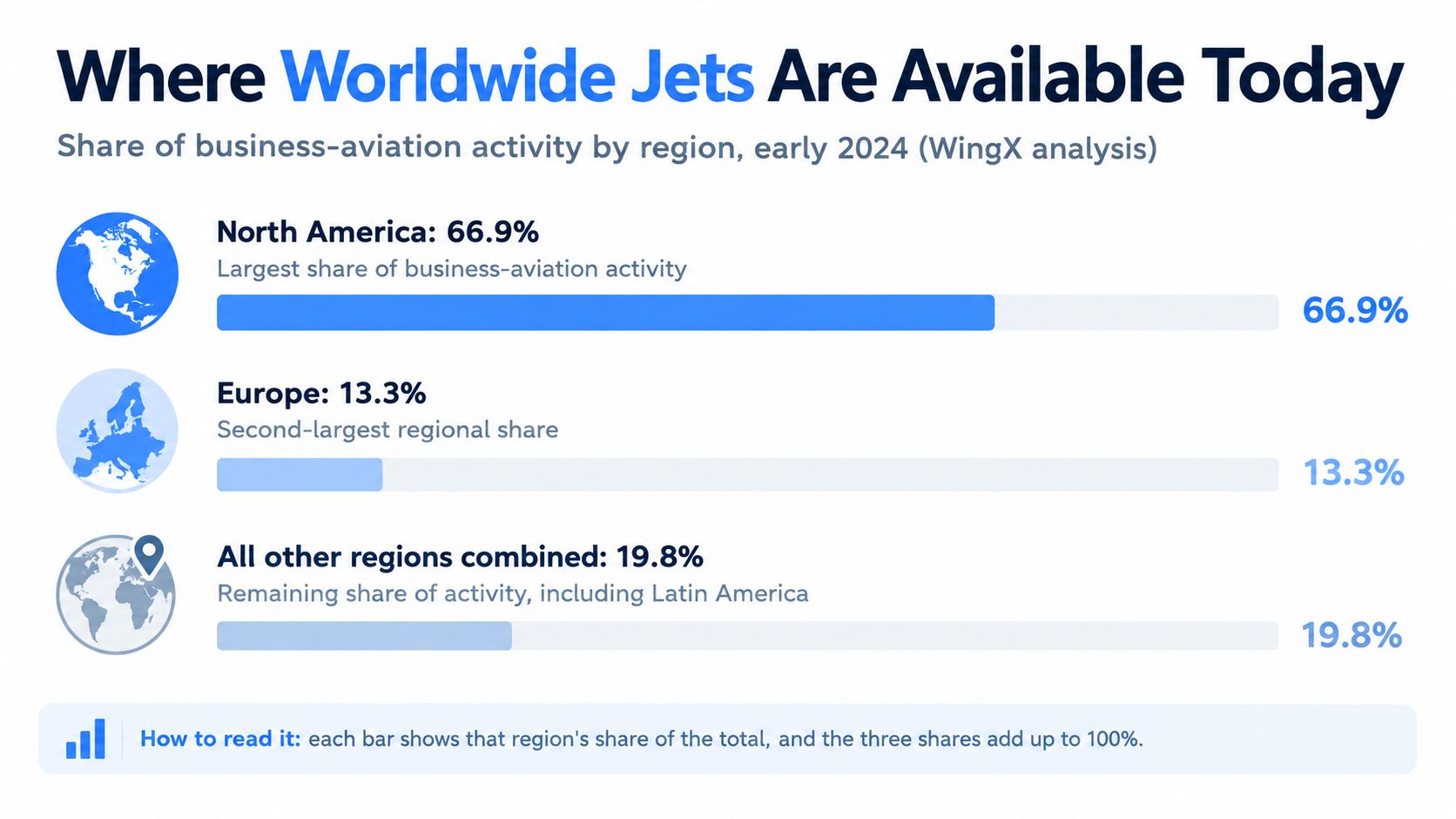
Share of business-aviation activity by region, early 2024
Region | Share of activity | What it means for a charter |
|---|---|---|
North America | 66.9% | Deepest sourcing market; a useful starting point for rapid operator searches |
Europe | 13.3% | Established operator network serving many cross-border routes |
Latin America | 10.1% | Start with major hubs and plan earlier for remote airports |
Asia-Pacific and Australia/New Zealand | 7.2% | Search major hubs and check range carefully on long sectors |
Middle East | 1.4% | Important transit region; confirm locally based aircraft early |
Africa | 1.1% | Check local coverage first and allow for positioning and additional lead time |
These regional shares come from WINGX's early-2024 business-aviation analysis, which includes business jets and turboprops, not jets alone. The sourcing implications are planning guidance, not measured guarantees of availability or response speed.
The visual groups the smaller regional shares together for a simpler comparison.
Activity isn't an aircraft inventory
A flight count measures movements, not the number of aircraft sitting ready for hire. The same aircraft can make repeated flights, while another may be undergoing maintenance, reserved for its owner, or unavailable for your dates.
A region with a small activity share can still have a suitable aircraft nearby for a short trip. Conversely, a busy market doesn't guarantee that the right cabin, luggage capacity, and crew will be available at your preferred airport.
For a London-to-Dubai itinerary, a broker can investigate European departure-side operators alongside aircraft returning toward the Middle East. A Lagos-to-Accra request may involve a narrower local search and could require an aircraft to arrive empty from another airport. Neither outcome can be established from regional percentages alone.
That empty arrival is a positioning leg. It takes time and may appear in the charter price even though you aren't aboard.
Ask where the quoted aircraft starts
For an intercontinental itinerary, use a long-range aircraft guide to understand the categories, then ask the operator to assess the actual mission. Published range isn't a promise of nonstop performance with your passengers, bags, weather, and required fuel reserves.
Before comparing quotes, ask whether each aircraft is already near departure, where it must come from, and what happens if its preceding flight runs late. When your itinerary touches a region with a smaller activity share, raise those questions early rather than discovering positioning requirements after accepting a price.
Rules That Decide Whether a Cross-Border Charter Flies
In the United States, on-demand charter operates under FAA 14 CFR Part 135, while private noncommercial flying generally falls under Part 91. The FAA's charter-certification overview explains how a carrier applies for and holds that operating authority. An aircraft offered for hire needs more than an owner willing to rent it out.
Two separate permissions are easy to confuse here. A commercial pilot certificate works like a driver's license: it qualifies the person at the controls. The Part 135 operating certificate is closer to a business permit: it authorizes the company to sell carriage to the public. A pilot can hold the first and still fly an illegal charter if no certificated operator stands behind the flight. Equally, a licensed pilot cannot turn an otherwise unauthorized operation into a legal charter.
Which certificate governs which kind of flight
Flight type | Governing rule | Who must hold the certificate | Check before booking |
|---|---|---|---|
US on-demand charter | 14 CFR Part 135 | Certificate holder with operational control | Certificate holder named in booking documents |
Private flight, no compensation | 14 CFR Part 91 | No charter certificate required when carriage isn't sold; owner or operator and pilot still need applicable documentation | Owner, aircraft, and pilot documentation |
Charter by a non-US operator into the US | Home-state certificate plus applicable US entry and operating requirements | Foreign operator with necessary US permissions | Written confirmation of applicable permissions |
Charter within the EU | EASA-framework air operator certificate issued by the operator's state, with applicable operating permissions | Certificate holder with operational control | Authority for the proposed service and route |
Multi-country trip with several operators | Each leg's operator approvals and applicable national requirements | Operator responsible for each leg | Coverage for every leg, not only departure |
The table is a screening guide, not a substitute for checking the proposed operation with the relevant authorities. An operating certificate isn't unrestricted permission to sell any route, particularly a domestic sector within another country.
Establish who controls the flight
Operational control means authority over initiating, conducting, and terminating the flight. Ask who holds that responsibility, rather than assuming it's the company that sent the invoice.
The broker should document:
- Responsible operator: Legal name, certificate details, and the assigned aircraft's relationship to that operator.
- Authority for the mission: Confirmation that the proposed commercial service falls within the operator's approvals.
- Country-specific permissions: Applicable entry, landing, overflight, customs, and handling arrangements across the itinerary.
Suppose a proposal uses one company name, but the aircraft will fly under another company's certificate. That isn't automatically unlawful, because brokers and operators often differ. Leaving the relationship unexplained is the verification failure.
The contract or accompanying operator disclosure should identify the certificate holder, not just the aircraft owner or intermediary. Before payment, ask: Which legal entity is responsible for operating this flight, and where is that recorded?
Safety Benchmarks to Check Before You Book
Quoting airline accident statistics as if they described private charter is a category mistake. Scheduled airlines, owner-flown aircraft, and on-demand charter work like three different sports: they share a ball, but the rules, exposure, and record keeping are not the same. Published airline accident figures describe scheduled commercial operations, so use them as background about aviation safety rather than as a scorecard for a specific charter operator. A certificate resource such as the FAA's charter-certification overview tells you what kind of approval an operator holds; it does not turn airline statistics into charter risk data.
Ask what the rate actually measures
A rate needs a denominator, the amount of activity against which events are counted. Departures and flight hours measure different exposure, so they shouldn't be swapped in a comparison. Ten events across one million departures is not the same exposure as ten events across one million flight hours.
A small operator's apparent rate can swing sharply after a single event. An accident-free history without flight-volume information doesn't establish that one operator is safer than another.
A safety claim is useful only when you know which operation it describes, what period it covers, and how much flying occurred.
For a practical assessment of whether private jets are safe, focus on the proposed operator and assignment. Request confirmation of crew qualifications, maintenance status, operational history, and any current third-party safety audit.
Ask for a maintenance-status summary rather than expecting unrestricted access to every technical record. If an audit credential is offered, verify its holder, scope, and validity. A polished cabin and a recognizable aircraft model don't answer those questions.
Sustainability Evidence Worth Requesting
A charter's emissions depend on its complete flight profile, not just takeoff and landing. The EASA European Aviation Environmental Report describes a methodology combining flight plans, radar updates, billing information, route charges, and an aircraft database, using actual airport-pair distance and cruise altitude to calculate fuel burn and emissions.
For a charter comparison, that means examining the mission rather than attaching a green label to an aircraft category. A suitably sized aircraft departing nearby may present a different fuel picture from an aircraft that must first reposition across a continent.
Separate fuel evidence from environmental promises
Sustainable aviation fuel, or SAF, isn't universally available: William Blair's aviation-services industry update describes SAF as less than 0.1% of global jet-fuel supply, cites IATA's projected requirement of roughly 500 million tonnes annually by 2050 for net-zero goals, and identifies expanding uplift access in Manchester, Burlington, Austin, Williston, and Hong Kong.
Those locations illustrate uneven access, not a guarantee of fuel availability for your departure. Ask for confirmation for the actual airport and flight.
Request an environmental record containing:
- Fuel burn by leg: Identify estimates before departure and measured or reconciled figures afterward.
- Flight profile: Actual airport pair, distance, and cruise altitude.
- Positioning: Empty sectors included in the mission calculation.
- Passenger and aircraft details: Passenger count and aircraft type used.
- SAF documentation: Whether physical uplift occurred at departure, with supporting fuel records where available.
Keep offsets separate from measured fuel use. An offset purchase doesn't mean the aircraft burned less fuel, and an estimate shouldn't be presented as a verified post-flight result.
For a time-critical business mission, the defensible explanation is specific: why the trip was needed, which alternatives were considered, how the aircraft was selected, and what environmental evidence supports the decision.
Plan Your Cross-Border Flight in Seven Steps
A larger fleet creates more sourcing possibilities, but it doesn't make every aircraft bookable. In 2025, the global active business-jet fleet reached 15,364 aircraft, 4% above 2024 and 21% above 2019, according to WINGX figures reported by Business Air News.
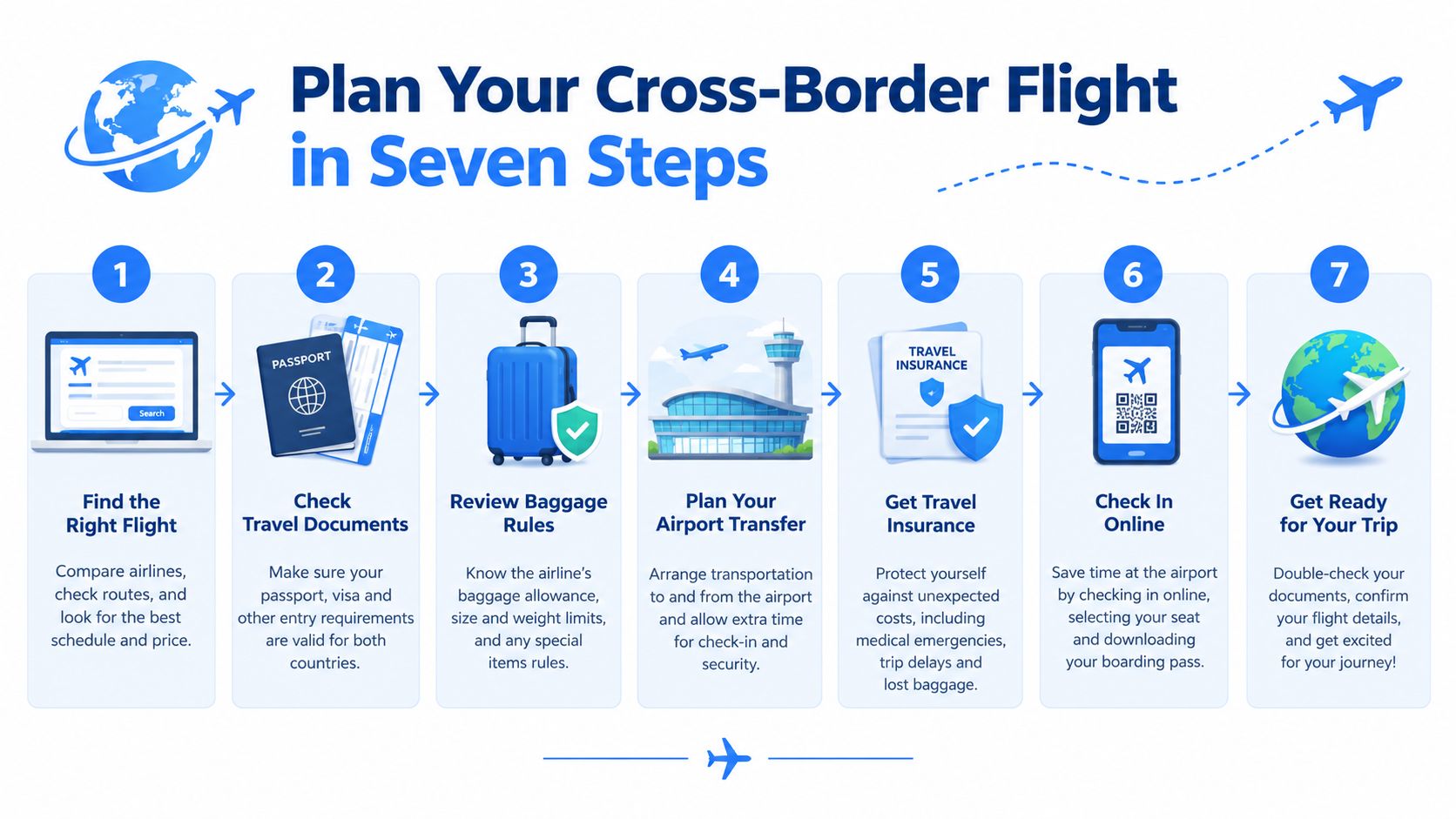
Use this sequence to turn a travel request into a documented booking.
Build a request an operator can assess
- Write the mission brief.
Specify departure and destination airports or acceptable alternatives, travel dates, passenger count, luggage, and arrival deadlines. Distinguish a preferred departure from a hard requirement, such as reaching a meeting before it starts.
Describe medical equipment, mobility needs, pets, sports equipment, or sensitive cargo before aircraft selection. For the hypothetical Frankfurt-to-Nairobi group, include bag dimensions and approximate weights, not merely “standard luggage.”
Common slip: Choosing by seat count alone. A cabin can have enough seats without enough practical baggage capacity for the group.
- Set the response schedule and booking deadline.
Ask when you'll receive an initial proposal, when the operator expects to confirm availability, and when the quoted terms expire. A broker's quote-response target is an administrative goal, not evidence that an aircraft and crew are secured.
For urgent travel, identify a fallback departure window and acceptable alternate airports. Ask which unresolved item currently prevents confirmation, such as owner approval, crew availability, or a permit.
Common slip: Treating a fast quotation as a confirmed flight. Keep the distinction between “proposal received” and “operator accepted” explicit.
- Choose for the demanding leg, not the most impressive cabin.
Have the operator assess payload, baggage, airport performance, and practical range across the itinerary. Ask whether any sector needs a fuel stop and whether positioning affects aircraft or crew availability.
For a hypothetical short hop with four passengers and modest bags, challenge a heavy-jet recommendation unless cabin needs or availability justify it. For an overnight intercontinental trip, ask about usable sleeping arrangements rather than accepting a photograph of reclining seats.
Common slip: Buying excess capability while overlooking the feature passengers actually need.
- Verify the proposed operator and aircraft.
Ask the broker to provide an operator disclosure naming the certificate holder and proposed aircraft registration. Check whether any aircraft substitution requires your approval and whether the replacement must meet the same documented criteria.
If credentials such as ARGUS Platinum or Wyvern Wingman are offered, request current verification for the operating company. These are supplementary checks, not substitutes for legal operating authority or mission-specific assessment.
Common slip: Accepting the broker's reputation as proof of the operator's qualifications. Record who conducted the checks and what remains provisional.
Resolve permissions and commercial terms
- Confirm border and airport arrangements.
Request a leg-by-leg readiness summary covering applicable landing and overflight permissions, customs arrangements, handling, and crew documentation. If the itinerary changes operators, obtain a separate confirmation for each assignment.
Passengers should also review passport, visa, medication, and payment arrangements. Translate AI's packing and money tips for international travel offers a useful personal-preparation companion to the aviation paperwork.
Common slip: Assuming private travel bypasses immigration or customs. Share passenger details securely and confirm when the manifest becomes final.
- Compare the total commitment.
Put proposals beside each other using the same itinerary and assumptions. Identify positioning, fuel treatment, handling, parking, crew expenses, catering, ground transfers, and any items that remain chargeable afterward.
Ask how weather disruption, deicing, schedule changes, cancellation, and aircraft substitution affect the price. A lower headline figure isn't necessarily a lower total cost if essential items are excluded.
Common slip: Comparing an inclusive proposal with a flight-only estimate. Obtain written answers before authorizing payment, and independently verify any changed payment instructions.
A visual walkthrough can help travelers discuss the sequence with their trip coordinator.
- Confirm the order and keep oversight through arrival.
Obtain written acceptance showing the itinerary, operating company, aircraft arrangements, payment terms, cancellation conditions, and named coordination contact. Ask when the final passenger instructions will arrive and how changes will be communicated.
Build the ground journey into the plan using a door-to-door transport service checklist. Confirm the private terminal, driver meeting point, luggage vehicle, and destination contact rather than assuming everyone means the same airport entrance.
Common slip: Treating payment as the end of planning. Request updates on aircraft readiness, material permit issues, departure changes, and arrival arrangements.
Before accepting: Keep the operator disclosure, agreed commercial terms, and environmental reporting commitment together in the booking file.
A mobilization estimate remains conditional on aircraft, crew, permissions, and airport readiness. Ask the coordinator to distinguish confirmed arrangements from targets, especially when the trip is urgent.
Approved Jets arranges worldwide on-demand charter and coordinates supporting travel logistics through its operator network. Send your route, dates, passenger details, and luggage requirements to Approved Jets, then request the proposed operator's certificate details and flight-specific emissions evidence before accepting a quote.
Updated