
What Is a Team Charter and How It Drives Real Results
Learn what is a team charter, why it matters, and how modern organizations use it to set goals, define roles, and improve coordination on every mission.

Approved Jets
On this page
- Table of Contents
- When Teams Spin Without a Shared Rulebook
- The Clear Definition of a Team Charter
- What belongs in the first version
- What a charter isn't
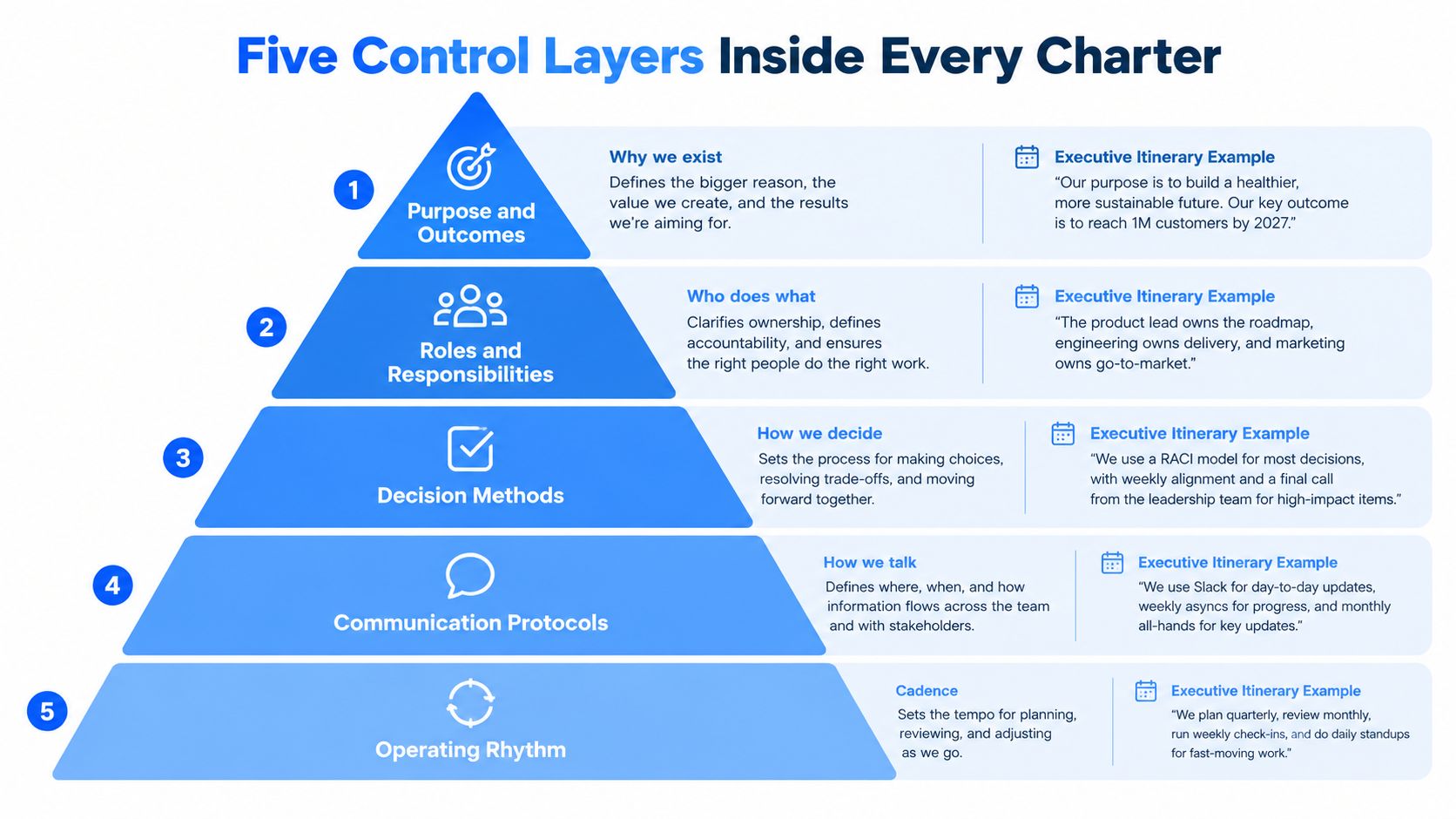
- The Five Control Layers Inside Every Charter
- Purpose and outcomes
- Roles and responsibilities
- Decision methods
- Communication protocols
- Escalation and review
- What the Research Shows About Results
- What managers may feel first
- Choosing the Right Decision Method for Each Moment
- Pairing a Charter With a RACI Matrix
- The same rules, different assignments
- How Charters Work Across Sports, Entertainment, and Corporate Teams
- Building Your First Charter in the Next 90 Days
- The v1 package
A trip request lands at an operations desk, and everyone moves quickly. Yet speed without clear ownership can create its own delays. One person calls the operator, another contacts the ground team, and a third sends the client an update based on incomplete information. The aircraft may be available, but the operation still feels out of control.
That's the practical reason managers ask what is a team charter. They're not looking for another corporate document. They need a shared operating agreement that tells people who decides, who acts, what information travels where, and what happens when the plan changes.
Table of Contents
- When Teams Spin Without a Shared Rulebook
- The Clear Definition of a Team Charter
- The Five Control Layers Inside Every Charter
- What the Research Shows About Results
- Choosing the Right Decision Method for Each Moment
- Pairing a Charter With a RACI Matrix
- How Charters Work Across Sports, Entertainment, and Corporate Teams
- Building Your First Charter in the Next 90 Days
When Teams Spin Without a Shared Rulebook
It's a Tuesday morning at a private aviation operations desk. A request arrives for an executive trip with several stops and a tight schedule. Three schedulers see the same message, each assumes the others are handling part of it, and the first few minutes disappear into duplicated work.
One scheduler begins sourcing aircraft. Another calls the fixed-base operator about ground arrangements. A third starts checking catering and passenger preferences, but nobody has been assigned final ownership. Two people contact the same FBO, while the client receives conflicting arrival estimates from different members of the team.
The situation becomes more difficult when weather affects the route. The crew is holding short while a text thread debates who should call the passenger. The team hasn't agreed on who can approve a diversion, who must be consulted, or when the account lead should escalate the issue to an executive. Everyone is active, but the operation lacks a common sequence of decisions.
The failure points are specific:
- Unclear ownership: No named person owns catering, client updates, or the final itinerary.
- Missing decision rules: The team hasn't agreed which decisions require consultation and which can be made immediately.
- Undocumented escalation paths: Nobody knows when an operational problem moves from scheduler to lead, operator, security specialist, or executive.
- No shared definition of success: One person prioritizes departure time, another prioritizes aircraft type, and another prioritizes passenger comfort.
Improving frontline collaboration becomes an operating discipline rather than a vague cultural goal when it matters most. Teams working across desks, operators, vehicles, and time zones need visible agreements that reduce assumptions.
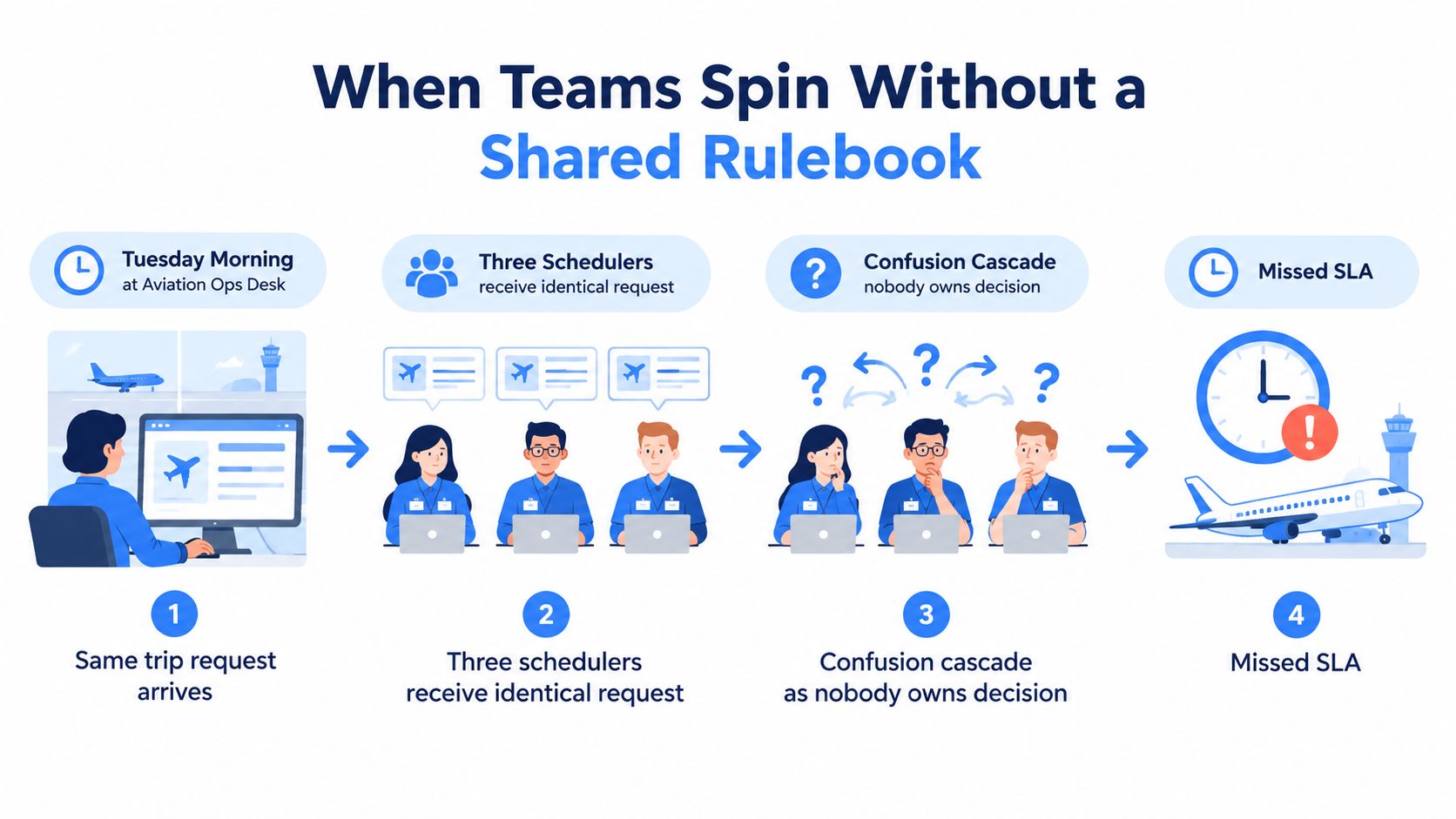
Every failure in this example is something a team charter is designed to prevent. It gives the team a place to settle ownership, decision rights, communication expectations, and escalation before a real disruption makes those questions urgent.
The Clear Definition of a Team Charter
A useful working definition is simple: a team charter is a written agreement created by the team that explains why the team exists and how its members will work together. It establishes purpose, goals, roles, responsibilities, communication practices, decision rules, and acceptable behavior. A practical definition and broader explanation appear in this team charter framework.
The document is best understood as an operating constitution. A constitution doesn't dictate every daily action. It establishes how authority works, how decisions are made, and what boundaries apply. A team charter does the same for a working group. It governs how the team runs itself without trying to script every conversation or task.
What belongs in the first version
A useful first version should answer the questions people ask when work becomes complicated:
- Purpose and outcomes: Why does this team exist, and what will successful work look like?
- Members and accountabilities: Who belongs to the team, and what does each person own?
- Decision rights: Which decisions use command, consultation, voting, or consensus?
- Communication norms: Which channel handles urgent operations, routine updates, documentation, and client communication?
- Working rhythm: When does the team meet, and what response-time expectations apply during normal and irregular operations?
- Escalation triggers: What conditions require a senior decision, specialist input, or external approval?
- Revision clause: When will the team review the charter, and who records changes?
The University of Washington guidance describes a charter as a set of expectations to which members agree. It recommends a one- to two-page charter, with at least three important team goals and at least two norms from each relevant category, followed by sign-off from every member. Those requirements come from its team charter guidance.
What a charter isn't
A project plan describes deliverables, milestones, resources, and dependencies. A kickoff deck introduces the work and gives people context. A charter defines the team's operating agreement. The project plan may change as the mission develops, while the charter explains how the team will make and manage those changes.
The Five Control Layers Inside Every Charter
A charter becomes useful when it turns broad agreement into operating controls. Consider a multi-stop executive itinerary involving a lead scheduler, aircraft operations contact, ground transportation provider, security specialist, cabin lead, and client representative.
Purpose and outcomes
The first layer explains why the team exists for this mission. The purpose might be to coordinate a secure, discreet itinerary while protecting the client's schedule and ensuring every handoff is visible.
The team should also state how it will judge readiness. Relevant measures might include departure coordination, complete documentation, accurate passenger information, timely updates, and clean handoffs between air and ground partners. The point isn't to create a long scorecard. It's to prevent different people from optimizing for different definitions of success.
Roles and responsibilities
The second layer names the people responsible for the work. The lead scheduler might own the itinerary record. The aircraft operations contact might verify aircraft and crew information. The security specialist might advise on route and destination risks. The cabin lead might own onboard requirements.
Names matter because role labels alone can remain ambiguous. “Operations” is a department. “Jordan owns aircraft verification” is an accountability.
Decision methods
The third layer explains who decides. A routine vendor follow-up may need one owner to act and inform the group. An aircraft swap may require consultation with operations and security. A policy change may require broad agreement.
Without this layer, people negotiate authority in the middle of an incident. The research on team interaction processes supports the value of specifying roles and future interaction processes, particularly when teams must coordinate across boundaries.
Communication protocols
The fourth layer defines where information belongs. An urgent disruption might use a designated operations channel, while the itinerary record stores the authoritative version of timing, passenger details, and approvals. The charter can also define who sends client updates and who confirms receipt of a critical message.
Escalation and review
The fifth layer answers what happens when normal work breaks down. It identifies the escalation owner, the threshold for bringing in leadership, and the process for reviewing the mission afterward.
Practical rule: If the team can't explain who decides during a disruption, the charter is incomplete.
Together, these layers turn a messy set of possible scenarios into controlled operating lanes. They don't eliminate uncertainty. They make the response to uncertainty faster and more consistent.
What the Research Shows About Results
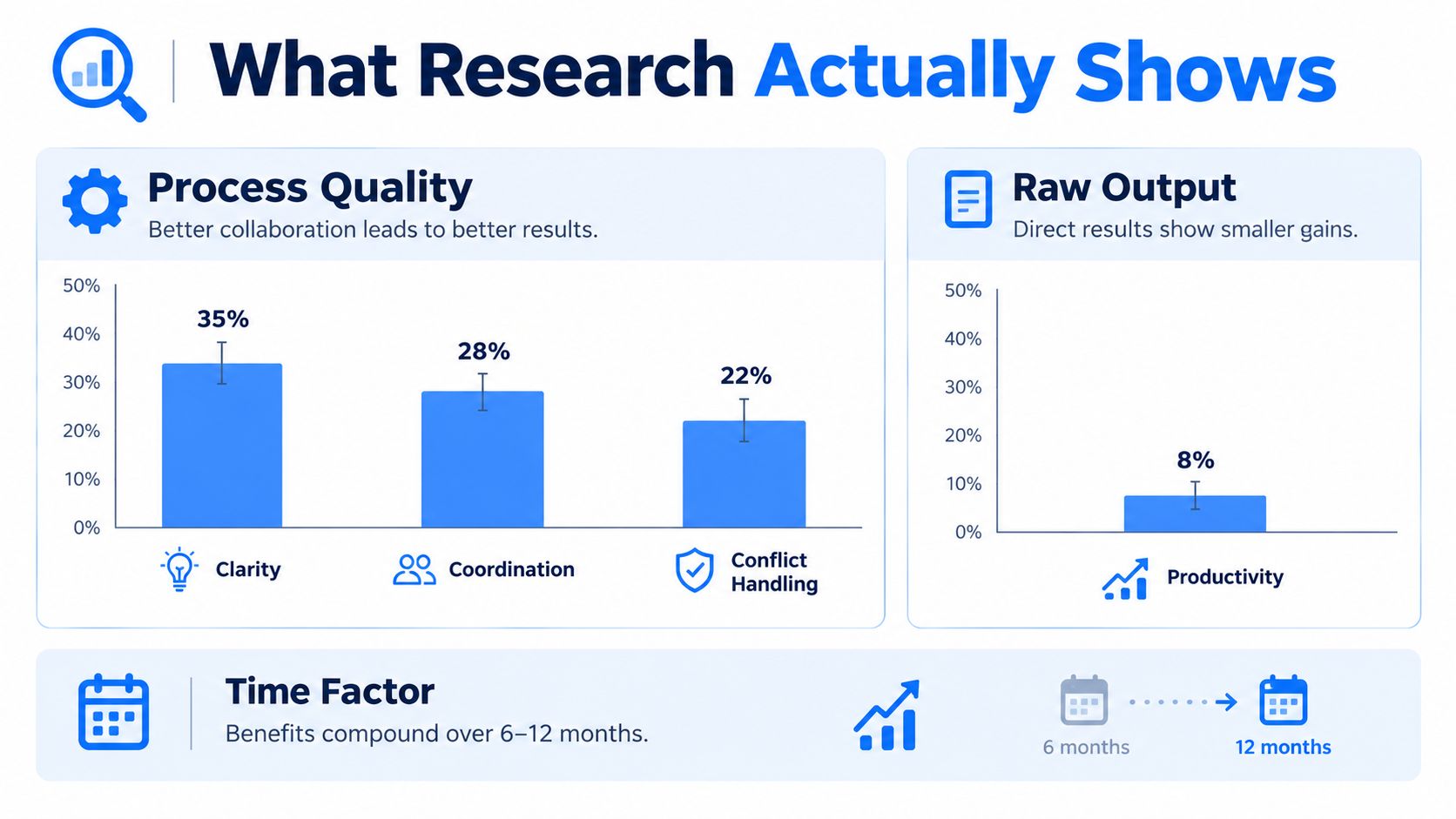
The strongest evidence supports a careful claim: team charters improve team processes more reliably than they improve final output quality. They clarify expectations, strengthen early coordination, and give members a shared method for addressing friction. They do not guarantee higher productivity.
A study of 1,891 teams comprising 8,556 students working on an eight-week international business consulting project found that charter use improved process-related performance mainly during the forming stage. The study found no direct association between charter use and final-report grades. Charter teams also reported more conflict, yet that conflict did not reduce peer evaluations or final output quality. The findings appear in this study of team charter assignments.
The result fits the way a charter works in practice. It sets the operating rules for handoffs, urgent updates, and disagreements. In private aviation, that may mean clarifying who confirms an aircraft change, which record contains the approved timing, and who informs the client when a departure window is at risk. The document can keep coordination orderly. It cannot supply technical competence, aircraft availability, adequate staffing, sound judgment, or disciplined execution.
What managers may feel first
The early benefit usually appears in process quality rather than a dramatic business outcome. A manager may notice:
- Fewer clarification calls after a new person joins the team.
- Less duplicated outreach to operators and vendors.
- Faster handoffs between scheduling, dispatch, ground coordination, and client service.
- Earlier discussion of disagreements that might otherwise surface during a disruption.
- More consistent meeting decisions because the team knows which method applies.
A separate evaluation of 98 students across four classes found that 74% considered the charter assignment moderately to very useful, while 75% said it helped clarify group goals and objectives. Those findings were reported in the same study, so they should be read as evidence about perceived coordination value, not proof of universal business results.
Those numbers do not establish that every corporate team needs a charter. They show why managers should treat one as a coordination instrument, not an automatic performance solution. Managers examining how team behavior affects collaboration may also find these behavioral assessment insights from Synopsys useful.
Evidence is thinner for long-term cultural change, revenue growth, or innovation claims. A charter needs leadership reinforcement, use in meetings and handoffs, and periodic revision. Left untouched in a shared folder, it becomes administration rather than control.
Choosing the Right Decision Method for Each Moment
A charter should map the team's decision process before pressure arrives. Four methods are especially useful, and each fits a different balance of urgency, expertise, and buy-in.
| Decision Method | Best For | Main Risk | Aviation Example |
|---|---|---|---|
| Command | Time-sensitive or lower-impact decisions with a clear owner | The decision-maker may miss important information | The captain commands on an immediate safety matter |
| Consult | Decisions requiring specialist input while preserving one accountable owner | Consultation can become delay if nobody closes the decision | Dispatch consults operations and security on alternate airports |
| Vote | Selecting between defined options when group preference matters | A majority can overlook minority expertise or risk | The client group votes on whether to overnight or continue |
| Consensus | High-impact choices requiring broad support | The team may struggle to reach agreement under time pressure | Leaders agree on a sensitive policy or mission change |
A weather diversion illustrates why the distinction matters. The captain owns safety decisions. Dispatch contributes route and alternate-airport expertise. The broker weighs commercial and logistical consequences. The client group may express a preference about continuing or stopping, but it shouldn't override flight-safety authority.
The charter should record these boundaries in advance. It might say that the captain commands on safety, dispatch is consulted on routing, the account lead owns client communication, and an executive resolves a commercial deadlock after the relevant specialists have been heard.
Managers comparing decision frameworks can review this explanation of RAPID, DACI, and RACI frameworks compared. The framework matters less than the team's discipline in applying it.
For broader context, a corporate travel operating model also benefits from separating safety authority, operational expertise, commercial ownership, and client preference.
Match the method to the stakes. Use command when delay creates danger, consultation when expertise matters, voting when preference is the question, and consensus when durable commitment matters more than speed.
Pairing a Charter With a RACI Matrix
A charter defines the rules of the game. A RACI matrix identifies the actors for each important task. The two tools solve different problems, and using only one leaves a predictable gap.
- Responsible: The person who performs or coordinates the work.
- Accountable: The person who owns the result and makes sure the task is completed properly.
- Consulted: The specialist whose knowledge must shape the work before it is finalized.
- Informed: The person who needs a timely update but doesn't approve or perform the task.
Consider a medevac transfer. The flight coordinator is Responsible for assembling aircraft, timing, and logistics. The account owner is Accountable for the overall outcome. Medical staff are Consulted on patient condition and transport requirements. The receiving hospital is Informed about timing, aircraft details, and changes that affect the handoff.
The charter still governs the process. It can specify that medical suitability requires consultation, that safety concerns use command authority, and that any delay beyond the agreed operating threshold triggers escalation.
The same rules, different assignments
On a multi-leg executive itinerary, the RACI assignments may change from one leg to another. A local coordinator might be Responsible for ground transport on the first leg, while the central trip lead remains Accountable for the itinerary. At a later destination, a regional operations contact may become Responsible for the next handoff.
The charter's decision methods don't need to change every time the person changes. The team still knows which decisions require consultation, who can approve a vendor change, and which channel carries the authoritative update. The RACI matrix makes the task-level ownership visible.
A peer-reviewed report on charter and RACI tools describes this pairing as a way to connect broad team agreements with explicit task ownership.
The most common charter failure is not disagreement. It's mutual assumption. Everyone believes someone else is handling the critical step. RACI prevents that gap by forcing the team to name the performer, owner, advisers, and recipients for work that cannot be left implicit.
How Charters Work Across Sports, Entertainment, and Corporate Teams
A championship sports roster may agree on practice expectations, rotation rules, sideline signals, and a path for escalating conflict. The players still need talent and coaching, but they don't have to invent the operating rules during a close match.
An entertainment tour team faces a different environment. Musicians, tour managers, drivers, venue staff, production leads, and security personnel move through changing locations and compressed schedules. Their charter might define who approves a transport change, who communicates with the venue, who protects the artist's schedule, and how the team handles a missed handoff.
The language changes with the work, but the structure remains familiar:
- Purpose: Win the match, deliver the show, or move executives safely between commitments.
- Roles: Assign responsibility to players, crew leads, coordinators, drivers, or travel managers.
- Decision rights: Clarify what the captain, tour manager, operations lead, or executive can decide.
- Communication: Define signals, channels, update ownership, and urgent contact methods.
- Review: Capture lessons and revise the agreement when conditions change.
A corporate travel squad may include a travel manager, executive assistant, security adviser, finance contact, and external aviation partners. Its chain of command won't look like a sports sideline, but it still needs a clear distinction between operational authority, client preference, and executive approval.
A sports team may revisit its charter after a coaching change. A tour team may adjust it after a venue or transport failure. A corporate travel team may revise it after a recurring documentation problem or a change in leadership. The charter is a portable contract. It travels across teams because it describes how people coordinate, not the industry vocabulary they use.
Managers planning group movement can see how this idea applies to sports team charter flights. Treat the charter as a framework that travels well, then adapt its roles, thresholds, and communication norms to the mission.
Building Your First Charter in the Next 90 Days
A new manager doesn't need to produce a perfect document on the first attempt. Use the first 30 days to investigate the operation before writing polished language.
Speak with schedulers, dispatchers, client-service staff, operators, and anyone who receives late handoffs. Collect recurring pain points, review the existing decision log, and identify where people currently rely on personal memory. Draft a v0 document covering purpose, scope, roles, decision rules, communication channels, escalation, and review cadence.
During days 31 to 60, run two working sessions with the team. Ask members to challenge vague phrases such as “respond quickly” or “keep stakeholders informed.” Replace them with observable expectations. Add RACI assignments for critical tasks, pilot the draft on a real multi-leg client trip, and record every point where the document fails to answer a question.
The final 30 days should turn the draft into a working control. Lock v1 after the team resolves open issues, store it in the workspace people already use, and schedule the first 90-day retrospective. The review should examine actual handoffs, decisions, escalations, and gaps rather than asking whether everyone still likes the wording.
The v1 package
A practical package should contain:
- Purpose and scope: Why the team exists and which work falls outside its authority.
- Success definition: The operational outcomes the team will monitor.
- Member and role list: Named people with clear accountabilities.
- Decision matrix: Command, consult, vote, or consensus by decision type.
- Communication protocol: Channels, update ownership, and response expectations.
- Escalation path: Triggers, decision owners, and backup contacts.
- RACI matrix: Task-level ownership for critical workflows.
- Review record: Revision date, approval status, and next review point.
For a private aviation operation, managers can use this guide to chartering a private jet as a practical context for testing whether the charter covers real trip decisions rather than abstract teamwork.
Approved Jets coordinates on-demand private aviation, corporate travel, group flights, medical evacuation, cargo logistics, and end-to-end trip support through a vetted operator network. If your team needs a reliable operating partner for complex or time-sensitive travel, visit Approved Jets and discuss the mission with its aviation specialists.