

Corporate Travel in 2026: Smarter Programs and Spend
Plan smarter corporate travel in 2026 with cost-saving programs, private jet options and spend controls that keep every business trip efficient and on budget.

Approved Jets

On this page
- Table of Contents
- What Corporate Travel Actually Means in 2026
- The four controls that matter
- The Real Cost of a Business Trip
- Hidden Cost Breakdown per Business Trip
- Comparing Commercial, Premium, and Private Aviation
- Match the mode to the work
- Designing a Corporate Travel Policy That Holds
- Write clauses that control behavior
- Treat duty of care as an operating requirement
- Why a Managed Program Beats Ad-Hoc Booking
- What centralization changes
- Three Trips, Three Playbooks
- Common Misconceptions About Private Aviation for Business
- A 90-Day Roadmap to Build or Rebuild Your Program
- Days 1 to 30 for diagnosis
- Days 31 to 60 for design
- Days 61 to 90 for deployment
Your CFO is staring at a travel budget that looks controlled until someone adds the missed meeting, the overnight hotel, the delayed board session, and the executive who spent half a day recovering from a difficult itinerary. At the same time, a travel manager is being asked to support more movement without assuming that every trip deserves a premium cabin or a private aircraft.
That tension defines corporate travel in 2026. The right question isn't, “Which ticket is cheapest?” It's, “What combination of cost, time, risk, and discretion protects the business outcome?” A well-designed program treats every journey as an operating decision, then matches the travel mode and policy to the value of the trip.
Table of Contents
- What Corporate Travel Actually Means in 2026
- The Real Cost of a Business Trip
- Comparing Commercial, Premium, and Private Aviation
- Designing a Corporate Travel Policy That Holds
- Why a Managed Program Beats Ad-Hoc Booking
- Three Trips, Three Playbooks
- Common Misconceptions About Private Aviation for Business
- A 90-Day Roadmap to Build or Rebuild Your Program
What Corporate Travel Actually Means in 2026
A CFO recalibrating travel spend should start with the itinerary's business purpose, not the traveler's preferred cabin. A client negotiation, plant intervention, board tour, and routine internal meeting may all involve an aircraft, but they don't carry the same time sensitivity, confidentiality requirements, or disruption risk.
The market remains substantial. Global business travel spending grew 10% in 2024 to approximately USD 1.47 trillion, while the 2025 outlook projected USD 1.57 trillion, still about USD 134 billion, or 14%, below 2019 levels after inflation adjustment, according to the VDR Business Travel Report. That combination matters. Demand is expanding, but purchasing power hasn't fully recovered, so program owners need sharper trip-level decisions.
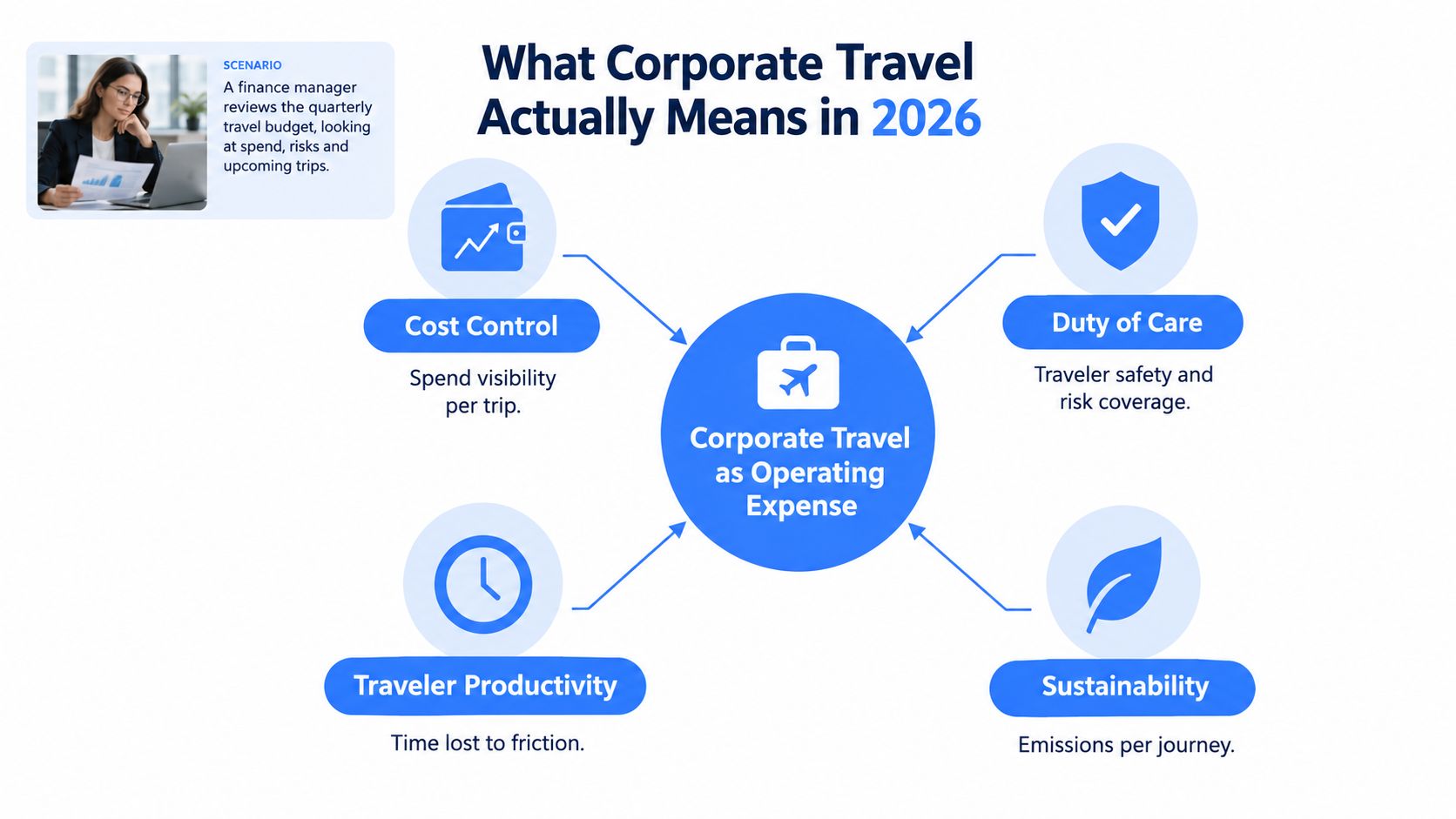
The four controls that matter
Time measures more than flight duration. It includes airport transfers, queues, connections, recovery, and the working hours that disappear around them. A direct route can be more valuable than a lower fare when the traveler must deliver a decision immediately after landing.
Cost includes the complete trip, not merely the fare. Add hotels, ground transport, meals, change fees, overtime, and the cost of an executive being unavailable. Finance should see those elements together.
Risk covers traveler location, security exposure, operational continuity, and the company's duty of care. If nobody can quickly confirm where a traveler is or how to support them, the booking process has created a governance gap.
Discretion becomes decisive for acquisitions, investor meetings, litigation, sensitive negotiations, and executive movement. Confidentiality can depend on the terminal, passenger manifest, ground transfer, and schedule control, not just the cabin.
Advisor's rule: Choose the mode that protects the business objective at an acceptable total cost. Ticket class is only one input.
Commercial aviation remains the sensible default for predictable point-to-point travel. Premium commercial service earns its place when long-haul comfort protects performance. Private aviation is justified when direct routing, schedule control, confidentiality, or multi-city flexibility outweighs the higher fare. A 2026 program should blend all three rather than force every trip into one category.
The Real Cost of a Business Trip
The hidden cost of travel is usually lost productive time. A 2025 survey reported that 86% of business travelers lost at least one hour of productive time after a stressful trip, while 45% of C-level executives lost four to eight hours because of travel stress, according to Booking.com for Business.
An independent Travel Stress Index estimated that business travelers lose an average of 6.9 hours per trip to stress, with a reported financial equivalent of US$662 per trip. That doesn't mean a charter is automatically economical. It means finance should compare the price of transport with the value of the working time and decision capacity the itinerary consumes.
A useful internal calculation assigns a loaded hourly value to each traveler, then adds the cost of delay, overnight accommodation, missed meetings, and recovery. A US$4,000 commercial ticket with twelve lost productive hours may be more expensive to the company than a US$9,000 charter that protects a full working day, but only when the protected time has a real business use.
Hidden Cost Breakdown per Business Trip
| Cost Component | Commercial Coach | Premium Commercial | Private Charter |
|---|---|---|---|
| Fare | Lowest base fare, subject to route and timing | Higher fare with improved comfort and service | Highest direct transport cost |
| Door-to-door time | Vulnerable to connections, queues, and airport transfers | Similar network constraints, with a better onboard environment | Direct routing and private terminal access can reduce friction |
| Schedule control | Fixed airline schedule | Fixed airline schedule with more flexible service options | Departure time and routing shaped around the mission |
| Productivity exposure | Greater risk of fragmented work time and recovery | Lower fatigue, but airport and schedule exposure remains | More usable time when the itinerary is time-sensitive |
| Disruption cost | Rebooking, missed meetings, and possible overnight stays | Similar disruption risks, often with better support | Operator availability, aircraft positioning, and weather still matter |
| Expense visibility | Requires disciplined capture across vendors | Requires disciplined capture across vendors | Requires a clear charter quote, passenger record, and ancillary ledger |
Finance teams should connect itinerary data to expense data. A system supporting VAT-compliant travel expense tracking can help reconcile receipts, tax treatment, cards, and trip records, which is particularly useful when a journey includes multiple suppliers.
The decision also depends on mission design. A practical reference for the private option is how much it costs to charter a private jet, but the quoted aircraft price still needs to sit beside traveler hours, ground movements, and the consequence of arriving late.
Comparing Commercial, Premium, and Private Aviation
Travel mode should follow the trip's operating profile. Commercial aviation works well when the route is frequent, the schedule is predictable, and the traveler can absorb airport processes. Premium commercial travel makes more sense when the journey is long and the traveler needs to arrive ready for demanding work. Private aviation earns approval when the itinerary is difficult to serve through the airline network or when discretion and timing are central to the outcome.
Door-to-door timing is the first filter. A commercial route may have a short airborne segment but still consume much of a working day through ground travel, security, boarding, and connections. Premium service improves the cabin experience, but it doesn't remove the airline timetable. A private aircraft can use a more suitable airport and support direct routing, although aircraft availability, weather, customs, and positioning still require professional coordination.
| Criterion | Commercial | Premium Commercial | Private Aviation |
|---|---|---|---|
| Best fit | Predictable point-to-point travel | Long-haul travel where rest supports performance | High-value, time-sensitive, multi-stop, or discreet missions |
| Schedule | Determined by airline network | Determined by airline network | Built around the trip, subject to aircraft and operational constraints |
| Airport access | Major commercial airports | Major commercial airports | Private terminals and a wider airport choice |
| Multi-city flexibility | Limited by published schedules | Limited by published schedules | Stronger support for same-day multi-stop routing |
| Confidentiality | Public airport and cabin environment | Public airport and cabin environment | Greater control over passenger flow and manifest |
| Productivity | Interrupted by ground and airport friction | Better onboard comfort, same network exposure | More control over working time and itinerary continuity |
| Cost logic | Lowest direct fare | Higher fare for comfort and service | Higher direct cost justified by mission value |
Match the mode to the work
Use commercial travel for a routine supplier visit with a stable schedule and enough margin around the meeting. Use premium commercial for an overnight long-haul journey where fatigue could weaken negotiations or decision-making. Use private aviation for a board tour across multiple locations, a fast operational intervention, or a confidential investor meeting where public travel creates unacceptable exposure.
The program should also distinguish comfort from control. A premium seat may make a traveler more comfortable, but it won't solve a connection that forces an overnight stay. Private aviation may solve the connection, yet it introduces a larger financial commitment and needs a documented approval trail.
Decision rule: Buy comfort when fatigue is the problem. Buy control when the itinerary, timing, or confidentiality is the problem.
Designing a Corporate Travel Policy That Holds
A corporate travel policy should function as a risk document, not a reimbursement memo. It needs to tell travelers who may authorize a trip, which options are acceptable, how exceptions are approved, and what information the company must have before departure.
Start with booking authority. Define who can book for employees, executives, groups, and urgent missions, then set approval levels based on trip purpose and spend exposure. A vague instruction to “book reasonably” gives finance little control and gives travelers no reliable standard.
Write clauses that control behavior
Preferred supplier tiers should identify negotiated airlines, hotels, ground providers, brokers, and security partners. The policy should explain when a traveler may leave the preferred network, such as when the route, timing, or safety profile makes the preferred option unsuitable.
Class-of-service thresholds should connect eligibility to the journey rather than seniority alone. For example, premium cabin access can depend on flight length, overnight scheduling, medical needs, or the requirement to work immediately after arrival. Private aviation should require a separate business case covering time saved, itinerary complexity, confidentiality, and alternatives considered.
Pre-trip approval should route requests to the right owner before ticketing. A routine visit may need line-manager approval, while an executive trip through a higher-risk destination may require security pre-clearance. Every traveler should submit the final itinerary before departure, including passenger details, ground transfers, and emergency contacts.
Expense capture should require a complete record of airfare or charter cost, hotels, transfers, meals, and changes. Match the expense to the approved trip so finance can distinguish a policy exception from a legitimate operational adjustment.
Treat duty of care as an operating requirement
The company should know where travelers are expected to be and who can reach them. The policy should specify emergency support, escalation ownership, security advisories, and the process for changing an itinerary during disruption.
A strong policy also defines exceptions. An executive shouldn't have to debate a policy portal during a crisis, but the exception still needs an owner, reason, and retrospective review. Specific language protects both the company and traveler. Generic language shifts the argument to the airport, after the money and risk have already been committed.
Why a Managed Program Beats Ad-Hoc Booking
An assistant books a flight for one executive, then another traveler changes the meeting, a transfer fails, and finance must reconstruct the cost afterward. Ad-hoc booking feels flexible, but it spreads spend across suppliers, obscures traveler location, and leaves responsibility unclear.
A managed program assigns one coordinator, broker, or specialist provider responsibility for the complete movement. That owner compares commercial schedules with private aircraft, coordinates ground transport, maintains the approval record, and updates security when plans change. The value is operational control, not another booking form.
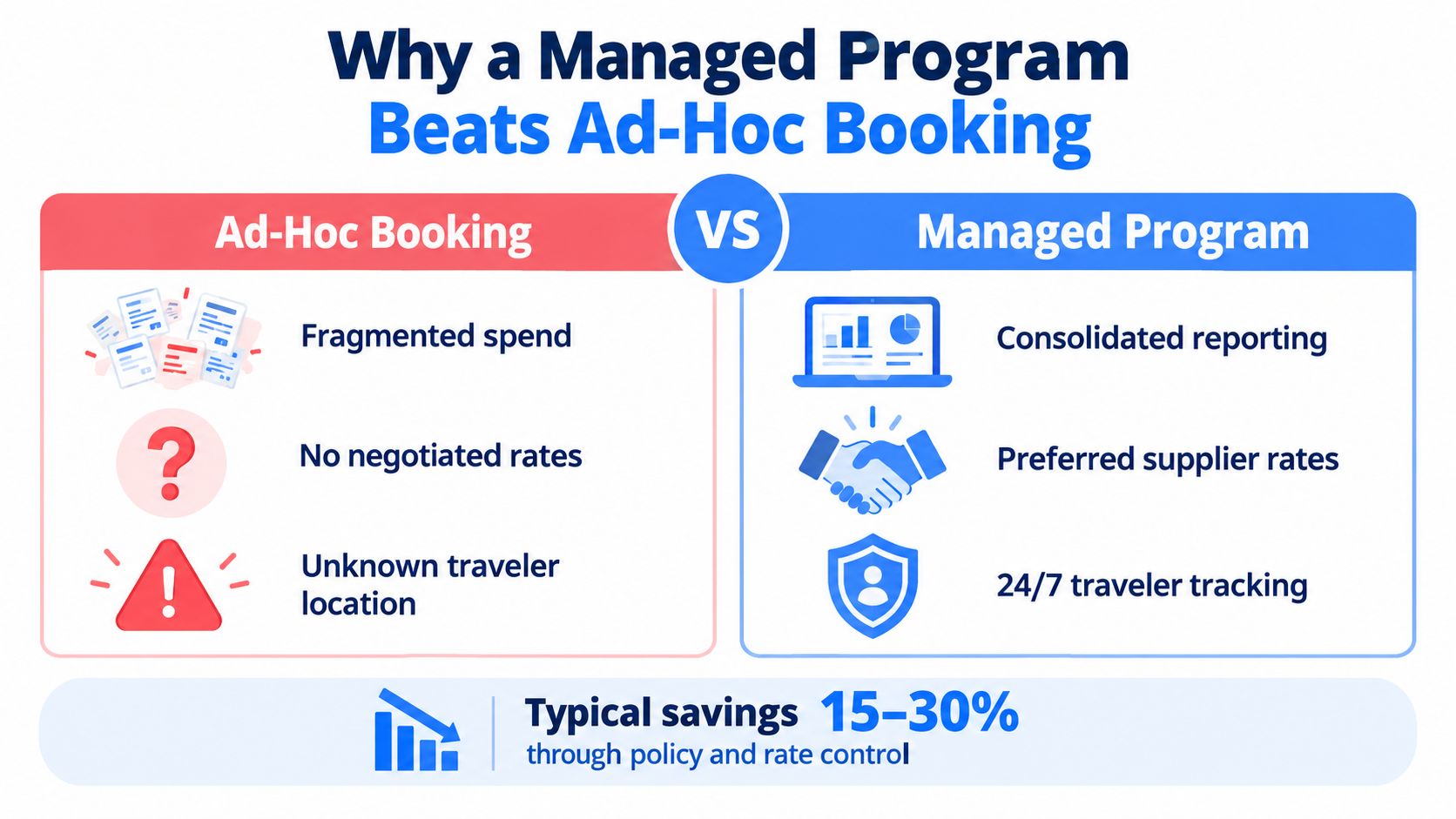
What centralization changes
A managed program combines demand across routes and suppliers, which strengthens rate discussions and produces consistent reporting. It can also test an urgent commercial booking against the full itinerary cost, including an overnight stay, additional ground time, or a direct charter.
Central control improves traveler visibility during disruption. The team can contact travelers, coordinate security or medical support, and maintain one current itinerary instead of searching through email threads. Finance receives a clear record of what was approved, booked, changed, and expensed.
For complex executive movement, the provider must cover more than ticket searches. Aircraft sourcing, operator checks, ground handling, customs coordination, passenger documentation, and active oversight need named owners. A corporate flight management approach makes those responsibilities explicit instead of leaving an assistant to coordinate disconnected vendors.
Specialist partners can handle the destination layer as well. For executive retreats, events, and sensitive meetings, luxury destination management companies can coordinate local logistics that an airline booking engine does not cover.
Finance perspective: Fragmented booking can appear cheaper because coordination costs remain hidden. A managed program shows the full cost, then gives the company a basis for controlling it.
Use the embedded resource below when evaluating a service model for executives and travel managers.
The right partner does not force private aviation onto every trip. It compares commercial, premium, and private options, then records why the selected mode fits the mission, time constraints, risk exposure, and itinerary design.
Three Trips, Three Playbooks
A travel policy becomes useful when it produces different answers for different missions. The following examples show how itinerary structure, approval logic, and aircraft selection should change together.
A board tour across three states in two days is not a normal flight booking. The team needs to reach each location, protect meeting time, avoid unnecessary hotel nights, and preserve enough margin for the final session. A light jet may support a more direct sequence through suitable airports, while a commercial itinerary could force the group into fixed schedules and additional ground transfers. The approval should document the board agenda, the alternative routing, the number of travelers, and the working time protected.
An urgent operational dispatch follows a different logic. If a plant shutdown, acquisition close, or critical equipment failure requires a specialist on site, the question isn't whether the cheapest seat exists. It's whether the traveler can depart soon enough and arrive with the right tools, documents, and support. An on-demand provider may source a turboprop or midsize jet, subject to mission needs and availability, then coordinate ground movement directly to the operating site.
A confidential investor or client visit requires control over visibility. The company may need a private terminal, a clean passenger manifest, secure transfers, and an itinerary that doesn't expose the meeting through public airport movements. The aircraft's cabin finish matters less than who sees the traveler, who handles the information, and how quickly the team can move between locations.
| Scenario | Itinerary Pattern | Recommended Aircraft | Policy Trigger | Primary Benefit |
|---|---|---|---|---|
| Board tour | Multiple cities across states within a compressed schedule | Light jet or suitable midsize jet | Executive group, multi-stop routing, documented time value | Protects meeting continuity and reduces itinerary fragmentation |
| Operational dispatch | Urgent departure to a plant or transaction location | Turboprop or midsize jet, based on route and payload | Incident owner approval and mission urgency | Moves the required people and equipment without waiting for a convenient airline schedule |
| Confidential investor visit | Direct routing with controlled passenger and ground movement | Aircraft matched to distance, group size, and discretion needs | Security and executive approval | Reduces public exposure and preserves confidentiality |
The traveler also needs a practical work plan. A checklist covering connectivity, document access, power, and offline contingencies can complement these arrangements. SwiftNet Wifi offers remote travel tips that can help travelers prepare for work away from the office, though connectivity planning should still reflect the aircraft, route, and meeting requirements.
Common Misconceptions About Private Aviation for Business
Private aviation fails when companies defend it with status language or pretend it always reduces cost. The defensible argument is narrower: a private aircraft can be the right operating tool when time, access, confidentiality, or routing control has greater business value than the fare difference.
| Myth | Reality | Trip Where It Breaks |
|---|---|---|
| Private jets are always more expensive than first class | The direct fare is usually higher, but total trip cost includes lost work time, extra nights, and missed meetings | A multi-city tour where commercial schedules force fragmented routing |
| Private aviation exists for status, not productivity | Its business case often rests on direct access, controlled timing, and usable work time | A leadership team moving between several operating locations |
| Private jets only make sense for CEOs | The relevant test is mission value, not title | A specialist sent to resolve an urgent plant problem |
| Empty legs are basically free deals | An empty leg still depends on route, timing, aircraft availability, and operational fit | A traveler whose meeting time can't move to match the aircraft |
| A corporate flight is just a charter receipt | The program also needs operator diligence, passenger records, ground coordination, and approval evidence | A sensitive investor visit requiring controlled movement |
A four-leg same-day European tour illustrates the issue. The program owner shouldn't compare only a private quote with four commercial fares. The analysis must include airport transfers, connections, possible overnight stays, and the working hours lost between meetings. Conversely, a short urgent dispatch may not justify private aviation if a suitable commercial route gets the specialist there in time.
Safety also requires a process rather than an assumption. Travel managers evaluating private aviation can review practical questions in are private jets safe, then require operator credentials, aircraft information, crew details, and contingency procedures before approval.
The useful defense: Private aviation is neither a luxury default nor a universal saving. It's a controlled option for a defined business problem.
A 90-Day Roadmap to Build or Rebuild Your Program
A program can move from informal booking to accountable operating control without waiting for a major technology overhaul. The first priority is evidence. The second is policy. The third is consistent execution.
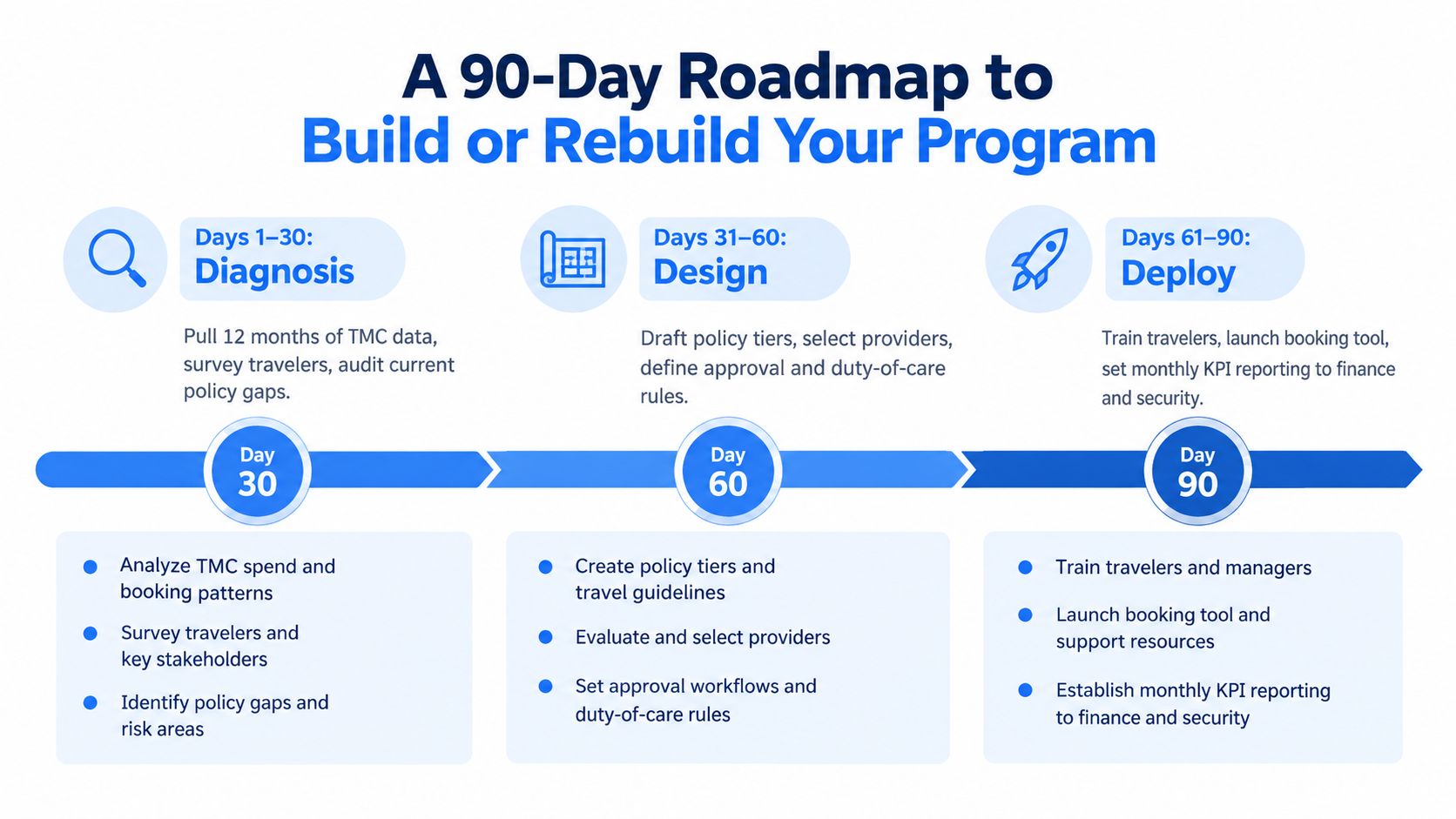
Days 1 to 30 for diagnosis
Pull 12 months of TMC data, traveler feedback, expense records, and incident reports. Segment trips by route, frequency, traveler tier, purpose, disruption, and exception type. Identify where commercial schedules create repeated delays, where policy language fails, and where security cannot confirm traveler location.
Days 31 to 60 for design
Draft policy version one with booking authority, supplier tiers, class-of-service rules, approval gates, expense capture, duty-of-care requirements, and exception ownership. Select a managed program partner or appoint an internal coordinator. Pilot private aviation on two defined use cases, such as multi-city executive travel and urgent operational dispatch, with written success criteria.
Days 61 to 90 for deployment
Train assistants, travelers, finance, security, and approvers. Launch the booking and expense workflow, connect itinerary visibility to duty-of-care procedures, and review the first 30-day operating period. Assign one accountable owner and establish a quarterly review cadence.
Report the KPIs that expose trade-offs rather than vanity activity:
- Average door-to-door time: Measure the full journey, not airborne time.
- Policy exception rate: Track where the policy conflicts with operational reality.
- Traveler satisfaction: Separate comfort complaints from genuine productivity barriers.
- Incident response time: Record how quickly the company can locate, contact, and support a traveler.
The market context supports this discipline. GBTA forecasts US$1.71 trillion in global business travel spending and 1.84 billion trips in 2026, while noting that higher prices, geopolitical uncertainty, and transportation pressures are influencing spending, according to Navan's State of Corporate Travel and Expense 2026. The same source notes that fewer travel managers expect to increase budgets for 2026 and that 9% anticipate cuts. More travel with tighter budgets demands better trip selection, not blanket restrictions.
Approved Jets arranges on-demand charter flights and integrated travel services for executive and corporate missions, including aircraft sourcing, ground movements, and end-to-end coordination. If your program needs a defensible way to compare commercial schedules with private options for time-sensitive or confidential travel, visit Approved Jets and discuss the itinerary with its corporate mobility team.