Safest Private Jet: How Safety Is Really Assessed
Learn how the safest private jet is judged: operator certificates, safety management systems, maintenance, crew training and route fit, with 2026 data.
16 min read
Most online rankings claiming to name the safest private jet get the question backwards. They line up glossy cabin photos, point to triple-engine designs or advanced flight decks, and crown a single model such as a Dassault Falcon 8X or Gulfstream G650 as the winner. That advice sounds reassuring, yet it measures the hardware while ignoring the human and organizational system flying it.
Real accident data tells a sharper story. In its 2025 NBAA Top Safety Focus Areas, the National Business Aviation Association identifies loss of control in flight as the deadliest general-aviation accident category and flags human factors, procedural noncompliance, and operational differences across aircraft types as persistent hazards. Hardware alone hasn't flattened global risk either. Preliminary figures reported by Business Jet Traveler counted 18 fatal turbine-business-aircraft accidents worldwide in the first half of 2025 causing 81 passenger and crew deaths, up from 17 accidents and 54 deaths in the first half of 2024.
Safety isn't bolted to a tail number at the factory. It's built by the certificate-holding operator managing the pilots, maintenance schedules, and dispatch decisions, then tested against the exact runway and weather waiting at your destination.
Table of Contents
- Why the Operator Matters More Than the Jet
- Why Public Numbers Never Tell the Whole Story
- A Safety Checklist for Any Private Jet Charter
- How to Verify Each Operator Check
- Comparing Quotes Without Guessing
- Operator Certificates, Aircraft Rules and Accident Data
- What Aircraft Certification Proves and What It Cannot
- Reading NTSB Totals Without Misusing Them
- A Worked Comparison Between Two Charter Quotes
- Safety Management Systems and Flight Monitoring
- How the SMS Loop Stops an Accident Weeks Early
- What Evidence to Request Before Complex Trips
- Matching the Aircraft to the Route and Airport
- When a Smaller Jet Is the Safer Call
- Three Questions to Ask About Your Planned Airport
- Foreign Operators and Cross-Border Checks
- Cross-Border Itineraries and Ground Security
- Confirm the Operator Before You Book
Why the Operator Matters More Than the Jet
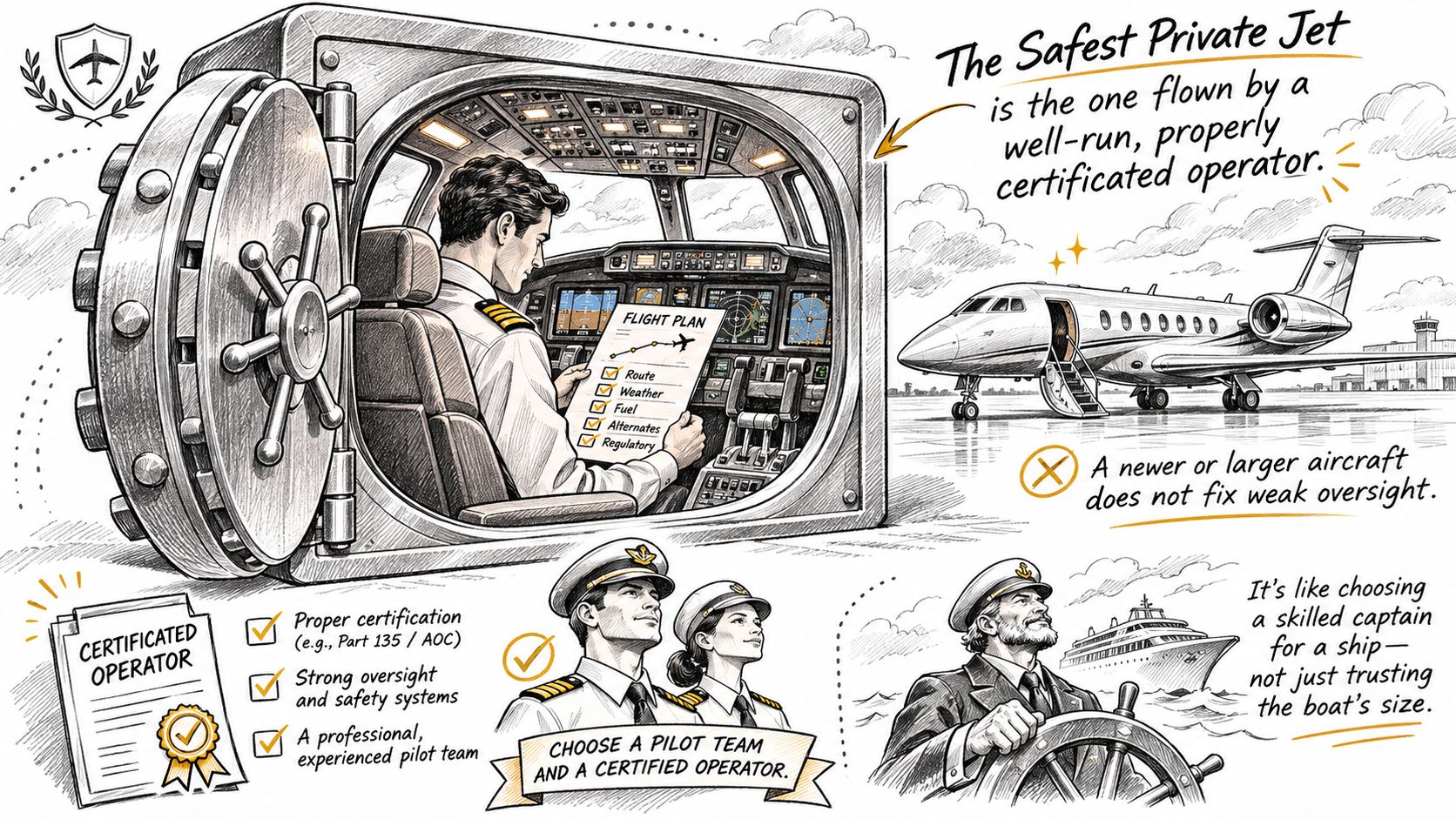
The safest private jet for your trip is the one flown by a well-run, properly certificated operator. A brand-new airframe or a larger cabin doesn't compensate for rushed maintenance, tired crews, or weak dispatch oversight. Picking a charter flight purely by aircraft model is like choosing a restaurant for the brand of ovens in the back while ignoring the chefs' training and the kitchen's health inspections.
Every charter flight operates as a four-layer system. The foundation is the operator's air carrier certificate, followed by its active safety management processes, its documented accident and incident history, and finally how accurately the aircraft's performance fits the specific route and airport. If any of the first three layers is weak, an impressive model name on the quote sheet won't protect you.
Why Public Numbers Never Tell the Whole Story
In the United States, commercial private jet charter operates mainly under FAA Part 135, while international operators follow equivalent civil aviation frameworks set by their home countries. That means the core verification standards travel across borders even when the regulator's name changes. Whether you work directly with a fleet or through an aircraft charter brokerage, you're evaluating the certificate holder flying the plane, not the marketing label on the cabin door.
Public aviation statistics also have real blind spots. Most headline figures are published as raw accident totals rather than exposure-adjusted rates per flight hour, which makes year-to-year swings easy to misread. Preliminary figures from Aviation International News on 2024 business-jet fatalities showed worldwide business-jet deaths dropping to 21 in 2024 from 32 in 2023, a decline of nearly 35%. Yet preliminary data from Aviation International News covering the first nine months of 2025 recorded 25 worldwide business-jet and turboprop accidents causing 99 deaths, compared with 23 accidents and 75 deaths during the same stretch in 2024.
Industry-wide totals don't move in a straight line, and they can't tell you whether the specific operator quoting your Friday departure maintains strict discipline in its hangar and cockpit.
Because macro trends can't substitute for due diligence, travelers and corporate flight coordinators need a repeatable screening tool. A structured operator checklist turns vague promises about safety into verifiable records you can inspect before wiring a deposit.
A Safety Checklist for Any Private Jet Charter
Before you accept a charter quote, run the certificate-holding operator through seven concrete checks. Strong operators already keep these records organized for regulators and third-party auditors such as ARGUS Platinum, Wyvern Wingman, and IS-BAO, so answering your questions shouldn't take days or trigger pushback.
Check | Strong answer | Where to verify | Red flag |
|---|---|---|---|
Operating certificate | Part 135 or foreign equivalent, named on the flight | FAA certificate lookup or the operator's documents | Operator cannot name its certificate |
Safety management system | Written SMS with hazard register and audit | SMS manual and third-party audit credential | No written SMS, only a claim of FAA compliance |
Flight data monitoring | Routine review of approach and bank-angle trends | Operator's safety reporting summary | No flight data monitoring program |
Crew training | Documented controlled-flight-into-terrain avoidance and recency rules | Training records on request | Vague answers on crew recency |
Maintenance control | Current maintenance-control program with tracked inspections | Maintenance records and logbook access | Overdue inspections or refusal to show records |
Incident history | Any accident or incident explained and closed out | NTSB accident database search | Unexplained accidents or incidents |
Mission fit | Runway, range and payload margins that suit the route | Performance data and the planned route | Aircraft running near its limits at a short or high-altitude airport |
How to Verify Each Operator Check
Start with the operating certificate, because illegal or "gray" charter flights still surface when an aircraft owner tries to offset costs without holding commercial authorization. Confirm the exact legal name and certificate designator printed on the charter agreement, then verify it through the FAA's public Part 135 registry or the operator's Air Carrier Certificate PDF.
Next, separate minimum regulatory compliance from proactive oversight. According to the NTSB's Most Wanted List advocacy on Part 135 safety, most organizations conducting Part 135 operations historically didn't maintain, and weren't required to maintain, a formal Safety Management System (SMS), a flight-data-monitoring (FDM) program, or controlled-flight-into-terrain (CFIT) avoidance training. The NTSB specifically recommends scaling SMS and FDM across an entire operation because FDM catches recurring exceedances like unstable approaches, excessive bank angles, high sink rates, or flight-path deviations before they end in a crash. Ask whether the operator reviews flight data routinely and how crews train against CFIT risks during night flights, poor visibility, or terrain-heavy arrivals.
Checking maintenance control and incident history closes the remaining operational gaps. A mature operator tracks airframe hours, engine directives, and scheduled inspections in a digital maintenance system and can confirm no deferred items affect your leg. For past events, search the NTSB aviation accident database under the operator's legal name rather than just the aircraft tail number, since tail numbers move between owners while safety culture stays with the company.
The short video below walks through practical questions travelers can raise when evaluating charter operators and aircraft readiness.
Comparing Quotes Without Guessing
Never evaluate a single quote in isolation. Send your seven questions in writing to at least two operators quoting the same itinerary, and store their answers side by side. When you compare written responses, evasiveness stands out immediately: one dispatcher sends an audit certificate, crew recency confirmation, and runway performance sheet within an hour, while another replies with a generic brochure line about "strict FAA standards."
Corporate travel teams handling recurring executive or medical missions often formalize this comparison using a structured risk matrix from Safety Space to weigh hazard likelihood against potential severity across each bidder. Scoring each operator against clear criteria keeps price pressure from overriding operational discipline.
Practical rule: One incomplete answer isn't an automatic reason to cancel a trip, but it is a reason to pause. Ask a follow-up question, request the missing document, and walk away only if the operator can't or won't back up its claim.
Operator Certificates, Aircraft Rules and Accident Data
An operator's certificate is the single biggest regulatory gate in private aviation. In the United States, FAA Part 135 sets the legal framework for on-demand charter, dictating operational control, crew duty limits, training checks, and maintenance oversight. Understanding how those commercial rules differ from private owner-flown flights under Part 91 vs. Part 135 charter rules explains why two identical jets parked side by side on the same ramp can carry very different risk profiles.
Long-term regulatory data proves that tighter operational rules move the needle. A congressionally mandated FAA study of Part 135 operators recorded annual U.S. on-demand charter accident rates ranging from 0.829 to 1.330 accidents per 100,000 flight hours between 2012 and 2016, with fatal-accident rates between 0.196 and 0.295 per 100,000 hours. Over a longer horizon, the same FAA analysis found that the on-demand Part 135 accident rate dropped from 2.67 per 100,000 flight hours in 1992 to 2001 down to 1.5 in 2002 to 2011.
At Approved Jets, we operate exclusively as a charter broker and don't own, operate, lease, or maintain any aircraft. Every flight we arrange is flown by registered Part 135 operators or their foreign equivalent that meet and exceed FAA standards alongside our own internal requirements, because operator-level compliance is far more predictive than cabin luxury or brand reputation.
What Aircraft Certification Proves and What It Cannot
Buyers often assume larger cabin jets are safer because they look closer to commercial airliners. There is a real regulatory threshold behind that perception, though it's narrower than marketing copy suggests. Under FAA transport-category design approval rules, any multiengine airplane with more than 19 seats or a maximum takeoff weight above 19,000 pounds must be certificated in the transport category under 14 CFR Part 25.
Part 25 standards govern structural strength, system redundancy, propulsion, flight characteristics, equipment, and emergency provisions before an aircraft earns its type certificate. A large-cabin jet exceeding 19,000 pounds meets that transport-category baseline, whereas smaller light jets may be certificated under different airworthiness rules. Still, Part 25 certification verifies how the airplane was designed and tested at the factory. It tells you nothing about whether today's crew slept well, whether maintenance mechanics signed off an inspection properly, or whether dispatch checked braking action at the destination.
Reading NTSB Totals Without Misusing Them
Accident totals across civil-aviation sectors highlight why "private aviation" shouldn't be lumped into one bucket. Figures from the NTSB 2019 U.S. civil-aviation data summary break out commercial airlines, charter carriers, and general aviation separately.
Operating category | Accidents | Fatal accidents | Fatalities |
|---|---|---|---|
Part 135 commuter and on-demand carriers | 42 | 13 | 34 |
Part 121 air carriers | 40 | 2 | 4 |
General aviation | 1,220 | 233 | 414 |
Those numbers are raw annual totals, not rates adjusted for flight hours or departures, so they can't prove one aircraft model beats another. What they do confirm is that scheduled Part 121 airlines, on-demand Part 135 charter operators, and general-aviation flights operate in distinct regulatory environments with sharply different oversight requirements. Because a single year can skew perceptions, the NTSB also publishes multi-year tables spanning 2005 to 2024 so analysts can track sustained patterns instead of reacting to one headline.
A Worked Comparison Between Two Charter Quotes
Say a corporate travel manager receives two quotes for a cross-country executive trip on a midsize jet. Quote A offers a newer airframe from a familiar manufacturer at a slightly lower price, while Quote B uses an older airframe from a different builder. Instead of using the aircraft brand as a shortcut, the travel manager verifies that both quotes are true Part 135 commercial flights, pulls each certificate holder's multi-year NTSB history, and checks training documentation.
Quote A's operator turns out to have two recent runway incidents with thin explanations and no formal third-party audit, while Quote B's operator has a clean multi-year record and transparent maintenance logs. Quote B is the stronger safety decision regardless of cabin age.
One bad year across the industry tells you very little about your next flight, yet a repeating pattern of incidents inside a single operator tells you almost everything you need to know.
Safety Management Systems and Flight Monitoring
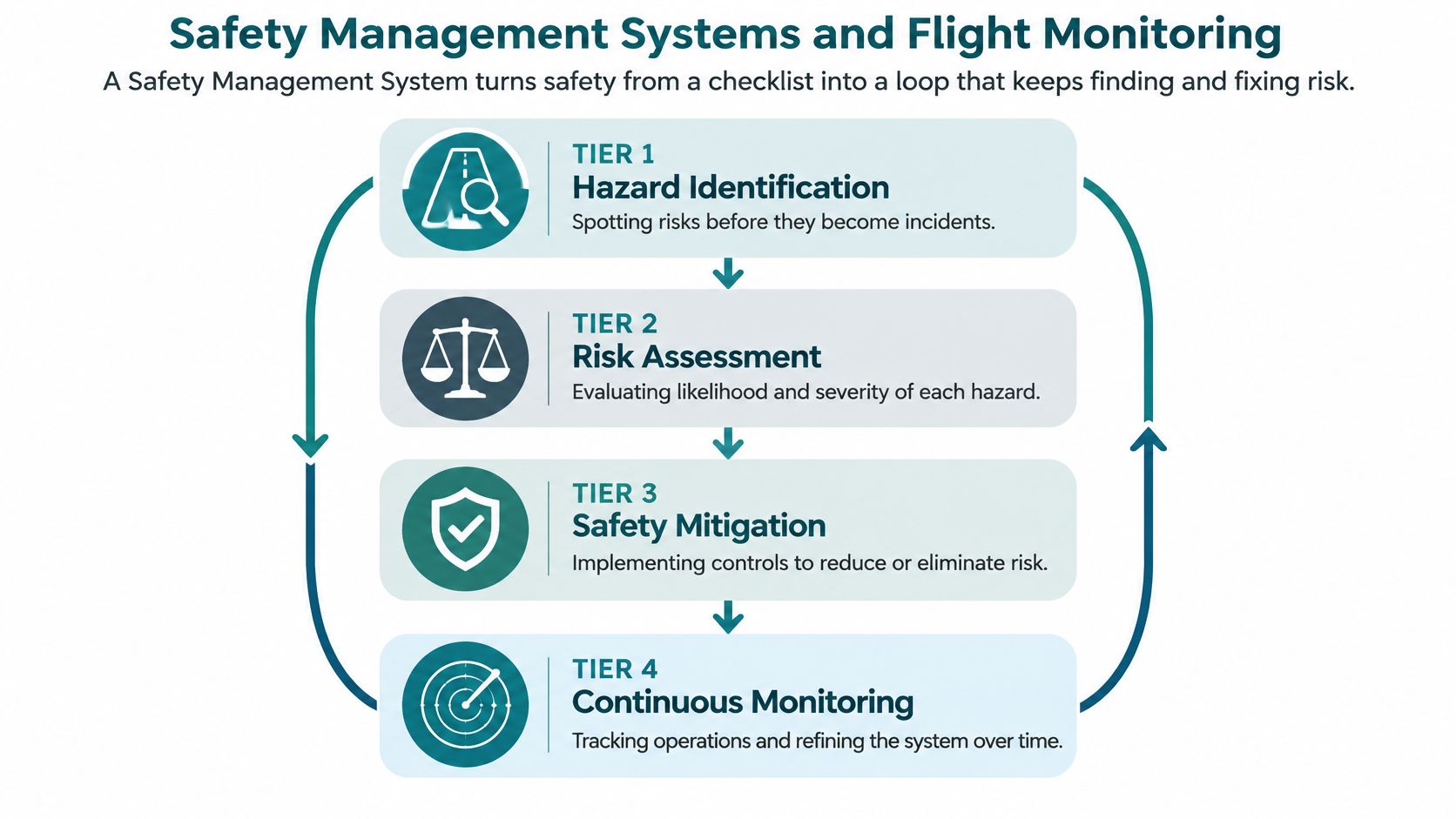
Regulatory checklists verify whether an operator met minimum rules on the day of an inspection. A Safety Management System (SMS) converts safety into a continuous feedback loop that catches emerging risk between audits. Instead of waiting for an incident to trigger corrective action, an SMS requires an organization to hunt for weak spots every week and prove that fixes work.
Under the FAA Safety Management Systems final rule, Part 135 operators must develop and implement formal SMS programs, with operators certificated before May 28, 2024 generally required to comply by May 28, 2027. The rule didn't appear out of theory: the FAA identified 35 Part 135 accidents whose risk could potentially have been mitigated through an active SMS. Those four core pillars form a closed cycle of hazard identification, risk assessment, safety-assurance monitoring, and corrective action.
How the SMS Loop Stops an Accident Weeks Early
Say a charter fleet flies frequently into a busy coastal airport with tight airspace restrictions. Over three weeks, automated flight-data downloads flag a subtle cluster of high sink rates and unstable approaches during late-afternoon arrivals. Nobody bent metal, no passenger noticed anything unusual, and no regulator was called.
In a weak operation, those flights disappear into the logbook until a wet runway turns the next rushed approach into a runway overrun. Inside a working SMS, the safety officer logs the trend in the hazard register, interviews crews through non-punitive voluntary reporting, and discovers that air traffic control frequently keeps jets high until close to the final approach fix. Management issues an arrival briefing memo, adjusts descent planning guidance, adds the scenario to simulator training, and monitors the next month of flight data until the exceedance rate drops back to zero.
What Evidence to Request Before Complex Trips
Because compliance deadlines stretch into 2027, some Part 135 operators already run mature, audited SMS programs while others are still drafting binders. Ask for proof that the loop runs:
- Current hazard register: Request a redacted summary showing active operational risks the operator tracks right now, not a blank template.
- Voluntary reporting channels: Confirm that pilots, mechanics, and dispatchers can submit safety reports without fear of punishment.
- Closed-loop tracking: Ask for an example of a recent trend flagged by monitoring and the documented corrective step that closed the risk.
Active SMS discipline pays off most on complex missions where coordination drives exposure far more than aircraft capability. International routing across unfamiliar airspace, weather-sensitive mountain airports, medical flights carrying specialized equipment, high-value cargo moves, and tight multi-leg executive itineraries all strain communication between crew, maintenance, and dispatch. An operator that can walk you through its live SMS carries far more credibility than one that merely states it has a manual on the shelf.
Matching the Aircraft to the Route and Airport
Even a flagship heavy jet with synthetic vision and fly-by-wire controls can become the wrong safety choice if its performance envelope clashes with the airport you picked. Public rankings obsess over cruise altitude and cabin width, yet the highest operational stress clusters around approach, landing, runway, and ground operations.
Recent industry numbers sharpen that focus. According to a business-aviation safety review published by Just Helicopters, FAA figures for fiscal 2025 recorded 1,636 runway incursions, with 61% involving pilot deviations and 20% involving air-traffic-control errors. The same report notes that runway excursions remain the most common business-aviation accident type, accounting for nearly one-third of business-aviation accidents.
Matching the airframe to the runway starts well before departure. Reviewing private jet runway requirements alongside real-time field conditions exposes constraints that glossy aircraft comparison charts leave out.
Route check | What to ask | Example risk |
|---|---|---|
Runway length and slope | Required takeoff and landing distance at planned weight | Short strip with a downhill slope |
Weather and braking | Contaminated-runway performance for the arrival time | Wet or snow-covered surface at destination |
Terrain and approach | Published approach and terrain clearance for the route | Mountainous approach in poor visibility |
Rescue and curfews | Airport rescue capability and operating hours | Arrival at an airport with a curfew |
Alternates and margins | Alternate airport plus fuel and payload reserve | Destination closes after departure |
When a Smaller Jet Is the Safer Call
Consider a time-sensitive medical evacuation or winter executive trip into a high-elevation mountain airport with a steep runway slope and slush on the pavement. A heavy ultra-long-range jet may look impressive on paper, yet its landing weight and contaminated-runway stopping distance can shrink safety margins right down to the legal minimum. If snow intensifies mid-flight and the field closes, that aircraft also needs enough fuel and payload flexibility to divert cleanly to a lower-altitude alternate.
A midsize or super-midsize aircraft with stronger short-field landing performance, or a lighter jet matched closely to passenger count and baggage weight, often leaves wider stopping and climb-out margins on the exact same mission. Good dispatchers match the aircraft to passenger load, luggage volume, terrain, and runway conditions first, treating cabin size as a secondary preference.
Three Questions to Ask About Your Planned Airport
- What are the calculated takeoff and landing distances at our exact passenger and fuel weight? If the numbers rely on dry pavement and calm winds while rain or snow sits in the forecast, ask for contaminated-runway calculations.
- Which alternate airport is filed, and how does diversion fuel affect payload? Confirm you won't have to offload luggage or push fuel reserves tight if visibility drops below approach minimums.
- Does the airport's rescue coverage and curfew window fit our schedule with buffer time? Late departures into curfew-restricted fields create schedule pressure, and schedule pressure is where rushed approaches begin.
Foreign Operators and Cross-Border Checks
International charters follow the same safety logic as domestic U.S. trips, with one extra layer of homework: the Air Operator Certificate (AOC) is issued by the civil aviation authority where the operator is legally based. A European charter carrier holds approval from its national authority under EASA oversight, a British operator answers to the UK CAA, and carriers in Canada, the Middle East, or Asia-Pacific answer to their respective national regulators.
Don't assume a foreign certificate signals lower quality, and don't skip verification because an operator looks well-known. Run the verification in three focused steps:
- Confirm the issuing authority and certificate number: Ask for the operator's exact legal entity, AOC number, and country of registry, then cross-check the active status on that aviation authority's public register.
- Apply the same operational standards: Equivalent national regimes still require structured maintenance-control programs, recurrent crew training, and reportable incident histories, so request the same documentation you'd expect from a U.S. Part 135 carrier.
- Pin down operational control on every leg: Multi-country itineraries sometimes rely on partner aircraft or sub-charters for positioning or return segments. Confirm who holds legal operational control on each leg, since switching operators mid-trip splits responsibility for maintenance tracking and crew rest limits.
Cross-Border Itineraries and Ground Security
Say you're chartering from New York to Geneva on a European-certificated heavy jet, with a return flight four days later. Before confirming, verify that the foreign operator's certificate covers both the outbound and return segments, and ask whether the same aircraft and rested crew remain assigned for the trip home or whether a different certificate holder takes over the second leg. Knowing that upfront prevents last-minute tail swaps to an unvetted carrier.
Cross-border safety also extends beyond the cockpit to local ramp access, screening, and terminal protocols. Flight departments planning trips into regions with distinct regulatory frameworks, such as reviewing aviation security rules in Australia compiled by ABCO Security Services Australia, coordinate operator checks with destination security compliance so nothing catches the crew or passengers off guard on arrival.
A foreign certificate isn't a lower safety bar by default. Judge every operator, domestic or international, by the documents it produces and the discipline behind its operations.
Confirm the Operator Before You Book
Make one firm decision rule your standard for every trip: never confirm a private jet charter until the certificate-holding operator clears your safety checks. Price comparisons only make sense once every competing quote sits above the same operational floor.
Before signing a charter agreement, lock down three items in writing:
- Certificate and aircraft basis: Get the operator's legal name, Part 135 or foreign-equivalent certificate identifier, and confirmation of the aircraft's certification basis and airworthiness status.
- Active safety systems and crew readiness: Request the operator's SMS overview, flight-data monitoring practice, and confirmation of crew recency and training records.
- Route-specific performance: Review the runway distances, planned alternates, and fuel margins calculated for your actual passenger count, baggage, and expected arrival weather.
At Approved Jets, safety is considered before price in every quote, and your account manager answers specific questions about the assigned aircraft before you confirm. Because charter quotes are estimates that can shift with aircraft availability, fuel costs, positioning fees, landing fees, overnight charges, de-icing, catering, and ground transportation, finishing your safety review first keeps changing trip logistics from rushing a critical decision. If you need immediate assistance on a time-sensitive mission, our flight advisors are available 24/7 at +1 (866) 678-1411.
Save the operator's certificate, audit credentials, and route notes alongside your booking confirmation. Keeping that written safety file ensures corporate compliance teams, family offices, and travel managers can verify exactly why an operator was approved long after the wheels touch down.
Approved Jets arranges domestic and international on-demand charters, corporate travel, medical evacuations, and specialized logistics exclusively through vetted FAA Part 135 and foreign-equivalent operators matched to your exact route and runway profile. Every quote puts operator verification ahead of price, with dedicated advisors ready to answer aircraft-specific safety questions before you sign. Start planning your next trip with confidence by visiting Approved Jets.