Part 91 vs Part 135: Which Rules Apply to Your Flight
Part 91 vs Part 135 explained for charter buyers and brokers: operational control, maintenance rules, safety data and which rules apply to your trip.
17 min read

In an FAA safety-statistics presentation built on U.S. National Transportation Safety Board accident data for 2008 through 2023, the approximate accident rate was 4.9 for general aviation flying under Part 91 and 1.3 for on-demand operations under Part 135, with approximate fatal-accident rates of 0.9 and 0.4 respectively, per the FAA's safety data. Those are the numbers people quote when they ask which Part is safer. They don't answer that question, and they were never built to.
The Part number attached to a flight is a statement of accountability, not a safety grade. It tells you who is legally answerable for the dispatch decision, who assigns the crew, who signs for the maintenance program, and who answers when a destination goes below minimums at 11 p.m. Under Part 135, a certificate holder carries that weight. Under Part 91, the owner or operator of the aircraft does.
Two identical aircraft parked on the same ramp can sit under different rule sets depending on who is selling the seat and who is running the flight. That's why the useful question in any Part 91 vs Part 135 comparison isn't which label is safer. It's which obligations attach to this aircraft, this operator, this altitude and this date.
Table of Contents
- Part 91 and Part 135 at a Glance
- Operational Control Decides Who Is Accountable
- Who Holds the Pen When Weather Turns
- Five Questions That Settle Control
- Which Part Fits Each Trip Type
- Where the Medical Mission Changes the Rule
- Safety Data Behind the Part Numbers
- Two Populations, Not Two Versions of One
- The Gap Inside Part 135
- Maintenance Rules Change at Nine and Ten Passengers
- The Certificate Holder Owns the Work
- Records That Follow the Component
- Crew, Equipment and Records Under Each Part
- Equipment Rules Stack, They Don't Replace
- Crew Duty Is a Scheduling Constraint
- Confirm the Operator's Certificate Before You Book
Part 91 and Part 135 at a Glance
Part 91 governs private, noncommercial general aviation. Part 135 governs commuter and on-demand commercial operations, including air taxi and charter services. Both describe regulatory frameworks, not aircraft categories, which is exactly how the electronic Code of Federal Regulations for Part 135 structures them.
The layering is what surprises people. Part 135 flight-operation requirements apply "in addition to" Part 91 requirements, so a charter aircraft has to satisfy both rule sets at once, and the equipment subpart adds obligations without demanding duplicate equipment. The modern Part 135 framework was substantially formalized in a major 1990 rulemaking and has been amended steadily since.
What that framework produces is a certificated operator running an FAA-approved system: manuals, dispatch and operational control procedures, pilot qualification and recurrent training, recordkeeping, maintenance programs, weather minimums and passenger-carrying procedures. A Part 91 flight can run just as professionally, with excellent aircraft and experienced crews. Its regulatory baseline is less prescriptive, because nobody is buying a seat on it.
One airframe makes the difference concrete. An eight-seat jet flown by its owner for personal trips sits under Part 91. The same jet, same crew, same paint, sold by the trip or by the seat, moves under Part 135 and inside a certificate holder's approved system. The aircraft didn't change. The accountability did.
Part 91 and Part 135 compared on seven criteria
Criterion | Part 91 | Part 135 | Why it matters to a buyer |
|---|---|---|---|
Primary use | Private, noncommercial general aviation | Commuter and on-demand commercial operations, including charter | Tells you whether a seat is being sold on the flight |
Operating certificate | No air carrier certificate; owner or operator responsible | Operator holds a Part 119 certificate and FAA operations specifications | The certificate, not the aircraft, defines what the operator may fly |
Operational control | Owner or operator of the flight | Certificate holder, with named individuals identified in its manual | Control decides who can legally release, change or cancel the trip |
Maintenance, 9 or fewer passengers | 100-hour, annual, manufacturer or operator-designed program | Manufacturer's program or FAA-approved alternative, plus Parts 91 and 43 | Sets the inspection cadence behind aircraft availability |
Maintenance, 10 or more passengers | Same options; Part 91K operators may elect their own CAMP | Continuous Airworthiness Maintenance Program (CAMP) | A heavier program tightens scheduling windows and cost |
Equipment | Part 91 baseline | Part 91 baseline plus Part 135 additions, such as IFR passenger equipment | Determines whether the aircraft is configured for your mission |
Safety management | Generally not required for private flying | New applicants need a Safety Management System; existing certificate holders have a transition period to comply | A certificate in hand doesn't prove the SMS is complete |
Read that table as a map of who answers for what. When a quote lands in your inbox, "Part 135 capable" means almost nothing on its own; plenty of well-kept private aircraft could meet the equipment standard on paper without ever flying a commercial trip. The question that matters is which certificate holder is operating the flight and what its operations specifications authorize. That is where the accountability sits.
Operational Control Decides Who Is Accountable
Operational control is the legal spine of the entire distinction. Under Part 135, the certificate holder is explicitly responsible for it and must identify, in its required manual, the individuals authorized to exercise it, as the Part 135 regulations set out. That isn't paperwork. It means the certificated operator, not the aircraft owner, the broker or the client, controls dispatch decisions, crew assignment, aircraft suitability, weather and fuel evaluation, and the release or continuation of the flight inside approved systems.
Who Holds the Pen When Weather Turns
A standard Part 135 certificate requires named management personnel: a Director of Operations, a Chief Pilot and a Director of Maintenance. Those names sit in the manual for a reason. When the destination goes below minimums at 10 p.m., one of those people is accountable for the decision, and the decision has to fit the operator's approved procedures rather than anyone's preference.
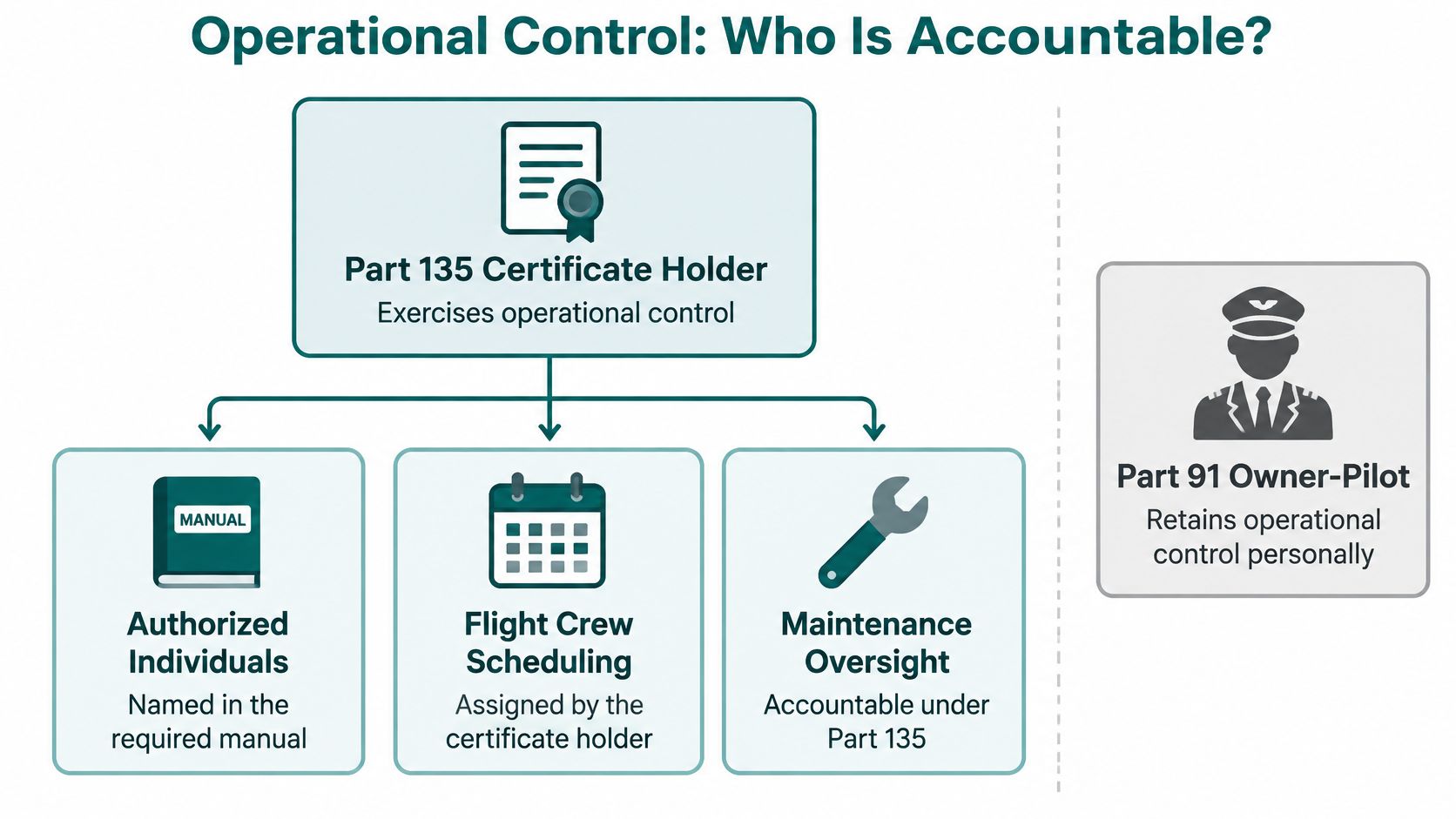
Part 91 differs in kind, not degree. The owner or operator controls its own flight and doesn't sit inside the air-carrier certification framework. Fractional programs are the specialized exception, governed by additional Part 91 subparts and management specifications.
Five Questions That Settle Control
The economics of a flight usually answer the regulatory question faster than any document review. Apply these to your own arrangement:
- Who selects the crew? If a management company assigns the pilots, the arrangement is drifting toward charter whether or not anyone calls it that.
- Who accepts operational responsibility? A named certificate holder, or whoever happens to be available that morning.
- Who pays whom? An owner paying a manager for oversight is one thing. An executive paying per trip for the use of someone else's aircraft is another.
- Do passengers provide compensation? Compensation for carriage is the fact that pulls a flight into the commercial regime.
- Does the flight run under an operator's certificate and operations specifications? If nobody can produce them, control hasn't been established.
Say a corporate jet is managed by a company that chooses the crew, schedules the aircraft and bills the executive per trip. Whatever the registration or the cabin says, that arrangement raises a charter question the parties need to answer in writing before the next flight.
If the answer to "who holds operational control?" takes more than one name, keep asking.
For anyone booking through a broker, the practical consequence is that the broker's role is coordination rather than command. Approved Jets does not own or operate any aircraft and every flight is operated by a registered Part 135 operator or a foreign equivalent. Because we act as a broker and not a carrier, questions about air transportation, aircraft safety, crew conduct, baggage handling or onboard experience go to the operator named on the contract. That division is exactly what aircraft charter brokerage is meant to make legible.
Multi-leg, international, medical, cargo and time-critical trips all depend on this split. Changing weather, alternates, crew duty and aircraft substitution have to rest with a qualified certificate holder rather than being divided informally among owner, broker and crew. Ask for two documents: the operations specifications covering the aircraft, and the manual section listing who may exercise operational control.
Which Part Fits Each Trip Type
If you pay for a seat or a trip on an aircraft flown by someone else, expect Part 135 and verify the certificate holder. If you own the aircraft and fly it for your own purposes, Part 91 applies and you carry the maintenance and crew responsibility yourself.
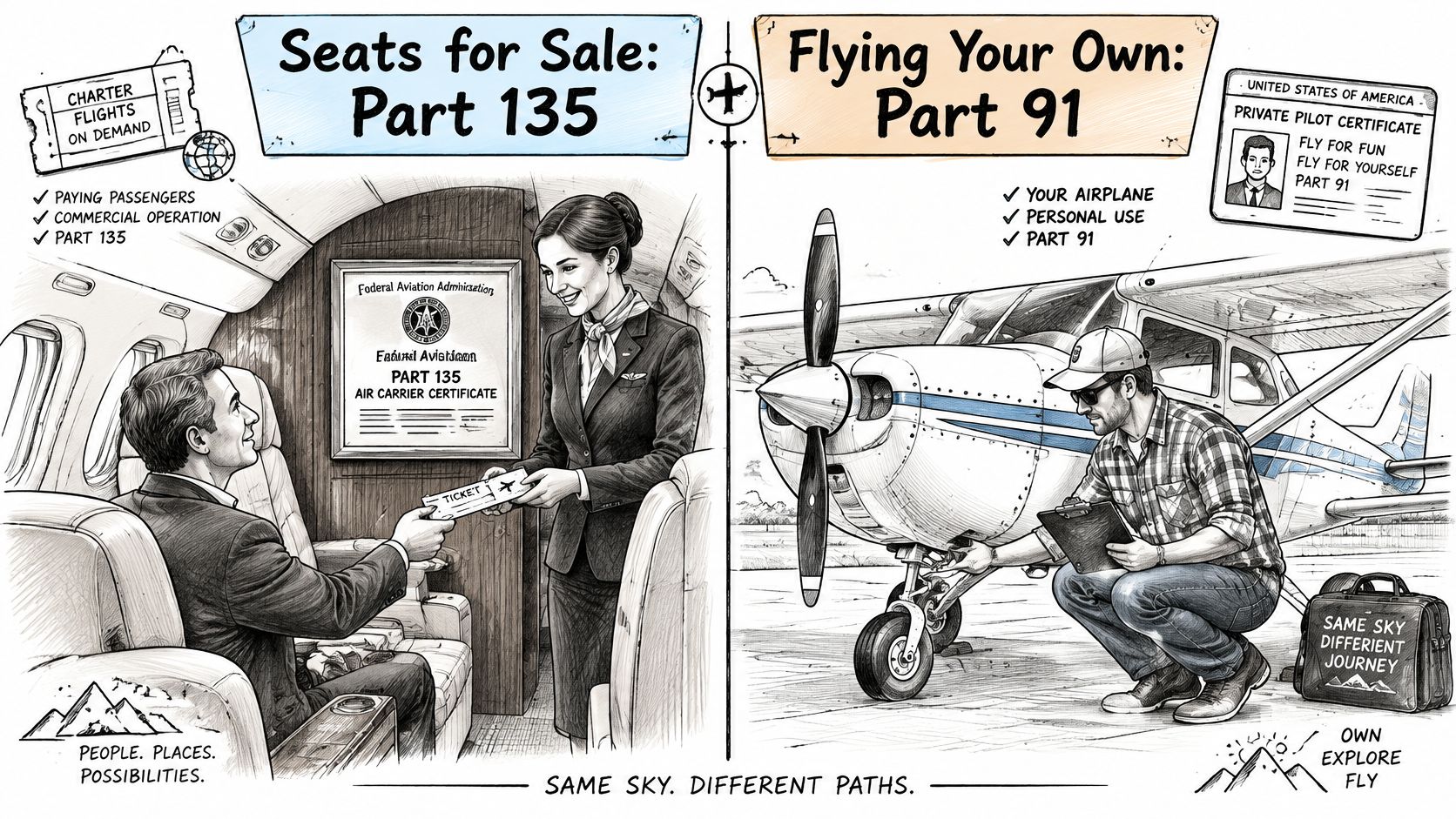
Six trip types cover most of what a corporate travel manager or an owner will book in a year. The rule set follows the economics of the flight, not the cabin finish.
Likely rule set and verification step by trip type
Trip type | Likely rule set | Who holds operational control | What to verify |
|---|---|---|---|
Owner flies own aircraft, no paid seats | Part 91 | Owner or operator of the flight | Owner keeps maintenance and crew responsibility |
Per-seat or per-trip charter for paying passengers | Part 135 | Certificate holder with operations specifications | Operator certificate and aircraft listing under its system |
Corporate flights run by a management company | Depends on control and payment facts | Decided by the operational control decision questions | Written confirmation of crew selection, billing and operator |
Medical evacuation with a medical team | Part 135, with §135.85 occupant exceptions | Certificate holder | Medical personnel training completed within the preceding 24 calendar months |
Fractional ownership | Part 91 with specialized subparts | Fractional program under its management specifications | Management specifications and program manager authority |
Cargo or time-critical multi-leg charter | Part 135 | Certificate holder for weather, alternates and aircraft substitution | Written contingency plan; quotes remain estimates until confirmed |
Where the Medical Mission Changes the Rule
Part 135 contains specific exceptions for who may be carried outside the part's ordinary passenger-carrying provisions. Section 135.85 is titled "Carriage of persons without compliance with the passenger-carrying provisions of this part," which tells you the regulation distinguishes revenue passengers from authorized occupants and mission personnel, as the Part 135 subpart B text shows.
Medical evacuation is the clearest case. Medical personnel may be carried under specialized provisions, and required briefings can be omitted where those personnel have completed an FAA-approved medical-personnel training program within the preceding 24 calendar months. That 24-month window is a documentation requirement, not a formality, and an operator running these missions needs it on file before the flight is dispatched rather than after.
Here's how the same trip plays out differently across the two frameworks:
The corporate case deserves its own warning. A dry lease, a management agreement, an owner-flown leg or a repositioning flight does not automatically make a mission Part 91. What decides it is the parties' actual conduct, the payment structure, who has possession of the aircraft, who controls the crew and who makes the operational calls, as the Federal Register text on the certification framework makes clear. An arrangement marketed as private can still create an impermissible holding out or unauthorized charter risk. Get written confirmation of who holds operational control before the flight, not after a problem.
For most charter buyers the recommendation is blunt: choose the certified Part 135 operator and its specific authorizations, not the aircraft type. Owners who fly privately can stay under Part 91 with a professional management team, and should have any arrangement that starts carrying paying passengers reviewed before the next flight leaves.
Safety Data Behind the Part Numbers
Record counts get quoted far more often than they get explained. An FAA review of general-aviation accident and incident records covering January 1984 through October 2004 found that roughly nine of every ten records involved aircraft operating under Part 91, with the remainder involving Part 135 operations.
That works out to roughly eleven Part 91 records for every Part 135 record, a figure that circulates as though it were a risk ratio. It is nothing of the kind. These are counts of records, and counts alone cannot rank risk because they carry no exposure data. A numerator without a denominator tells you how many events were logged, and nothing about how much flying produced them.
Two Populations, Not Two Versions of One
The Part 91 population is enormous and heterogeneous. It spans private aircraft of every size, pilot experience level, mission type and operating environment, from a weekend pilot in a light single to a professionally crewed long-range jet. Part 135 is a smaller population of commercial operators, each working inside additional oversight and standardized procedures. Comparing raw counts between the two is comparing a continent to an island.
Accident rates by operating part, 1984 to 2004 counts and 2008 to 2023 rates
Measure | Part 91 general aviation | Part 135 on-demand | How to read it |
|---|---|---|---|
Share of GA accident and incident records, 1984 to 2004 | Roughly nine in ten | Roughly one in ten | Counts only, without exposure adjustment |
Approximate accident rate, 2008 to 2023 | 4.9 | 1.3 | NTSB-based FAA presentation; highest among major civil-aviation categories for Part 91 |
Approximate fatal-accident rate, 2008 to 2023 | 0.9 | 0.4 | Same source; Part 135 still above scheduled airline operations |
The rate figures change the shape of the argument. The FAA presentation that produced them characterized Part 91 as carrying the highest accident rate among major civil-aviation categories, and Part 135 as lower while remaining above scheduled airline operations. Both statements hold at once, which is why a single label cannot carry a safety decision.
The Gap Inside Part 135
The averages hide the variance inside each certificate type. Two Part 135 operators can differ from each other by more than the average gap between the two Parts. One runs a mature safety management system, third-party audit credentials, standardized crews and a maintenance control function that documents everything. Another holds the same certificate and treats the manual as a filing requirement. The Part number is identical on both contracts; the accountability behind it is not.
Practical rule: a certificate shows which rule set applies. An audit and a training record show how consistently the operator follows it.
That is why Approved Jets prioritizes operators with third-party safety ratings such as Argus Platinum and Wyvern Wingman, and why a buyer should ask which audits cover the operator named on the contract. The question of how safe a private jet flight really is gets answered at the operator level, where accountability is exercised.
Read the numbers as a reason to inspect the operator, and read the Part number as a statement of which accountability structure applies. Certification, operator-specific safety systems, crew training, maintenance control and independent audit credentials carry more weight than the digit after "Part."
Maintenance Rules Change at Nine and Ten Passengers
Nine passengers is the line that decides your maintenance program, and it matters more than the aircraft model. FAA guidance states that Part 135 operators carrying nine or fewer passengers must comply with at least the manufacturer's recommended maintenance program under 14 CFR §135.421, while Part 135 operations carrying 10 or more passengers generally require a Continuous Airworthiness Maintenance Program, or CAMP, under §§135.411 and 135.423 to 135.443, as the FAA inspector guidance sets out.
Part 91 gives operators a broader menu. An inspection program may be a 100-hour program, an annual program, a manufacturer-recommended program or an operator-designed program depending on the aircraft and the operation. Part 91K operators may elect to develop their own CAMP. In practice, a charter aircraft carrying eight passengers and one carrying twelve can face materially different maintenance-program requirements even when the aircraft model is similar.
The Certificate Holder Owns the Work
FAA guidance is direct that Part 135 maintenance requirements are more stringent than Part 91 requirements, and that aircraft with nine or fewer passenger seats follow applicable Parts 91 and 43 provisions plus specific Part 135 requirements, per the FAA's Part 135 certification page. Operators must comply with the manufacturer's recommended programs, or an FAA-approved alternative, for engines, propellers, rotors and required emergency equipment.
The responsibility doesn't transfer when the work does. The certificate holder remains directly responsible for contracted maintenance, must control providers through its maintenance manual and procedures, and must ensure covered work is performed under its supervision. That single sentence separates a charter operation from a private owner who happens to use the same shop.
Records That Follow the Component
Maintenance requirements by passenger count and record type
Passenger seats or record | Part 135 requirement | Part 91 requirement | What a charter buyer checks |
|---|---|---|---|
9 or fewer passengers | Manufacturer's recommended program or FAA-approved alternative (135.421), plus Parts 91 and 43 | 100-hour, annual, manufacturer or operator-designed program | Aircraft listed under the operator's Part 135 system with a current inspection program |
10 or more passengers | CAMP under 135.411 and 135.423 to 135.443 | Same options; Part 91K operators may elect their own CAMP | Inspection windows that could affect aircraft availability |
Time- or cycle-limited components | Manufacturer overhaul limits with complete records; gaps can force zero-time restoration | Airworthiness required; records kept by owner or operator | Continuous traceability for each component |
Time-limited components are where records turn into money. FAA guidance highlights the need to comply with manufacturer-recommended time-between-overhaul limits and to keep complete records for time- or cycle-limited parts, because incomplete records can require restoration to zero-time status. A missing logbook entry doesn't stay a paperwork problem for long.
For a buyer, the screening questions follow directly. Is the aircraft listed and authorized under the operator's Part 135 system, and is its inspection program current? Do the time- and cycle-limited components have continuous traceability from installation onward? And what inspection window falls during your travel dates, because a CAMP can pull an aircraft out of service on a schedule that has nothing to do with your trip.
Owners on the Part 91 side carry this differently. Aircraft management programs handle maintenance tracking, crew staffing, regulatory compliance and charter revenue generation, which is often the reason an owner delegates the calendar in the first place. If you're weighing that route, the aircraft maintenance programme you choose sets the documentation standard long before anyone asks for it.
Crew, Equipment and Records Under Each Part
Part 135 is not a different pilot-license category. It's a regulatory framework that adds operational controls on top of the baseline Part 91 rules, and the Part 135 aircraft and equipment subpart says so explicitly: its requirements apply in addition to Part 91 requirements and don't require duplication of equipment already mandated elsewhere.
Equipment Rules Stack, They Don't Replace
The practical effect shows up in configuration. An on-demand charter carrying passengers under IFR must meet Part 135 rules covering instruments, electrical systems, static-pressure equipment and anti-icing. A comparable noncommercial Part 91 flight is evaluated primarily under Part 91's general operating and flight rules. Same aircraft type, different equipment standard, because the mission is different.
Crew Duty Is a Scheduling Constraint
On the crew side, Part 135 requires an FAA-approved training and qualification system: pilot qualification, recurrent training, proficiency checks, flight and duty time limits, and required rest before duty under 135.267. Part 91 owner-pilot flying has no equivalent system of flight-time and rest caps, and the limits that do exist come from the pilot's own judgment, company policy or insurer requirements.
The pilot in command is always the final authority for a flight. What changes under Part 135 is how many decisions have already been made for them, in writing, before they reach the airport.
Consider a two-pilot charter scheduled on back-to-back legs with a short turnaround. That schedule has to fit inside duty limits, which may force a crew change or a later departure. An owner-pilot flying the same routing on the same day is governed by their own assessment of fatigue and by the responsibility every pilot in command carries.
Records close the loop. A certificate holder must keep training, maintenance and flight records that match its operations specifications, and those records are producible. An owner's records are kept because good practice demands it, not because a certificate requires it.
Three questions sort a quote quickly. Who is the pilot of record for this flight, by name? What is the crew's recent duty history, particularly if they flew a long Part 91 trip the day before? And which equipment list applies to the specific aircraft serial number booked, not the model? We use aircraft and crews that meet or exceed FAA Part 135 regulations, and those questions are how that claim gets tested on any given trip.
Confirm the Operator's Certificate Before You Book
The certificate is the accountability document. A quote shows price, aircraft category and itinerary; the operating certificate and operations specifications show which legal entity is authorized to carry passengers for hire, under what limits, and with which aircraft.
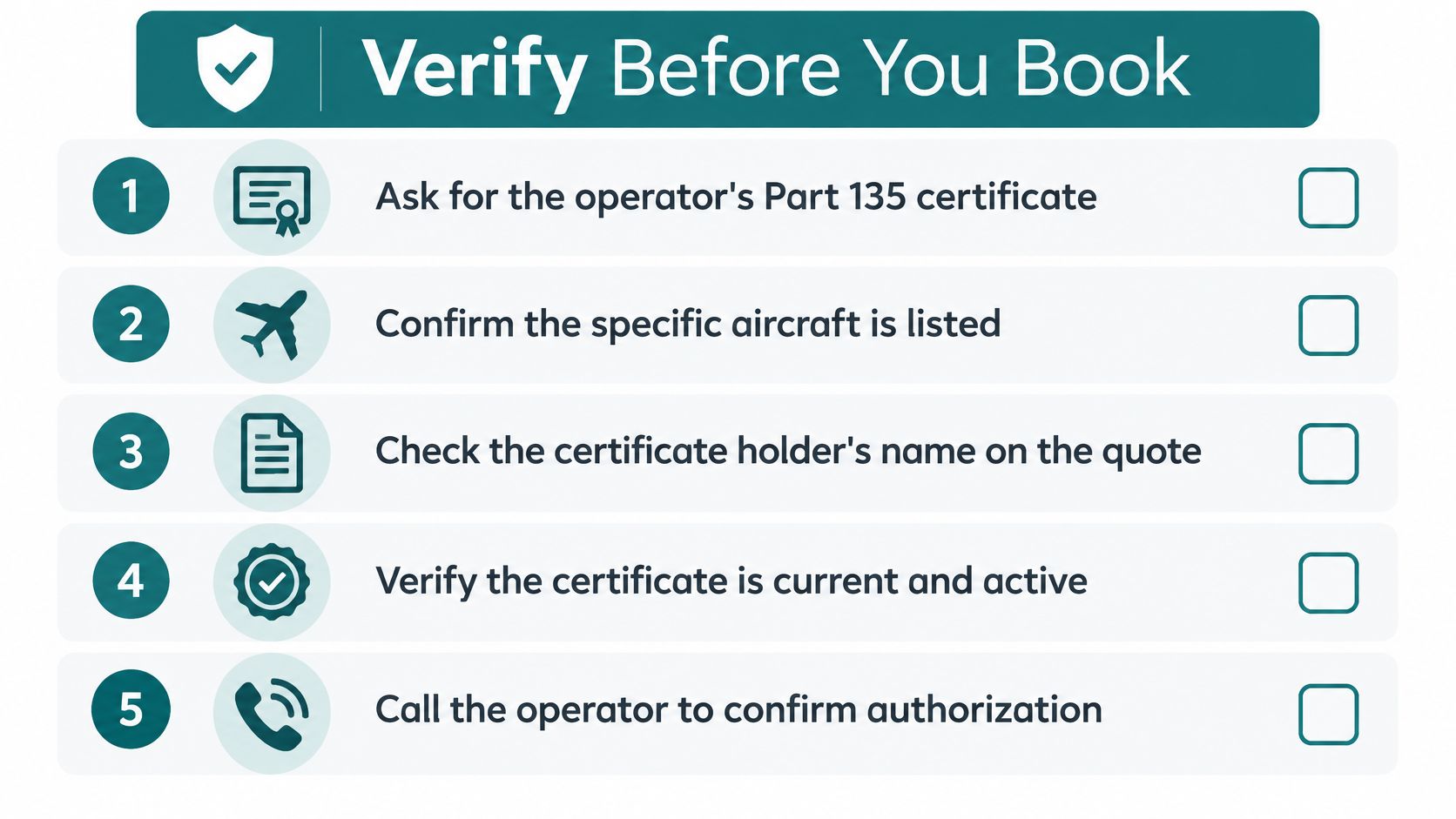
- Request the Part 135 certificate and the operations specifications covering the aircraft type, because a certificate alone does not show what the operator may fly.
- Match the legal names exactly. The operator on the certificate should be the entity named in the contract, not only a brand, parent company or broker logo.
- Confirm the aircraft is listed under that operator's system with a current inspection program, because inspection status affects availability on your dates.
- Ask for the Director of Operations, Chief Pilot and Director of Maintenance, the accountable managers named in the operator's manual structure.
- Check Safety Management System status. The FAA's summary of the rule changes sets May 28, 2027 as the general compliance date for existing certificate holders and Part 91.147 air-tour operators, while new Part 135 applicants must have an SMS during certification; a current certificate alone does not prove the SMS is complete.
- Look for third-party audits such as Argus Platinum or Wyvern Wingman, and confirm the audit covers the operator named on your contract rather than an affiliated brand.
- Read the quote in writing, including price basis, fees, taxes, expiry and cancellation terms. Quotes can change with aircraft availability, fuel costs, positioning fees, landing fees, overnight charges, de-icing, catering and ground transportation.
Requirements also move through rulemaking. Proposed and adopted changes can alter equipment and inspection obligations under both parts, so recheck the rules that apply to the altitude, aircraft and date you are flying before assuming last year's answer still holds.
All flights we arrange are operated by registered Part 135 operators or their foreign equivalent, which meet and exceed FAA standards and our own internal requirements. We are an air charter broker under DOT regulations, operating under Part 295, so the certificate belongs to the operator. Ask for the certificate package in writing before any deposit leaves your account.
Approved Jets arranges flights through a global network of FAA Part 135 operators and foreign equivalents, and we'll identify the certificate holder behind any trip we quote along with the aircraft listed under that operator's system. If you're deciding between charter and managing your own aircraft, our team can work through which obligations apply to the specific missions you fly, rather than the label on a listing. Send us your itinerary at Approved Jets and we'll return the operator details with a written quote.