Private Jet Runway Requirements: What Decides Suitability
Private jet runway requirements hinge on weight, temperature, elevation and surface condition. See the numbers that decide if a runway works.
15 min read
A super midsize jet is scheduled out of a high-desert field at 2pm in July. Four passengers, a week of bags, full fuel, and a forecast of 34°C. The airport diagram lists 6,000 feet of pavement, which sounds generous until the operator's performance run comes back and the aircraft can't legally do it at that weight, on that runway, in that heat.
That gap between what's painted on the ground and what the jet can use is the whole subject of private jet runway requirements. It's also where most charter planning goes wrong, because the number everyone quotes first is the least useful one.
A runway isn't a fixed asset you either fit or don't. It's a margin that shrinks and grows with temperature, weight, slope, wind and surface, and the jet fits only when every one of those inputs still leaves room for a rejected takeoff. What follows is how to read the numbers in that order.
Table of Contents
- Typical Runway Lengths by Private Jet Category
- The planning column the table hides
- The Four Distances That Decide Takeoff and Landing
- Why a 6,000-foot runway can behave like 5,000
- How Altitude and Heat Shrink Your Runway Margin
- Wet, Snowy and Contaminated Runways
- Aircraft Size and Airport Infrastructure Limits
- Reading that rule at private-jet scale
- How to Check a Runway Before You Fly
- Confirm Runway Fit Before You Commit to a Flight
Typical Runway Lengths by Private Jet Category
Typical takeoff and planning runway lengths by jet category
Category | Example aircraft | Typical takeoff distance |
|---|---|---|
Light jet | Cessna Citation CJ3, Embraer Phenom 100 | about 3,000-4,000 ft |
Midsize jet | Cessna Citation XLS, Learjet 75 | about 4,000-5,500 ft |
Super midsize jet | Bombardier Challenger 350, Cessna Citation Longitude | about 4,800-6,000 ft |
Heavy jet | Bombardier Global 6000, Dassault Falcon 7X, Gulfstream G650 | about 5,500-7,000 ft |
A light jet like the Citation CJ3 or Phenom 100 clears roughly 3,000 to 4,000 feet of takeoff run at maximum weight on a standard sea-level day. That's why light private jet options reach fields no airliner would consider. On a 3,500-foot strip, though, the planning figure climbs toward 4,000 feet once margin is applied.
Midsize aircraft such as the Citation XLS and Learjet 75 sit at 4,000 to 5,500 feet. This is the band where runway choice starts costing you airports. The field that works comfortably for a CJ3 often doesn't work for an XLS at full fuel on a warm day.
Super midsize jets like the Challenger 350 and Citation Longitude need about 4,800 to 6,000 feet, and heavy aircraft such as the Global 6000, Falcon 7X and Gulfstream G650 about 5,500 to 7,000 feet. These are the departures that get flagged for weight most often, because their margin at maximum range fuel is thinnest.
None of those figures is a standard. The FAA airport design guidance is explicit that private-jet runway requirements are performance-based rather than governed by one universal runway length, and it groups airplanes with maximum certificated takeoff weights of 60,000 pounds (27,200 kilograms) or less according to similar performance and operating-weight characteristics. The curves behind those groups come from FAA-approved aircraft flight manuals and reflect operating rules under 14 CFR Part 25 and Part 91.
The planning column the table hides
For turbojet airplanes using the 60-percent useful-load curves, that same guidance increases the recommended runway length by 15 percent, subject to a maximum increase of 5,500 feet (1,676 meters). A light jet with a 3,500-foot book figure is planned at about 4,000 feet. A jet that needs 5,000 feet is planned at 5,750.
The load curve is the fine print. A published runway figure means nothing until you know whether it was computed at 60 percent or 90 percent useful load.
A separate FAA summary applies a comparable 15 percent adjustment to 60-percent useful-load lengths up to 4,800 feet (1,460 meters) and to 90-percent useful-load lengths up to 6,100 feet (1,860 meters). Two aircraft quoted at 5,500 feet can therefore be describing entirely different conditions, and comparing them without knowing the curve tells you nothing. Use the table as a first screen, then replace it with the flight manual figure for the weight you're carrying.
The Four Distances That Decide Takeoff and Landing
The runway length printed on an airport diagram is the length of pavement. It is not the length your jet can use.
Declared distances and what each one limits
Measure | Full name | What it covers | Limiting rule |
|---|---|---|---|
TORA | Takeoff run available | Runway length usable for the ground roll | Cannot exceed the runway length |
TODA | Takeoff distance available | Runway plus any approved clearway | Adds clearway length to the takeoff distance |
ASDA | Accelerate-stop distance available | Runway plus any stopway for a rejected takeoff | Sets how far a jet can accelerate before stopping safely |
LDA | Landing distance available | Runway length usable for landing in each direction | Sets the stopping room on landing |
The FAA airport design standards identify all four measures, and they answer four different questions. TORA is the runway a jet can use for its ground roll. TODA adds an approved clearway to that run. ASDA covers a rejected takeoff using the runway plus any stopway. LDA is the room a jet has to stop on landing.
The guidance also requires every one of those distances to be checked against takeoff, landing, accelerate-stop, obstacle-clearance and one-engine-inoperative performance. That's five separate safety cases running on the same piece of asphalt.
Why a 6,000-foot runway can behave like 5,000
Here's the case that catches people. A runway is physically 6,000 feet long, but declared distances are set separately for each direction, and the departures end can be published at 5,000 feet because of a displaced threshold or an obstacle on climb-out. A jet that needs 5,500 feet to clear the obstacles on that heading cannot use the runway, even though the diagram says 6,000.
The reverse is just as common. The same strip may give a heavy jet a usable takeoff one way and a materially shorter one the other, because declared distances limit runway use independently in each direction. Usable takeoff and landing distances then differ from the nominal runway length.
This matters most for midsize, super-midsize and heavy business jets, whose required distances move with fuel load, passenger and baggage weight, runway slope, wind, wet or contaminated pavement, temperature and obstacles. A runway can be long enough and still be operationally unsuitable for a particular departure weight.
The habit to build: read the declared distances for the exact direction of takeoff and the exact direction of landing, not the headline length on the airport diagram.
Do that before you fall in love with an airport's location.
How Altitude and Heat Shrink Your Runway Margin
Thin air is the quietest thief a runway has. Density altitude is the height the aircraft believes it is flying at, given the pressure and temperature of the day, and it doesn't care what the survey plate says. At a high field on a hot afternoon, the jet behaves as though it were taking off from somewhere considerably further up the mountain.
The chain from thin air to a longer roll is short, and it only runs one way.
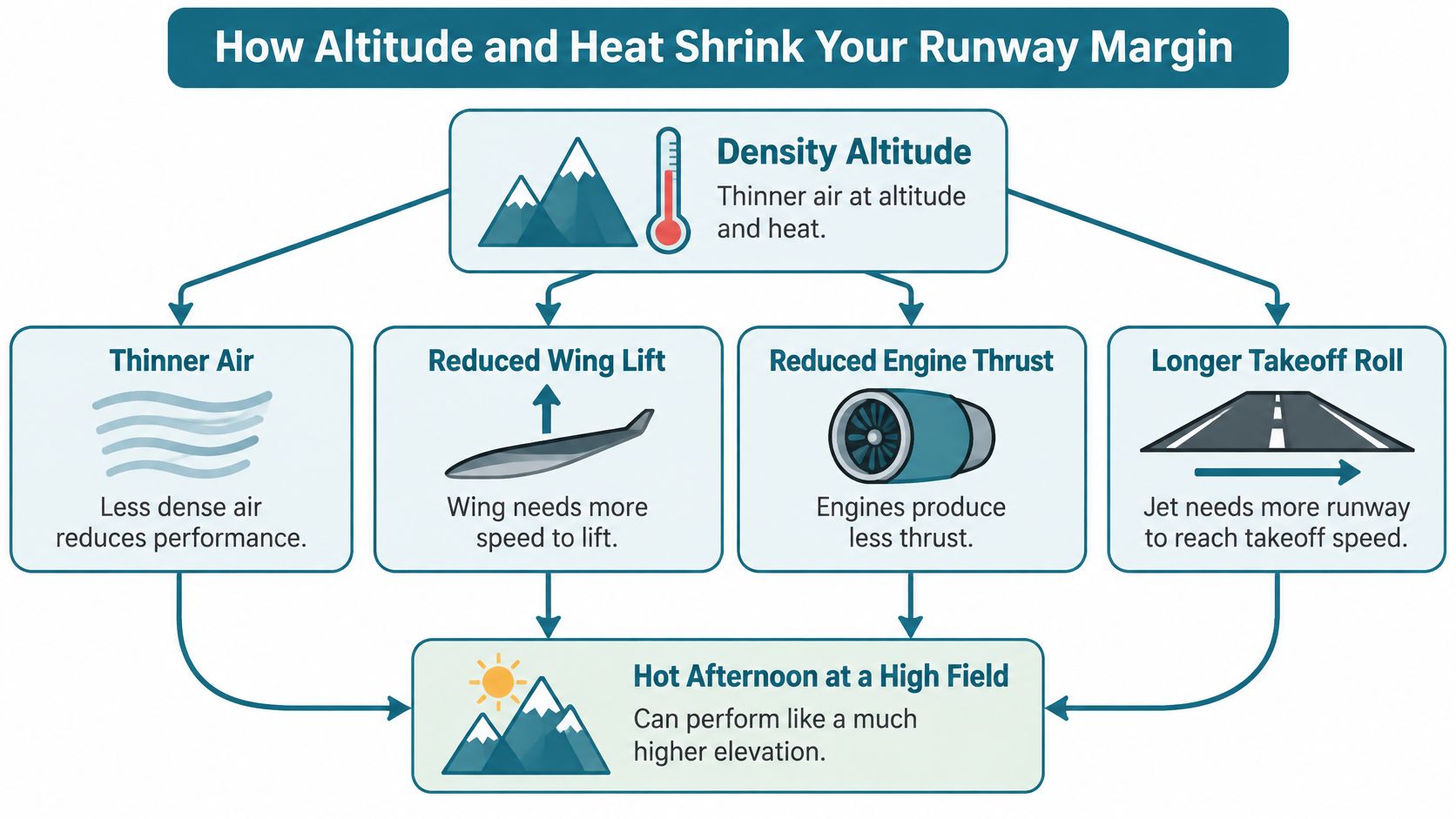
Density altitude rises with field elevation and heat because less dense air gives the wing less lift and the engine less mass flow. FAA flight-planning guidance, reproduced in NBAA's 2023 review of runway excursions in business aviation, names runway length, obstacles and expected density altitude as the factors that decide takeoff and landing distance and whether a jet can leave with a full load.
Airport planners work from the same inputs when they size a runway in the first place: field elevation, the mean maximum temperature of the hottest month, runway gradient, the critical aircraft type and aircraft loading. Every one of those inputs pushes in the same direction. Higher elevation, higher temperature and steeper gradient each increase the runway length a business jet needs, which is why a strip that fits a jet in spring may not fit it in August.
Conditions that change the runway a private jet needs
Factor | Effect on required runway | Example | Planning response |
|---|---|---|---|
Density altitude | Thinner air cuts lift and engine thrust, lengthening the takeoff roll | Hot afternoon at a high field, departing with reduced payload | Use density altitude for the actual departure hour |
Outside air temperature | Higher temperature reduces performance much like a higher field | A 35°C day may push a midsize jet past its cool-day limit | Recalculate with the forecast temperature for departure |
Runway slope | Uphill slope lengthens takeoff, downhill slope lengthens the landing roll | Short runway with a steep upslope in the departure direction | Apply the gradient shown on the airport chart |
Tailwind | Higher ground speed is needed to lift off and the stopping roll gets longer | Departure with a tailwind from a short runway | Plan for the wind component in the planned direction |
Takeoff weight | Heavier jets need higher speed and a longer roll | Full fuel and passengers versus an empty cabin | Use the loaded weight, not maximum weight |
The compounding is what people underestimate. Temperature, slope, weight and wind rarely act alone, and each one consumes part of the margin the published length seems to offer. The same super midsize jet leaving at light weight on a cool 7am and again at full fuel on a 34°C afternoon is, for runway purposes, two different aircraft at the same airport. One may take off with room to spare. The other may need a payload cut or a different field.
Practical rule: request performance for the forecast temperature at your departure hour, not the seasonal average. Averages are built from nights and mornings, and your flight isn't happening then.
If you want to run the arithmetic yourself before the operator does, this walkthrough on calculating density altitude for takeoffs takes you from field elevation and altimeter setting through to the figure the charts want.
Landing deserves the same treatment and rarely gets it. Thin air stretches the landing roll just as it stretches the takeoff roll, because the jet touches down faster in the same less dense air, and a downhill gradient adds further. Check the landing distance at the actual landing weight, not the takeoff figure you already calculated for departure.
Wet, Snowy and Contaminated Runways
A runway that clears a fully fuelled jet in dry July can refuse the same jet in February rain. The pavement has not shrunk. The stopping margin has. In planning terms, a wet runway and a dry runway are two different airports.
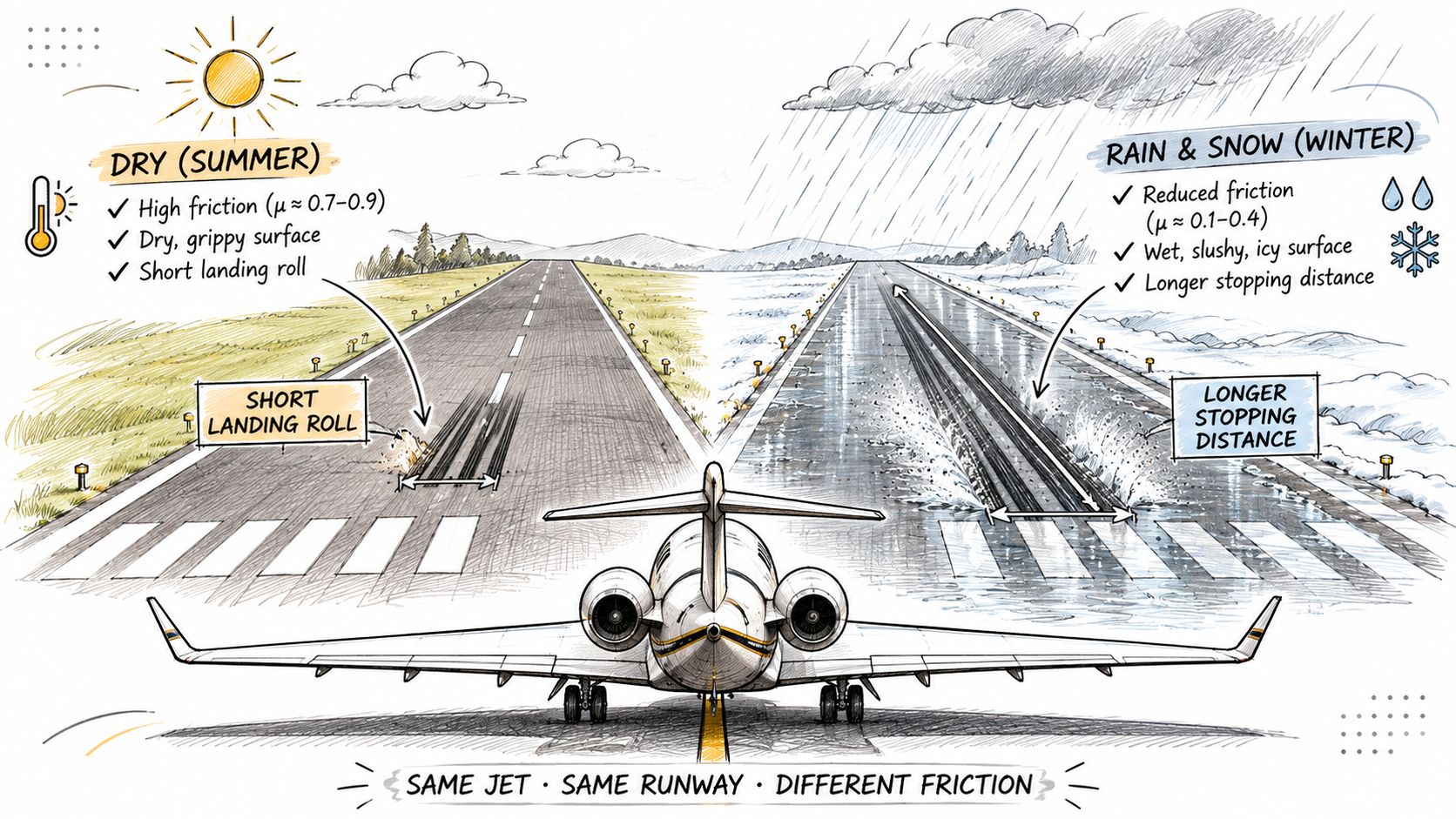
EASA's contamination materials are blunt about why. Water, slush, snow and ice reduce friction, they can increase stopping distances, and they introduce uncertainty, because the actual friction and the drag of the contaminant may not match the performance assumptions (EASA contamination rulemaking). The practical effect is simple: the dry-runway number you planned with stops being the number that governs the landing. Wet or contaminated conditions call for a recalculated landing distance from the operator's performance data, using the runway condition and landing weight expected at the time of arrival.
The question is dated. "Can the jet use the runway?" has a different answer in July than in January, and a different answer at midday than after an afternoon storm cell.
The failure mode, when friction and margin run out together, looks like this.
Payload belongs in the same calculation. A jet at full fuel carrying a sports team, medical equipment, or a season's worth of luggage is a different aircraft from the one that used the strip at midday with two passengers. Rain, snow, high temperature, or a tailwind can each push that departure outside the field's limits. Two of them together usually will. That is why published runway length is only the starting point: loaded weight plus surface condition decides how much of that pavement the aircraft can use.
The live side matters just as much. Runway condition reports, braking action, wind, and temperature can all change after dispatch, so access is a day-of question rather than a seasonal one. Some of the airports that are genuinely difficult to land at earn that reputation from surface and weather far more than from length.
Check weather-sensitive payload and alternate airports before departure, and resist any promise of access based only on published runway dimensions. On a time-critical or remote itinerary, a diversion or a payload cut can undo the reason for the trip.
Aircraft Size and Airport Infrastructure Limits
Performance gets an aircraft into the air. Infrastructure decides whether the airport will accept it. These are separate tests, and passing the first tells you nothing about the second.
The FAA airport design guidance sets its standards by airplane design group, a classification built on wingspan and tail height rather than weight. For Airplane Design Group III, covering aircraft with wingspans of roughly 79 feet to under 118 feet, the standard runway width is 150 feet, with 25-foot shoulders and a 200-foot-wide blast pad. It separately notes that the transverse grade of the runway safety area beyond the runway ends should stay within plus or minus 5 percent.
Reading that rule at private-jet scale
Group III is not some airliner-only bracket. A Global 6000 spans about 94 feet and a Falcon 7X about 86 feet, which places both of them inside it. So those width, shoulder and blast pad figures are the published standards a jet of that size generates, not numbers to dismiss. The practical reading runs the other direction: at smaller fields built for smaller design groups, a runway can be long enough on paper yet come with narrow pavement, thin shoulders, a short runway-end safety area or an obstacle environment that rules the larger aircraft out. For your own aircraft, confirm its design group and the airport's standards for that group in the manufacturer's airport planning data.
A heavy jet can clear the length check and still be turned away by something duller. The checks that decide it:
- Runway width and shoulders. A long narrow strip is a different proposition from a wide one, particularly in crosswind.
- Pavement strength. Published length says nothing about whether the surface will carry the aircraft's weight.
- Parking and taxiway turn clearance. A jet that can land but can't park or turn off is a scheduling problem with wings.
- Obstacle environment. Departure and approach paths decide usable performance as much as pavement does.
- Operator approval and procedures. Some operators apply margins more conservative than the field requires, and their answer is the one that counts.
Length is one line on a longer checklist. Wingspan and weight set the infrastructure demands, the airport's design group sets what it was built to take, and the operator's own procedures can tighten every line above it.
How to Check a Runway Before You Fly
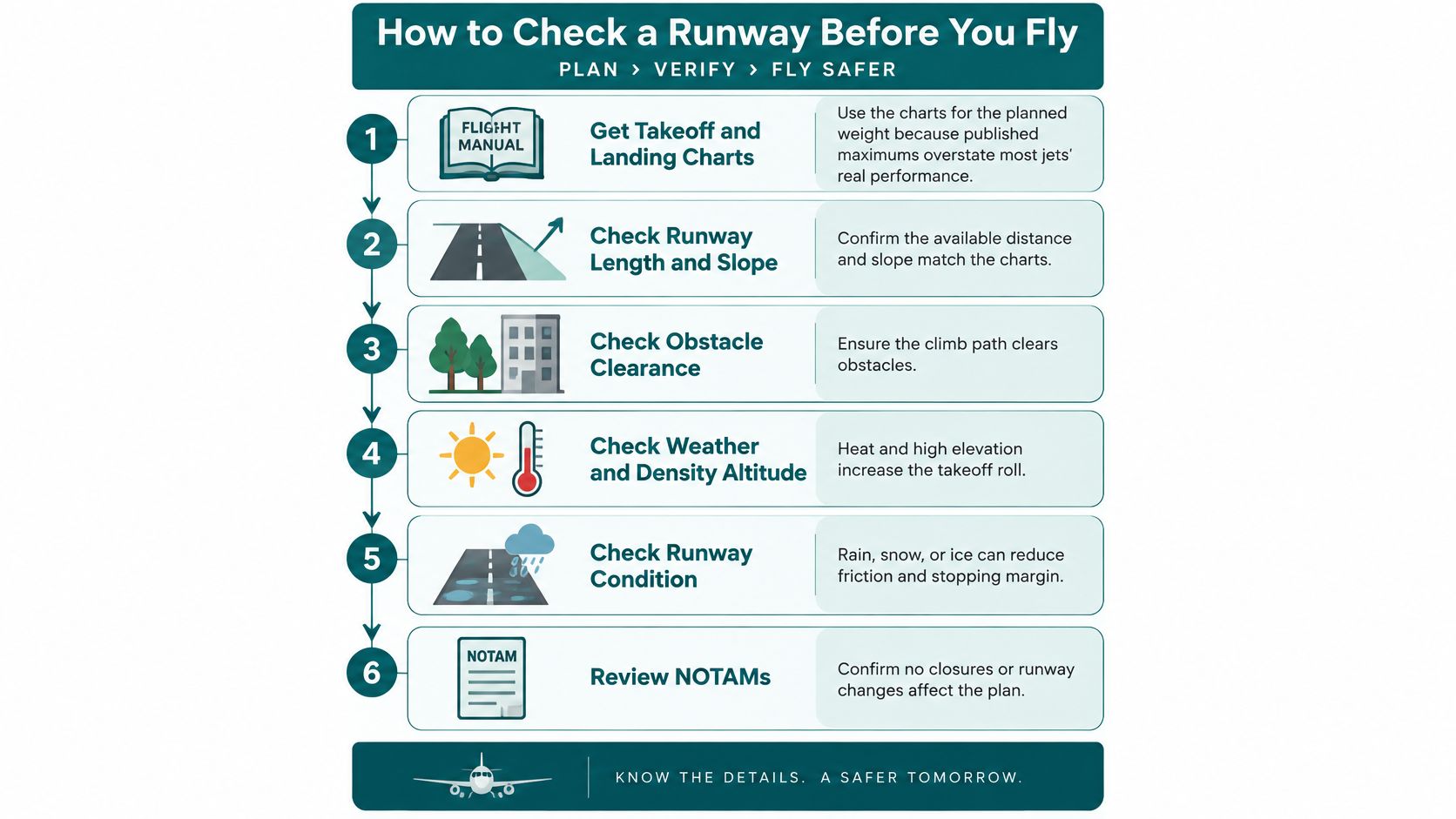
A runway that works on a cool morning can stop working on a hot afternoon once fuel, passengers and bags are loaded. That is why the published length is only the starting point. The usable margin comes from a calculation for the exact aircraft, weight, runway direction, weather and payload, not from a category average in a brochure.
FAA design guidance calls for evaluating takeoff and landing performance from the manufacturer's charts, then accounting for runway gradient, elevation, temperature, wind, surface condition, aircraft weight and available declared distances (FAA aircraft performance guidance). The order matters. Weight and density altitude determine how much runway the jet needs, while declared distances determine how much runway it has.
- Pull the charts for the planned weight. Published maximums describe an aircraft weight and test condition that rarely match a real trip. The flight manual figure for your weight is the only one that binds.
- Enter the loaded weight. Fuel, passengers, bags and cargo, all of it. A guessed weight creates a guessed margin, and the takeoff roll pays for the error.
- Set field elevation and the forecast temperature for the departure hour. Read density altitude off the result. A seasonal average hides the afternoon peak that decides the answer.
- Apply the operator's planning margin where the method calls for one. The margin is what converts a book figure into a dispatchable one.
- Pull the declared distances for the direction you'll use. Check takeoff and landing distances separately. Single-runway fields leave nothing to fall back on, which is why a regional departure point such as chartering out of Gainesville, Georgia should be checked for the exact direction in use.
- Check slope and wind components. An uphill departure or a tailwind lengthens the roll and reduces the margin available for stopping if the takeoff is rejected.
- Read the latest runway condition report and braking action. On a wet, snowy or icy surface, apply the contaminated-runway factor and recalculate rather than adjusting by feel.
- Confirm the physical fit. Width, shoulders, pavement strength and apron space still matter after the performance numbers pass. A runway can clear the calculation and fail the aircraft on the ground.
- Name an alternate and a payload plan before departure. If the margin is thin, decide now what you would shed or where you would divert, not at the hold-short line.
One passenger-side note sits outside the runway calculation. Multi-leg days reward packing that survives a cabin, a car and a hotel in the same afternoon, and the Nuage Wears travel comfort guide covers that layer of preparation.
A check that passes looks unremarkable. Every step clears at the loaded weight, the forecast temperature for the actual hour and the declared distances for the actual direction, with margin left for a rejected takeoff. If one input is estimated, the output is an estimate too.
Confirm Runway Fit Before You Commit to a Flight
A runway works when every check passes at the loaded weight and forecast conditions. That is the decision rule to hold onto when a quote arrives faster than a performance calculation does. Published length is the starting point, not the answer. Temperature, loaded weight, surface condition and the declared distances available in the actual direction decide how much of that pavement the jet can really use.
The booking conversation should start here. Approved Jets receives and processes quote requests and travel requirements, sources aircraft and operators through its network, and presents charter options, pricing and itinerary details. All flights are operated by registered Part 135 Operators or their foreign equivalent, which Approved Jets says meet and exceed FAA standards and its own internal requirements. The company is a private aviation brokerage and concierge, so the runway check belongs with the operator supplying the aircraft.
Send the passenger count, bag weight and route, including departure and arrival airports, your date and time window, and any special payload such as medical equipment. Then ask for three things: a takeoff performance check at the loaded weight, the declared distances for the planned direction of takeoff and landing, and a named alternate airport. Also request landing performance at the expected arrival weight and condition. If the numbers arrive without those assumptions, they cannot confirm fit.
Compare quotes on identical assumptions. Quotes from Approved Jets are estimates only and can change with aircraft availability, fuel costs, positioning fees, landing fees, overnight charges, de-icing, catering and ground transportation. A quote built on a different aircraft, airport or departure window is a different trip, even if the headline total looks lower. Keep the payload, schedule and airport pair constant before treating two options as comparable.
Book only after the runway figures are confirmed in writing for your aircraft, your weight and your departure hour. Category averages belong in early planning, not at the hold-short line.
Send your route, passenger count, bag weight and dates to Approved Jets, and it will present aircraft options, pricing and itinerary details. Ask the team to request runway performance figures from the operator for your loaded weight and departure hour before you commit. Start at Approved Jets and make runway fit part of the first quote conversation.