Aircraft Charter Brokerage: Who Flies and Who Pays
Aircraft charter brokerage arranges the flight; the Part 135 operator flies it. Compare roles, ARGUS and Wyvern checks, and quote lines before you book.
14 min read
An aircraft charter broker arranges transportation, while the FAA-certificated Part 135 operator keeps operational control of the flight.
The familiar advice to choose the broker with the biggest aircraft network misses the buyer's main exposure. A long list of available jets doesn't tell a travel manager who can legally dispatch the aircraft, who must answer for a failed departure, or which assumptions could increase the invoice.
For a business traveler, the useful comparison starts with the contracting entity and ends with the final-price risk. Cabin photographs and hourly rates belong somewhere in between.
Table of Contents
- What an Aircraft Charter Broker Actually Sells
- Broker, operator, and marketplace at a glance
- A cabin photograph isn't permission to depart
- Who Is Responsible After the Broker Books
- Broker capacity and who the customer can pursue
- Separate the incident from the booking failure
- How Brokers Vet the Operator Before Quoting
- Operator verification checklist
- Ratings supplement the certificate
- From First Call to Wheels-Up
- Establish the mission before sourcing
- Resolve acceptance before airport arrival
- How to Compare Charter Quotes Line by Line
- Charter quote lines and who bears the risk
- Compare dollars and delivery risk together
- When Brokerage Beats a Commercial Ticket
- Match the transport to the consequence
- When commercial still wins
- Book Only After the Operator Is Named
- Access isn't the same as commitment
- Keep the payment gate simple
What an Aircraft Charter Broker Actually Sells
Aircraft charter brokerage matches a mission to a legally qualified operator; it doesn't fly the aircraft. That's a useful line for a corporate travel policy because it separates procurement from aviation responsibility.
The National Business Aviation Association's charter-brokering guidance distinguishes customer agents, carrier agents, and indirect air carriers, explains the FAA Part 135 operating framework, and identifies applicable DOT economic authority and Part 295 obligations for indirect air carriers. Agents generally don't need an FAA air-carrier certificate merely to arrange transportation, but they still face disclosure and consumer-protection obligations and can't represent themselves as the operating carrier without the appropriate authority.
Broker, operator, and marketplace at a glance
Role | What they sell | Who controls the flight | Typical U.S. authority | Where recourse sits |
|---|---|---|---|---|
Charter broker | Arrangement, sourcing, and trip coordination | Does not operate the aircraft | DOT Part 295 if an indirect air carrier; no FAA air-carrier certificate if only an agent | Broker contract and required disclosures; air-transport claims go to the operator |
Part 135 operator | The flight itself | Operational control of crew, aircraft, and dispatch | FAA Part 135 certificate plus Operations Specifications | Carrier responsibility for safety, crew, baggage, and onboard service, subject to applicable terms and law |
Marketplace or listing platform | Aircraft listings and sometimes instant prices | None in its listing role; the selected operator flies | Platform terms aren't an air-carrier certificate | Platform terms govern its service; the operator remains the carrier |
Read the broker row as a procurement service. The broker searches across operators, interprets the itinerary, and coordinates the transaction. Read the operator row as the entity that supplies the aircraft and crew and makes operational decisions.
The marketplace row describes a sales channel, not an operating authorization. A platform can also perform brokerage functions, so its actual contracting capacity matters more than the label on its homepage.
A cabin photograph isn't permission to depart
Say an executive needs a weekday Miami-to-New York flight. A midsize jet may look suitable, but the photograph doesn't establish which company will operate it or whether that company can perform the proposed mission.
At Approved Jets, we operate exclusively as a charter broker and don't own, operate, lease, or maintain aircraft. We are an Air Charter Broker under DOT regulations, operating under Part 295; the transaction documents should make our capacity clear.
Concierge coordination is another distinct service. For travelers sorting out that boundary, the Uptown Rent A Car concierge guide provides context for the ground-side assistance that may surround a flight, without replacing the aviation operator's responsibilities.
Procurement rule: Label every proposal as a broker offer, an operator offer, or a marketplace listing before comparing hourly rates.
Who Is Responsible After the Broker Books
A mechanical cancellation at Miami creates several separate questions. The operator decides whether the aircraft can fly. The broker may coordinate a replacement, while the signed agreements determine refund rights, replacement costs, and who must communicate with the passenger.
The U.S. Department of Transportation's explanation of air-charter brokers identifies disclosures covering the direct carrier, the broker's contracting capacity, total transportation cost, known third-party charges, and whether the broker carries liability insurance, including its limits. Those disclosures can be delivered electronically, making a pre-payment packet a practical purchasing control rather than an administrative afterthought.
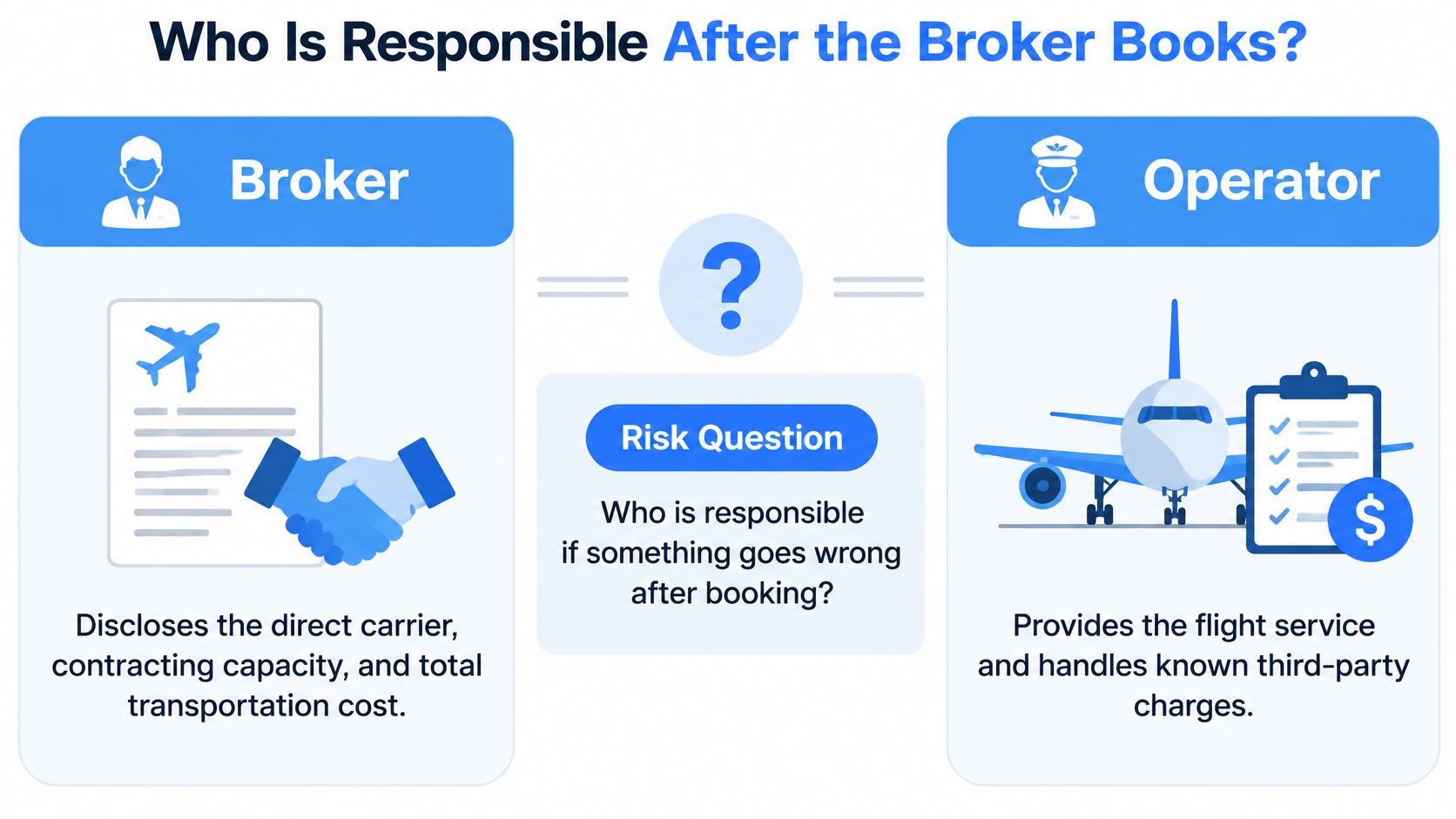
Broker capacity and who the customer can pursue
Contracting capacity | Who the broker acts for | Who is the direct air carrier | What the buyer should have in writing |
|---|---|---|---|
Agent for the customer | The charter client | The certificated operator named on the quote | Capacity disclosure, carrier identity, total cost, known third-party charges, broker insurance limits |
Agent for the air carrier | The certificated operator | That same operator | Written agency agreement covering relationship, payment, and commission before the trip is sold |
Indirect air carrier | Sells or arranges single-entity charter in its own name | Still the certificated operator in operational control | Applicable DOT economic authority, compliance documentation, and a clear statement that the broker isn't the operating airline |
A customer-agent structure places the broker on the buyer's side of the arrangement. A carrier-agent structure places it on the operator's side. An indirect-air-carrier structure changes the broker's commercial obligations, but doesn't give it operational control of the aircraft.
The GSA's air-charter-broker requirements reinforce the importance of operator approval, aircraft airworthiness, and a written agency agreement defining the relationship, payment, and commission arrangements.
Separate the incident from the booking failure
Damaged baggage and crew conduct concern the operator's flight service. An undisclosed broker capacity or misleading booking representation concerns the broker's own conduct. A medical event requires the crew's operational response, while any subsequent claim needs assessment against the relevant contracts and applicable law.
At Approved Jets, we're a broker, not a carrier. Claims about air transportation, aircraft safety, crew conduct, baggage handling, or the onboard experience must be directed to the applicable operator.
That allocation shouldn't leave the buyer guessing about assistance. Before paying, identify who will answer a disruption call, who can authorize a refund, and whether replacement transport is an obligation or just something the broker will try to source.
How Brokers Vet the Operator Before Quoting
A long list of available aircraft says little about who will operate a particular flight. Before comparing cabins, buyers should establish which operator holds operational control and whether its approvals cover the proposed trip.
NBAA's broker-ethics guidance recommends checking the operator's current FAA Part 135 certificate, applicable DOT registration, independent safety-audit reports, and FAA enforcement history. Resolving gaps before signing can reduce the risk of a dispatcher later rejecting the trip.
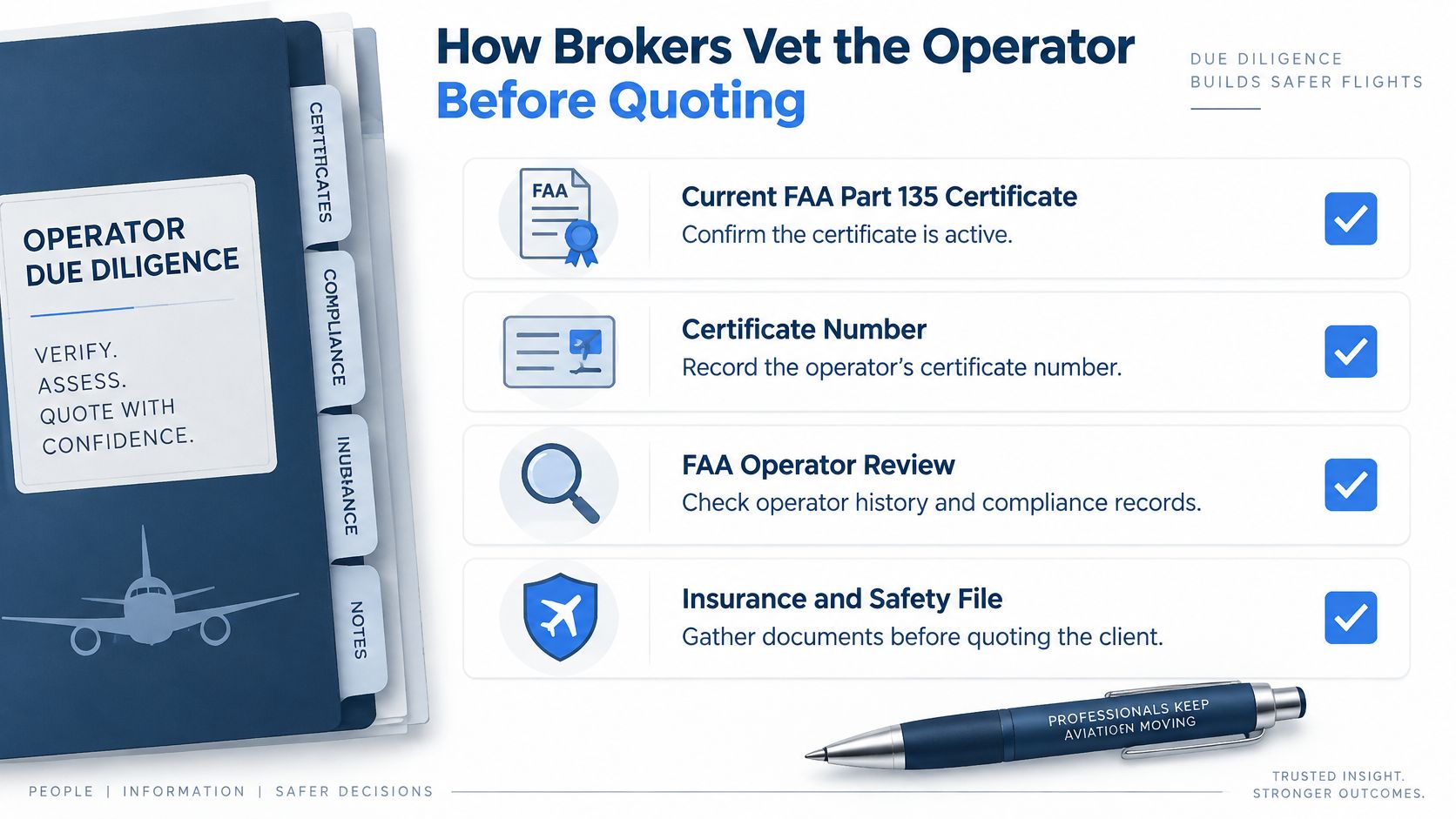
Operator verification checklist
Check | What to confirm | Where to confirm |
|---|---|---|
FAA Part 135 certificate | Current certificate; record the certificate number | FAA operator records |
DOT air-taxi or economic authority | Applicable registration or authority is current | DOT authority records |
Operations Specifications | Authorize the proposed type of operation | Operator certificate file |
Aircraft registration and airworthiness | Current documents and airworthy condition | Aircraft records |
Exclusive use of a qualifying aircraft | Ownership or qualifying lease | Lease or title documents |
Maintenance records | Records continuity, overhaul compliance, and life-limited-component status | Operator maintenance file |
Current flight manual | Available for the aircraft | Aircraft file |
Hazardous-materials program | Applicable program and shipment acceptance capability | Operator program documents |
Independent safety audits | ARGUS or Wyvern status if represented; supplementary to certification | Audit report |
FAA enforcement history | Open or recent actions and their documented explanation | FAA enforcement records |
The FAA's Part 135 certification guidance says Operations Specifications must authorize each intended type of operation. It also describes requirements for a qualifying aircraft to be available for the operator's exclusive use through ownership or a lease lasting six continuous months from certification, as well as aircraft registration, a current airworthiness certificate, and airworthy condition.
Maintenance records present a separate question: can the aircraft be dispatched for the proposed trip? The FAA's general certification requirements address manufacturer-recommended overhauls, continuity of maintenance records, time- or cycle-limited components, and a current flight manual or equivalent information.
Ratings supplement the certificate
Two similar midsize jets can have different availability if one is approaching an inspection or engine overhaul. The operator's current confirmation of aircraft eligibility matters; a broker does not replace the operator's maintenance organization.
Approved Jets says it uses aircraft and crews that meet or exceed FAA Part 135 regulations and prioritizes operators with ARGUS Platinum and Wyvern Wingman ratings. Those third-party credentials supplement, rather than replace, certificate and aircraft checks. The private-jet safety overview explains considerations for evaluating safety assurances.
A safety claim is useful when the buyer can connect it to the proposed operator, aircraft, and crew.
International ground arrangements need separate checks, including local transport and destination services. For example, on-the-ground support for Japan tour operators concerns destination coordination, not verification of a U.S. charter operator.
For a Miami departure, review the proposed operator's documents and confirm that they apply to the mission. A familiar aircraft registration alone does not establish that the trip is authorized or available.
From First Call to Wheels-Up
A departure can stall because the aircraft is unavailable, but it can also stall because the passenger's luggage won't fit or the operator hasn't accepted the medical equipment. The first conversation should surface those constraints before anyone starts comparing cabins.
Our booking process has four stages: Inquiry & Discovery, Aircraft Sourcing & Quoting, End-to-End Logistics, and Wheels-Up & Beyond. Each stage resolves a different kind of uncertainty.
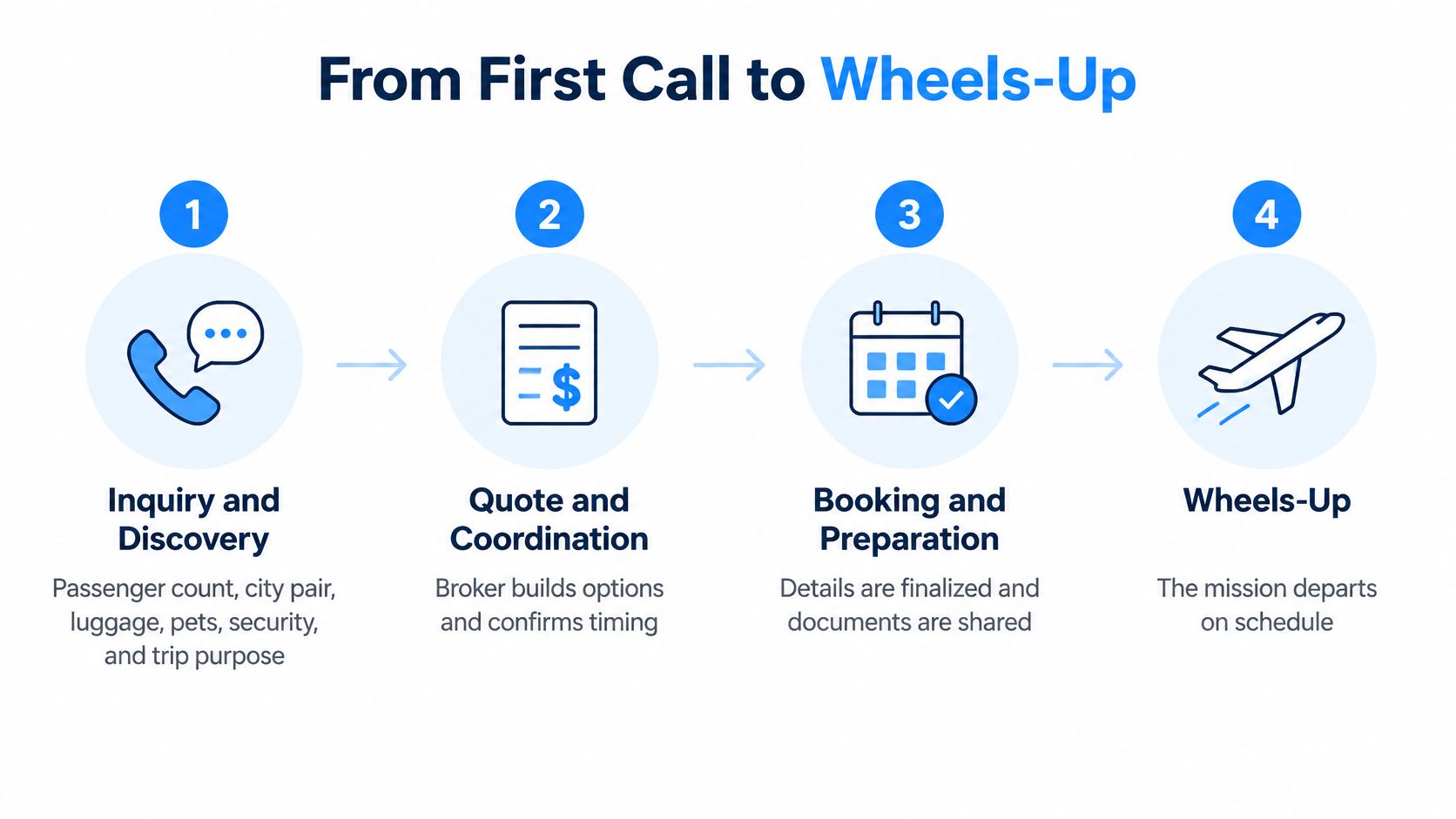
Establish the mission before sourcing
- Inquiry & Discovery. Provide passenger count, city pair, preferred departure, luggage volume, pets, mobility needs, security requirements, and trip purpose. A meeting trip, a team movement, and a medical evacuation can require entirely different aircraft and acceptance procedures.
At Approved Jets, booking with 24 to 48 hours of notice gives the widest aircraft selection and allows highly specific catering or logistical requests. Treat that as a planning window to confirm against the actual mission, not a guarantee that every aircraft category will be available.
- Aircraft Sourcing & Quoting. The broker matches the requirement with eligible operators and returns aircraft options, pricing, and itinerary details. A late addition, such as bulky presentation equipment or a pet carrier, can force a different aircraft after the initial search.
Compare proposals against the same departure assumptions. An option that requires repositioning or an earlier takeoff isn't interchangeable with an aircraft already positioned for the requested schedule.
Resolve acceptance before airport arrival
- End-to-End Logistics. Confirm catering, the fixed-base operator (FBO), ground transfers, customs documents, and any regulated equipment or cargo. Obtain the operator's reporting time for the particular flight instead of treating private-terminal access as permission to arrive whenever convenient.
The FAA's hazardous-materials guidance states that most Part 135 carriers need an FAA-approved hazardous-materials program covering acceptance, transportation, and employee training. Oxygen equipment, laboratory specimens, pharmaceuticals, and lithium batteries therefore need early review of classification, packaging, documentation, and acceptance requirements.
- Wheels-Up & Beyond. The operator dispatches the flight; the broker coordinates confirmations, changes, payment logistics, and communication through arrival. Booking documents should identify the operating carrier, and any substitution should trigger a fresh review of the relevant mission requirements.
A last-minute oxygen-equipment disclosure can stop a medical movement at the FBO even when the cabin is ready. International and multi-leg itineraries deserve earlier preparation because a permit, handler, or acceptance issue can affect the entire route.
How to Compare Charter Quotes Line by Line
Which assumptions can still move the invoice, and who pays if they move? That's a more useful purchasing question than asking for the lowest hourly rate.
The air-charter-broker disclosure rule requires disclosure of total transportation cost and, when known, certain separate third-party charges, but doesn't necessarily require every individual fee to be itemized. A legally adequate disclosure can therefore still leave a finance team wanting a more detailed commercial comparison.
Charter quote lines and who bears the risk
Use this worksheet as a negotiation template, not a substitute for the signed terms.
Line item | Usually fixed or estimated | What moves it | Who bears a change |
|---|---|---|---|
Base aircraft trip | Seek a fixed amount once the aircraft is assigned | Aircraft category, hours, airport pair, and itinerary changes | Allocation in the accepted quote |
Repositioning or empty leg | Often estimated during sourcing | Where the aircraft starts and finishes | Party identified in the quote; resolve before payment |
Fuel | Included, estimated, or pass-through | Price and burn on the actual routing | Buyer if passed through; seller within an agreed cap |
Landing, parking, and hangar | Estimated until the FBO confirms | Airport, timing, and overnight requirements | Buyer when designated as third-party pass-through |
International permits and handling | Estimated | Country, lead time, routing, and handler | Buyer if excluded from the fixed price |
De-icing, crew overnight, and duty limits | Contingent | Weather, schedule changes, and duty constraints | Party named in contingency terms |
Taxes, segment fees, customs, and airport taxes | Pass-through | Route and applicable tax rules | Client under the charter terms |
Catering and ground transfers | Optional unless included | Requested service and subsequent changes | Buyer unless expressly included |
Cancellation | Operator- and notice-specific | Aircraft type and proximity to departure | Allocation disclosed before signing |
The base trip should become a firm comparison point once the aircraft and itinerary are settled. Ask the seller to identify remaining exceptions rather than accepting an unqualified all-inclusive description.
Repositioning deserves its own discussion. An empty flight to reach Miami may be part of the quoted total, an estimated addition, or tied to another itinerary whose movement could affect availability.
Compare dollars and delivery risk together
At Approved Jets, the client is responsible for taxes, duties, surcharges, and regulatory fees, including Federal Excise Tax, segment fees, international customs and immigration fees, and local airport taxes. These aren't interchangeable with a broker's service fee.
Our cancellation terms vary by operator, aircraft type, and proximity to departure, and the exact terms are provided before the charter agreement is signed. The charter-pricing guide offers further context for the cost categories buyers encounter.
Say a heavy-jet proposal excludes a crew overnight that another proposal includes. If the meeting runs late, the apparently cheaper option may require accommodation, a changed departure, or replacement transport. The relevant saving is the difference after applying the same schedule assumptions, not the difference between headline totals.
Finance test: Require every charge to be labeled fixed, estimated, pass-through, or optional, with a named party responsible for changes.
Unknown charges aren't automatically evidence of poor brokerage. Airport handling, weather-dependent services, and routing can remain uncertain during inquiry. A credible quote explains the uncertainty, establishes an approval process for additions, and distinguishes contingency assistance from a guaranteed replacement aircraft.
When Brokerage Beats a Commercial Ticket
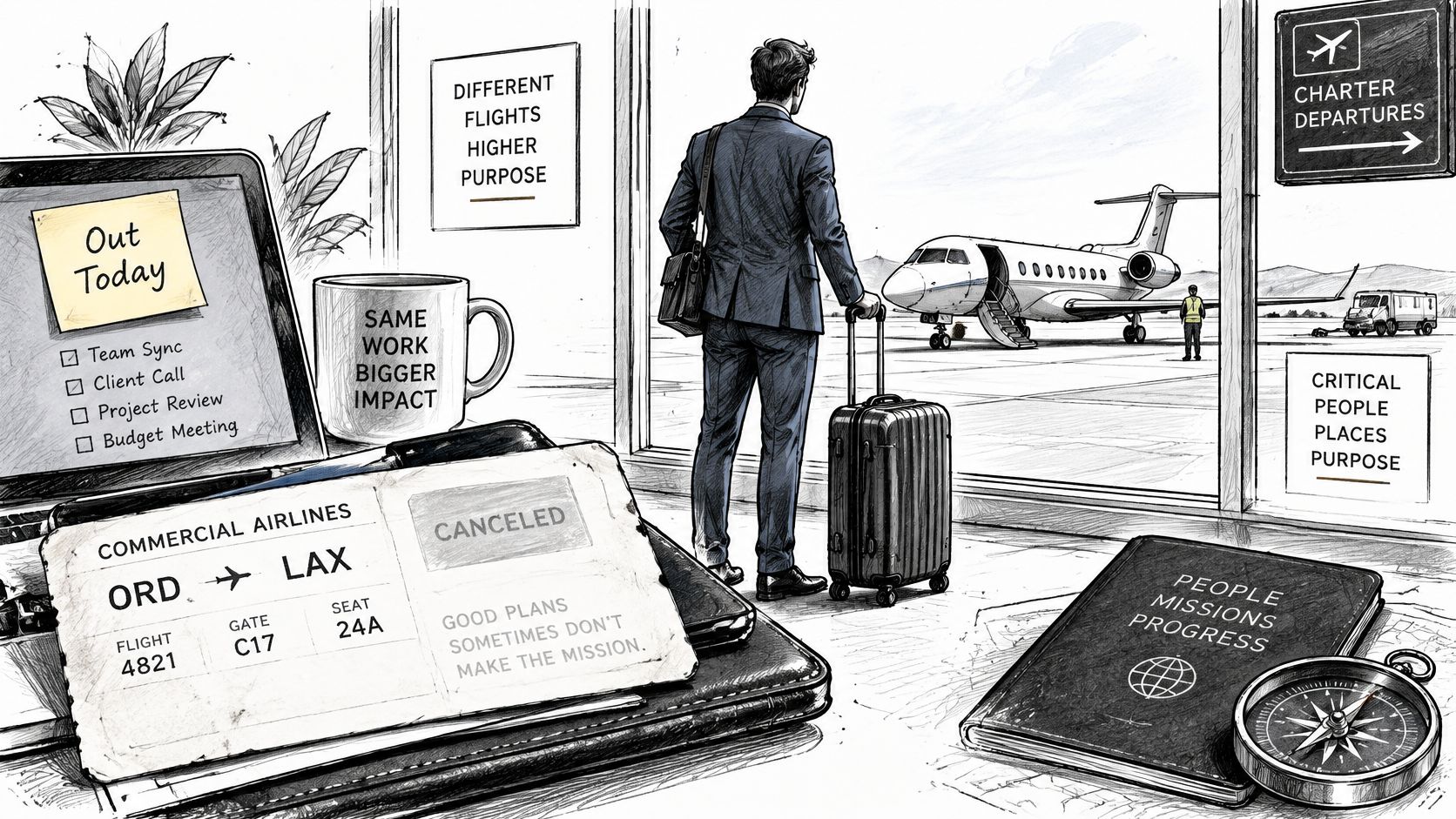
Say a leadership team needs to visit several facilities and return home after the final meeting. Commercial flights may serve every city, yet still fail to connect the appointments without an overnight stay. Charter becomes a scheduling purchase rather than a cabin upgrade.
The controller should compare the complete alternatives: tickets, hotels, ground transfers, staff time, and the consequences of missing the meeting. A charter quote doesn't become economical merely because the passengers are senior executives.
Match the transport to the consequence
Mission | What can justify charter | What the buyer must test |
|---|---|---|
Corporate roadshow | Direct routing and a timetable built around meetings | Whether airport access and ground travel preserve the time saving |
Sports or entertainment movement | Keeping people and equipment together | Baggage volume, cabin configuration, discretion, and recovery arrangements |
Medical evacuation or repatriation | Appropriate medical equipment and accompanying care | Clinical suitability and operator acceptance |
High-value cargo | Dedicated routing and controlled handoffs | Chain of custody, handling, and shipment eligibility |
Group movements require more than multiplying a passenger fare. The aircraft must accommodate equipment as well as people, and the arrival plan must get everyone to the venue. Our group-charter planning guide addresses that type of mission matching.
Medical and cargo buyers face a different decision. A passenger cabin that appears suitable on a seat map may lack the equipment, loading arrangements, or acceptance capability the mission needs.
When commercial still wins
A routine city pair with flexible dates and a convenient nonstop is a strong case for commercial travel. A premium cabin or an available semi-private seat may satisfy the traveler without purchasing an entire aircraft.
For that comparison, Passport Premiere's discussion of can travel agents find cheaper flights is relevant to the commercial-ticket side of the decision. Compare actual itineraries and conditions rather than assuming either a broker or an airline channel must always be cheaper.
Score the proposed trip on people traveling, stops required, and the cost of arriving late. Add privacy, equipment, and clinical constraints where relevant. If commercial service meets those requirements, brokerage may add cost without solving a meaningful problem.
Book Only After the Operator Is Named
The first conversation should be operationally specific: passengers, city pair, luggage, timing, and whether the mission is corporate, group, cargo, or medical. The payment decision should be equally specific.
A broker can be valuable without being the airline. The buyer needs someone who can source suitable options, explain the contract, and remain accountable for the coordination they promised. That doesn't justify accepting an unnamed operator or an open-ended invoice.
Access isn't the same as commitment
At Approved Jets, we have access to a network of over 1,000 aircraft. That describes sourcing reach, not ownership, guaranteed availability, or a reservation of a particular aircraft.
Our flight advisors are available 24/7 for immediate charters at +1 (866) 678-1411. Clients can also email charter@approved-jets.com with the mission details. Availability of an advisor shouldn't be confused with confirmation that a flight has been accepted.
A useful final check is to compare the latest proposal with the booking confirmation. Make sure the selected aircraft, operator, itinerary, inclusions, and exceptions haven't changed during the exchange. If a substitution occurs, pause long enough to assess what it changes for the mission and the contract.
Don't approve a charter payment solely because the hourly rate looks competitive. Approve a documented mission with an identifiable carrier and an understood financial exposure.
Keep the payment gate simple
Before releasing funds, the travel manager and finance approver should have the following items together in the booking file:
- Contracting capacity: A clear statement of the capacity in which the broker is acting.
- Named direct carrier: The operating company's legal name and current operating-certificate number.
- Promised audit status: Current ARGUS or Wyvern documentation if that credential formed part of the offer.
- Comparable written quote: Charges labeled fixed, estimated, pass-through, or optional, together with cancellation terms and responsibility for changes.
A missing document isn't proof that a flight is unsafe or that a quote is improper. It is a reason not to pay yet. Resolve the gap while the buyer still has the ability to compare alternatives.
Approved Jets offers charter sourcing and end-to-end travel coordination through independently operated aircraft. Visit Approved Jets to submit your itinerary and discuss aircraft options, operator documentation, and the assumptions behind your charter proposal.