Private Jet Travel Guide: Costs, Booking and Logistics
Private jet travel explained: real hourly costs, charter vs jet card vs fractional, how to book, time savings, safety checks and when it's worth it.
14 min read

Your Chicago meeting is scheduled to end at 4 p.m., and your deal team needs to be in Denver by 9 a.m. the next morning. Suppose the available airline schedules won't get everyone there in time. Private jet travel becomes a practical option, but the decision shouldn't turn on an hourly rate or a promise of a faster flight.
You need the total trip cost, a workable door-to-door schedule, and an aircraft suited to the mission. That means checking what happens before pickup, after landing, and if weather or maintenance disrupts the plan.
Table of Contents
- What Private Jet Travel Is and Who Books It
- What Private Jet Travel Costs by Aircraft Class
- Build the total from separate lines
- Compare like with like
- Choose Between Charter, Jet Cards, Fractional Ownership and Full Ownership
- Access comes with conditions
- How to Book a Private Jet Step by Step
- From request to confirmed aircraft
- Finalize the details that prevent delays
- When Private Jet Travel Saves Time Through Airport Access
- Put emissions beside the time saving
- Door-to-Door Logistics and Hidden Constraints
- Confirm suitability, not just availability
- Safety, Regulation and Discretion You Can Check
- Check the operating company
- Special Missions for Group Travel, Medevac and Cargo
- Match the aircraft to the task
- Request Quotes and Take the First Step
What Private Jet Travel Is and Who Books It
Private jet travel means flying on an aircraft chartered or owned for one party's use. Passengers request the departure schedule rather than choosing an airline timetable, although the operator still has to approve it against airport, weather, aircraft, and crew constraints.
Think of the difference between a taxi on call and a bus route. You select the taxi's pickup point and destination, but you don't control road closures. Private aviation offers similar flexibility, not freedom from operational limits.
For the Chicago team, the useful question isn't whether the cabin is more comfortable. It's whether a direct departure after the meeting creates a dependable arrival without sacrificing the next morning's work.

The Federal Aviation Administration's business-jet operations report records 5,099,528 operations in 2021, a record 5,369,454 in 2022, and 5,139,626 in 2023. Those figures show that activity retained much of its rebound, although that series alone doesn't establish a comparison with the pre-pandemic baseline.
Users include corporate executives and travel managers, high-net-worth families, professional sports teams, entertainment talent, and medical teams transporting patients. Their requirements differ: an executive may need a confidential working cabin, while a family may need space for pets and bulky luggage. Our clients at Approved Jets include executives, professional athletes, entrepreneurs, entertainers, and global brands.
Start with the mission: How often do you fly, how time-sensitive is each journey, and how many people travel together?
Those answers determine whether private access solves a recurring problem or adds expense to a trip an airline could handle well.
What Private Jet Travel Costs by Aircraft Class
Aircraft class sets the starting point for a trip budget, but the route and aircraft availability determine the actual quote. Use seat bands as a first filter, then check whether the aircraft can fly the route with your passengers and baggage without an inconvenient fuel stop.
Typical seats and planning checks by aircraft class
Aircraft class | Typical seats | Price drivers to check |
|---|---|---|
Light jet | 4–6 | Shorter range can limit nonstop routes; minimum billable hours can weigh heavily on short trips. |
Midsize jet | 6–8 | Route length, winds, payload, and fuel-stop requirements affect flight time and aircraft suitability. |
Super midsize jet | 8–9 | Range with passengers and bags, along with any fuel stop, can change the trip's flying hours. |
Heavy jet | 10–16 | Exact aircraft and cabin configuration matter; longer missions may add crew overnight and other fixed charges. |
Ultra long range jet | 12–16 | Long-haul capability depends on the specific aircraft, payload, and route; confirm whether the itinerary can be flown nonstop. |
Seat bands are planning guides, not guarantees for a particular aircraft. A larger cabin can cost more to operate, but choosing by hourly rate alone misses positioning, minimums, and fixed fees.
Build the total from separate lines
Start with estimated billable flight hours multiplied by the quoted hourly rate. Billable time may include positioning, and minimum charges can make a short passenger flight cost more per hour flown.
Quote line | What to establish |
|---|---|
Passenger flying | Estimated hours, billing basis, and minimum charges |
Positioning | Empty flying required before pickup or after drop-off |
Landing and handling | Airport, terminal, parking, and handling charges included |
Crew overnight | Accommodation, allowances, and extended-trip costs |
Catering | Standard provisions versus separately ordered meals |
De-icing | Whether excluded and how actual charges are passed through |
Ground transportation | Vehicle type, waiting time, and transfer charges |
Taxes and other charges | What's included, excluded, or settled afterward |
For a hypothetical comparison, a midsize flight lasting 2.5 hours at an assumed $5,000 per hour produces a $12,500 passenger-leg charge. Two equivalent legs total $25,000. Add an assumed one hour of positioning at that same rate, and the flying subtotal reaches $30,000, before other charges.
That example shows why the hourly figure is only one part of the budget. A short trip may be affected by minimum billable hours, while a round trip may require the aircraft to remain overnight or reposition elsewhere. Holiday and event demand can also reduce the available choices.
Compare like with like
Approved Jets quotes are estimates and can change with aircraft availability, fuel costs, positioning, landing fees, overnight charges, de-icing, catering, and ground transportation. Ask which amounts are fixed at acceptance and which may be charged at actual cost.
Compare quotes for the same aircraft class, airports, schedule, and fee categories. Get exclusions in writing, especially cancellation terms, itinerary changes, and replacement-aircraft pricing. A lower hourly rate can still produce a higher trip total if the aircraft must fly farther empty to collect you.
Choose Between Charter, Jet Cards, Fractional Ownership and Full Ownership
Private travel models compared
Model | Upfront commitment | Access and scheduling | Best fit |
|---|---|---|---|
Pay-per-trip charter | None beyond the trip cost | Book each flight against available aircraft | Occasional or one-off trips |
Jet card | Prepaid block of flight hours | Contractual priority access at a set rate, subject to conditions | Regular trips without ownership |
Fractional ownership | Share purchase plus monthly fees | Scheduled access through a managed program | Frequent, predictable travel |
Full ownership | Aircraft purchase plus ongoing annual costs | Control of the aircraft, subject to operational limits | Sustained high utilization and control requirements |
Apply the criteria in this order: trip volume, schedule flexibility, upfront commitment, and desired control. Don't begin with the appeal of owning an aircraft.
As a hypothetical comparison, someone making six round trips a year should usually start by testing charter rather than committing capital to a fractional share. A traveler flying four times a month has a stronger reason to evaluate a card or share, but frequency alone doesn't establish which contract costs less.
Access comes with conditions
A jet card may offer a defined rate and prepaid hours, but check expiration, peak-day restrictions, booking notice, aircraft substitutions, and refund provisions. A fractional program adds ownership and management obligations to the cost of flying.
Full ownership creates control, not guaranteed availability. Crew, maintenance, insurance, and hangar commitments continue when the aircraft isn't flying, and an owner still needs a recovery plan during maintenance.
- Choose charter for isolated trips, changing routes, or destinations poorly served by airlines.
- Evaluate a card when regular travel justifies prepaid access without ownership.
- Test fractional access against a predictable, frequent travel calendar.
- Consider ownership when sustained utilization and control requirements justify the fixed commitments.
We offer luxury charter from regional hops to transcontinental journeys, alongside corporate travel, group travel, cargo and logistics, aircraft management, and medical evacuation and repatriation. Our 24/7 concierge access supports coordination, but the right access model still starts with your mission brief, not a membership pitch.
How to Book a Private Jet Step by Step
A clear request helps the advisor distinguish an attractive aircraft from one that can operate your itinerary. This process overview captures the main booking stages.
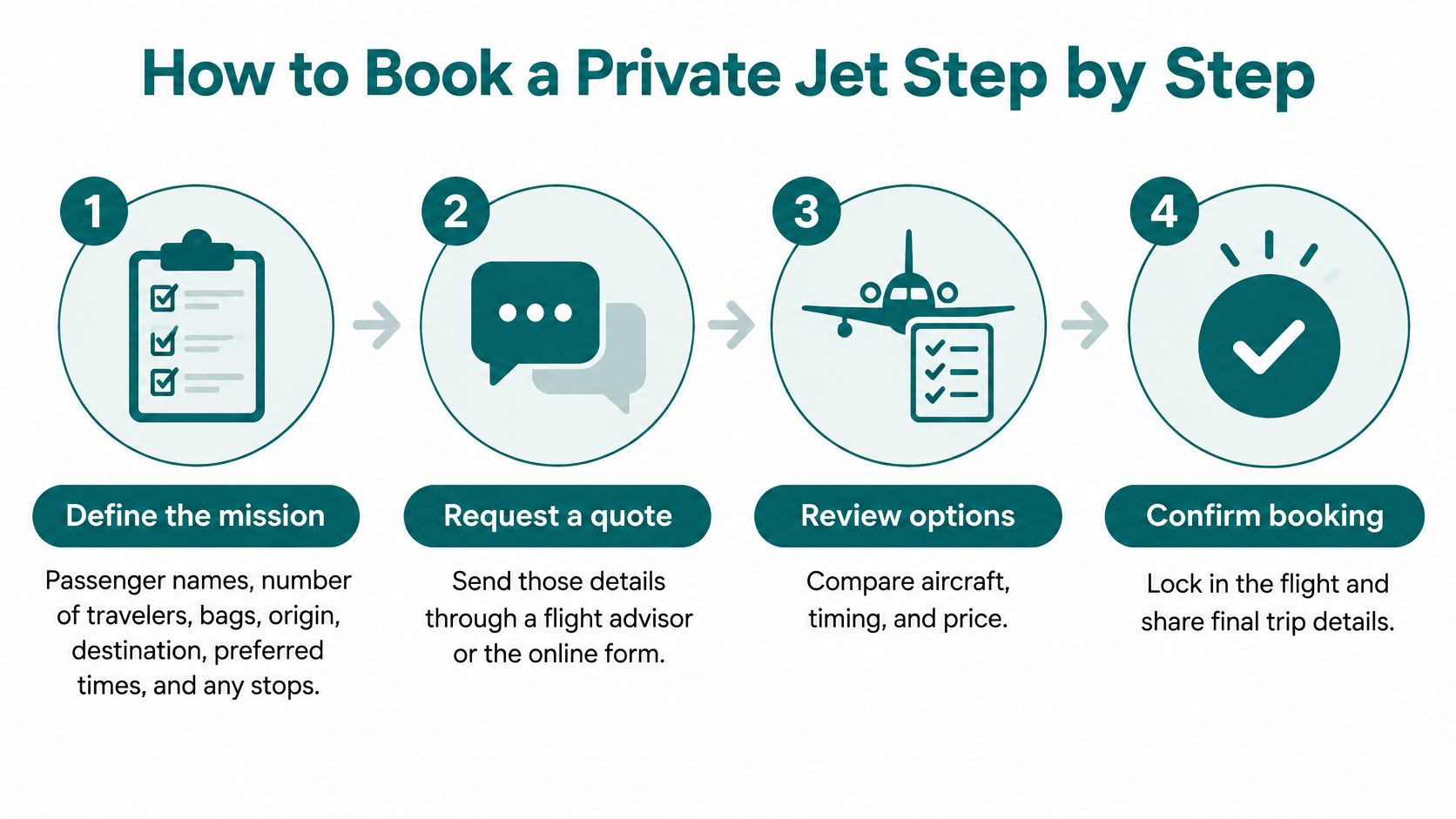
From request to confirmed aircraft
- Define the mission. Supply passenger names, traveler count, baggage dimensions and weight, origin, destination, preferred times, and stops. Include pets, mobility requirements, oversized equipment, and any meeting time that can't move.
- Request a written proposal. Contact our flight advisors or use the Get a Quote button for a personalized charter proposal. We process the requirements, source aircraft and operators through our network, and present options, pricing, and itinerary details; don't assume an initial option remains available indefinitely.
- Compare operational fit. Review the actual seating layout, luggage compartment, cabin access, and any proposed fuel stop, not just the aircraft class. Confirm that positioning, fees, taxes, and exclusions are visible before comparing totals.
- Identify the operator. Obtain the operating company's identity and applicable certificate, then review its safety credentials before committing. Our explanation of aircraft charter brokerage clarifies how the arranging role differs from operating the flight.
- Approve and confirm. Read the itinerary, payment schedule, cancellation terms, and aircraft-substitution provisions before authorizing payment. We facilitate communication with the selected operator, assist with payment processing and booking logistics, and send booking confirmations and updates.
Finalize the details that prevent delays
- Reconcile the passenger and service details. As a planning practice, review the manifest, transfers, and catering 24 to 48 hours before departure, unless the operator requires earlier completion. Incorrect passenger information can obstruct border clearance, while a late declaration of oversized bags can force an aircraft reassessment.
- Follow the confirmed reporting instructions. A 15-to-30-minute arrival window may suit a straightforward domestic departure, but treat it as a planning example, not a universal entitlement. Bring the required identification and follow the operator's specific instructions for international, medical, or security-sensitive travel.
Keep a single trip contact responsible for approving changes. Separate instructions from an assistant, passenger, and ground driver can otherwise leave the operator working from conflicting departure times.
For a visual introduction to private charter, watch the video below.
When Private Jet Travel Saves Time Through Airport Access
Suppose a three-person team needs to reach a plant in a small city. In a hypothetical comparison, the commercial itinerary includes a connection, two hours of flying and waiting, and a 90-minute drive; a private option reaches a regional airport 10 minutes from the plant and roughly halves the complete journey.
That advantage comes from airport location, not necessarily aircraft speed. NBAA's explanation of business aviation's strategic value identifies about 5,000 U.S. airports available to business aircraft, compared with approximately 500 used by scheduled airlines.
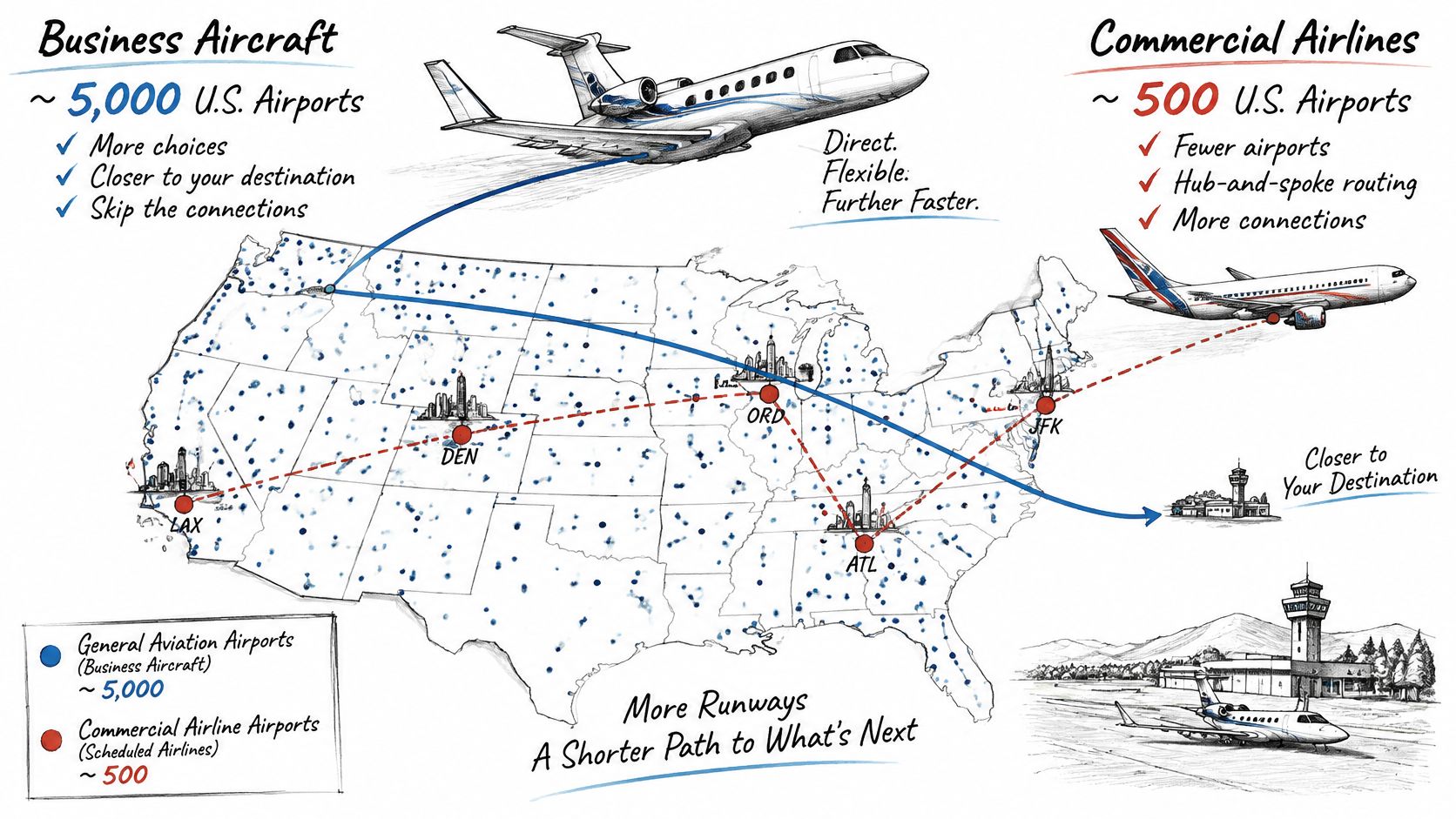
On a short hub-to-hub route with a convenient nonstop flight, the advantage can shrink substantially. List both street addresses, usable airports, terminal time, transfers, and contingency allowances before assigning a value to hours saved.
Put emissions beside the time saving
The London–Dubai comparison published through UCL Open estimated about 9,022 kilograms of CO₂-equivalent per private-jet passenger, versus roughly 923 kilograms commercially; its broader comparisons described private travel as approximately nine times commercial aviation, 35 times rail, and 52 times coach.
For a 500 km mission at an estimated 38% load factor, Transport & Environment's analysis estimated 1,702 g CO₂ per passenger-kilometer for a Citation Excel and 1,462 g for a Phenom 300, falling to 649 g and 557 g, respectively, at full capacity.
Reporting on the global flight analysis found roughly half of the analyzed private-charter flights traveled less than 500 km. Empty positioning adds fuel burn without transporting passengers.
Yale Environment 360 reported a 46% increase in global private-jet emissions from 2019 to 2023, with the most frequent fliers producing up to 2,400 tons of CO₂ annually.
Compare avoided fuel burn before buying offsets: consolidate travelers, match aircraft to payload, remove unnecessary positioning, and test rail or ground alternatives.
Purchased offsets don't reduce the aircraft's fuel consumption. For sustainable aviation fuel claims, request the accounting method and distinguish physical fuel use from separately allocated environmental benefits.
Door-to-Door Logistics and Hidden Constraints
A journey is only as fast as its weakest link. A nearby runway doesn't help if customs isn't available, the aircraft can't use it in forecast conditions, or the arriving passengers face an unplanned road transfer.
Airport opening hours, runway performance, parking permission, and handling availability all matter. Long working days can also make the requested return incompatible with crew duty limits, even when the aircraft itself remains available.
Confirm suitability, not just availability
Fortune's reporting on private aviation activity cited light jets accounting for 26.5% of departures in the first half of 2025. A small cabin may suit the passenger count while failing the baggage requirement, so send dimensions for golf bags, production cases, wheelchairs, or sports equipment before accepting an aircraft.
We coordinate ground transport, catering, security, and special requests, managing the complete trip rather than treating landing as the endpoint. Our approach to door-to-door transport service makes the surface journey part of the planning process.
Vehicle relocation is a separate task from an airport transfer. If an extended stay requires shipping your own car, National Car Transport's resource lets you compare flat-rate car shipping quotes, helping you distinguish that cost and delivery schedule from passenger transportation.
Before accepting the itinerary, confirm:
- Alternate airport: Where will the flight land if weather or operating restrictions prevent use of the primary airport, and what happens to the transfer?
- Customs and handling: Who has confirmed clearance arrangements, operating hours, passenger documents, and arrival permission?
- Baggage acceptance: What bag count, dimensions, and weight has the operator approved for this specific mission?
- Recovery plan: Who sources a replacement aircraft, how is availability assessed, and who pays any difference?
- Cancellation terms: What charges apply to passenger cancellation, schedule changes, and operator disruption?
Consider an international team whose preferred arrival airport lacks suitable clearance at the requested time. Discovering that before booking allows a different arrival plan; discovering it after departure could mean a diversion and, in a hypothetical case, losing half a day to revised transfers.
A backup plan isn't a guaranteed backup aircraft. Get the recovery obligations in writing rather than accepting a general assurance that someone will handle it.
Safety, Regulation and Discretion You Can Check
The broker arranging your flight isn't the company operating it. A polished proposal doesn't replace verification of the operator responsible for the aircraft and crew.
A peer-reviewed analysis of private aviation distinguishes U.S. private operations under Part 91, charter operations under Part 135, and scheduled airlines under Part 121. A company transporting its own executives may operate under Part 91; an on-demand charter carrying paying passengers generally requires a Part 135 operator certificate.
Check the operating company
The operator holds responsibility for operational control, aircraft airworthiness, and crew qualifications. Use our guide to private jet safety to frame questions about those responsibilities.
- Certificate: Confirm the operator's applicable authorization and that the proposed aircraft is authorized for the service.
- Independent credentials: Verify current ARGUS Platinum or Wyvern Wingman status rather than relying on an undated logo.
- Crew preparation: Ask about recurrent training, aircraft-specific experience, and qualifications for the proposed mission.
- Aircraft condition: Review age alongside maintenance status and relevant records. Cabin refurbishment isn't evidence of mechanical condition.
We use aircraft and crews that meet or exceed FAA Part 135 regulations, prioritizing operators with Argus Platinum and Wyvern Wingman third-party safety ratings. We're a broker, not a carrier; claims involving air transportation, aircraft safety, crew conduct, baggage handling, or onboard experience must be directed to the applicable operator.
Discretion is a process, not a cabin feature.
Private terminals reduce public touchpoints, but passenger manifests still need to reach authorized personnel and relevant authorities. Confirm who receives itinerary details, how updates are shared, and whether confidentiality agreements cover assistants, drivers, and other vendors.
Limit distribution to people who need the information. Privacy depends on manifest handling and operator procedures, not just avoiding a busy airline terminal.
Special Missions for Group Travel, Medevac and Cargo
For a hypothetical 12-person sports or corporate group, a larger aircraft can spread positioning and fixed charges across more travelers. But nominal seat count isn't enough: equipment, baggage volume, and payload may make a different aircraft, or an additional aircraft, necessary.
Medical evacuation requires a different specification. Confirm a clinical team qualified for the patient's condition, an appropriate stretcher or medical-equipment configuration, oxygen and power requirements, receiving-facility acceptance, and the operator's actual launch readiness. A rapid departure is useless if the patient can't be safely supported throughout the journey.
Match the aircraft to the task
- Group travel: Approve the seating arrangement, baggage plan, and any split-group contingency before payment.
- Medevac: Establish medical capability, range, transfer arrangements, and responsibility for clinical decisions.
- Cargo: Confirm loading dimensions, floor and payload limits, restraint arrangements, hazardous-goods acceptance, and customs paperwork.
For each mission, verify the applicable operating certificate, crew experience, insurance, and aircraft-replacement provisions. A passenger cabin shouldn't be treated as a cargo solution without operator approval.
Say a manufacturer needs a replacement machine part across the country before production can restart. A dedicated flight may avoid a freight connection, but the planner must first establish that the part fits through the loading opening and can be safely secured. Urgency doesn't remove those checks.
Request Quotes and Take the First Step
Prepare a mission brief with passenger names, traveler count, baggage count and weight, endpoints, preferred times, and stops. Send the same requirements to shortlisted providers so differences in the proposals reflect aircraft and terms, not inconsistent instructions.
Compare the complete payable total, unresolved allowances, and cancellation exposure. Confirm the alternate-airport arrangements, border handling, baggage acceptance, recovery plan, and contract terms before authorizing the booking.
Choose the proposal that can deliver the mission at an understood cost, not the one with the smallest headline number.
If the flight connects to a cruise, establish the ship's embarkation deadline and a suitable arrival buffer before committing to either booking. Best Cruise Rates lets you request a cruise quote, which can help establish the sailing details against which the air itinerary must work.
This week, send a mission brief for one real upcoming trip. Compare the resulting proposals with your current travel spend, complete door-to-door time, and the operational and environmental trade-offs you're willing to accept.
Approved Jets arranges private charter and coordinates the ground transport, catering, security, and special requirements that make the full journey work. Visit Approved Jets with your route, dates, passenger details, and baggage requirements to request a personalized proposal and assess the complete trip before committing.