Private Jet Meal: Bespoke Menus & Logistics Guide
Discover private jet meal options, from bespoke menus to seamless logistics. Elevate your in-flight dining with our complete guide to exclusive catering.

Approved Jets
On this page
- Table of Contents
- How a Private Jet Meal Actually Gets Ordered
- The brief must be operational
- What Counts as Private Jet Catering
- The cost follows the mission
- Service Levels from Snacks to Full Multi-Course Dining
- Choose for the aircraft, not the brochure
- Why Timing Drives What Reaches the Cabin
- Cold storage controls the schedule
- Delays change the decision
- Dietary Requests, Allergens, and Special Diets That Change the Order
- What passengers should disclose
- Responsibility must be assigned
- The Contrarian Case That Bespoke Does Not Mean Safe
- Rare proteins need a process
- Requesting a Bespoke Menu Without Dropping the Ball
- Send a complete brief
- Design the menu for reheating
- When the Meal Is Worth the Spend and When It Isn't
- Spend where the brief creates value
You're about to board a private jet for a short business trip, and someone asks what you want to eat. You request a restaurant-style entrée, a chilled seafood starter, a specific wine, and a gluten-free dessert. The request sounds simple. Operationally, it isn't.
That private jet meal may be prepared in a ground kitchen, rapidly chilled, driven to the FBO, loaded before departure, stored in a compact galley, and reheated later in an oven that wasn't designed for restaurant production. A premium menu matters, but headcount, timing, temperature control, dietary disclosure, and aircraft capability matter first.
Table of Contents
- How a Private Jet Meal Actually Gets Ordered
- What Counts as Private Jet Catering
- Service Levels from Snacks to Full Multi-Course Dining
- Why Timing Drives What Reaches the Cabin
- Dietary Requests, Allergens, and Special Diets That Change the Order
- The Contrarian Case That Bespoke Does Not Mean Safe
- Requesting a Bespoke Menu Without Dropping the Ball
- When the Meal Is Worth the Spend and When It Isn't
How a Private Jet Meal Actually Gets Ordered
A private jet meal starts before the aircraft arrives at the FBO. The broker or charter manager takes the catering brief, identifies a suitable caterer near the departure airport, confirms the passenger count, and checks what the assigned aircraft can store, reheat, and serve.
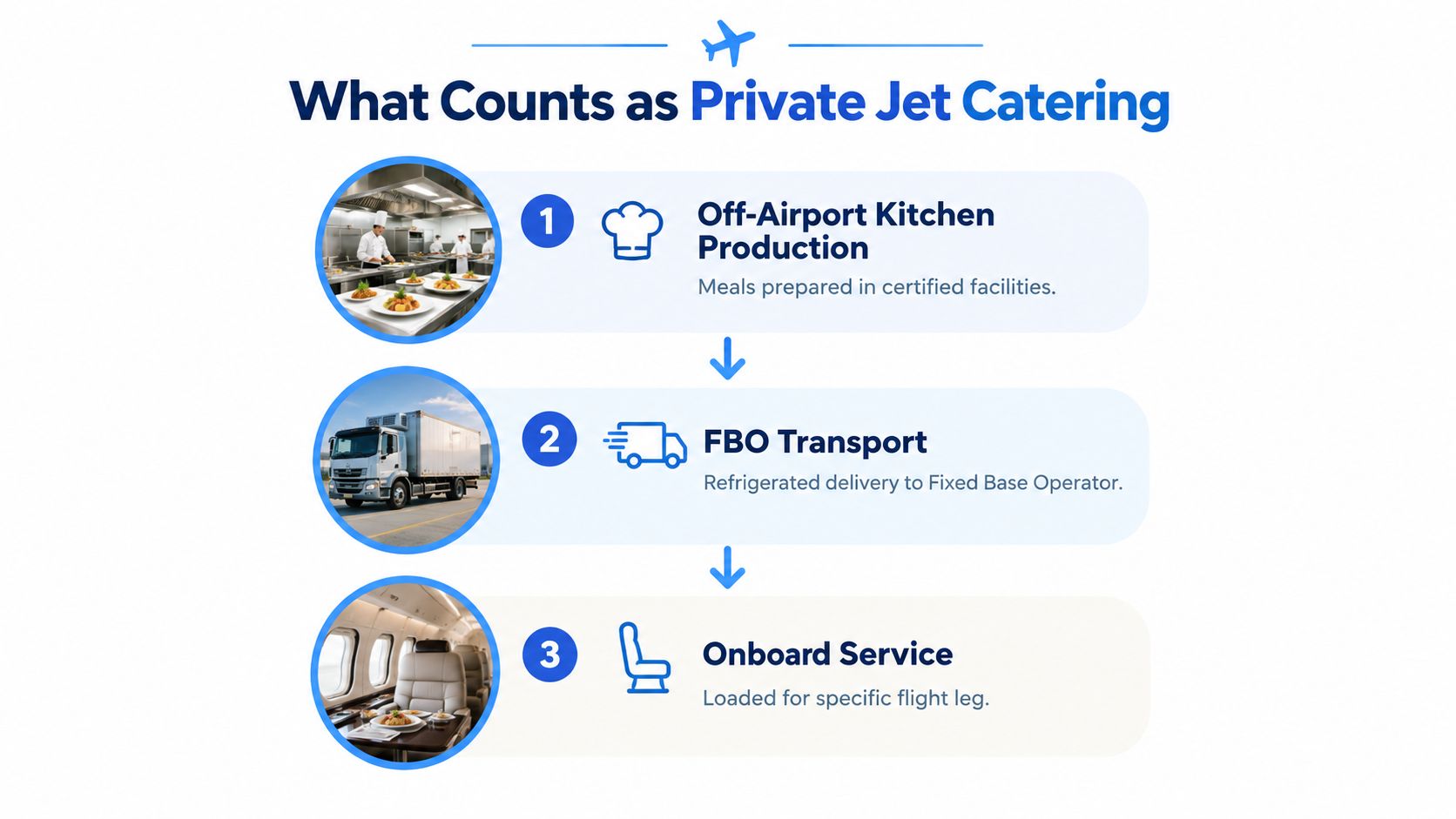
That sequence matters because private aviation rarely functions like a restaurant delivery order. The meal may be produced on the ground, chilled, transported under refrigeration, handed to the operator, loaded onto the aircraft, and served only after the flight is underway.
The brief must be operational
Give the coordinator more than “something light” or “a nice dinner.” Provide:
- Passenger count: Confirm who is flying, including children and late additions.
- Dietary information: List allergies, religious requirements, medical restrictions, preferences, and the severity of any reaction.
- Service timing: State whether passengers want food immediately after takeoff, during a meeting, or near arrival.
- Aircraft details: The operator needs the specific aircraft configuration, not merely “light jet” or “heavy jet.”
- Beverage requirements: Specify still and sparkling water, coffee, non-alcoholic drinks, wine, or spirits. For passengers selecting premium bottles, a specialist resource on premium wine in aviation can help frame the storage and service considerations.
The charter manager then coordinates the caterer, confirms the loading deadline, checks packaging, and tracks delivery to the aircraft. The operator and crew remain responsible for accepting, storing, reheating, and serving the food within the aircraft's limits.
A passenger arranging the aircraft should understand the broader sequence described in how to charter a private jet, because catering is part of the mission plan, not an isolated amenity. A late passenger count can change portions, labels, loading, and waste decisions.
Practical rule: If the caterer doesn't know the aircraft, service time, and final passenger count, the order isn't finished.
The most reliable process ends with a documented handoff. The coordinator confirms what was ordered, when it was loaded, how it was packaged, and what the crew should do if the food arrives outside the agreed condition.
What Counts as Private Jet Catering
Private jet catering means food and beverages prepared or assembled for a specific private flight leg, transported from an off-airport kitchen to an FBO, and loaded for onboard service. It isn't the same as food purchased in an FBO lounge, a snack drawer stocked by an owner, or a commercial airline tray produced for a standardized cabin.
The distinction is important. Commercial airline catering is built around volume, fixed menus, and repeatable service. A charter order is built around a smaller passenger group, a specific departure point, an aircraft's galley, and a service schedule that may change close to departure.
The cost follows the mission
Catering is usually material but relatively small compared with the aircraft charter itself. A 2015 industry report described a common rule of thumb of about 1.5% of the total flight price, which would put catering at approximately $300 on a $20,000 charter. The figure is an average planning reference, not a guaranteed quote, and it can include premium ingredients, packaging, delivery, and airport handling. (Forbes)
The same report described corporate flight-department catering orders averaging approximately $350, often covering three or four passengers. That implies an approximate food-and-service budget of $88 to $117 per passenger, although the total can include logistics beyond the food itself. (Forbes)
Aircraft scale changes the economics. Large privately operated Airbus and Boeing aircraft, configured for roughly 150 commercial seats but used privately, were associated with catering bills averaging about $1,700 per segment. (Forbes)
A short flight with cold snacks and coffee is a different service category from a long mission with premium ingredients, multiple courses, special diets, and formal service. Treating both as “jet catering” hides the work that drives the quote.
Service Levels from Snacks to Full Multi-Course Dining
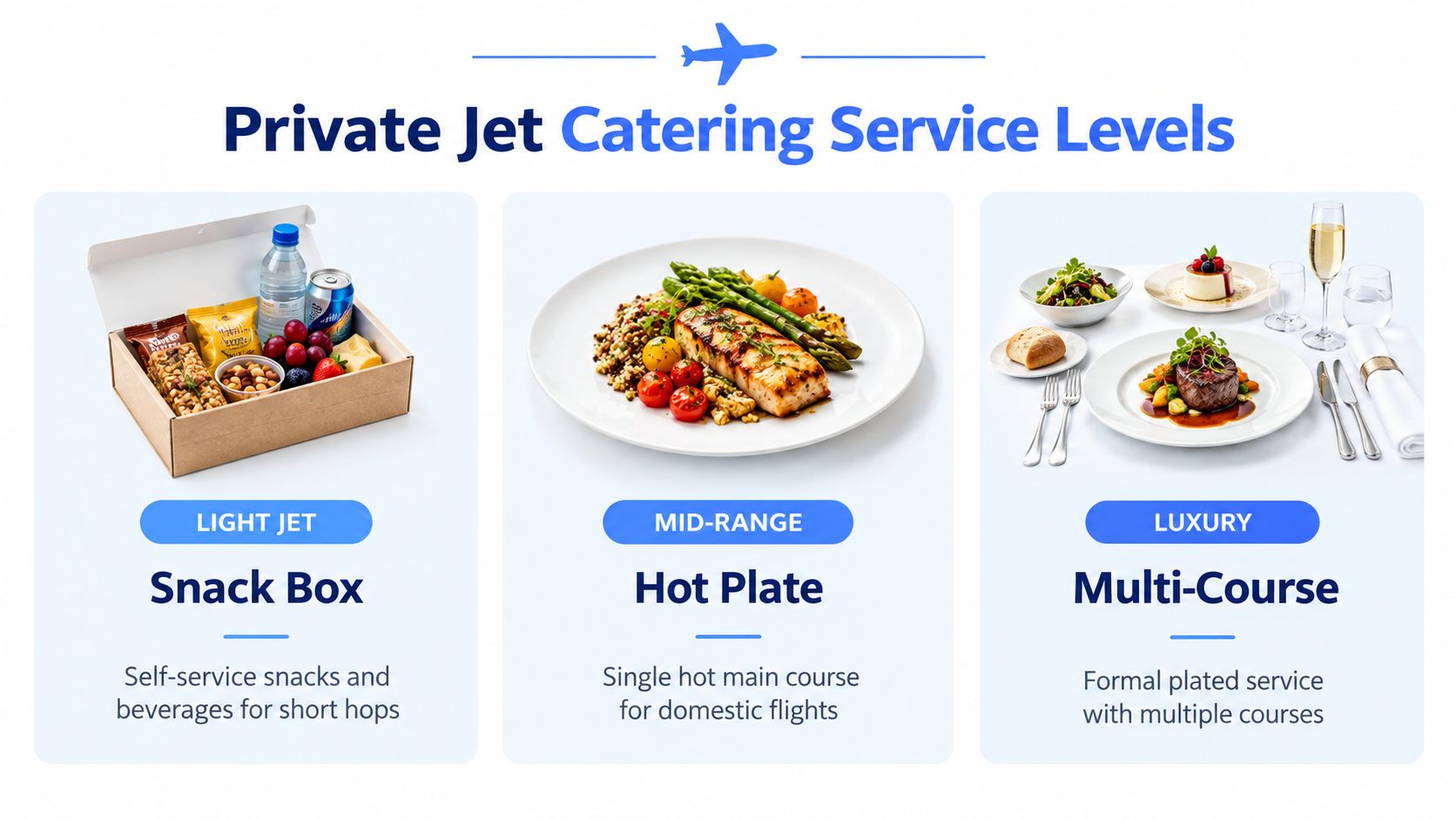
The right service level depends on flight duration, passenger count, aircraft equipment, and crew availability. A snack box can be the more professional choice on a short sector, while a heavy jet with a flight attendant can support a carefully timed plated meal.
Choose for the aircraft, not the brochure
A light-jet passenger may be better served by chilled sandwiches, fruit, nuts, pastries, and bottled beverages. A midsize aircraft may support a single hot main, provided its oven, tray dimensions, storage, and electrical capacity have been checked. A heavy jet can accommodate a more structured service, but only if the menu is engineered around the galley and the crew's workflow.
| Tier | Best For | Typical Contents | Indicative Price | Flight Attendant |
|---|---|---|---|---|
| Light jet snack box | Short sectors and self-service travel | Snacks, beverages, fruit, sandwiches, chilled items | Approximately $230 to $2,000 per flight leg across reported private-jet catering examples, depending on scope and aircraft | Often not required |
| Mid-range hot plate | A domestic flight requiring a substantial meal | One reheated main, salad, dessert, beverages | Varies by menu, airport, aircraft, and handling | Useful, but not always required |
| Luxury multi-course | Heavy-jet travel, executive dining, or group service | Starter, main, sides, dessert, beverages, formal serviceware | Varies substantially with ingredients, courses, sourcing, and service | Strongly preferred |
The reported catering range of approximately $230 to $2,000 per flight leg illustrates why a single “private jet meal price” is misleading. A short light-jet sector with simple food is not comparable with an international itinerary involving premium ingredients, multiple courses, specialized diets, or a large-cabin aircraft. (The Air Charter Journal)
Breakfast often generates more catering orders than lunch, with dinner lower still, according to the industry report cited above. (Forbes) That pattern makes sense operationally. Morning passengers often want coffee, fruit, pastries, and a practical meal before meetings, while dinner service usually requires more deliberate timing and presentation.
The key mistake is ordering a menu that the aircraft can't finish properly. A beautiful entrée that dries out in a small oven is worse than a well-designed cold platter.
Why Timing Drives What Reaches the Cabin
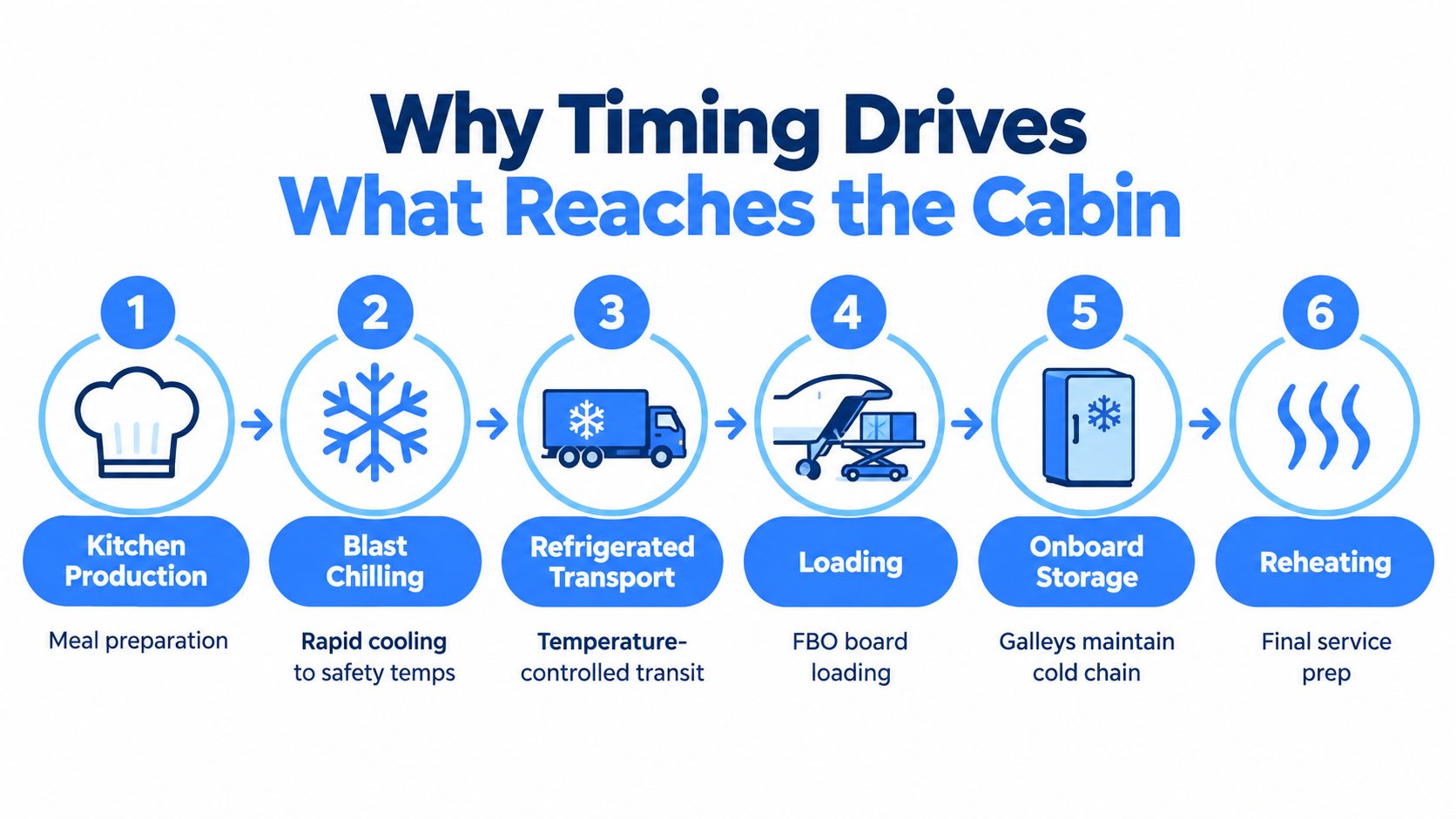
A private jet meal moves through a controlled chain. The kitchen prepares it, blast chills it where appropriate, transfers it under refrigeration, delivers it to the FBO, loads it onto the aircraft, stores it in the galley, and reheats it close to service.
Cold storage controls the schedule
Chilled items should be held at 41°F (5°C) or below until reheating or service, according to the FDA sanitary transportation framework. That requirement covers more than the caterer's kitchen. The coordinator must account for ground transfer, FBO handling, aircraft loading, boarding, and any delay before the crew serves the food.
Guidance for flight catering also identifies below 10°C (50°F) for cold meals aboard aircraft, above 60°C (145°F) for hot meals, and -18°C (0°F) or below for frozen food. Meals intended for hot service should remain cold until they enter the oven, rather than being heated immediately after takeoff. (Civil Aviation Authority of Bangladesh)
A short international example makes the point. A chilled seafood entrée can be loaded shortly before departure, held cold during boarding and climb, then reheated only when the crew is ready to serve it. The request isn't just “send seafood.” It specifies cold storage, packaging, loading time, reheating, and service.
Delays change the decision
Prepared food can't be treated as an unlimited buffer. Flight-attendant food-safety guidance recommends reheating prepared foods to 165°F (74°C) and discarding catering left out for service for more than two hours. It also describes limited holding windows for cold food once it leaves temperature control, and food shouldn't be returned to refrigeration to extend its usable life. (Flight Attendant Safety Stand Down)
If a family boards early and leaves a grazing platter on the table during a ground delay, the crew may need to replace it rather than chill and serve it again. A sports team with staggered service may need individually timed portions instead of one large platter exposed while everyone eats.
For a broader explanation of the discipline behind cold chain management explained, focus on the handoff, not only the fridge. The caterer, operator, and crew should agree on loading time, packaging condition, monitoring, and the action required if the meal arrives outside the validated range.
Dietary Requests, Allergens, and Special Diets That Change the Order
A passenger who says “gluten-free” or “nut-free” has not yet given the coordinator a usable brief. Confirm whether the request reflects preference, intolerance, religious practice, or a medically serious allergy. Each category changes ingredient verification, preparation controls, packaging, labels, and cabin-handling instructions.
The FDA transportation guidance covers allergen cross-contact prevention, separation of ready-to-eat and raw food, temperature control, and protection from non-food contamination. Those controls still apply on a private aircraft, where refrigeration, reheating capacity, and separation space may be limited. The aircraft galley can turn a safe catering plan into a compromised service plan if the operator has not confirmed how meals will be stored, finished, and served.
What passengers should disclose
Give the exact requirement before production begins:
- Vegan or vegetarian: State whether eggs, dairy, honey, or shared cooking equipment are excluded.
- Kosher or halal: Specify the required certification or preparation standard, rather than naming only the dish.
- Gluten-free: Confirm whether cross-contact must be prevented, particularly for celiac disease.
- Low-sodium or diabetic: Provide the medical requirement and any physician-approved limits.
- Pediatric meals: Share the child's age, familiar foods, texture needs, and allergy information.
- Severe allergies: Name the allergen, reaction risk, and whether separate preparation and sealed labeling are required.
The caterer should confirm ingredients, preparation controls, packaging, labels, and reheating instructions. The operator should confirm that the aircraft can store the meals separately and that the oven and service area will not undermine the agreed process. A confident answer from a passenger-facing representative does not prove that those controls are documented. Training resources such as staff allergen training modules provide useful context, but the flight brief still needs written confirmation for the specific meal.
Responsibility must be assigned
| Party | Required action |
|---|---|
| Passenger | Disclose medical, allergy, religious, and preference details accurately and early |
| Broker or charter manager | Pass the information to the caterer and operator, then confirm feasibility |
| Caterer | Verify ingredients, control cross-contact, seal and label portions, and provide reheating guidance |
| Operator and crew | Store, reheat, and serve the meal according to the agreed handling instructions |
A premium label does not make a medically restricted meal suitable. For complex medical nutrition requirements, physician-approved food may be safer than standard charter catering without documented confirmation. The same FDA transportation guidance on allergen cross-contact and temperature control applies equally aboard aircraft.
The Contrarian Case That Bespoke Does Not Mean Safe
A customized private jet meal can be less safe than a simpler one if the process isn't documented. Premium ingredients, a famous restaurant, and elegant packaging don't verify the center temperature of a thick protein or prevent cross-contact inside a compact galley.
International aviation-catering material treats cooking temperature and time as formal hazard-control points for foods of animal origin. One cited guideline specifies a minimum 65°C core temperature for cooking meats in airline catering, while an example from the World Organisation for Animal Health recommends 70°C for 30 minutes for meat from susceptible animals. (IATA smarter regulation report)
Rare proteins need a process
A medium-rare steak, sous-vide chicken, or lightly cooked fish shouldn't be approved from a menu description alone. Ask who cooked it, how the process was validated, how it will be transported, and how the aircraft crew will finish it.
Aircraft ovens can heat unevenly. Aviation food-safety guidance says the internal temperature should be checked at the slowest-heating point, and large trays should be monitored at the slowest-heating location. The oven display doesn't prove that the thickest portion has reached the required condition. (Flight Safety Foundation)
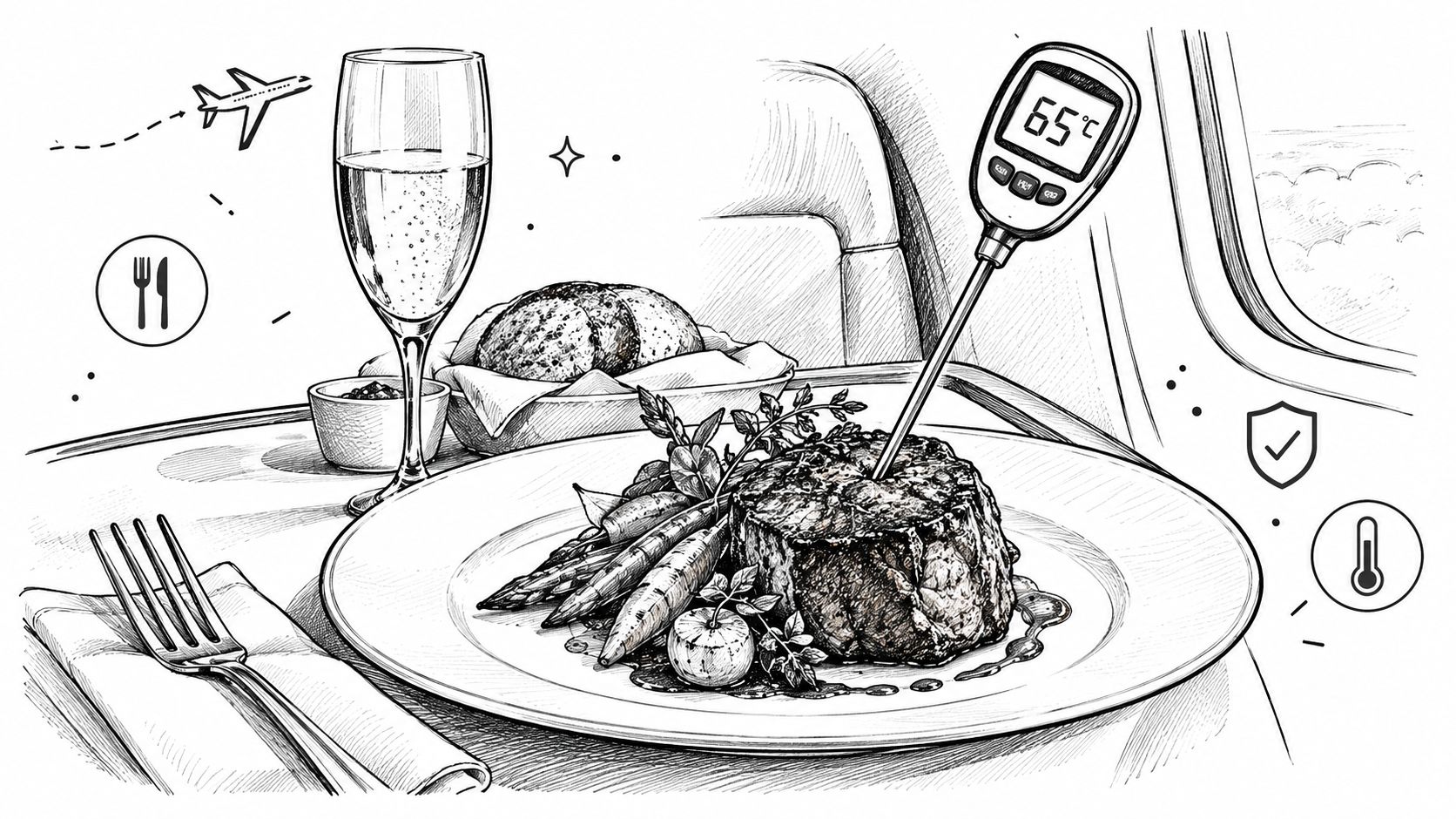
The galley also has practical limits. A lean protein may dry out during reheating, while a sauce-based dish can tolerate the process better. Portion mass, container material, oven program, target internal temperature, and plating sequence all influence the result.
Ask for the reheating method, not just the menu.
Passengers evaluating the broader operational question can also review are private jets safe, but catering safety still requires its own checks. The right questions are specific: How is the meal chilled? What temperature is recorded at handoff? Where is the probe placed? What happens if packaging is damaged or the meal arrives above the validated limit?
Requesting a Bespoke Menu Without Dropping the Ball
A reliable catering request reads more like a flight specification than a restaurant preference. It gives each party enough information to make a safe decision before the kitchen starts production.
Send a complete brief
Use this sequence:
- Set the service target. Give the departure date, departure airport, aircraft, route, and desired meal window.
- Confirm the headcount. Include passengers, children, crew requirements if applicable, and the deadline for final changes.
- List dietary controls. Separate preferences from allergies and medical restrictions. Include ingredient exclusions and cross-contact requirements.
- Describe the menu. State the main dish, sides, dessert, snacks, beverages, and preferred portion style.
- Check the galley. Confirm oven type, tray dimensions, refrigeration, electrical limits, service equipment, and available storage.
- Document the handoff. Require the loading time, packaging condition, labels, and agreed temperature-monitoring method.
- Define rejection. If chilled food arrives above the validated limit, packaging is compromised, or chain of custody is uncertain, require replacement rather than salvage.
A useful message to a broker or caterer is:
“Please confirm a meal for the final passenger manifest, with separate sealed portions for each dietary requirement. Provide the ingredients and allergen statement, loading time, handoff temperature, storage instructions, oven program, target internal temperature, and replacement procedure if the chilled meals arrive outside the agreed limit.”
That wording forces the conversation away from vague promises. It also gives the crew instructions they can use during a delay or multi-leg itinerary.
Design the menu for reheating
Choose composed salads, cured proteins, desserts, and other items that remain stable when chilled when the aircraft has limited galley capability. Use sauce-based mains where appropriate, and avoid transferring delicate restaurant dishes without testing how they behave after chilling and reheating.
Catering timing should reflect the airport and request complexity. A common menu may be manageable with advance coordination, while rare ingredients, remote departure points, or complex dietary requirements need more planning. The coordinator should tell you the actual deadline rather than accept a request that can't be executed properly.
Waste also belongs in the brief. Individual tailoring reduces satisfaction risk, but no-shows, changed schedules, and oversized portions can leave food unused. IATA estimates that passengers generate about 1.43 kilograms of cabin waste per flight, with nearly 6 million tonnes annually at full-capacity levels, and more than 20% consists of untouched food and drinks that generally can't be reused because of safety and operational rules. (IATA sustainability thought piece)
Right-sized portions, modular snack-and-main formats, accurate headcounts, and confirmed deadlines usually do more for waste reduction than premium “eco” packaging alone.
When the Meal Is Worth the Spend and When It Isn't
For a short light-jet sector, a calibrated snack-and-beverage box usually beats an over-ordered plated dinner. It reduces service complexity, limits waste, and avoids asking a small galley to reproduce food that needs restaurant equipment.
That doesn't mean cheap food is the answer. It means the format should match the mission. Fresh fruit, sandwiches, pastries, composed salads, coffee, water, and a few well-chosen snacks can feel deliberate when the portions are right and the packaging is clean.
A hot course earns its place on a longer domestic or international flight, particularly when passengers need to work, rest, or arrive ready for a meeting. With a flight attendant, timed release from refrigeration, controlled reheating, and plated service can turn the meal into a meaningful part of the journey rather than a container opened at random.
Spend where the brief creates value
The strongest catering decisions usually follow three principles:
- Match service to elapsed time. Don't order multiple courses when passengers have little time to eat.
- Match food to equipment. Don't request a delicate entrée until the actual galley and oven have been confirmed.
- Match portions to certainty. Don't load a large spread for a passenger count that may change.
The cost benchmark also needs perspective. Catering is commonly treated as about 1.5% of a charter's total flight price, and an example $20,000 charter would put that planning average at about $300. (Forbes) That doesn't make every upgrade worthwhile. It does show why the operational quality of a meal depends less on chasing the lowest quote than on specifying the service correctly.
Before confirming a flight, ask the broker three questions:
- What exactly can this aircraft store, reheat, and serve?
- Who is verifying the dietary and allergen controls?
- What happens if the schedule changes or the meal arrives outside specification?
You can also compare the aircraft and trip economics through private jet charter prices, then allocate catering around the actual mission instead of selecting a menu in isolation. The best private jet meal isn't necessarily the most expensive one. It's the one that arrives safe, on time, correctly labeled, and suited to the cabin.
Approved Jets coordinates private jet charters and integrated trip logistics, including VIP catering, custom hot meals, premium beverages, dietary requests, and aircraft-specific service planning. Share your route, passenger details, aircraft requirements, and meal brief with Approved Jets to arrange a flight where catering is managed as part of the operation, not left until the last minute.