Private Jet Group Travel: Aircraft Options and Planning
Compare private jet group travel options by seat count, range and baggage, then plan routes, airports and operator checks before you book.
13 min read

About 120 million passengers travel on U.S. general-aviation flights each year, and business aviation contributed $128.3 billion to U.S. gross domestic product in 2018, according to the NBAA Business Aviation Fact Book. Numbers that size reframe the topic. A sports squad, a tour crew or a 40-person delegation isn't a niche request inside the system, it's ordinary traffic moving through it.
The on-demand side has grown with the rest. Operators regulated under Part 135 flew 3.1 million hours in 2010 and 3.5 million in 2016, an increase of roughly 12.9%, according to the FAA's study of operators regulated under Part 135. What that growth doesn't tell you is where group trips break. The aircraft is rarely the hard part. The limits are airport permission, payload, and who legally holds operational control of the flight.
Table of Contents
- Group Private Jet Options and Seat Counts
- Where the seat maximum stops being the answer
- One Large Aircraft or Several Smaller Ones
- How to Plan a Group Itinerary Step by Step
- The step most groups skip
- Airport Access, Curfews and Backup Airports
- Real Group Scenarios and How Each Flies
- Verify the Operator and Itinerary Before You Book
- Four checks that decide legality
- Five confirmations to get in writing
Group Private Jet Options and Seat Counts
Seat count starts every group charter conversation and settles very little on its own. Aircraft selection runs on passenger count, baggage volume, stage length and airport constraints at the same time, because a cabin certified for eight people carries far fewer once golf bags, camera cases or a touring rig come aboard. Private jets are generally counted in aviation datasets as general-aviation aircraft with fewer than 19 passengers. Past that line, the mission moves to heavy business jets, converted airliners or several aircraft, which changes fuel burn, runway requirements, slot access, handling arrangements and contingency planning, as the Our World in Data aviation emissions dataset reflects in its aircraft-level accounting.
Aircraft class | Typical passenger seats | Best-fit group |
|---|---|---|
Light jet | 6–8 | 2–5 travelers with light bags |
Midsize jet | 7–9 | 4–7 travelers, small team with gear |
Super midsize jet | 8–10 | 6–8 travelers on longer legs |
Heavy jet | 12–18 | 8–14 travelers on transcontinental routes |
Narrowbody airliner (charter layout) | 150–189 | Sports squads and large events |
Where the seat maximum stops being the answer
Advertised configurations describe an empty cabin on a short leg. Baggage volume, not headcount, is usually what forces the upgrade. A light jet that seats eight runs out of hold space long before it runs out of seats when six passengers travel with ski bags or exhibition crates. Stage length pushes the same way from the fuel side, because a full cabin and full tanks rarely coexist at the published maximum range. Airport limits then narrow the list again. A runway, stand, curfew or handling arrangement that works for a midsize jet may fail for a heavy jet on the same trip.
Work an example. Nine passengers, 18 checked bags, a five-hour international leg. Seats alone rule out the light and midsize classes. What decides between a heavy jet and a super midsize is a payload and range calculation that includes bags and reserve fuel, not the brochure figure. Ask for that calculation in writing, and check the layout on the specific tail, since two aircraft of the same type can be configured differently. The guide to private jet seating walks through cabin arrangements class by class.
The test that works: pick the smallest class that carries every passenger and every bag on the longest leg with reserve fuel, then confirm the cabin layout on the actual aircraft.
Groups that outgrow single-aircraft capacity are routine rather than exceptional. With access to a network of over 1,000 aircraft, the question is rarely whether something exists. It is which combination of class and airport fits the manifest, and whether the operator can support the whole itinerary legally from departure through arrival. Approved Jets sources appropriately sized airliners and heavy jets for large parties, sports teams, corporate retreats and destination weddings. Event organizers carrying the ground side of a large trip need lead time too, and this browse big-group team bonding ideas is a practical companion for the days around the flying.
One Large Aircraft or Several Smaller Ones
One full bus costs less per rider than four half-empty cars. The bus wins only if it goes where the riders are going, and that condition governs group charter too. Take 12 people on a four-hour leg. A single heavy jet at high load factor spreads fuel, crew time and positioning across twelve seats. Three midsize jets carrying four each give you staggered departures and easier airport options, but each aircraft flies with roughly half its seats filled, so cost and emissions per passenger both climb. Neither answer is wrong. The mission decides.
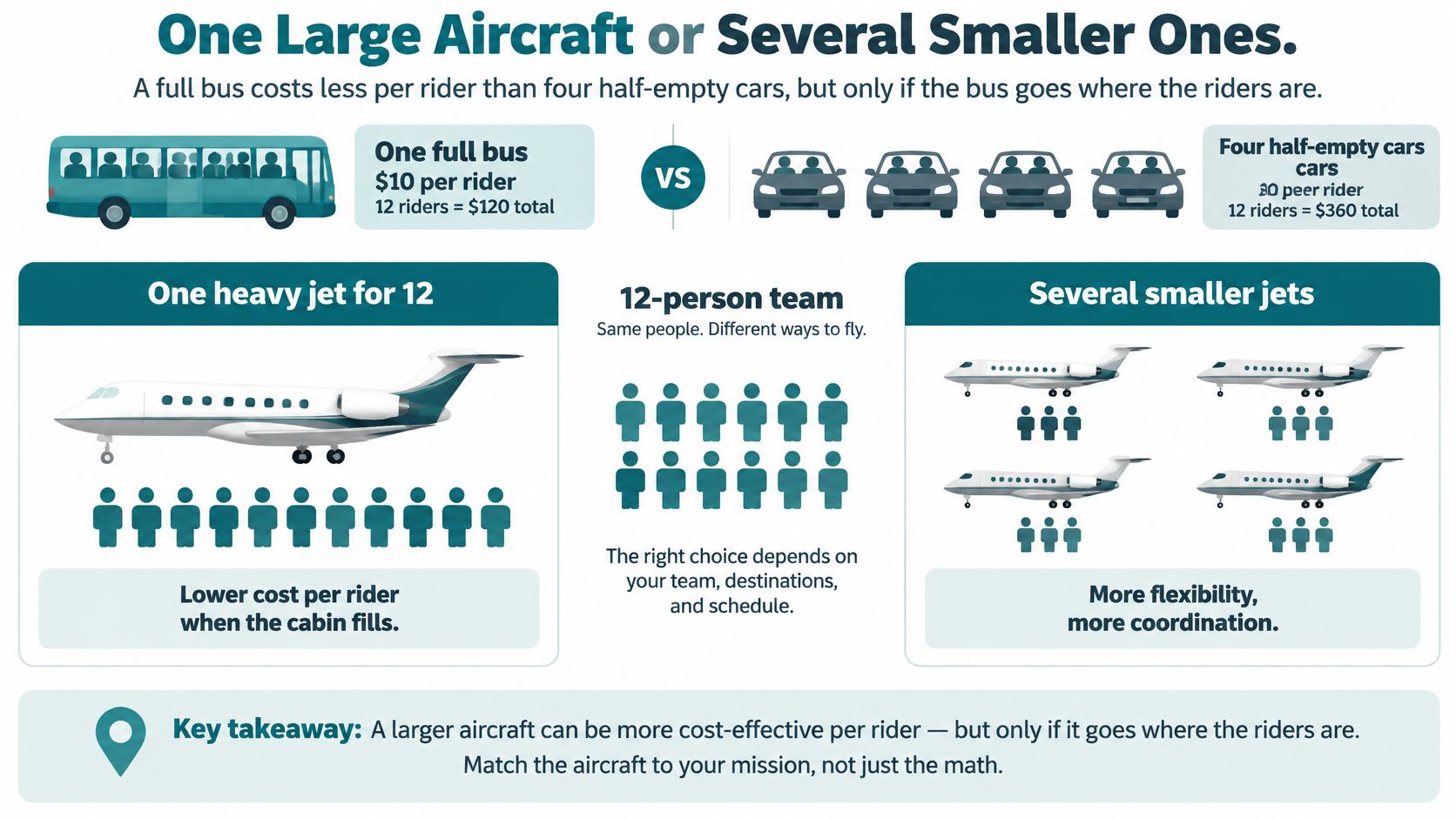
The emissions question only makes sense per passenger. Aircraft-level fuel and CO2 get divided among the travelers on board, so a large aircraft can burn more in total and less per seat at the same time. A light jet carrying four people on a route a heavy jet could serve with twelve is the wasteful case, not the efficient one.
Option | Passengers per departure | Schedule control | Airport access | Emissions per passenger | Flexibility |
|---|---|---|---|---|---|
One large aircraft | 12–18 in a heavy jet | One departure, fixed plan | Needs runway, stand and handling for the type | Lower when full, higher when partly empty | Low |
Several midsize jets | 6–9 each | Staggered departures | Easier at smaller airports | Higher per seat when lightly loaded | Medium |
Scheduled commercial seats | 1 per booking | Tied to timetables | Major hubs | Depends on load factor and route | High |
Scheduled VIP airliner | Roughly 19–50 in typical airliner configurations | Set timetable | Major airports | Depends on load factor and route | Low to medium |
Four variables decide which row you land in: load factor, aircraft size against the mission, empty-leg exposure, and route distance including any positioning flight that carries nobody. A heavy jet repositioning two hours each way to move a group on a 40-minute hop loses on every measure that matters. The split option carries its own hidden cost: two aircraft means two crews, two sets of duty limits, and two chances of a delay reaching one part of your group while the other half lands on time. A single aircraft moves the whole manifest as one risk, which is easier to manage but harder to absorb when something goes wrong. Several aircraft spread the risk across tails, and the price of that insurance is coordination.
The airport column deserves more weight than groups usually give it. A heavy jet narrows you to airports with the runway length, ramp space and handling for the type, and the airport you want may be the smaller field closer to the venue. Splitting the party across midsize jets is sometimes the only way to use it. Chartering privately does not exempt the flight from any of this; runway limits, slot windows and noise restrictions apply to a chartered tail exactly as they apply to a scheduled one.
Be skeptical of the claim that group charter is productive by default. The Institute for Policy Studies reported that, even using conservative assumptions for leisure flying at Hanscom Field, 49% of private-jet activity was recreational, which doesn't make any single team charter wasteful but does mean the productivity case has to be shown per trip, as the high flyers analysis from the Institute for Policy Studies sets out. Run the break-even on total mission fuel and cost per passenger, including repositioning, deadhead sectors and ground transfers, and treat offsets as a supplement to reduction rather than a substitute for it.
A rule I'd apply: if the group can't fill at least two-thirds of the cabin on the longest leg, price the split option before you sign anything.
How to Plan a Group Itinerary Step by Step
The order matters more than the checklist. Each step depends on the one before it, and skipping ahead is how groups end up with an aircraft that can't take the bags or an airport that closes before the event finishes.
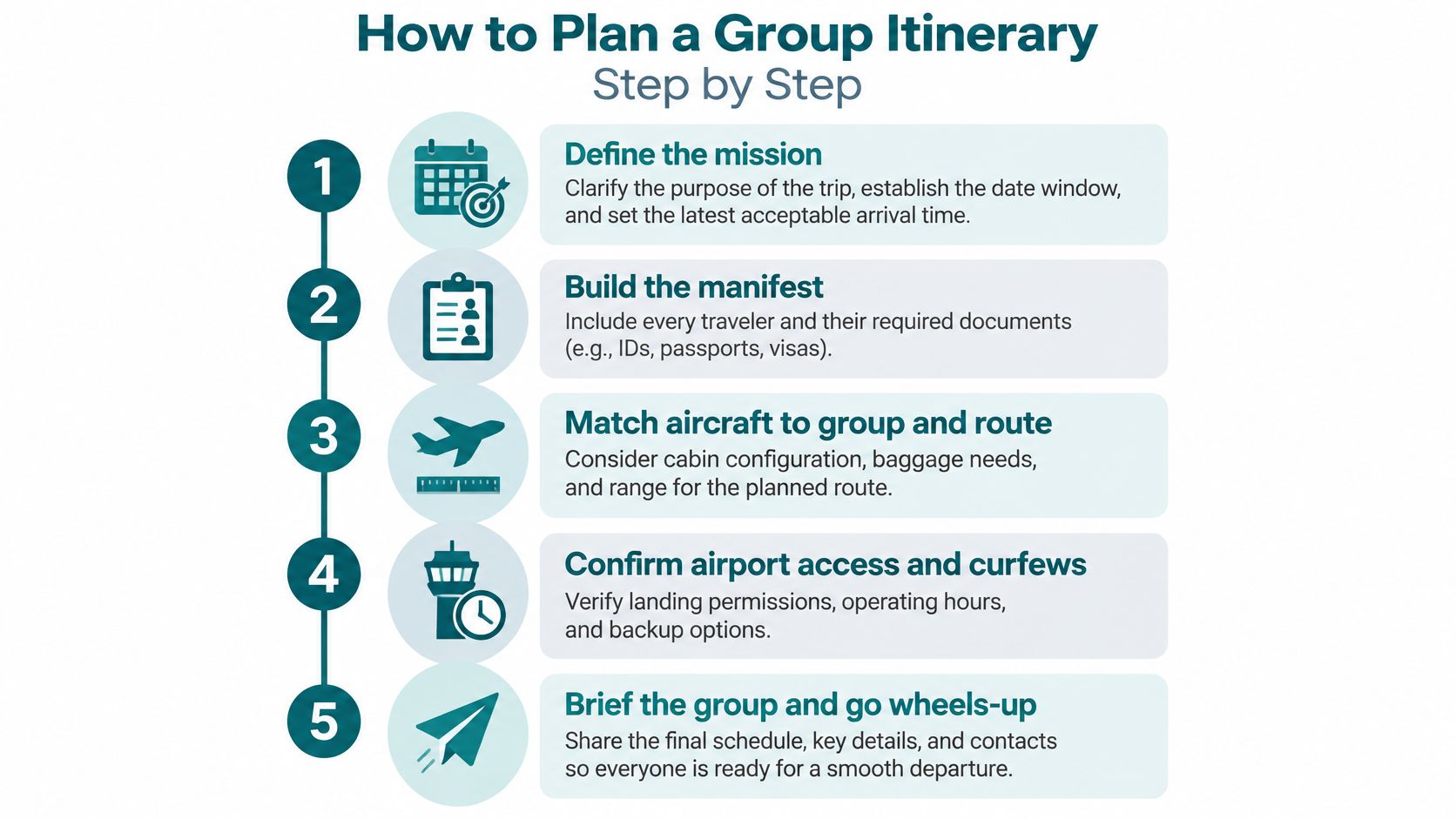
- Define the mission. Purpose, date window and the latest acceptable arrival time. Everything downstream, aircraft class, airport pair, crew schedule, gets measured against that arrival.
- Build the manifest. Every traveler's name, seat requirement, bag count, and any medical, production or sports equipment. This is the input to every payload number, so an incomplete manifest invalidates the aircraft recommendation.
- Choose the airport pair, then two alternates at each end. Confirm the FBO handles your aircraft class before anyone prices the flight, because airport fit eliminates aircraft faster than budget does.
- Set the timing. Block time, ground transfers, customs and immigration, and crew duty limits on the return leg. Late events often create the hardest constraint because they can push a departure beyond the crew schedule.
- Send the full manifest and compare per mission. Seat price hides repositioning, so compare total cost and total elapsed time for the itinerary as flown.
- Lock catering, ground transport, security and documents. These have lead times, and a customs form or a catering order can't be sorted at the FBO counter on the day.
- Confirm operator, aircraft and crew in writing, and declare regulated items. Declarations can change which operator is able to accept the trip, so they belong before the deposit, not after.
- Prepare the day-of plan. Check-in times, a weather alternate, and one named person in the notification chain when a leg slips.
Steps five through eight are where a broker adds practical value. Approved Jets receives and processes quote requests and travel requirements, sources aircraft and Operators through its network, and presents charter options with pricing and itinerary detail. It also coordinates ground transport, catering, security and special requests so those pieces run on one schedule instead of four. Approved Jets is a broker and not a carrier, and it provides active oversight from departure through arrival.
The step most groups skip
Airport selection gets treated as a detail and then becomes the constraint. A production crew moving 16 people and 40 equipment cases across a two-stop European itinerary has to settle the second airport before it settles the aircraft, because a 40-case load changes the handling requirements and a tighter FBO may not accept the volume. Multi-leg routing deserves the same care as the manifest, and this multi-stop route planner guide covers how to sequence stops without stranding the group. Ground-side sequencing still needs to fit the arrival window and venue timing, and the Hen Hideaways itinerary planning tips can serve as a general checklist for that event-side schedule.
Airport Access, Curfews and Backup Airports
A private itinerary removes the airline timetable, not the network. The constraint moves from gate connections to airport permission, and permission is conditional. Slots, operating hours, night curfews, parking capacity, fuel availability, customs facilities and local emissions rules all decide whether a large group aircraft can use the airport you picked. Industry analysis of the charter market lists constrained airport capacity, crew availability, emissions reporting, security requirements, night curfews, passenger-rights obligations and multinational compliance as pressures landing on a single mission, per the air charter services market forecast from Global Information.
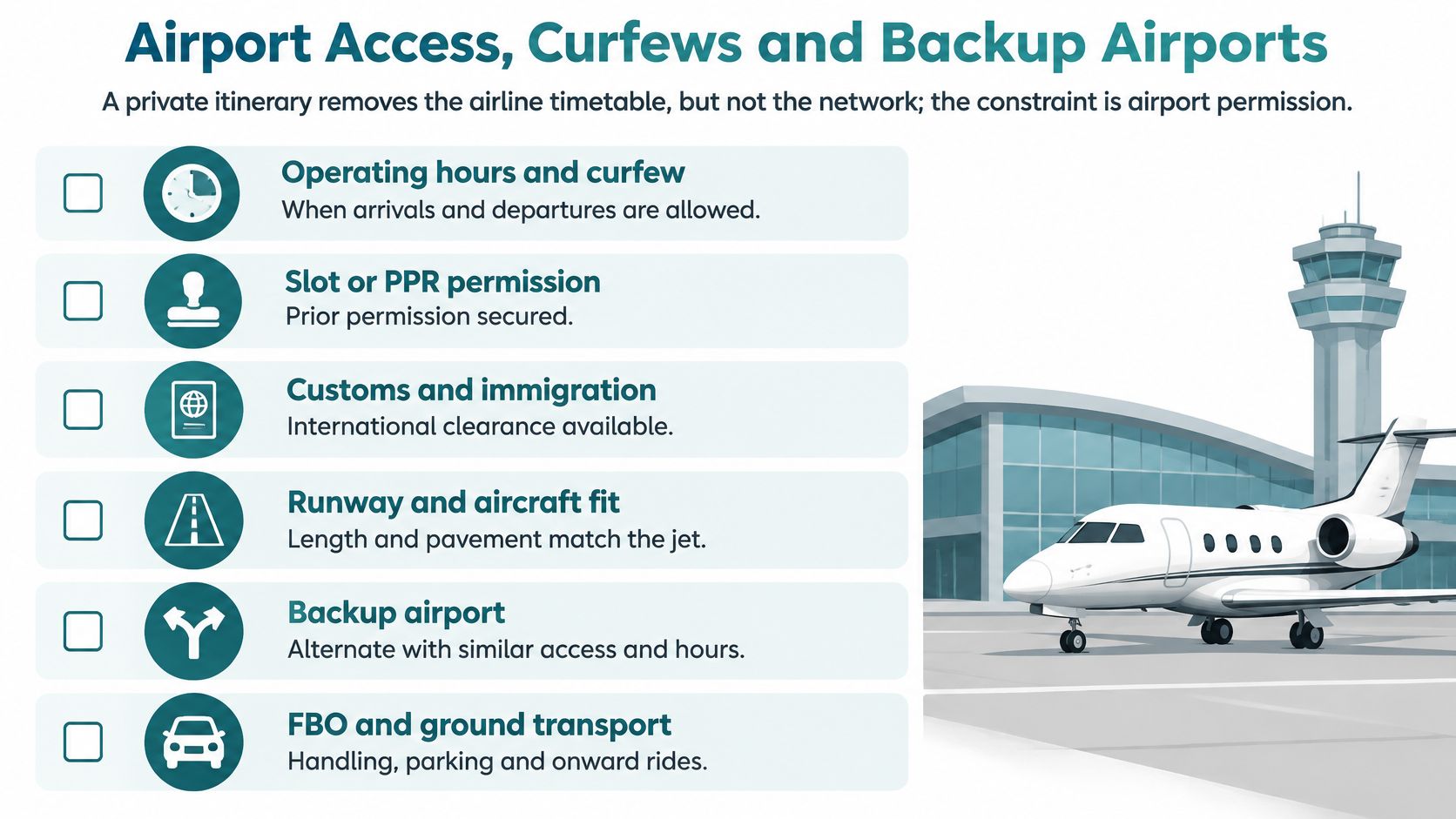
The working checklist, confirmed for every airport on the itinerary and every alternate:
- Operating hours and curfew. When arrivals and departures are allowed, and whether a late event pushes you past the cutoff.
- Slot or prior permission. Some fields require advance approval for the aircraft category, and approval isn't automatic because the operator asked.
- Customs and immigration. Available on your arrival day and at your arrival hour, not just at the airport generally.
- Runway and aircraft fit. Length, pavement strength and stand size matched to the type, since a regional field that suits a heavy jet can refuse a 180-seat airliner.
- Backup airport. An alternate inside the group's ground-transfer window, with similar hours and access.
- FBO and ground transport. Handling capacity, overnight parking, and enough vehicles for the whole party plus bags.
The airliner example is the one that catches planners. A narrowbody charter needs a longer runway, a bigger stand and different ground handling than a midsize jet, so the airport that worked for last year's 10-person trip may be unusable for this year's 150-person one.
Then plan the failure cases. The destination FBO can't accept the aircraft, the aircraft can't remain overnight, a late event pushes departure past curfew. Name one backup airport and write the rule for switching to it before the trip starts, so nobody negotiates it at midnight.
Crew duty limits are the hidden clock in every recovery plan. A delayed departure can leave the crew legally unable to fly the return leg, and no amount of passenger goodwill fixes that.
Real Group Scenarios and How Each Flies
Global private jet flights reached 3,878,836 in 2025, a 4.6% increase from 2024, according to WingX data reported by Forbes. Group movements also cluster around calendars rather than spreading evenly. Private flying had surpassed 2019 levels by 32.1% as of mid-May 2024, according to Stratos Jets citing industry data, and during the July to September 2024 sports-event period in Paris, ExecuJet's Paris FBO handled 493 aircraft movements and 1,257 passengers, according to ExecuJet.
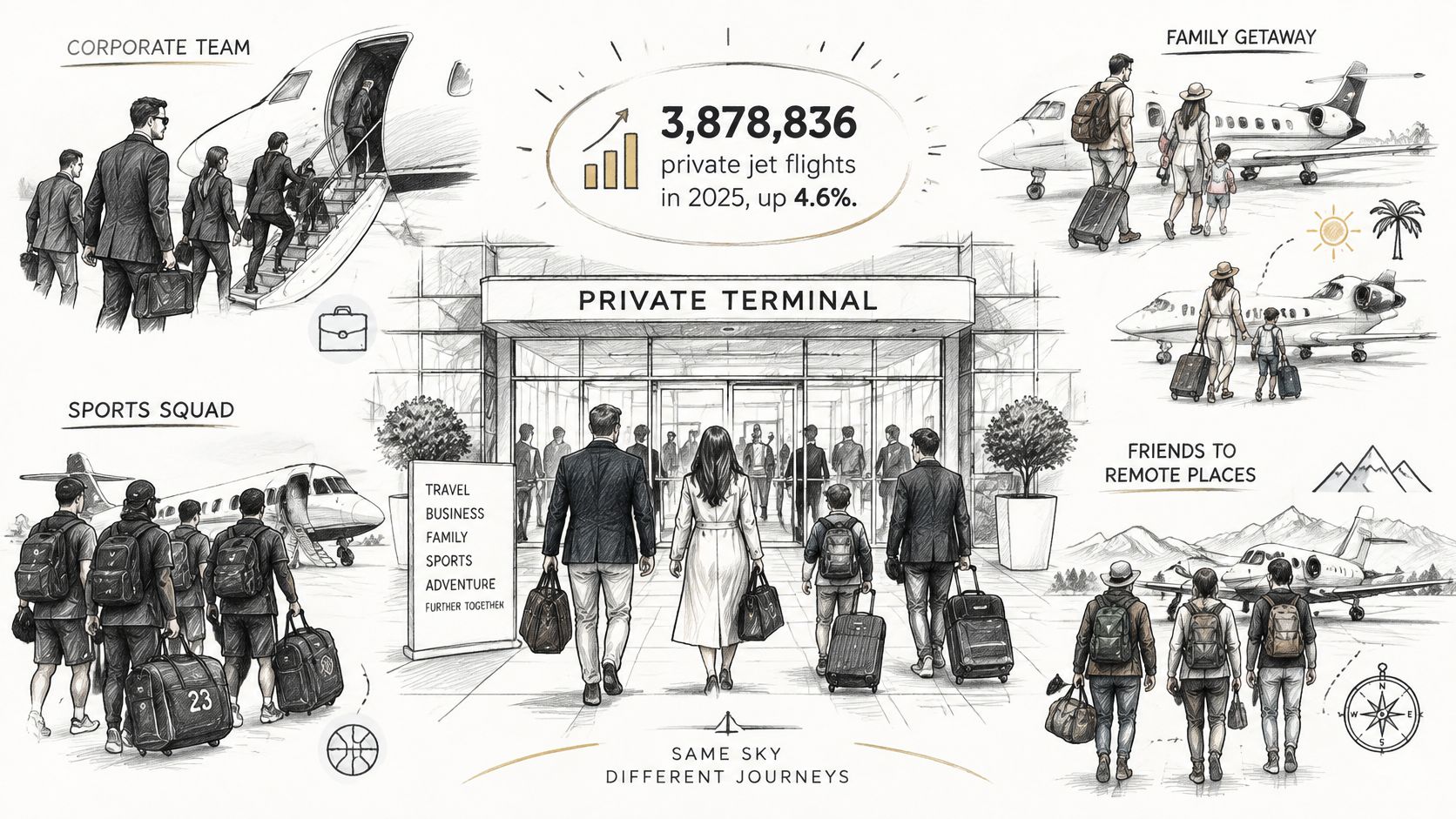
22-person sports squad with equipment bags. Seat count is the easy part; equipment volume on a long leg decides the aircraft. First check: whether a narrowbody charter or a pair of heavy jets fits runway, stand and handling at both ends.
Corporate delegation of nine with 18 bags on a five-hour international trip. Payload and reserve fuel decide, not cabin size. First check: an aircraft-specific payload calculation before committing to a heavy jet over a super midsize.
30-person wedding party with two arrival windows. Alternate airports and ground-transfer times decide the plan. First check: two aircraft on staggered departures, and whether the second arrival still lands inside the venue's timeline.
Medical team carrying equipment. Hazardous-materials declarations and special equipment decide who can fly it. First check: the operator's approved programs, before the aircraft.
The pattern repeats. In each case the binding constraint was airport permission, payload or legality, and in none of them was it the number of seats. That's why the aircraft question comes fourth or fifth in the sequence, not first.
Verify the Operator and Itinerary Before You Book
A signed contract and a tail number on a quote don't make a group charter legal. In the United States, a company may not offer charter air service for compensation or hire unless it holds a valid air-carrier or operating certificate under 14 CFR Part 121, Part 125 or Part 135, and in a conventional charter the certificated carrier retains operational control and carries responsibility for regulatory compliance and flight safety, as the FAA advisory circular on chartering an aircraft explains. Charter operations also carry higher pilot training and certification standards, maintenance procedures and operational safety rules than ordinary Part 91 private flights.
Four checks that decide legality
- The certificate holder's name and status. Compensated passenger transport has to sit with a certificated operator, typically under Parts 119 and 135 for on-demand charter, and Part 119 covers the air-carrier certification itself, per the FAA safe charter operations regulations.
- Who holds operational control. A broker or travel coordinator can manage logistics, but the certificated carrier stays responsible for flight execution, aircraft substitution, crew assignment, maintenance release and irregular operations.
- Whether the aircraft and crew sit under that certificate. An aircraft listed by an owner or an informal operator is not the same thing as an aircraft on the carrier's certificate.
- How international legs meet foreign-equivalent rules. One itinerary can cross several regulatory systems, and each segment has to be authorized on its own terms.
Informal arrangements are where groups get caught. A private pilot may not act as pilot in command of an aircraft carrying people or property for compensation or hire, and expense sharing under 14 CFR 61.113(c) covers only fuel, oil, airport expenditures and rental fees shared pro rata, with a bona fide common purpose and the pilot choosing the destination, per FAA guidance for pilots, owners and operators. A team cannot hire a private pilot and split the invoice.
Regulated cargo is the other quiet failure point. Most Part 135 carriers must maintain an FAA-approved hazardous-materials program, so medical equipment, production materials and team supplies have to be declared before the aircraft is chosen, per FAA hazardous materials guidance for Part 135 operators.
Approved Jets operates as a charter broker and not a carrier, and doesn't own, operate, lease or maintain aircraft. It is an Air Charter Broker under DOT Regulations, operating under Part 295, which is why questions about air transportation, aircraft safety, crew conduct, baggage handling or the onboard experience go to the operator flying the trip. The explainer on aircraft charter brokerage covers where that line sits.
Five confirmations to get in writing
- The operator's certificate and who holds operational control of the flight.
- Aircraft and crew coverage under that certificate, by tail number.
- Airport permissions at both ends and at both alternates.
- Manifest and bags matched to payload with reserve fuel.
- A contingency plan naming who decides on delays, curfews or diversions.
Then send the manifest, the mission window and two airport options to your broker, request a written charter proposal, and verify the operator before you accept any quote. The cheapest line item is worthless if the flight can't legally operate.
Groups don't fail on the aircraft; they fail on the details nobody priced. Approved Jets arranges group charters using heavy jets and airliners sized to the manifest, vets operators through a network of over 1,000 aircraft, and coordinates the ground transport, catering, security and customs paperwork that decide whether the itinerary holds. Send your manifest, date window and two airport options to Approved Jets and let the team come back with a written proposal you can check line by line.