Private Jet Charter New York City: Costs and Booking
Private jet charter New York City guide: pick Teterboro, JFK or LaGuardia, compare aircraft sizes and pricing factors, then book with verified operators.
16 min read

You have a Boston stop early in the day and a Midtown meeting that will not move. A commercial connection means a security line, a gate change, and a car that may sit at a tunnel while the room fills without you. That is when private jet charter in New York City stops being a comfort question and becomes a clock question. The airborne hour is often the easy part. What decides whether you walk in on time is the airport, the aircraft that can use it, and whether a certificated operator is the one flying you. I would score the trip on total door-to-door time, not on which dot sits closest to Manhattan.
Table of Contents
- Choose the Airport That Shortens the Whole Trip
- Why distance misleads
- Matching Aircraft Size to Your Party and Route
- A sizing rule you can apply today
- What Teterboro will and will not accept
- What Sets the Price of a New York Charter
- The lines that move the total
- One illustrative total
- Safety Credentials to Verify Before You Pay
- The file to build before you wire anything
- Red flags that should stop payment
- How to Book a New York Charter Step by Step
- Who does which job
- A morning that starts at 7:00 a.m.
- Ground Transfers and FBO Logistics Around New York
- The Van Wyck problem
- What the FBO changes about the morning
- Confirm the Charter and Lock In Your Flight
- The list to clear before you commit
- Frequently Asked Questions for Business and High-Net-Worth Travelers
- How much notice do you need?
- Is a private jet worse for the environment?
- How should a corporate team record the trip?
- What if the trip changes?
Choose the Airport That Shortens the Whole Trip
Say you leave Boston early and need to be in a Midtown conference room at 7:30 a.m. The map says Teterboro. The clock may say something else if the bridges are jammed, if a runway change stacks arrivals, or if the jet you want cannot use the field. The closest airport on a map is not always the fastest airport on the clock.
Airport | Operating profile | Main constraint | Best fit |
|---|---|---|---|
Teterboro (TEB) | 24-hour tower, three FBOs, about 12 miles from Midtown | 100,000 lb operating weight limit and departure noise rules | Manhattan executive trips with light and midsize jets |
Westchester County (HPN) | Suburban FBOs with lighter traffic | Longer drive to Midtown | Trips starting or ending north of the city |
Newark Liberty (EWR) | Shares airspace with JFK, LaGuardia and Teterboro | Regional congestion and arrival restrictions | Heavier aircraft and New Jersey destinations |
LaGuardia (LGA) | Commercial airport with general aviation access | Slot controls and limited general aviation access | Short Northeast hops |
JFK | International gateway with full customs | Van Wyck congestion and busy airspace | International departures and arrivals |
Morristown (MMU) | Business-aviation focus at a smaller field | Longer drive to Midtown | Corporate trips into northern New Jersey |
Republic (FRG) | Suburban Long Island field | Runway length limits for larger jets | Light jets bound for Long Island |
Long Island MacArthur (ISP) | Long Island field with general aviation access | Longer drive from Midtown | Eastern Long Island and the Hamptons |
Teterboro sits in the Meadowlands, roughly 12 miles from Midtown Manhattan, and it is the default many travelers name first, according to the Port Authority's July 2024 Teterboro presentation. That same report recorded 83,265 aircraft movements from January to June 2024, including 72,930 jet movements (about 87.6 percent of the total) and 2,802 helicopter movements. Total movements rose from 43,890 in 2020, an increase of about 89.7 percent. That volume is why a quote that ignores operating limits is a quote that can slip.
Why distance misleads
The FAA flight deck page for Teterboro describes a 24-hour air-traffic-control airport sitting beneath New York Class B airspace, so pilots need an ATC clearance before they enter or leave that airspace. Cabin size does not clear you. Weight, noise, and sequencing do.
The harder problem is shared sky. The FAA's New York airspace briefing treats JFK, LaGuardia, Newark, and Teterboro as closely spaced airports whose flows interact. A runway change, weather, a shared fix, or miles-in-trail spacing can hold your charter even when the crew and the aircraft are ready. NBAA's point in that same discussion is that approaches, departures, and en-route traffic converge in limited airspace, so the region delays more easily than a single-airport city.
A usable proposal names the planned airport, at least one alternate, the repositioning assumption, and the trigger for switching, such as an arrival restriction or a weather-driven configuration. Westchester, Republic, Morristown, and Newark belong in that comparison whenever the passenger's real door is not Midtown, the jet needs more runway, or customs changes the plan.
Once you are out of the car, the last blocks still matter. Riders who rely on audio navigation for LA Metro riders from Waymap already treat spoken guidance as part of the trip, not an afterthought. Do the same math here. Add drive time, delay exposure, and the walk from the FBO to the meeting, then compare two airports. The lower total wins, even if it is farther on the map.
Matching Aircraft Size to Your Party and Route
Pick the cabin from the mission, not from the brochure photo. Seats, range, and whether the jet can use Teterboro are three different tests, and a pretty hourly rate does not pass any of them.
Category | Typical seats | Typical range | Teterboro fit |
|---|---|---|---|
Light jet | 4-6 | about 1,200-1,500 nm | Easy; well within weight limits |
Midsize jet | 6-8 | about 2,000 nm | Easy; common for Manhattan executive trips |
Super-midsize jet | 8-9 | about 2,800-3,200 nm | Good; check weight and noise on late departures |
Heavy jet | 10-14 | about 3,500-4,500 nm | Confirm actual operating weight is below 100,000 lb |
Ultra-long-range jet | 12-19 | 6,000 nm or more | Needs a performance review; may need an alternate airport |
Those ranges are planning bands, not a promise for a named tail on a hot day with a full fuel load. Treat hourly rates the same way. They are indicative, before fees, positioning, catering, and taxes, and they only become real in a live quote.
A sizing rule you can apply today
Count people, then add checked bags as if they were extra passengers. Measure range against the longest leg, and leave margin for winds and an alternate. Six executives on a New York to Miami trip of roughly 1,100 nautical miles sit comfortably in a midsize jet. A team of nine going New York to London does not. That leg outruns light and midsize categories, so you are in a heavy or ultra-long-range jet, with a performance review before anyone talks about Teterboro.
Practical rule: Choose the smallest category that still has room for the party and enough range for the longest leg plus about a 15 percent margin.
Buying the next size up "just in case" is how empty seats and a rejected airport show up on the same itinerary.
What Teterboro will and will not accept
The Port Authority's Teterboro page is blunt about the surface limit. Aircraft with an actual operating weight above 100,000 pounds cannot use the airport. If the type can exceed that number, the operator must give Airport Operations certification that the actual operating weight is below it.
Departure noise is just as specific. The limit is 80 dB(A) on Runway 24 from 22:00 to 07:00, 90 dB(A) on Runway 24 from 07:00 to 22:00, and 95 dB(A) on Runways 01, 19, and 06 at all times. Non-essential flying is voluntarily discouraged from 23:00 to 06:00 local time. A late-night heavy departure needs both the weight check and the noise check. A midsize jet usually clears both without a debate.
Ask for an aircraft-specific performance look at the temperature, payload, and fuel you actually need. If the numbers fail, move the departure to Newark or JFK rather than trimming bags on the ramp.
What Sets the Price of a New York Charter
The hourly rate is not the price. Two quotes for the same city pair can land far apart because that rate is one line on a longer bill. Peak demand makes the gap wider. NBAA figures discussed in October 2024 showed Part 135 charter activity in September 2024 was 7 percent higher than September 2019, while Part 91 flying was 4 percent below that pre-pandemic month, per the NBAA-BACE newsroom note. Charter demand did not return to the old pattern. It outgrew it, and weekday mornings feel that.
The lines that move the total
- Aircraft category: This is the largest driver of the hourly rate. A heavy jet does not price like a light jet, even on a short hop.
- Positioning: The empty flight to pick you up is usually billed as flight time. A jet parked in Atlanta is not a free jet.
- Minimums: Short hops, such as Teterboro to Boston, often carry a daily or trip minimum that beats a pure hourly sum.
- Airport charges: FBO handling, landing, and parking show up even when the hourly rate looked tidy.
- Trip extras: Catering, ground transport, and crew expenses sit outside the flight-time math.
- International add-ons: Customs, overflight permits, and crew layovers appear the moment the route leaves the United States.
- Timing: Weekday mornings, Friday evenings, and holiday weekends pull the strongest demand and the fewest cheap tails.
- Flexibility: A movable window opens aircraft that are already nearby, which cuts the empty leg.
- Cancellation terms: A cheap rate with a harsh cancel clause is not a cheap trip if the meeting moves.
One illustrative total
Take a midsize jet, Teterboro to Miami, 2.8 flight hours at $4,500 an hour. Flight time alone is $12,600. If that aircraft first flies 1.2 hours empty from Atlanta, add $5,400, and you are at $18,000 before fees, catering, and taxes. These figures are a worked example, not a published tariff. Your quote will differ by tail, day, and operator.
Ask whether the quote assumes a weekday morning, a Friday evening, or a holiday weekend, then price a flexible window beside it before you accept the number.
Request the quote itemized, and compare all-in totals rather than hourly rates. A one-way, an empty leg, or a movable departure is where money comes out. For a fuller line-by-line look, see our guide on how much it costs to charter a private jet.
Safety Credentials to Verify Before You Pay
A charter is legal, and it is as safe as the rules intend, only when a certificated operator flies the aircraft under its approved authority. The broker arranges the trip. The operator carries it. Those are different jobs, and paying the wrong party does not merge them.
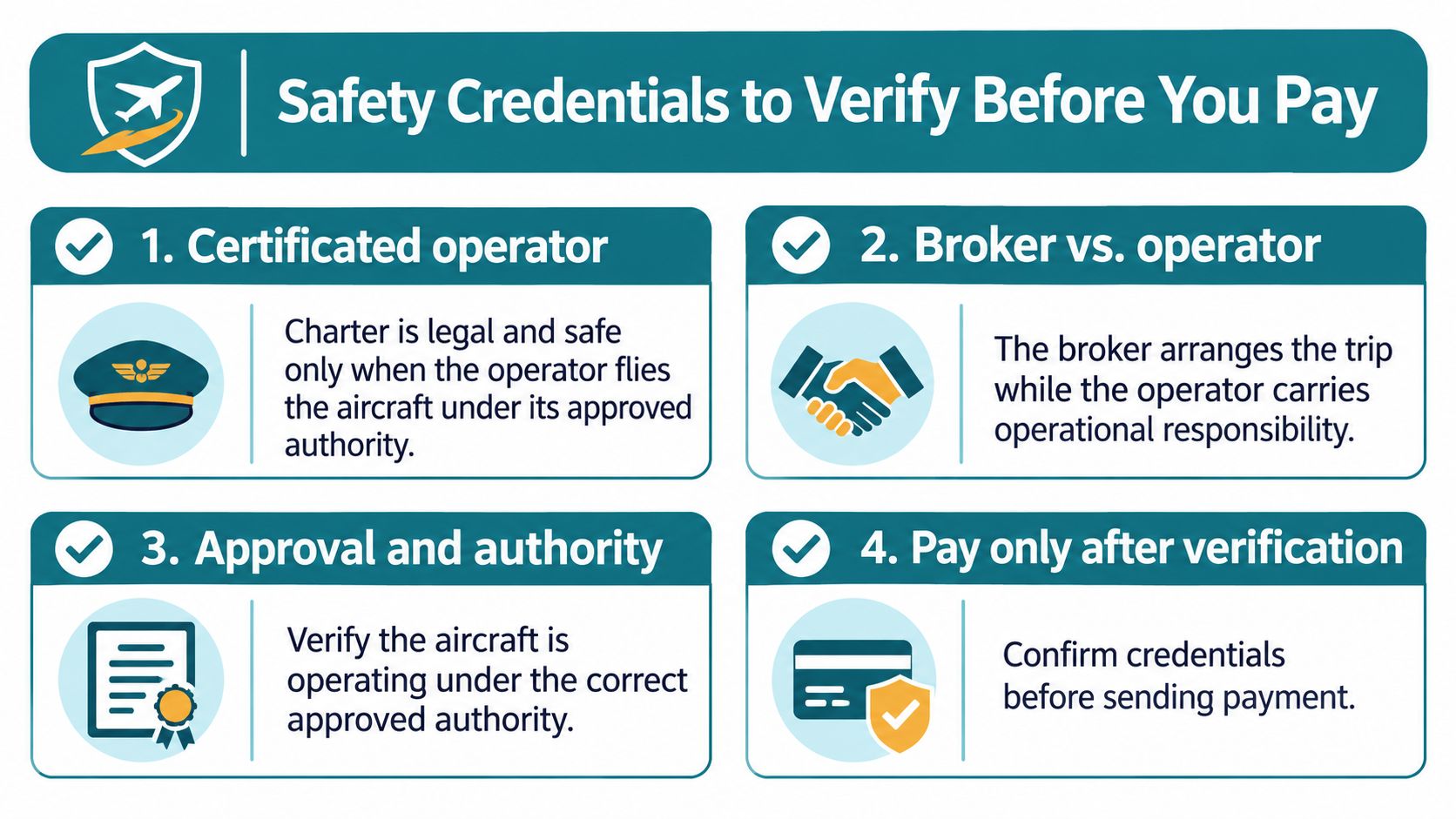
We operate only as a charter broker. We do not own, operate, lease, or maintain aircraft, and we are an Air Charter Broker under DOT rules, Part 295. That registration is not the operator's certificate. The FAA still expects the flight to be conducted by the certificate holder whose authority covers it.
The file to build before you wire anything
- Operator name: The legal carrier, not the marketing brand on the email signature.
- Air Carrier or Operating Certificate: Ask to see it. If the company refuses, walk away.
- Aircraft registration: Match the tail to the quote.
- Authorized category: The operating specs must cover this kind of on-demand flight.
- Crew qualifications: Training and recurrent checks belong to the operator, not to a promise in a brochure.
- Third-party ratings: We prioritize operators with ARGUS Platinum and Wyvern Wingman ratings, on aircraft and crews that meet or exceed FAA Part 135.
- Hazardous-materials program: Required reading if you are moving medical supplies or other dangerous goods.
The FAA's public warning on illegal charters calls them a serious hazard and tells passengers to confirm the aircraft is authorized for charter. The agency's practical test is simple. Ask to see the Air Carrier or Operating Certificate, and choose another operator if it is withheld. Charter sits above a private pilot carrying friends because the rules demand more pilot training, maintenance, operational compliance, recurrent proficiency checks, and more frequent FAA inspection. A deeper look at that stack is in our note on whether private jets are safe.
Red flags that should stop payment
- No certificate: The operator will not show authorization.
- No named carrier: The broker will not say who is flying the trip.
- A swapped category: The aircraft in the confirmation is not the category in the quote.
- Pressure to pay first: Speed is offered as a reason to skip the file.
A corporate travel manager booking a Thursday departure should put the certificate detail, the registration, and the category in a shared file before the deposit moves. Urgent medical, sports, or cargo trips do not get a pass on that step. The pressure to leave is exactly when a bad operator hopes you will skip it.
How to Book a New York Charter Step by Step
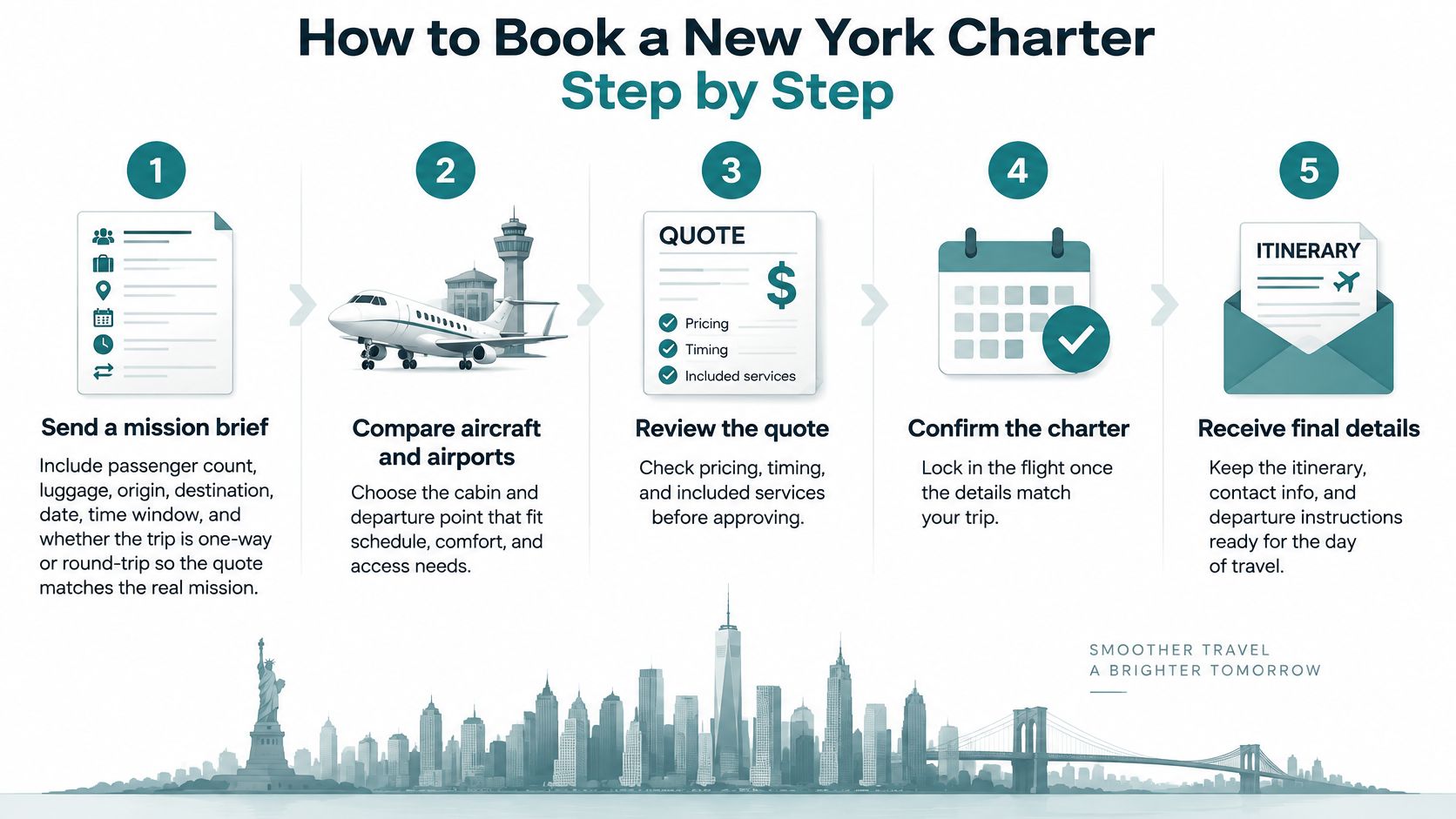
Work the sequence in order. Skipping a step is how a cheap quote becomes a late aircraft.
- Send a mission brief with passenger count, luggage, origin, destination, date, time window, and whether the trip is international, because every later option hangs on that brief.
- Ask for two airport options and one alternate in the same quote, so a runway or weather change does not restart the booking.
- Compare aircraft the broker sources through its operator network, matched to the mission and the bags, not to a generic "midsize" label.
- Verify the operating carrier before you pay, using the certificate, registration, and category file from the safety check.
- Read the itemized quote for positioning, fees, catering, taxes, and cancellation terms, because those lines hold most of the price gap.
- Sign the charter agreement, pay the deposit, and keep the booking confirmation so later changes have a document to amend.
- Send the manifest, passport details, and customs data well before departure, and earlier still on an international leg.
- Confirm the ground transfer and FBO timing the day before, including who meets the car.
- On the day, arrive at the FBO, clear screening, board, and track the flight against the written plan, not against a text thread.
Who does which job
We receive the request, source aircraft and operators through the network, and present options, pricing, and the itinerary. The certificated operator flies the aircraft. That split matters when something on the brief is regulated.
On-demand charter in the United States sits mainly under FAA Part 135, not under airline rules. The FAA's Part 135 hazardous-materials page describes on-demand operations as aircraft with 30 passenger seats or fewer, a maximum payload of 7,500 pounds, or any rotorcraft, with authority written into the operator's specifications. Charter also requires higher pilot training, maintenance, and operational compliance than a private flight, plus regular proficiency checks and more frequent FAA checks of pilots and aircraft. If the New York departure carries valuable equipment or medical supplies, the operator generally needs an FAA-approved hazardous-materials program covering acceptance, transport, and training under 49 CFR Parts 100–185 and the applicable ICAO instructions. Availability is not enough. Scope, crew, and cargo procedure have to match the brief.
A morning that starts at 7:00 a.m.
A 7:00 a.m. departure needs the manifest the evening before, not in the car. If the runway is JFK and the pickup is Midtown, the car is an early-morning booking, not a rideshare ordered at the curb. Approve nothing that is not confirmed in writing. A verbal "we're set" does not hold a tail, a slot, or a cancellation term.
Ground Transfers and FBO Logistics Around New York
A 25-minute flight becomes a 90-minute journey when the ground leg hits peak traffic. That is the gap between wheels-down and the door you care about.
Airport | Typical drive to Midtown | Traffic risk | Notes |
|---|---|---|---|
Teterboro (TEB) | 20-40 minutes | Moderate at tunnel and bridge approaches | Three FBOs and a short ground leg |
LaGuardia (LGA) | 25-50 minutes | High at peak hours | Fast in light traffic, unreliable at rush hour |
Newark Liberty (EWR) | 30-60 minutes | Moderate to high | Tunnel and turnpike access |
JFK | 45-90 minutes | High, due to the Van Wyck bottleneck | Longest ground leg, full international customs |
Westchester County (HPN) | 50-90 minutes | Moderate | Suburban route with variable traffic |
These drive bands are planning ranges for a normal day, not a guarantee at 8:00 a.m. on a Friday.
The Van Wyck problem
New York State, in the Port Authority's 2025 airport traffic report materials, identifies the Van Wyck Expressway as a major bottleneck for JFK passenger and cargo access, with more than $2 billion in improvement work underway. Construction does not shrink your meeting. If the flight is international and JFK is the right field for customs and runway, budget the ground leg as the long part of the day. If the flight is domestic and the door is Midtown, that same expressway is a reason to look at Teterboro or Newark before you lock JFK.
What the FBO changes about the morning
A fixed-base operator is not a commercial terminal with a shorter line. You get private check-in, security screening, and fueling on the ramp. On an international arrival, customs coordination happens there too, which changes how early you should be on site. You do not need two hours. You do need a buffer that survives a slow bridge.
For a 9:00 a.m. wheels-up at Teterboro, a Midtown car should leave around 7:45 a.m. so you are at the FBO by 8:30 a.m. with room to spare. For a 9:00 a.m. JFK departure, leave closer to 6:30 to 7:00 a.m., and treat the later end of that window as the optimistic case.
Book a car with a meet-and-greet, share the flight and tail number, and agree a pickup window with the driver before the night prior. Our note on door-to-door transport service walks through how that handoff is coordinated with the aircraft, rather than left as a separate errand.
- Pickup point: Name the lobby or the FBO door, not "the airport."
- Driver contact: Put a phone number in the same file as the tail number.
- Luggage: Tell the driver about golf bags, garment bags, or medical cases before the curb.
- Backup car: Have a second option if FBO timing slips and the first driver has to leave.
Confirm the Charter and Lock In Your Flight

Book private when the hours you save, multiplied by what that hour is worth, beat the premium over a commercial ticket. An executive who gets three hours back on a Chicago round trip often covers a midsize jet on a short sector and still has the morning intact. If the hours are not worth the premium, fly the airline and stop negotiating with yourself.
The list to clear before you commit
- Airport: Chosen, with a named alternate and a written trigger for the switch.
- Aircraft: Sized with margin for bags and for the longest leg, and cleared for the field.
- Quote: Read in full, including positioning and the cancellation terms.
- Operator: Certificate checked and recorded with the registration and category.
- Ground: Transfer confirmed, with a backup if the FBO time moves.
A corporate travel manager should write that file into every trip so the next booking does not start from zero. A traveler arranging one trip only needs the brief and the certificate. Either way, do not approve a flight that exists only in a phone call.
You can get a personalized proposal from our flight advisors or through the Get a Quote option. Advisors are available 24/7 for immediate charters at +1 (866) 678-1411, and the same desk answers at charter@approved-jets.com. Send the mission brief, and ask for the operator certificate before any payment.
The short video below shows how a coordinated charter day is supposed to feel once the airport, the aircraft, and the car are already decided.
Frequently Asked Questions for Business and High-Net-Worth Travelers
How much notice do you need?
Lead time follows aircraft availability and airport conditions, not a fixed calendar rule. Ask for the earliest feasible departure in the first quote instead of assuming a same-day flight will be there. A movable window usually beats a same-hour demand on price and on choice of tail.
Is a private jet worse for the environment?
An investigation citing the Institute for Policy Studies reported that private jets emit about 10 times more pollutants per passenger than commercial aircraft, as covered by the Democrat and Chronicle. That multiple moves with occupancy, aircraft type, stage length, empty repositioning, and the commercial trip you would have taken instead. Model the specific route before you treat one number as your footprint, and separate a mission you cannot do any other way from a discretionary leisure leg.
How should a corporate team record the trip?
Keep the verification file, the itemized quote, and the booking confirmation together, and include the passenger count and the route so the trip can be reported later. A folder that only holds a credit-card receipt will not answer an audit or a board question.
What if the trip changes?
Read the cancellation terms in the itemized quote and confirm which costs apply before anyone moves the day. A change after the crew is positioned is a different bill from a change the week before.
Approved Jets arranges on-demand private jet charter in New York City by matching your brief to a certificated operator and coordinating the airport, the aircraft, and the ground leg as one trip. If the next morning depends on a Boston stop, a Miami leg, or a longer international departure, send the details and ask for the operator certificate before you pay. Visit Approved Jets to request a written proposal.