Pet Plane Travel: A Step-by-Step Guide for Private Flights
Pet plane travel explained: pick a pet-friendly operator, meet crate and health certificate rules, and time paperwork so your dog or cat flies safely.
13 min read
More than 2 million pets and other live animals are transported by air in the United States each year, according to the American Veterinary Medical Association, citing Department of Transportation data. That's a transportation operation, not a passenger amenity. The count includes animals beyond household pets, but the planning lesson is clear: an available aircraft doesn't automatically mean an animal can make the journey.
For private flights, the right starting question is whether the complete itinerary works for your pet. Pet plane travel is a route-level go or no-go decision involving the animal's health, aircraft acceptance, transit rules, destination entry requirements and document deadlines.
Table of Contents
- Which Travel Route Fits Your Pet
- Calming an Anxious or Senior Pet for the Flight
- Rehearse the journey before departure
- Vet the Operator and Carrier Before You Pay
- Ask these questions in order
- Crate and Welfare Limits Operators Check
- Check the pet, crate and aircraft together
- Step-by-Step Timeline From Booking to Wheels-Up
- Build the sequence around your destination
- Keep failure points in one checklist
- Ground Transfers, Customs and Arrival Logistics
- Follow the animal from departure to the final address
- Plan for problems without expecting them
- Confirm Your Pet's Route Before You Pay a Deposit
- Separate booking speed from preparation time
Which Travel Route Fits Your Pet
Start by choosing how your animal will travel, rather than choosing an aircraft and trying to fit the pet into the booking afterward. We match flights to registered Part 135 operators or foreign equivalents, but the operating carrier decides whether the animal is accepted aboard.
Government permission and cabin permission answer different questions. The FAA's guidance on flying with pets leaves cabin acceptance to individual airlines; owner-accompanied cabin pets generally fall outside Animal Welfare Act transportation regulation, while destination entry law remains a separate requirement.
Pet travel routes on private flights
Route | Where the pet rides | Who sets the rules | Best fit |
|---|---|---|---|
Owner-accompanied cabin | In the cabin, with the owner | Operator and aircraft policy, with FAA leaving acceptance to carriers | Small, calm dogs and cats that stay in a carrier |
Crated aboard in a designated area | Secured in a crate in an area the operator designates | Operator, carrier and aircraft limits | Larger animals the operator can safely stow |
Pet transport company shipment | Shipped as cargo with a transport provider | Transport provider, carrier and USDA APHIS rules | Long-distance moves where the owner isn't on the aircraft |
Service animal | In the cabin with a handler | Disability travel rules and carrier policy, separate from pet policy | Trained assistance animals with the required documentation |
Say a 6 kg terrier is flying privately from New York to London. The operator might accept the dog in the cabin, yet the journey can still fail if its entry paperwork doesn't match the arrival arrangements. Cabin eligibility isn't permission to cross a border.
The illustration captures the different preparations that need to come together.
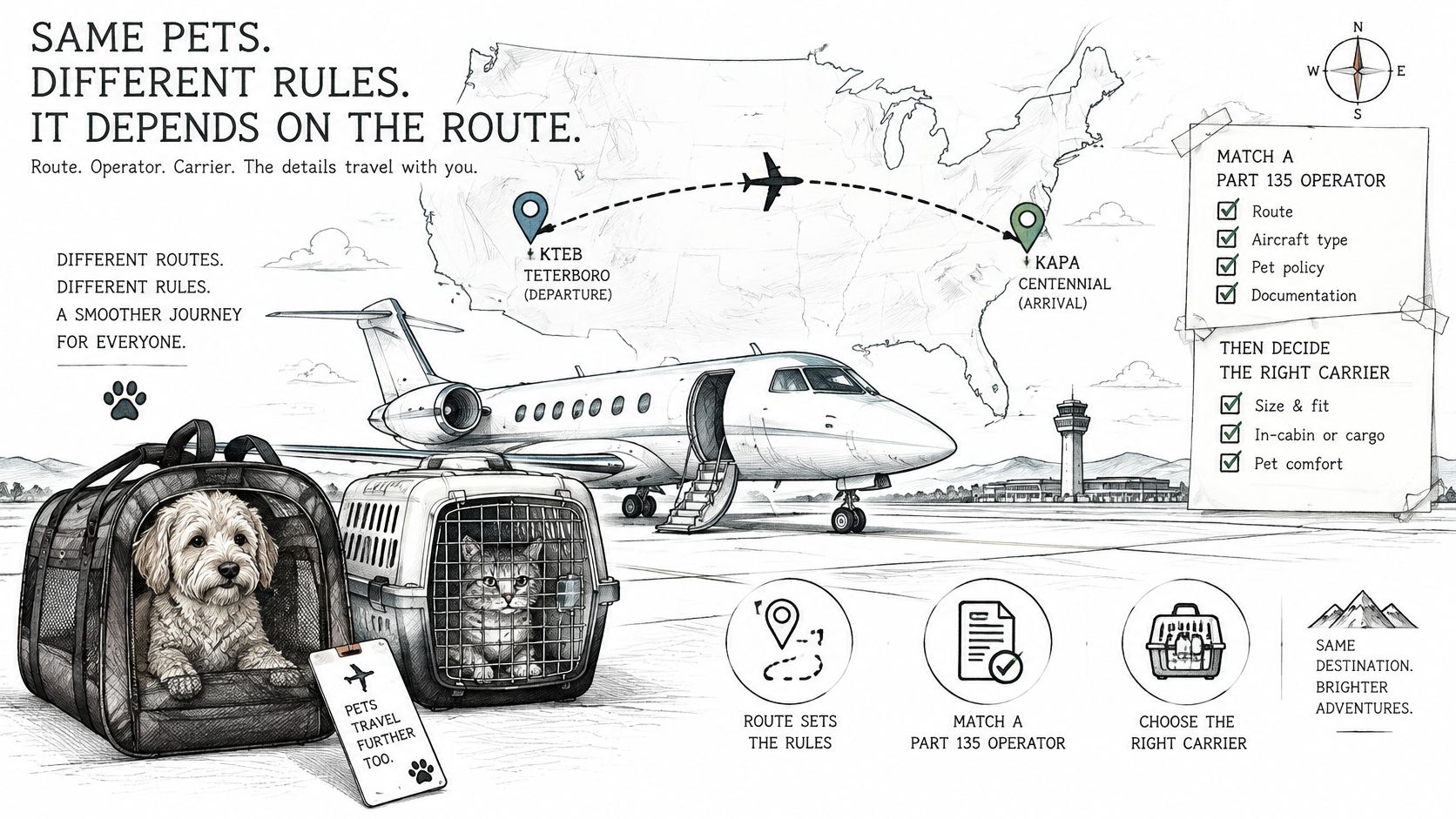
Route-first rule: Choose the transport category, then test the operator, paperwork and destination for that category.
Compare the cost considerations for flying with a pet after identifying a workable route. For a small, settled pet, test owner-accompanied cabin travel first. For a larger animal, begin with the operator's secure-crate arrangement; for an unaccompanied relocation, investigate a transport-provider shipment.
Calming an Anxious or Senior Pet for the Flight
A flat-faced dog may have complete paperwork and an accepted carrier, yet still face a problem if its route includes a hot ground stop. A veterinarian may recommend changing the itinerary because the animal's fitness depends on the conditions along the way, not just at departure and arrival. Paperwork can be in order while a particular route remains unsuitable.
That distinction matters for senior animals and reactive pets, too. Eligibility is an administrative decision. Fitness to fly is a veterinary and welfare decision, and both must line up for the whole route.
Pet profiles that need extra planning before flying
Pet profile | Risk to discuss | Preparation to raise with your vet |
|---|---|---|
Brachycephalic breeds (flat-faced dogs and cats) | Airway strain and heat stress, generally higher risk | Pre-flight assessment and a clear heat plan for each stop |
Senior animals | Lower tolerance for stress, temperature change and long connections | Pre-flight exam and a nonstop or shortest route where possible |
Anxious or reactive pets | Stress, self-injury or crate escape | Crate rehearsal and calming plan; sedation only on vet advice |
Puppies and kittens below the age limit | Not eligible under the transport age rule | Wait until eligible and confirm the operator's cutoff |
Healthy adult, crate-trained | Lower baseline risk | Standard documentation and a crate check at the gate |
Rehearse the journey before departure
Start short carrier sessions at home, using two to three weeks as a practical training target rather than attempting one long session just before departure. Leave the carrier open and reward voluntary entry. Then add brief closures, carrying, and a practice car ride. A familiar blanket or worn T-shirt may help, provided your pet will not chew or swallow it.
Arrange a veterinary assessment before the flight and appropriate gentle exercise before departure. Do not sedate your pet unless its veterinarian prescribes it for that animal and the operator accepts the plan. If car sickness could complicate the airport transfer, read about nausea treatments for dogs to help prepare questions for your vet, not to choose medication independently.
Many travelers feel unsure about pet eligibility, airline policies and the overall process. For an anxious or senior pet, turn that uncertainty into specific checks: ask whether the animal can travel in the planned cabin arrangement, consider how each transit stop affects its comfort, and confirm that its health and paperwork fit the entire itinerary.
Long connections can add confinement, handling and temperature changes. If your vet identifies a breed or health concern, compare suitable route options, such as a nonstop or cabin-based journey, or a professionally coordinated route. If no suitable itinerary is available, postponing travel may be the safer choice.
Vet the Operator and Carrier Before You Pay
Approved Jets is a broker, not a carrier. All flights are operated by registered Part 135 operators or foreign equivalents, which we require to meet FAA standards and our internal requirements. Claims concerning air transportation, aircraft safety, crew conduct, baggage handling or the onboard experience must be directed to the applicable operator.
Tell your flight advisor about your pet before aircraft selection. We can then check whether the proposed aircraft accommodates the animal, rather than discovering a restriction after you've committed.
Ask these questions in order
- Does this specific tail number accept pets, confirmed in writing for this date?
- Is the registered Part 135 operator or foreign equivalent named on the quote?
- Which third-party safety ratings does the operator hold, such as ARGUS Platinum or Wyvern Wingman, and can it provide proof?
- Has the carrier accepted this animal in writing before the deposit?
- Will the pet ride in the cabin or a designated area, and what crate standard applies?
- What pet fees and cancellation terms apply, itemized?
Operator questions and what a strong answer looks like
Question to ask | Why it matters | Strong answer |
|---|---|---|
Does this specific aircraft accept pets? | Acceptance is aircraft-specific | Yes, confirmed in writing for this tail number and date |
Is the operator a registered Part 135 operator or foreign equivalent? | Establishes the regulatory baseline | Yes, with the operator named on the quote |
Which third-party safety ratings does the operator hold? | Provides an independent assessment beyond broker requirements | Names ratings such as ARGUS Platinum or Wyvern Wingman, with proof |
Has the carrier accepted the animal in writing? | Carrier rules can add requirements beyond national law | Written confirmation before deposit |
Is the pet in the cabin or a designated area? | Determines crate arrangements and animal access | Clear placement and the required crate standard |
What fees and cancellation terms apply to the pet? | Avoids unexpected charges | Itemized fees and a stated cancellation window |
The U.S. Department of State's international pet-travel guidance says airlines typically require health certificates no older than 10 days, even where the destination accepts older certificates. CBP and USDA also caution that carriers maintain additional policies.
Compare answers, not reassuring descriptions. A provider offering written aircraft acceptance and clear cancellation terms gives you something actionable; a verbal assurance that pets are welcome doesn't.
If an answer affects whether your pet can board, get it in writing before paying.
Crate and Welfare Limits Operators Check
Welfare and crate limits for pets in transport
Requirement | Limit or rule | Who sets it |
|---|---|---|
Minimum age for dogs and cats | At least 8 weeks old and weaned for at least 5 days | U.S. Department of Transportation guidance |
Food interval for older animals | At least every 24 hours | USDA and DOT guidance |
Water interval for older animals | At least every 12 hours | USDA and DOT guidance |
Food and water for puppies and kittens | Required when in transit for more than 12 hours | DOT guidance |
Temperature exposure | Avoid above 85°F (29.5°C) or below 45°F (7.2°C) for more than 4 hours | USDA guidance |
Crate construction | Minimum size, ventilation, strength, sanitation and safe handling | DOT guidance, with aircraft acceptance checked by the operator |
These limits follow USDA and DOT transport guidance. Confirm the current requirements with the operator and your veterinarian before travel. Cabin pets may be subject to different arrangements, so don't assume the table sets a universal cabin policy.
Check the pet, crate and aircraft together
A crate that suits your pet must also fit the aircraft and its approved placement. Your pet should be able to stand naturally, turn around and lie down comfortably. Check the door latch, fasteners, ventilation openings and absorbent floor lining. Secure water fittings so they remain accessible without creating an escape opportunity.
For example, a 9 kg dog may fit comfortably in its crate, while the crate itself cannot pass through the selected aircraft's doorway or fit safely in the cabin. The operator can refuse it even if its size works for the dog. Choose another aircraft or approved placement rather than using a smaller enclosure that restricts the animal.
- Photograph the setup: Send clear pictures of the assembled crate, its door and ventilation, and your pet standing inside.
- Measure the exterior: Include projecting handles, wheels and attached bowls, then compare the measurements with the operator's sizing note.
- Screen every ground stop: Check private-airport facilities, expected ramp time and seasonal heat or cold.
- Assign care responsibility: Agree who provides water, checks the animal and records any feeding during handovers.
Weather planning must include the airport transfer and waiting period, not only time in the air. Ask what temperatures are expected at each stop and where your pet will wait if departure is delayed. The published exposure limits are not comfort targets. A vulnerable pet may need a more protective plan, so consider the full route, including ground stops, when deciding whether the trip is suitable.
Step-by-Step Timeline From Booking to Wheels-Up
Count backward from both departure and arrival. The USDA APHIS guidance for accredited veterinarians notes that international preparation can take several weeks to many months; Morocco illustrates narrow windows, with issuance within five business days of export, endorsement within three calendar days, final inspection within 24 hours of departure and endorsed-certificate validity of three calendar days.
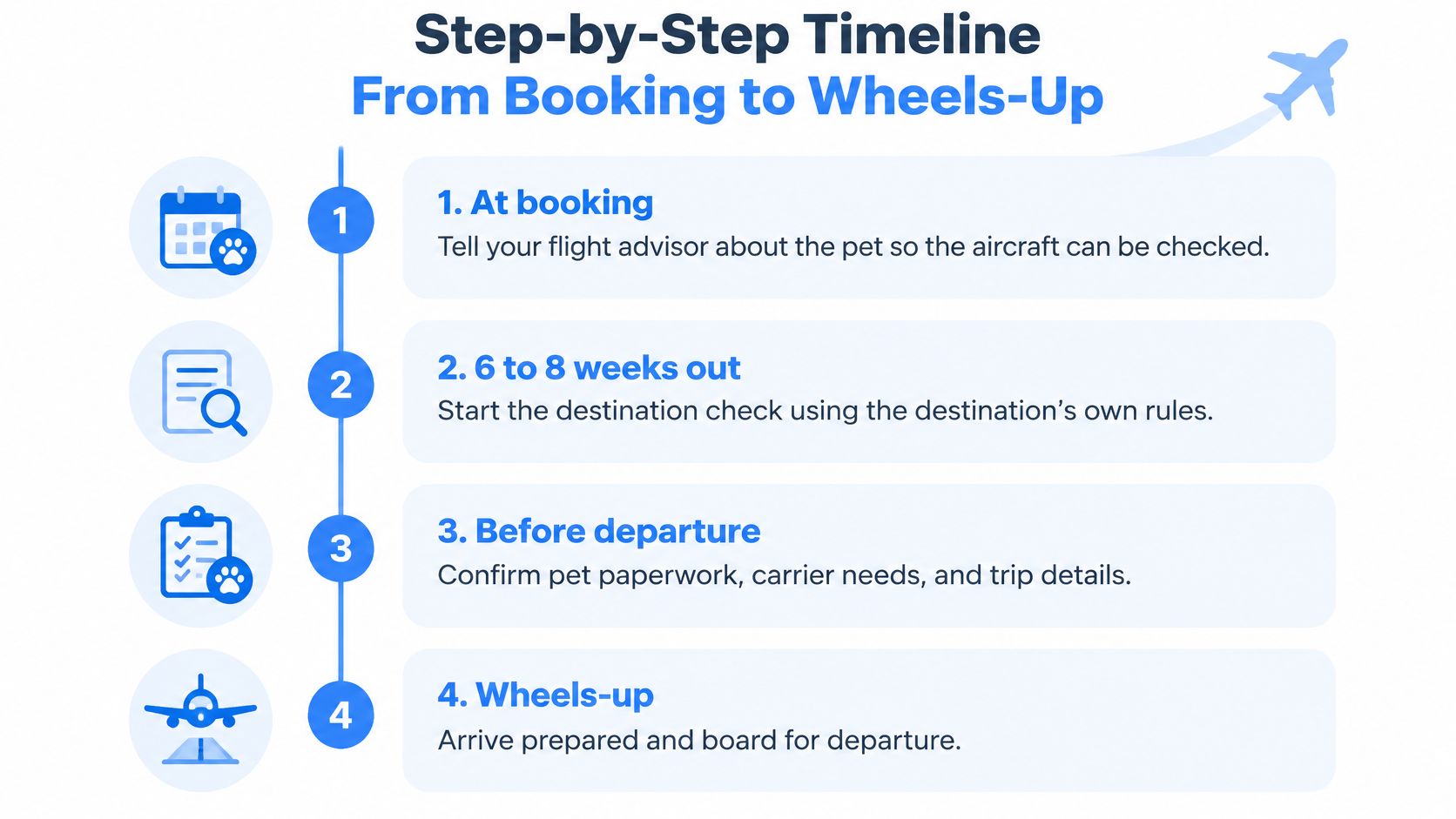
Use the visual timeline as a planning outline, not a substitute for destination-specific deadlines.
Build the sequence around your destination
- Declare the pet at booking. Give your flight advisor the animal's details so we can check aircraft accommodation.
- Start the destination review early. A six-to-eight-week planning checkpoint can be useful, but it isn't a guarantee that preparation will fit. Include transit countries and the return journey.
- Verify identity before vaccination. Have the veterinarian scan the microchip and reconcile its number across records.
- Confirm vaccine validity and the applicable waiting period before fixing a nonrefundable departure.
- Schedule tests and treatments. Use a USDA-accredited veterinarian or the appropriate equivalent, with the destination's certificate format available.
- Obtain the operator-accepted crate and confirm the pet's movement reservation.
- Arrange certificate issuance and endorsement. We handle customs paperwork for international pet flights; veterinary certification and government endorsement still require the appropriate professionals.
- Audit the documents before departure. Keep separate fields for issuance, endorsement, examination and permitted arrival.
- Complete the terminal check. Inspect the animal, label, water access and original documents before boarding.
Document and treatment timing windows
Step | Timing window | Why it matters |
|---|---|---|
Health certificate for airline acceptance | Issued within the carrier's certificate-age limit | Carrier acceptance can be stricter than destination law |
Morocco certificate (narrow example) | Issuance, endorsement, examination and validity windows must all align | Separate clocks govern the same journey |
Microchip and rabies vaccine order | Chip implanted before or at the same time as vaccination | Incorrect sequencing can require revaccination |
Rabies waiting period for applicable UK- and EU-linked journeys | 21 full days after first vaccination, counting the next day as day one, under the UK pet-travel framework | Premature travel can make the pet ineligible |
UK tapeworm treatment for dogs from the U.S. | Between 24 and 120 hours before entry, according to USDA's Great Britain entry guidance | Treatment must match actual arrival |
Pre-departure document audit | Schedule well before wheels-up, leaving time for corrections | Identity and date errors need resolution before boarding |
For example, a London arrival at 18:00 Friday places the dog's treatment appointment between 18:00 Sunday and 18:00 Thursday. Have the veterinarian confirm the calculation against the official certificate.
Keep failure points in one checklist
Check for a chip-number mismatch, vaccination recorded before chip implantation, an expired booster, mistimed tapeworm treatment and a crate accepted for entry but rejected by the carrier. Keep scans available, but carry originals.
Our pet-travel requirements guide can support the planning conversation. We recommend arriving at the private terminal, or FBO, 15 to 30 minutes before departure, where the pilot greets passengers and escorts them to the aircraft; confirm whether pet formalities require an earlier arrival.
Use this video alongside the written itinerary and document checklist.
Ground Transfers, Customs and Arrival Logistics
A pet-friendly flight isn't a complete transport plan. The car, terminal handover, border inspection and final drive all need named responsibilities, especially when an assistant or travel manager is coordinating on the owner's behalf.
We coordinate ground transport and customs with the operator. Confirm who will meet the aircraft, where the pet must remain during inspection and when the onward driver should arrive.
Follow the animal from departure to the final address
- Book the departure vehicle. Specify that an animal is traveling, confirm space for the assembled crate and arrange a suitable restraint. Allow for a water or toilet stop without disrupting the terminal handover.
- Prepare the inspection pack. Keep the original certificate, microchip record, vaccination evidence and any import permissions accessible, not buried in luggage.
- Recheck arrival eligibility after a delay. Ask the veterinarian or entry authority whether the revised landing remains inside treatment and certificate windows. Don't assume a flight delay extends permission.
- Confirm the onward vehicle before landing. The driver needs the correct terminal, crate dimensions and permission to carry the animal.
- Monitor recovery after arrival. Offer a quiet environment, follow the veterinary feeding and hydration plan, and watch breathing, gait, alertness and toileting during the first day.
Say a Friday evening arrival moves to Saturday. That change shifts the treatment calculation, but it doesn't automatically mean the treatment must be repeated. The veterinarian should check the actual appointment against the revised entry time and decide what action is necessary.
Assign a person to recheck the pet's eligibility whenever the arrival time changes.
Plan for problems without expecting them
Identify a local veterinary clinic and an out-of-hours option before departure. Ask about local bite-reporting and quarantine procedures, and keep medication instructions with the animal's records. Persistent breathing difficulty, collapse or marked distress warrants urgent veterinary attention rather than waiting for the pet to settle.
For the final transfer, check that the vehicle is temperature-controlled before loading. Avoid leaving a crated animal in a parked car while passengers finish customs or collect bags.
Request an itemized itinerary showing customs handling, ground transport, pet fees and crate costs separately. Our door-to-door transport coordination helps align those handovers, but the written plan should still identify who is responsible at every stage.
Confirm Your Pet's Route Before You Pay a Deposit
Don't commit until the complete route has written clearance. Aircraft availability alone isn't enough, and a flexible departure time won't fix a vaccination sequence or an unsuitable transport arrangement.
Your go or no-go check should establish:
- Pet suitability: The planned journey fits the animal's health, behavior and care needs.
- Aircraft acceptance: The operating carrier accepts this animal on the identified aircraft.
- Document alignment: Certification, treatments and entry permission remain valid for the planned movement.
- Crate compatibility: The operator accepts the enclosure and its intended placement.
If any item is missing, pause the deposit and resolve it. A clear refusal is more useful than an ambiguous assurance because it tells you what must change.
Separate booking speed from preparation time
Booking with 24 to 48 hours of notice gives our customers the widest aircraft selection and room for highly specific catering or logistical requests. That isn't a pet-import preparation period. A complex international journey may require substantially more lead time before an aircraft can be booked responsibly.
Our quotes are estimates and can change with aircraft availability, fuel costs, positioning, landing fees, overnight charges, de-icing, catering and ground transportation. Ask for those items to be distinguished from the pet fee and confirm the applicable cancellation terms.
Send your pet's age, breed, weight, destination and planned date, along with relevant health or behavior concerns. Request a written route check before committing, including operator acceptance, document responsibilities and the ground-transfer plan.
We help match travelers with pet-friendly operators, confirm aircraft accommodation and coordinate international customs paperwork and ground transfers. Visit Approved Jets with your pet's details and proposed itinerary to begin a written route check before you book.
Updated