Aircraft Maintenance Programme: What It Must Cover
Learn how an aircraft maintenance programme sets tasks, intervals, records and urgent AD changes, plus who stays responsible when work is outsourced.
18 min read

The advice you hear most often about an aircraft maintenance programme is to keep it current. Review it annually, get the revision signed, file it where the auditor can find it, and the subject is closed. It's popular advice because it's easy to satisfy and easy to prove you satisfied it.
It also misses the part that grounds aircraft. A current document proves that somebody edited a document. It doesn't prove that a new life limit was compared against this aircraft's configuration, that a task threshold doesn't fall due before the paperwork deadline, or that the shortest applicable authority window was used.
A freshly stamped programme doesn't tell you:
- Configuration: whether a modification, a swapped component or a pending service bulletin changes which limits apply to this tail number.
- Utilisation: whether a season of short sectors brings a cycle limit forward before the revision date arrives.
- Deadline: whether a domestic authority shortened a foreign revision window from months to weeks.
- Effectiveness: whether three repeat write-ups on the same system changed a task or just produced three repair invoices.
The definition itself is simple enough. A programme is a controlled system that states what maintenance must be performed, how often, and how its effectiveness is monitored. Under the European continuing-airworthiness framework it must include the frequency of all required maintenance, repetitive airworthiness directives and the Airworthiness Limitations Section. That's the document. Compliance is a separate question, and it's answered on the tail number, not on page one.
Two people usually need this answer in the same conversation. A flight department manager needs to know whether the schedule is defensible. A charter broker needs to know whether the aircraft on the quote is ready to fly. Both are asking the same thing: has every directive and every life limit been checked against this aircraft, its utilisation, and the shortest deadline that applies to it.
Table of Contents
- Which Clock Makes Each Task Due
- One Aircraft on Three Different Clocks
- Why Progressive Inspection Is Not a Free Pass
- Tasks Records and Mandatory Items
- One Component, Four Intervals
- The Items That Cannot Be Optional
- Records Are the Proof, Not the Filing Cabinet
- When a Directive or Software Disagrees With the Programme
- The Deadline Isn't Always the One You Expected
- Four Checks on One Tail Number
- Five Steps When the Software Disagrees
- How Reliability Data Rewrites Intervals
- What MSG-3 Actually Asks
- The Data That Feeds a Revision
- The Annual Review as a Real Test
- Owner-Managed or Contracted Control
- The Duty That Doesn't Transfer
- A Short Audit Scene
- What Pushes Maintenance Cost Up
- The Labour Number to Budget Against
- What Moves a Private Invoice
- A Planning Habit That Works
- Check the Programme Before You Dispatch
Which Clock Makes Each Task Due
An annual checklist isn't a programme. It's one line inside one. An aircraft maintenance programme is the controlled schedule covering the whole aircraft, and every task on it becomes due on whichever measurable parameter arrives first, not on a single anniversary date. The FAA advisory circular on developing an approved programme sets out the parameters an operator can use: time in service, engine or component operating hours, calendar time, and the number of aircraft or engine cycles. A programme can use one of them or several at once, and most do.
Parameter | What it counts | Typical task | Hits first when |
|---|---|---|---|
Time in service | Aircraft flight hours | Airframe inspections and many ICA tasks | Utilisation is high |
Engine or component hours | Operating time of that unit | Engine, APU and component tasks | Unit time differs from airframe time |
Calendar time | Days or months regardless of flying | Emergency equipment, corrosion, batteries | The aircraft flies little |
Aircraft or engine cycles | Takeoffs, landings or engine cycles | Landing gear and cycle-limited structure | Sectors are short and frequent |
Progressive inspection | Items spread through the year | Complete aircraft coverage inside 12 months | The operator wants to avoid one long grounding |
Read the table as a sorting exercise. Each task gets one primary clock, and the other three act as backstops that can arrive without warning.
One Aircraft on Three Different Clocks
Take a midsize jet on a short-sector charter pattern, 40-minute hops with eight or ten landings a day. The landing-gear inspection is counted in cycles, so it comes due while the airframe total still looks modest. The emergency equipment rides the calendar, so the same aircraft reaches a replacement date that has nothing to do with how much it flew. The engine task follows engine hours, and those won't match airframe hours if the engine runs on the ground or the unit was changed at the last shop visit.
Move that aircraft to a corporate account flying two long transatlantic legs a month. Cycles slow down, hours climb, and the same programme produces a completely different order of work. Nothing on the document changed. The utilisation did.
Why Progressive Inspection Is Not a Free Pass
The FAA permits progressive inspections, where individual inspection items are distributed across the year rather than completed in one visit, provided the complete aircraft is inspected within every 12-month period. That structure shortens long grounding events and keeps a working aircraft closer to availability.
It only works when hours, cycles, calendar dates and completion status are all current in the same system. Spread items across a year with sloppy records and you don't get progressive inspection. You get gaps nobody can see until an auditor or a buyer asks which items were signed in which window.
The practical rule is to list every task against the parameter that will expire first for this tail number. An anniversary date is a filing habit, not a maintenance limit.
Tasks Records and Mandatory Items
"Annual" and "engine check" are labels. A label tells you roughly what happens in a hangar. It doesn't tell you what's due. EASA's AMP guidance and compliance checklist expects task-level definitions covering the periods or frequencies at which components are checked, cleaned, lubricated, replenished, adjusted, tested, overhauled or replaced (EASA AMP compliance checklist).
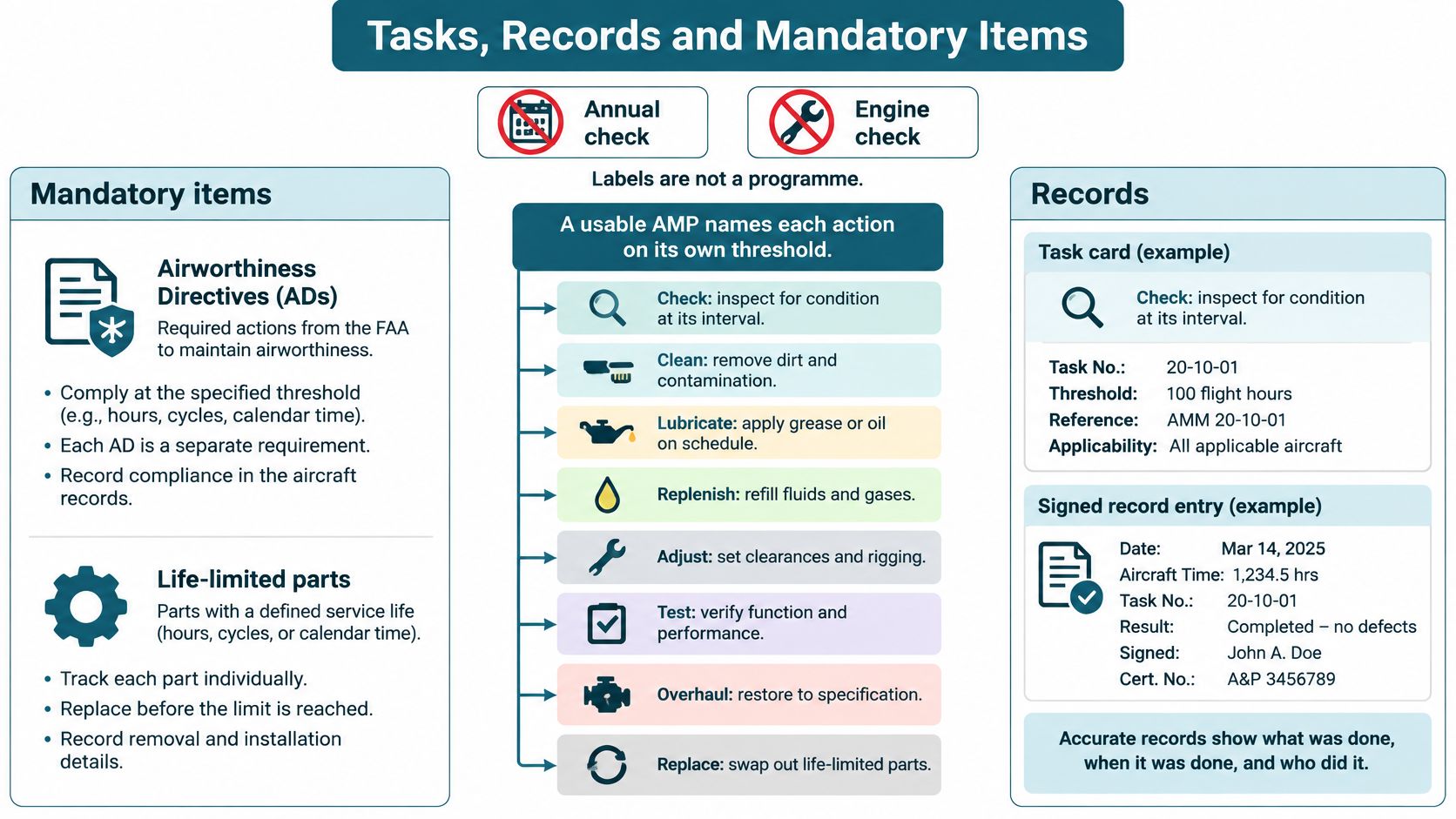
That granularity matters because one part can carry several clocks at once.
One Component, Four Intervals
Take a hydraulic actuator. It might need lubrication every 100 flight hours, an operational test every 12 months, an overhaul after a defined number of cycles, and replacement at a life limit. Four actions, four drivers, one part, and each interval recorded and controlled on its own line. Collapse them into "actuator check" and you've lost the ability to prove which one was met.
The same checklist asks the programme to state its own periodic review frequency and any additional deviation, which gives an auditor a traceable link between the schedule you chose and the approved or declared basis behind it.
The Items That Cannot Be Optional
Some work doesn't belong to a review cycle at all. It belongs to every flight.
- Repetitive airworthiness directives: each appears as a controlled line with its own threshold and its own compliance record.
- Airworthiness Limitations Section items: life limits and mandatory tasks the programme must incorporate, not summarise.
- Instructions for Continued Airworthiness: the manufacturer basis for the schedule, or for smaller EASA Part-ML aircraft, the Minimum Inspection Programme framework.
- Open defects and deferrals: a discrepancy found on a trip stays visible until it's cleared or deferred under an approved procedure. It doesn't dissolve into the next inspection.
If a task can't be done inside its limit, postponement follows a procedure agreed with the competent authority. A message in a group chat isn't a postponement. It's an unapproved extension, and it's the first thing a serious auditor asks about.
Records Are the Proof, Not the Filing Cabinet
Under the EU continuing-airworthiness framework, detailed maintenance records must be retained for at least 36 months, or longer where required until an equivalent subsequent maintenance action is completed (EASA continuing-airworthiness FAQs).
Records rule: the question is never "do we have the record". It's whether this record shows that this task on this component was done inside its limit, and what the next due date is.
Two aircraft of the same model on the same charter certificate can hit hour, cycle and calendar limits weeks apart. The type schedule is the starting point. The aircraft-specific one is what gets inspected.
Before you accept a programme as usable, open it and check that every life limit and every repetitive directive appears as its own line. A life limit written as a sentence inside a larger inspection note will eventually be missed, and it will be missed on the aircraft that flies the most.
When a Directive or Software Disagrees With the Programme
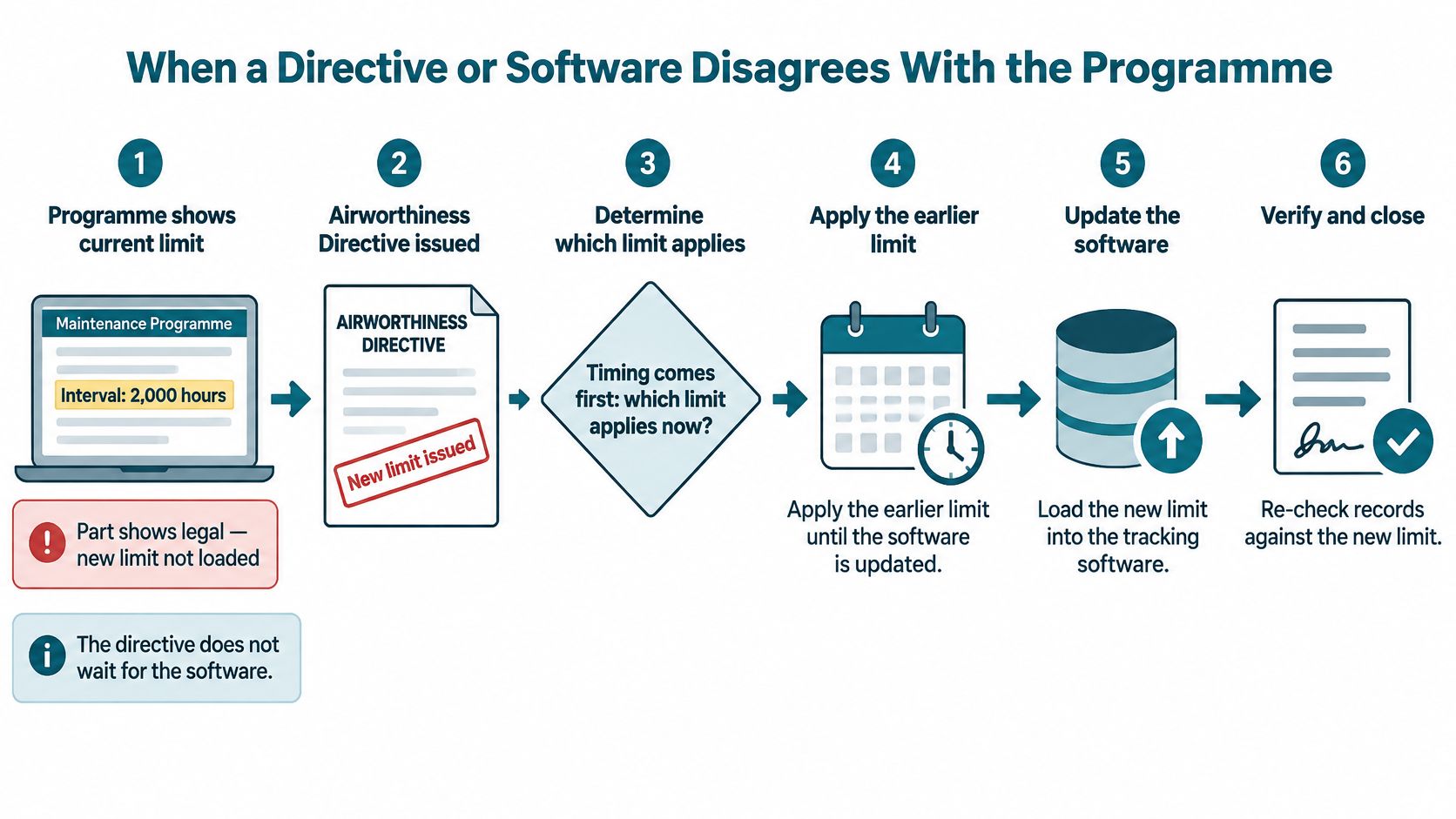
A green status in tracking software does not prove an aircraft complies. The system can show 240 hours remaining against a 2,000-hour interval while missing a newer directive or a life limit that applies to this aircraft's configuration. The controlling check is whether each requirement has been matched to the aircraft and its records, then compared against the shortest applicable deadline.
The Deadline Isn't Always the One You Expected
A programme may call for an annual review, but an authority directive can impose a shorter compliance period or require changes to the approved programme. Under FAA rules, applicable airworthiness directives set their own compliance requirements. A foreign authority's revision window does not automatically establish the FAA deadline.
The practical rule is to read the directive itself, identify the aircraft and configuration it covers, and apply its stated effective date, compliance time and required actions. Do not assume that a revision window in a foreign programme controls an aircraft subject to a different authority.
Trigger | Deadline to check | What must change | What it does not do |
|---|---|---|---|
New or revised directive | The effective date and compliance time stated in the directive | Applicable tasks, thresholds or limitations in the programme and tracking records | Prove that the physical maintenance action is complete |
Airworthiness Limitations Section or life-limit change | The limit and compliance instructions applicable to the aircraft | Affected limitations and component status | Replace an inspection of the aircraft's configuration and records |
Programme review | The interval required by the applicable authority and approved programme | Programme text and task tracking, where required | Extend a directive's compliance time |
Task threshold reached before a document deadline | The threshold due date | The required maintenance action | Become compliant through a paperwork revision alone |
A document deadline and a maintenance threshold are separate clocks. If a component reaches its limit first, editing the programme later cannot make the missed limit valid.
Four Checks on One Tail Number
Work from the aircraft's registration and configuration, not just its model name. Two aircraft of the same type may have different modifications, equipment or utilisation, and therefore different applicable tasks.
- Identify the controlling authority. Establish which authority's requirements apply to the aircraft.
- Read the directive's scope and instructions. Check applicability, effective date, compliance time, required action and any programme-revision requirement.
- Compare all applicable deadlines. Include directive limits, airworthiness limitations, life limits and approved programme tasks. Use the earliest applicable due point.
- Match the requirements to the aircraft's records. Confirm the relevant configuration and modification state, then verify that the programme and tracking entries reflect them.
Precedence rule: Apply the most restrictive requirement that applies to the aircraft under its controlling authority and approved programme. A software update date does not reset a directive's effective date or compliance time.
Five Steps When the Software Disagrees
Treat the software as a tracking tool, not the authority for deciding what applies. A sound reconciliation connects the directive, the aircraft's configuration and the maintenance record.
- Flag the affected tasks when a potentially applicable change is identified. Do not rely on the existing green status until its basis is checked.
- Find the earliest applicable due point across the directive, Airworthiness Limitations Section, Instructions for Continued Airworthiness and approved programme.
- Record the technical interpretation in the aircraft's records, with its basis and approval where required.
- Update the tracking system to match the established requirement and record.
- Have another qualified person check the entry against the aircraft's configuration, modification state and open maintenance items.
A revised PDF proves that a document changed. It does not prove that the right directive was applied, that the aircraft matches its scope, or that a task was completed before its limit. Compliance depends on that chain of evidence.
How Reliability Data Rewrites Intervals
A programme approved once and never questioned is a calendar with a stamp on it. The better model treats each task as a hypothesis: this action, at this interval, prevents this failure. Then it checks whether the hypothesis holds in service.
What MSG-3 Actually Asks
MSG-3 logic starts from the consequence of failure rather than from a fixed overhaul time. If a failure has no safety effect and no hidden exposure, the programme can monitor condition instead of tearing the unit down on a schedule. That's cheaper, but it moves the burden onto evidence gathering. Someone has to prove the monitoring is catching what it should.
EASA guidance identifies four circumstances where a reliability programme should be developed: when the AMP uses MSG-3 logic, when it contains condition-monitored components, when significant system components lack fixed overhaul periods, or when the manufacturer's maintenance planning document or Maintenance Review Board report requires one (EASA guidance on reliability programmes).
The Data That Feeds a Revision
A working loop trends specific things, not general impressions.
- Flight defects and repeat write-ups on the same system
- Reductions in operational reliability, including technical delays and technical incidents
- Engine condition and auxiliary power unit performance
- Component reliability, especially unscheduled removals
The loop runs in four moves. Establish the data, analyse it, define a corrective action, review on a schedule. The output can be a changed task, a changed interval, or a documented conclusion that the current task is working. Any of those is a result. A review that produces no finding across three consecutive cycles usually means the review isn't looking.
One warning gets ignored constantly. Pooling reliability data across operators is valid only when aircraft type, operating mode and maintenance procedures are substantially similar. A low-use corporate jet and a high-cycle charter of the same type will distort each other's statistics, and the average describes neither aircraft.
The Annual Review as a Real Test
For smaller aircraft under EASA Part-ML, the programme must be reviewed at least annually, assessing whether it remains valid in light of operating experience and whether amendments are necessary. A declared AMP may be reviewed by the person conducting the airworthiness review; an approved AMP by the CAMO or airworthiness review staff (EASA AMP FAQs).
A review worth the name compares actual flight hours, cycles, defect patterns, repeated removals, manufacturer revisions, new directives and any change in mission profile against the schedule still on file. Not against last year's review.
Ask any broker or owner to show the last review in which a finding actually changed a task or an interval. If reviews never change anything, the programme is running on assumption and the paperwork is there to look tidy.
Owner-Managed or Contracted Control
Ownership questions arrive before cost questions, and they should. Who controls the programme is a different question from who turns the wrenches, and confusing the two is how aircraft end up with signed work cards and no evidence the programme is doing anything.
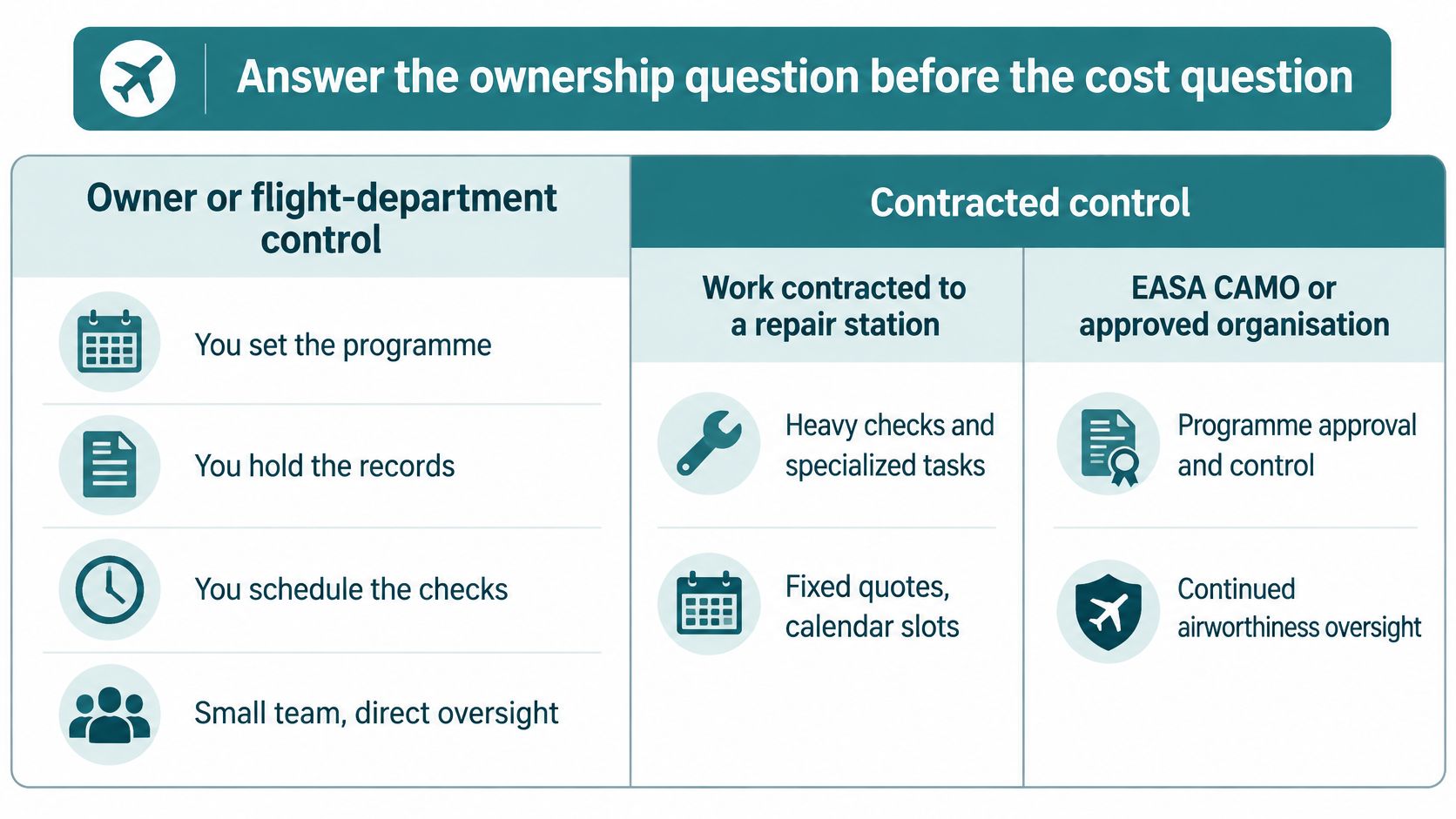
Model | Who does the work | Who stays accountable | Evidence to request |
|---|---|---|---|
Owner or flight department | In-house maintenance control, shops as needed | The operator or certificate holder | Open defects and interval status for this tail |
Repair station contract | The contracted shop | Certificate holder; the Part 135 effectiveness duty does not move | Maintenance-control records and closed repeat items |
EASA CAMO or approved organisation | CAMO and approved maintenance organisation | Operator must still keep tasks inside the approved AMP | Review against hours, cycles, defects and new ADs |
Declared Part-ML AMP | Maintenance provider under a declared programme | Owner, with airworthiness-review involvement | Yearly validity check against ICA or MIP basis |
The Duty That Doesn't Transfer
Under 14 CFR §135.431, the certificate holder must continuously analyse and surveil the performance and effectiveness of its inspection, maintenance, preventive-maintenance and alteration programmes, and must correct identified deficiencies (eCFR).
Read that carefully. It's a duty about effectiveness, not about labour. Contracting the heavy check to a repair station doesn't move it. Neither does hiring a management company to run the schedule.
That leaves a practical gap. Repair stations produce work cards and invoices. The certificate holder owes a trend analysis. No invoice line item says "we noticed three repeat write-ups on the same bleed valve and changed the inspection interval".
A Short Audit Scene
An owner asks for the status of a managed aircraft before a sale. The shop produces work cards, every one signed, every heavy check current. Then somebody asks what happened after three consecutive write-ups on the same pressurisation controller. The answer is three separate repairs, each correct in isolation, none of them connected.
That aircraft is not under control, even though its last inspection is signed and stamped. The defect was addressed. The programme wasn't.
An aircraft management services arrangement handles maintenance tracking, crew staffing, regulatory compliance and charter revenue generation, and the good ones keep inspection calendars, component-life records and shop coordination in one place. What no arrangement can do is make an owner's accountability disappear, because it doesn't.
Ask for the loop, not the invoice. Current maintenance-control records, open-defect status, a recurring-item review, and evidence that a reliability finding produced a documented corrective action. Four documents, and a manager who can't produce them is managing a calendar rather than an aircraft.
Postponements belong inside an authority-agreed procedure. If the answer to "can we push this task" starts with a phone call to the shop rather than a reference to an approved deferral process, the answer is no.
What Pushes Maintenance Cost Up
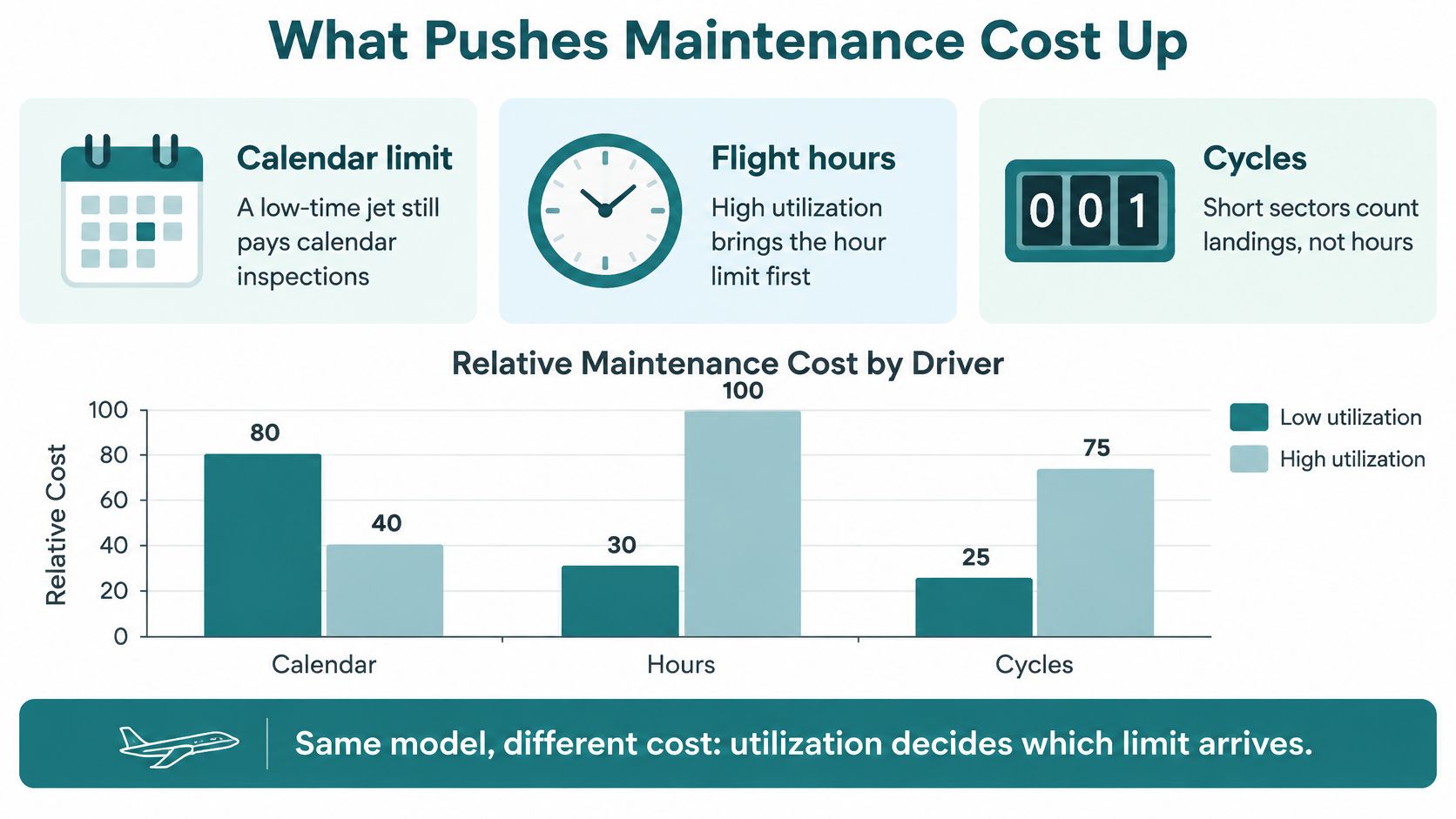
Same model, two owners, two very different invoices. Utilisation decides which limit arrives first, and that decides what the year costs. A low-time jet still pays for calendar inspections, corrosion control and equipment replacements. A high-cycle charter pays earlier for landing gear, cycle-limited structural tasks and unscheduled removals.
The Labour Number to Budget Against
Oliver Wyman's 2024 aviation MRO survey found global MRO labour costs rose an average of 7.3 percent in 2023, while survey respondents expected a further 5.8 percent increase in 2024 (Oliver Wyman MRO survey).
Treat that as a planning band for labour inflation, not a quote for a tail number. Your rate depends on the shop, the region, the aircraft type and how much of the work is done on site.
Source | Figure | Scope | Use |
|---|---|---|---|
Oliver Wyman 2024 survey, 2023 actual | +7.3% average MRO labour cost | Global MRO | Planning band, not a tail-number quote |
Oliver Wyman 2024 survey, 2024 expectation | +5.8% expected increase | Global MRO | Labour-inflation allowance for next year's budget |
US Bureau of Transportation Statistics | Direct maintenance costs for calendar 2024 through Q2 FY2025 | Air carriers above 20 million dollars annual revenue | Airline context only |
Lufthansa Technik component contracts | About 5,100 aircraft, up 6% | Airline-scale MRO at end of 2025 | Shows maintenance bought as a system, not a private-jet cost |
The bottom two rows are context, and treating them as a private-jet benchmark is a common mistake. The Bureau of Transportation Statistics maintenance reporting covers air carriers with more than 20 million dollars in annual revenue (BTS data spotlight). Lufthansa Technik serviced approximately 5,100 aircraft under long-term component contracts at the end of 2025, 6 percent more than the previous year (Lufthansa Group annual report). Both describe industrial-scale MRO. Neither predicts what a single Global or Challenger will cost next spring.
What Moves a Private Invoice
Beyond the hourly rate, five things swing a business jet maintenance bill even when the programme itself is unchanged.
- Parts lead time: a component on back order holds the aircraft open and the labour clock running.
- A directive that pulls work forward: a task planned for next year lands in this quarter's budget.
- An engine or APU shop visit: the largest single line on most invoices, and rarely a surprise when trend data was watched.
- Remote mobilisation: sending a technician and tooling to a distant FBO costs more than the same job at home base.
- Lost charter days: an aircraft open for maintenance earns nothing, and that's a real number in the annual plan.
Procurement discipline on the indirect side helps too, and there's a useful overview of cutting costs on indirect MRO spend that applies as much to a flight department as to an airline.
A Planning Habit That Works
Forecast the next twelve months by the earliest of hours, cycles and calendar for each task, then add a labour-inflation allowance near that 6 to 7 percent band and a contingency for one unscheduled removal. For the fixed costs beyond the hangar, this breakdown of how much private jets cost to own covers the lines a budget usually forgets.
The point of the forecast isn't precision. It's knowing which quarter is expensive before it arrives, so the aircraft isn't parked waiting on a decision.
Check the Programme Before You Dispatch
Five questions decide whether this tail number is ready for the next flight, the next sale, or a handover to a new management company. Answer them on the registration, not on the fleet type.
- Is every due task tied to the clock that expires first on this aircraft? A low-time jet with fresh paint still goes overdue on a calendar item. Check the calendar column before the hours column.
- Are repetitive directives and airworthiness limitations their own controlled lines? If they live inside a larger inspection note, they're not being tracked, they're being remembered.
- Has every directive issued this quarter been assessed against the shortest authority window? A foreign 12-month revision period doesn't protect an N-registered aircraft from a shorter domestic deadline.
- Can someone show that repeat defects changed a task? Not that they were signed off. That the programme was amended, or that a documented engineering decision concluded it shouldn't be.
- Where tracking software and the approved programme disagree, is the affected task frozen at the earliest limit? If the answer is "the system will catch up", the system is now the authority, and it isn't one.
Any no means the programme isn't current, regardless of how clean the last inspection stamp looks. Three of those questions can be answered from a screen. Two need a person who understands the aircraft and can point to the record that proves the decision.
Before any trip: ask the operator for open-defect and recurring-item status. It takes one email, and it tells you more about the aircraft than the age of the paint.
Approved Jets operates exclusively as a charter broker. We don't own, operate, lease or maintain aircraft, and every flight is arranged with a registered Part 135 operator or a foreign equivalent. Coordination on a managed aircraft or a charter begins only after the operator has shown the programme is in force, and that coordination doesn't replace the operator's programme or the operator's accountability for its effectiveness. For a passenger-side view of what a well-run maintenance operation looks like, this piece on reliable jet maintenance is a useful companion.
Approved Jets arranges charter and managed aircraft through a vetted network of FAA Part 135 and foreign-equivalent operators, and we ask the maintenance questions before a tail number reaches your itinerary, not after. If you'd rather see open-defect status and a live programme than take a brochure's word for it, our advisors will walk you through exactly what we check and why. Visit Approved Jets to start a trip request or a conversation about managing an aircraft you already own.