Jet Fractional Ownership Cost: Real Numbers for 2026
Jet fractional ownership cost explained with share prices, monthly fees, hourly charges, resale losses and a clear comparison with chartering.
13 min read

A $1,800 occupied-hour rate can produce a $680,000 first-year cash outlay in an illustrative fractional purchase: a $500,000 share, $7,500 in monthly fees, and 50 hours flown. That's the consequence of the three-part payment structure described in the FAA's aircraft operating-cost analysis, not an unusually expensive flight. To evaluate jet fractional ownership cost, compare the money you spend over the ownership period, less what you recover at exit, with the hours you fly.
Table of Contents
- Fractional Jet Ownership Cost Components and Five-Year Total
- Separate the purchase from the operating budget
- Build the ownership-period schedule
- Utilization Decides Your Effective Cost per Hour
- More flying lowers the average, not the bill
- Aircraft category can change the answer substantially
- Contract Minimums and Hours You Pay for but Never Fly
- Price the shortfall before signing
- Turn the clauses into questions
- Exit Costs and Resale Losses Most Buyers Miss
- Translate resale uncertainty into flight cost
- Evaluate liquidity separately from valuation
- Fractional Ownership Versus Charter Cost Compared
- Compare the complete mission
- Use a matched charter proposal
- Decide Whether Ownership Beats Charter for Your Hours
- Build a decision-ready comparison
- Make the choice against actual demand
Fractional Jet Ownership Cost Components and Five-Year Total
Fractional jet ownership cost components and typical ranges
Cost component | Typical range | How it is billed | What it means for the owner |
|---|---|---|---|
Aircraft share purchase | $354,000 to $705,000 | One-time upfront payment | Recovered only through resale, minus fees and depreciation |
Monthly management fee | $6,450 to $9,534 per month | Every month, flying or not | Continues during nonuse |
Occupied-hour charge | $1,189 to $2,405 per hour | Per hour flown | Budget separately for fuel adjustments and trip extras |
Example first year ($500,000 share, $7,500 monthly, 50 hours at $1,800) | $680,000 | Share plus 12 months of fees plus 50 hours | Before taxes, financing and trip-specific expenses |
These published example ranges describe the acquisition, management, and flight-charge components, not a binding aircraft quote; the FAA's operating-cost guidance describes the underlying arrangement as a management company selling shares to unrelated owners while maintaining, insuring, and operating the aircraft. Treat the ranges as starting inputs for a quote comparison, not evidence that every aircraft category is available at those prices.
Separate the purchase from the operating budget
The share purchase commits capital to an asset. It isn't interchangeable with a flight charge because you may recover part of that capital when you sell, although the amount and timing remain uncertain.
The management fee belongs in your fixed operating budget. You should read the agreement's coverage schedule rather than assume that every maintenance, crew, insurance, or administrative expense is included.
The occupied-hour charge is the variable component. Its definition matters as much as its advertised amount: your spreadsheet needs the provider's billable-time rules and a separate allowance for excluded trip expenses.
For the illustrative purchase in the table, the arithmetic is:
- Share acquisition: $500,000 paid upfront.
- Annual management fees: $7,500 multiplied by 12, producing $90,000.
- Flight charges: 50 occupied hours multiplied by $1,800, producing another $90,000.
- First-year cash requirement: $500,000 plus $90,000 plus $90,000, or $680,000.
A $590,000 estimate includes the purchase and annual management fees but omits the flown-hour charges. It isn't the first-year total for this scenario.
Build the ownership-period schedule
Holding these illustrative assumptions constant, management fees total $450,000 over five years, before any flight charges. With the assumed annual flying, flight charges add another $450,000, bringing gross cash expenditure to $1.4 million before resale proceeds, taxes, financing, and extras.
That's not the same as economic ownership cost. A cash-flow schedule records the full purchase when paid and resale proceeds when received; an economic comparison subtracts net resale proceeds from acquisition cost so you don't treat recoverable capital as permanently spent.
Practical rule: Maintain separate lines for cash required, net ownership cost, and cost per occupied hour. Each answers a different finance question.
Our guide to private jet ownership costs provides context for evaluating ownership obligations beyond the purchase itself. For a charter benchmark, our quotes are estimates only and can change with aircraft availability, fuel costs, positioning fees, landing fees, overnight charges, de-icing, catering, and ground transportation.
Convert every fractional quote into share cost, annual fixed fees, and occupied-hour rate, then create a five-year schedule. Include contract escalators as separate assumptions rather than treating today's fee as permanently fixed.
Utilization Decides Your Effective Cost per Hour
At low utilization, the illustrative $1,800 flight charge becomes $5,400 per flown hour once management fees are allocated. The aircraft hasn't become more expensive to operate in this calculation. You're spreading the same fixed commitment across fewer hours.
The following sensitivity holds the illustrative monthly management fee at $7,500 and the occupied-hour charge at $1,800, with no annual billing minimum. It excludes the share purchase, taxes, financing, and trip extras.
Effective cost per flight hour by annual utilization
Annual hours flown | Annual fees and hourly charges |
|---|---|
25 | $135,000 total; $5,400 per flown hour |
50 | $180,000 total; $3,600 per flown hour |
100 | $270,000 total; $2,700 per flown hour |
150 | $360,000 total; $2,400 per flown hour |
These are calculated scenarios, not provider quotations. The formula is annual management fees plus occupied-hour charges, divided by actual hours flown.
More flying lowers the average, not the bill
The relationship is straightforward, but it's easy to misread. Flying more raises total expenditure while reducing the fixed-fee allocation per hour; a lower average doesn't mean you've saved money by taking an unnecessary trip.
The illustration below isolates that fixed-cost effect.
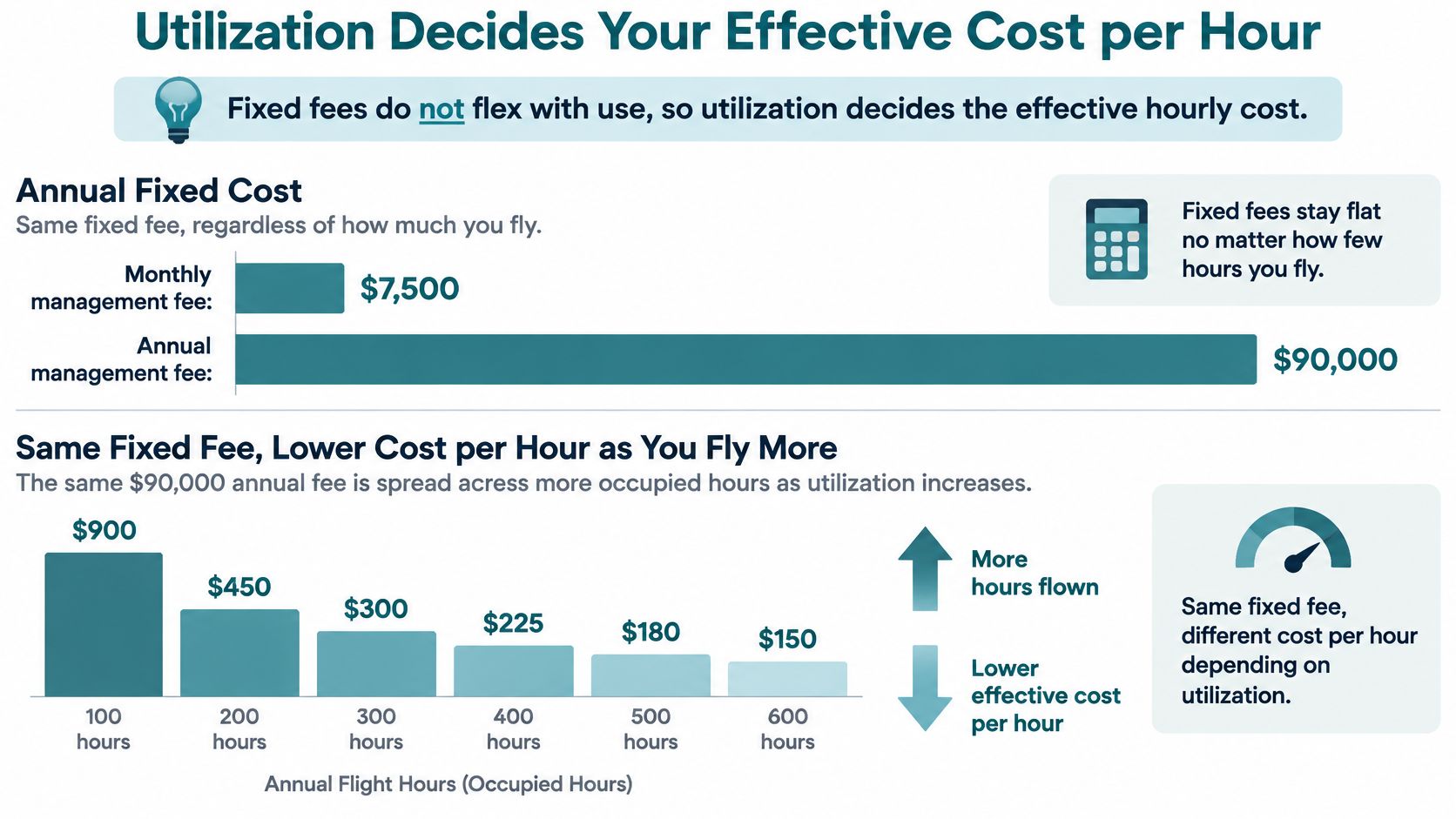
For an occasional traveler, long periods without flying don't remove the management obligation. For a corporate travel manager, the right denominator is approved, plausible travel demand, not the maximum number of hours the team could theoretically use.
DuBois Aviation's resource on hourly rate versus actual cost provides a useful budgeting lens: distinguish the flight-rate input from the cost of sustaining access. Don't transfer another aircraft's calculator assumptions into a fractional quote without checking them.
Aircraft category can change the answer substantially
A separate TrueSkies fractional-ownership analysis describes a representative 1/8 midsize-share model flying 100 hours annually, with roughly $180,000 in management fees plus $400,000 to $900,000 in occupied-flight charges, before share capital. That scenario implies $5,800 to $10,800 per occupied hour for management and flight charges combined.
It's a different model, not an extension of the lower-rate table. Its flight-charge assumptions are substantially higher, which is why aircraft category and provider pricing must remain explicit.
Don't select the utilization row that makes ownership look attractive. Select the row your travel calendar can support.
Overuse also needs its own scenario. Additional flying may require extra-hour purchases or a larger capacity commitment, so you can't assume the same share supports unlimited hours at an unchanged rate.
Build five-year projections at 25, 50, 100, and 150 annual hours using the illustrative table's assumptions, then replace those inputs with written provider terms. Use your realistic travel forecast as the base case and a lower-demand forecast as the stress case.
Contract Minimums and Hours You Pay for but Never Fly
Entitlement isn't the same as utilization. FAA Advisory Circular 91-84 explains that ownership interests convert into hours through a predetermined ratio or formula, and use cannot exceed the hours associated with the purchased share during the multiyear agreement. As a hypothetical allocation, a 1/16 share in a program assigning 800 annual aircraft hours would provide 50 nominal hours.
First check whether that entitlement matches your travel pattern. Then determine what you owe when you don't use it.
Price the shortfall before signing
A CharterClear fractional-cost comparison identifies a program with a 50-hour annual minimum, a maximum 60-month term, and access subject to a 10-hour response time; it also discusses an industry example with a 36-month minimum term, 50 guaranteed annual hours, and an approximately $4,500 occupied-hour rate for a midsize jet, affected by fuel prices.
Using that latter rate, consider an owner who flies 30 hours but is contractually liable for 50 hours. The unused 20 hours represent $90,000 of exposure, while the full minimum produces $225,000 in annual variable charges, before management fees and acquisition.
If the contract bills the entire minimum, dividing those variable charges by hours used produces $7,500 per flown hour in this hypothetical shortfall scenario. That's a different result from multiplying actual flying by the advertised rate.
A guaranteed allocation doesn't, by itself, establish a take-or-pay billing obligation. You need the agreement to distinguish available hours, required payments, and unused-hour treatment.
Turn the clauses into questions
Ask the fractional provider to answer these questions in writing:
- Minimum treatment: Is the minimum billed regardless of use, carried forward, forfeited, or satisfied through another specified commitment?
- Fuel adjustments: What index, calculation date, or adjustment mechanism changes the occupied-hour charge?
- Time accounting: Does billable time include taxi allowances, ferry flying, interchange adjustments, or other nonoccupied time?
- Positioning and pass-throughs: Which costs sit outside the quoted rate, and when are they disclosed?
- Access conditions: What notice, peak-demand restrictions, and aircraft substitutions apply to your expected travel dates?
A seasonal travel calendar deserves particular attention. Annual entitlement can appear adequate while the access conditions fail to accommodate the dates that make the arrangement valuable.
Don't value unused hours at face value unless you can use, transfer, or recover them under the agreement. A nominal benefit that expires unused doesn't reduce your cost per flight hour.
Exit Costs and Resale Losses Most Buyers Miss
Exit terms can outweigh a modest monthly-fee saving. A Fractional Jet Ownership resale analysis describes published models with approximately 35% to 60% share-value loss over five years and reported remarketing fees of about 5% to 12%. These are sensitivity inputs, not guaranteed resale outcomes.
For a hypothetical $500,000 share, the table applies the remarketing percentage to resale value, not the original purchase price. A different contractual fee basis would change the results.
Net resale proceeds on a $500,000 share after depreciation and remarketing fees
Value lost over five years | Resale value | Remarketing fee (5% to 12%) | Net proceeds |
|---|---|---|---|
35% | $325,000 | $16,250 to $39,000 | $286,000 to $308,750 |
50% | $250,000 | $12,500 to $30,000 | $220,000 to $237,500 |
60% | $200,000 | $10,000 to $24,000 | $176,000 to $190,000 |
Translate resale uncertainty into flight cost
Under these assumptions, unrecovered acquisition capital ranges from $191,250 to $324,000. At a hypothetical 250 occupied hours over the holding period, that adds $765 to $1,296 per hour before management fees or flight charges.
The difference between the table's highest and lowest net proceeds is $132,750. Spread across the hypothetical ownership period, that is equivalent to $2,212.50 per month, illustrating why a seemingly attractive monthly discount can be smaller than the exit uncertainty.
Exit test: Compare proposals using net proceeds after every disposal charge, not the provider's headline residual-value estimate.
Resale timing, aircraft obsolescence, a soft preowned market, and the contract's valuation formula can interact. A provider-controlled buyback procedure may also give you less influence over price or settlement timing than an independently negotiated sale.
Evaluate liquidity separately from valuation
A stated value doesn't answer when you'll receive cash. Ask for the valuation date, payment timetable, early-exit conditions, and treatment of management obligations while the sale or buyback remains unsettled.
For business owners coordinating an aircraft decision with a broader transaction, Allied Tax Advisors' discussion of exit strategies for San Diego businesses offers a planning reference. It isn't an aircraft-valuation source; the relevant connection is coordinating liquidity, ownership structure, and transaction timing with professional advisers.
Keep the accounting labels precise. Net capital cost equals purchase price minus net resale proceeds; total ownership cost adds all fees paid while owning, including management, flight, financing, and trip expenses.
If remarketing fees have already been deducted in net proceeds, don't add them again. Double-counting exit charges can distort a comparison just as much as ignoring them.
Fractional Ownership Versus Charter Cost Compared
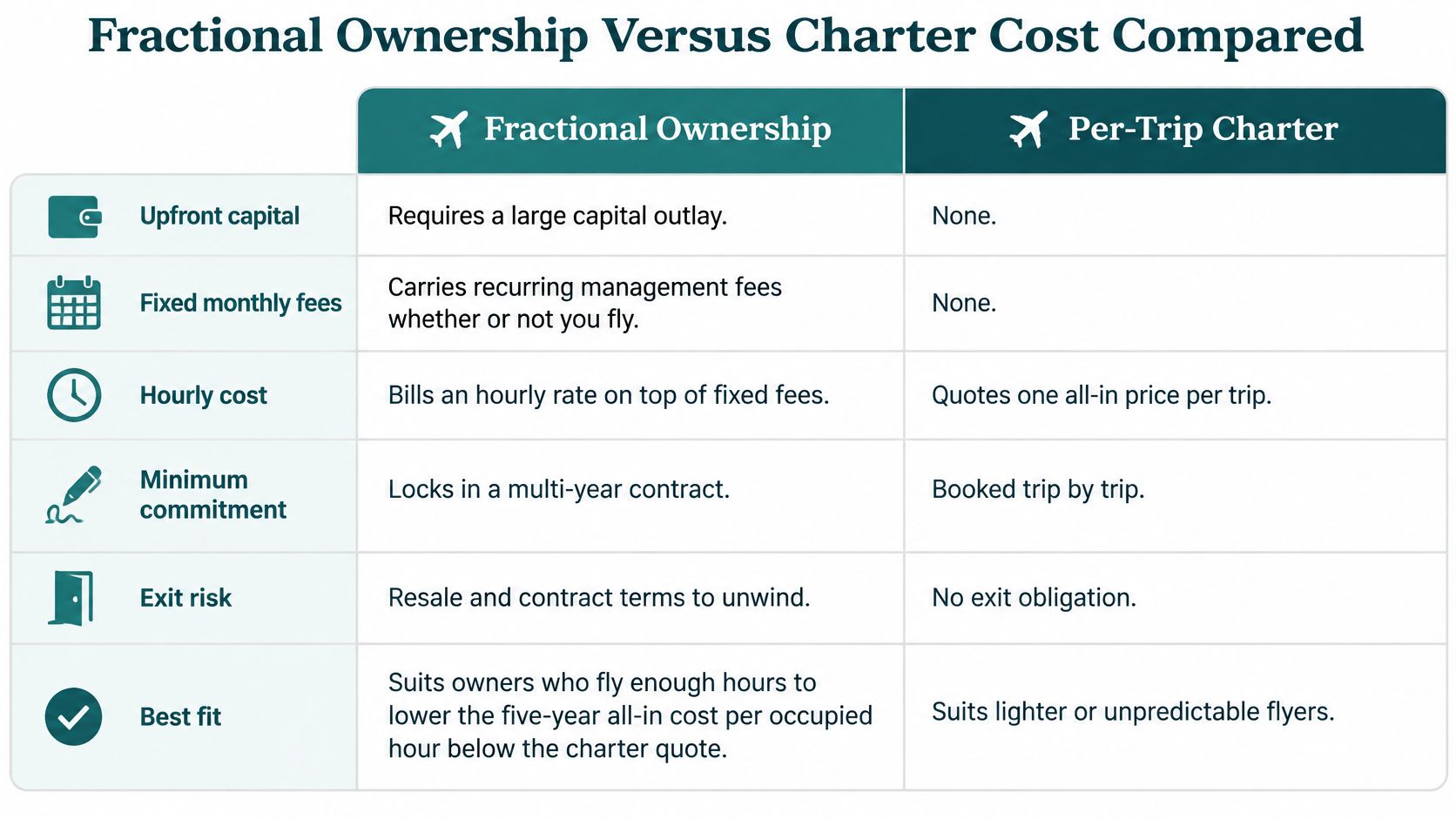
A low monthly ownership fee can look efficient until unused contract hours and exit losses are allocated across the hours flown. Charter places the entire cost into each trip but normally avoids the continuing commitment and resale exposure. Convert both alternatives into all-in cost per occupied hour before treating either one as cheaper.
Fractional ownership and charter compared on cost criteria
Cost factor | Fractional ownership | Charter per trip | Best cost signal |
|---|---|---|---|
Upfront capital | Share purchase, a large one-time cost | No aircraft-share purchase | Capital placed at risk before the first flight |
Fixed monthly fees | Billed even when contracted hours go unused | No ownership management fee | Fixed fees divided by realistic annual hours |
Hourly cost | Occupied-hour charge plus trip extras | Full quoted trip price on each flight | Actual occupied hours and itinerary requirements |
Minimum commitment | Multiyear term and annual hour minimum | Usually no ongoing program commitment | Hours likely to be flown, not the contractual ceiling |
Exit risk | Resale losses and remarketing fees | No aircraft-share resale obligation | Net ownership cost after disposal charges |
Utilization changes the answer. At low flight volume, fixed ownership dollars and paid-for but unflown hours are spread over a small base, pushing the effective hourly rate higher. At higher volume, those same fixed costs dilute across more occupied hours, though resale losses still reduce the result. Charter avoids that amortization problem because every proposal stands on its own trip price.
Compare the complete mission
Read both proposals by expense category rather than label. A fractional invoice can separate occupied-hour charges from fuel-related costs, crew travel, away-base parking or hangar charges, landing fees, airport taxes, customs, permits, catering, and ground transportation. A charter proposal may bundle some of those items into the trip price while listing others as exclusions or estimated charges.
An international itinerary exposes the difference clearly. The ownership calculation may show flight time on one line while crew lodging, handling, customs, permits, and local charges appear elsewhere. A charter proposal can assemble the same mission into a single price with stated inclusions and exclusions.
Reconcile occupied time, ferry or positioning time, aircraft interchange, and pass-through expenses before comparing totals. A lower advertised hourly rate can produce the higher mission cost.
Use a matched charter proposal
Benchmark ownership against a live proposal rather than a generic market hourly rate. Our private jet charter cost guide provides the framework for comparing trip-level pricing.
Approved Jets operates exclusively as a charter broker and does not own, operate, lease, or maintain aircraft. It receives travel requirements, sources aircraft and Operators through its network, and presents charter options, pricing, and itinerary details. An Approved Jets quote is an estimate that can change with aircraft availability, fuel costs, positioning fees, landing fees, overnight charges, de-icing, catering, and ground transportation. Quotes remain valid for the stated period, or for 48 hours when no period is stated; final pricing is confirmed only through a booking agreement or written confirmation.
- Match the mission: Use the same airports, dates, passenger count, cabin class, luggage, and schedule flexibility.
- Match the time basis: Compare occupied hours with any positioning or ferry exposure separately.
- Match the scope: Separate confirmed inclusions from estimated extras.
- Match the flexibility: Compare cancellation, schedule-change, and availability conditions alongside price.
The matched proposal gives charter a defensible benchmark. It also shows whether ownership's monthly fee is producing usable flight hours or funding contractual access.
Decide Whether Ownership Beats Charter for Your Hours
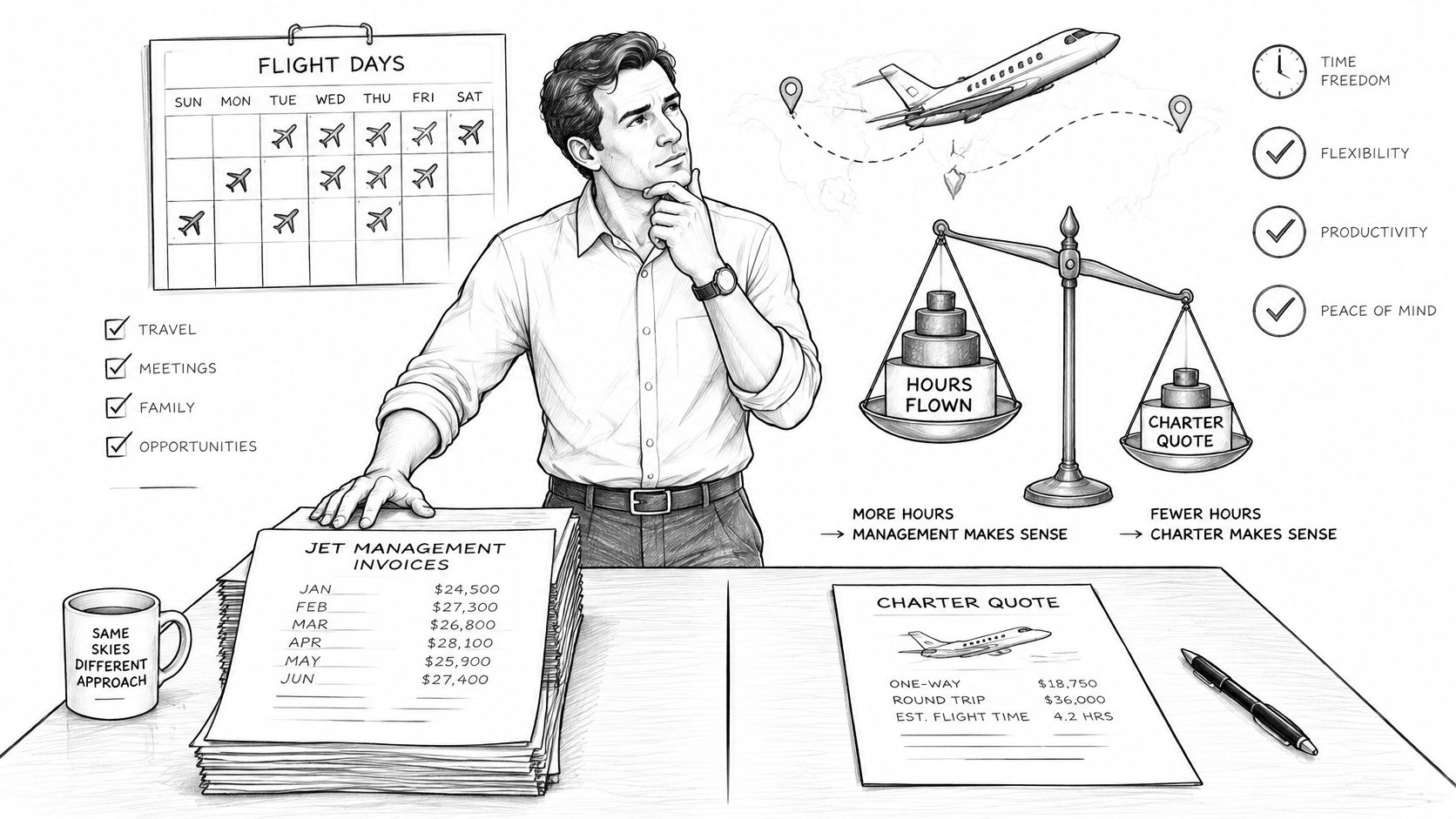
Choose fractional ownership on cost grounds only when your realistic all-in cost per occupied hour falls below matched charter pricing, and you're willing to accept the exit exposure. Access preferences can justify paying more, but identify that premium explicitly rather than calling it a saving.
Use the same financial discipline whether you're reviewing an ownership invoice or a charter proposal.
Build a decision-ready comparison
Calculate ownership cost as purchase price minus net exit proceeds, plus fixed fees, flight charges, and trip extras, divided by expected occupied hours. Add financing or an explicit opportunity-cost assumption where relevant, and keep tax effects separate until your adviser validates them.
For example, under the illustrative management-fee model, $90,000 annually divided by 50 flown hours allocates $1,800 of fixed fees to each hour, before the occupied-hour charge. That allocation is why a flight-rate comparison alone can produce the wrong decision.
For a broader capital-allocation perspective, Blue Sage Tax's vehicle lease analysis from Blue Sage Tax & Accounting Inc. provides a related buy-versus-use framework. Aircraft tax treatment requires its own advice; don't transfer vehicle deductions or assumptions into an aviation model.
Complete these steps before committing:
- Run utilization sensitivities. Calculate five-year all-in cost per occupied hour at the illustrative annual usage levels of 25, 50, 100, and 150 hours, including a conservative exit case.
- Obtain at least two matched charter quotes. Record each proposal's validity period and exclusions. Our flight advisors can prepare a personalized charter proposal for your mission.
- Get contractual inputs in writing. Confirm minimums, fuel adjustments, time accounting, and the resale formula before treating the spreadsheet as decision-ready.
- Reconfirm before booking. Our quotes remain valid for their stated period, or 48 hours from issuance if none is stated. After expiration, pricing and availability must be reconfirmed; final pricing is confirmed only through an executed booking agreement or our written confirmation.
Keep the full mission assumptions beside any supporting presentation or discussion.
Make the choice against actual demand
If prepaid access is also under consideration, compare jet card costs separately rather than treating a card as equivalent to aircraft ownership. Its terms need their own cash-flow and usage analysis.
If realistic annual hours fall below your calculated breakeven, charter is the cheaper choice under those assumptions. If hours remain consistently above it, a fractional share may justify its capital commitment and exit risk, provided the access terms fit your calendar.
Approved Jets can prepare a personalized charter proposal for the same missions you're evaluating for fractional ownership, giving you a trip-specific cost benchmark. Visit Approved Jets and contact our flight advisors or use the Get a Quote button with your routes, dates, passenger count, and cabin requirements.