Jet Card Costs in 2026: Per-Hour Rates and Hidden Fees
Learn what jet card costs really include: per-hour rates by aircraft, 25-hour block prices, hidden taxes and fees, and how cards compare to charter.
15 min read
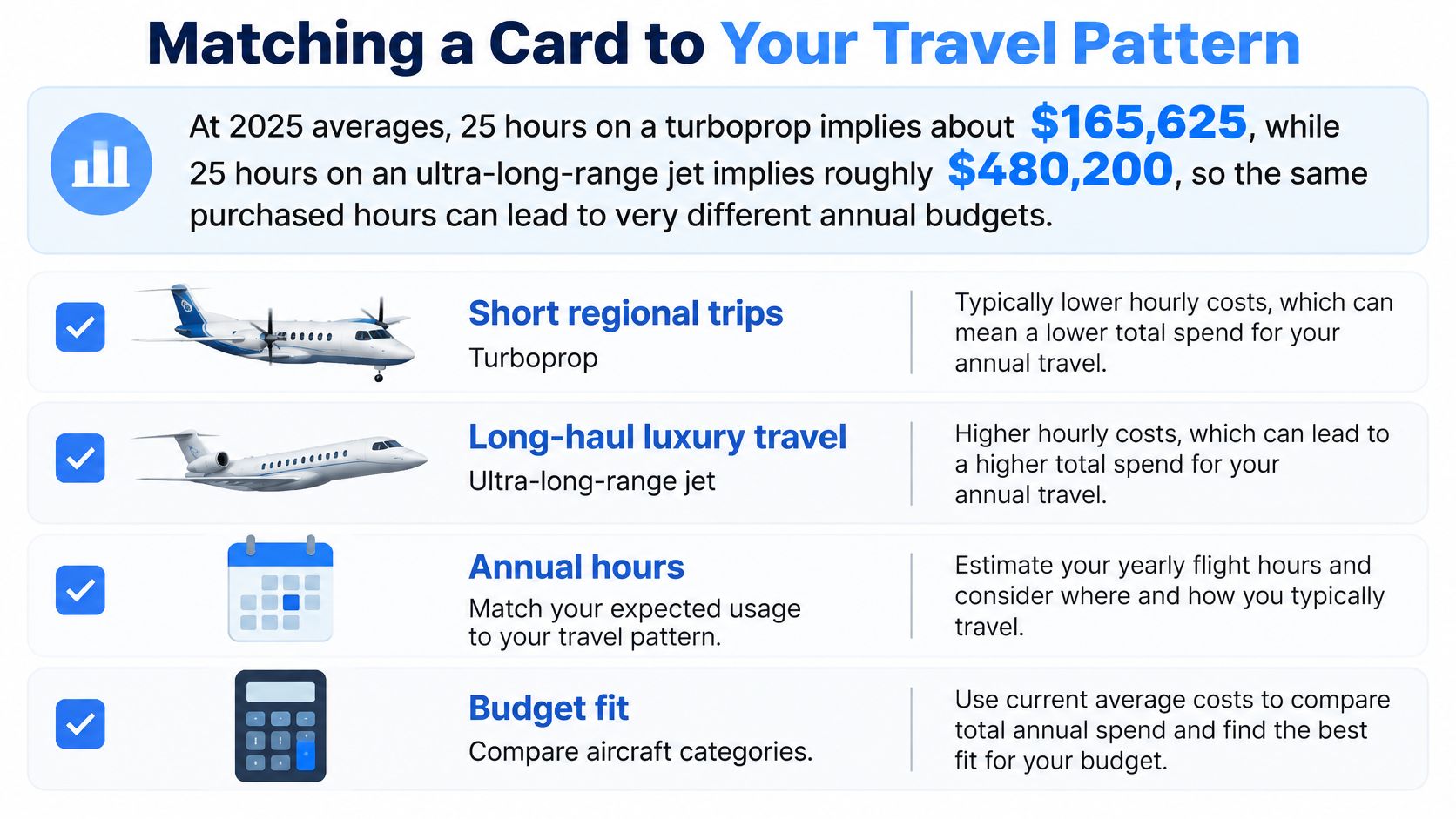
At year-end 2025, the average North American jet-card rate across seven aircraft categories was $11,578 per occupied hour, including fuel surcharges and the 7.5% U.S. federal excise tax, according to the William Blair aviation services update for Q4 2025. That single average hides the decision that matters most. The same analysis put turboprops at $6,625 per hour and ultra-long-range jets at $19,208, so 25 hours can mean about $165,625 or roughly $480,200 before program-specific charges.
That's why jet card costs shouldn't be judged by a headline hourly rate. You need aircraft category, prepaid block size, tax and fuel treatment, peak rules, membership fees and your realistic annual hours. Change any one of them and the same card produces a very different annual budget.
Table of Contents
- Jet Card Costs at a Glance
- All-In Hourly Rates and Implied 25-Hour Blocks by Aircraft Category
- Upfront Cash and How a Block Draws Down
- Indicative 25-Hour Block Prices by Aircraft Tier
- How the Drawdown Works
- Hidden Charges That Raise the Real Price
- Add-On Charges on a $10,000 Hourly Card Rate
- Membership Fees and What They Do to Small Blocks
- Effective Hourly Cost by Annual Hours Flown
- Jet Card vs Charter vs Fractional Ownership
- Jet Cards, Charter and Fractional Ownership Compared
- Matching a Card to Your Travel Pattern
- Three Buyer Profiles
- Get an All-In Quote Before You Commit
- Five Steps Before You Sign
Jet Card Costs at a Glance
A jet card is a prepaid block of occupied flight hours on a set aircraft category, usually sold at a fixed hourly rate for a term. You're not buying an aircraft. You're buying contracted access, with price protection and availability terms that depend on the program.
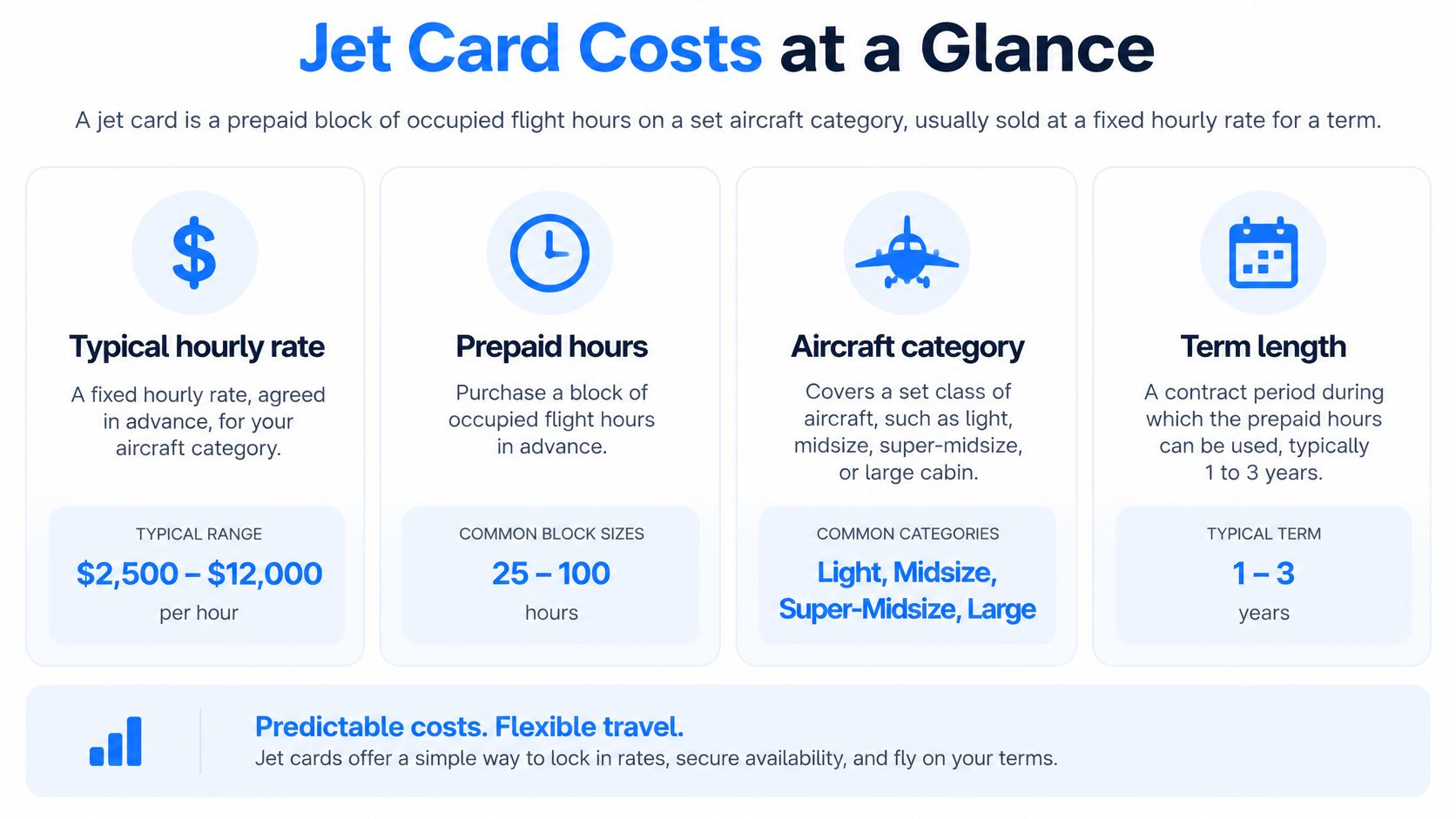
The cleanest budgeting benchmark is an all-in rate. The William Blair Q1 2025 benchmark for guaranteed-rate programs reported average hourly prices including fuel surcharges and the 7.5% U.S. federal excise tax. These aren't quotes, and your provider can price above or below them. They do show the shape of the market.
All-In Hourly Rates and Implied 25-Hour Blocks by Aircraft Category
Aircraft category | All-in hourly rate | Implied 25-hour block |
|---|---|---|
Very-light jet | $7,869 | $196,725 |
Light jet | $8,305 | $207,625 |
Midsize jet | $9,817 | $245,425 |
Super-midsize jet | $12,510 | $312,750 |
Large-cabin jet | $15,197 | $379,925 |
Ultra-long-range jet | $19,152 | $478,800 |
The jump isn't linear. Moving from a light jet at $8,305 to a super-midsize jet at $12,510 raises hourly cost by roughly 51%. Moving from a light jet to an ultra-long-range jet more than doubles it. Cabin size, range, baggage capacity, runway access and passenger load decide whether you can stay in the lower category or need the larger aircraft.
Compare cards by aircraft category first. A rate without a cabin class tells you almost nothing.
All Approved Jets prices are quoted in US Dollars regardless of the payment method used, which removes currency conversion from your comparison. Before you look at any provider's marketing rate, name the category you'd need for your typical passengers, bags and longest nonstop route. That's the rate column that governs your budget.
Upfront Cash and How a Block Draws Down
Most cards require the cash before the first flight. Published market guidance summarized in Haute Jets' jet card membership guide describes a typical purchase as approximately 25 flight hours, with indicative 2026 prices of $125,000 to $170,000 for a light-jet block, $220,000 to $300,000 for a midsize block, and more than $400,000 for some heavy-jet cards.
Other market reporting is higher. A published pricing summary on Avi-Go places a 25-hour light-jet card at approximately $150,000 to $225,000 and gives a broader range from about $180,000 for a light jet to $340,000 or more for a large-cabin aircraft. Those examples equal roughly $7,300 to $13,600 per hour before fuel and tax. Stepping from the low-end light-jet example to the large-cabin example adds at least $160,000, or roughly 89%.
Sources differ because programs differ. Some rates include tax and fuel, others don't, and aircraft age, service area and availability guarantees change the price. Treat the spread as a warning to normalize terms, not as a reason to pick the lowest number.
Indicative 25-Hour Block Prices by Aircraft Tier
Aircraft tier | 25-hour block price | Implied price per hour |
|---|---|---|
Light jet (2026 indicative) | $125,000-$170,000 | $5,000-$6,800 |
Light jet (market reporting) | $150,000-$225,000 | $6,000-$9,000 |
Midsize jet | $220,000-$300,000 | $8,800-$12,000 |
Large-cabin jet | $340,000 or more | $13,600 or more |
Heavy jet | More than $400,000 | More than $16,000 |
The implied hourly figures are simple division before taxes, surcharges and minimums. A $150,000 25-hour light-jet card implies $6,000 per hour. A $275,000 25-hour midsize card implies $11,000 per hour. Neither figure is your final trip cost until you know what's excluded.
How the Drawdown Works
- Buy the block: You prepay for a set number of hours, commonly 25, in a chosen aircraft category.
- Book a trip: The provider quotes occupied flight time for your itinerary and confirms availability under card terms.
- Fly and deduct: After each flight, the provider deducts occupied hours from your prepaid balance.
- Track the remainder: You compare remaining hours against planned trips, minimums and peak dates.
- Handle expiry: At term end, your contract decides whether unused value can be refunded, transferred, extended or rolled over.
That last step changes effective cost more than many buyers expect. Say you buy that $150,000 light-jet card and fly only 10 hours. You've used $60,000 of nominal value at $6,000 per hour, leaving $90,000 unused. If rollover is allowed, that value may survive. If hours expire, your effective cost for the flying you did becomes $150,000 divided by 10, or $15,000 per flown hour, before any other fees.
Ask three questions before wiring funds. How are unused hours valued at expiry? Do daily or segment minimums increase each deduction beyond actual occupied time? Can you switch aircraft category mid-term, and at what interchange rate?
Practical rule: Divide the block by your realistic annual occupied hours. If 25 hours would take three years to use but expires sooner, the cheap rate is expensive.
Tax treatment belongs in the same check. If tax is excluded from a $10,000 hourly rate, the 7.5% charge turns it into $10,750 and adds $18,750 across 25 hours. A buyer comparing an all-in card against a plus-tax card without adjusting for that gap will rank them incorrectly.
Run the years-to-consume test on every offer. A traveler flying 12 hours a year needs just over two years to use 25 hours, while a traveler flying 40 hours a year consumes the block in under eight months. The first buyer carries expiry and opportunity-cost risk. The second gets rate protection across repeated trips. Same product, opposite economics.
Hidden Charges That Raise the Real Price
A fixed aircraft-hour rate doesn't guarantee a fixed invoice. A PilotPrivate jet card guide lists recurring additions including the 7.5% U.S. federal excise tax, fuel adjustments of roughly 5 to 15%, peak-day premiums of about 25 to 50%, segment minimums, repositioning, de-icing and international handling.
Use a $10,000 hourly card rate to see the scale. Excise tax adds $750 per hour. A fuel adjustment adds $500 to $1,500 per hour. A peak premium adds $2,500 to $5,000 per hour. Stack two of them and your $10,000 hour is no longer close to $10,000.
Add-On Charges on a $10,000 Hourly Card Rate
Charge | Typical size | Effect on $10,000 per hour |
|---|---|---|
Federal excise tax | 7.5% | $750 per hour |
Fuel adjustment | 5-15% | $500-$1,500 per hour |
Peak-day premium | 25-50% | $2,500-$5,000 per hour |
Segment or minimum billable time | Set by operator minimum | Charges for minimum time even on shorter flights |
Repositioning or de-icing | Set by trip positioning and weather | Added when positioning or de-icing is required |
International taxes and handling | Set by route and country | Added for customs, handling and local fees |
Sort charges by predictability. Excise tax is formulaic. Fuel may follow a stated index or adjustment range. Peak premiums depend on the provider's calendar. De-icing, international handling and some repositioning are pass-through items tied to weather, route and aircraft location.
Our quotes are estimates only and can change based on aircraft availability, fuel costs, positioning fees, landing fees, overnight charges, de-icing, catering and ground transportation. You're also responsible for taxes, duties, surcharges and regulatory fees on a charter, such as Federal Excise Tax, segment fees, international customs and immigration fees and local airport taxes. A transparent quote separates those items instead of burying them in a single reassuring number.
The short peak trip exposes the problem fastest. A 1-hour hop at $10,000 with a 50% peak premium already bills $15,000 before any minimum-time rule applies. If the program bills a higher segment minimum, the effective price for that one hour in the air climbs again.
Don't ask only, what's the rate? Ask for sample invoices for four scenarios: short domestic, peak period, international and multi-leg. Compare totals for the same itinerary across providers. The card with the higher hourly rate can win if its invoice includes items the cheaper card passes through.
Membership Fees and What They Do to Small Blocks
Some programs add an annual membership fee on top of flight charges. The fee itself may look modest next to a six-figure block. Per hour, it isn't modest when you fly little.
A FlyCraft analysis of true jet card cost gives an example of a $14,500 annual membership fee attached to a $10,000 hourly card rate. Spread across 25 hours, the fee adds $580 per hour. Spread across only 10 hours, it adds $1,450 per hour.
Walk through the 10-hour case. Billed flying costs 10 times $10,000, or $100,000. Add the $14,500 fee and total spend is $114,500. Divide by 10 hours and your effective cost is $11,450 per hour, a 14.5% premium over the headline rate before tax, fuel or peak charges enter the calculation.
Effective Hourly Cost by Annual Hours Flown
Annual hours flown | Membership cost per hour | Effective hourly cost |
|---|---|---|
10 hours | $1,450 | $11,450 |
25 hours | $580 | $10,580 |
50 hours | $290 | $10,290 |
The same analysis reports published rates from approximately $3,400 per hour for a one-way turboprop to $20,500 for an ultra-long-range jet, with many light-jet rates between $6,000 and $10,400 and super-midsize rates between $9,250 and $13,900. Those ranges show why membership math matters most at the lower end. A $1,450 hourly fee load on a $6,000 light-jet rate is a far larger percentage increase than the same load on a $20,500 aircraft.
Utilization is a pricing term, even when it isn't printed in the rate table.
Underuse punishes you twice. The membership fee spreads over fewer hours, and unused prepaid hours may approach expiry. A frequent flyer dilutes the fee and consumes the block while the contracted rate still applies.
Use one formula for every proposal: total annual spend equals membership fee plus billed flight hours, then divide by hours flown. Test it at 10, 25 and 50 hours, even if you expect to land in the middle. If the card only works at 50 hours and your honest forecast is 14, the program's economics don't fit your travel, regardless of how attractive the hourly rate looks in a brochure.
Jet Card vs Charter vs Fractional Ownership
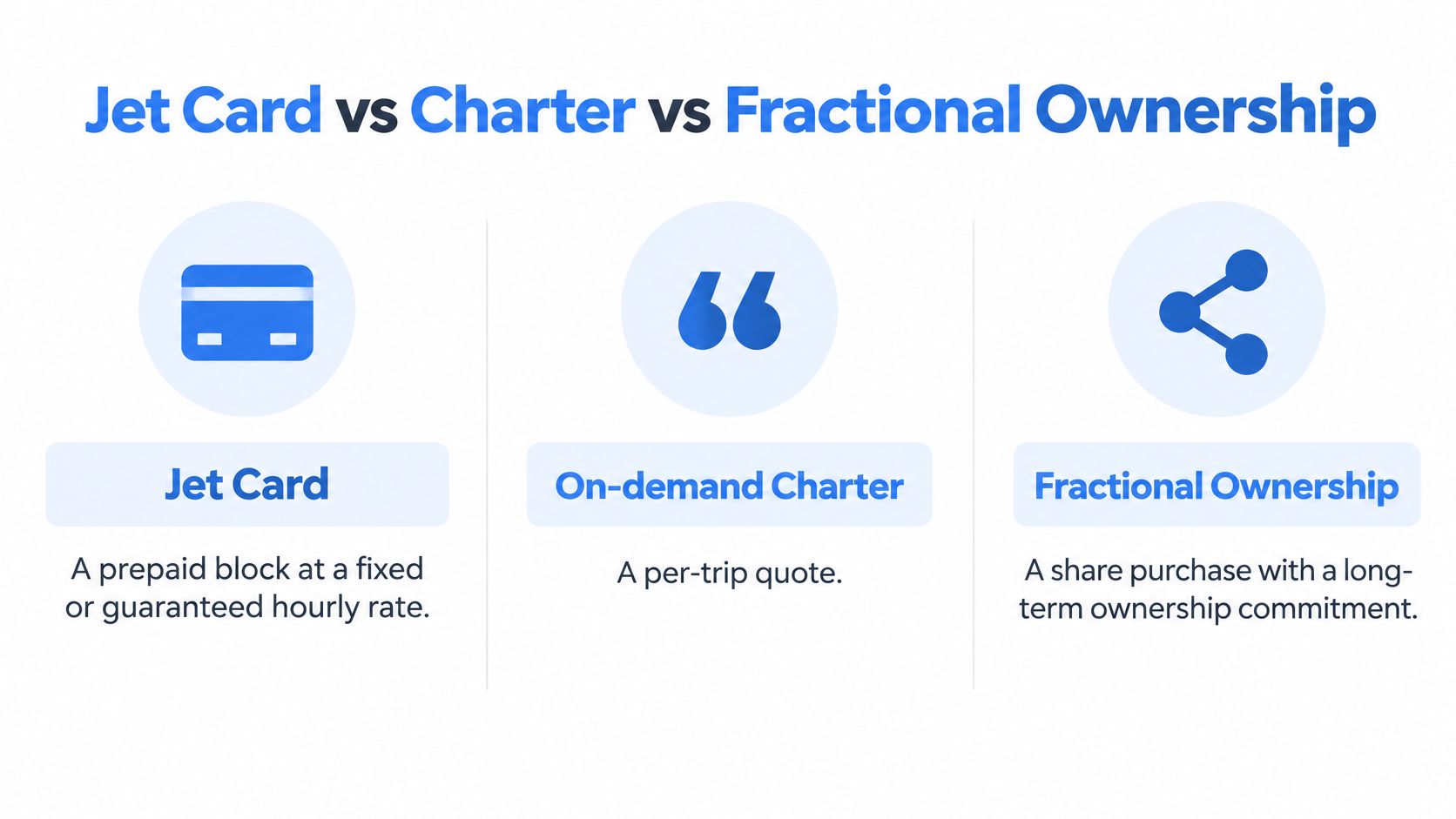
Three models solve different problems. A jet card is a prepaid block at a fixed or guaranteed hourly rate. On-demand charter is a per-trip quote. Fractional ownership is a share purchase with a monthly management fee and a longer commitment.
The comparison chart below puts those structures side by side before you weigh price.
Jet Cards, Charter and Fractional Ownership Compared
Model | Upfront commitment | Cost basis | Repositioning | Cancellation |
|---|---|---|---|---|
Jet card | Prepaid block, typically about 25 hours | Guaranteed rate, $11,257 per occupied hour average in Q3 2025 | Not billed separately | Domestic often 48-72 hours without penalty |
On-demand charter | None beyond the trip | Per-trip quote | Included or charged in the trip quote | Set by operator and timing in the charter agreement |
Fractional ownership | Share purchase plus monthly fee | Share cost plus monthly and occupied-hour charges | Governed by share program terms | Governed by share agreement terms |
The central card tradeoff is repositioning risk. Industry benchmarking covered by National Law Review's Q3 2025 pricing release reported an average guaranteed jet-card rate of $11,257 per hour in Q3 2025, including fuel surcharges and the 7.5% federal excise tax. Rates were calculated on occupied hours, so customers didn't separately pay for repositioning before or after the flight.
That protection costs money. You pay a contracted premium for schedule assurance and predictable access, and the provider absorbs more empty-leg and fleet-positioning risk. On charter, a well-positioned aircraft can produce a lower trip price. A poorly positioned one can erase the apparent saving.
For a concrete test, a card at $11,257 per hour for a 4-hour round trip implies $45,028 before exclusions. Get a charter quote for the identical dates, airports, passengers and aircraft category, then check whether repositioning, overnight charges and cancellation exposure are inside that quote. Our guide to private jet charter prices helps you frame that same-itinerary comparison. Domestic flights can typically be canceled without penalty up to 48 to 72 hours in advance, but your signed terms control the actual deadline.
The video below adds useful context on choosing between access models when trip frequency and flexibility pull in opposite directions.
Decision patterns are fairly consistent. Occasional trips to varied destinations usually favor charter because you avoid prepayment and expiry. A regular route with predictable hours favors a card because occupied-hour billing and guaranteed access reduce variance. Long-term, high-volume use may justify fractional ownership, but you accept share capital and contract complexity.
The same logic applies beyond aviation when you buy private access instead of public schedules. Travelers planning ground time in Europe, for example, can use Northern Spain Travel's private tour guide to compare private arrangements with standard options. In every case, test each model against the same annual itinerary, not against its headline rate.
Matching a Card to Your Travel Pattern
Start with the spread you can't negotiate away. Aircraft category sets the budget range, then your calendar decides where inside that range you land. A buyer who needs long range and a large cabin shouldn't benchmark against light-jet advertising.
The checklist below connects annual hours and mission type to the block size you should consider.
Take a practical light-jet example. A 3-hour round trip at the $8,305 benchmark implies $24,915 for occupied time. Apply a hypothetical 25% peak premium and the trip adds about $6,229, reaching roughly $31,144 before any items outside that benchmark's scope. One calendar choice changed the trip budget by more than many buyers' negotiated hourly discount.
Three Buyer Profiles
- Executive on a fixed corridor: Say you fly 30 to 60 hours a year between repeated city pairs. A midsize card at a guaranteed rate can suit you because utilization dilutes fees, the block turns over quickly and availability matters on workdays.
- Family flying peak seasons: Say you fly 10 to 15 hours a year, mostly holidays and school breaks. Peak premiums hit a large share of your trips, and membership cost per hour stays high. A smaller block or trip-by-trip charter often deserves first comparison.
- Corporate travel manager: Several travelers can make cost per passenger more useful than cost per hour. A larger aircraft carrying a full leadership team may beat a smaller jet on per-person economics once meeting time and separate travel are counted. Our overview of sharing private jet flights is relevant when seats would otherwise go empty.
Work in this order. First, estimate annual occupied hours by route, using realistic flight times rather than wishful schedules. Second, choose aircraft category from passenger count, baggage and nonstop range. Third, calculate all-in hourly cost with tax, fuel and expected peak exposure.
If your busiest travel weeks are also peak weeks, model the premium as part of your base budget, not as an exception.
Your answer changes when the mission changes. A new route can push you into a longer-range category. A larger group can make a bigger cabin cheaper per passenger. A shift away from holiday travel can remove peak premiums and improve card economics without renegotiating the rate. Re-run the profile whenever any of those inputs move.
Get an All-In Quote Before You Commit
A quote is only useful if you know its scope, currency and expiry. Ask for the total in writing, itemized by occupied hours, taxes, fuel treatment, peak charges, minimums and pass-through costs. If a line item can change, the quote should say what drives the change.
All our prices are quoted in US Dollars regardless of payment method. Our quotes are valid for the period stated in them, or for 48 hours from issuance if no period is stated. After expiration, pricing and availability must be reconfirmed. Final pricing is confirmed only upon execution of a booking agreement or written confirmation from us.
Those rules protect you from treating an estimate as a locked fare. Aircraft move, fuel and positioning change, and another customer can book the airframe you were quoted. A stale quote isn't a budget. It's a starting point.
Five Steps Before You Sign
- Ask for a sample invoice: Request one that shows taxes, surcharges, segment rules and pass-through items for a trip like yours.
- Ask for effective cost per trip: Convert hourly rates, minimums and peak premiums into the total for your exact itinerary.
- Compare like with like: Get two or three quotes for the same aircraft category, airports, dates, passengers and cancellation needs.
- Reconfirm after validity ends: Don't budget from an expired number. Ask for updated pricing and availability in writing.
- Read exit terms last and carefully: Check rollover, transfer, refund and category-interchange rules before you sign, not when hours remain near expiry.
A broker can make the comparison cleaner. We receive your itinerary, source aircraft through our operator network and present charter options with pricing and trip details for the same mission you're testing against a card. If you're new to the process, our guide on how to charter a private jet explains the booking sequence before you request options.
Build one annual model and force every offer into it. Include the prepaid block or charter totals, membership fee, expected peak exposure, taxes and likely pass-through charges. Then divide by realistic occupied hours and, for group travel, by passengers carried. Providers may present different rate structures, but your itinerary stays constant.
Watch for quotes that answer a narrower question than the one you asked. A rate for a light jet doesn't solve a trip needing super-midsize range. A non-peak sample invoice doesn't predict a holiday departure. A 50-hour effective rate doesn't describe your cost if you'll fly 12 hours. Precision about the mission matters more than precision about the decimal.
Choose the card only if its all-in annual figure beats charter and other access models at the hours you'll actually fly.
That decision rule sounds strict because prepayment is strict. Once you've bought the block, you've committed capital and accepted expiry, category and availability terms. Charter keeps your commitment trip by trip. Fractional ownership extends commitment further. The right choice is the one whose total annual cost and flexibility match the travel pattern you can document, not the one with the most polished hourly headline.
Bring your last year of trips, or your best route-by-route forecast, to the quote conversation. Dates, passenger counts, preferred airports and flexibility on departure times all affect aircraft choice and positioning. With that detail, we can price the actual mission and show where a card, charter or a mix of both gives you the lower all-in result.
Send Approved Jets your typical routes, passenger counts and travel dates, and we'll prepare same-itinerary charter options you can compare directly with any jet card proposal on total trip cost, aircraft category and terms. Visit Approved Jets to request an all-in quote before you prepay for hours you may not use.