How Long Flight Times Really Are: Routes and Delays
Find out how long flight time really is on common routes, what winds and delays change, and how private charter door-to-door timing compares.
13 min read
A timetable answers “how long flight time is” with one tidy number. That number is rarely the time you spend getting somewhere. It is usually a scheduled gate-to-gate block, and sometimes only a rough guess at the hours in the air. It leaves out the taxi, the queue, the late inbound aircraft, and the car at each end.
Three clocks run on every trip. Airborne time is wheels-off to wheels-on. Block time is gate-out to gate-in. Door-to-door time is the moment you leave home until you reach the meeting, the hotel, or the transfer. Winds, routing, airport congestion, and delays can move each clock on its own. The westbound leg and the eastbound return on the same city pair are not the same length. A short published hop can still eat an afternoon once the terminal is included.
What follows splits those three numbers, shows what shifts the airborne piece, and gives you a way to build an estimate you can book against.
Table of Contents
- Typical Flight Times on Common Routes
- Flight Time, Block Time and Gate-to-Gate Segments
- Three clocks, defined once
- One trip, split into segments
- Four Factors That Shift Airborne Time
- A check you can run the day before
- How Delays Add Time You Cannot Plan
- Where the late minutes come from
- What to put on the calendar
- Private Charter vs Commercial Door-to-Door Time
- Estimate Your Trip Time and Book With Confidence
Typical Flight Times on Common Routes
Start with the figure people look up first, the time the aircraft is flying.
Route | Typical airborne time | Main variable |
|---|---|---|
New York to Los Angeles | 5 hours 30 minutes to 6 hours | Westbound headwinds add time |
Los Angeles to New York | 4 hours 30 minutes to 5 hours | Eastbound tailwinds shorten the trip |
London to New York | 7 to 8 hours | Westbound flights take longer |
London to Dubai | 6 hours 30 minutes to 7 hours | Routing over Europe and the Middle East |
Los Angeles to Tokyo | 10 hours 30 minutes to 11 hours 30 minutes | Pacific winds and great-circle routing |
Singapore to London | 13 to 14 hours | Range, winds and airspace over Asia and Europe |
Read every cell as wheels-up to touchdown. These bands are the airborne portion of a nonstop, so the full trip is longer. Taxi, boarding, and the ride to the airport sit outside the table. New York and Los Angeles show why one city pair is not one duration. Westbound, plan on 5 hours 30 minutes to 6 hours. Eastbound, the same pair often lands in 4 hours 30 minutes to 5 hours. That is about an hour of difference on an identical route, driven by the wind, not by a shorter map.
London to New York sits in a 7 to 8 hour airborne band, and westbound flights are the longer ones. London to Dubai looks shorter than many travelers expect, yet routing over Europe and the Middle East still keeps it inside 6 hours 30 minutes to 7 hours. Farther out, Los Angeles to Tokyo commonly needs 10 hours 30 minutes to 11 hours 30 minutes once Pacific winds and the great-circle track are in play. Singapore to London, at 13 to 14 hours, also depends on aircraft range, the winds, and the airspace available over Asia and Europe.
Practical rule: Take the published nonstop time as the midpoint, then expect a swing of roughly 30 minutes to an hour either way from wind and routing.
If a schedule prints a single hour, treat it as the middle of a band. Note which way you are flying before you promise an arrival. The next clock, the one that includes the ground roll at both airports, is what a meeting on the other side feels.
Flight Time, Block Time and Gate-to-Gate Segments
Say a colleague books you on a flight advertised as three hours and puts a car at the destination for wheels-down plus ten minutes. You will miss that car. The three hours was never the whole aircraft movement, and it was never your door-to-door day.
Three clocks, defined once
Airborne time runs from wheels-off to wheels-on. Block time runs from gate-out to gate-in, which is the gate-to-gate trip passengers live through. Door-to-door time runs from leaving home until you reach the destination address. Under 14 CFR §1.1, as set out in FAA guidance, flight time begins when an aircraft first moves under its own power for the purpose of flight and ends when it comes to rest after landing. Towing before taxiing does not count. Taxiing from the gate to a de-icing area does count. A passenger may spend 2 hours and 30 minutes from gate departure to gate arrival, yet only the airborne slice is what people casually call time in the air. The FAA's pilot measure covers the full block-to-block interval, which is why crew-duty math and a passenger's “how long was the flight” answer can disagree even when the route never changed.
One trip, split into segments
The Bureau of Transportation Statistics records scheduled elapsed time, wheels-off time, airborne time, taxi-out, cancellations, and diversions for covered domestic nonstop flights. A route sold as a 3-hour flight can be pulled apart. A 20-minute taxi-out, 2 hours and 35 minutes airborne, and a 15-minute taxi-in produce a 3-hour-10-minute gate-to-gate trip.
Segment | Typical time | What changes it |
|---|---|---|
Taxi-out from gate | 10 to 25 min (example: 20 min) | Runway queues and airport congestion |
Airborne, wheels-off to wheels-on | Route dependent (example: 2 h 35 min) | Winds, routing, weather and cruise altitude |
Taxi-in to gate | 5 to 15 min (example: 15 min) | Gate availability and apron traffic |
Gate-to-gate total | Sum of segments (example: 3 h 10 min) | All of the above |
Delay buffer | 15 min or more when late | Late inbound aircraft, air traffic holds and weather |
Walk that example in order. You push at the gate and spend 20 minutes in the departure queue, which already counts as flight time for the crew. You are airborne for 2 hours and 35 minutes. After landing you wait 15 minutes for a gate and creep across the apron. Add those pieces and the aircraft has been “in the trip” for 3 hours and 10 minutes. The extra ten minutes never showed up in the advertisement.
Runway queues at busy hubs drive taxi time. Winds and routing drive the airborne piece. Because the statistics agency keeps taxi-out, airborne time, and taxi-in as separate fields, an analyst can see which segment made two flights on the same city pair finish at different hours. Congestion stretches the taxi. Weather stretches the cruise. Neither one rewrites the other.
A route advertised as three hours is a three-hour-ten-minute trip once both taxis are honest, so a meeting booked on arrival should allow time for the taxi to the gate.
Build the buffer into the calendar before you leave, not after the captain has already announced a gate hold.
Four Factors That Shift Airborne Time
Four things move the hours between wheels-off and wheels-on. They rarely move together, so a single “average” hides which one is active on your day.
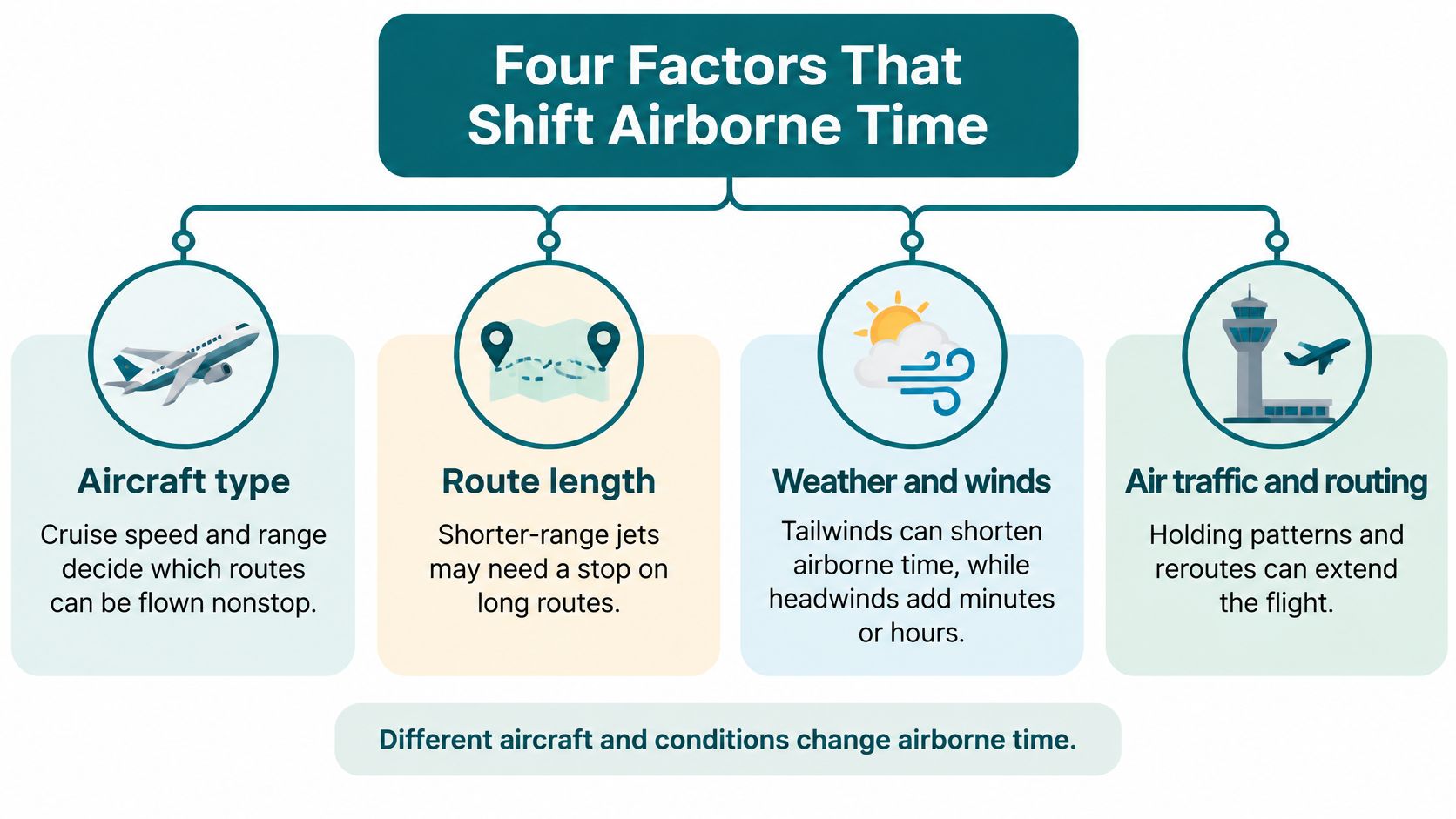
Aircraft type sets the nonstop. Cruise speed and range decide which city pairs can be flown without a stop. A shorter-range jet may need a fuel stop on a sector that a long-range jet flies direct, and that stop adds a full arrival and departure, not a few extra minutes of cruise. Speed still matters inside the same range class. If you are comparing types, our note on how fast private jets fly is the right place to match cruise speed to the sector before you guess a duration.
Winds move the same route by half an hour to an hour. A jet-stream tailwind can cut an eastbound transatlantic sector by roughly 30 to 60 minutes. A headwind on the return adds a similar amount. That is why the New York pair in the first table is not symmetric, and why tomorrow's forecast can beat last month's average.
Routing is not the line on the globe. The great-circle path is the shortest on paper. Weather avoidance, plus restricted or military airspace, can add distance the schedule never printed. The trade-off is worth taking. A detour around a storm adds minutes. A diversion after you have already committed to the storm track costs hours, plus a new slot, fuel, and a crew-duty problem.
Air traffic control stretches the cruise itself. Holding patterns, sequencing into a busy airport, and an altitude restriction can add time while you are already airborne. You are not delayed at the gate. You are flying a longer path, or a slower one, because someone else is ahead of you.
A check you can run the day before
Look at the forecast winds for your direction of flight. Then compare the planned route with the track a recent flight flew on a flight-tracking tool. Ask which of the four factors is the likely mover on your city pair. On a short domestic hop it is often the arrival sequence. On a long east-west sector it is usually the wind. On a route that skirts closed airspace, it is the track itself. Name the factor before you lock the meeting on the other side.
How Delays Add Time You Cannot Plan
A published duration is a forecast. In the Department of Transportation delay report, a flight counts as delayed when it reaches the gate, or where applicable leaves it, at least 15 minutes after the scheduled time. That line matters because it sets the size of the hole a delay can open before the airline even calls it one.
Where the late minutes come from
The labels shift by month and airport, yet the pattern is steady: late-arriving aircraft and aviation-system issues are consistently among the largest causes, and the late inbound is often the single biggest contributor. Airline-controlled items such as crew, maintenance and baggage still matter. Extreme weather and security are real, though usually smaller shares.
The underestimated cause is the airplane that is late before your boarding pass is scanned. One aircraft can fly several legs in a day, so a morning knock-on becomes a midday delay and can still be there at dusk. Connections tighten the screw. If a layover sits inside the same 15-minute window used to define “late,” the first leg can spend the whole cushion before the second leg begins. Taxi queues then stretch block time even when the cruise was clean.
What to put on the calendar
Plan three numbers. Airborne time is the wheels-up to touchdown estimate. Block time is the scheduled gate-to-gate figure, such as 90 minutes. Door-to-door time is what your calendar feels after a late inbound, taxi congestion, boarding and the ride after landing. Give the next commitment at least a 15-minute buffer, and more when a connection or a fixed meeting depends on the arrival. On a tight day, choose the earliest departure you can live with so any cascade has room to land somewhere other than your meeting.
Private Charter vs Commercial Door-to-Door Time
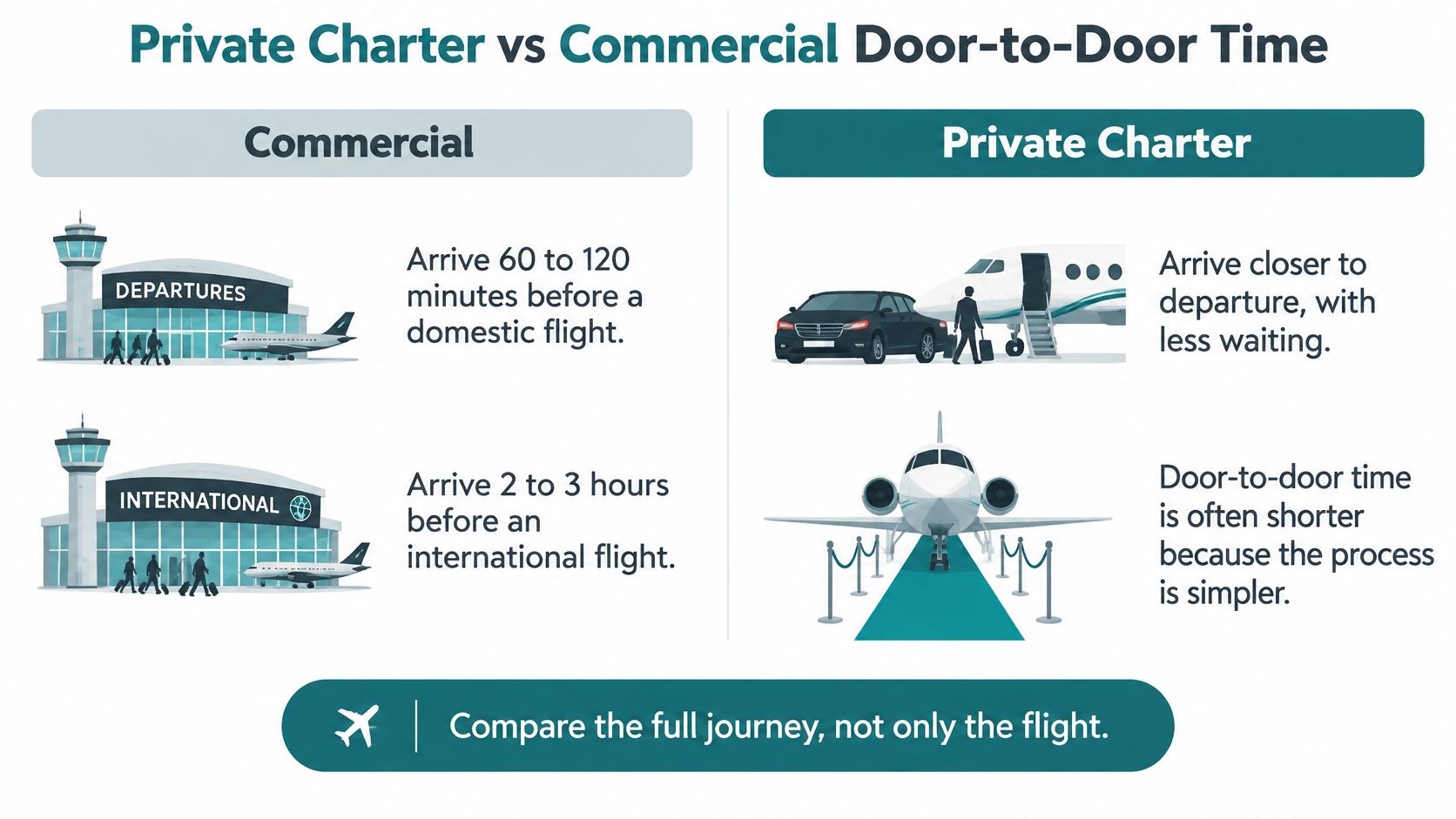
Compare the whole journey, not only the sector in the air. On a short trip the airport is often the longest stage. On a long one, each connection can add several hours that never appear in the nonstop table.
Stage | Commercial flight | Private charter |
|---|---|---|
Arrive before departure | 60 to 120 minutes domestic, 2 to 3 hours international | 15 to 30 min at the private terminal |
Security | Screening at the airport terminal | Screening handled at the private terminal |
Boarding | Gate boarding with airline staff | Pilot greets and escorts you to the aircraft |
Connections | Often 1 to 2 stops on long routes | Usually direct, depends on aircraft range |
Notice needed | Days to months ahead | Typically airborne within 2 to 4 hours of inquiry |
Walk the rows. A commercial traveler is usually at the terminal 60 to 120 minutes before a domestic departure and two to three hours before an international one. At a private terminal, the useful window is 15 to 30 minutes before departure. That single row is why a two-hour flight can feel like half a day. Security on the commercial side is the public checkpoint. On a charter it is handled at the private terminal, so you are not in the same queue as a full departure bank.
Boarding follows the same split. Airline staff process a gate. On a charter the pilot greets you and walks you to the aircraft. Connections are where long commercial itineraries lose the afternoon. One or two stops, each with its own minimum connect time, can add several hours to a city pair that a longer-range jet would fly direct. Range still sets the limit, which is why it helps to check how far private jets can fly before you assume a nonstop.
Notice is the last row, and it changes who the option is for. Commercial seats on a peak day can mean booking days or months out. We can typically have you airborne in as little as 2 to 4 hours. That does not delete the rest of the trip. You still need a car to the private terminal. Weather holds and air traffic delays still apply. What you drop is the connection and most of the terminal wait.
For a short trip, a 2-hour nonstop commercial sector can take four hours or more door to door once both airport windows and both ground rides are in. The same city pair, leaving from a nearby private terminal, can fit in about three hours. On a long international day the gap is usually the connection, not the cruise. If the ground piece is the part you want tightened, a door-to-door transport service is the stage to plan with the flight, not after it.
The same door-to-door idea shows up when a team moves straight from the aircraft to a car, which is the rhythm in this short walk-through.
Estimate Your Trip Time and Book With Confidence
The timetable gives you one number. The trip runs on three: the airborne leg, the gate-to-gate block, and the door-to-door total. Build the estimate in six steps, in this order, so each buffer lands on the right clock.
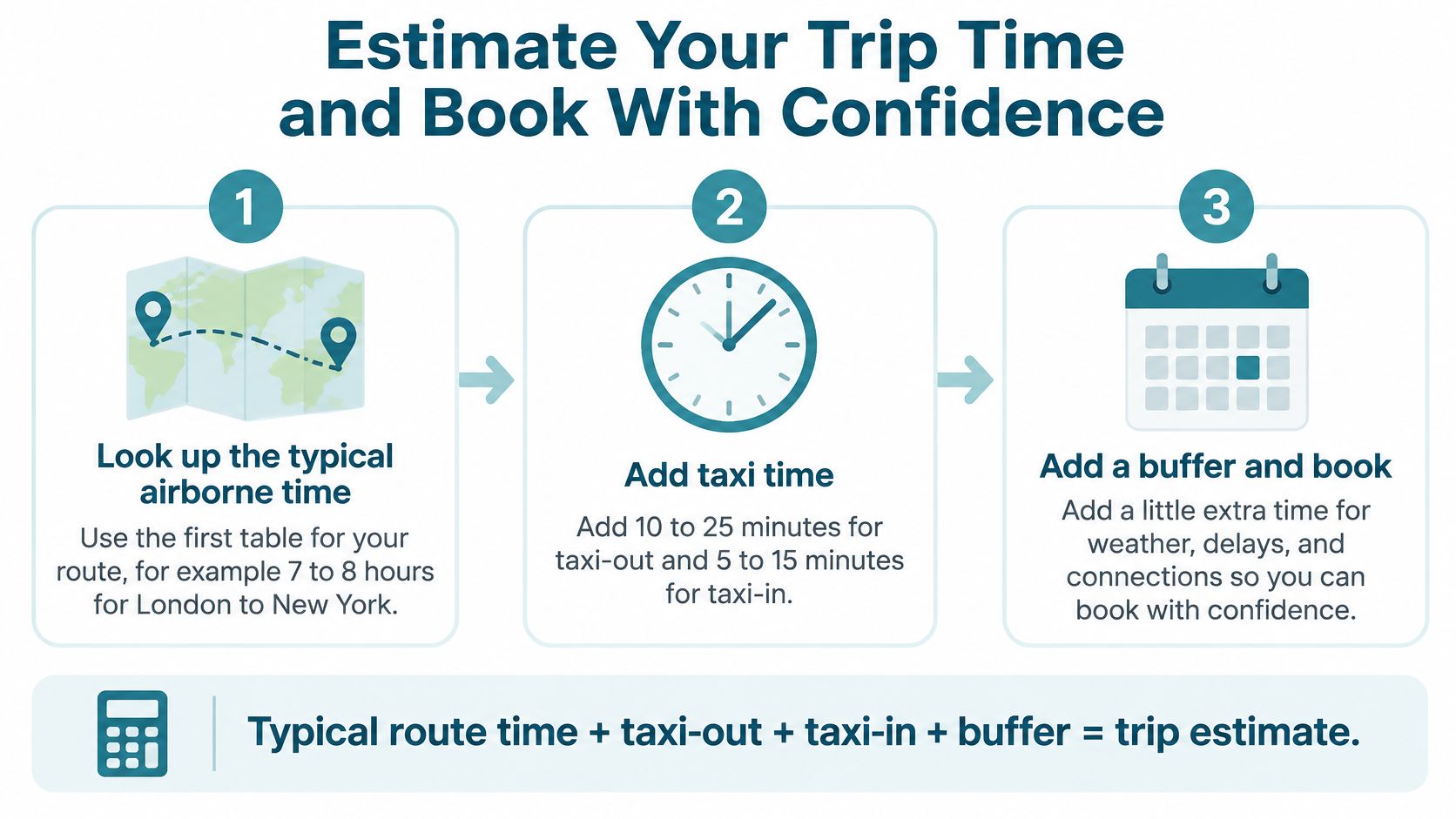
- Look up the airborne band. Use the first table. London to New York is 7 to 8 hours in the air, not 7 hours door to door.
- Add both taxis. Put in 10 to 25 minutes for taxi-out and 5 to 15 minutes for taxi-in. Busy hubs belong at the high end.
- Add a delay buffer. Start at 15 minutes, and add more if you are connecting or arriving in a weather window.
- Add the airport arrival. That is 60 to 120 minutes before a domestic commercial flight, 2 to 3 hours before an international one, or 15 to 30 minutes at a private terminal.
- Add the ground transfers at both ends, priced at the likely traffic hour rather than the empty-road one.
- Check the day before. Read the forecast winds and open a flight tracker. If recent tracks on your city pair are running long, use the high end of the band.
Step 2 is the step travellers shorten. FAA performance-monitoring definitions set actual block time as actual gate-in minus actual gate-out, and block delay as actual block time minus scheduled block time. Leave the gate at 10:05 and reach the destination gate at 13:20, and the block is 195 minutes. Against a 175-minute timetable that is a 20-minute block delay, even when the airborne leg ran close to schedule and taxi time caused most of the gap. An airborne-only estimate would have called that flight on time.
Once both options sit in door-to-door minutes, pick the lower total when the meeting time is fixed. If the schedule is tight, take the earliest departure and put the buffer in front of the next commitment rather than after it. Booking with 24 to 48 hours of notice gives the widest aircraft choice and room for specific catering or logistics, and advisors are on the line 24/7 for an immediate charter at +1 (866) 678-1411. A charter quote is an estimate that can still move with aircraft availability, fuel, positioning and landing fees, so confirm the final figure in the agreement. Domestic flights can typically be canceled without penalty up to 48 to 72 hours before departure, and the exact cancellation terms are provided before the charter agreement is signed.
The same buffer logic covers any evening you have planned. A late block delay can push back a ferry, a car, or a check-in, the kind of timing that matters for romantic lakeside stays and honeymoon experiences as much as for a dinner reservation.
Approved Jets arranges on-demand charter and the ground pieces around it, so the duration you plan is the door-to-door trip rather than a single timetable cell. Tell us the city pair, the passenger count, and the meeting you cannot miss. The pair fixes the range the aircraft needs, so the match starts from how far a private jet can fly and a realistic block rather than a cruise speed. Visit Approved Jets to start that estimate.